ESP DODGE RAM SRT-10 2006 Service Repair Manual
[x] Cancel search | Manufacturer: DODGE, Model Year: 2006, Model line: RAM SRT-10, Model: DODGE RAM SRT-10 2006Pages: 5267, PDF Size: 68.7 MB
Page 4312 of 5267
MOTOR-SHIFT
DESCRIPTION
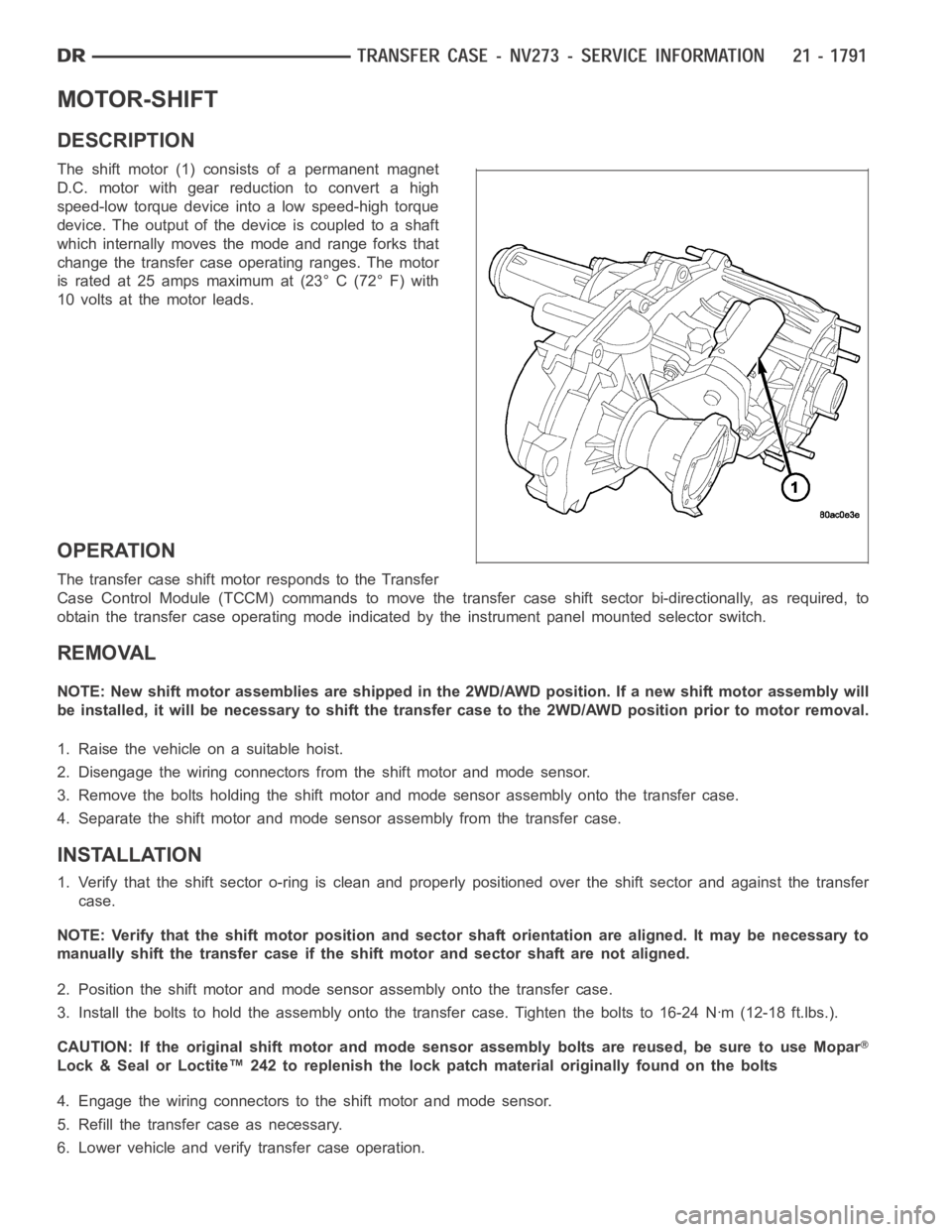
The shift motor (1) consists of a permanent magnet
D.C. motor with gear reduction to convert a high
speed-low torque device into a low speed-high torque
device. The output of the device is coupled to a shaft
which internally moves the mode and range forks that
change the transfer case operating ranges. The motor
is rated at 25 amps maximum at (23° C (72° F) with
10 volts at the motor leads.
OPERATION
The transfer case shift motor responds to the Transfer
Case Control Module (TCCM) commands to move the transfer case shift sectorbi-directionally, as required, to
obtain the transfer case operating mode indicated by the instrument panelmounted selector switch.
REMOVAL
NOTE: New shift motor assemblies are shipped in the 2WD/AWD position. If a new shift motor assembly will
be installed, it will be necessary to shift the transfer case to the 2WD/AWDposition prior to motor removal.
1. Raise the vehicle on a suitable hoist.
2. Disengage the wiring connectors from the shift motor and mode sensor.
3. Remove the bolts holding the shift motor and mode sensor assembly onto the transfer case.
4. Separate the shift motor and mode sensor assembly from the transfer case.
INSTALLATION
1. Verify that the shift sector o-ring is clean and properly positioned over the shift sector and against the transfer
case.
NOTE: Verify that the shift motor position and sector shaft orientation are aligned. It may be necessary to
manually shift the transfer case if the shift motor and sector shaft are notaligned.
2. Position the shift motor and mode sensor assembly onto the transfer case.
3. Install the bolts to hold the assembly onto the transfer case. Tighten the bolts to 16-24 Nꞏm (12-18 ft.lbs.).
CAUTION: If the original shift motor and mode sensor assembly bolts are reused, be sure to use Mopar
Lock & Seal or Loctite™ 242 to replenish the lock patch material originallyfound on the bolts
4. Engage the wiring connectors to the shift motor and mode sensor.
5. Refill the transfer case as necessary.
6. Lower vehicle and verify transfer case operation.
Page 4441 of 5267
SIDE VIEW MIRROR GLASS
REMOVAL
STANDARD MIRROR
WARNING: Always wear eye and hand protection
when servicing the mirror assembly. Failure to
observe this warning may result in personal injury
from broken glass.
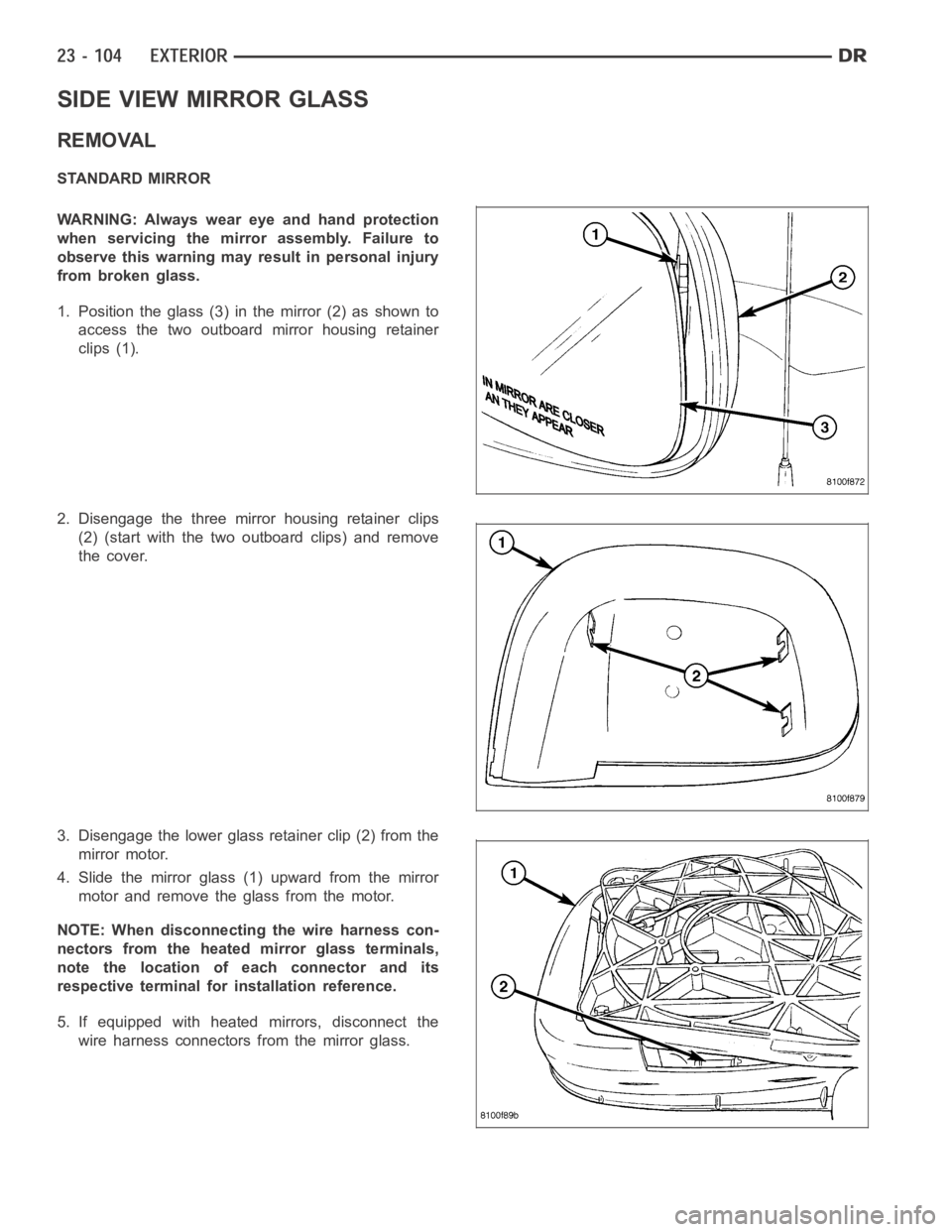
1. Position the glass (3) in the mirror (2) as shown to
access the two outboard mirror housing retainer
clips (1).
2. Disengage the three mirror housing retainer clips
(2) (start with the two outboard clips) and remove
the cover.
3. Disengage the lower glass retainer clip (2) from the
mirror motor.
4. Slide the mirror glass (1) upward from the mirror
motor and remove the glass from the motor.
NOTE: When disconnecting the wire harness con-
nectors from the heated mirror glass terminals,
note the location of each connector and its
respective terminal for installation reference.
5. If equipped with heated mirrors, disconnect the
wire harness connectors from the mirror glass.
Page 4442 of 5267
TOW PACKAGE MIRROR
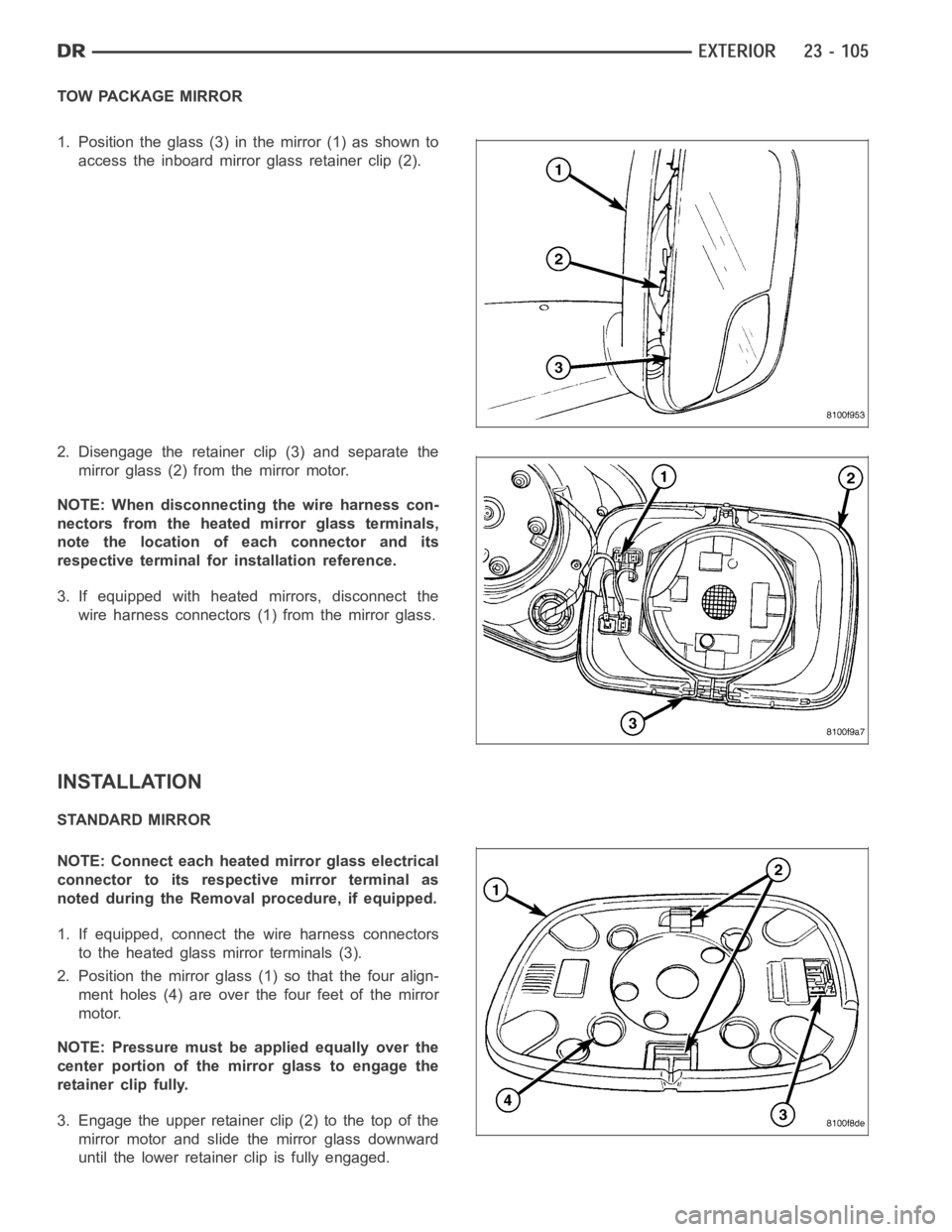
1. Position the glass (3) in the mirror (1) as shown to
access the inboard mirror glass retainer clip (2).
2. Disengage the retainer clip (3) and separate the
mirror glass (2) from the mirror motor.
NOTE: When disconnecting the wire harness con-
nectors from the heated mirror glass terminals,
note the location of each connector and its
respective terminal for installation reference.
3. If equipped with heated mirrors, disconnect the
wire harness connectors (1) from the mirror glass.
INSTALLATION
STANDARD MIRROR
NOTE: Connect each heated mirror glass electrical
connector to its respective mirror terminal as
noted during the Removal procedure, if equipped.
1. If equipped, connect the wire harness connectors
to the heated glass mirror terminals (3).
2. Position the mirror glass (1) so that the four align-
ment holes (4) are over the four feet of the mirror
motor.
NOTE: Pressure must be applied equally over the
center portion of the mirror glass to engage the
retainer clip fully.
3. Engage the upper retainer clip (2) to the top of the
mirror motor and slide the mirror glass downward
until the lower retainerclip is fully engaged.
Page 4443 of 5267
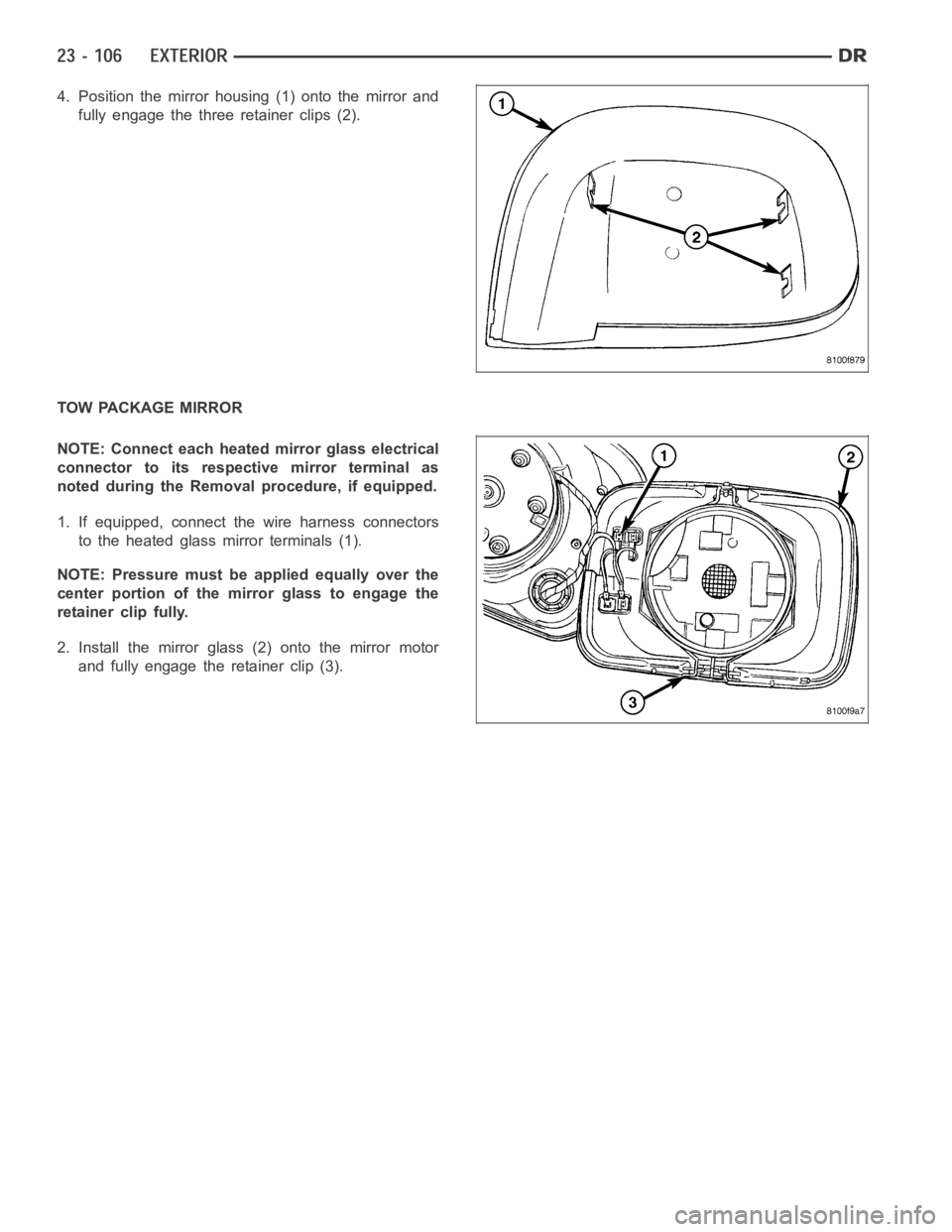
4. Position the mirror housing (1) onto the mirror and
fully engage the three retainer clips (2).
TOW PACKAGE MIRROR
NOTE: Connect each heated mirror glass electrical
connector to its respective mirror terminal as
noted during the Removal procedure, if equipped.
1. If equipped, connect the wire harness connectors
to the heated glass mirror terminals (1).
NOTE: Pressure must be applied equally over the
center portion of the mirror glass to engage the
retainer clip fully.
2. Install the mirror glass (2) onto the mirror motor
and fully engage the retainer clip (3).
Page 4556 of 5267
PA I N T T O U C H - U P
DESCRIPTION
If the painted metal surface of a vehicle becomes scratched or chipped, it should be touched-up as soon as pos-
sible to avoid corrosion.
WARNING: Use an OSHA approved respirator and safety glasses when sprayingpaint or solvents in a con-
fined area. Failure to follow this warning may result in possible personalinjury or death.
When repairing painted metal surfaces, for best results, use MOPAR
Scratch Filler/Primer, Touch-Up Paints and
Clear Top Coat (Refer to VEHICLE DATA/VEHICLE INFORMATION/BODY CODE PLATE - DESCRIPTION) for
Body Code Plate information.
STANDARD PROCEDURE
PA I N T T O U C H - U P
1. Scrape any loose paint and corrosion from inside the scratch or chip.
WARNING: Avoid prolonged skin contact with petroleum or alcohol–based cleaning solvents. Failure to fol-
low this warning can result in possible personal injury or death.
2. Clean affected area with MOPAR
Tar/Road Oil Remover or equivalent, and allow to dry.
3. Fill the inside of the scratch or chip with a coat of filler/primer. Do notoverlap primer onto good surface finish.
The applicator brush should be wet enough to puddle-fill the scratch or chip without running. Do not stroke brush
applicator on body surface. Allow the filler/primer to dry hard.
4. Cover the filler/primer with color touch-up paint. Do not overlap touch-up color onto the original color coat around
the scratch or chip. Butt the new color to the original color, if possible. Do not stroke applicator brush on body
surface. Allow touch-up paint to dry hard.
5. On vehicles without clearcoat, the touch-up color can be lightly finesse sanded (1500 grit) and polished with
rubbing compound.
6. On vehicles with clearcoat, apply clear top coat to touch-up paint with the same technique as described in Step
4. Allow clear top coat to dry hard. If desired, the clearcoat can be lightlyfinesse sanded (1500 grit) and polished
with rubbing compound.
Page 4599 of 5267
WINDSHIELD
WARNING
WINDSHIELD SAFETY PRECAUTIONS
Do not operate the vehicle within 24 hours of windshield installation. It takes at least 24 hours for urethane
adhesive to cure. If it is not cured, the windshield may not perform properlyinanaccident.
Urethane adhesives are applied as a system. Use glass cleaner, glass prep solvent, glass primer, PVC
(vinyl) primer and pinch weld (fence) primer provided by the adhesive manufacturer. If not, structural
integrity could be compromised.
DaimlerChrysler does not recommend glass adhesive by brand. Techniciansshould review product
labels and technical data sheets, and use only adhesives that their manufactures warranty and will
restore a vehicle to the requirements of fmvss 212. Technicians should also insure that primers and
cleaners are compatible with the particular adhesive used.
Be sure to refer to the urethane manufacturer’s directions for curing timespecifications and do not
use adhesive after its expiration date.
Vapors that are emitted from the urethane adhesive or primer could cause personal injury or death.
Use them in a well-ventilated area.
Skin contact with urethane adhesive should be avoided. Personal injury ordeath may result.
Always wear eye and hand protection when working with glass.
Protect all painted and trimmed surfaces from coming in contact with urethane or primers.
Be careful not to damage painted surfaces when removing moldings or cutting urethane around windshield.
REMOVAL
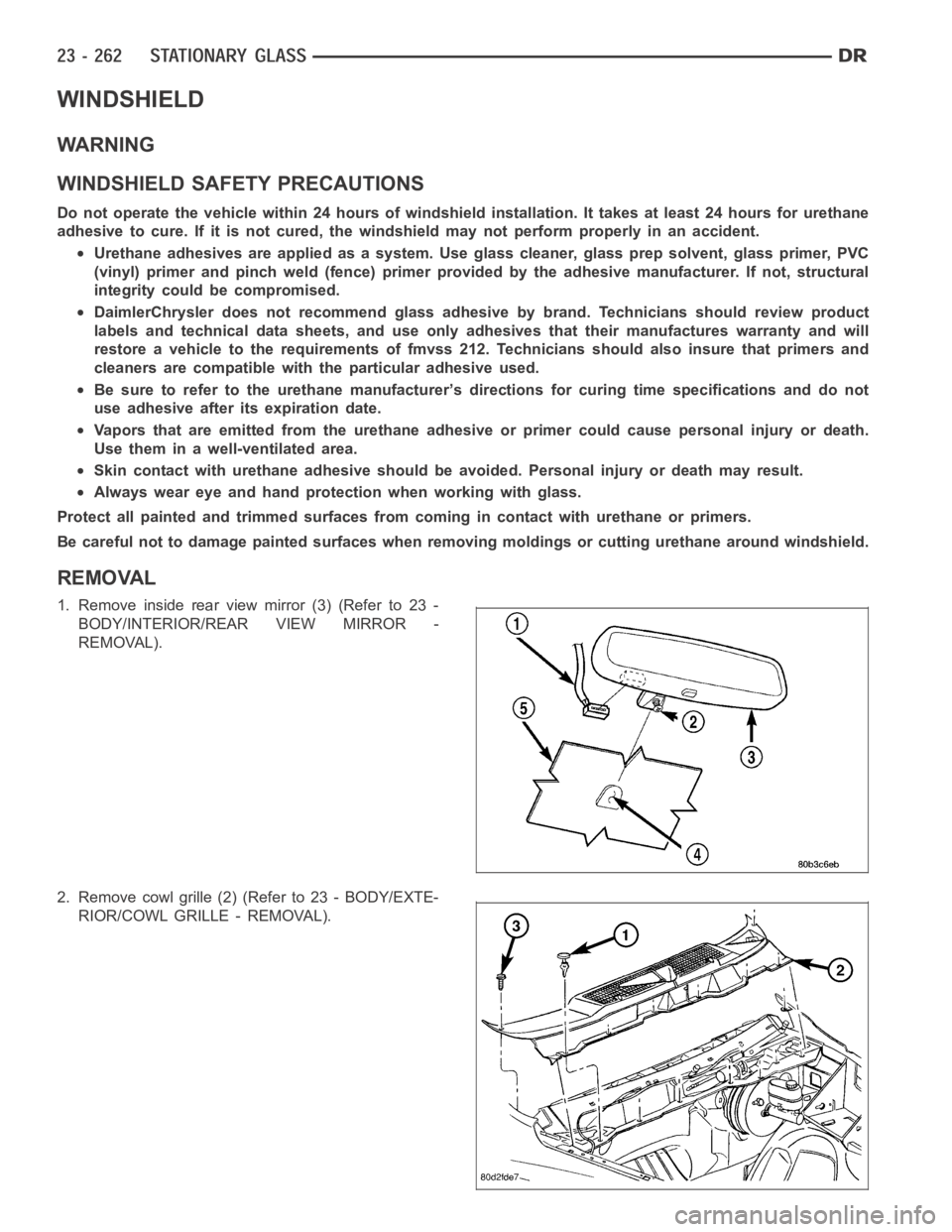
1. Remove inside rear view mirror (3) (Refer to 23 -
BODY/INTERIOR/REAR VIEW MIRROR -
REMOVAL).
2. Remove cowl grille (2) (Refer to 23 - BODY/EXTE-
RIOR/COWL GRILLE - REMOVAL).
Page 4609 of 5267
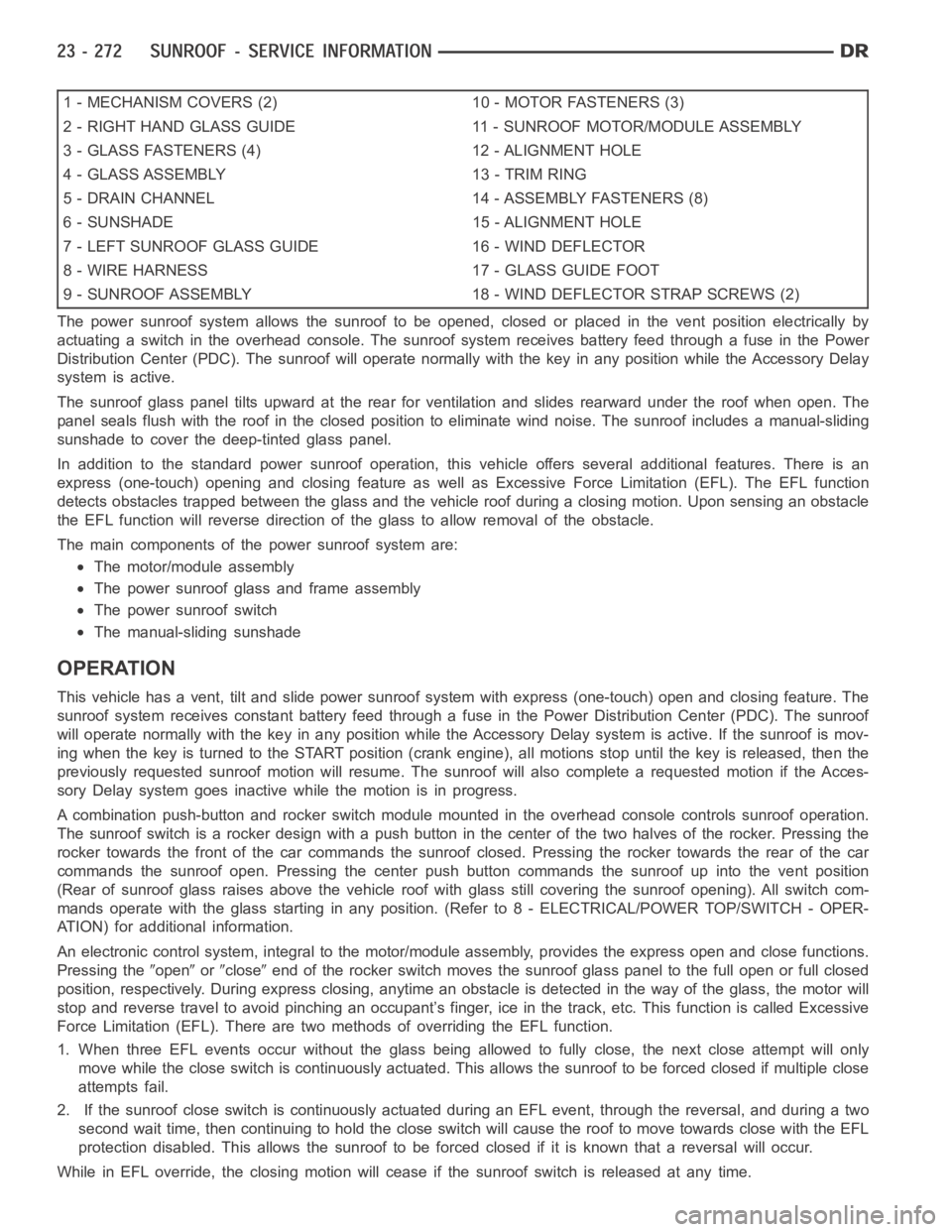
1 - MECHANISM COVERS (2) 10 - MOTOR FASTENERS (3)
2 - RIGHT HAND GLASS GUIDE 11 - SUNROOF MOTOR/MODULE ASSEMBLY
3 - GLASS FASTENERS (4) 12 - ALIGNMENT HOLE
4 - GLASS ASSEMBLY 13 - TRIM RING
5 - DRAIN CHANNEL 14 - ASSEMBLY FASTENERS (8)
6 - SUNSHADE 15 - ALIGNMENT HOLE
7 - LEFT SUNROOF GLASS GUIDE 16 - WIND DEFLECTOR
8 - WIRE HARNESS 17 - GLASS GUIDE FOOT
9 - SUNROOF ASSEMBLY 18 - WIND DEFLECTOR STRAP SCREWS (2)
The power sunroof system allows the sunroof to be opened, closed or placed in the vent position electrically by
actuating a switch in the overhead console. The sunroof system receives battery feed through a fuse in the Power
Distribution Center (PDC). The sunroof will operate normally with the keyin any position while the Accessory Delay
system is active.
The sunroof glass panel tilts upward at the rear for ventilation and slidesrearward under the roof when open. The
panel seals flush with the roof in the closed position to eliminate wind noise. The sunroof includes a manual-sliding
sunshade to cover the deep-tinted glass panel.
In addition to the standard power sunroof operation, this vehicle offers several additional features. There is an
express (one-touch) opening and closing feature as well as Excessive Force Limitation (EFL). The EFL function
detects obstacles trapped between the glass and the vehicle roof during a closing motion. Upon sensing an obstacle
the EFL function will reverse direction of the glass to allow removal of theobstacle.
The main components of thepower sunroof system are:
The motor/module assembly
The power sunroof glass and frame assembly
The power sunroof switch
The manual-sliding sunshade
OPERATION
This vehicle has a vent, tilt and slide power sunroof system with express (one-touch) open and closing feature. The
sunroof system receives constant battery feed through a fuse in the Power Distribution Center (PDC). The sunroof
will operate normally with the key in any position while the Accessory Delay system is active. If the sunroof is mov-
ing when the key is turned to the START position (crank engine), all motionsstop until the key is released, then the
previously requested sunroof motion will resume. The sunroof will also complete a requested motion if the Acces-
sory Delay system goes inactivewhile the motion is in progress.
A combination push-button and rocker switch module mounted in the overhead console controls sunroof operation.
The sunroof switch is a rocker design with a push button in the center of the two halves of the rocker. Pressing the
rocker towards the front of the car commands the sunroof closed. Pressing the rocker towards the rear of the car
commands the sunroof open. Pressing the center push button commands the sunroof up into the vent position
(Rear of sunroof glass raises above the vehicle roof with glass still covering the sunroof opening). All switch com-
mands operate with the glass startingin any position. (Refer to 8 - ELECTRICAL/POWER TOP/SWITCH - OPER-
ATION) for additional information.
An electronic control system, integralto the motor/module assembly, provides the express open and close functions.
Pressing the
openorcloseend of the rocker switch moves the sunroof glass panel to the full open or fullclosed
position, respectively. During express closing, anytime an obstacle is detected in the way of the glass, the motor will
stop and reverse travel to avoid pinching an occupant’s finger, ice in the track, etc. This function is called Excessive
Force Limitation (EFL). There are two methods of overriding the EFL function.
1. When three EFL events occur without the glass being allowed to fully close, the next close attempt will only
move while the close switch is continuously actuated. This allows the sunrooftobeforcedclosedifmultipleclose
attempts fail.
2. If the sunroof close switch is continuously actuated during an EFL event, through the reversal, and during a two
second wait time, then continuing to hold the close switch will cause the roof to move towards close with the EFL
protection disabled. This allows the sunroof to be forced closed if it is known that a reversal will occur.
While in EFL override, the closing motion will cease if the sunroof switch is released at any time.
Page 4610 of 5267
The motor/module is programmed to learn the speed required to drive the panel based on position and recalibrates
itself as needed. If the sunroof becomes uncalibrated, it will only respond to the vent switch. If the vent switch is
pressed, the glass will move toward vent; if the switch is released, all motion stops. In the event that the sunroof
system becomes uncalibrated performthe sunroof position calibration procedure, (Refer to 8 - ELECTRICAL/
POWER TOP/MOTOR - STANDARD PROCEDURE -SUNROOF POSITION CALIBRATION).
DIAGNOSIS AND TESTING
POWER TOP - SUNROOF
Any diagnosis of the power sunroof system should begin with the use of a scantool and the proper Diagnostic
Procedures Information. The scan tool can provide confirmation that the Controller Area Network (CAN) Data Bus is
functional, that all of the electronic modules are sending and receiving the proper messages on the CAN Data Bus,
and that the power sunroof motor is being sent the proper hard wired output by the sunroof switch.
For complete circuit diagrams, refer to the appropriate wiring information. The wiring information includes wiring dia-
grams, proper wire and connector repair procedures, details of wire harness routing and retention, connector pin-out
information and location views for the various wire harness connectors, splices and grounds.
Refer to the appropriate diagnostic information.
SUNROOF
Refer to SUNROOF DIAGNOSIS CHART for possible causes. Before beginning sunroof diagnostics verify that all
other power accessories are in proper operating condition. If not, a common electrical problem may exist. Refer to
Wiring Diagrams, in this publication for circuit, splice and component descriptions. Check the condition of the circuit
protection (20 amp circuit breaker in the Junction Block). Inspect all wiring connector pins for proper engagement
and continuity. Check for battery voltage at the power sunroof controller, refer to Wiring Diagrams, for circuit infor-
mation. If battery voltage of more than 10 volts is detected at the controller, proceed with the following tests (the
controller will not operate at less than 10 volts).
Before beginning diagnosis for wind noise or water leaks, verify that the problem was not caused by releasing the
control switch before the sunroof was fully closed. The sunroof module hasa water-management system. If how-
ever, the sunroof glass is in a partial closed position, high pressure water may be forced beyond the water man-
agement system boundariesand onto the headlining.
Every time the sunroof module loses power it must be initialized. This is done by connecting power to the sunroof
and moving the sunroof toward the closed position. When initialization occurs a slight “kick” in the sunroof module
will be seen and heard. This is the indication that the sunroof module is initialized
SUNROOF DIAGNOSIS CHART
SYMPTOM POSSIBLE CAUSE
Sunroof motor inoperative. Faulty control switch.
Faulty circuit ground between sunroof module, control switch,
and body harness.
Faulty power circuit between sunroof module, control switch,
and body harness.
Faulty sunroof drive motor.
Faulty sunroof module.
Audible whine when switch is depressed,
sunroof does not operate.Faulty sunroof drive motor.
Binding cable.
Audible clicking or ratcheting when switch is
pressed, sunroof does not operate.Broken or worn drive cable.
Worn drive motor gear.
Mechanisms not synchronized.
Page 4659 of 5267
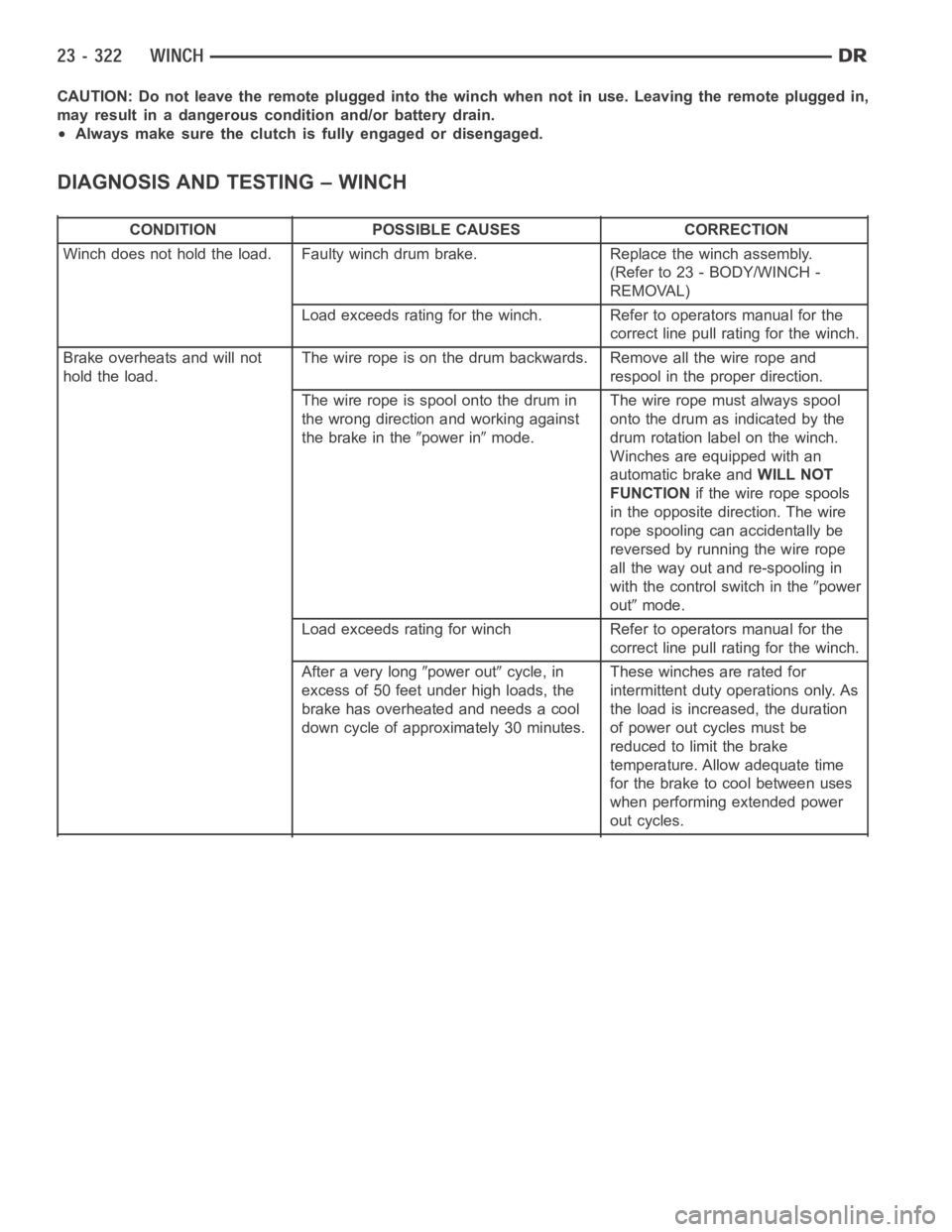
CAUTION: Do not leave the remote plugged into the winch when not in use. Leaving the remote plugged in,
may result in a dangerous condition and/or battery drain.
Always make sure the clutch is fully engaged or disengaged.
DIAGNOSIS AND TESTING – WINCH
CONDITION POSSIBLE CAUSES CORRECTION
Winch does not hold the load. Faulty winch drum brake. Replace the winch assembly.
(Refer to 23 - BODY/WINCH -
REMOVAL)
Load exceeds rating for the winch. Refer to operators manual for the
correct line pull rating for the winch.
Brake overheats and will not
hold the load.The wire rope is on the drum backwards. Remove all the wire rope and
respool in the proper direction.
Thewireropeisspoolontothedrumin
the wrong direction and working against
the brake in the
power inmode.The wire rope must always spool
onto the drum as indicated by the
drum rotation label on the winch.
Winches are equipped with an
automatic brake andWILL NOT
FUNCTIONif the wire rope spools
intheoppositedirection.Thewire
rope spooling can accidentally be
reversed by running the wire rope
all the way out and re-spooling in
with the control switch in the
power
out
mode.
Load exceeds rating for winch Refer to operators manual for the
correct line pull rating for the winch.
After a very long
power outcycle, in
excess of 50 feet under high loads, the
brake has overheated and needs a cool
down cycle of approximately 30 minutes.These winches are rated for
intermittent duty operations only. As
the load is increased, the duration
of power out cycles must be
reduced to limit the brake
temperature. Allow adequate time
for the brake to cool between uses
when performing extended power
out cycles.
Page 4881 of 5267
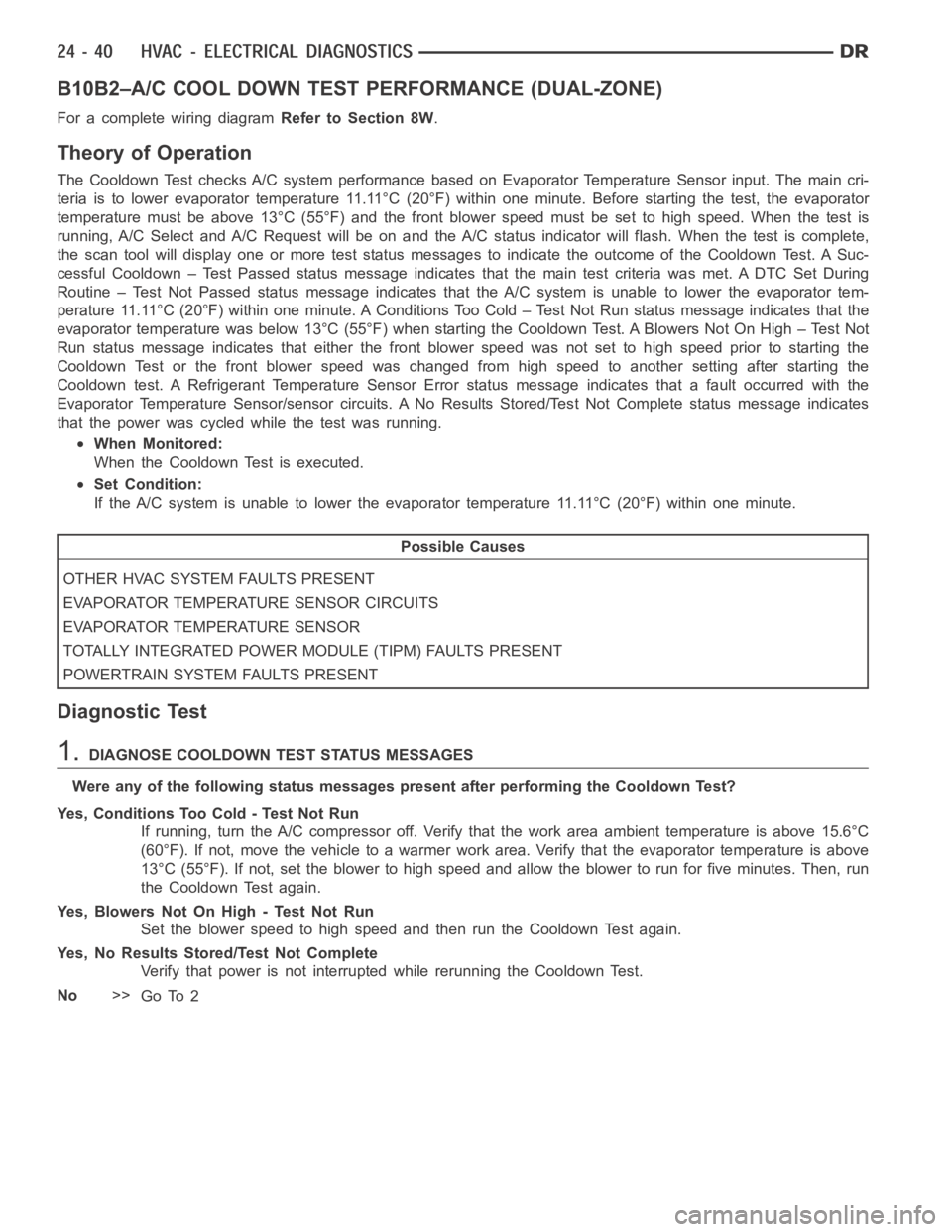
B10B2–A/C COOL DOWN TEST PERFORMANCE (DUAL-ZONE)
For a complete wiring diagramRefer to Section 8W.
Theory of Operation
The Cooldown Test checks A/C system performance based on Evaporator Temperature Sensor input. The main cri-
teria is to lower evaporator temperature 11.11°C (20°F) within one minute. Before starting the test, the evaporator
temperature must be above 13°C (55°F) and the front blower speed must be setto high speed. When the test is
running, A/C Select and A/C Request will be on and the A/C status indicator will flash. When the test is complete,
the scan tool will display one or more test status messages to indicate the outcome of the Cooldown Test. A Suc-
cessful Cooldown – Test Passed status message indicates that the main testcriteria was met. A DTC Set During
Routine – Test Not Passed status message indicates that the A/C system is unable to lower the evaporator tem-
perature 11.11°C (20°F) within one minute. A Conditions Too Cold – Test NotRun status message indicates that the
evaporator temperature was below 13°C (55°F) when starting the Cooldown Test. A Blowers Not On High – Test Not
Run status message indicates that either the front blower speed was not setto high speed prior to starting the
Cooldown Test or the front blower speed was changed from high speed to another setting after starting the
Cooldown test. A Refrigerant Temperature Sensor Error status message indicates that a fault occurred with the
Evaporator Temperature Sensor/sensor circuits. A No Results Stored/Test Not Complete status message indicates
that the power was cycled while the test was running.
When Monitored:
When the Cooldown Test is executed.
Set Condition:
If the A/C system is unable to lower the evaporator temperature 11.11°C (20°F) within one minute.
Possible Causes
OTHER HVAC SYSTEM FAULTS PRESENT
EVAPORATOR TEMPERATURE SENSOR CIRCUITS
EVAPORATOR TEMPERATURE SENSOR
TOTALLY INTEGRATED POWER MODULE (TIPM) FAULTS PRESENT
POWERTRAIN SYSTEM FAULTS PRESENT
Diagnostic Test
1.DIAGNOSE COOLDOWN TEST STATUS MESSAGES
WereanyofthefollowingstatusmessagespresentafterperformingtheCooldown Test?
Yes, Conditions Too Cold - Test Not Run
If running, turn the A/C compressor off. Verify that the work area ambient temperature is above 15.6°C
(60°F). If not, move the vehicle to a warmer work area. Verify that the evaporator temperature is above
13°C (55°F). If not, set the blower to high speed and allow the blower to run for five minutes. Then, run
the Cooldown Test again.
Yes, Blowers Not On High - Test Not Run
Set the blower speed to high speed and then run the Cooldown Test again.
Yes, No Results Stored/Test Not Complete
Verify that power is not interrupted while rerunning the Cooldown Test.
No>>
Go To 2