ignition DODGE RAM SRT-10 2006 Service Repair Manual
[x] Cancel search | Manufacturer: DODGE, Model Year: 2006, Model line: RAM SRT-10, Model: DODGE RAM SRT-10 2006Pages: 5267, PDF Size: 68.7 MB
Page 248 of 5267
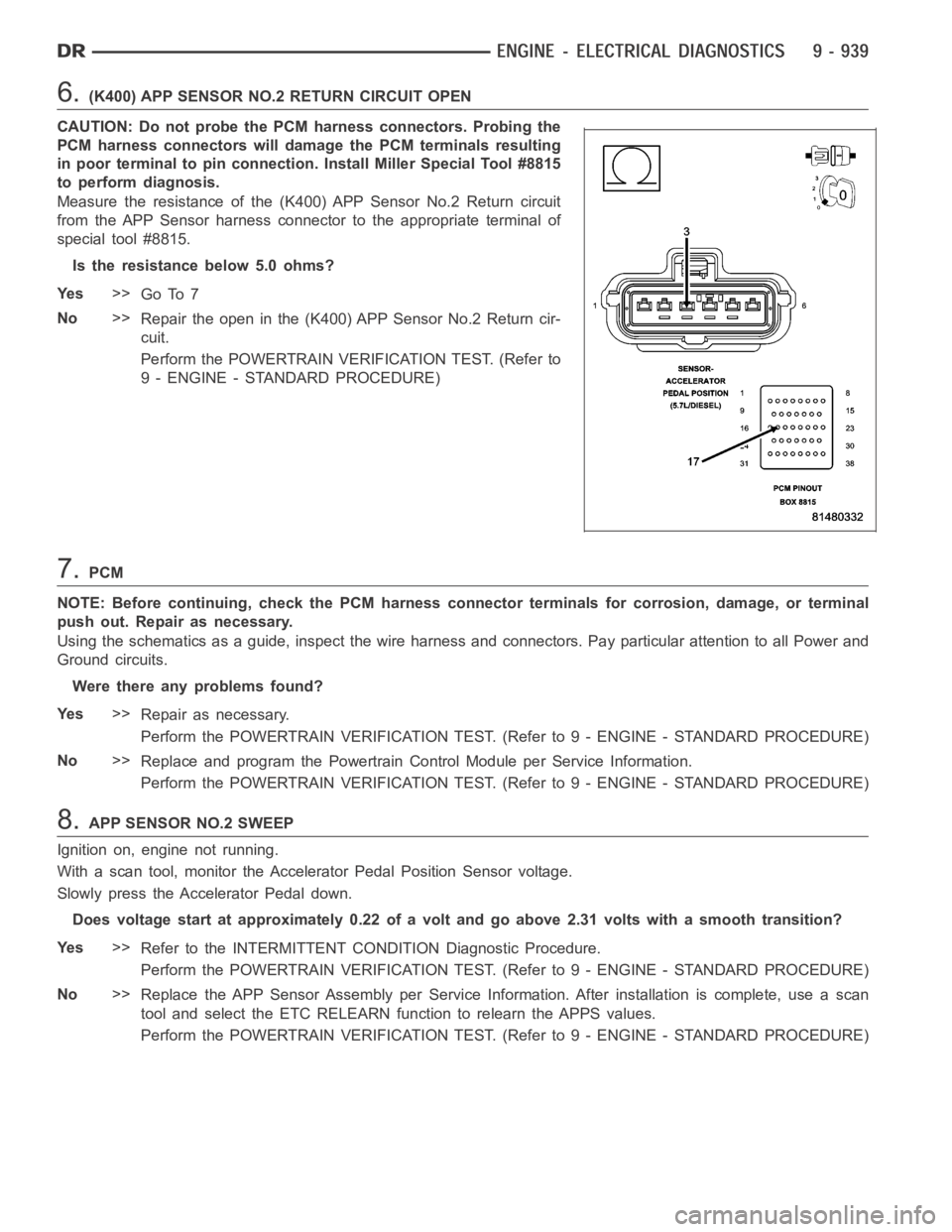
6.(K400) APP SENSOR NO.2 RETURN CIRCUIT OPEN
CAUTION: Do not probe the PCM harness connectors. Probing the
PCM harness connectors will damage the PCM terminals resulting
in poor terminal to pin connection. Install Miller Special Tool #8815
to perform diagnosis.
Measure the resistance of the (K400) APP Sensor No.2 Return circuit
from the APP Sensor harness connector to the appropriate terminal of
special tool #8815.
Is the resistance below 5.0 ohms?
Ye s>>
Go To 7
No>>
Repair the open in the (K400) APP Sensor No.2 Return cir-
cuit.
Perform the POWERTRAIN VERIFICATION TEST. (Refer to
9 - ENGINE - STANDARD PROCEDURE)
7.PCM
NOTE: Before continuing, check the PCM harness connector terminals for corrosion, damage, or terminal
push out. Repair as necessary.
Using the schematics as a guide, inspect the wire harness and connectors. Pay particular attention to all Power and
Ground circuits.
Were there any problems found?
Ye s>>
Repair as necessary.
Perform the POWERTRAIN VERIFICATION TEST. (Refer to 9 - ENGINE - STANDARD PROCEDURE)
No>>
Replace and program the Powertrain Control Module per Service Information.
Perform the POWERTRAIN VERIFICATION TEST. (Refer to 9 - ENGINE - STANDARD PROCEDURE)
8.APP SENSOR NO.2 SWEEP
Ignition on, engine not running.
With a scan tool, monitor the Accelerator Pedal Position Sensor voltage.
Slowly press the Accelerator Pedal down.
Does voltage start at approximately 0.22 of a volt and go above 2.31 volts with a smooth transition?
Ye s>>
Refer to the INTERMITTENT CONDITION Diagnostic Procedure.
Perform the POWERTRAIN VERIFICATION TEST. (Refer to 9 - ENGINE - STANDARD PROCEDURE)
No>>
Replace the APP Sensor Assembly per Service Information. After installation is complete, use a scan
tool and select the ETC RELEARN function to relearn the APPS values.
Perform the POWERTRAIN VERIFICATION TEST. (Refer to 9 - ENGINE - STANDARD PROCEDURE)
Page 250 of 5267
When Monitored:
With the ignition on and no other DTCs present for TP Sensor No.1 or No.2.
Set Condition:
PCM recognizes TP Sensors No.1 and No.2 are not coherent. One trip fault andthe code will set within 5
seconds. ETC light is illuminated.
Possible Causes
(K22) TP SENSOR NO.1 OR (K122) TP SENSOR NO.2 SIGNAL CIRCUIT SHORTED TO BATTERY VOLTAGE
RESISTANCE IN THE (K22) TP SENSOR NO.1 OR (K122) TP SENSOR NO.2 SIGNAL CIRCUIT
(K22) TP SENSOR NO.1 OR (K122) TP SENSOR NO.2 SIGNAL CIRCUIT SHORTED TO GROUND
RESISTANCE IN (F855) 5-VOLT SUPPLY CIRCUIT
(F855) 5-VOLT SUPPLY CIRCUIT SHORTED TO GROUND
RESISTANCE IN THE (K922) SENSOR GROUND CIRCUIT
(K22) TP SENSOR NO.1 SIGNAL CIRCUIT SHORTED TO THE (K122) TP SENSOR NO.2 SIGNAL CIRCUIT
THROTTLE POSITION SENSOR
PCM
Always perform the Pre-Diagnostic Troubleshooting procedure before proceeding. (Refer to 9 - ENGINE -
DIAGNOSIS AND TESTING).
Diagnostic Test
1.ACTIVE DTC
NOTE: The throttle plate and linkage should be free from binding and carbonbuild up.
NOTE: Make sure the throttle plate is at the idle position.
Ignition on, engine not running.
NOTE: Inspect the engine for vacuum leaks.
With a scan tool, read DTCs.
Is the DTC active at this time?
Ye s>>
Go To 2
No>>
Go To 11
2.(K22) TP SENSOR NO.1 OR (K122) TP SENSOR NO.2 SIGNAL CIRCUIT SHORTED TO BATTERY
V O LTA G E
Turn the ignition off.
Disconnect the C2 PCM harness connector.
Disconnect the Throttle Body harness connector.
Ignition on, engine not running.
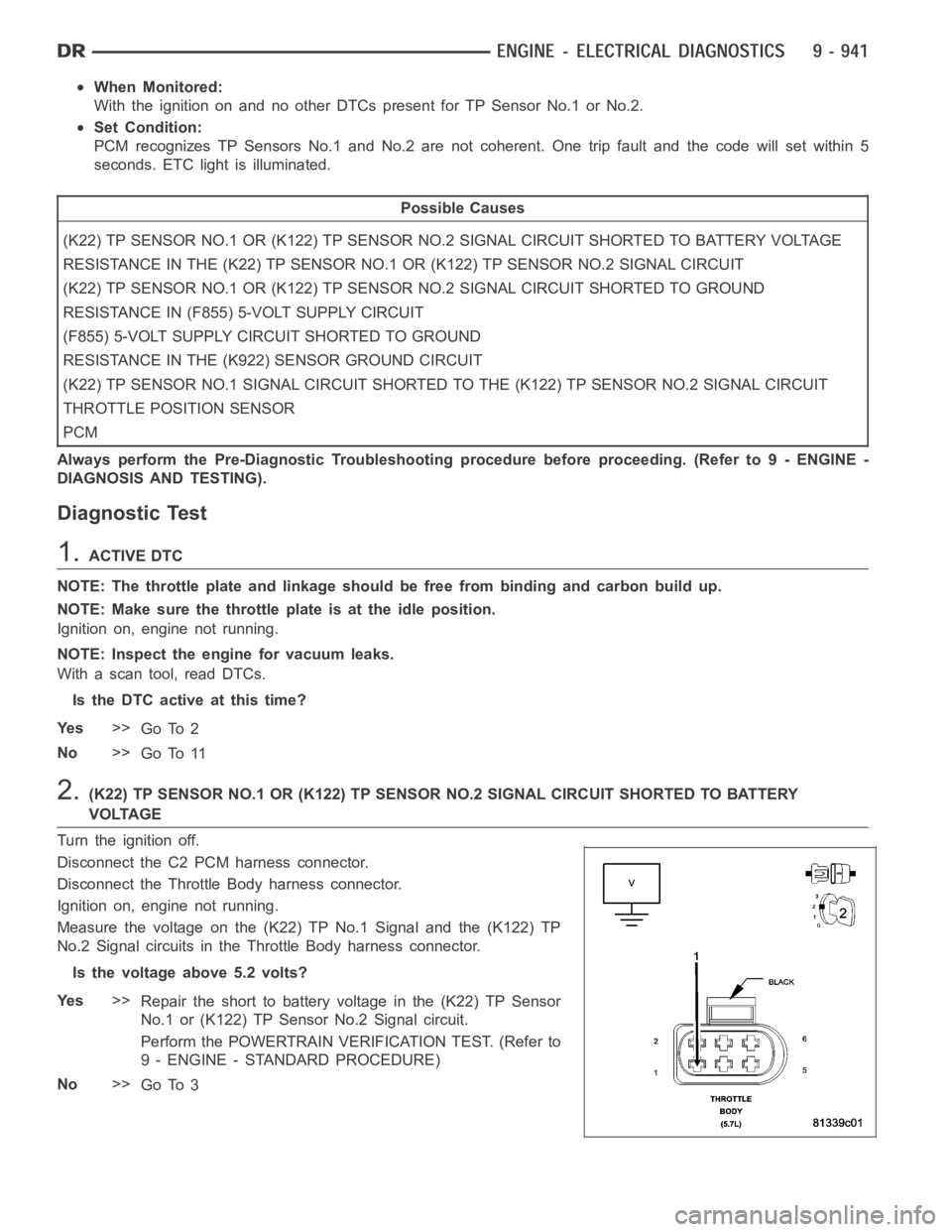
Measure the voltage on the (K22) TP No.1 Signal and the (K122) TP
No.2 Signal circuits in the Throttle Body harness connector.
Is the voltage above 5.2 volts?
Ye s>>
Repair the short to battery voltage in the (K22) TP Sensor
No.1 or (K122) TP Sensor No.2 Signal circuit.
Perform the POWERTRAIN VERIFICATION TEST. (Refer to
9 - ENGINE - STANDARD PROCEDURE)
No>>
Go To 3
Page 251 of 5267
3.THROTTLE POSITION SENSOR
Turn the ignition off.
Connect the C2 PCM harness connector.
Ignition on, engine not running.
With a scan tool, monitor the TP Sensor No.1 and No.2 voltage.
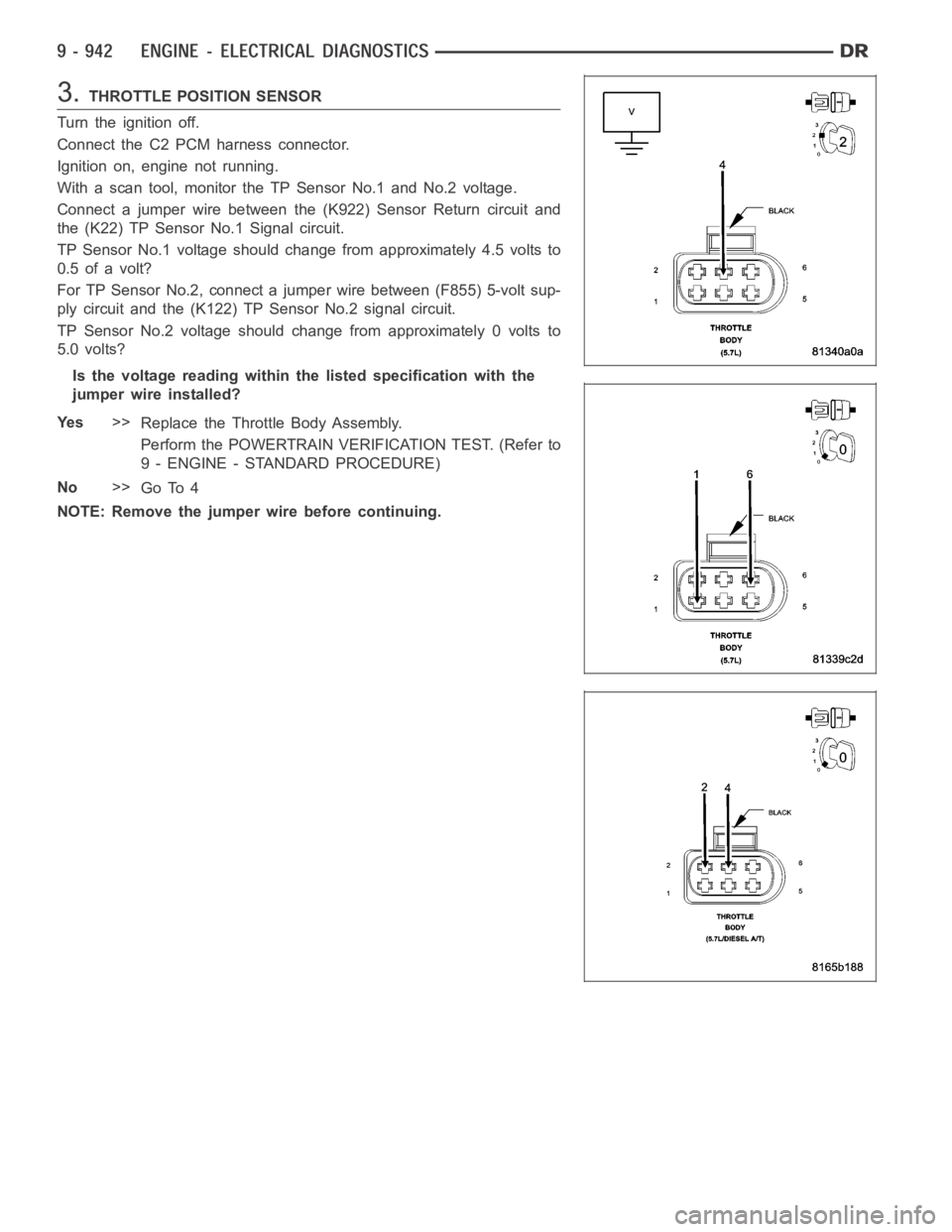
Connect a jumper wire between the (K922) Sensor Return circuit and
the (K22) TP Sensor No.1 Signal circuit.
TP Sensor No.1 voltage should change from approximately 4.5 volts to
0.5 of a volt?
For TP Sensor No.2, connect a jumper wire between (F855) 5-volt sup-
ply circuit and the (K122) TP Sensor No.2 signal circuit.
TP Sensor No.2 voltage should change from approximately 0 volts to
5.0 volts?
Isthevoltagereadingwithinthelistedspecificationwiththe
jumper wire installed?
Ye s>>
Replace the Throttle Body Assembly.
Perform the POWERTRAIN VERIFICATION TEST. (Refer to
9 - ENGINE - STANDARD PROCEDURE)
No>>
Go To 4
NOTE: Remove the jumper wire before continuing.
Page 252 of 5267
4.EXCESSIVE RESISTANCE IN THE (K22) TP SENSOR NO.1 OR (K122) TP SENSOR NO.2 SIGNAL CIRCUIT
Turn the ignition off.
Disconnect the C2 PCM harness connector.
CAUTION: Do not probe the PCM harness connectors. Probing the
PCM harness connectors will damage the PCM terminals resulting
in poor terminal to pin connection. Install Miller Special Tool #8815
to perform diagnosis.
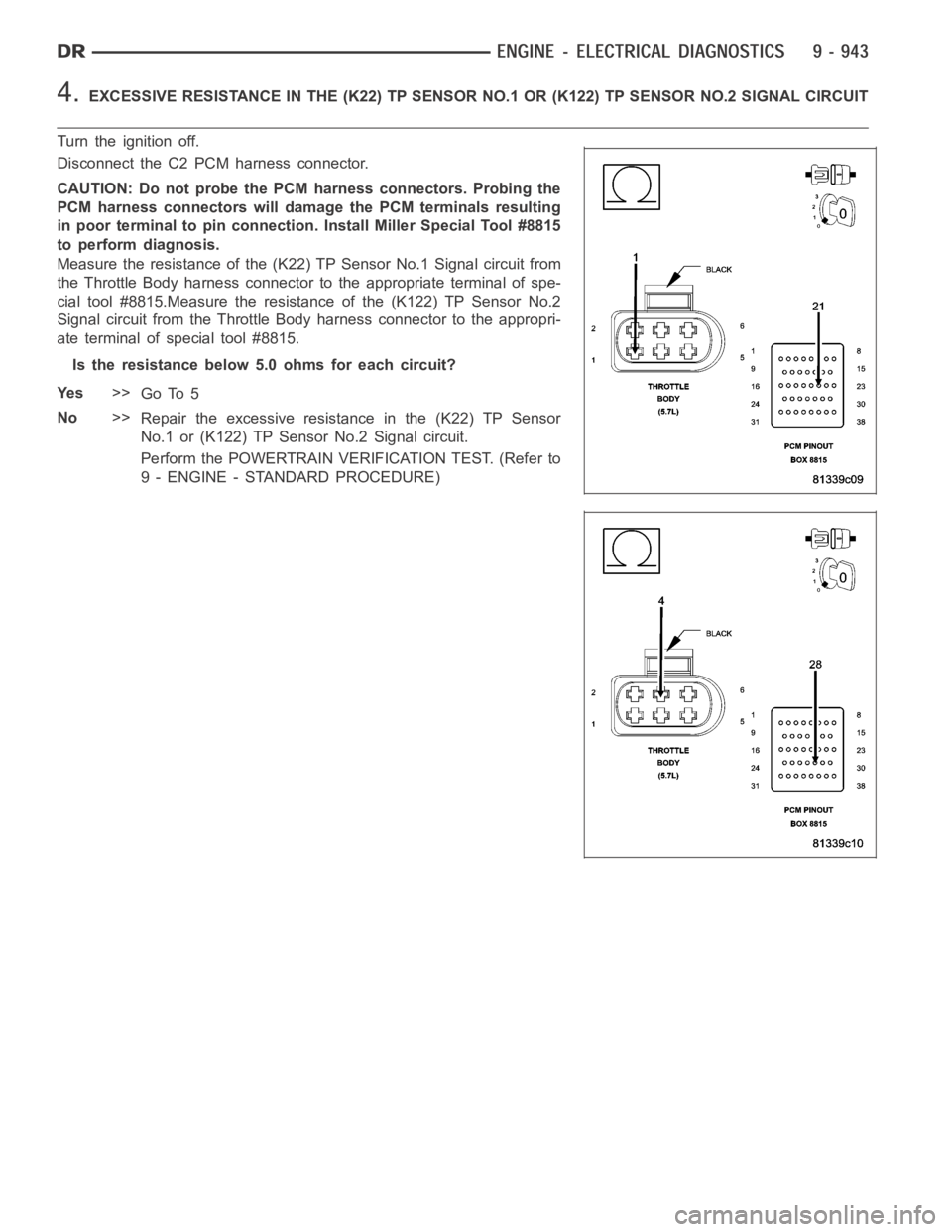
Measure the resistance of the (K22) TP Sensor No.1 Signal circuit from
the Throttle Body harness connector to the appropriate terminal of spe-
cial tool #8815.Measure the resistance of the (K122) TP Sensor No.2
Signal circuit from the Throttle Body harness connector to the appropri-
ate terminal of special tool #8815.
Is the resistance below 5.0 ohms for each circuit?
Ye s>>
Go To 5
No>>
Repair the excessive resistance in the (K22) TP Sensor
No.1 or (K122) TP Sensor No.2 Signal circuit.
Perform the POWERTRAIN VERIFICATION TEST. (Refer to
9 - ENGINE - STANDARD PROCEDURE)
Page 256 of 5267
10.PCM
NOTE: Before continuing, check the PCM harness connector terminals for corrosion, damage, or terminal
push out. Repair as necessary.
Using the schematics as a guide, inspect the wire harness and connectors. Pay particular attention to all Power and
Ground circuits.
Were there any problems found?
Ye s>>
Repair as necessary.
Perform the POWERTRAIN VERIFICATION TEST. (Refer to 9 - ENGINE - STANDARD PROCEDURE)
No>>
Replace and program the Powertrain Control Module per Service Information.
Perform the POWERTRAIN VERIFICATION TEST. (Refer to 9 - ENGINE - STANDARD PROCEDURE)
11 .THROTTLE FOLLOWER TEST
Ignition on, engine not running.
With a scan tool, perform the Throttle Follower Test and monitor the TP Sensor No.1 or No.2 voltage.
Slowly press the throttle pedal down.
The voltage for TP Sensor No.1 should start at approximately 0.8 of a volt and increase to above 4.2 volts.
The voltage for TP Sensor No.2 should start at approximately 4.2 volts and decrease to approximately 0.8 of a volt.
Is the voltage within the range of the listed specification for the appropriate Sensor?
Ye s>>
Refer to the INTERMITTENT CONDITION Diagnostic Procedure.
Perform the POWERTRAIN VERIFICATION TEST. (Refer to 9 - ENGINE - STANDARD PROCEDURE)
No>>
Disconnect the Battery when replacing the Throttle Body Assembly. Replace the Throttle Body Assem-
bly. After installation is complete, use a scan tool and select the ETC RELEARN function.
Perform the POWERTRAIN VERIFICATION TEST. (Refer to 9 - ENGINE - STANDARD PROCEDURE)
Page 258 of 5267
When Monitored:
With the ignition on and no APPS No.1 and APPS No.2 DTC present.
Set Condition:
APPS values No.1 and No.2 are not coherent. Idle is additionally forced when the brake pedal is pressed or
failed. Acceleration rate and Engine output are limited. One trip fault and the code will set within 5 seconds.
ETC light is flashing.
Possible Causes
EXCESSIVE RESISTANCE IN THE (F855) 5-VOLT SUPPLY CIRCUIT
EXCESSIVE RESISTANCE IN THE (F856) 5-VOLT SUPPLY CIRCUIT
EXCESSIVE RESISTANCE IN THE (K167) SENSOR NO.1 RETURN CIRCUIT
EXCESSIVE RESISTANCE IN THE (K400) SENSOR NO.2 RETURN CIRCUIT
EXCESSIVE RESISTANCE IN THE (K23) APP SENSOR NO.1 SIGNAL CIRCUIT
EXCESSIVE RESISTANCE IN THE (K29) APP SENSOR NO.2 SIGNAL CIRCUIT
APP SENSOR
PCM
Always perform the Pre-Diagnostic Troubleshooting procedure before proceeding. (Refer to 9 - ENGINE -
DIAGNOSIS AND TESTING).
Diagnostic Test
1.ACTIVE DTC
Ignition on, engine not running.
With a scan tool, read DTCs.
NOTE: Repair any other 5-Volt Supply or APPS High and Low DTCs before diagnosing P2138.
Is the DTC active at this time?
Ye s>>
Go To 2
No>>
Refer to the INTERMITTENT CONDITION Diagnostic Procedure.
Perform the POWERTRAIN VERIFICATION TEST. (Refer to 9 - ENGINE - STANDARD PROCEDURE)
Page 259 of 5267
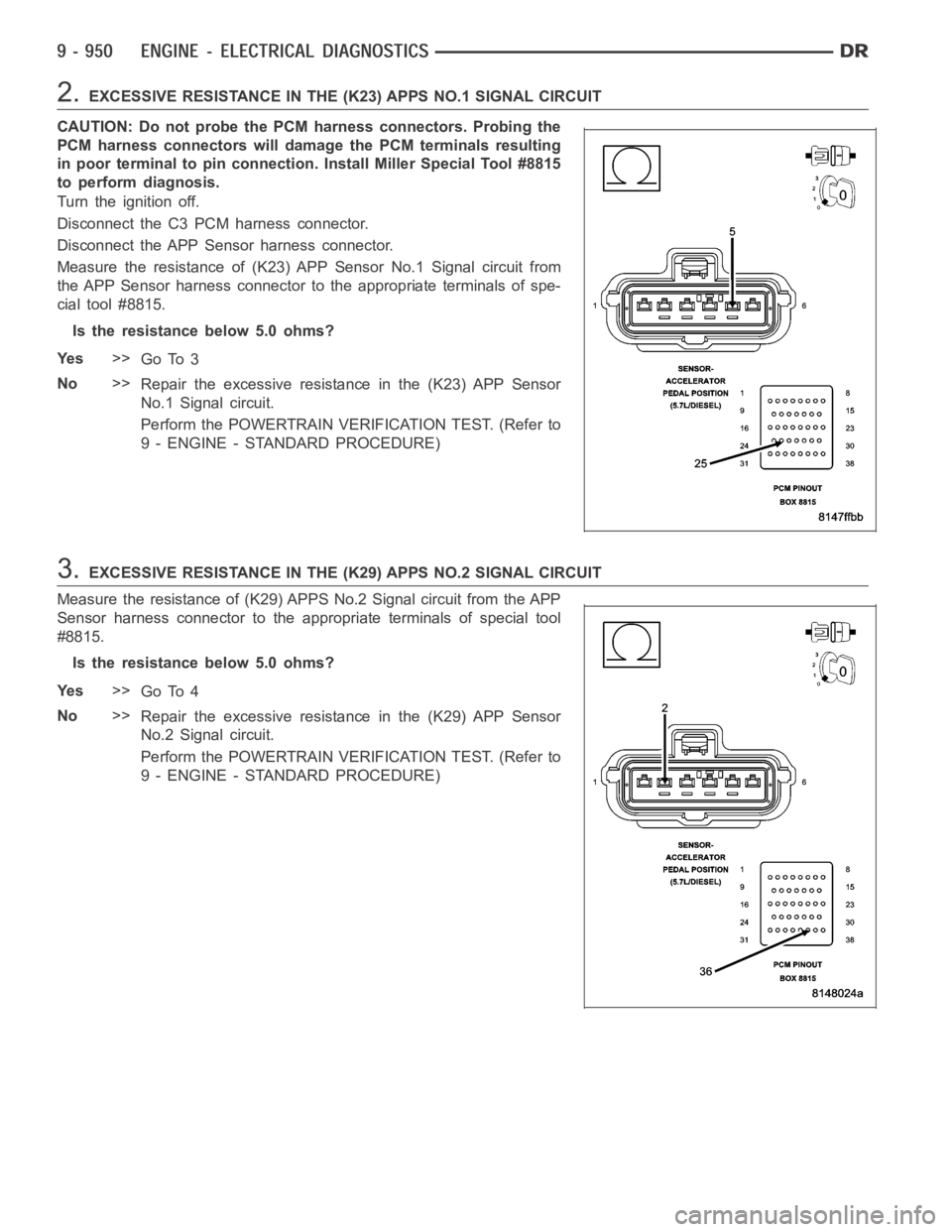
2.EXCESSIVE RESISTANCE IN THE (K23) APPS NO.1 SIGNAL CIRCUIT
CAUTION: Do not probe the PCM harness connectors. Probing the
PCM harness connectors will damage the PCM terminals resulting
in poor terminal to pin connection. Install Miller Special Tool #8815
to perform diagnosis.
Turn the ignition off.
Disconnect the C3 PCM harness connector.
Disconnect the APP Sensor harness connector.
Measure the resistance of (K23) APP Sensor No.1 Signal circuit from
the APP Sensor harness connector to the appropriate terminals of spe-
cial tool #8815.
Is the resistance below 5.0 ohms?
Ye s>>
Go To 3
No>>
Repair the excessive resistance in the (K23) APP Sensor
No.1 Signal circuit.
Perform the POWERTRAIN VERIFICATION TEST. (Refer to
9 - ENGINE - STANDARD PROCEDURE)
3.EXCESSIVE RESISTANCE IN THE (K29) APPS NO.2 SIGNAL CIRCUIT
Measure the resistance of (K29) APPS No.2 Signal circuit from the APP
Sensor harness connector to the appropriate terminals of special tool
#8815.
Is the resistance below 5.0 ohms?
Ye s>>
Go To 4
No>>
Repair the excessive resistance in the (K29) APP Sensor
No.2 Signal circuit.
Perform the POWERTRAIN VERIFICATION TEST. (Refer to
9 - ENGINE - STANDARD PROCEDURE)
Page 262 of 5267
8.CHECKING APPS NO.1 AND NO.2 WITH A LAB SCOPE
Ignition on, engine not running.
Set up a lab scope in a way that you can view two graphs simultaneously.
Backprobe (K23) APP Sensor No.1 Signal circuit using Channel 1 at the APP Sensor harness connector.
Backprobe (K29) APP Sensor No.2 Signal circuit using Channel 2 at the APP Sensor harness connector.
Slowly press and release the Accelerator Pedal while monitoring the lab scope screen.
Does the scope pattern show any missing or erratic signals?
Ye s>>
Replace the APP Sensor Assembly per Service Information. After installation is complete, use a scan
tool and select the ETC RELEARN function to relearn the APPS values.
Perform the POWERTRAIN VERIFICATION TEST. (Refer to 9 - ENGINE - STANDARD PROCEDURE)
No>>
Go To 9
9.PCM
NOTE: Before continuing, check the PCM harness connector terminals for corrosion, damage, or terminal
push out. Repair as necessary.
Using the schematics as a guide, inspect the wire harness and connectors. Pay particular attention to all Power and
Ground circuits.
Were there any problems found?
Ye s>>
Repair as necessary.
Perform the POWERTRAIN VERIFICATION TEST. (Refer to 9 - ENGINE - STANDARD PROCEDURE)
No>>
Replace and program the Powertrain Control Module per Service Information.
Perform the POWERTRAIN VERIFICATION TEST. (Refer to 9 - ENGINE - STANDARD PROCEDURE)
Page 264 of 5267
When Monitored:
Ignition on.
Set Condition:
PCM recognizes Vehicle speed input No.2 erratic or high. VSS No.2 is based on the average of the Front
Wheel Speeds. One trip fault and the code will set within 5 seconds. No MIL and No ETC light. Cruise is
disabled.
Possible Causes
(B222) VEHICLE SPEED NO.2 SIGNAL CIRCUIT SHORTED TO VOLTAGE
(B222) VEHICLE SPEED NO.2 SIGNAL CIRCUIT OPEN
(B222) VEHICLE SPEED NO.2 SIGNAL CIRCUIT SHORTED TO GROUND
TIRE CIRCUMFERENCE
PCM
Always perform the Pre-Diagnostic Troubleshooting procedure before proceeding. (Refer to 9 - ENGINE -
DIAGNOSIS AND TESTING).
Diagnostic Test
1.ACTIVE DTC
Ignition on, engine not running.
NOTE: Check for any Bus Communication DTCs. If no Bus or Communication DTCsare set, check for active
DTCs stored in the Anti-Lock Brake Module. Any bus or communication DTCs orVSS DTCs in the Anti-Lock
Brake Module must be properly diagnosed before continuing.
With a scan tool, read DTCs.
Is the DTC active at this time?
Ye s>>
Go To 2
No>>
Refer to the INTERMITTENT CONDITION Diagnostic Procedure.
Perform the POWERTRAIN VERIFICATION TEST. (Refer to 9 - ENGINE - STANDARD PROCEDURE)
2.VISUAL INSPECTION
NOTE: This code can set due to tire circumference differences and from the front or rear wheels being on
a slippery surface while the opposite tires are not.
This code may also set on a hard acceleration on loose gravel or during otheroff road driving conditions.
Check tire pressure of all the tires.
Checktirewearonallthetires.
Ask the customer what the road and driving conditions were like when the fault set.
Were any problems found?
Ye s>>
Repair as necessary. If the code set during a front OR rear wheel spin condition, no repair is necessary.
Perform the POWERTRAIN VERIFICATION TEST. (Refer to 9 - ENGINE - STANDARD PROCEDURE)
No>>
Go To 3
Page 265 of 5267
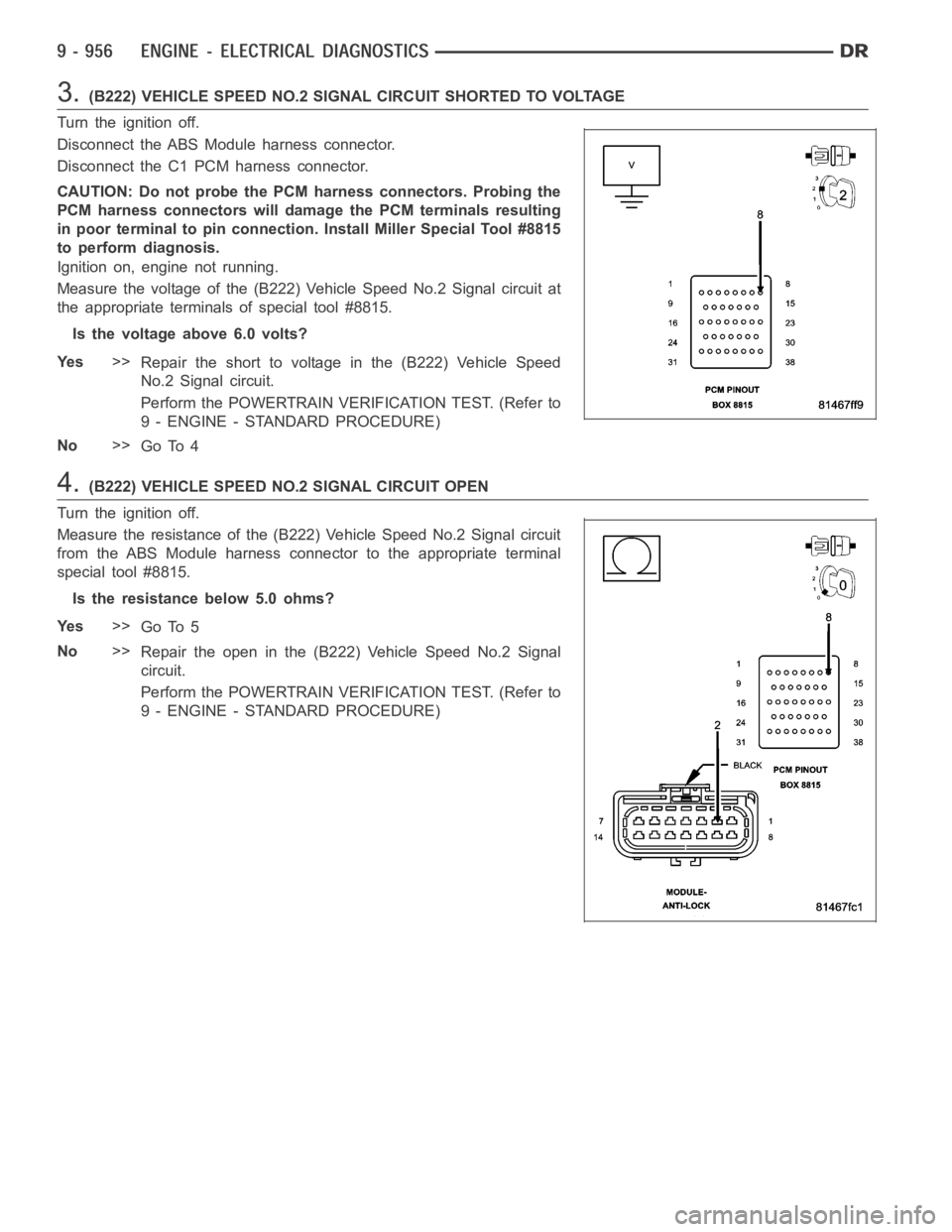
3.(B222) VEHICLE SPEED NO.2 SIGNAL CIRCUIT SHORTED TO VOLTAGE
Turn the ignition off.
Disconnect the ABS Module harness connector.
Disconnect the C1 PCM harness connector.
CAUTION: Do not probe the PCM harness connectors. Probing the
PCM harness connectors will damage the PCM terminals resulting
in poor terminal to pin connection. Install Miller Special Tool #8815
to perform diagnosis.
Ignition on, engine not running.
Measure the voltage of the (B222) Vehicle Speed No.2 Signal circuit at
the appropriate terminals of special tool #8815.
Is the voltage above 6.0 volts?
Ye s>>
Repair the short to voltage in the (B222) Vehicle Speed
No.2 Signal circuit.
Perform the POWERTRAIN VERIFICATION TEST. (Refer to
9 - ENGINE - STANDARD PROCEDURE)
No>>
Go To 4
4.(B222) VEHICLE SPEED NO.2 SIGNAL CIRCUIT OPEN
Turn the ignition off.
Measure the resistance of the (B222) Vehicle Speed No.2 Signal circuit
from the ABS Module harness connector to the appropriate terminal
special tool #8815.
Is the resistance below 5.0 ohms?
Ye s>>
Go To 5
No>>
Repair the open in the (B222) Vehicle Speed No.2 Signal
circuit.
Perform the POWERTRAIN VERIFICATION TEST. (Refer to
9 - ENGINE - STANDARD PROCEDURE)