jump start DODGE RAM SRT-10 2006 Service Repair Manual
[x] Cancel search | Manufacturer: DODGE, Model Year: 2006, Model line: RAM SRT-10, Model: DODGE RAM SRT-10 2006Pages: 5267, PDF Size: 68.7 MB
Page 33 of 5267
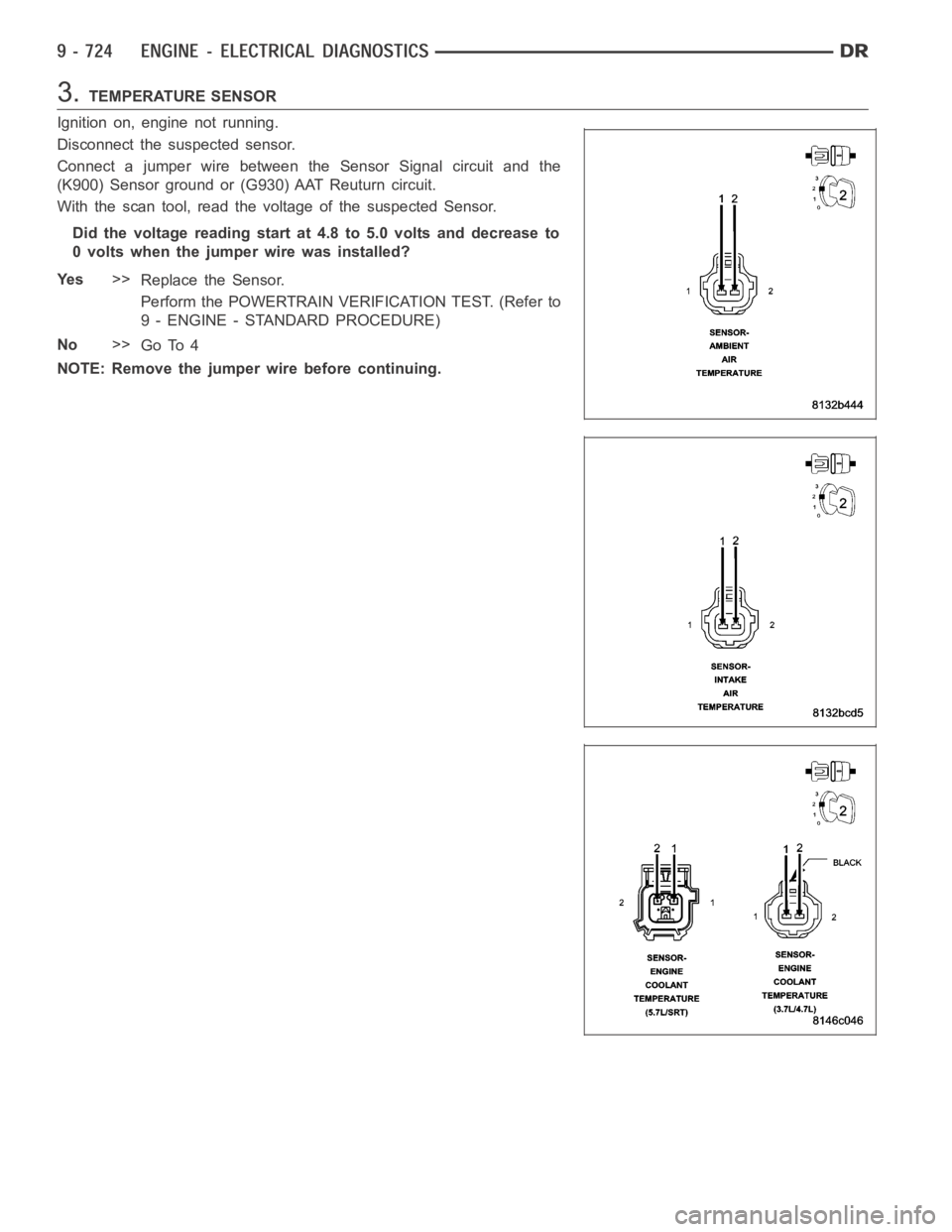
3.TEMPERATURE SENSOR
Ignition on, engine not running.
Disconnect the suspected sensor.
Connect a jumper wire between the Sensor Signal circuit and the
(K900) Sensor ground or (G930) AAT Reuturn circuit.
With the scan tool, read the voltage of the suspected Sensor.
Did the voltage reading start at 4.8 to 5.0 volts and decrease to
0 volts when the jumper wire was installed?
Ye s>>
Replace the Sensor.
Perform the POWERTRAIN VERIFICATION TEST. (Refer to
9 - ENGINE - STANDARD PROCEDURE)
No>>
Go To 4
NOTE: Remove the jumper wire before continuing.
Page 273 of 5267
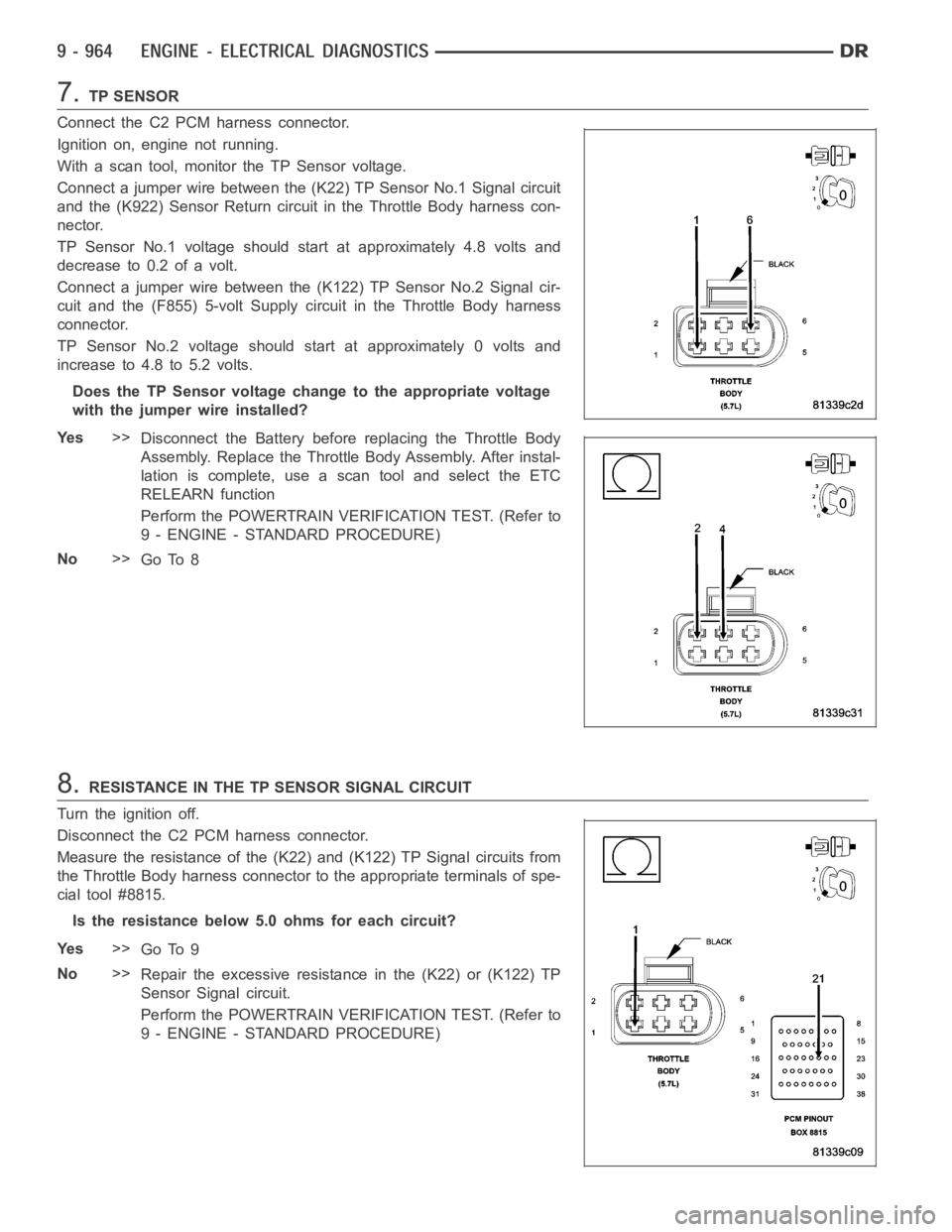
7.TP SENSOR
Connect the C2 PCM harness connector.
Ignition on, engine not running.
With a scan tool, monitor the TP Sensor voltage.
Connect a jumper wire between the (K22) TP Sensor No.1 Signal circuit
and the (K922) Sensor Return circuit in the Throttle Body harness con-
nector.
TP Sensor No.1 voltage should start at approximately 4.8 volts and
decrease to 0.2 of a volt.
Connect a jumper wire between the (K122) TP Sensor No.2 Signal cir-
cuit and the (F855) 5-volt Supply circuit in the Throttle Body harness
connector.
TP Sensor No.2 voltage should start at approximately 0 volts and
increase to 4.8 to 5.2 volts.
Does the TP Sensor voltage change to the appropriate voltage
with the jumper wire installed?
Ye s>>
Disconnect the Battery before replacing the Throttle Body
Assembly. Replace the ThrottleBody Assembly. After instal-
lation is complete, use a scan tool and select the ETC
RELEARN function
Perform the POWERTRAIN VERIFICATION TEST. (Refer to
9 - ENGINE - STANDARD PROCEDURE)
No>>
Go To 8
8.RESISTANCE IN THE TP SENSOR SIGNAL CIRCUIT
Turn the ignition off.
Disconnect the C2 PCM harness connector.
Measure the resistance of the (K22) and (K122) TP Signal circuits from
the Throttle Body harness connector to the appropriate terminals of spe-
cial tool #8815.
Is the resistance below 5.0 ohms for each circuit?
Ye s>>
Go To 9
No>>
Repair the excessive resistance in the (K22) or (K122) TP
Sensor Signal circuit.
Perform the POWERTRAIN VERIFICATION TEST. (Refer to
9 - ENGINE - STANDARD PROCEDURE)
Page 283 of 5267
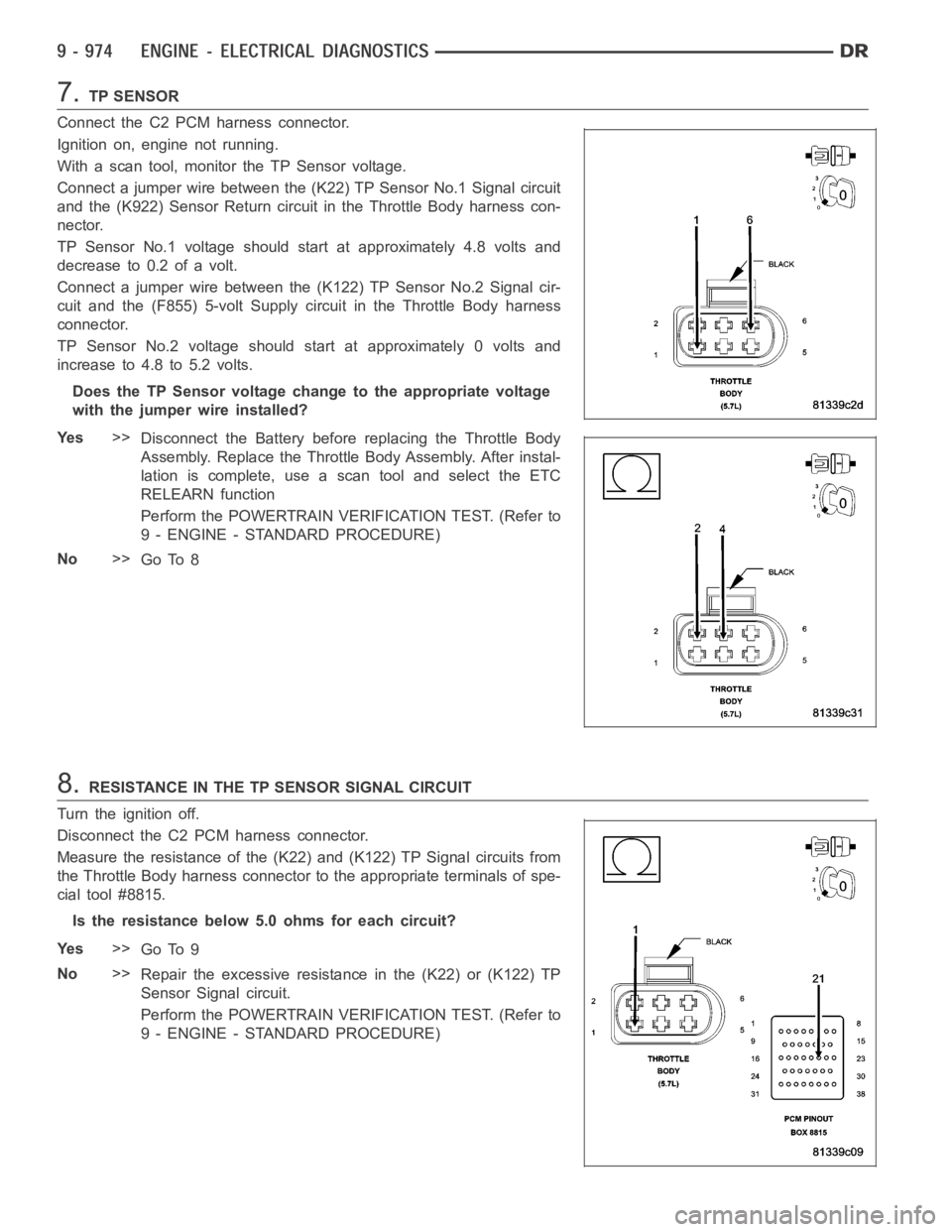
7.TP SENSOR
Connect the C2 PCM harness connector.
Ignition on, engine not running.
With a scan tool, monitor the TP Sensor voltage.
Connect a jumper wire between the (K22) TP Sensor No.1 Signal circuit
and the (K922) Sensor Return circuit in the Throttle Body harness con-
nector.
TP Sensor No.1 voltage should start at approximately 4.8 volts and
decrease to 0.2 of a volt.
Connect a jumper wire between the (K122) TP Sensor No.2 Signal cir-
cuit and the (F855) 5-volt Supply circuit in the Throttle Body harness
connector.
TP Sensor No.2 voltage should start at approximately 0 volts and
increase to 4.8 to 5.2 volts.
Does the TP Sensor voltage change to the appropriate voltage
with the jumper wire installed?
Ye s>>
Disconnect the Battery before replacing the Throttle Body
Assembly. Replace the ThrottleBody Assembly. After instal-
lation is complete, use a scan tool and select the ETC
RELEARN function
Perform the POWERTRAIN VERIFICATION TEST. (Refer to
9 - ENGINE - STANDARD PROCEDURE)
No>>
Go To 8
8.RESISTANCE IN THE TP SENSOR SIGNAL CIRCUIT
Turn the ignition off.
Disconnect the C2 PCM harness connector.
Measure the resistance of the (K22) and (K122) TP Signal circuits from
the Throttle Body harness connector to the appropriate terminals of spe-
cial tool #8815.
Is the resistance below 5.0 ohms for each circuit?
Ye s>>
Go To 9
No>>
Repair the excessive resistance in the (K22) or (K122) TP
Sensor Signal circuit.
Perform the POWERTRAIN VERIFICATION TEST. (Refer to
9 - ENGINE - STANDARD PROCEDURE)
Page 293 of 5267
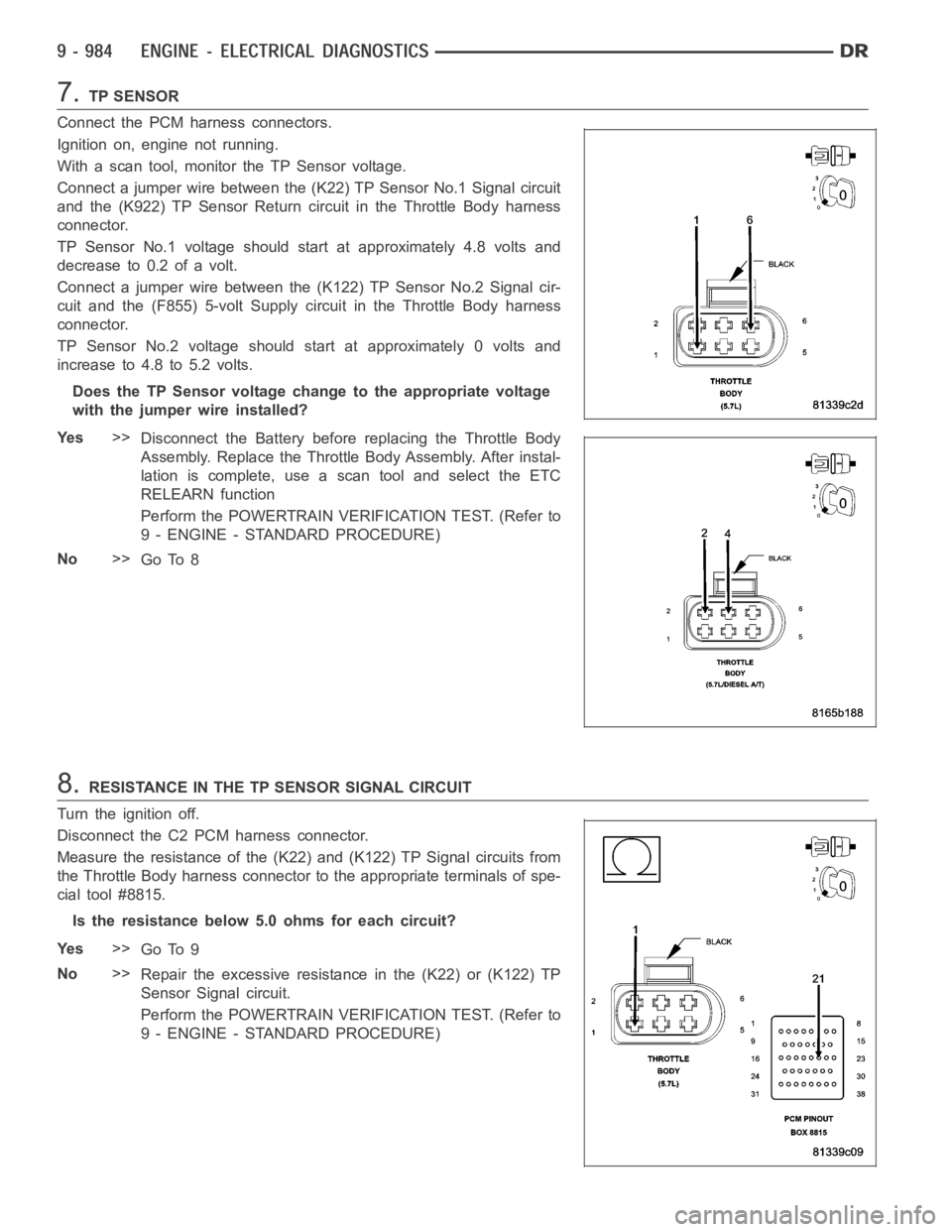
7.TP SENSOR
Connect the PCM harness connectors.
Ignition on, engine not running.
With a scan tool, monitor the TP Sensor voltage.
Connect a jumper wire between the (K22) TP Sensor No.1 Signal circuit
and the (K922) TP Sensor Return circuit in the Throttle Body harness
connector.
TP Sensor No.1 voltage should start at approximately 4.8 volts and
decrease to 0.2 of a volt.
Connect a jumper wire between the (K122) TP Sensor No.2 Signal cir-
cuit and the (F855) 5-volt Supply circuit in the Throttle Body harness
connector.
TP Sensor No.2 voltage should start at approximately 0 volts and
increase to 4.8 to 5.2 volts.
Does the TP Sensor voltage change to the appropriate voltage
with the jumper wire installed?
Ye s>>
Disconnect the Battery before replacing the Throttle Body
Assembly. Replace the ThrottleBody Assembly. After instal-
lation is complete, use a scan tool and select the ETC
RELEARN function
Perform the POWERTRAIN VERIFICATION TEST. (Refer to
9 - ENGINE - STANDARD PROCEDURE)
No>>
Go To 8
8.RESISTANCE IN THE TP SENSOR SIGNAL CIRCUIT
Turn the ignition off.
Disconnect the C2 PCM harness connector.
Measure the resistance of the (K22) and (K122) TP Signal circuits from
the Throttle Body harness connector to the appropriate terminals of spe-
cial tool #8815.
Is the resistance below 5.0 ohms for each circuit?
Ye s>>
Go To 9
No>>
Repair the excessive resistance in the (K22) or (K122) TP
Sensor Signal circuit.
Perform the POWERTRAIN VERIFICATION TEST. (Refer to
9 - ENGINE - STANDARD PROCEDURE)
Page 303 of 5267
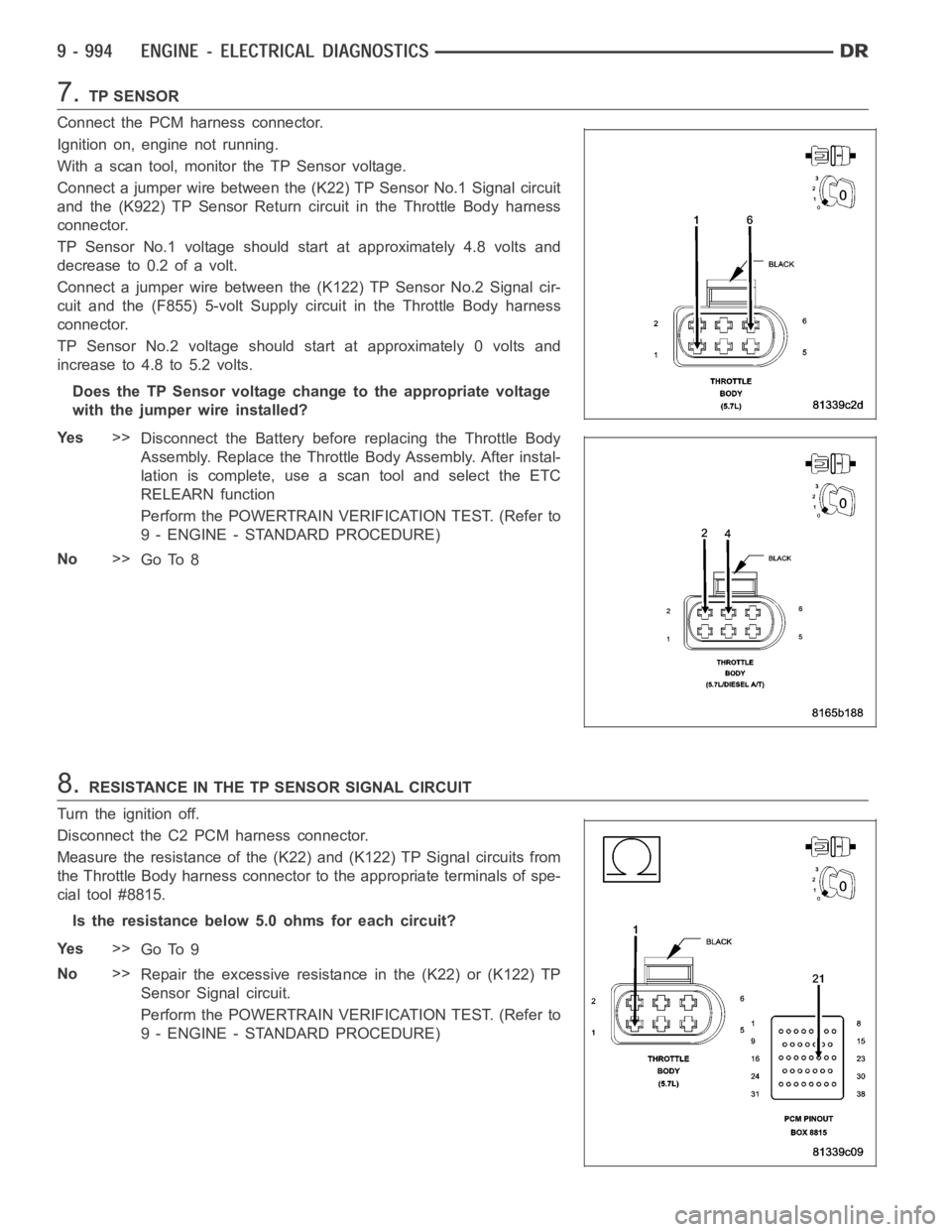
7.TP SENSOR
Connect the PCM harness connector.
Ignition on, engine not running.
With a scan tool, monitor the TP Sensor voltage.
Connect a jumper wire between the (K22) TP Sensor No.1 Signal circuit
and the (K922) TP Sensor Return circuit in the Throttle Body harness
connector.
TP Sensor No.1 voltage should start at approximately 4.8 volts and
decrease to 0.2 of a volt.
Connect a jumper wire between the (K122) TP Sensor No.2 Signal cir-
cuit and the (F855) 5-volt Supply circuit in the Throttle Body harness
connector.
TP Sensor No.2 voltage should start at approximately 0 volts and
increase to 4.8 to 5.2 volts.
Does the TP Sensor voltage change to the appropriate voltage
with the jumper wire installed?
Ye s>>
Disconnect the Battery before replacing the Throttle Body
Assembly. Replace the ThrottleBody Assembly. After instal-
lation is complete, use a scan tool and select the ETC
RELEARN function
Perform the POWERTRAIN VERIFICATION TEST. (Refer to
9 - ENGINE - STANDARD PROCEDURE)
No>>
Go To 8
8.RESISTANCE IN THE TP SENSOR SIGNAL CIRCUIT
Turn the ignition off.
Disconnect the C2 PCM harness connector.
Measure the resistance of the (K22) and (K122) TP Signal circuits from
the Throttle Body harness connector to the appropriate terminals of spe-
cial tool #8815.
Is the resistance below 5.0 ohms for each circuit?
Ye s>>
Go To 9
No>>
Repair the excessive resistance in the (K22) or (K122) TP
Sensor Signal circuit.
Perform the POWERTRAIN VERIFICATION TEST. (Refer to
9 - ENGINE - STANDARD PROCEDURE)
Page 311 of 5267
Inspect the coolant system for proper level and condition.
Is the coolant level and condition OK?
Ye s>>
Go To 3
No>>
Inspect the vehicle for a coolant leak and add the necessary amount of coolant.
Perform the POWERTRAIN VERIFICATION TEST. (Refer to 9 - ENGINE - STANDARD PROCEDURE)
3.THERMOSTAT
NOTE: This test works best if performed on a cold engine (cold soak).
Ignition on, engine not running.
With a scan tool, read the Eng Coolant Tmp Deg value. If the engine was allowed to sit overnight (cold soak), the
temperature value should be a sensible value that is somewhere close to theambient temperature.
NOTE: If engine coolant temperature is above 82°C (180°F), allow the engine to cool until 65°C (150°F) is
reached.
Start the Engine.
During engine warm-up monitor the Eng Coolant Tmp Deg value. The temp deg value change should be a smooth
transition from start up to normal operating temp 82°C (180°F). Also monitor the actual coolant temperature with a
thermometer.
NOTE: As the engine warms up to operating temperature, the actual coolant temperature (thermometer read-
ing) and the Eng Coolant Tmp Deg on the scan tool should stay relatively closetoeachother.
Using the appropriate service information, determine the proper openingtemperature of the thermostat.
Did the thermostat open at the proper temperature?
Ye s>>
Go To 4
No>>
Replace the thermostat.
Perform the POWERTRAIN VERIFICATION TEST. (Refer to 9 - ENGINE - STANDARD PROCEDURE)
4.ECT SENSOR
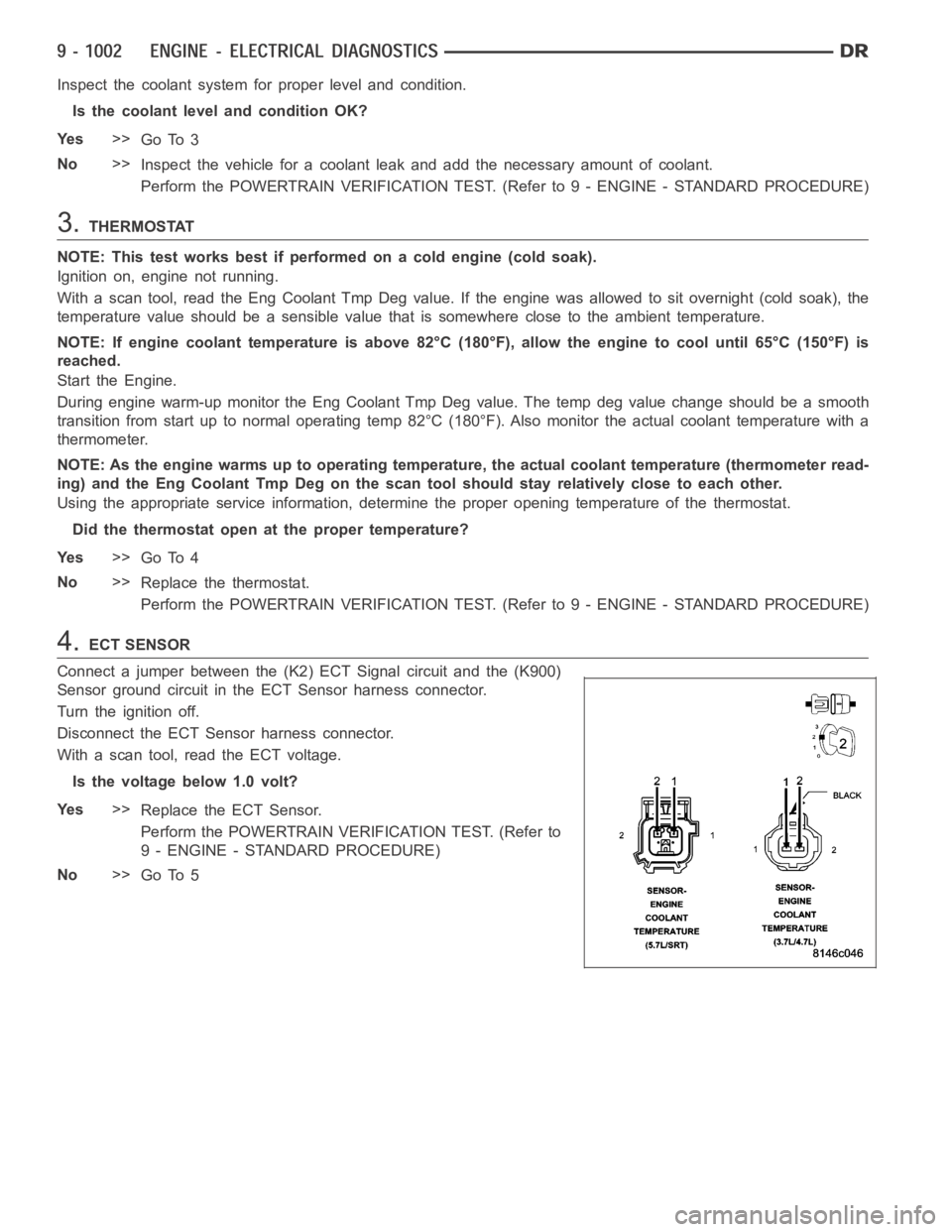
Connect a jumper between the (K2) ECT Signal circuit and the (K900)
Sensor ground circuit in the ECT Sensor harness connector.
Turn the ignition off.
Disconnect the ECT Sensor harness connector.
With a scan tool, read the ECT voltage.
Is the voltage below 1.0 volt?
Ye s>>
Replace the ECT Sensor.
Perform the POWERTRAIN VERIFICATION TEST. (Refer to
9 - ENGINE - STANDARD PROCEDURE)
No>>
Go To 5
Page 352 of 5267
3.EXCESSIVE RESISTANCE IN THE CASE GROUND
WARNING: When the engine is operating, do not stand in direct line with the fan. Do not put your hands
near the pulleys, belts, or fan. Do notwear loose clothing. Failure to follow these instructions can result in
personal injury or death.
Start the engine.
Warm the engine to operating temperature.
NOTE: Make sure all wires are clear of the engine’s moving parts.
Measure the voltage between the Generator Case and Battery ground post.
Is the voltage above 0.1 of a volt?
Ye s>>
Repair the excessive resistance in the Generator Case Ground.
Perform the POWERTRAIN VERIFICATION TEST. (Refer to 9 - ENGINE - STANDARD PROCEDURE)
No>>
Go To 4
4.GENERATOR OPERATION
Turn the ignition off.
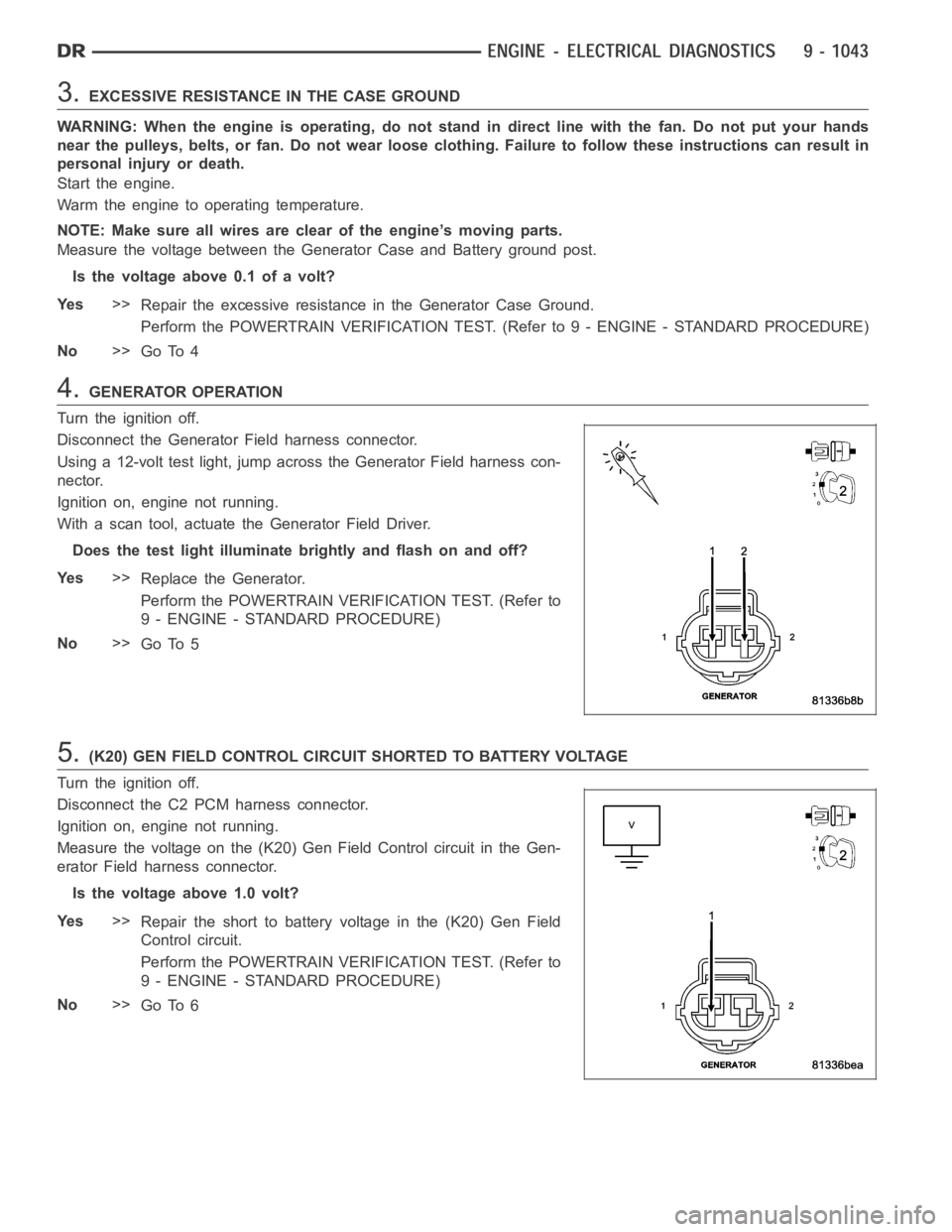
Disconnect the Generator Field harness connector.
Using a 12-volt test light, jump across the Generator Field harness con-
nector.
Ignition on, engine not running.
With a scan tool, actuate theGenerator Field Driver.
Does the test light illuminate brightly and flash on and off?
Ye s>>
Replace the Generator.
Perform the POWERTRAIN VERIFICATION TEST. (Refer to
9 - ENGINE - STANDARD PROCEDURE)
No>>
Go To 5
5.(K20) GEN FIELD CONTROL CIRCUIT SHORTED TO BATTERY VOLTAGE
Turn the ignition off.
Disconnect the C2 PCM harness connector.
Ignition on, engine not running.
Measure the voltage on the (K20) Gen Field Control circuit in the Gen-
erator Field harness connector.
Is the voltage above 1.0 volt?
Ye s>>
Repair the short to battery voltage in the (K20) Gen Field
Control circuit.
Perform the POWERTRAIN VERIFICATION TEST. (Refer to
9 - ENGINE - STANDARD PROCEDURE)
No>>
Go To 6
Page 439 of 5267
3.EXCESSIVE RESISTANCE IN THE BATTERY CIRCUIT
Turn the ignition off.
Check the Battery Cables for excessive resistance using the service information procedure.
Did either Battery Cable have a voltage drop greater than 0.2 of a volt?
Ye s>>
Repair the excessive resistance in the Battery circuit.
Perform the POWERTRAIN VERIFICATION TEST. (Refer to 9 - ENGINE - STANDARD PROCEDURE)
No>>
Go To 4
4.STARTER RELAY
Turn ignition off.
Remove the Starter Relay from IPM.
CAUTION: The Parking Brake must be on and the Transmission must be in park for a vehicle equipped with
an automatic transmission.
WARNING: When the engine is operating, do not stand in direct line with the fan. Do not put your hands
near the pulleys, belts, or fan. Do notwear loose clothing. Failure to follow these instructions can result in
personal injury or death.
Briefly connect a jumper wire from the Internal Fused B+ circuit to the (T750) Starter Relay Output circuit.
Did the Starter Motor crank the engine?
Ye s>>
Go To 5
No>>
Go To 7
5.(T751) FUSED IGNITION SWITCH OUTPUT CIRCUIT
Ignition on, engine not running.
Using a 12-volt test light, probe the (T751) Fused Ignition Switch Output circuit in the Starter Relay connector.
While observing 12-volt test light, hold ignition key in the start position.
Does the test light illuminate brightly?
Ye s>>
Go To 6
No>>
Repair the excessive resistance in the(T751)FusedIgnitionSwitchOutput circuit. Inspect related fuses
and repair as necessary.
Perform the POWERTRAIN VERIFICATION TEST. (Refer to 9 - ENGINE - STANDARD PROCEDURE)
Page 935 of 5267
3.(K25) BATTERY TEMP SENSOR SIGNAL
With the scan tool, read the Battery Temp Sensor voltage with the Batt Temp Sensor still disconnected.
Is the voltage above 4.6 volts?
Ye s>>
Go To 4
No>>
Go To 7
4.BATTERY TEMPERATURE SENSOR
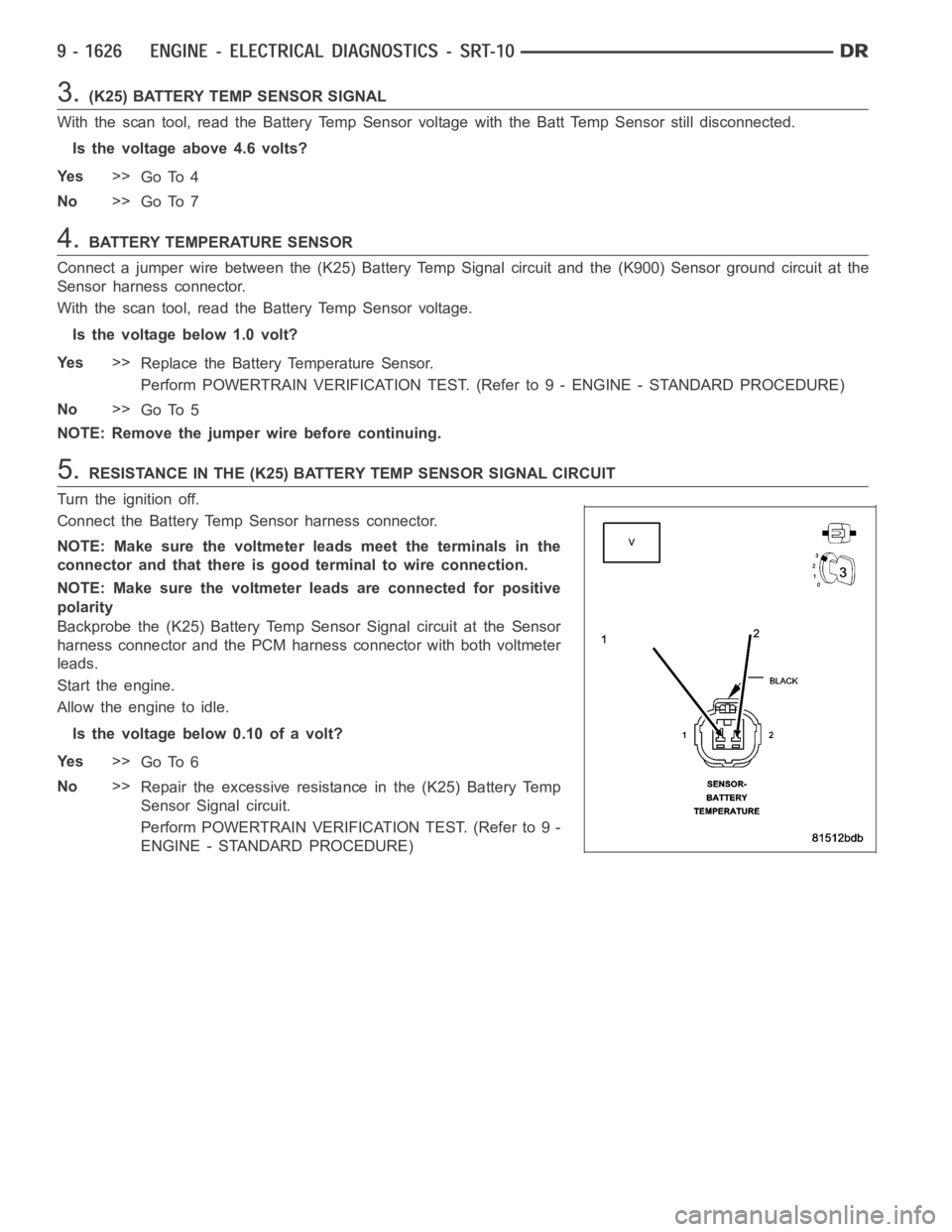
Connect a jumper wire between the (K25) Battery Temp Signal circuit and the(K900) Sensor ground circuit at the
Sensor harness connector.
With the scan tool, read the Battery Temp Sensor voltage.
Is the voltage below 1.0 volt?
Ye s>>
Replace the Battery Temperature Sensor.
Perform POWERTRAIN VERIFICATION TEST. (Refer to 9 - ENGINE - STANDARD PROCEDURE)
No>>
Go To 5
NOTE: Remove the jumper wire before continuing.
5.RESISTANCE IN THE (K25) BATTERY TEMP SENSOR SIGNAL CIRCUIT
Turn the ignition off.
Connect the Battery Temp Sensor harness connector.
NOTE: Make sure the voltmeter leads meet the terminals in the
connector and that there is good terminal to wire connection.
NOTE: Make sure the voltmeter leads are connected for positive
polarity
Backprobe the (K25) Battery Temp Sensor Signal circuit at the Sensor
harness connector and the PCM harness connector with both voltmeter
leads.
Start the engine.
Allow the engine to idle.
Is the voltage below 0.10 of a volt?
Ye s>>
Go To 6
No>>
Repair the excessive resistance in the (K25) Battery Temp
Sensor Signal circuit.
Perform POWERTRAIN VERIFICATION TEST. (Refer to 9 -
ENGINE - STANDARD PROCEDURE)
Page 944 of 5267
When Monitored:
With the engine RPM above 400, the TPS voltage less than 1.13 volts, and battery voltage greater than 10.4
volts
Set Condition:
With the engine RPM above 400, the TPS voltage less than 1.13 volts, and battery voltage greater than 10.4
volts
Possible Causes
(K1) MAP SIGNAL CIRCUIT SHORTED TO BATTERY VOLTAGE
(K1) MAP SIGNAL CIRCUIT OPEN
(K1) MAP SIGNAL CIRCUIT SHORTED TO THE (F856) 5-VOLT SUPPLY CIRCUIT
(K900) SENSOR GROUND CIRCUIT OPEN
MAP SENSOR
PCM
Always perform the Pre-Diagnostic Troubleshooting procedure before proceeding. (Refer to 9 - ENGINE -
DIAGNOSIS AND TESTING).
Diagnostic Test
1.MAP SENSOR VOLTAGE ABOVE 4.92 VOLTS
Start the engine.
With a scan tool, read the MAP Sensor voltage.
Is the voltage above 4.92 volts?
Ye s>>
Go To 2
No>>
Refer to the INTERMITTENT CONDITION Diagnostic Procedure. (Refer to 9 - ENGINE - DIAGNOSIS
AND TESTING)
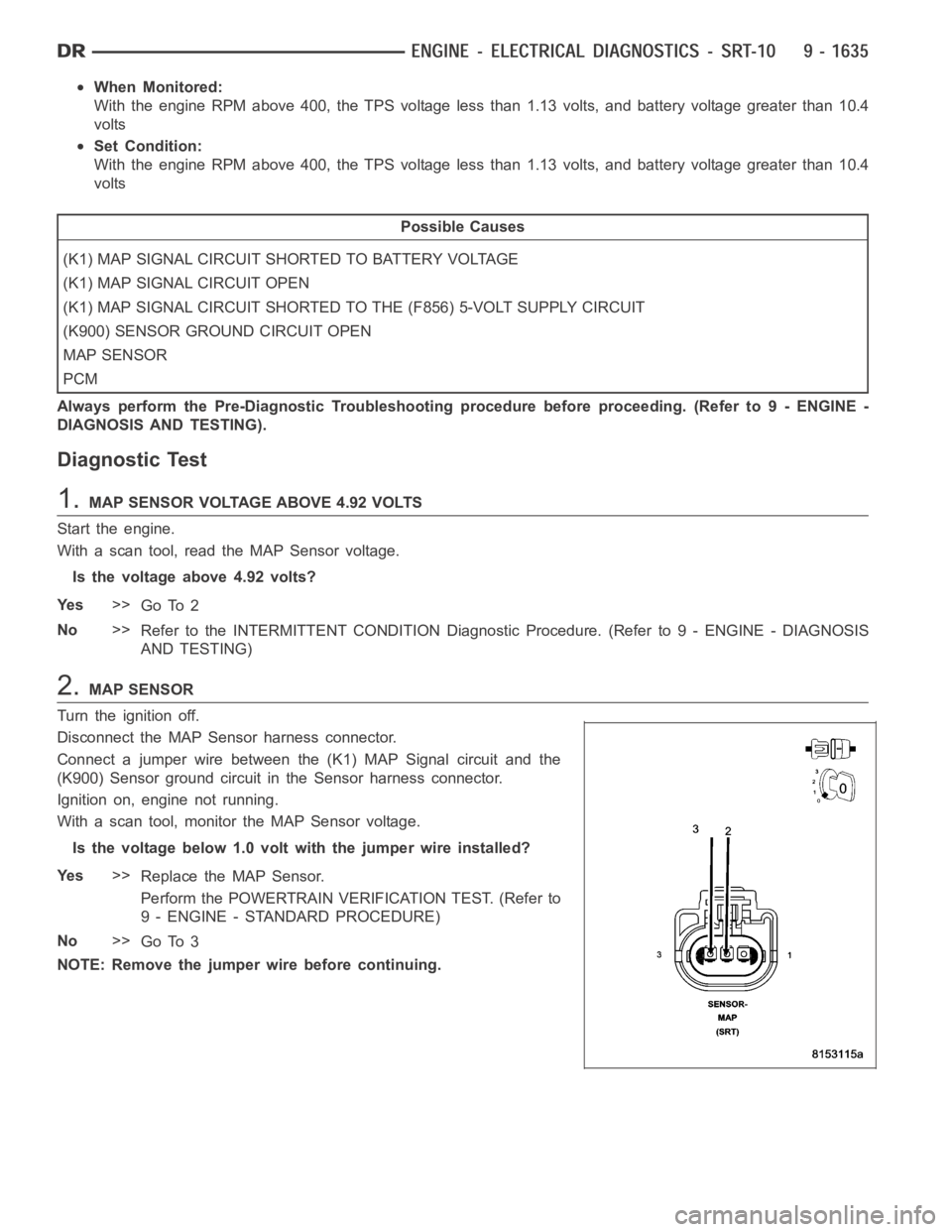
2.MAP SENSOR
Turn the ignition off.
Disconnect the MAP Sensor harness connector.
Connect a jumper wire between the (K1) MAP Signal circuit and the
(K900) Sensor ground circuit in the Sensor harness connector.
Ignition on, engine not running.
With a scan tool, monitor the MAP Sensor voltage.
Is the voltage below 1.0 volt with the jumper wire installed?
Ye s>>
Replace the MAP Sensor.
Perform the POWERTRAIN VERIFICATION TEST. (Refer to
9 - ENGINE - STANDARD PROCEDURE)
No>>
Go To 3
NOTE: Remove the jumper wire before continuing.