key DODGE RAM SRT-10 2006 Service User Guide
[x] Cancel search | Manufacturer: DODGE, Model Year: 2006, Model line: RAM SRT-10, Model: DODGE RAM SRT-10 2006Pages: 5267, PDF Size: 68.7 MB
Page 425 of 5267
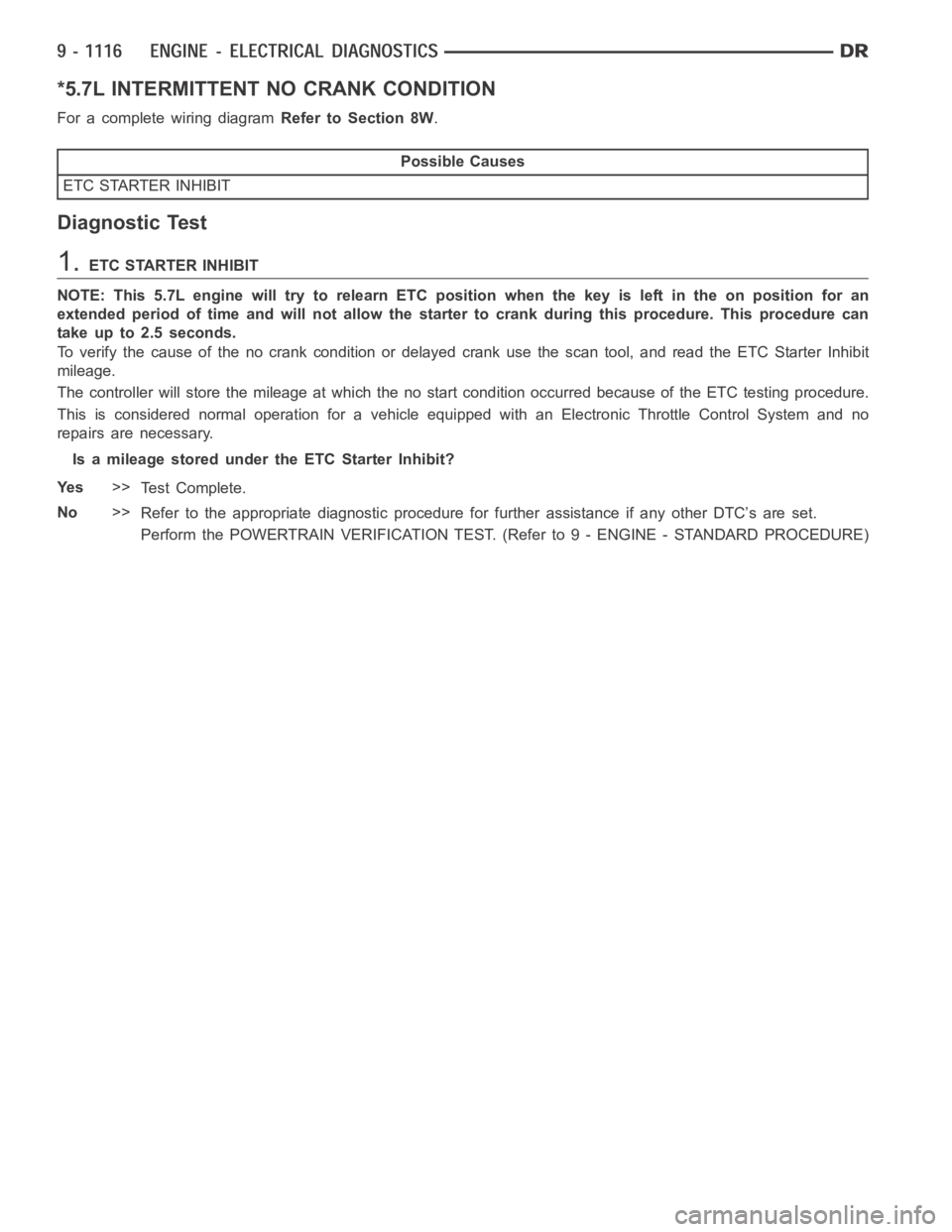
*5.7L INTERMITTENT NO CRANK CONDITION
For a complete wiring diagramRefer to Section 8W.
Possible Causes
ETC STARTER INHIBIT
Diagnostic Test
1.ETC STARTER INHIBIT
NOTE: This 5.7L engine will try to relearn ETC position when the key is left in the on position for an
extended period of time and will not allow the starter to crank during this procedure. This procedure can
take up to 2.5 seconds.
To verify the cause of the no crank condition or delayed crank use the scan tool, and read the ETC Starter Inhibit
mileage.
The controller will store the mileage at which the no start condition occurred because of the ETC testing procedure.
This is considered normal operation for a vehicle equipped with an Electronic Throttle Control System and no
repairs are necessary.
Is a mileage stored under the ETC Starter Inhibit?
Ye s>>
Te s t C o m p l e t e .
No>>
Refer to the appropriate diagnostic procedure for further assistance if any other DTC’s are set.
Perform the POWERTRAIN VERIFICATION TEST. (Refer to 9 - ENGINE - STANDARD PROCEDURE)
Page 433 of 5267
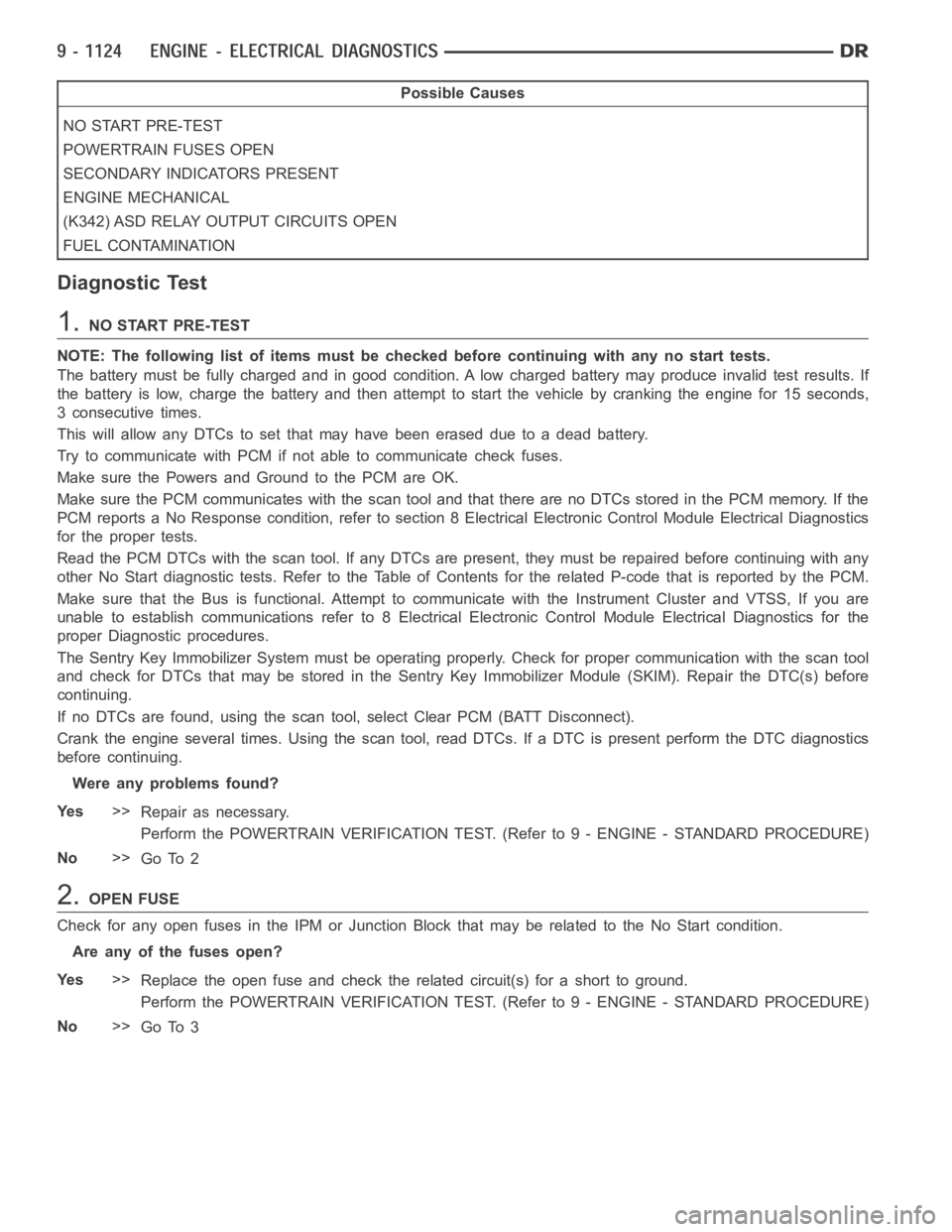
Possible Causes
NO START PRE-TEST
POWERTRAIN FUSES OPEN
SECONDARY INDICATORS PRESENT
ENGINE MECHANICAL
(K342) ASD RELAY OUTPUT CIRCUITS OPEN
FUEL CONTAMINATION
Diagnostic Test
1.NO START PRE-TEST
NOTE: The following list of items must be checked before continuing with any no start tests.
The battery must be fully charged and in good condition. A low charged battery may produce invalid test results. If
the battery is low, charge the battery and then attempt to start the vehicleby cranking the engine for 15 seconds,
3 consecutive times.
This will allow any DTCs to set that may have been erased due to a dead battery.
Try to communicate with PCM if not able to communicate check fuses.
Make sure the Powers and Ground to the PCM are OK.
Make sure the PCM communicates with the scan tool and that there are no DTCs stored in the PCM memory. If the
PCM reports a No Response condition, refer to section 8 Electrical Electronic Control Module Electrical Diagnostics
for the proper tests.
Read the PCM DTCs with the scan tool. If any DTCs are present, they must be repaired before continuing with any
other No Start diagnostic tests. Refer to the Table of Contents for the related P-code that is reported by the PCM.
Make sure that the Bus is functional. Attempt to communicate with the Instrument Cluster and VTSS, If you are
unable to establish communications refer to 8 Electrical Electronic Control Module Electrical Diagnostics for the
proper Diagnostic procedures.
The Sentry Key Immobilizer System mustbe operating properly. Check for proper communication with the scan tool
and check for DTCs that may be stored in the Sentry Key Immobilizer Module (SKIM). Repair the DTC(s) before
continuing.
If no DTCs are found, using the scan tool, select Clear PCM (BATT Disconnect).
Crank the engine several times. Using the scan tool, read DTCs. If a DTC is present perform the DTC diagnostics
before continuing.
Were any problems found?
Ye s>>
Repair as necessary.
Perform the POWERTRAIN VERIFICATION TEST. (Refer to 9 - ENGINE - STANDARD PROCEDURE)
No>>
Go To 2
2.OPEN FUSE
Check for any open fuses in the IPM or Junction Block that may be related to theNoStartcondition.
Are any of the fuses open?
Ye s>>
Replace the open fuse and check the related circuit(s) for a short to ground.
Perform the POWERTRAIN VERIFICATION TEST. (Refer to 9 - ENGINE - STANDARD PROCEDURE)
No>>
Go To 3
Page 439 of 5267
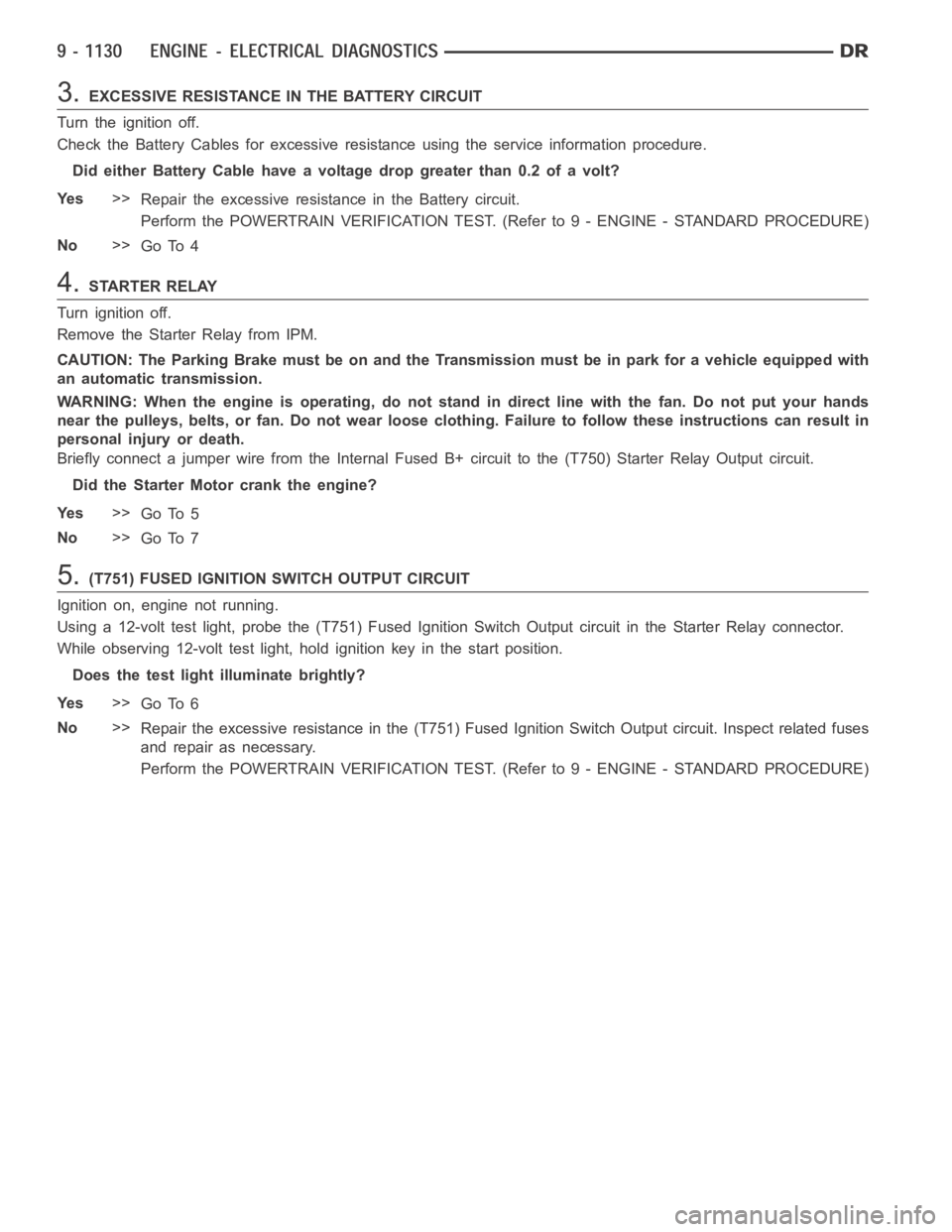
3.EXCESSIVE RESISTANCE IN THE BATTERY CIRCUIT
Turn the ignition off.
Check the Battery Cables for excessive resistance using the service information procedure.
Did either Battery Cable have a voltage drop greater than 0.2 of a volt?
Ye s>>
Repair the excessive resistance in the Battery circuit.
Perform the POWERTRAIN VERIFICATION TEST. (Refer to 9 - ENGINE - STANDARD PROCEDURE)
No>>
Go To 4
4.STARTER RELAY
Turn ignition off.
Remove the Starter Relay from IPM.
CAUTION: The Parking Brake must be on and the Transmission must be in park for a vehicle equipped with
an automatic transmission.
WARNING: When the engine is operating, do not stand in direct line with the fan. Do not put your hands
near the pulleys, belts, or fan. Do notwear loose clothing. Failure to follow these instructions can result in
personal injury or death.
Briefly connect a jumper wire from the Internal Fused B+ circuit to the (T750) Starter Relay Output circuit.
Did the Starter Motor crank the engine?
Ye s>>
Go To 5
No>>
Go To 7
5.(T751) FUSED IGNITION SWITCH OUTPUT CIRCUIT
Ignition on, engine not running.
Using a 12-volt test light, probe the (T751) Fused Ignition Switch Output circuit in the Starter Relay connector.
While observing 12-volt test light, hold ignition key in the start position.
Does the test light illuminate brightly?
Ye s>>
Go To 6
No>>
Repair the excessive resistance in the(T751)FusedIgnitionSwitchOutput circuit. Inspect related fuses
and repair as necessary.
Perform the POWERTRAIN VERIFICATION TEST. (Refer to 9 - ENGINE - STANDARD PROCEDURE)
Page 448 of 5267
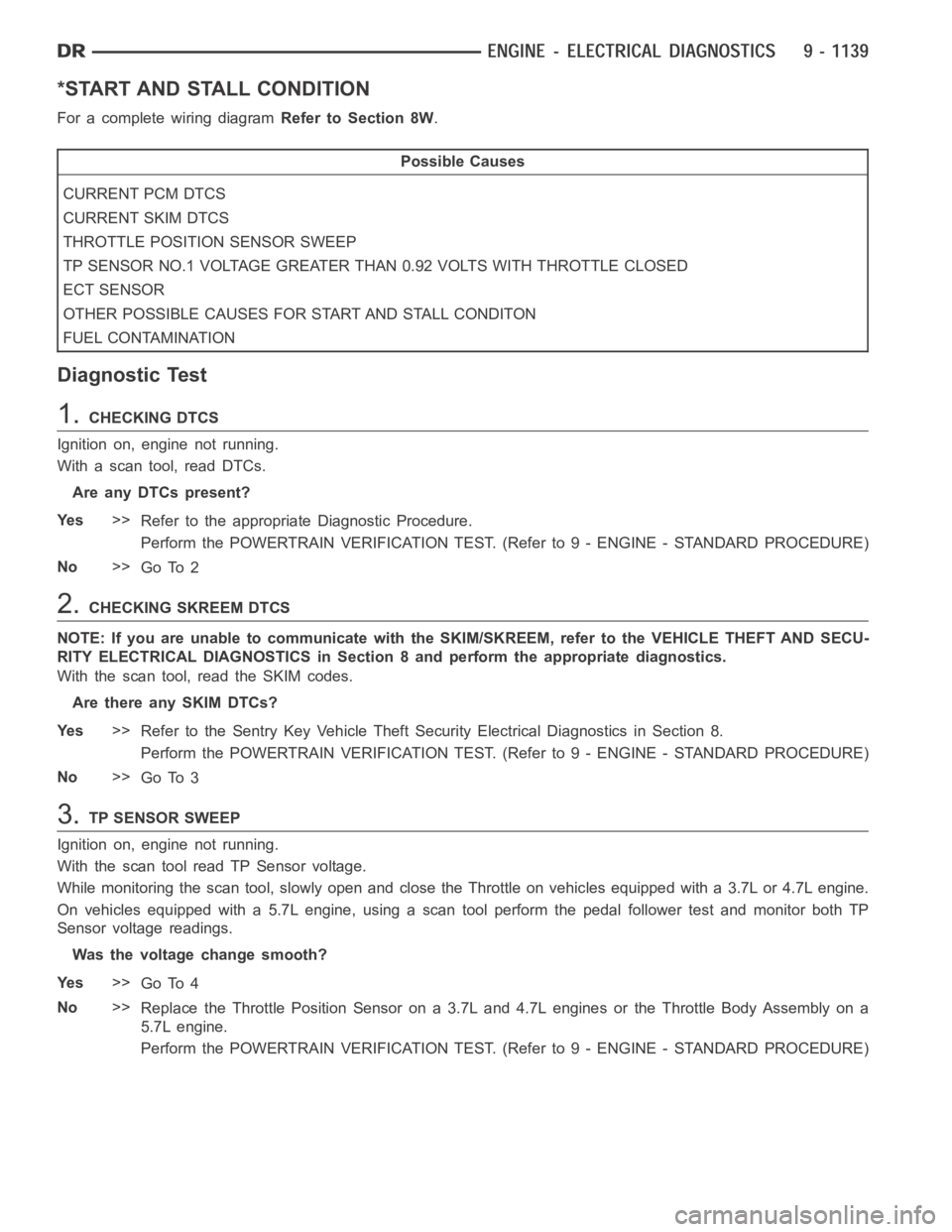
*START AND STALL CONDITION
For a complete wiring diagramRefer to Section 8W.
Possible Causes
CURRENT PCM DTCS
CURRENT SKIM DTCS
THROTTLE POSITION SENSOR SWEEP
TP SENSOR NO.1 VOLTAGE GREATER THAN 0.92 VOLTS WITH THROTTLE CLOSED
ECT SENSOR
OTHER POSSIBLE CAUSES FOR START AND STALL CONDITON
FUEL CONTAMINATION
Diagnostic Test
1.CHECKING DTCS
Ignition on, engine not running.
With a scan tool, read DTCs.
Are any DTCs present?
Ye s>>
Refer to the appropriate Diagnostic Procedure.
Perform the POWERTRAIN VERIFICATION TEST. (Refer to 9 - ENGINE - STANDARD PROCEDURE)
No>>
Go To 2
2.CHECKING SKREEM DTCS
NOTE: If you are unable to communicate with the SKIM/SKREEM, refer to the VEHICLE THEFT AND SECU-
RITY ELECTRICAL DIAGNOSTICS in Section 8 and perform the appropriate diagnostics.
With the scan tool, read the SKIM codes.
Are there any SKIM DTCs?
Ye s>>
Refer to the Sentry Key Vehicle Theft Security Electrical Diagnostics in Section 8.
Perform the POWERTRAIN VERIFICATION TEST. (Refer to 9 - ENGINE - STANDARD PROCEDURE)
No>>
Go To 3
3.TP SENSOR SWEEP
Ignition on, engine not running.
With the scan tool read TP Sensor voltage.
While monitoring the scan tool, slowly open and close the Throttle on vehicles equipped with a 3.7L or 4.7L engine.
On vehicles equipped with a 5.7L engine, using a scan tool perform the pedalfollower test and monitor both TP
Sensor voltage readings.
Was the voltage change smooth?
Ye s>>
Go To 4
No>>
Replace the Throttle Position Sensor on a 3.7L and 4.7L engines or the Throttle Body Assembly on a
5.7L engine.
Perform the POWERTRAIN VERIFICATION TEST. (Refer to 9 - ENGINE - STANDARD PROCEDURE)
Page 451 of 5267
POWERTRAIN VERIFICATION TEST
For a complete wiring diagramRefer to Section 8W.
Diagnostic Test
1.SELECTING THE PROPER VERIFICATION TEST
The following verification test are for different repairs. Select the appropriate Verification test for the
repair that has been completed.
Speed Control repair
Go To 2
Charging System repair
Go To 3
NVLD System repair
Go To 4
All other repairs
Go To 5
2.POWERTRAIN VERIFICATION TEST 1
NOTE: 1. If this vehicle is equipped with an Electronic Throttle Control system, and the APP Sensors, PCM,
or Throttle Body Assembly have been replaced, use the scan tool to perform the ETC RELEARN function.
NOTE: 2. After completing the Powertrain Verification Test the Transmission Verification Test must be per-
formed.
NOTE: 3. If the PCM has been replaced and the correct VIN and mileage have notbeen programmed, a DTC
will set in the ABS Module, Airbag Module and the SKIM/SKREEM.
NOTE: 4. If the vehicle is equipped with a Sentry Key Remote Entry, Secret Key data must be updated. Refer
to the Service Information for the PCM, SKIM/SKREEM and the Transponder (ignition key) for programming
information. Using the scan tool, program the Secret Key information intothe PCM using the PCM replaced
function under the WCM menu.
5. Inspect the vehicle to make sure that all engine components are properlyinstalled and connected.
6. Connect the scan tool to the data link connector and erase all codes.
7. Turn the speed control ON (if equipped, cruise light will be on).
8. Depress and release the SET Switch when the vehicle speed is greater than35 MPH. The speed control should
engage and hold the selected speed.
9. Press and hold the RESUME/ACCEL Switch. The vehicle speed should increase by at least 2 MPH.
10. Press and hold the COAST switch. The vehicle speed should decrease.
11. Using caution, press and release the brake pedal. The speed control should disengage.
12. Bring the vehicle speed back up to 35 MPH.
13. Press the RESUME/ACCEL switch. The speed control should resume the previously set speed.
14. Hold down the SET switch. The vehicle should decelerate.
15. Make sure vehicle speed is greater than 35 mph and release the SET Switch. The vehicle should adjust and set
a new vehicle speed.
16. Press and release the CANCEL switch. The speed control should disengage.
17. Bring the vehicle speed back up above 35 mph and engage speed control.
18. Turn the Speed Control Off. (Cruise light will be off). The speed control should disengage.
NOTE: OVERSHOOT/UNDERSHOOT FOLLOWING SPEED CONTROL SET.
19. If the vehicle operator repeatedly presses and releases the SET buttonwith their foot off of the accelerator
(referred to as
lift foot set), the vehicle may accelerate and exceed the desired set speed by up to 5 mph (8km/h).
20. It may also decelerate to less than the desired set speed, before finally achieving the desired set speed.
21. The Speed Control System has an adaptive strategy that compensates forvehicle-to-vehicle variations in speed
control cable lengths.
22. When the speed control is set with the vehicles operators foot off of theaccelerator pedal, the speed control
thinks there is excessive speed control cable slack and adapts accordingly.
Page 452 of 5267
23. If thelift foot setsare continually used, a speed control overshoot/undershoot condition will develop.
24. To
unlearnthe overshoot/undershoot condition, the vehicle operator has to press and release the set button
while maintaining the desired set speedusing the accelerator pedal (not decelerating or accelerating).
25. Then turn the cruise control switch to the OFF position (or press the CANCEL button if equipped) after waiting
10 seconds.
26. This procedure must be performed approximately 10-15 times to completely unlearn the overshoot/undershoot
condition.
Did the Speed Control pass the above test?
Ye s>>
Repair is complete.
No>>
Check for any related Technical Service Bulletins and/or refer to the appropriate Diagnostic Procedure.
3.POWERTRAIN VERIFICATION TEST 2
1. If this vehicle is equipped with an Electronic Throttle Control system,and the APP Sensors, PCM, or Throttle
Body Assembly has been replaced use a scan tool to perform the ETC RELEARN function.
NOTE: 2. After completing the Powertrain Verification Test the Transmission Verification Test must be per-
formed.
NOTE: 3. If the PCM has been replaced and the correct VIN and mileage have notbeen programmed, a DTC
will set in the ABS Module, Airbag Module and the SKIM/SKREEM.
NOTE: 4. If the vehicle is equipped with a Sentry Key Remote Entry, Secret Key data must be updated. Refer
to the Service Information for the PCM, SKIM/SKREEM and the Transponder (ignition key) for programming
information. Using the scan tool, program the Secret Key information intothe PCM using the PCM replaced
function under the WCM menu.
5. Inspect the vehicle to make sure that all components related to the repair are properly installed and connected.
6. With the scan tool, clear DTCs.
7. Perform generator output test. Refer to the appropriate service information as necessary.
8. Start the engine and set engine speed to 2000 RPM for at least thirty seconds.
9. Cycle the ignition key off and on.
10. With the scan tool, read the DTCs.
Are any DTCs or symptoms remaining?
Ye s>>
Check for any Technical Service Bulletins and/or refer to the appropriateDiagnostic Procedure.
No>>
Repair is complete.
4.POWERTRAIN VERIFICATION TEST 3
1. Install the Miller Tool #8404 Evaporative Emission Leak Detector (EELD) according to the instructions in the pre-
vious DTC table.
2. Set the smoke/air control switch to AIR.
3. Insert the tester’s AIR supply tip (clear hose) into the appropriate calibration orifice on the tester’s control panel
(based on DTC leak size).
4. Press the remote smoke/air start button.
5. Position the red flag on the air flow meter so it is aligned with the indicator ball.
6. When the calibration is complete, release the remote button. The EELD flow meter is now calibrated in liters per
minute to the size of leak indicated by the DTC set in the PCM.
7. Install the service port adapter #8404-14 on the vehicle’s service port.
8. Connect the Air supply hose from the EELD to the vehicle.
9. Press the remote button to activate AIR flow.
NOTE: 10. Larger volume fuel tanks, lower fuel levels or if the vehicle is equipped with a Flow Management
Valve may indicate high flow and will require 4 to 5 minutes to fill.
11. Compare the flow meter indicator ball reading to the red flag.
12. ABOVE the red flag indicates a leak present.
13. BELOW the red flag indicates a sealed system.
Page 453 of 5267
NOTE: If this vehicle is equipped with an Electronic Throttle Control system, and the APP Sensors, PCM, or
Throttle Body Assembly have been replaced, use the scan tool to perform theETC RELEARN function.
14. If the indicator ball shows a leak present, perform the smoke test indicated in the previous test and identify the
leak and repair. Perform this verification test when the repair is complete.
Didtheindicatorballindicatethealeakispresent?
Ye s>>
Repeat the DTC test to identify the leak and repair.
No>>
Repair is complete.
5.POWERTRAIN VERIFICATION TEST 4
NOTE: 1. After completing the Powertrain Verification Test the Transmission Verification Test must be per-
formed.
NOTE: 2. If the PCM has been replaced and the correct VIN and mileage have notbeen programmed, a DTC
will set in the ABS Module, Airbag Module and the SKIM/SKREEM.
NOTE: 3. If the vehicle is equipped with a Sentry Key Remote Entry, Secret Key data must be updated. Refer
to the Service Information for the PCM, SKIM/SKREEM and the Transponder (ignition key) for programming
information. Using the scan tool, program the Secret Key information intothe PCM using the PCM replaced
function under the WCM menu.
NOTE: 4. If this vehicle is equipped with an Electronic Throttle Control system, and the APP Sensors, PCM,
or Throttle Body Assembly have been replaced, use the scan tool to perform the ETC RELEARN function.
NOTE: 5. When replacing an O2 Sensor, the PCM RAM memory must be cleared, either by disconnecting the
PCM C1 connector or momentarily disconnecting the Battery negative terminal.
6. The NGC learns the characteristics of each O2 heater element and these old values should be cleared when
installing a new O2 sensor. The customermay experience driveability issues if this is not performed.
7. Inspect the vehicle to make sure that all engine components are properlyinstalled and connected. Reassemble
and reconnect components as necessary.
8. Connect the scan tool to the data link connector.
9. Make sure the fuel tank has at least a quarter tank of fuel. Turn off all accessories.
10. If the Catalyst was replaced, with the scan tool go to the MiscellaneousMenu Option
Catalyst Replacedand
press enter.
11. If a Comprehensive Component DTC was repaired, perform steps 12 - 14. Ifa Major OBDII Monitor DTC was
repaired skip those steps and continue verification.
12. After the ignition has been off for at least 10 seconds, restart the vehicle and run 2 minutes.
13. With the scan tool, monitor the appropriate pre-test enabling conditions until all conditions have been met. Once
the conditions have been met, switch screen to the appropriate OBDII monitor, (Audible beeps when the monitor is
running).
14. If the repaired OBDII trouble code has reset or was seen in the monitor while on the road test, the repair is not
complete. Check for any related technical service bulletins or flash updates and return to Engine Electrical Diag-
nostic List.
15. If the conditions cannot be duplicated, erase all DTCs with the Scan tool.
16. If another DTC has set, return to the Engine Electrical Diagnostic Listand follow the path specified for that DTC.
Did the OBDII Monitor run successfully and has the Good Trip Counter changed to one or more?
Ye s>>
Repair is complete.
No>>
Check for any related Technical Service Bulletins and/or refer to the appropriate Diagnostic Procedure.
Page 455 of 5267
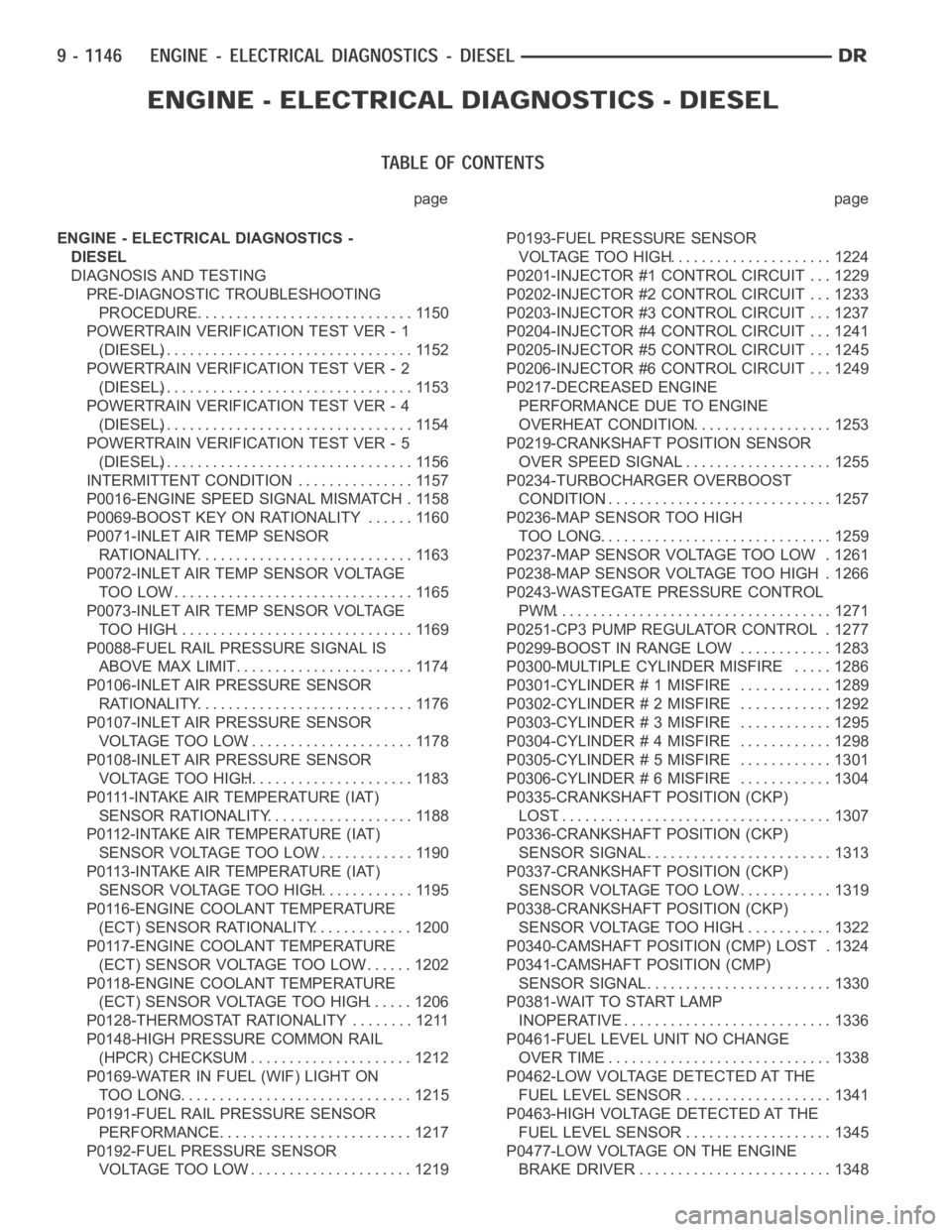
page page
ENGINE - ELECTRICAL DIAGNOSTICS -
DIESEL
DIAGNOSIS AND TESTING
PRE-DIAGNOSTIC TROUBLESHOOTING
PROCEDURE............................. 1150
POWERTRAIN VERIFICATION TEST VER - 1
(DIESEL)................................. 1152
POWERTRAIN VERIFICATION TEST VER - 2
(DIESEL)................................. 1153
POWERTRAIN VERIFICATION TEST VER - 4
(DIESEL)................................. 1154
POWERTRAIN VERIFICATION TEST VER - 5
(DIESEL)................................. 1156
INTERMITTENT CONDITION ............... 1157
P0016-ENGINE SPEED SIGNAL MISMATCH . 1158
P0069-BOOST KEY ON RATIONALITY ...... 1160
P0071-INLET AIR TEMP SENSOR
RATIONALITY............................ 1163
P0072-INLET AIR TEMP SENSOR VOLTAGE
TOO LOW................................ 1165
P0073-INLET AIR TEMP SENSOR VOLTAGE
TOO HIGH............................... 1169
P0088-FUEL RAIL PRESSURE SIGNAL IS
ABOVE MAX LIMIT........................ 1174
P0106-INLET AIR PRESSURE SENSOR
RATIONALITY............................ 1176
P0107-INLET AIR PRESSURE SENSOR
VOLTAGE TOO LOW...................... 1178
P0108-INLET AIR PRESSURE SENSOR
VOLTAGE TOO HIGH...................... 1183
P0111-INTAKE AIR TEMPERATURE (IAT)
SENSOR RATIONALITY................... 1188
P0112-INTAKE AIR TEMPERATURE (IAT)
SENSOR VOLTAGE TOO LOW............. 1190
P0113-INTAKE AIR TEMPERATURE (IAT)
SENSOR VOLTAGE TOO HIGH............. 1195
P0116-ENGINE COOLANT TEMPERATURE
(ECT) SENSOR RATIONALITY............. 1200
P0117-ENGINE COOLANT TEMPERATURE
(ECT) SENSOR VOLTAGE TOO LOW....... 1202
P0118-ENGINE COOLANT TEMPERATURE
(ECT) SENSOR VOLTAGE TOO HIGH...... 1206
P0128-THERMOSTAT RATIONALITY ........ 1211
P0148-HIGH PRESSURE COMMON RAIL
(HPCR) CHECKSUM...................... 1212
P0169-WATER IN FUEL (WIF) LIGHT ON
TOO LONG............................... 1215
P0191-FUEL RAIL PRESSURE SENSOR
PERFORMANCE.......................... 1217
P0192-FUEL PRESSURE SENSOR
VOLTAGE TOO LOW...................... 1219P0193-FUEL PRESSURE SENSOR
VOLTAGE TOO HIGH...................... 1224
P0201-INJECTOR #1 CONTROL CIRCUIT . . . 1229
P0202-INJECTOR #2 CONTROL CIRCUIT . . . 1233
P0203-INJECTOR #3 CONTROL CIRCUIT . . . 1237
P0204-INJECTOR #4 CONTROL CIRCUIT . . . 1241
P0205-INJECTOR #5 CONTROL CIRCUIT . . . 1245
P0206-INJECTOR #6 CONTROL CIRCUIT . . . 1249
P0217-DECREASED ENGINE
PERFORMANCE DUE TO ENGINE
OVERHEAT CONDITION................... 1253
P0219-CRANKSHAFT POSITION SENSOR
OVER SPEED SIGNAL.................... 1255
P0234-TURBOCHARGER OVERBOOST
CONDITION.............................. 1257
P0236-MAP SENSOR TOO HIGH
TOO LONG............................... 1259
P0237-MAP SENSOR VOLTAGE TOO LOW . 1261
P0238-MAP SENSOR VOLTAGE TOO HIGH . 1266
P0243-WASTEGATE PRESSURE CONTROL
PWM.................................... 1271
P0251-CP3 PUMP REGULATOR CONTROL . 1277
P0299-BOOST IN RANGE LOW ............ 1283
P0300-MULTIPLE CYLINDER MISFIRE ..... 1286
P0301-CYLINDER # 1 MISFIRE ............ 1289
P0302-CYLINDER # 2 MISFIRE ............ 1292
P0303-CYLINDER # 3 MISFIRE ............ 1295
P0304-CYLINDER # 4 MISFIRE ............ 1298
P0305-CYLINDER # 5 MISFIRE ............ 1301
P0306-CYLINDER # 6 MISFIRE ............ 1304
P0335-CRANKSHAFT POSITION (CKP)
LOST.................................... 1307
P0336-CRANKSHAFT POSITION (CKP)
SENSOR SIGNAL......................... 1313
P0337-CRANKSHAFT POSITION (CKP)
SENSOR VOLTAGE TOO LOW............. 1319
P0338-CRANKSHAFT POSITION (CKP)
SENSOR VOLTAGE TOO HIGH............ 1322
P0340-CAMSHAFT POSITION (CMP) LOST . 1324
P0341-CAMSHAFT POSITION (CMP)
SENSOR SIGNAL......................... 1330
P0381-WAIT TO START LAMP
INOPERATIVE............................ 1336
P0461-FUEL LEVEL UNIT NO CHANGE
OVER TIME.............................. 1338
P0462-LOW VOLTAGE DETECTED AT THE
FUEL LEVEL SENSOR.................... 1341
P0463-HIGH VOLTAGE DETECTED AT THE
FUEL LEVEL SENSOR.................... 1345
P0477-LOW VOLTAGE ON THE ENGINE
BRAKE DRIVER.......................... 1348
Page 456 of 5267
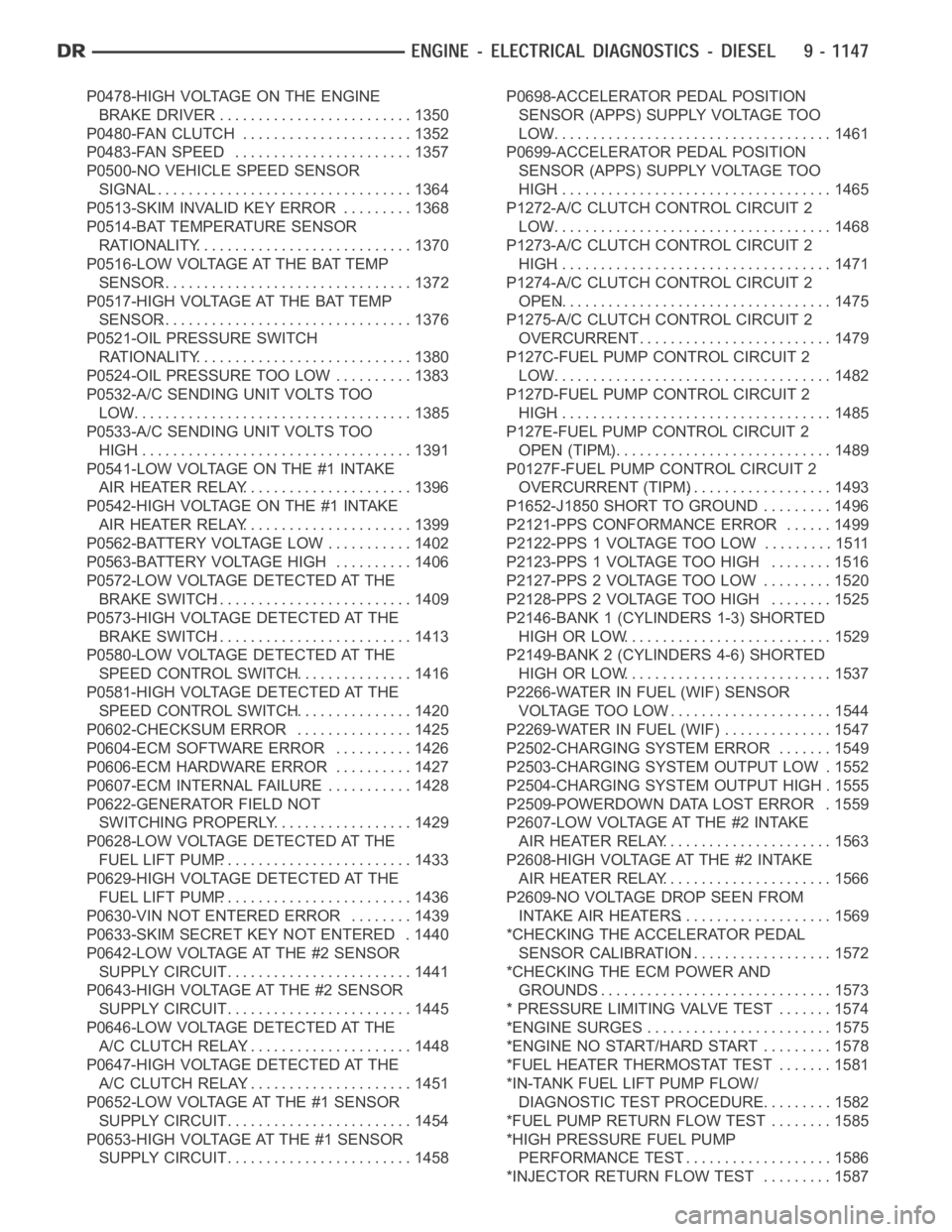
P0478-HIGH VOLTAGE ON THE ENGINE
BRAKE DRIVER.......................... 1350
P0480-FAN CLUTCH ...................... 1352
P0483-FAN SPEED ....................... 1357
P0500-NO VEHICLE SPEED SENSOR
SIGNAL.................................. 1364
P0513-SKIM INVALID KEY ERROR ......... 1368
P0514-BAT TEMPERATURE SENSOR
RATIONALITY............................ 1370
P0516-LOW VOLTAGE AT THE BAT TEMP
SENSOR................................. 1372
P0517-HIGH VOLTAGE AT THE BAT TEMP
SENSOR................................. 1376
P0521-OIL PRESSURE SWITCH
RATIONALITY............................ 1380
P0524-OIL PRESSURE TOO LOW .......... 1383
P0532-A/C SENDING UNIT VOLTS TOO
LOW..................................... 1385
P0533-A/C SENDING UNIT VOLTS TOO
HIGH.................................... 1391
P0541-LOW VOLTAGE ON THE #1 INTAKE
AIR HEATER RELAY...................... 1396
P0542-HIGH VOLTAGE ON THE #1 INTAKE
AIR HEATER RELAY...................... 1399
P0562-BATTERY VOLTAGE LOW ........... 1402
P0563-BATTERY VOLTAGE HIGH .......... 1406
P0572-LOW VOLTAGE DETECTED AT THE
BRAKE SWITCH.......................... 1409
P0573-HIGH VOLTAGE DETECTED AT THE
BRAKE SWITCH.......................... 1413
P0580-LOW VOLTAGE DETECTED AT THE
SPEED CONTROL SWITCH................ 1416
P0581-HIGH VOLTAGE DETECTED AT THE
SPEED CONTROL SWITCH................ 1420
P0602-CHECKSUM ERROR ............... 1425
P0604-ECM SOFTWARE ERROR .......... 1426
P0606-ECM HARDWARE ERROR .......... 1427
P0607-ECM INTERNAL FAILURE ........... 1428
P0622-GENERATOR FIELD NOT
SWITCHING PROPERLY.................. 1429
P0628-LOW VOLTAGE DETECTED AT THE
FUEL LIFT PUMP......................... 1433
P0629-HIGH VOLTAGE DETECTED AT THE
FUEL LIFT PUMP......................... 1436
P0630-VIN NOT ENTERED ERROR ........ 1439
P0633-SKIM SECRET KEY NOT ENTERED . 1440
P0642-LOW VOLTAGE AT THE #2 SENSOR
SUPPLY CIRCUIT......................... 1441
P0643-HIGH VOLTAGE AT THE #2 SENSOR
SUPPLY CIRCUIT......................... 1445
P0646-LOW VOLTAGE DETECTED AT THE
A/C CLUTCH RELAY...................... 1448
P0647-HIGH VOLTAGE DETECTED AT THE
A/C CLUTCH RELAY...................... 1451
P0652-LOW VOLTAGE AT THE #1 SENSOR
SUPPLY CIRCUIT......................... 1454
P0653-HIGH VOLTAGE AT THE #1 SENSOR
SUPPLY CIRCUIT......................... 1458P0698-ACCELERATOR PEDAL POSITION
SENSOR (APPS) SUPPLY VOLTAGE TOO
LOW..................................... 1461
P0699-ACCELERATOR PEDAL POSITION
SENSOR (APPS) SUPPLY VOLTAGE TOO
HIGH.................................... 1465
P1272-A/C CLUTCH CONTROL CIRCUIT 2
LOW..................................... 1468
P1273-A/C CLUTCH CONTROL CIRCUIT 2
HIGH.................................... 1471
P1274-A/C CLUTCH CONTROL CIRCUIT 2
OPEN.................................... 1475
P1275-A/C CLUTCH CONTROL CIRCUIT 2
OVERCURRENT.......................... 1479
P127C-FUEL PUMP CONTROL CIRCUIT 2
LOW..................................... 1482
P127D-FUEL PUMP CONTROL CIRCUIT 2
HIGH.................................... 1485
P127E-FUEL PUMP CONTROL CIRCUIT 2
OPEN (TIPM)............................. 1489
P0127F-FUEL PUMP CONTROL CIRCUIT 2
OVERCURRENT (TIPM)
................... 1493
P1652-J1850 SHORT TO GROUND ......... 1496
P2121-PPS CONFORMANCE ERROR ...... 1499
P2122-PPS 1 VOLTAGE TOO LOW ......... 1511
P2123-PPS 1 VOLTAGE TOO HIGH ........ 1516
P2127-PPS 2 VOLTAGE TOO LOW ......... 1520
P2128-PPS 2 VOLTAGE TOO HIGH ........ 1525
P2146-BANK 1 (CYLINDERS 1-3) SHORTED
HIGH OR LOW........................... 1529
P2149-BANK 2 (CYLINDERS 4-6) SHORTED
HIGH OR LOW........................... 1537
P2266-WATER IN FUEL (WIF) SENSOR
VOLTAGE TOO LOW...................... 1544
P2269-WATER IN FUEL (WIF) .............. 1547
P2502-CHARGING SYSTEM ERROR ....... 1549
P2503-CHARGING SYSTEM OUTPUT LOW . 1552
P2504-CHARGING SYSTEM OUTPUT HIGH . 1555
P2509-POWERDOWN DATA LOST ERROR . 1559
P2607-LOW VOLTAGE AT THE #2 INTAKE
AIR HEATER RELAY...................... 1563
P2608-HIGH VOLTAGE AT THE #2 INTAKE
AIR HEATER RELAY...................... 1566
P2609-NO VOLTAGE DROP SEEN FROM
INTAKE AIR HEATERS.................... 1569
*CHECKING THE ACCELERATOR PEDAL
SENSOR CALIBRATION................... 1572
*CHECKING THE ECM POWER AND
GROUNDS............................... 1573
* PRESSURE LIMITING VALVE TEST ....... 1574
*ENGINE SURGES ........................ 1575
*ENGINE NO START/HARD START ......... 1578
*FUEL HEATER THERMOSTAT TEST ....... 1581
*IN-TANK FUEL LIFT PUMP FLOW/
DIAGNOSTIC TEST PROCEDURE.......... 1582
*FUEL PUMP RETURN FLOW TEST ........ 1585
*HIGH PRESSURE FUEL PUMP
PERFORMANCE TEST.................... 1586
*INJECTOR RETURN FLOW TEST ......... 1587
Page 457 of 5267
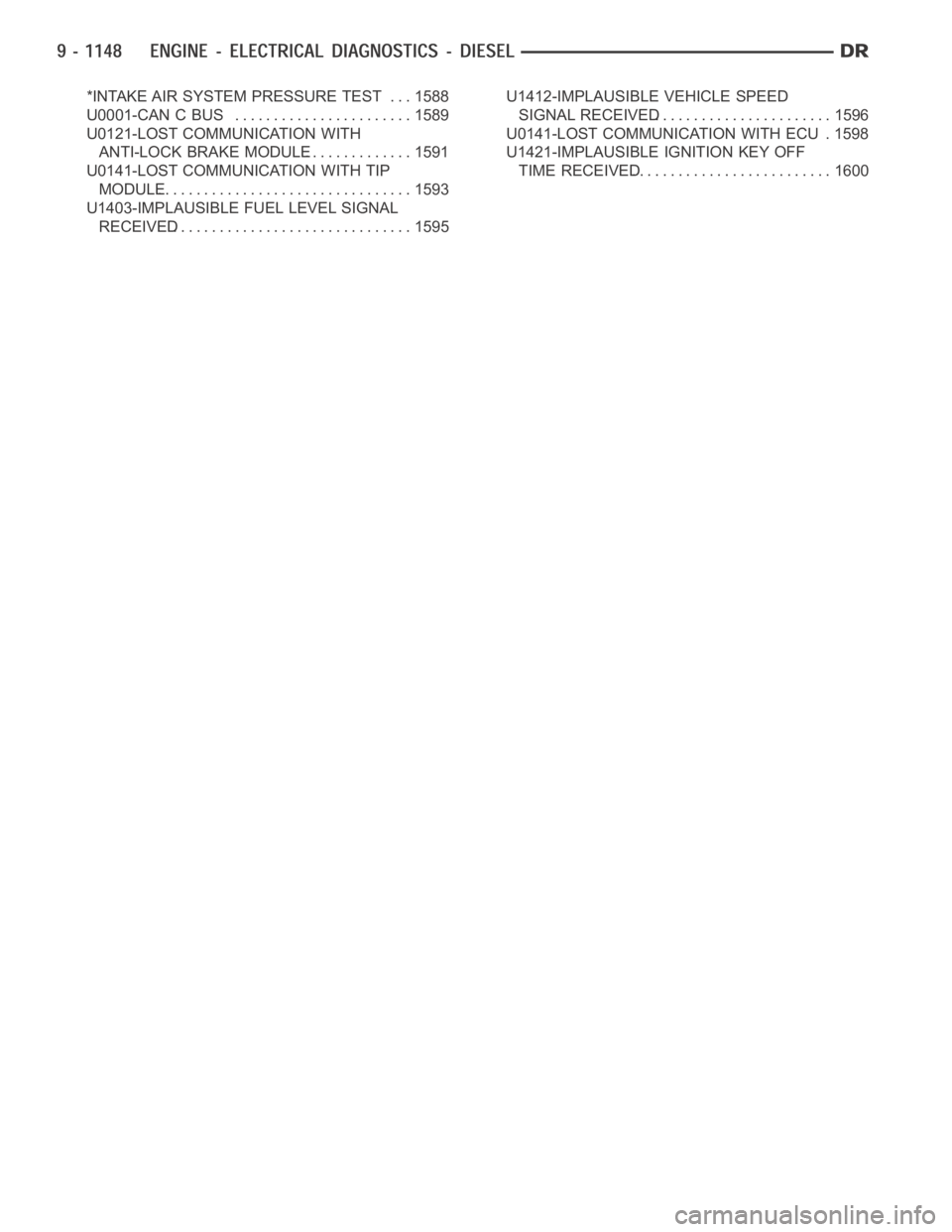
*INTAKE AIR SYSTEM PRESSURE TEST . . . 1588
U0001-CAN C BUS ....................... 1589
U0121-LOST COMMUNICATION WITH
ANTI-LOCK BRAKE MODULE.............. 1591
U0141-LOST COMMUNICATION WITH TIP
MODULE................................. 1593
U1403-IMPLAUSIBLE FUEL LEVEL SIGNAL
RECEIVED............................... 1595U1412-IMPLAUSIBLE VEHICLE SPEED
SIGNAL RECEIVED....................... 1596
U0141-LOST COMMUNICATION WITH ECU . 1598
U1421-IMPLAUSIBLE IGNITION KEY OFF
TIME RECEIVED.......................... 1600