lock DODGE RAM SRT-10 2006 Service Repair Manual
[x] Cancel search | Manufacturer: DODGE, Model Year: 2006, Model line: RAM SRT-10, Model: DODGE RAM SRT-10 2006Pages: 5267, PDF Size: 68.7 MB
Page 1880 of 5267
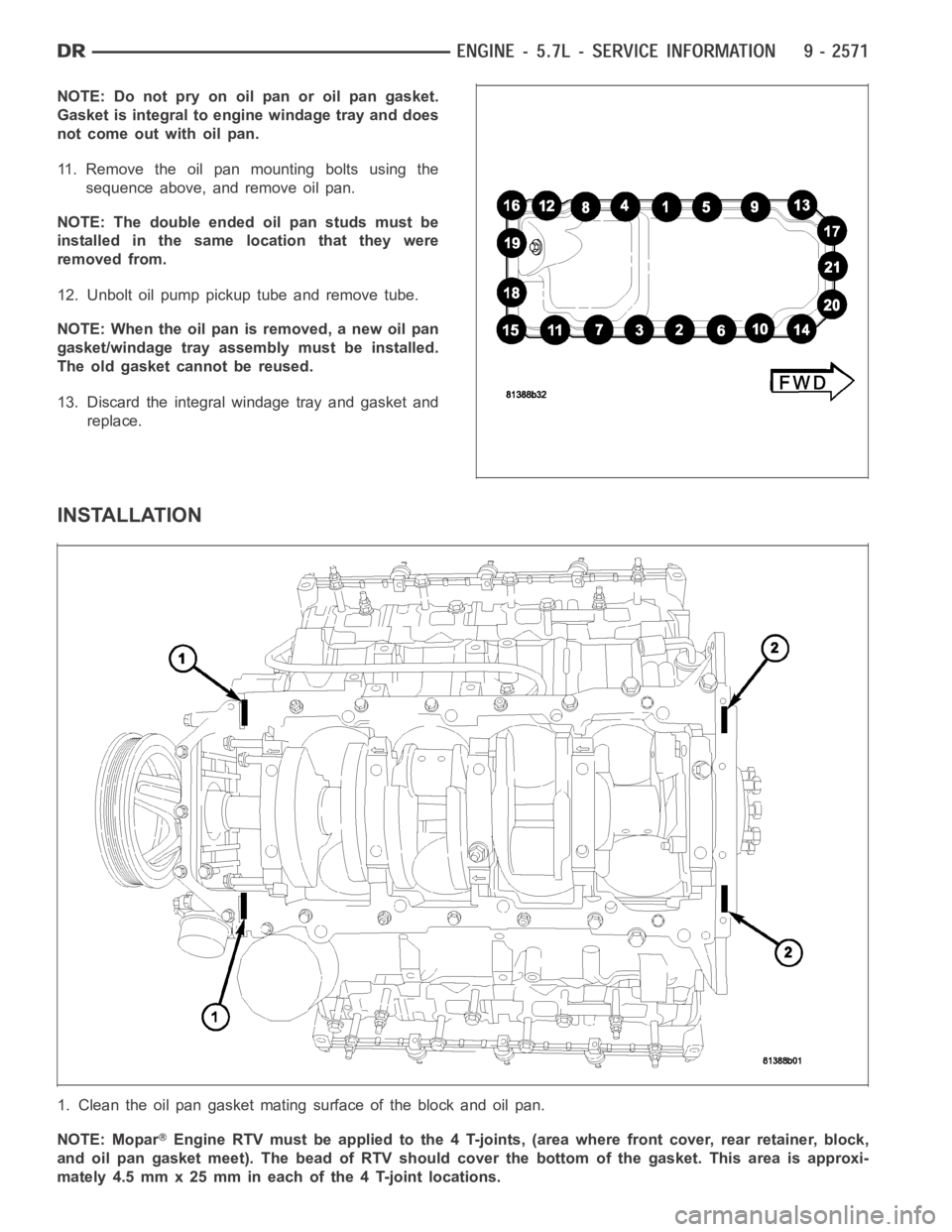
NOTE:Donotpryonoilpanoroilpangasket.
Gasket is integral to engine windage tray and does
not come out with oil pan.
11. Remove the oil pan mounting bolts using the
sequence above, and remove oil pan.
NOTE: The double ended oil pan studs must be
installed in the same location that they were
removed from.
12. Unbolt oil pump pickup tube and remove tube.
NOTE: When the oil pan is removed, a new oil pan
gasket/windage tray assembly must be installed.
The old gasket cannot be reused.
13. Discard the integral windage tray and gasket and
replace.
INSTALLATION
1. Clean the oil pan gasket mating surface of the block and oil pan.
NOTE: Mopar
Engine RTV must be applied to the 4 T-joints, (area where front cover, rear retainer, block,
and oil pan gasket meet). The bead of RTV should cover the bottom of the gasket. This area is approxi-
mately 4.5 mm x 25 mm in each of the 4 T-joint locations.
Page 1882 of 5267
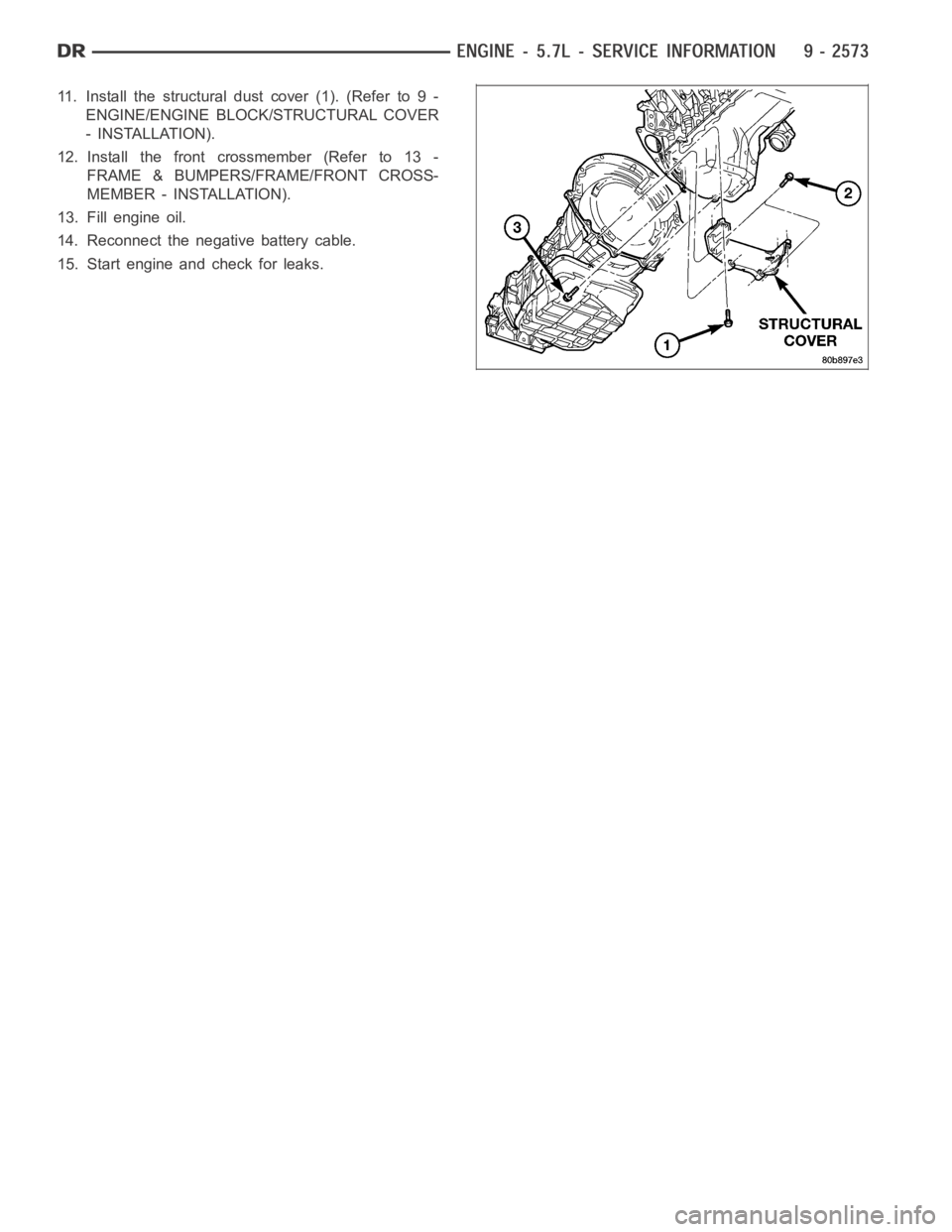
11. Install the structural dust cover (1). (Refer to 9 -
ENGINE/ENGINE BLOCK/STRUCTURAL COVER
- INSTALLATION).
12. Install the front crossmember (Refer to 13 -
FRAME & BUMPERS/FRAME/FRONT CROSS-
MEMBER - INSTALLATION).
13. Fill engine oil.
14. Reconnect the negative battery cable.
15. Start engine and check for leaks.
Page 1888 of 5267
INSPECTION
1. Inspect the intake sealing surface for cracks, nicks and distortion.
2. Inspect the intake manifold vacuum hose fittings for looseness or blockage.
3. Inspect the manifold to throttlebody mating surface for cracks, nicks and distortion.
INSTALLATION
1. Install intake manifold seals.
2. Position intake manifold and IAFM.
3. Install intake manifold retaining bolts, and tighten in sequence from the middle bolts towards the outside in a
crisscross pattern. Torque fasteners to 12 Nꞏm (105 in. lbs.).
4. Connect electrical connectors for the following components:
Manifold Absolute Pressure (MAP) Sensor
Intake Air Temperature (IAT) Sensor
Throttle Position (TPS) Sensor
Coolant Temperature (CTS) Sensor
Idle Air Control (IAC) Motor
5. Install generator.
6. Install A/C compressor.
7. Connect Brake booster hose and Positive crankcase ventilation (PCV) hose.
8. Install resonator assembly and air inlet hose.
9. Connect negative cable to battery.
Page 1892 of 5267
COVER - TIMING
REMOVAL
1. Disconnect the battery negative cable.
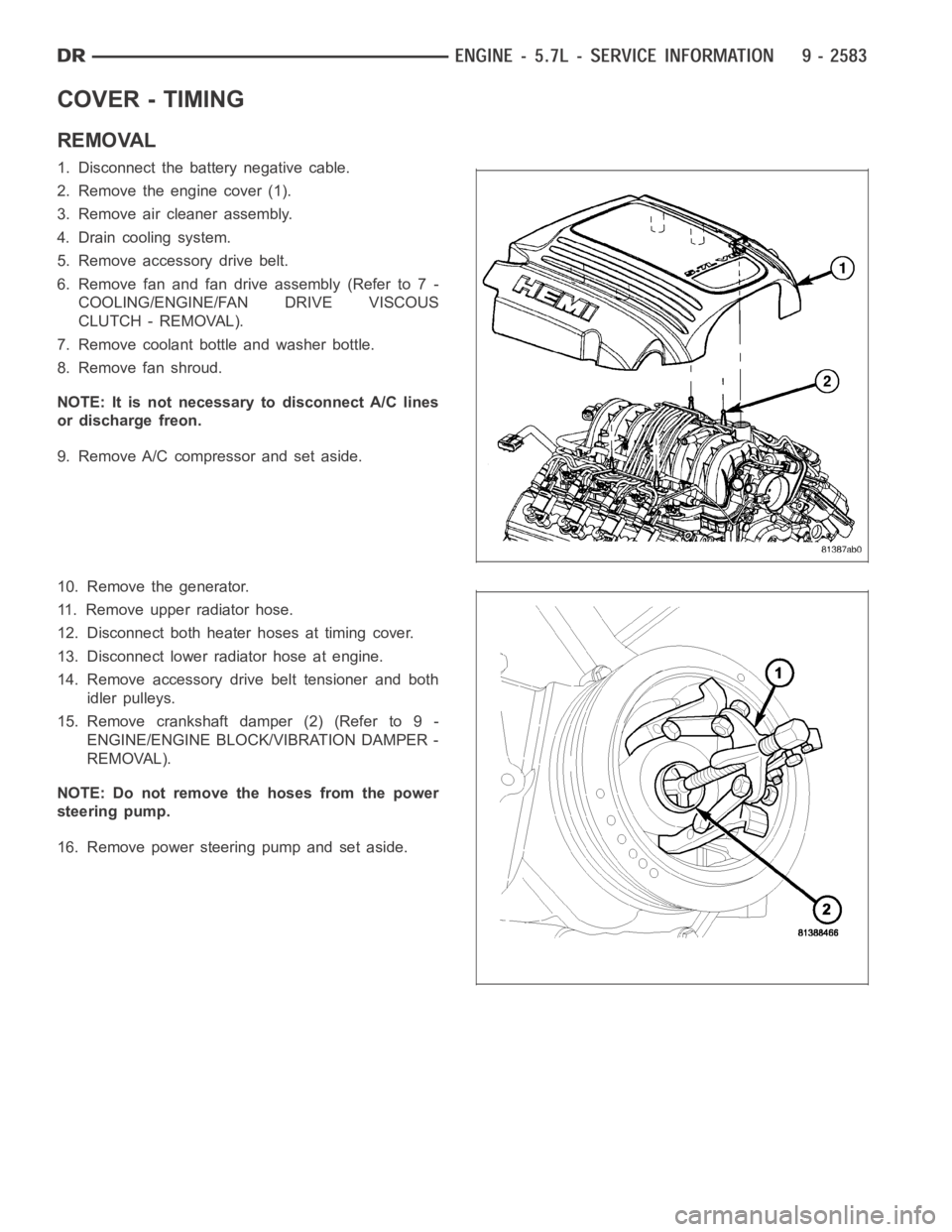
2. Remove the engine cover (1).
3. Remove air cleaner assembly.
4. Drain cooling system.
5. Remove accessory drive belt.
6. Remove fan and fan drive assembly (Refer to 7 -
COOLING/ENGINE/FAN DRIVE VISCOUS
CLUTCH - REMOVAL).
7. Remove coolant bottle and washer bottle.
8. Remove fan shroud.
NOTE: It is not necessary to disconnect A/C lines
or discharge freon.
9. Remove A/C compressor and set aside.
10. Remove the generator.
11. Remove upper radiator hose.
12. Disconnect both heater hoses at timing cover.
13. Disconnect lower radiator hose at engine.
14. Remove accessory drive belt tensioner and both
idler pulleys.
15. Remove crankshaft damper (2) (Refer to 9 -
ENGINE/ENGINE BLOCK/VIBRATION DAMPER -
REMOVAL).
NOTE: Do not remove the hoses from the power
steering pump.
16. Remove power steering pump and set aside.
Page 1894 of 5267
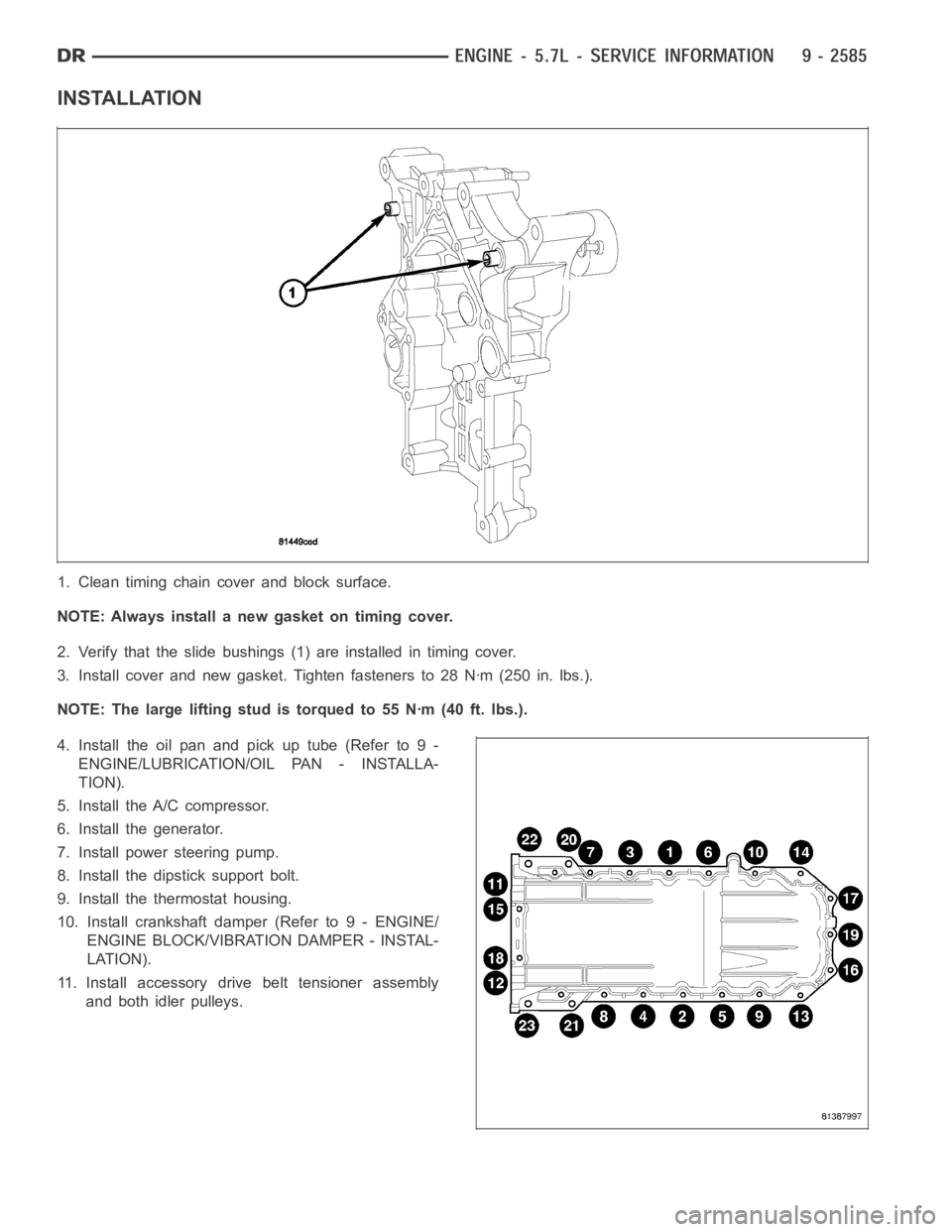
INSTALLATION
1. Clean timing chain cover and block surface.
NOTE: Always install a new gasket on timing cover.
2. Verify that the slide bushings (1) are installed in timing cover.
3. Install cover and new gasket. Tighten fasteners to 28 Nꞏm (250 in. lbs.).
NOTE: The large lifting stud is torqued to 55 Nꞏm (40 ft. lbs.).
4. Install the oil pan and pick up tube (Refer to 9 -
ENGINE/LUBRICATION/OIL PAN - INSTALLA-
TION).
5. Install the A/C compressor.
6. Install the generator.
7. Install power steering pump.
8. Install the dipstick support bolt.
9. Install the thermostat housing.
10. Install crankshaft damper (Refer to 9 - ENGINE/
ENGINE BLOCK/VIBRATION DAMPER - INSTAL-
LATION).
11. Install accessory drive belt tensioner assembly
and both idler pulleys.
Page 1896 of 5267
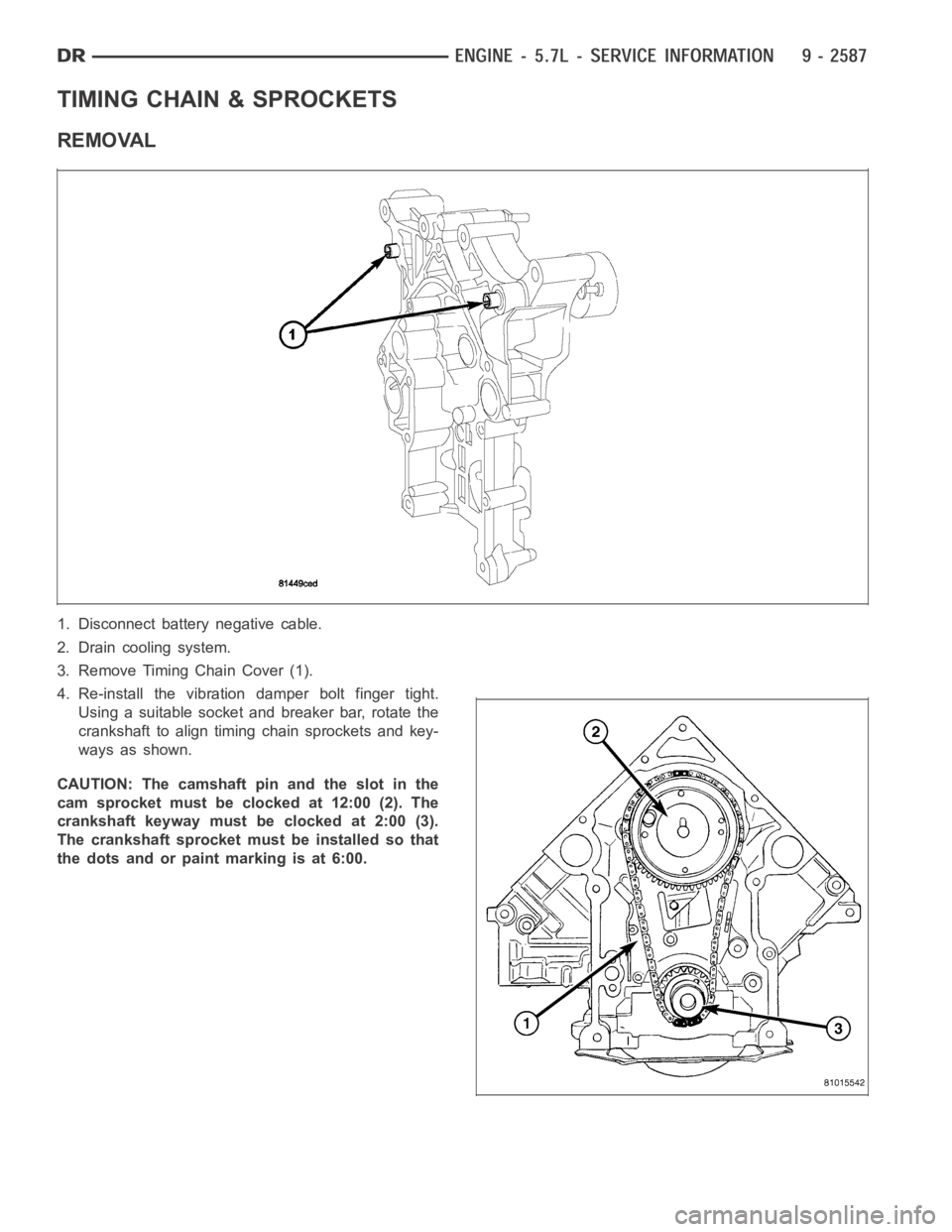
TIMING CHAIN & SPROCKETS
REMOVAL
1. Disconnect battery negative cable.
2. Drain cooling system.
3. Remove Timing Chain Cover (1).
4. Re-install the vibration damper bolt finger tight.
Using a suitable socket and breaker bar, rotate the
crankshaft to align timing chain sprockets and key-
ways as shown.
CAUTION: The camshaft pin and the slot in the
cam sprocket must be clocked at 12:00 (2). The
crankshaft keyway must be clocked at 2:00 (3).
The crankshaft sprocket must be installed so that
the dots and or paint marking is at 6:00.
Page 1898 of 5267
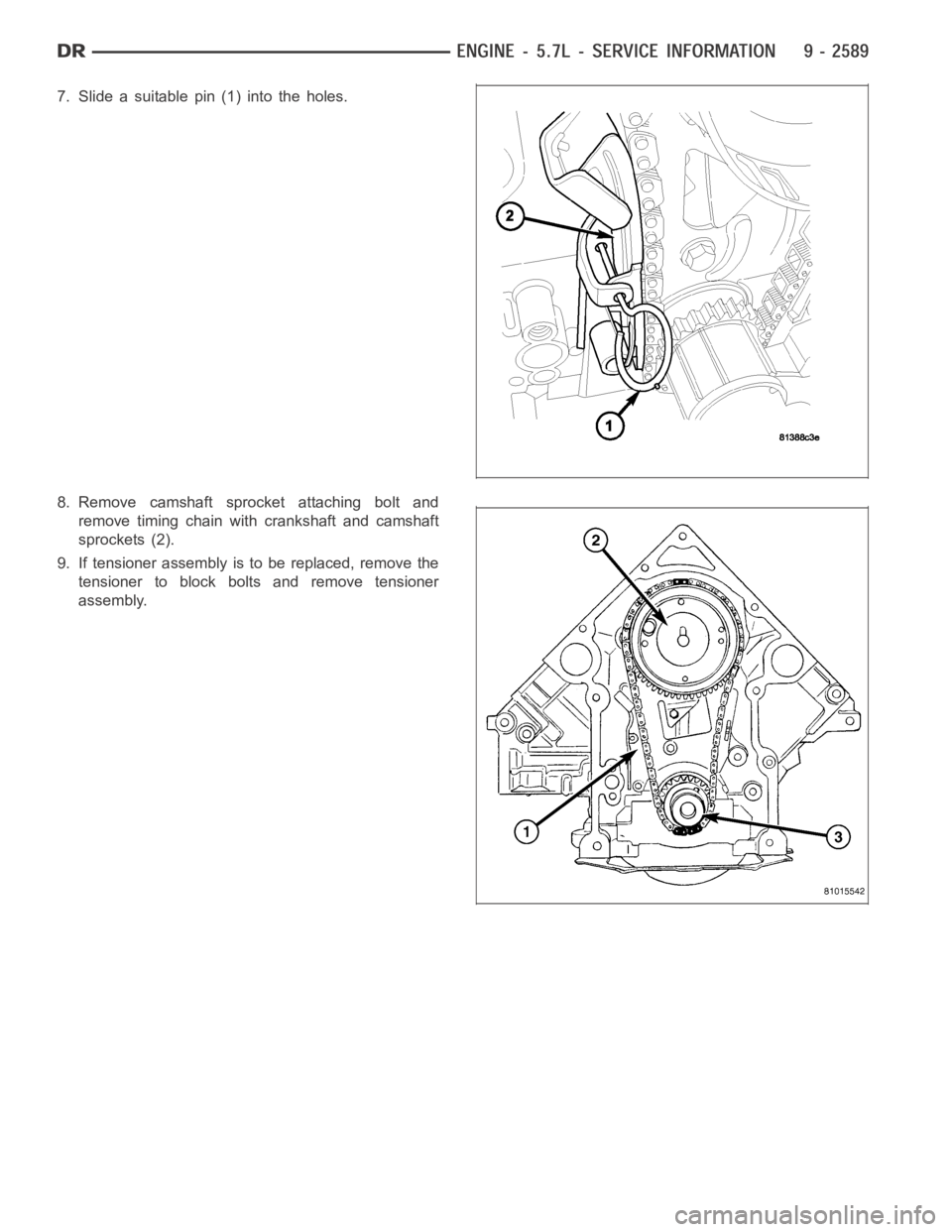
7. Slide a suitable pin (1) into the holes.
8. Remove camshaft sprocket attaching bolt and
remove timing chain with crankshaft and camshaft
sprockets (2).
9. If tensioner assembly is to be replaced, remove the
tensioner to block bolts and remove tensioner
assembly.
Page 1899 of 5267
INSTALLATION
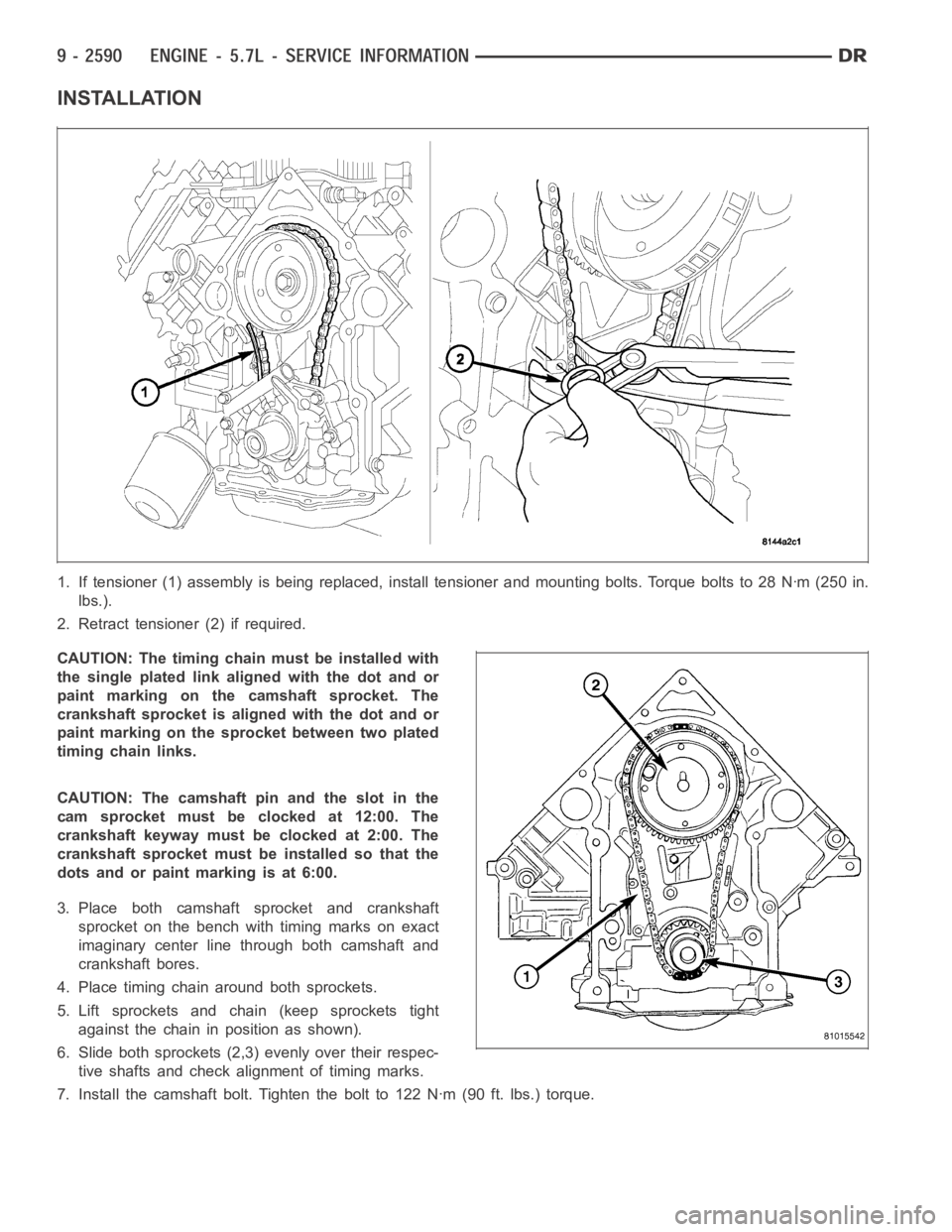
1. If tensioner (1) assembly is being replaced, install tensioner and mounting bolts. Torque bolts to 28 Nꞏm (250 in.
lbs.).
2. Retract tensioner (2) if required.
CAUTION: The timing chainmust be installed with
the single plated link aligned with the dot and or
paint marking on the camshaft sprocket. The
crankshaft sprocket is aligned with the dot and or
paint marking on the sprocket between two plated
timing chain links.
CAUTION: The camshaft pin and the slot in the
cam sprocket must be clocked at 12:00. The
crankshaft keyway must be clocked at 2:00. The
crankshaft sprocket must be installed so that the
dots and or paint marking is at 6:00.
3. Place both camshaft sprocket and crankshaft
sprocket on the bench with timing marks on exact
imaginary center line through both camshaft and
crankshaft bores.
4. Place timing chain around both sprockets.
5. Lift sprockets and chain (keep sprockets tight
against the chain in position as shown).
6. Slide both sprockets (2,3) evenly over their respec-
tive shafts and check alignment of timing marks.
7. Install the camshaft bolt. Tighten the bolt to 122 Nꞏm (90 ft. lbs.) torque.
Page 1903 of 5267
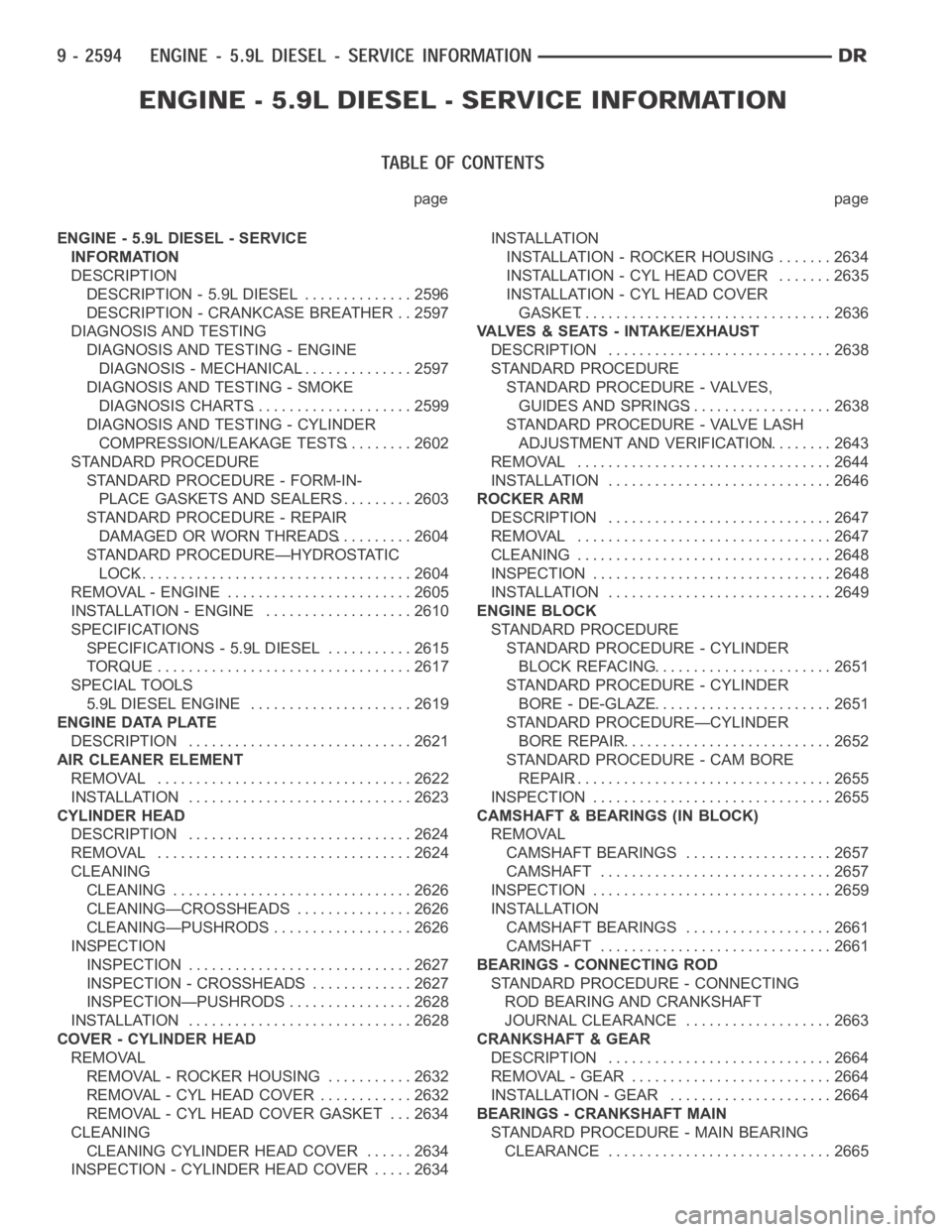
page page
ENGINE - 5.9L DIESEL - SERVICE
INFORMATION
DESCRIPTION
DESCRIPTION - 5.9L DIESEL .............. 2596
DESCRIPTION - CRANKCASE BREATHER . . 2597
DIAGNOSIS AND TESTING
DIAGNOSIS AND TESTING - ENGINE
DIAGNOSIS - MECHANICAL............... 2597
DIAGNOSIS AND TESTING - SMOKE
DIAGNOSIS CHARTS..................... 2599
DIAGNOSIS AND TESTING - CYLINDER
COMPRESSION/LEAKAGE TESTS......... 2602
STANDARD PROCEDURE
STANDARD PROCEDURE - FORM-IN-
PLACE GASKETS AND SEALERS.......... 2603
STANDARD PROCEDURE - REPAIR
DAMAGED OR WORN THREADS.......... 2604
STANDARD PROCEDURE—HYDROSTATIC
LOCK.................................... 2604
REMOVAL - ENGINE ........................ 2605
INSTALLATION - ENGINE ................... 2610
SPECIFICATIONS
SPECIFICATIONS - 5.9L DIESEL ........... 2615
TORQUE ................................. 2617
SPECIAL TOOLS
5.9L DIESEL ENGINE ..................... 2619
ENGINE DATA PLATE
DESCRIPTION ............................. 2621
AIR CLEANER ELEMENT
REMOVAL ................................. 2622
INSTALLATION ............................. 2623
CYLINDER HEAD
DESCRIPTION ............................. 2624
REMOVAL ................................. 2624
CLEANING
CLEANING ............................... 2626
CLEANING—CROSSHEADS ............... 2626
CLEANING—PUSHRODS .................. 2626
INSPECTION
INSPECTION............................. 2627
INSPECTION - CROSSHEADS . . ........... 2627
INSPECTION—PUSHRODS................ 2628
INSTALLATION ............................. 2628
COVER - CYLINDER HEAD
REMOVAL
REMOVAL - ROCKER HOUSING ........... 2632
REMOVAL - CYL HEAD COVER ............ 2632
REMOVAL - CYL HEAD COVER GASKET . . . 2634
CLEANING
CLEANING CYLINDER HEAD COVER ...... 2634
INSPECTION - CYLINDER HEAD COVER ..... 2634INSTALLATION
INSTALLATION - ROCKER HOUSING ....... 2634
INSTALLATION - CYL HEAD COVER ....... 2635
INSTALLATION - CYL HEAD COVER
GASKET................................. 2636
VALVES & SEATS - INTAKE/EXHAUST
DESCRIPTION ............................. 2638
STANDARD PROCEDURE
STANDARD PROCEDURE - VALVES,
GUIDES AND SPRINGS................... 2638
STANDARD PROCEDURE - VALVE LASH
ADJUSTMENT AND VERIFICATION......... 2643
REMOVAL ................................. 2644
INSTALLATION ............................. 2646
ROCKER ARM
DESCRIPTION ............................. 2647
REMOVAL ................................. 2647
CLEANING ................................. 2648
INSPECTION............................... 2648
INSTALLATION ............................. 2649
ENGINE BLOCK
STANDARD PROCEDURE
STANDARD PROCEDURE - CYLINDER
BLOCK REFACING........................ 2651
STANDARD PROCEDURE - CYLINDER
BORE - DE-GLAZE........................ 2651
STANDARD PROCEDURE—CYLINDER
BORE REPAIR............................ 2652
STANDARD PROCEDURE - CAM BORE
REPAIR.................................. 2655
INSPECTION............................... 2655
CAMSHAFT & BEARINGS (IN BLOCK)
REMOVAL
CAMSHAFT BEARINGS................... 2657
CAMSHAFT .............................. 2657
INSPECTION
............................... 2659
INSTALLATION
CAMSHAFT BEARINGS................... 2661
CAMSHAFT .............................. 2661
BEARINGS - CONNECTING ROD
STANDARD PROCEDURE - CONNECTING
ROD BEARING AND CRANKSHAFT
JOURNAL CLEARANCE................... 2663
CRANKSHAFT & GEAR
DESCRIPTION ............................. 2664
REMOVAL - GEAR .......................... 2664
INSTALLATION - GEAR ..................... 2664
BEARINGS - CRANKSHAFT MAIN
STANDARD PROCEDURE - MAIN BEARING
CLEARANCE ............................. 2665
Page 1905 of 5267
ENGINE - 5.9L DIESEL - SERVICE INFORMATION
DESCRIPTION
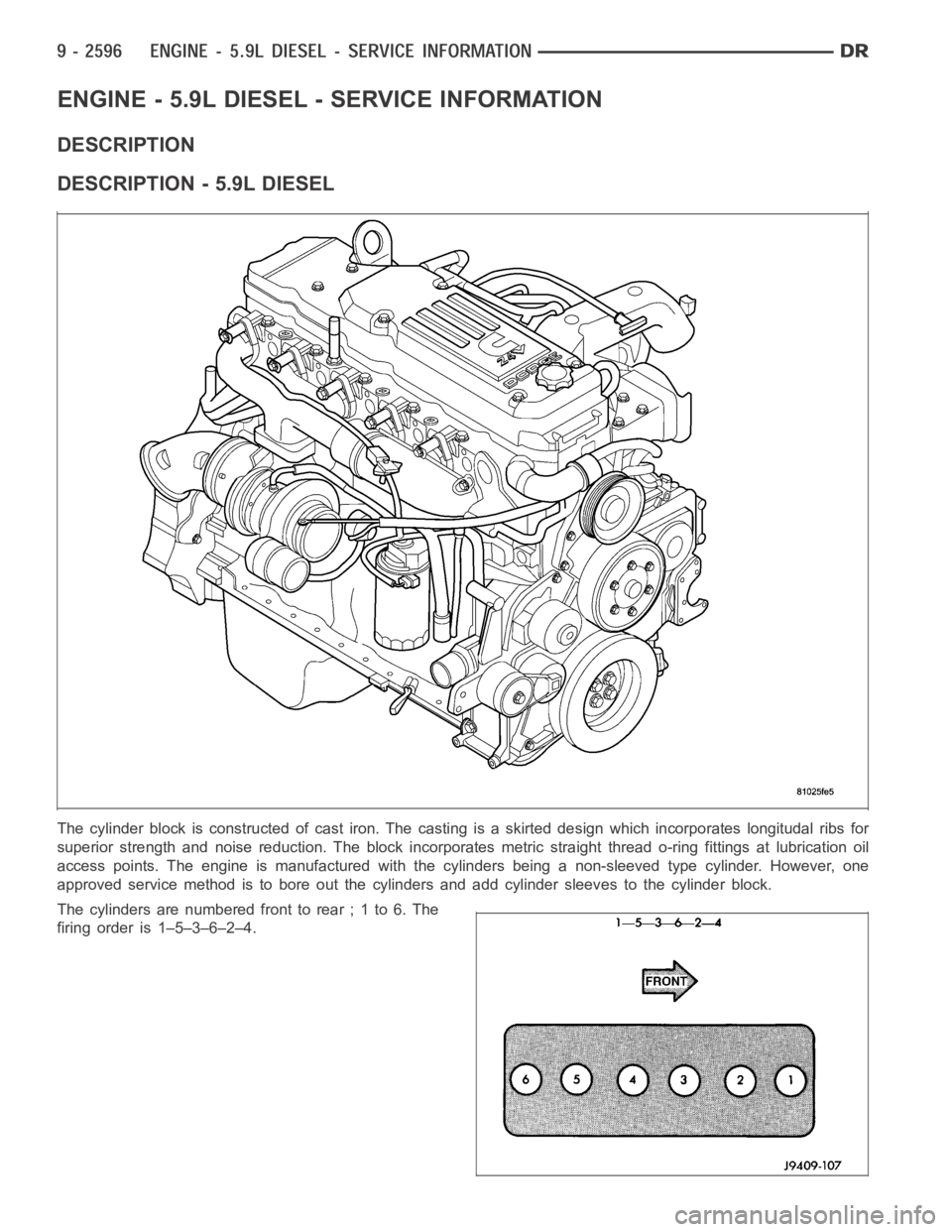
DESCRIPTION - 5.9L DIESEL
The cylinder block is constructed of cast iron. The casting is a skirted design which incorporates longitudal ribs for
superior strength and noise reduction. The block incorporates metric straight thread o-ring fittings at lubrication oil
access points. The engine is manufactured with the cylinders being a non-sleeved type cylinder. However, one
approved service method is to bore out the cylinders and add cylinder sleeves to the cylinder block.
The cylinders are numbered front to rear ; 1 to 6. The
firing order is 1–5–3–6–2–4.