air condition DODGE RAM SRT-10 2006 Service Owner's Manual
[x] Cancel search | Manufacturer: DODGE, Model Year: 2006, Model line: RAM SRT-10, Model: DODGE RAM SRT-10 2006Pages: 5267, PDF Size: 68.7 MB
Page 123 of 5267
P1521–INCORRECT ENGINE OIL TYPE
When Monitored:
Engine Running.
Set Condition:
Using the oil pressure, oil temperature and other vital engine inputs the PCM can determine the engine oil
viscosity. Incorrect viscosity will effect the operation of the MDS by delaying cylinder activation.
Possible Causes
INCORRECT ENGINE OIL TYPE
ENGINE OIL CONTAMINATION
ENGINE OIL
Always perform the Pre-Diagnostic Troubleshooting procedure before proceeding. (Refer to 9 - ENGINE -
DIAGNOSIS AND TESTING).
Diagnostic Test
1.ACTIVE DTC
NOTE: Review the customers oil change history. Make sure the customers is using the correct engine oil
viscosity. If the incorrect oil is being used, change the oil, using the correct engine oil viscosity.
Ignition on, engine off.
With the scan tool, read DTCs.
Is the DTC active at this time?
Ye s>>
Go to 2
No>>
Te s t C o m p l e t e .
2.ENGINE OIL
NOTE: If any engine oil pressure or oil temperature DTCs set along with P1521, repair them before continu-
ing with the P1521 diagnostics.
The following conditions must be checked.
OEM recommended oil viscosity is being used.
Customer is following the oil change schedule.
Check the engine oil for contamination. (i.e., fuel and/or engine coolant)
Internal engine condition that may effect oil pressure.
Were any of the above condition found?
Ye s>>
Repair as necessary.
Perform the POWERTRAIN VERIFICATION TEST. (Refer to 9 - ENGINE - STANDARD PROCEDURE)
No>>
Change the engine oil using the correct oil viscosity.
Perform the POWERTRAIN VERIFICATION TEST. (Refer to 9 - ENGINE - STANDARD PROCEDURE)
Page 146 of 5267
P1603-PCM INTERNAL DUAL-PORT RAM COMMUNICATION FAILURE
For a complete wiring diagramRefer to Section 8W.
When Monitored:
Ignition on and battery voltage greater than 10 volts.
Set Condition:
Internal PCM failure detected. One Trip Fault. Three good trips to turn offthe MIL.
Possible Causes
PCM FUSED IGNITION SWITCH CIRCUIT
PCM INTERNAL
Always perform the Pre-Diagnostic Troubleshooting procedure before proceeding. (Refer to 9 - ENGINE -
DIAGNOSIS AND TESTING).
Diagnostic Test
1.PCM IGNITION CIRCUITS
Turn the ignition off.
Disconnect the C1 PCM harness connector.
Ignition on, engine not running.
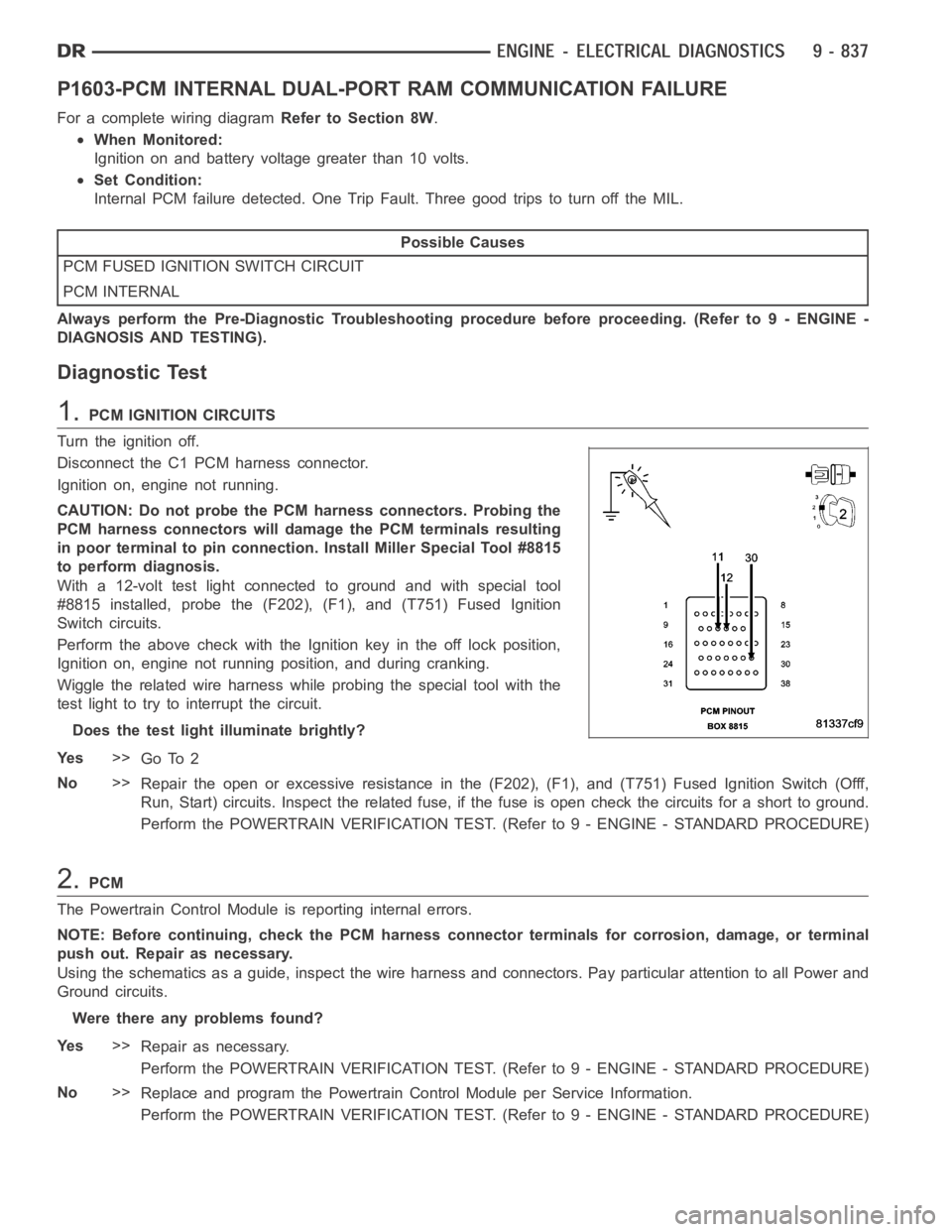
CAUTION: Do not probe the PCM harness connectors. Probing the
PCM harness connectors will damage the PCM terminals resulting
in poor terminal to pin connection. Install Miller Special Tool #8815
to perform diagnosis.
With a 12-volt test light connected to ground and with special tool
#8815 installed, probe the (F202), (F1), and (T751) Fused Ignition
Switch circuits.
Perform the above check with the Ignition key in the off lock position,
Ignition on, engine not running position, and during cranking.
Wiggle the related wire harness while probing the special tool with the
test light to try to interrupt the circuit.
Does the test light illuminate brightly?
Ye s>>
Go To 2
No>>
Repair the open or excessive resistance in the (F202), (F1), and (T751) Fused Ignition Switch (Offf,
Run, Start) circuits. Inspect the related fuse, if the fuse is open check the circuits for a short to ground.
Perform the POWERTRAIN VERIFICATION TEST. (Refer to 9 - ENGINE - STANDARD PROCEDURE)
2.PCM
The Powertrain Control Module is reporting internal errors.
NOTE: Before continuing, check the PCM harness connector terminals for corrosion, damage, or terminal
push out. Repair as necessary.
Using the schematics as a guide, inspect the wire harness and connectors. Pay particular attention to all Power and
Ground circuits.
Were there any problems found?
Ye s>>
Repair as necessary.
Perform the POWERTRAIN VERIFICATION TEST. (Refer to 9 - ENGINE - STANDARD PROCEDURE)
No>>
Replace and program the Powertrain Control Module per Service Information.
Perform the POWERTRAIN VERIFICATION TEST. (Refer to 9 - ENGINE - STANDARD PROCEDURE)
Page 147 of 5267
P1604-PCM INTERNAL DUAL-PORT RAM READ/WRITE INTEGRITY FAILURE
For a complete wiring diagramRefer to Section 8W.
When Monitored:
Ignition on and battery voltage greater than 10 volts.
Set Condition:
Internal PCM failure detected. One Trip Fault. Three good trips to turn offthe MIL.
Possible Causes
PCM FUSED IGNITION SWITCH CIRCUIT
PCM INTERNAL
Always perform the Pre-Diagnostic Troubleshooting procedure before proceeding. (Refer to 9 - ENGINE -
DIAGNOSIS AND TESTING).
Diagnostic Test
1.PCM IGNITION CIRCUITS
Turn the ignition off.
Disconnect the C1 PCM harness connector.
Ignition on, engine not running.
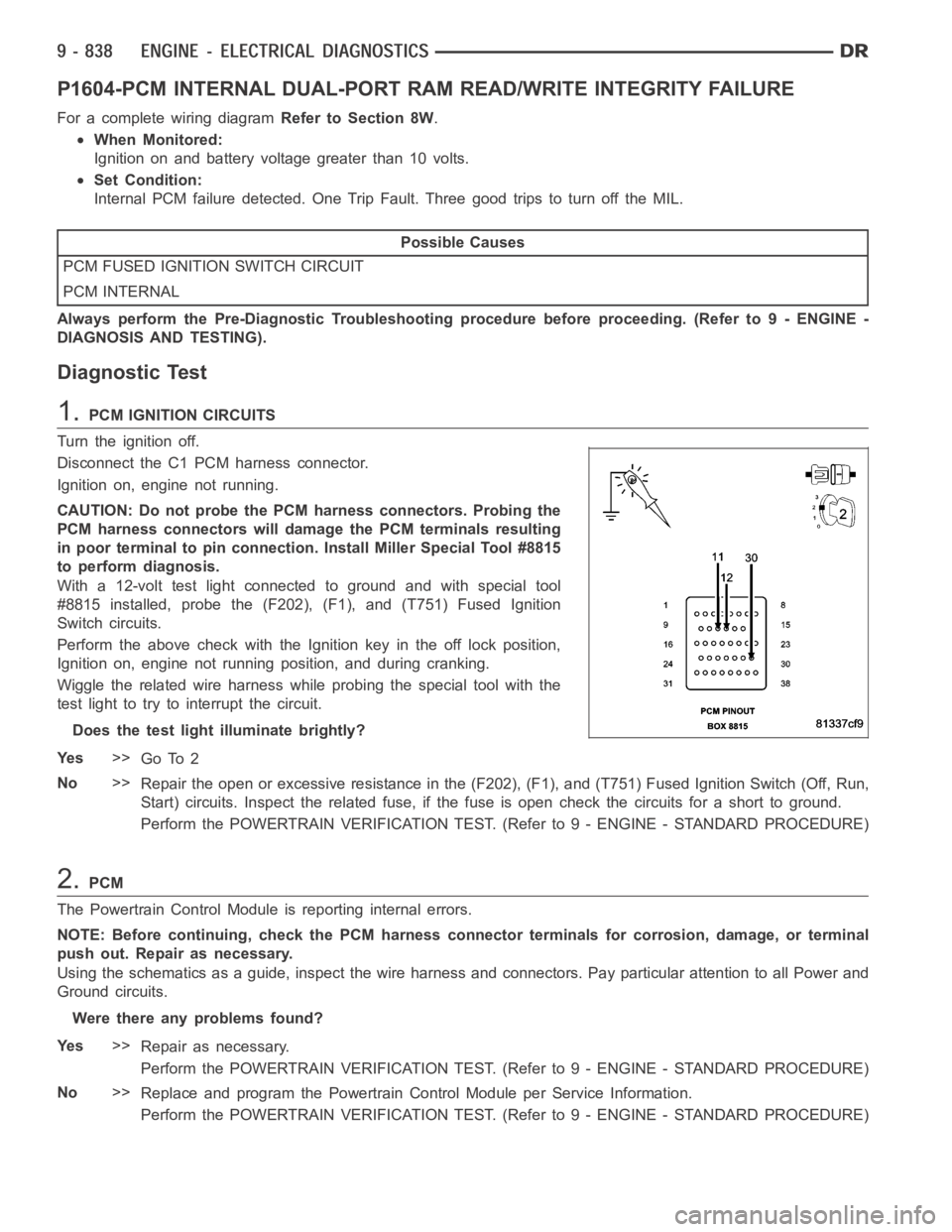
CAUTION: Do not probe the PCM harness connectors. Probing the
PCM harness connectors will damage the PCM terminals resulting
in poor terminal to pin connection. Install Miller Special Tool #8815
to perform diagnosis.
With a 12-volt test light connected to ground and with special tool
#8815 installed, probe the (F202), (F1), and (T751) Fused Ignition
Switch circuits.
Perform the above check with the Ignition key in the off lock position,
Ignition on, engine not running position, and during cranking.
Wiggle the related wire harness while probing the special tool with the
test light to try to interrupt the circuit.
Does the test light illuminate brightly?
Ye s>>
Go To 2
No>>
Repair the open or excessive resistance in the (F202), (F1), and (T751) Fused Ignition Switch (Off, Run,
Start) circuits. Inspect the related fuse, if the fuse is open check the circuits for a short to ground.
Perform the POWERTRAIN VERIFICATION TEST. (Refer to 9 - ENGINE - STANDARD PROCEDURE)
2.PCM
The Powertrain Control Module is reporting internal errors.
NOTE: Before continuing, check the PCM harness connector terminals for corrosion, damage, or terminal
push out. Repair as necessary.
Using the schematics as a guide, inspect the wire harness and connectors. Pay particular attention to all Power and
Ground circuits.
Were there any problems found?
Ye s>>
Repair as necessary.
Perform the POWERTRAIN VERIFICATION TEST. (Refer to 9 - ENGINE - STANDARD PROCEDURE)
No>>
Replace and program the Powertrain Control Module per Service Information.
Perform the POWERTRAIN VERIFICATION TEST. (Refer to 9 - ENGINE - STANDARD PROCEDURE)
Page 148 of 5267
P1607-PCM INTERNAL SHUTDOWN TIMER SLOW RATIONALITY
For a complete wiring diagramRefer to Section 8W.
When Monitored:
Ignition on and battery voltage greater than 10 volts.
Set Condition:
Internal PCM failure detected. One Trip Fault. Three good trips to turn offthe MIL.
Possible Causes
PCM FUSED IGNITION SWITCH CIRCUIT
PCM INTERNAL
Always perform the Pre-Diagnostic Troubleshooting procedure before proceeding. (Refer to 9 - ENGINE -
DIAGNOSIS AND TESTING).
Diagnostic Test
1.PCM IGNITION CIRCUITS
Turn the ignition off.
Disconnect the C1 PCM harness connector.
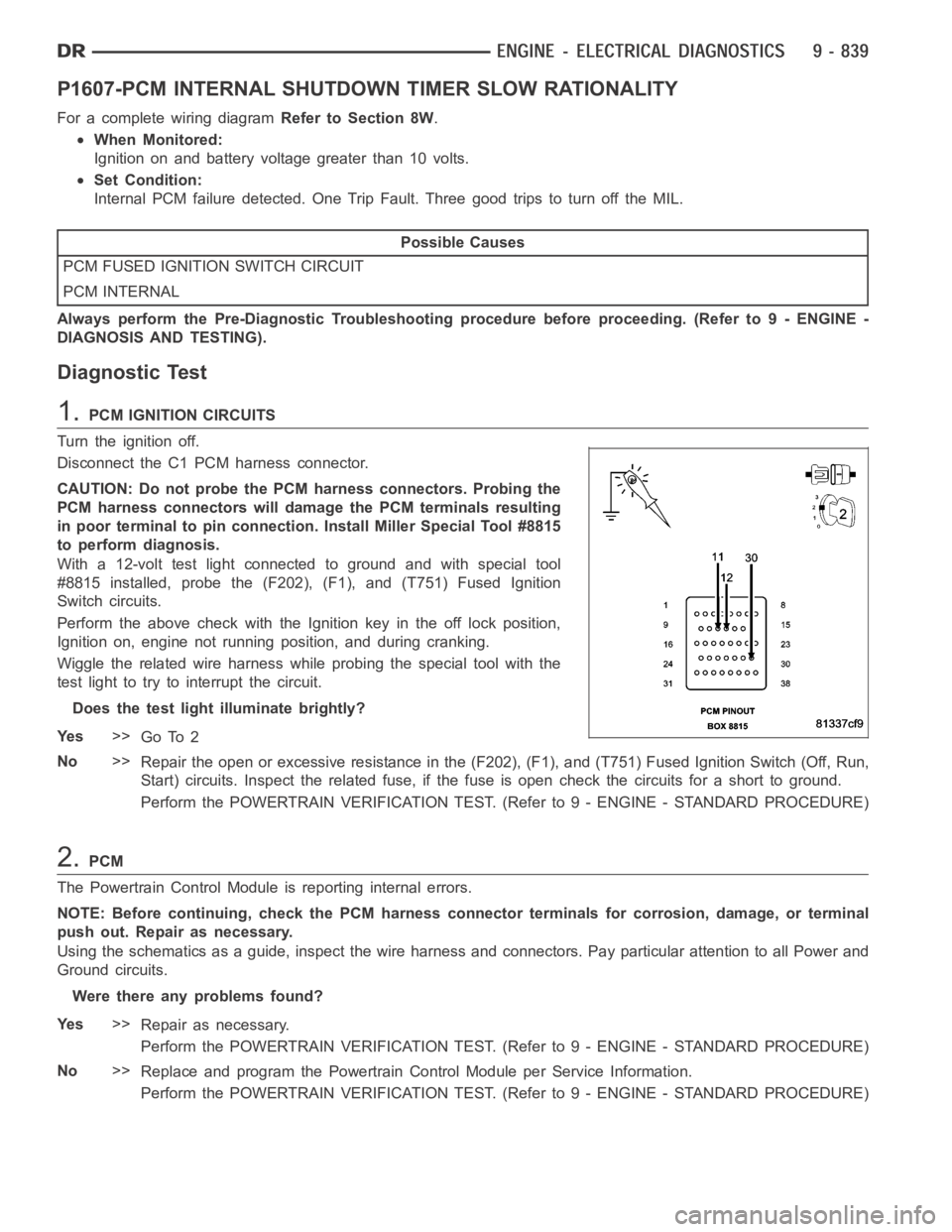
CAUTION: Do not probe the PCM harness connectors. Probing the
PCM harness connectors will damage the PCM terminals resulting
in poor terminal to pin connection. Install Miller Special Tool #8815
to perform diagnosis.
With a 12-volt test light connected to ground and with special tool
#8815 installed, probe the (F202), (F1), and (T751) Fused Ignition
Switch circuits.
Perform the above check with the Ignition key in the off lock position,
Ignition on, engine not running position, and during cranking.
Wiggle the related wire harness while probing the special tool with the
test light to try to interrupt the circuit.
Does the test light illuminate brightly?
Ye s>>
Go To 2
No>>
Repair the open or excessive resistance in the (F202), (F1), and (T751) Fused Ignition Switch (Off, Run,
Start) circuits. Inspect the related fuse, if the fuse is open check the circuits for a short to ground.
Perform the POWERTRAIN VERIFICATION TEST. (Refer to 9 - ENGINE - STANDARD PROCEDURE)
2.PCM
The Powertrain Control Module is reporting internal errors.
NOTE: Before continuing, check the PCM harness connector terminals for corrosion, damage, or terminal
push out. Repair as necessary.
Using the schematics as a guide, inspect the wire harness and connectors. Pay particular attention to all Power and
Ground circuits.
Were there any problems found?
Ye s>>
Repair as necessary.
Perform the POWERTRAIN VERIFICATION TEST. (Refer to 9 - ENGINE - STANDARD PROCEDURE)
No>>
Replace and program the Powertrain Control Module per Service Information.
Perform the POWERTRAIN VERIFICATION TEST. (Refer to 9 - ENGINE - STANDARD PROCEDURE)
Page 150 of 5267
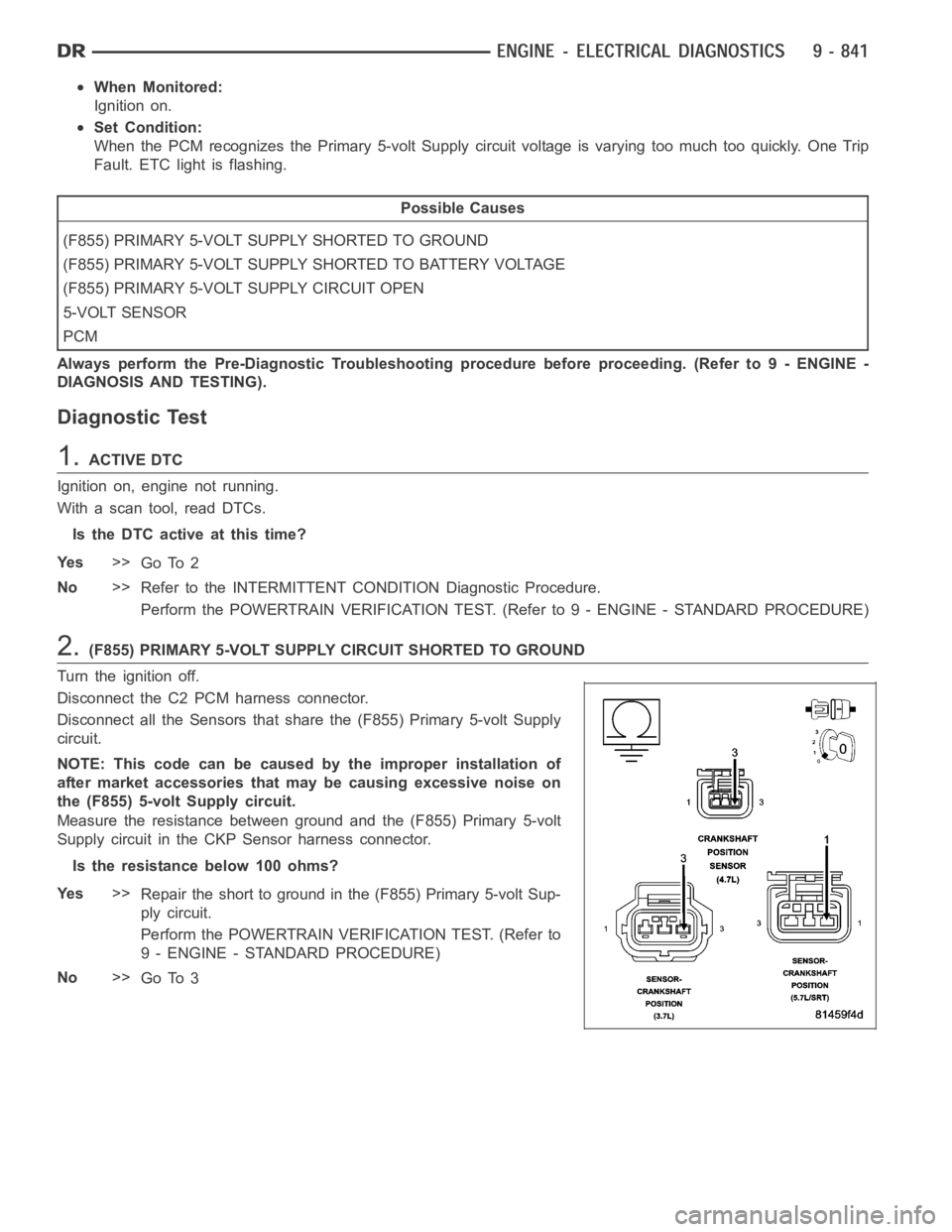
When Monitored:
Ignition on.
Set Condition:
When the PCM recognizes the Primary 5-volt Supply circuit voltage is varying too much too quickly. One Trip
Fault. ETC light is flashing.
Possible Causes
(F855) PRIMARY 5-VOLT SUPPLY SHORTED TO GROUND
(F855) PRIMARY 5-VOLT SUPPLY SHORTED TO BATTERY VOLTAGE
(F855) PRIMARY 5-VOLT SUPPLY CIRCUIT OPEN
5-VOLT SENSOR
PCM
Always perform the Pre-Diagnostic Troubleshooting procedure before proceeding. (Refer to 9 - ENGINE -
DIAGNOSIS AND TESTING).
Diagnostic Test
1.ACTIVE DTC
Ignition on, engine not running.
With a scan tool, read DTCs.
Is the DTC active at this time?
Ye s>>
Go To 2
No>>
Refer to the INTERMITTENT CONDITION Diagnostic Procedure.
Perform the POWERTRAIN VERIFICATION TEST. (Refer to 9 - ENGINE - STANDARD PROCEDURE)
2.(F855) PRIMARY 5-VOLT SUPPLY CIRCUIT SHORTED TO GROUND
Turn the ignition off.
Disconnect the C2 PCM harness connector.
Disconnect all the Sensors that share the (F855) Primary 5-volt Supply
circuit.
NOTE: This code can be caused by the improper installation of
after market accessories that may be causing excessive noise on
the (F855) 5-volt Supply circuit.
Measure the resistance between ground and the (F855) Primary 5-volt
Supply circuit in the CKP Sensor harness connector.
Istheresistancebelow100ohms?
Ye s>>
Repair the short to ground in the (F855) Primary 5-volt Sup-
ply circuit.
Perform the POWERTRAIN VERIFICATION TEST. (Refer to
9 - ENGINE - STANDARD PROCEDURE)
No>>
Go To 3
Page 155 of 5267
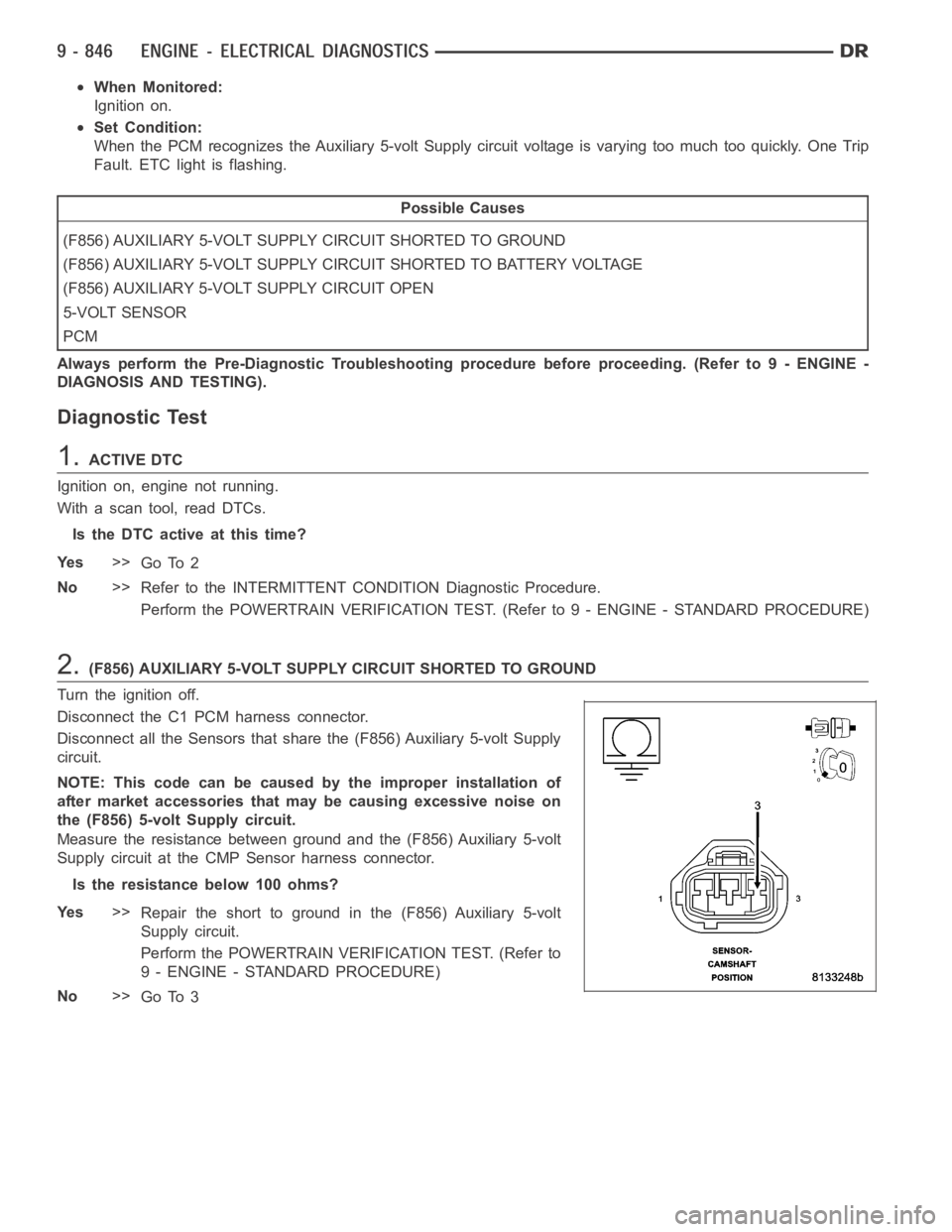
When Monitored:
Ignition on.
Set Condition:
When the PCM recognizes the Auxiliary 5-volt Supply circuit voltage is varying too much too quickly. One Trip
Fault. ETC light is flashing.
Possible Causes
(F856) AUXILIARY 5-VOLT SUPPLY CIRCUIT SHORTED TO GROUND
(F856) AUXILIARY 5-VOLT SUPPLY CIRCUIT SHORTED TO BATTERY VOLTAGE
(F856) AUXILIARY 5-VOLT SUPPLY CIRCUIT OPEN
5-VOLT SENSOR
PCM
Always perform the Pre-Diagnostic Troubleshooting procedure before proceeding. (Refer to 9 - ENGINE -
DIAGNOSIS AND TESTING).
Diagnostic Test
1.ACTIVE DTC
Ignition on, engine not running.
With a scan tool, read DTCs.
Is the DTC active at this time?
Ye s>>
Go To 2
No>>
Refer to the INTERMITTENT CONDITION Diagnostic Procedure.
Perform the POWERTRAIN VERIFICATION TEST. (Refer to 9 - ENGINE - STANDARD PROCEDURE)
2.(F856) AUXILIARY 5-VOLT SUPPLY CIRCUIT SHORTED TO GROUND
Turn the ignition off.
Disconnect the C1 PCM harness connector.
Disconnect all the Sensors that share the (F856) Auxiliary 5-volt Supply
circuit.
NOTE: This code can be caused by the improper installation of
after market accessories that may be causing excessive noise on
the (F856) 5-volt Supply circuit.
Measure the resistance between ground and the (F856) Auxiliary 5-volt
Supply circuit at the CMP Sensor harness connector.
Istheresistancebelow100ohms?
Ye s>>
Repair the short to ground in the (F856) Auxiliary 5-volt
Supply circuit.
Perform the POWERTRAIN VERIFICATION TEST. (Refer to
9 - ENGINE - STANDARD PROCEDURE)
No>>
Go To 3
Page 162 of 5267
P1897-LEVEL 1 RPM BUS UNLOCK
For a complete wiring diagramRefer to Section 8W.
When Monitored:
Engine running.
Set Condition:
When the PCM recognizes an internal failure to communicate with the FCM or the CMP and CKP Sensor
count periods are too short. One trip fault. ETC light is flashing.
Possible Causes
PCM
Always perform the Pre-Diagnostic Troubleshooting procedure before proceeding. (Refer to 9 - ENGINE -
DIAGNOSIS AND TESTING).
Diagnostic Test
1.PCM
NOTE: Diagnose any CMP or CKP Sensor faults before continuing. Check for intermittent loose CMP or CKP
connections.
The Powertrain Control Module is reporting internal errors, view repair to continue.
Repair
Replace and program the Powertrain Control Module per Service Information.
Perform the POWERTRAIN VERIFICATION TEST. (Refer to 9 - ENGINE - STANDARD PROCEDURE)
Page 163 of 5267
P2072-ELECTRONIC THROTTLE CONTROL SYSTEM - ICE BLOCKAGE
For a complete wiring diagramRefer to Section 8W.
When Monitored:
Ignition on.
Set Condition:
The PCM recognizes the Throttle plate is stuck during extremely cold Ambient Temperature operation. The
throttle plate goes through a de-icing procedure. If the throttle blade still doesn’t move this fault sets. The MIL
will not illuminate. The vehicle willbe in Limp home condition, limiting rpm and vehicle speed.
Possible Causes
THROTTLE PLATE FROZEN
Diagnostic Test
1.THROTTLE BODY INSPECTION
Ignition on, engine not running.
With a scan tool, read DTCs and record the related Freeze Frame data.
NOTE: This DTC sets in extreme cold Ambient Temperatures with the throttleplatestuckbythetimethe
vehicle gets to the dealership the condition may be corrected.
NOTE: Diagnose any other DTCs that may also be set before continuing.
Turn the ignition off.
Remove the Air Cleaner Assembly from the Throttle Body.
Check for any signs of a foreign material (ice or dirt) on the Throttle Plateor in the bore causing the Throttle Plate
to stick.
Isthethrottlebladestillstuckbecauseitisfrozen?
Ye s>>
Allow the Throttle Body to thaw naturally in a room temperature climate.
Perform the POWERTRAIN VERIFICATION TEST. (Refer to 9 - ENGINE - STANDARD PROCEDURE)
No>>
Te s t C o m p l e t e .
Page 165 of 5267
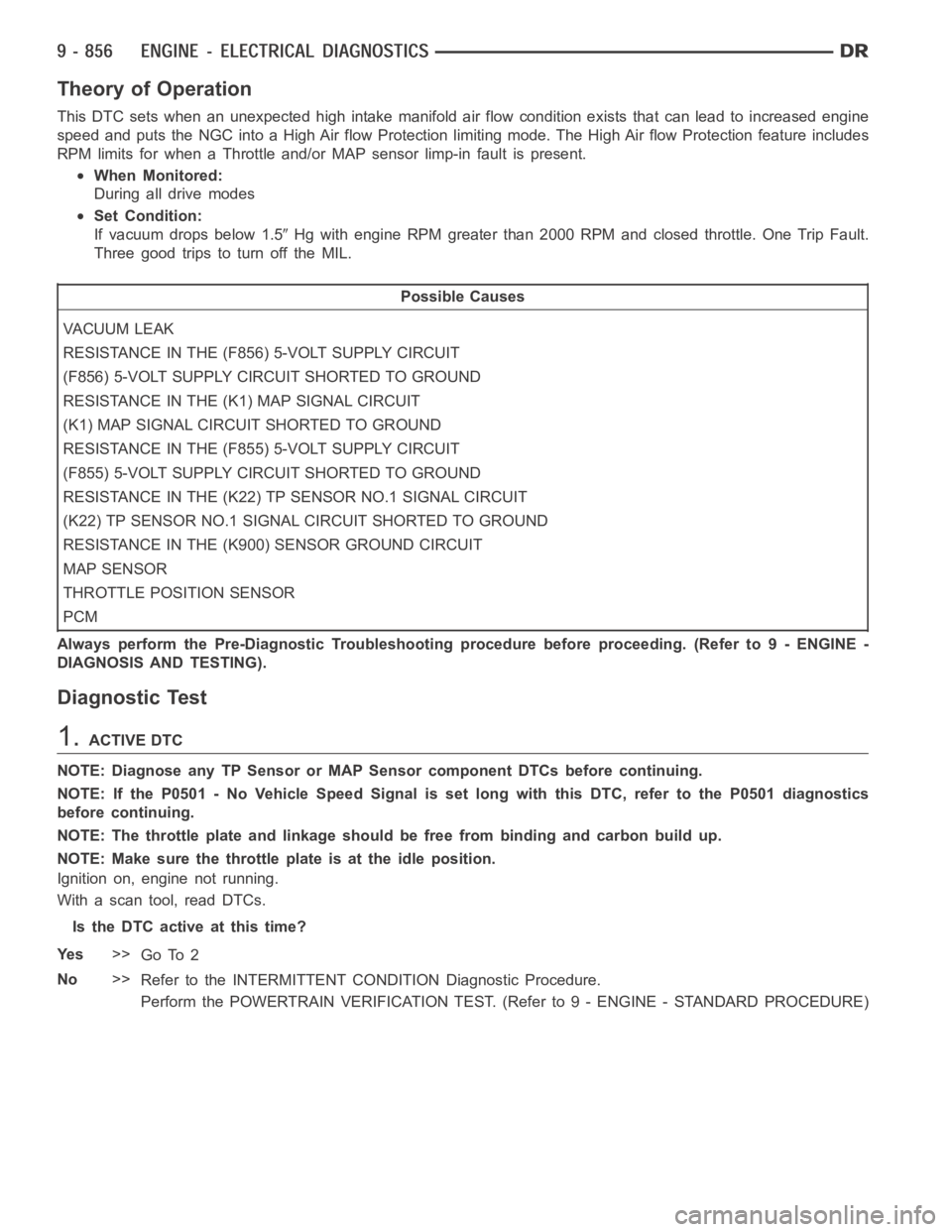
Theory of Operation
This DTC sets when an unexpected high intake manifold air flow condition exists that can lead to increased engine
speed and puts the NGC into a High Air flow Protection limiting mode. The High Air flow Protection feature includes
RPM limits for when a Throttle and/or MAP sensor limp-in fault is present.
When Monitored:
During all drive modes
Set Condition:
If vacuum drops below 1.5
Hg with engine RPM greater than 2000 RPM and closed throttle. One Trip Fault.
Three good trips to turn off the MIL.
Possible Causes
VACUUM LEAK
RESISTANCE IN THE (F856) 5-VOLT SUPPLY CIRCUIT
(F856) 5-VOLT SUPPLY CIRCUIT SHORTED TO GROUND
RESISTANCE IN THE (K1) MAP SIGNAL CIRCUIT
(K1) MAP SIGNAL CIRCUIT SHORTED TO GROUND
RESISTANCE IN THE (F855) 5-VOLT SUPPLY CIRCUIT
(F855) 5-VOLT SUPPLY CIRCUIT SHORTED TO GROUND
RESISTANCE IN THE (K22) TP SENSOR NO.1 SIGNAL CIRCUIT
(K22) TP SENSOR NO.1 SIGNAL CIRCUIT SHORTED TO GROUND
RESISTANCE IN THE (K900) SENSOR GROUND CIRCUIT
MAP SENSOR
THROTTLE POSITION SENSOR
PCM
Always perform the Pre-Diagnostic Troubleshooting procedure before proceeding. (Refer to 9 - ENGINE -
DIAGNOSIS AND TESTING).
Diagnostic Test
1.ACTIVE DTC
NOTE: Diagnose any TP Sensor or MAP Sensor component DTCs before continuing.
NOTE: If the P0501 - No Vehicle Speed Signal is set long with this DTC, refer to the P0501 diagnostics
before continuing.
NOTE: The throttle plate and linkage should be free from binding and carbonbuild up.
NOTE: Make sure the throttle plate is at the idle position.
Ignition on, engine not running.
With a scan tool, read DTCs.
Is the DTC active at this time?
Ye s>>
Go To 2
No>>
Refer to the INTERMITTENT CONDITION Diagnostic Procedure.
Perform the POWERTRAIN VERIFICATION TEST. (Refer to 9 - ENGINE - STANDARD PROCEDURE)
Page 166 of 5267
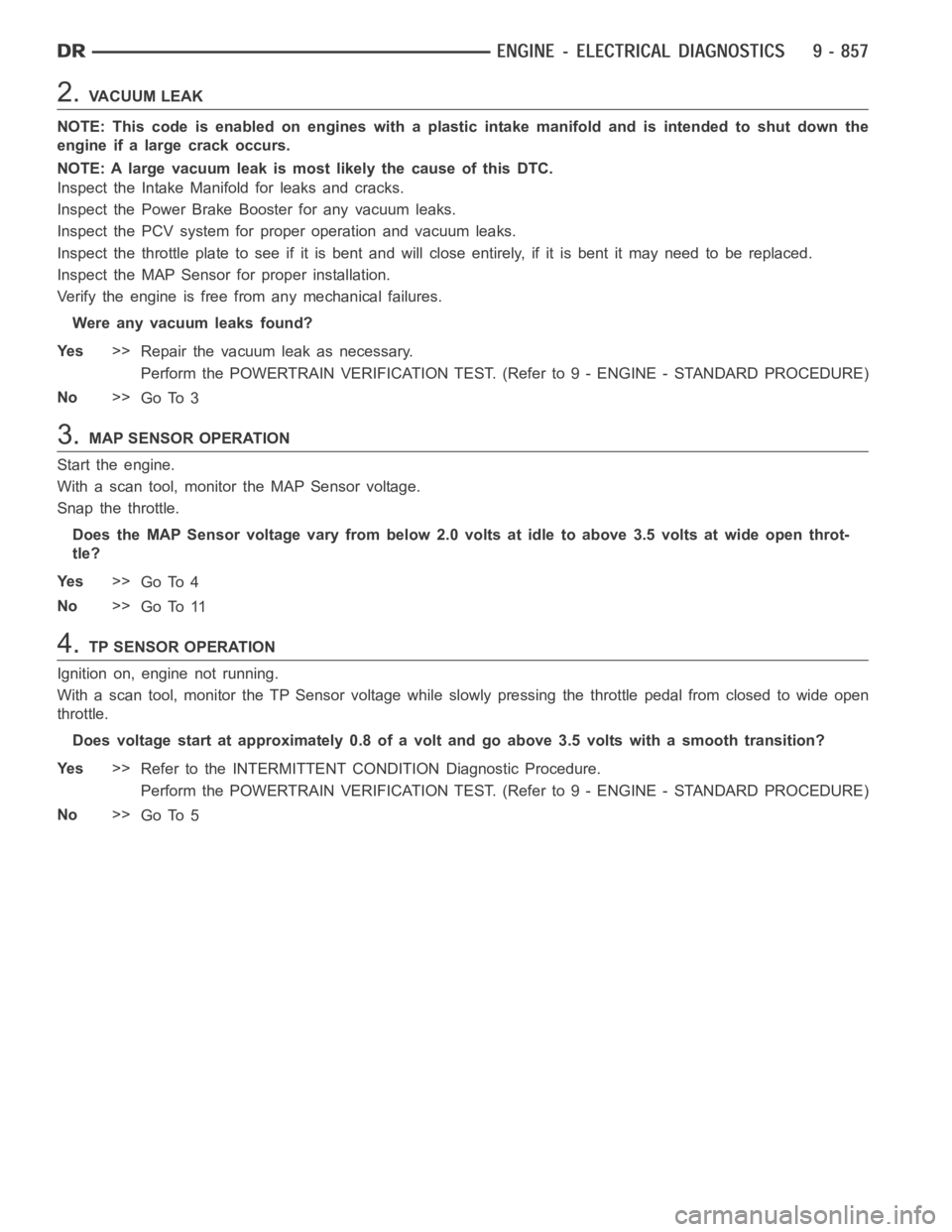
2.VACUUM LEAK
NOTE: This code is enabled on engines with a plastic intake manifold and is intended to shut down the
engine if a large crack occurs.
NOTE: A large vacuum leak is most likely the cause of this DTC.
Inspect the Intake Manifold for leaks and cracks.
Inspect the Power Brake Booster for any vacuum leaks.
Inspect the PCV system for proper operation and vacuum leaks.
Inspect the throttle plate to see if it is bent and will close entirely, if itis bent it may need to be replaced.
Inspect the MAP Sensor for proper installation.
Verify the engine is free from any mechanical failures.
Were any vacuum leaks found?
Ye s>>
Repair the vacuum leak as necessary.
Perform the POWERTRAIN VERIFICATION TEST. (Refer to 9 - ENGINE - STANDARD PROCEDURE)
No>>
Go To 3
3.MAP SENSOR OPERATION
Start the engine.
With a scan tool, monitor the MAP Sensor voltage.
Snap the throttle.
Does the MAP Sensor voltage vary from below 2.0 volts at idle to above 3.5 volts at wide open throt-
tle?
Ye s>>
Go To 4
No>>
Go To 11
4.TP SENSOR OPERATION
Ignition on, engine not running.
With a scan tool, monitor the TP Sensor voltage while slowly pressing the throttle pedal from closed to wide open
throttle.
Does voltage start at approximately 0.8 of a volt and go above 3.5 volts witha smooth transition?
Ye s>>
Refer to the INTERMITTENT CONDITION Diagnostic Procedure.
Perform the POWERTRAIN VERIFICATION TEST. (Refer to 9 - ENGINE - STANDARD PROCEDURE)
No>>
Go To 5