sensor DODGE RAM SRT-10 2006 Service Repair Manual
[x] Cancel search | Manufacturer: DODGE, Model Year: 2006, Model line: RAM SRT-10, Model: DODGE RAM SRT-10 2006Pages: 5267, PDF Size: 68.7 MB
Page 3364 of 5267
INSTALLATION .............................. 954
GEARTRAIN-PLANETARY
DESCRIPTION ............................... 955
OPERATION ................................. 956
DISASSEMBLY .............................. 957
CLEANING .................................. 957
INSPECTION ................................ 957
ASSEMBLY .................................. 958
MECHANISM-SHIFT
DESCRIPTION ............................... 959
OPERATION ................................. 959
VALVE-SOLENOID SWITCH
DESCRIPTION ............................... 960
OPERATION ................................. 960
CONVERTER-TORQUE
DESCRIPTION ............................... 961
OPERATION ................................. 964
REMOVAL ................................... 966
INSTALLATION .............................. 967
RELAY-TRANSMISSION CONTROL
DESCRIPTION ............................... 968OPERATION ................................. 968
SENSOR-TRANSMISSION RANGE
DESCRIPTION ............................... 969
OPERATION ................................. 969
ASSEMBLY-TRANSMISSION SOLENOID/TRS
DESCRIPTION ............................... 970
OPERATION ................................. 970
REMOVAL ................................... 971
INSTALLATION .............................. 972
SENSOR-TRANSMISSION TEMPERATURE
DESCRIPTION ............................... 973
OPERATION ................................. 973
BODY-VALVE
DESCRIPTION ............................... 974
OPERATION ................................. 975
REMOVAL ................................... 976
DISASSEMBLY .............................. 977
CLEANING .................................. 980
INSPECTION . . .............................. 981
ASSEMBLY .................................. 983
INSTALLATION .............................. 986
Page 3365 of 5267
AUTOMATIC TRANSMISSION - 45RFE/545RFE-SERVICEINFORMATION
DESCRIPTION
The 45RFE/545RFE automatic transmissions is a sophisticated, multi-range, electronically controlled transmission
which combines optimized gear ratios for responsive performance, state of the art efficiency features and low NVH.
Other features include driver adaptive shifting and three planetary gearsets to provide wide ratio capability with
precise ratio steps for optimum driveability. The three planetary gear sets also make available a unique alternate
second gear ratio. The primary 2nd gear ratio fits between 1st and 3rd gearsfor normal through-gear accelerations.
The alternate second gear ratio (2prime) allows smoother 4-2 kickdowns athigh speeds to provide 2nd gear pass-
ing performance over a wider highway cruising range.
The hydraulic portion of the transmission consists of the transmission fluid, fluid passages, hydraulic valves, and
various line pressure control components.
The primary mechanical components of the transmission consist of the following:
Three multiple disc input clutches
Three multiple disc holding clutches
Five hydraulic accumulators
Three planetary gear sets
Dual Stage Hydraulic oil pump
Valve body
Solenoid pack
The Transmission Control Module (TCM) is the “heart” or “brain” of the electronic control system and relies on infor-
mation from various direct and indirect inputs (sensors, switches, etc.)to determine driver demand and vehicle oper-
ating conditions. Depending on the vehicle configuration, the TCM may be astandalone module or it it may be
housed along with the Powertrain Control Module (PCM) in a single module. With this information, the TCM can
calculate and perform timely and quality shifts through various output orcontrol devices (solenoid pack, transmission
control relay, etc.).
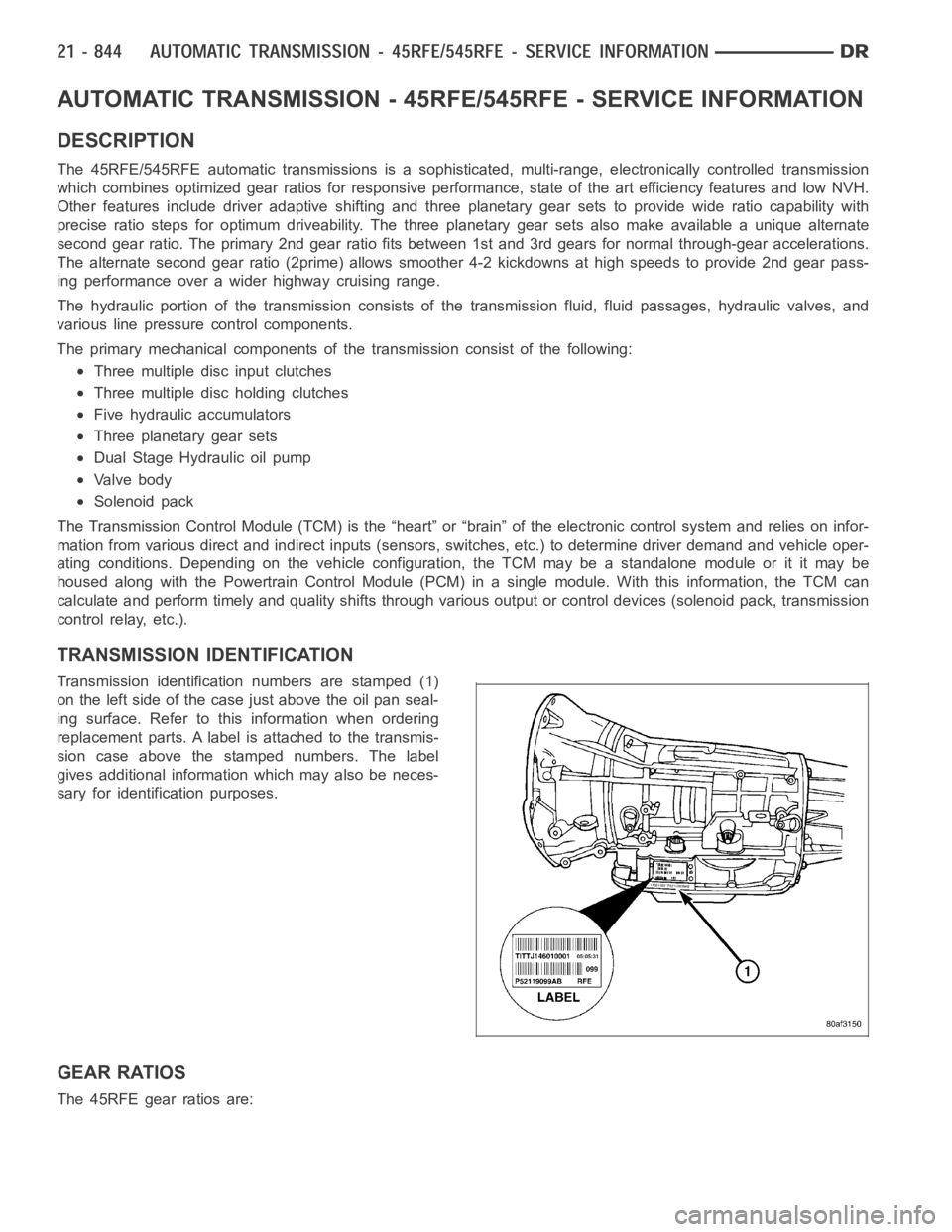
TRANSMISSION IDENTIFICATION
Transmission identification numbers are stamped (1)
on the left side of the case just above the oil pan seal-
ing surface. Refer to this information when ordering
replacement parts. A label is attached to the transmis-
sion case above the stamped numbers. The label
gives additional information which may also be neces-
sary for identification purposes.
GEAR RATIOS
The 45RFE gear ratios are:
Page 3366 of 5267
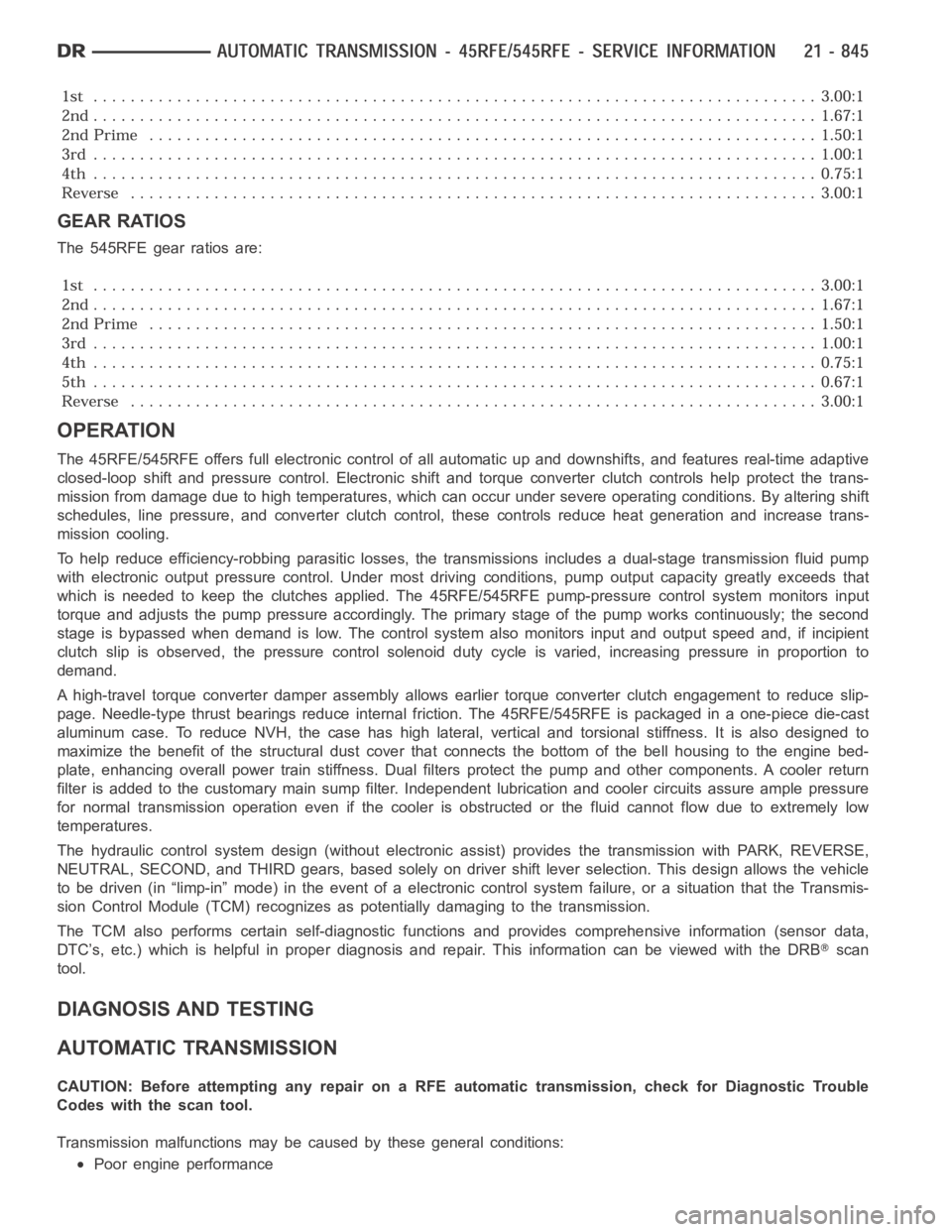
GEAR RATIOS
The 545RFE gear ratios are:
OPERATION
The 45RFE/545RFE offers full electronic control of all automatic up and downshifts, and features real-time adaptive
closed-loop shift and pressure control. Electronic shift and torque converter clutch controls help protect the trans-
mission from damage due to high temperatures, which can occur under severeoperating conditions. By altering shift
schedules, line pressure, and converter clutch control, these controls reduce heat generation and increase trans-
mission cooling.
To help reduce efficiency-robbing parasitic losses, the transmissions includes a dual-stage transmission fluid pump
with electronic output pressure control. Under most driving conditions,pump output capacity greatly exceeds that
which is needed to keep the clutches applied. The 45RFE/545RFE pump-pressure control system monitors input
torque and adjusts the pump pressure accordingly. The primary stage of thepump works continuously; the second
stage is bypassed when demand is low. The control system also monitors input and output speed and, if incipient
clutch slip is observed, the pressure control solenoid duty cycle is varied, increasing pressure in proportion to
demand.
A high-travel torque converter damper assembly allows earlier torque converter clutch engagement to reduce slip-
page. Needle-type thrust bearings reduce internal friction. The 45RFE/545RFE is packaged in a one-piece die-cast
aluminum case. To reduce NVH, the case has high lateral, vertical and torsional stiffness. It is also designed to
maximize the benefit of the structural dust cover that connects the bottomof the bell housing to the engine bed-
plate, enhancing overall power train stiffness. Dual filters protect thepump and other components. A cooler return
filter is added to the customary main sump filter. Independent lubrication and cooler circuits assure ample pressure
for normal transmission operation even if the cooler is obstructed or the fluid cannot flow due to extremely low
temperatures.
The hydraulic control system design (without electronic assist) provides the transmission with PARK, REVERSE,
NEUTRAL, SECOND, and THIRD gears, based solely on driver shift lever selection. This design allows the vehicle
to be driven (in “limp-in” mode) in the event of a electronic control systemfailure, or a situation that the Transmis-
sion Control Module (TCM) recognizes as potentially damaging to the transmission.
The TCM also performs certain self-diagnostic functions and provides comprehensive information (sensor data,
DTC’s, etc.) which is helpful in proper diagnosis and repair. This information can be viewed with the DRB
scan
tool.
DIAGNOSIS AND TESTING
AUTOMATIC TRANSMISSION
CAUTION: Before attempting any repair on a RFE automatic transmission, check for Diagnostic Trouble
Codes with the scan tool.
Transmission malfunctions may be caused by these general conditions:
Poor engine performance
Page 3369 of 5267
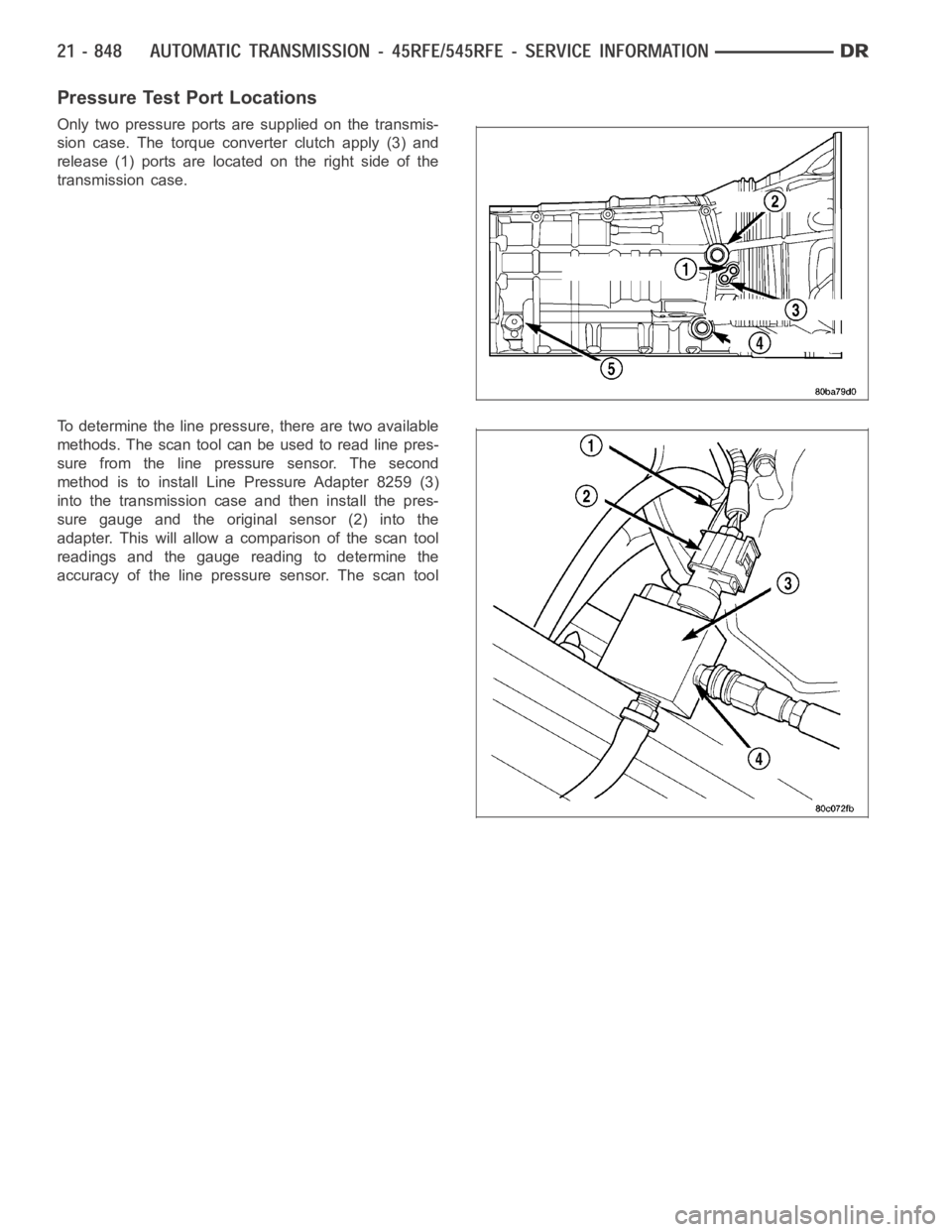
Pressure Test Port Locations
Only two pressure ports are supplied on the transmis-
sion case. The torque converter clutch apply (3) and
release(1)portsarelocatedontherightsideofthe
transmission case.
To determine the line pressure, there are two available
methods. The scan tool can be used to read line pres-
sure from the line pressure sensor. The second
method is to install Line Pressure Adapter 8259 (3)
into the transmission case and then install the pres-
sure gauge and the original sensor (2) into the
adapter. This will allow a comparison of the scan tool
readings and the gauge reading to determine the
accuracy of the line pressure sensor. The scan tool
Page 3373 of 5267
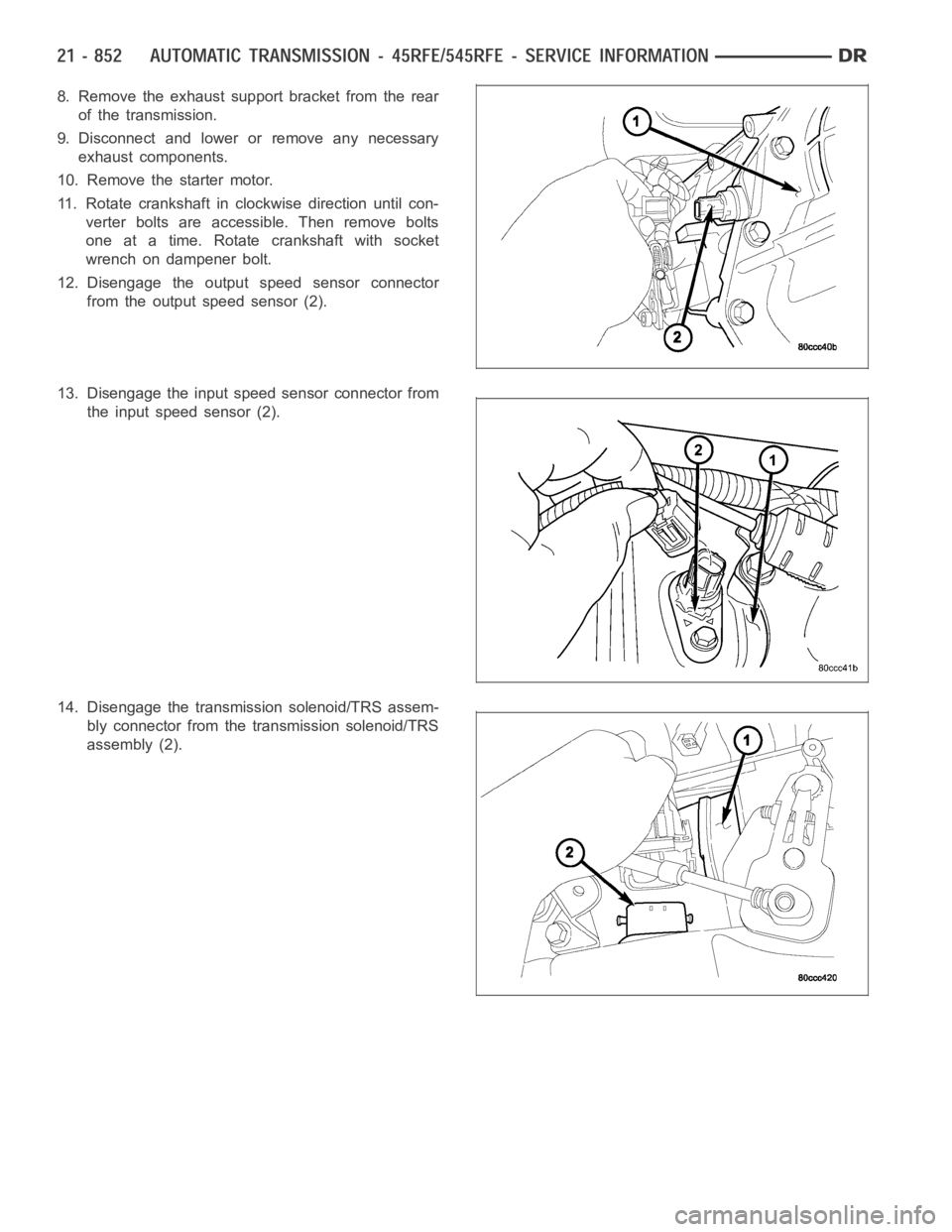
8. Remove the exhaust support bracket from the rear
of the transmission.
9. Disconnect and lower or remove any necessary
exhaust components.
10. Remove the starter motor.
11. Rotate crankshaft in clockwise direction until con-
verter bolts are accessible. Then remove bolts
one at a time. Rotate crankshaft with socket
wrench on dampener bolt.
12. Disengage the output speed sensor connector
from the output speed sensor (2).
13. Disengage the input speed sensor connector from
the input speed sensor (2).
14. Disengage the transmission solenoid/TRS assem-
bly connector from the transmission solenoid/TRS
assembly (2).
Page 3374 of 5267
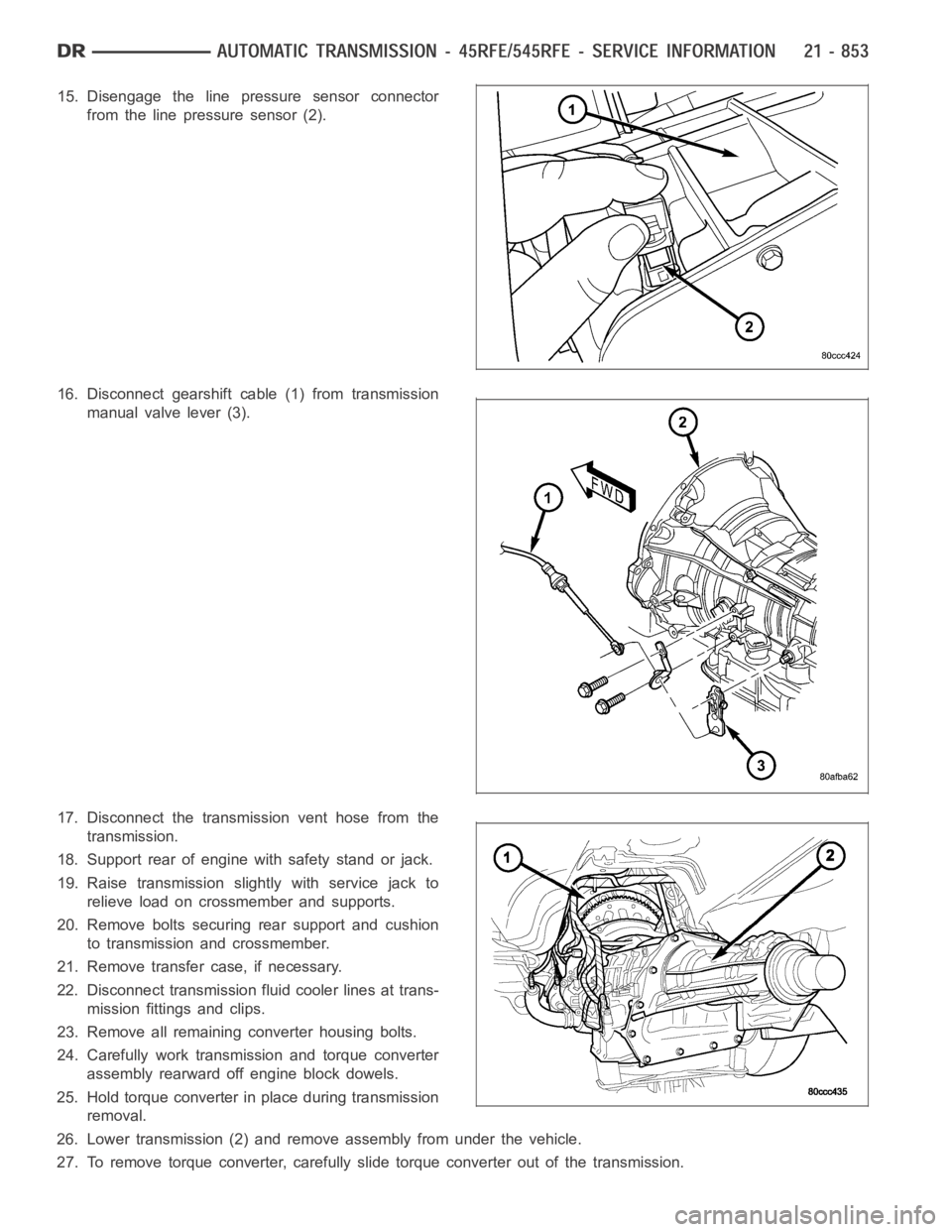
15. Disengage the line pressure sensor connector
from the line pressure sensor (2).
16. Disconnect gearshift cable (1) from transmission
manual valve lever (3).
17. Disconnect the transmission vent hose from the
transmission.
18. Support rear of engine with safety stand or jack.
19. Raise transmission slightly with service jack to
relieve load on crossmember and supports.
20. Remove bolts securing rear support and cushion
to transmission and crossmember.
21. Remove transfer case, if necessary.
22. Disconnect transmission fluid cooler lines at trans-
mission fittings and clips.
23. Remove all remaining converter housing bolts.
24. Carefully work transmission and torque converter
assembly rearward off engine block dowels.
25. Hold torque converter in place during transmission
removal.
26. Lower transmission (2) and remove assembly from under the vehicle.
27. To remove torque converter, carefully slide torque converter out of the transmission.
Page 3375 of 5267
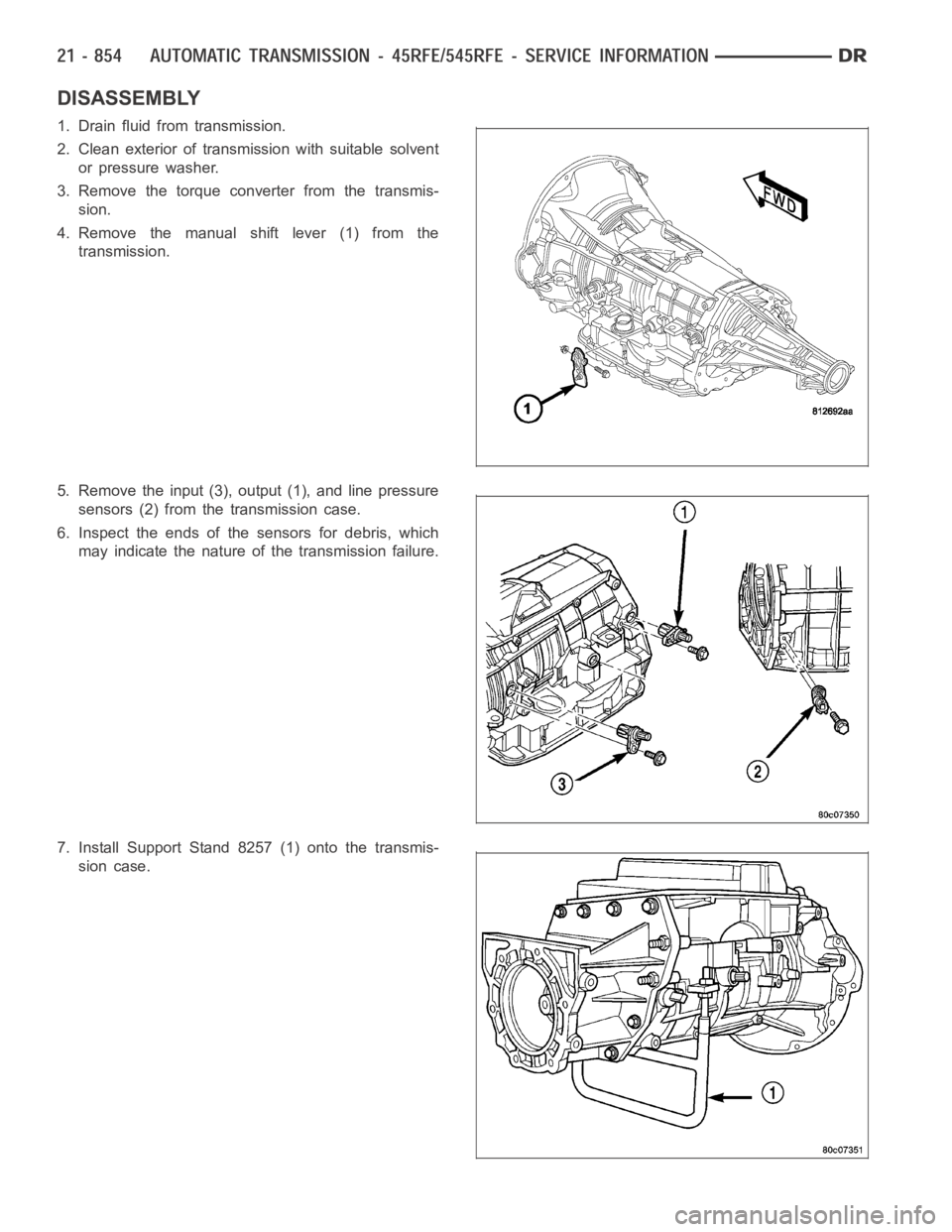
DISASSEMBLY
1. Drain fluid from transmission.
2. Clean exterior of transmission with suitable solvent
or pressure washer.
3. Remove the torque converter from the transmis-
sion.
4. Remove the manual shift lever (1) from the
transmission.
5. Remove the input (3), output (1), and line pressure
sensors (2) from the transmission case.
6. Inspect the ends of the sensors for debris, which
may indicate the nature of the transmission failure.
7. Install Support Stand 8257 (1) onto the transmis-
sion case.
Page 3389 of 5267
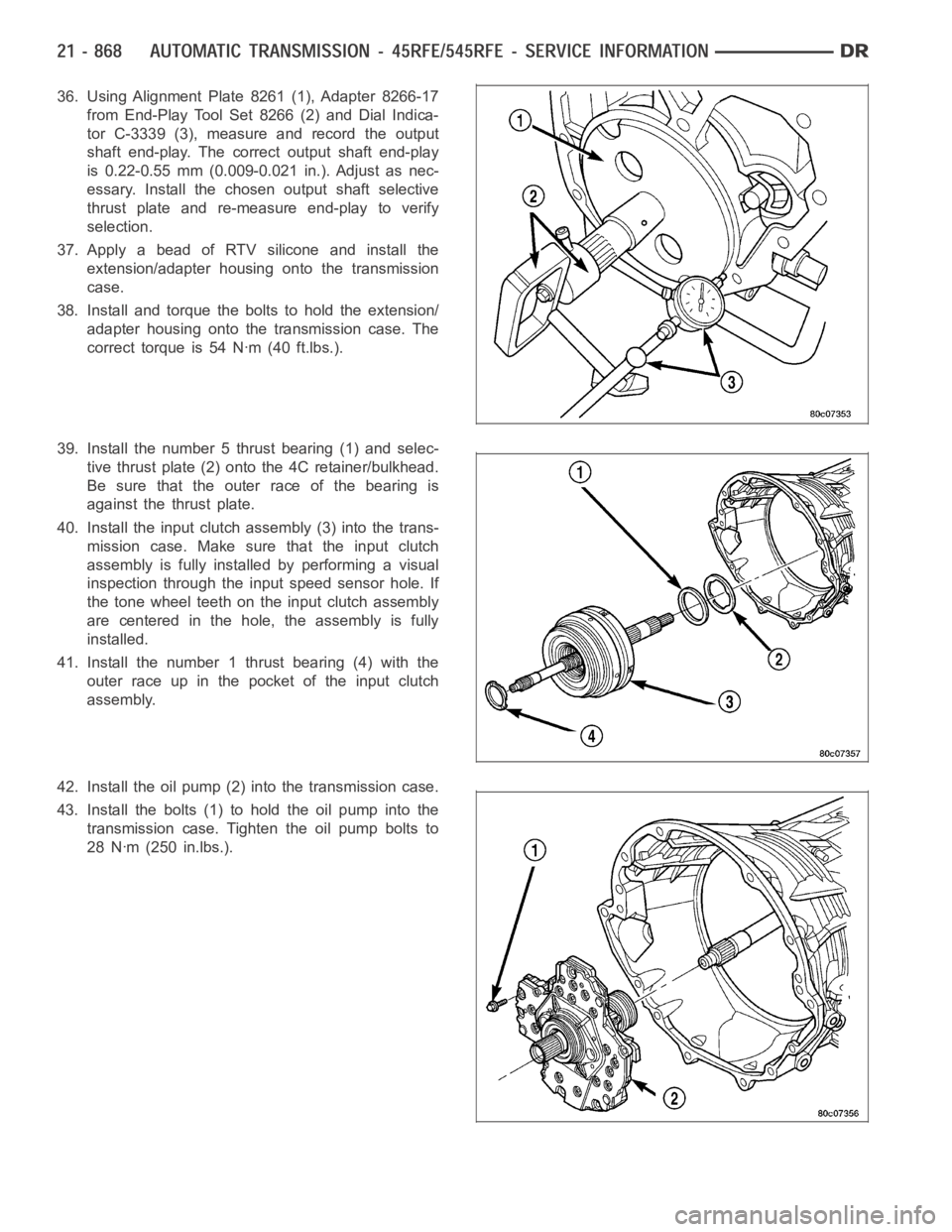
36. Using Alignment Plate 8261 (1), Adapter 8266-17
from End-Play Tool Set 8266 (2) and Dial Indica-
tor C-3339 (3), measure and record the output
shaft end-play. The correct output shaft end-play
is 0.22-0.55 mm (0.009-0.021 in.). Adjust as nec-
essary. Install the chosen output shaft selective
thrust plate and re-measure end-play to verify
selection.
37. Apply a bead of RTV silicone and install the
extension/adapter housing onto the transmission
case.
38. Install and torque the bolts to hold the extension/
adapter housing onto the transmission case. The
correct torque is 54 Nꞏm (40 ft.lbs.).
39. Install the number 5 thrust bearing (1) and selec-
tive thrust plate (2) onto the 4C retainer/bulkhead.
Be sure that the outer race of the bearing is
against the thrust plate.
40. Install the input clutch assembly (3) into the trans-
mission case. Make sure that the input clutch
assembly is fully installedbyperformingavisual
inspection through the input speed sensor hole. If
the tone wheel teeth on the input clutch assembly
are centered in the hole, the assembly is fully
installed.
41. Install the number 1 thrust bearing (4) with the
outer race up in the pocket of the input clutch
assembly.
42. Install the oil pump (2) into the transmission case.
43. Install the bolts (1) to hold the oil pump into the
transmission case. Tighten the oil pump bolts to
28 Nꞏm (250 in.lbs.).
Page 3391 of 5267
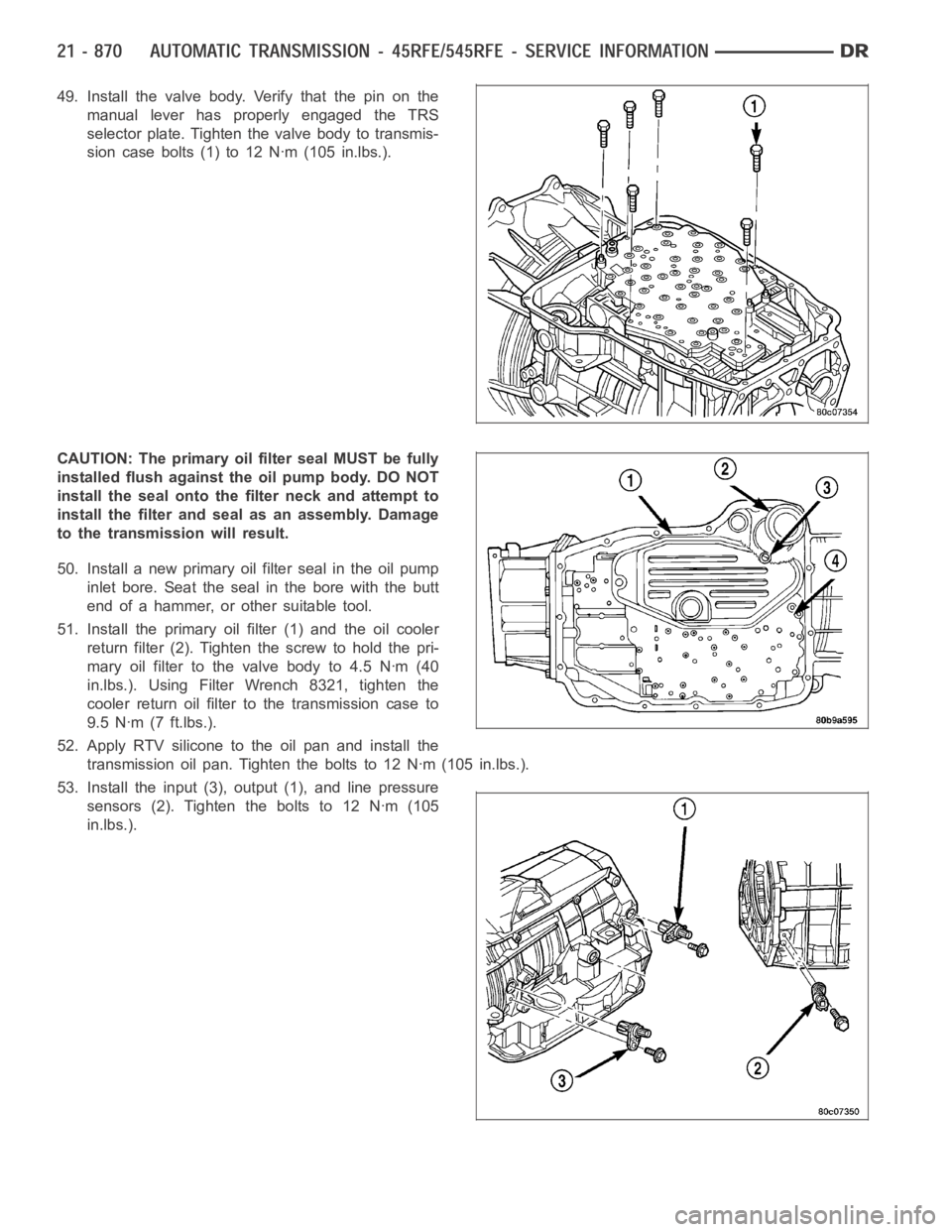
49. Install the valve body. Verify that the pin on the
manual lever has properly engaged the TRS
selector plate. Tighten the valve body to transmis-
sion case bolts (1) to 12 Nꞏm (105 in.lbs.).
CAUTION: The primary oil filter seal MUST be fully
installed flush against the oil pump body. DO NOT
install the seal onto the filter neck and attempt to
install the filter and seal as an assembly. Damage
to the transmission will result.
50. Install a new primary oil filter seal in the oil pump
inlet bore. Seat the seal in the bore with the butt
end of a hammer, or other suitable tool.
51. Install the primary oil filter (1) and the oil cooler
return filter (2). Tighten the screw to hold the pri-
mary oil filter to the valve body to 4.5 Nꞏm (40
in.lbs.). Using Filter Wrench 8321, tighten the
cooler return oil filter to the transmission case to
9.5 Nꞏm (7 ft.lbs.).
52. Apply RTV silicone to theoil pan and install the
transmission oil pan. Tighten the bolts to 12 Nꞏm (105 in.lbs.).
53. Install the input (3), output (1), and line pressure
sensors (2). Tighten the bolts to 12 Nꞏm (105
in.lbs.).
Page 3393 of 5267
18. Lower transmission onto crossmember and install bolts attaching transmission mount to crossmember. Tighten
clevis bracket to crossmember bolts to 47 Nꞏm (35 ft.lbs.). Tighten the clevis bracket to rear support bolt to 68
Nꞏm (50 ft.lbs.).
19. Remove engine support fixture.
20. Connect gearshift cable to transmission.
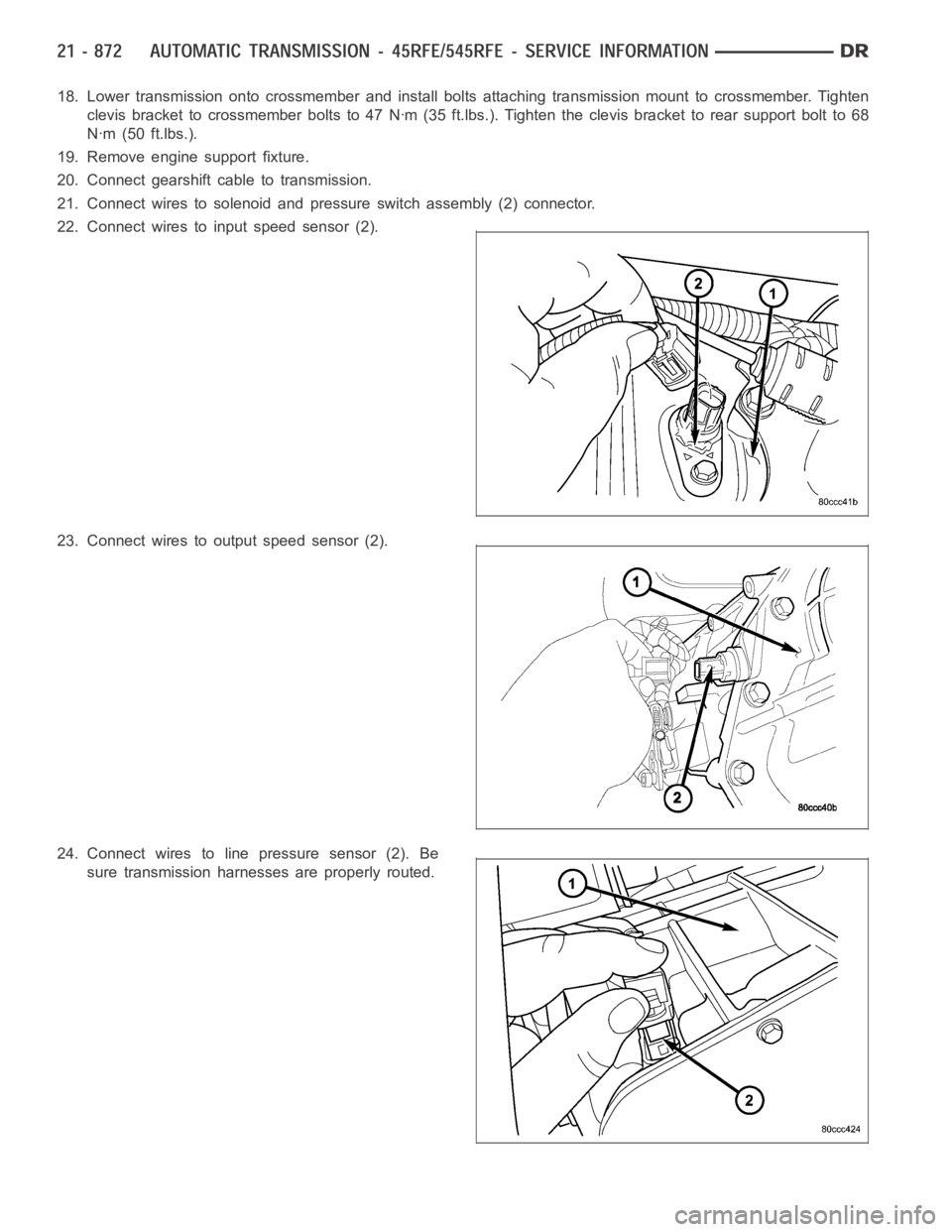
21. Connect wires to solenoid and pressure switch assembly (2) connector.
22. Connect wires to input speed sensor (2).
23. Connect wires to output speed sensor (2).
24. Connect wires to line pressure sensor (2). Be
sure transmission harnesses are properly routed.