brake DODGE SPRINTER 2005 1.G User Guide
[x] Cancel search | Manufacturer: DODGE, Model Year: 2005, Model line: SPRINTER, Model: DODGE SPRINTER 2005 1.GPages: 288, PDF Size: 27.89 MB
Page 141 of 288
STARTING AND OPERATING 141
5
POWER ASSISTANCE STARTING THE ENGINE
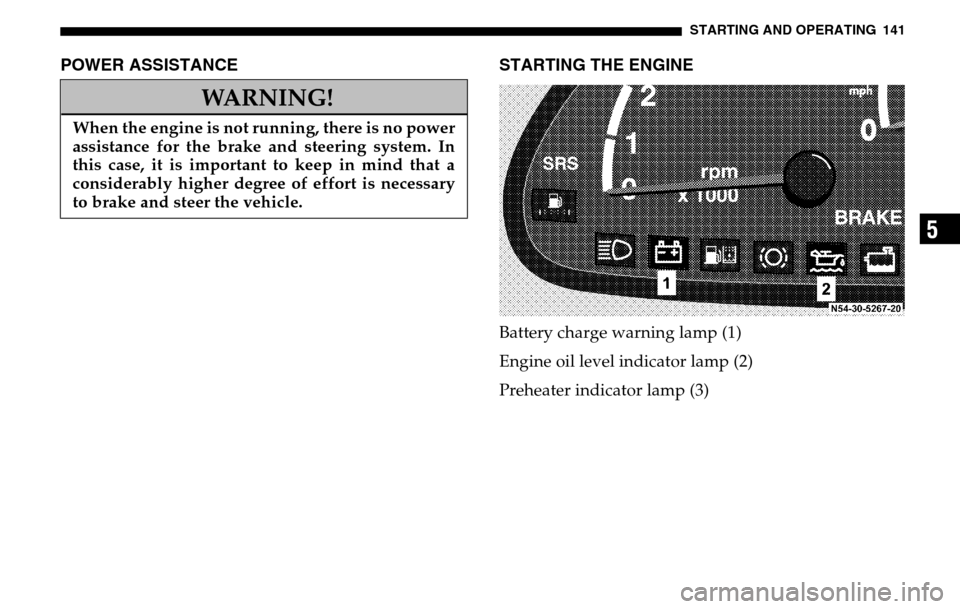
Battery charge warning lamp (1)
Engine oil level indicator lamp (2)
Preheater indicator lamp (3)
WARNING!
When the engine is not running, there is no power
assistance for the brake and steering system. In
this case, it is important to keep in mind that a
considerably higher degree of effort is necessary
to brake and steer the vehicle.
Page 142 of 288
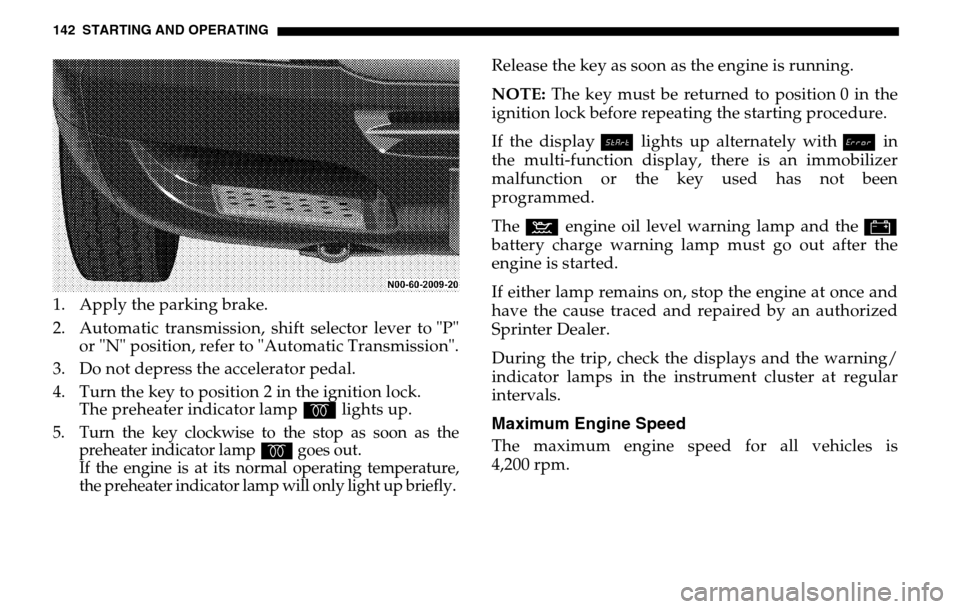
142 STARTING AND OPERATING1. Apply the parking brake.
2. Automatic transmission, shift selector lever to "P" or "N" position, refer to "Automatic Transmission".
3. Do not depress the accelerator pedal.
4. Turn the key to position 2 in the ignition lock. The preheater indicator lamp q lights up.5. Turn the key clockwise to the stop as soon as the
preheater indicator lamp
q
goes out.
If the engine is at its normal operating temperature,
the preheater indicator lamp will only light up briefly.
Release the key as soon as the engine is running.
NOTE: The key must be returned to position 0 in the
ignition lock before repeating the starting procedure.
If the display Á lights up alternately with î in
the multi-function display, there is an immobilizer
malfunction or the key used has not been
programmed.
The : engine oil level warning lamp and the #
battery charge warning lamp must go out after the
engine is started.
If either lamp remains on, stop the engine at once and
have the cause traced and repaired by an authorized
Sprinter Dealer.
During the trip, check the displays and the warning/
indicator lamps in the instrument cluster at regular
intervals.Maximum Engine SpeedThe maximum engine speed for all vehicles is
4,200 rpm.
Page 143 of 288
STARTING AND OPERATING 143
5
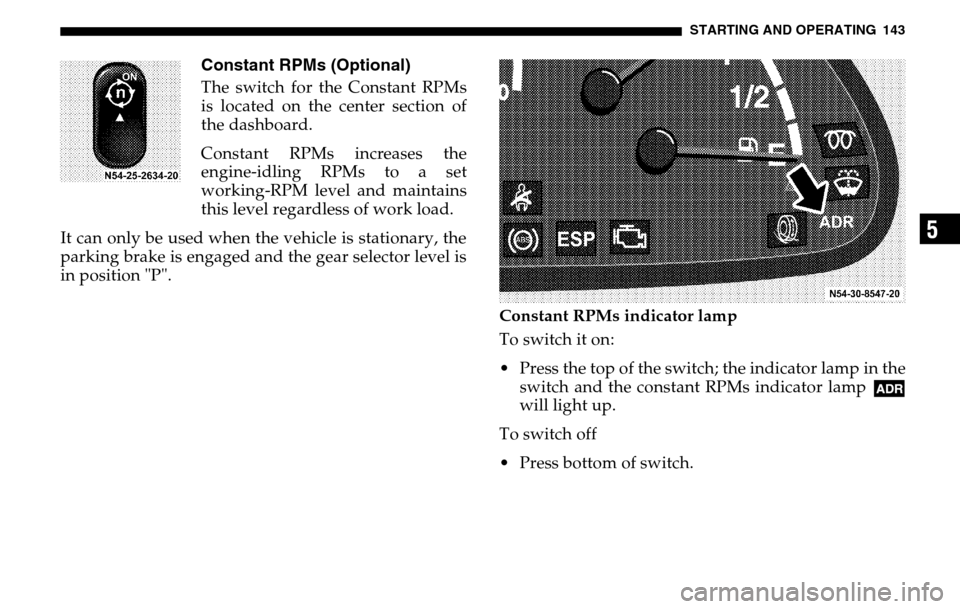
Constant RPMs (Optional)The switch for the Constant RPMs
is located on the center section of
the dashboard.
Constant RPMs increases the
engine-idling RPMs to a set
working-RPM level and maintains
this level regardless of work load.
It can only be used when the vehicle is stationary, the
parking brake is engaged and the gear selector level is
in position "P".
Constant RPMs indicator lamp
To switch it on:
Press the top of the switch; the indicator lamp in the switch and the constant RPMs indicator lamp
will light up.
To switch off
Press bottom of switch.
Page 144 of 288

144 STARTING AND OPERATINGNOTE: The Constant RPMs will automatically switch
off when the parking brake is released, the vehicle is in
motion or the control unit detects a malfunction.
The Constant RPMs will also automatically switch off
when you depress the brake pedal. In this case it will
automatically switch on again as soon as you release
the brake pedal.
STOPPING THE ENGINEAfter having brought the vehicle to a stop:
1. Do not depress the accelerator pedal.
2. Apply the parking brake.
3. Turn the key back to position 0 in the ignition lock.
NOTE: When the engine is very hot, such as after
climbing a long steep slope, allow the engine to idle for
1 to 2 minutes so that it can return to its normal
operating temperature.
Page 145 of 288
STARTING AND OPERATING 145
5
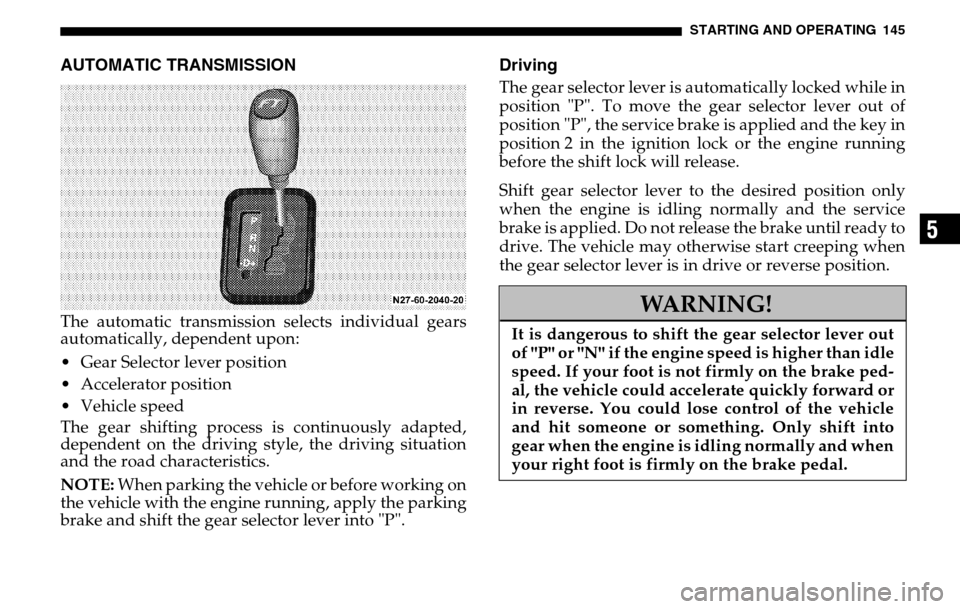
AUTOMATIC TRANSMISSIONThe automatic transmission selects individual gears
automatically, dependent upon:
Gear Selector lever position
Accelerator position
Vehicle speed
The gear shifting process is continuously adapted,
dependent on the driving style, the driving situation
and the road characteristics.
NOTE: When parking the vehicle or before working on
the vehicle with the engine running, apply the parking
brake and shift the gear selector lever into "P".
DrivingThe gear selector lever is automatically locked while in
position "P". To move the gear selector lever out of
position "P", the service brake is applied and the key in
position 2 in the ignition lock or the engine running
before the shift lock will release.
Shift gear selector lever to the desired position only
when the engine is idling normally and the service
brake is applied. Do not release the brake until ready to
drive. The vehicle may otherwise start creeping when
the gear selector lever is in drive or reverse position.
WARNING!
It is dangerous to shift the gear selector lever out
of "P" o r " N " if th e e n g i ne s p e e d i s h i g h e r t h a n i d le
speed. If your foot is not firmly on the brake ped-
al, the vehicle could accelerate quickly forward or
in reverse. You could lose control of the vehicle
and hit someone or something. Only shift into
gear when the engine is idling normally and when
your right foot is firmly on the brake pedal.
Page 146 of 288

146 STARTING AND OPERATINGNOTE: After selecting any driving position from "N"
or "P", wait a moment to allow the gear to fully engage
before accelerating, especially when the engine is cold.Accelerator PositionPartial throttle, for early upshifting and normal
acceleration
Full throttle, for later upshifting and rapid acceleration
Kickdown, (depressing the accelerator beyond full
throttle) for downshifting to a lower gear and
maximum acceleration. Once the desired speed is
attained, ease up on the accelerator, the transmission
shifts up again.StoppingFor brief stops, such as at traffic lights, leave the
transmission in gear and hold vehicle with the service
brake.
For longer stops with the engine idling, shift into "N"
or "P" and hold the vehicle with the service brake.
When stopping the vehicle on an uphill grade, do not
hold it with the accelerator, use the brake. This avoids
unnecessary transmission heat build up.
ManeuveringTo maneuver in tight areas, such as when pulling into
a parking space, control the vehicle speed by gradually
releasing the brakes. Acce lerate gently and never
abruptly step on the accelerator.
To rock a vehicle out of soft ground (mud or snow),
alternately shift from forward to reverse, while
applying slight partial throttle.
WARNING!
Getting out of your vehicle with the gear selector le-
ver not fully engaged in position "P" is dangerous.
Also, when parked on an incline, position "P" alone
may not prevent your vehicle from moving, possibly
hitting people or objects.Always set the parking brake in addition to
shifting to position "P".
When parked on an incline, also turn front wheel
against curb.
Page 147 of 288
STARTING AND OPERATING 147
5
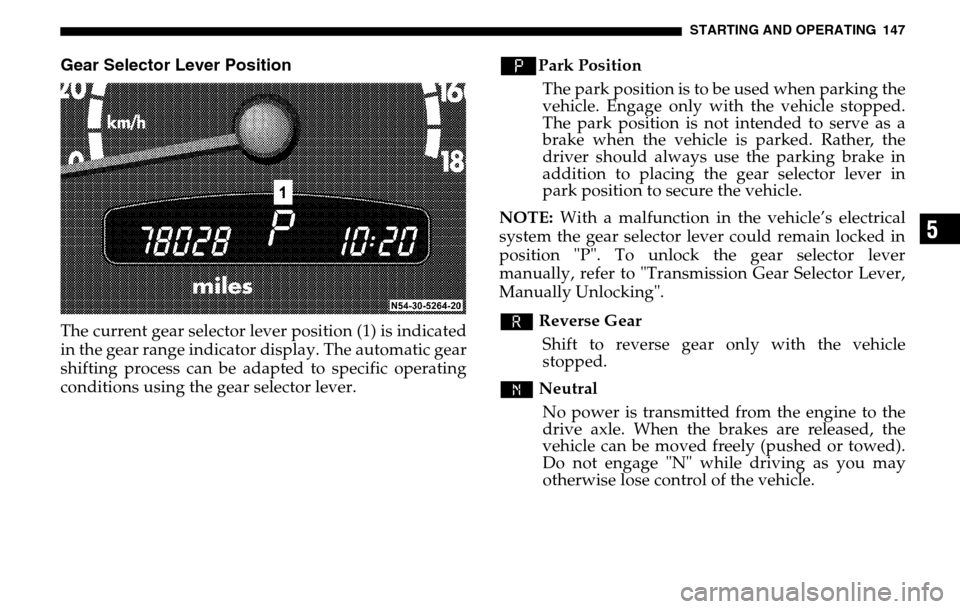
Gear Selector Lever PositionThe current gear selector lever position (1) is indicated
in the gear range indicator display. The automatic gear
shifting process can be adap ted to specific operating
conditions using the gear selector lever.
v
Park Position
The park position is to be used when parking the
vehicle. Engage only with the vehicle stopped.
The park position is not intended to serve as a
brake when the vehicle is parked. Rather, the
driver should always use the parking brake in
addition to placing the gear selector lever in
park position to secure the vehicle.
NOTE: With a malfunction in the vehicle’s electrical
system the gear selector lever could remain locked in
position "P". To unlock the gear selector lever
manually, refer to "Transmission Gear Selector Lever,
Manually Unlocking".
t Reverse Gear
Shift to reverse gear only with the vehicle
stopped.
s Neutral
No power is transmitted from the engine to the
drive axle. When the brakes are released, the
vehicle can be moved freely (pushed or towed).
Do not engage "N" while driving as you may
otherwise lose control of the vehicle.
Page 149 of 288

STARTING AND OPERATING 149
5
transmission are negatively affected by this mode of
operation.
The delayed upshift is effective with vehicle speeds
below 31 mph (50 km / h) at partial throttle and engine
temperatures below 95
°F (+35
°C).
To avoid overrevving the engine when the gear
selector lever is moved to a lower gear, the
transmission will not shift to a lower gear if the
engine’s revolutions per minute limit would be
exceeded. In this case there will be no downshift, even
when the vehicle speed reaches the engine’s rpm limit
of that gear, for example by applying the service
brakes.
To prevent the engine from laboring at low rpm when
driving uphill grades or with your vehicle heavily
loaded, the automatic transmission will downshift
when necessary to maintain engine rpm within the best
torque range. Gear
q
Upshift through 4th gear only. Suitable for
performance driving.
p Upshift through 3rd gear only. Suitable for
moderately steep hills. Since the transmission
does not shift higher than 3rd gear, this gear
selection will allow use of the engine’s braking
power downhill.
o Upshift through 2nd gear only. For driving in
mountainous regions or under extreme
operating conditions. This gear selection will
allow use of the engine’s braking power when
descending steep grades.
n Use this position, which makes maximum use of
the engine’s braking effect, while descending
very steep or lengthy downgrades and only at
speeds below 25 mph (38 km / h).
Page 152 of 288
152 STARTING AND OPERATING
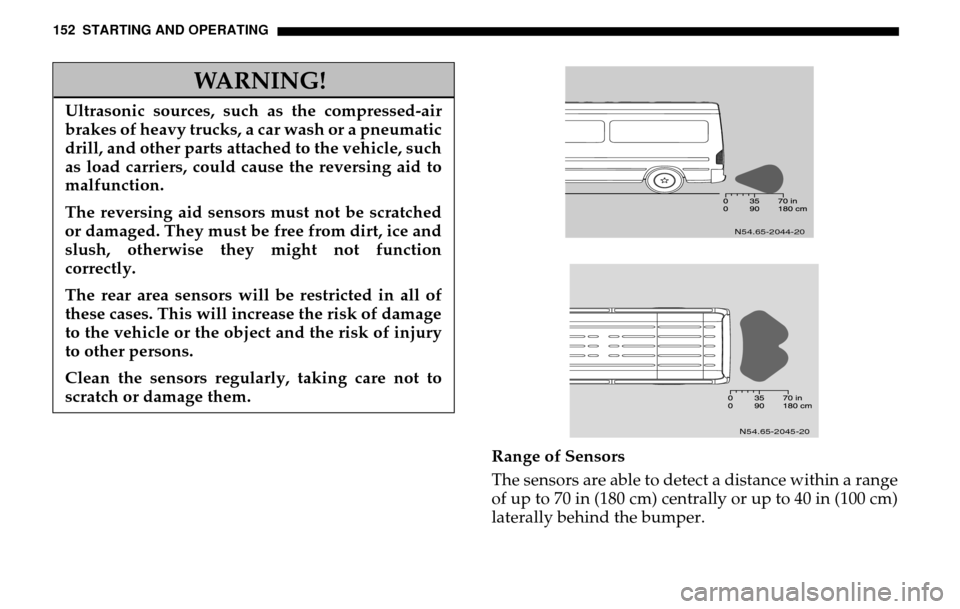
Range of Sensors
The sensors are able to detect a distance within a range
of up to 70 in (180 cm) centrally or up to 40 in (100 cm)
laterally behind the bumper.
WARNING!
Ultrasonic sources, such as the compressed-air
brakes of heavy trucks, a car wash or a pneumatic
drill, and other parts attached to the vehicle, such
as load carriers, could cause the reversing aid to
malfunction.
The reversing aid sensors must not be scratched
or damaged. They must be free from dirt, ice and
slush, otherwise they might not function
correctly.
The rear area sensors will be restricted in all of
these cases. This will increase the risk of damage
to the vehicle or the object and the risk of injury
to other persons.
Clean the sensors regularly, taking care not to
scratch or damage them.
N54.65-2044-20N54.65-2045-20
Page 155 of 288

STARTING AND OPERATING 155
5
Protect sharp edges with padding.
Check the tire pressures after loading the vehicle.
For passenger vans:
Do not stack loads higher than the upper edge of the backrests.
Always place the load against the backrests of the seat benches.
Whenever possible, transport loads behind seats that are not occupied.
Distribute the load in such a way that the permissible axle loads are not exceeded when the
vehicle is equipped with the maximum number of
seats. Loading the luggage compartment up to the
maximum payload would cause the permissible
rear axle load to be exceeded.
BRAKES
Service Brake
WARNING!
When the engine is not running, the brake and
steering systems are without power assistance.
Under these circumstances, a much greater effort
is necessary to stop or steer the vehicle.
After driving in heavy rain for some time without
applying the brakes or through water deep
enough to wet brake components, the first
braking action may be somewhat reduced and
increased pedal pressure may be necessary. Be
sure to maintain a safe distance from vehicles in
front.
Resting your foot on the brake pedal will cause
excessive and premature wear of the brake pads.
It can also result in the brakes overheating,
thereby significantly reducing their effectiveness.
It may not be possible to stop the vehicle in
sufficient time to avoid an accident.