brake DODGE SPRINTER 2005 1.G Workshop Manual
[x] Cancel search | Manufacturer: DODGE, Model Year: 2005, Model line: SPRINTER, Model: DODGE SPRINTER 2005 1.GPages: 288, PDF Size: 27.89 MB
Page 222 of 288
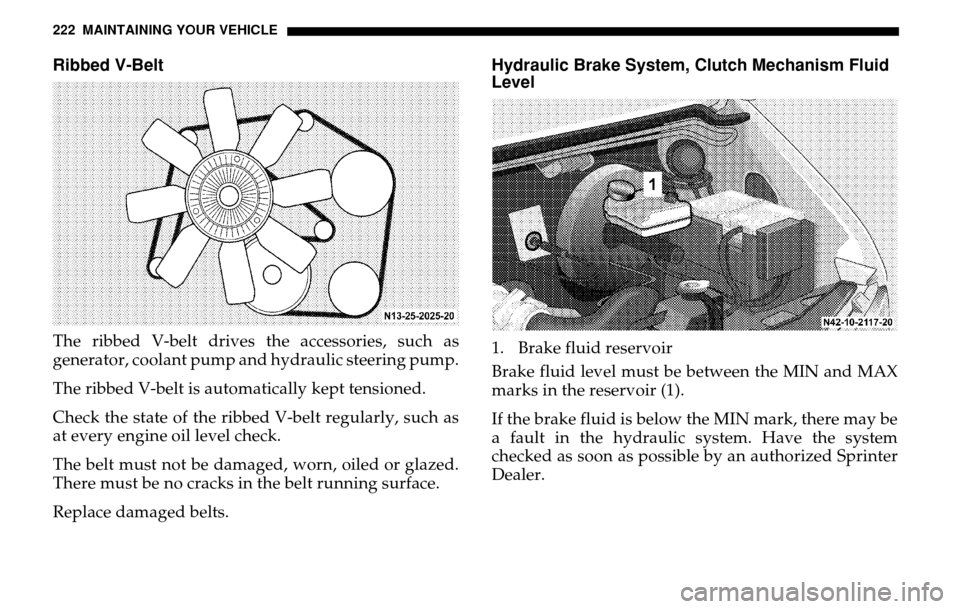
222 MAINTAINING YOUR VEHICLERibbed V-BeltThe ribbed V-belt drives the accessories, such as
generator, coolant pump and hydraulic steering pump.
The ribbed V-belt is automatically kept tensioned.
Check the state of the ribbed V-belt regularly, such as
at every engine oil level check.
The belt must not be damaged, worn, oiled or glazed.
There must be no cracks in the belt running surface.
Replace damaged belts.
Hydraulic Brake System, Clutch Mechanism Fluid
Level1. Brake fluid reservoir
Brake fluid level must be between the MIN and MAX
marks in the reservoir (1).
If the brake fluid is below the MIN mark, there may be
a fault in the hydraulic system. Have the system
checked as soon as possible by an authorized Sprinter
Dealer.
Page 223 of 288

MAINTAINING YOUR VEHICLE 223
7
Brake fluidRefer to the "Recommended Fluids" chart later in this
section for recommended brake fluids.
In the course of its service life, the boiling point of the
brake fluid will fall due to the continuous absorption of
moisture from the atmosphere.
If the brakes are placed under heavy loads (e.g., on
steep hills) bubbles of steam can then form in the brake
system.
This will adversely affect the brakes' effectiveness.Engine Cooling SystemThe use of aluminum components in Sprinter engines
requires that anticorrosive/antifreeze specifically
formulated to protect aluminum parts be used. The
factory approved Service Products are suitable for
Sprinter engines and can be mixed with the original
anticorrosion/antifreeze filled in at factory.
Cooling system design and anticorrosion/antifreeze
agent used stipulate the replacement interval for the
coolant solution in your vehicle. Please observe the
replacement interval specified in the Service Booklet
for your vehicle.
Failure to use MB 325.0 an ticorrosion/antifreeze and/or
equivalent to DaimlerChrys ler material standard MS-
9769 and/or adhere to the specified replacement interval
may result in a significantly shortened service life.For coolant composition and water quality, contact
your authorized Sprinter Dealer.Engine CoolantThe coolant is a mixture of water and a corrosion
inhibitor/antifreeze additive. Within the cooling
system, the corrosion inhibitor/antifreeze ensures
anti-corrosion protection
antifreeze protection
a higher boiling point.
The coolant added in the factory ensures adequate
antifreeze and anti-corrosion protection.
Refer to the "Recommended Fluids" chart for coolant
recommendations.
For reasons of anti-corrosion protection and to increase
the boiling point, the cool ant added to the cooling
system is designed for all year round operation – even
in countries with high prevailing temperatures.
Page 231 of 288
MAINTAINING YOUR VEHICLE 231
7
Appearance Care and Corrosion ProtectionIn operation, your vehicle is subjected to varying
external influences which, if gone unchecked, can
attack the paintwork as well as the underbody and
cause lasting damage.
Such damage is caused not only by extreme and
varying climatic conditions, but also by air pollution,
road salt, tar, gravel and stone chipping. Grease and
oil, fuel, coolant, brake flui d, bird droppings, insects, tree resins etc. should be removed immediately to
avoid paint damage. Frequent washing reduces and/
or eliminates the aggressiveness and potency of the
above adverse influences.
More frequent washings are necessary to deal with
unfavorable conditions; for example operation near the
ocean, in industrial areas (smoke, exhaust emissions),
or during the winter months.
You should check your vehicle from time to time for
stone chipping or other damage. Any damage should
be repaired as soon as possible to prevent the start of
corrosion.
In doing so, do not neglect the underside of the vehicle.
A prerequisite for a thorough check is a washing of the
underbody followed by a thorough inspection.
Damaged areas need to be undercoated again.
Your vehicle has been treated at the factory with a wax-
base rustproofing in the body cavities which will last
for the lifetime of the vehicle. Post-production
treatment is neither necessary nor recommended by
DaimlerChrysler Corporation.
WARNING!
Many cleaning products can be hazardous. Some
are poisonous, others are flammable. Always
keep cleaning products sealed and out of the
reach of children. Always follow the instructions
on the particular container. Always open your ve-
hicle’s doors or windows when cleaning the in-
side.
Never use fluids or solvents that are not designed
for cleaning your vehicle. Do not use fuel as a
cleaning agent. Fuel is flammable and constitutes
a health hazard.
Page 232 of 288
232 MAINTAINING YOUR VEHICLEBecause of the possibility of incompatibility between
materials used in the production process and others
applied later.
Scratches, corrosive deposits, corrosion or damage due
to negligent or incorrect care cannot always be
removed or repaired with car-care products. In such
cases it is best to seek aid by your authorized Sprinter
Dealer.
The following topics deal with the cleaning and care of
your vehicle and give important "how-to" information
as well as references to car-care products.
Power WasherWhen using a power washer for cleaning the vehicle
always observe manufacturers’ operating instructions.
WARNING!
Never use openings in the bodywork as steps.
You could otherwise damage the vehicle and it
could lead to an accident.
CAUTION!
Do not use abrasive or strong cleaning materials
such as steel wool or scouring powder, which will
scratch metal and painted surfaces.
CAUTION!
The intense jet of water of a round nozzle can
result in damage to the tire. Therefore never use a
round nozzle to power wash tires.
Always replace a damaged tire.
Always keep the jet of water moving across the
surface. To avoid damaging the vehicle, do not
aim the water jet directly at electrical components,
end of electrical lines, electrical connectors, intake
or ventilation openings, brake hoses, door joints,
seals, other rubber parts.
Page 241 of 288

MAINTAINING YOUR VEHICLE 241
7
No. Rated Circuit
1. 10A Parking lamp right, taillamp right
2. 10A High beam head lamp,right
3. 10A High beam head lamp, left, high beam indicator lamp
4. 10A Backup lamp
5. 10A Brake lamp
6. 20A Windshield wiper motor
7. 15A Horn, heated rear window, air recirculation switch,
optional equipment relay (terminal 15)
8. 20A Interior lighting, cigarette lighter, radio (terminal 30)
9. 15A Clock, hazard warning lamps, parking lamps 10. 10A Instrument lighting, license plate lamp
daytime driving lamps
11. 10A Side lamp, left; taillamp, left
12. 10A Low beam headlamp, right
13. 10A Low beam headlamp, left
14. 15A Fog lamp
15. 10A Radio (terminal 15)
16. 25A Engine control unit
17. 15A Engine control unit
18. 15A Ignition (terminal 15)
19. 15A Not in use
20. 15A Heater controls (terminal 30)
21. 30A Heater blower (terminal 30)
Page 244 of 288

244 MAINTAINING YOUR VEHICLENOTE: The arrangement of the fuses (1) depends on
the optional equipment installed on the vehicle. The
assignments are shown on the inside of the cover of the
fuse box.
Diodes:No. Circuit
1. Not in use
2. Not in use
3. Not in use
4. Not in use
Fuses:No. Rated Circuit
5. 10A Immobilizer
6. 7.5A Anti-lock brake system (ABS) Electronic Stability program (ESP)
*
7. 25A Anti-lock brake system (ABS) ElectronicStability program (ESP)
*
8. 40A Not in use Electronic Stability program(ESP)
*
9. 40A Anti-lock brake system (ABS)
10. Not in useRelays:No. Circuit
11. Not in use
12. Starter relay
13. Not in use* 2500 Type Vehicles only
Page 250 of 288
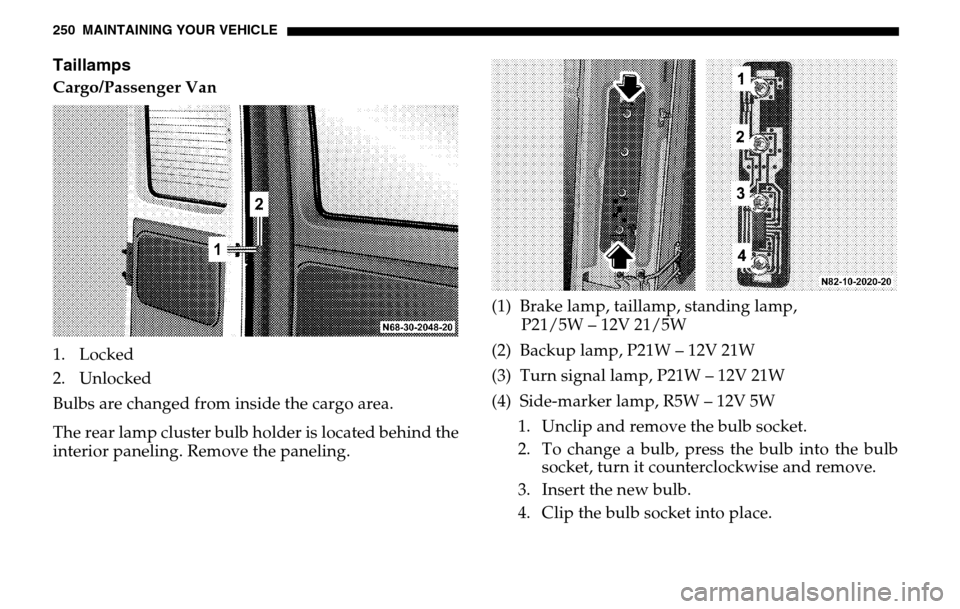
250 MAINTAINING YOUR VEHICLETaillampsCargo/Passenger Van
1. Locked
2. Unlocked
Bulbs are changed from inside the cargo area.
The rear lamp cluster bulb holder is located behind the
interior paneling. Remove the paneling. (1) Brake lamp, taillamp, standing lamp,
P21/5W – 12V 21/5W
(2) Backup lamp, P21W – 12V 21W
(3) Turn signal lamp, P21W – 12V 21W
(4) Side-marker lamp, R5W – 12V 5W 1. Unclip and remove the bulb socket.
2. To change a bulb, press the bulb into the bulb socket, turn it counterclockwise and remove.
3. Insert the new bulb.
4. Clip the bulb socket into place.
Page 252 of 288
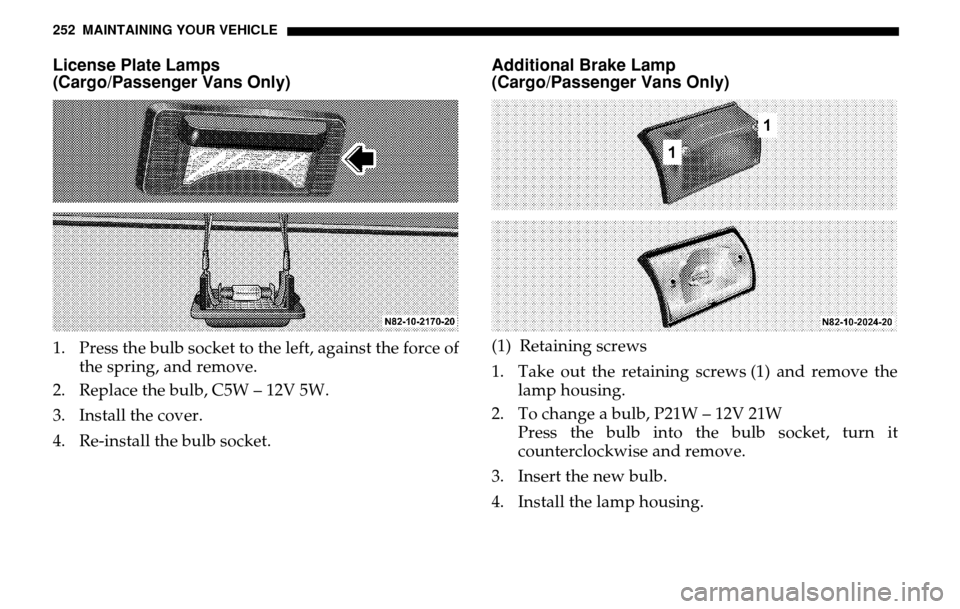
252 MAINTAINING YOUR VEHICLELicense Plate Lamps
(Cargo/Passenger Vans Only)1. Press the bulb socket to the left, against the force of the spring, and remove.
2. Replace the bulb, C5W – 12V 5W.
3. Install the cover.
4. Re-install the bulb socket.
Additional Brake Lamp
(Cargo/Passenger Vans Only)(1) Retaining screws
1. Take out the retaining screws (1) and remove the lamp housing.
2. To change a bulb, P21W – 12V 21W Press the bulb into the bulb socket, turn it
counterclockwise and remove.
3. Insert the new bulb.
4. Install the lamp housing.
Page 258 of 288
258 MAINTAINING YOUR VEHICLERecommended Fluids and LubricantsThe manufacturer recommends for your vehicle model
the use of DaimlerChrysler approved fluids and
lubricants, e.g. engine oil, gear oil, automatic
transmission fluid, brake fluid, power steering fluid,
coolant and anti-corrosion/anti-freeze fluid only.
WARNING!
Failure to use fluids and lubricants which meet
the standards and specifications described in this
booklet or failure to adhere to the specified re-
placement intervals may result in damage to safe-
ty-related systems of your vehicle, such as the
brake system, which could cause an accident and/
or serious injury to you and others.
Use only fluids and lubricants meeting the
standards and specifications and adhere to
specified replacement intervals.
CAUTION!
Failure to use fluids and lubricants which meet
the standards and specifications described in this
booklet or failure to adhere to the specified
replacement intervals may result in a significantly
shortened service life and/or damage to
components of your vehicle, the repair of which
will not be covered by Warranty.
Use only fluids and lubricants meeting the
standards and specifications and adhere to
specified replacement intervals.
Page 261 of 288

MAINTAINING YOUR VEHICLE 261
7
COMPONENT SERVICE INTERVAL PRODUCT NAME/PRODUCT NUMBER MB
SHEET
Air Conditioning
The air conditioning system of your vehicle contains R-134a, a refrigerant that does not deplete the ozone layer in the
upper atmosphere.
Refrigerant R-134a — Refrigerant R-134a 361.0 Automatic
Transmission Fluid once only at
80,000 mi
(128,000 km) Shell ATF 3403/M-115
MOPAR® Part No. 05127382AA, or equivalent
Fuchs/Shell ATF 3353 236.10
236.12
Brakes
Use brake fluid approved to DaimlerChr ysler standard MB 331.0 and/or DaimlerChrysler material standard MS-9971,
brake fluid certified to DOT 4 Plus standards, that also ma intains a minimum dry boiling point (ERBP) of 500°F (260°C),
a minimum wet boiling point (WERBP) of 356°F (180°C) and maximum viscosity of 1500 mm
2/s, conforming to FMVSS
116 and ISO 4925.
Brake Fluid 2 years Intac B026D Dry boiling point: 500°F (260°C )
Wet boiling point: 356°F (180°C),
MOPAR® MS-9971 Part No. 04549625AC, or equivalent 331.0
Engine Oil 12 months or 10,000 mi
(16,000 km) See "Approved Engine Oils"