brake DODGE SPRINTER 2005 1.G Owner's Manual
[x] Cancel search | Manufacturer: DODGE, Model Year: 2005, Model line: SPRINTER, Model: DODGE SPRINTER 2005 1.GPages: 288, PDF Size: 27.89 MB
Page 156 of 288
156 STARTING AND OPERATINGNOTE: On long and steep downhill slopes, reduce the
l o a d o n t h e b r a k e s b y s h i ft i n g d o w n a g e a r t o u t i l i z e t h e
braking effect of the engine.
To prevent corrosion on the brake pads, after driving
on very wet roads, especially if road salts have been
used, apply brakes before parking the vehicle. The heat
generated will help to dry the brake disks.
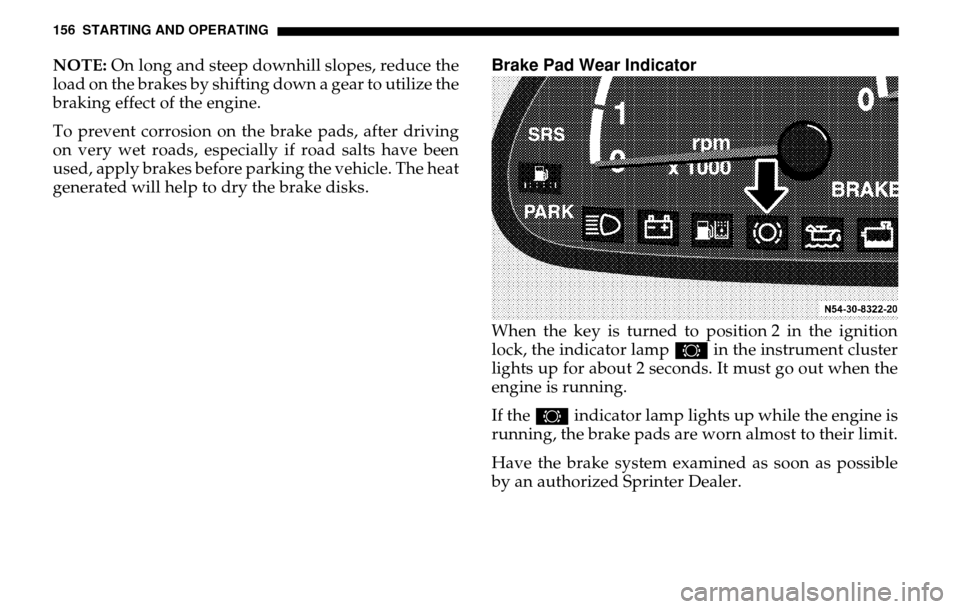
Brake Pad Wear IndicatorWhen the key is turned to position 2 in the ignition
lock, the indicator lamp 2 in the instrument cluster
lights up for about 2 seconds. It must go out when the
engine is running.
If the 2indicator lamp lights up while the engine is
running, the brake pads are worn almost to their limit.
Have the brake system examined as soon as possible
by an authorized Sprinter Dealer.
Page 157 of 288
STARTING AND OPERATING 157
5
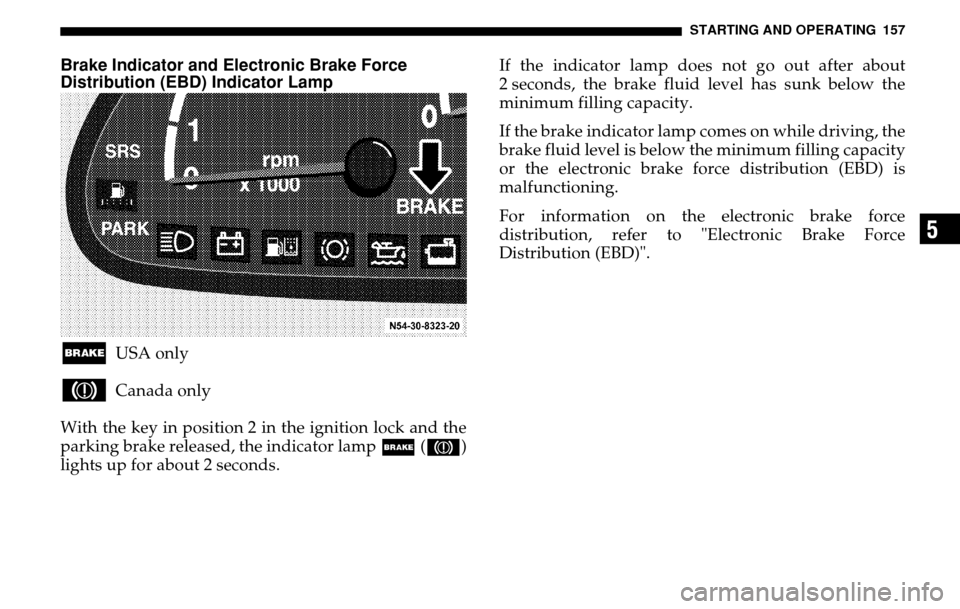
Brake Indicator and Electronic Brake Force
Distribution (EBD) Indicator Lamp;
USA only
3
Canada only
With the key in position 2 in the ignition lock and the
parking brake released, the indicator lamp ; (3 )
lights up for about 2 seconds. If the indicator lamp does not go out after about
2 seconds, the brake fluid level has sunk below the
minimum filling capacity.
If the brake indicator lamp comes on while driving, the
brake fluid level is below the minimum filling capacity
or the electronic brake force distribution (EBD) is
malfunctioning.
For information on the electronic brake force
distribution, refer to "Electronic Brake Force
Distribution (EBD)".
Page 158 of 288
158 STARTING AND OPERATINGNOTE: If you find that the minimum mark on the
brake fluid reservoir is reached, have the brake system
checked for pad thickness and leaks.
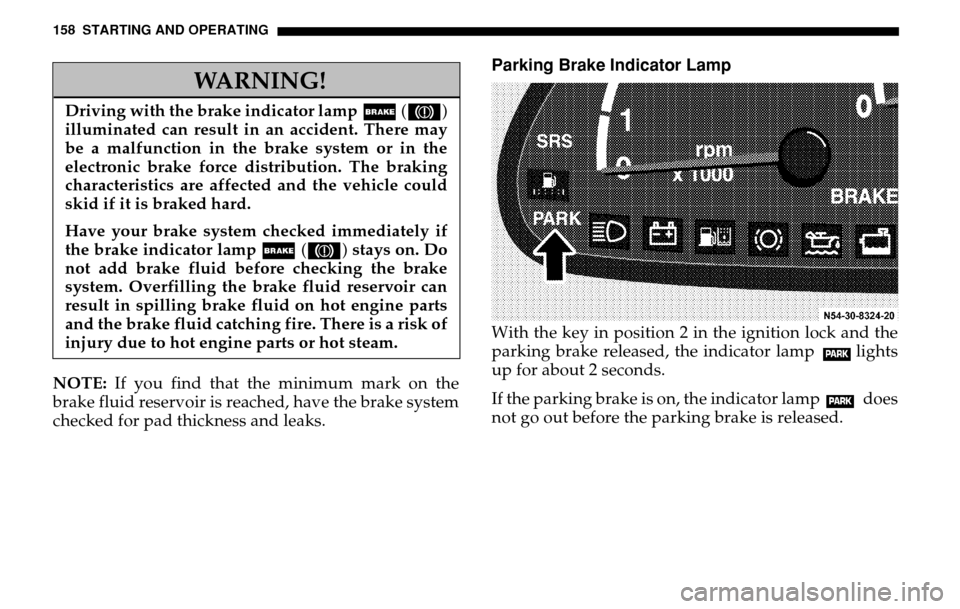
Parking Brake Indicator LampWith the key in position 2 in the ignition lock and the
parking brake released, th e indicator lamp lights
up for about 2 seconds.
If the parking brake is on, the indicator lamp does
not go out before the parking brake is released.
WARNING!
Driving with the brake indicator lamp ; (3 )
illuminated can result in an accident. There may
be a malfunction in the brake system or in the
electronic brake force distribution. The braking
characteristics are affected and the vehicle could
skid if it is braked hard.
Have your brake system checked immediately if
the brake indicator lamp ; (3 ) stays on. Do
not add brake fluid before checking the brake
system. Overfilling the brake fluid reservoir can
result in spilling brake fluid on hot engine parts
and the brake fluid catching fire. There is a risk of
injury due to hot engine parts or hot steam.
Page 159 of 288
STARTING AND OPERATING 159
5
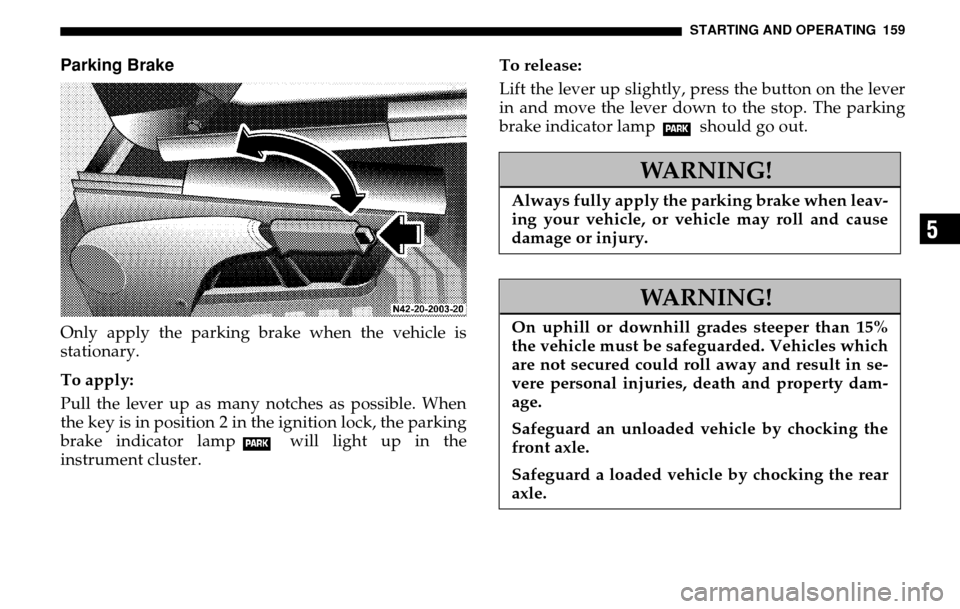
Parking BrakeOnly apply the parking brake when the vehicle is
stationary.
To apply:
Pull the lever up as many notches as possible. When
the key is in position 2 in the ignition lock, the parking
brake indicator lamp will light up in the
instrument cluster. To release:
Lift the lever up slightly, press the button on the lever
in and move the lever down to the stop. The parking
brake indicator lamp should go out.
WARNING!
Always fully apply the parking brake when leav-
ing your vehicle, or vehicle may roll and cause
damage or injury.
WARNING!
On uphill or downhill grades steeper than 15%
the vehicle must be safeguarded. Vehicles which
are not secured could roll away and result in se-
vere personal injuries, death and property dam-
age.
Safeguard an unloaded vehicle by chocking the
front axle.
Safeguard a loaded vehicle by chocking the rear
axle.
Page 160 of 288

160 STARTING AND OPERATING
Driving Safety SystemsThe vehicle can be equipped with the following
Driving Safety Systems:
Anti-lock brake system (ABS)
Electronic brake force distribution (EBV)
Acceleration skid control (ASR)
Brake assist system (BAS)
1
Electronic stability program (ESP)
*
NOTE: The maximum effectiveness of ABS, EBV, ASR
and ESP is only achieved if you drive with correct tire
pressures and adjust tire pressures to correspond with
the vehicle’s load. In winter operation, the maximum
effectiveness of the ABS and the ESP is only achieved
with winter tires (M+S tires), or snow chains as
required.
WARNING!
When leaving the vehicle always remove the key
from the ignition lock, and lock your vehicle.
Do not leave children unsupervised in the vehicle,
even if they are secured by a child restraint
system. The children could
injure themselves on parts of the vehicle
release the child-proof locks by pressing the central locking button and could thereby open
the doors and
cause injury to others as a result
get out of the vehicle and could either injure themselves when doing so or they could be
injured by the traffic approaching from the rear
suffer serious or fatal effects in the event of long periods of hot weather
release the parking brake. The vehicle could then start moving of its own accord.Unsupervised use of vehicle equipment may cause
severe personal injuries, death and property damage.
Page 161 of 288
STARTING AND OPERATING 161
5
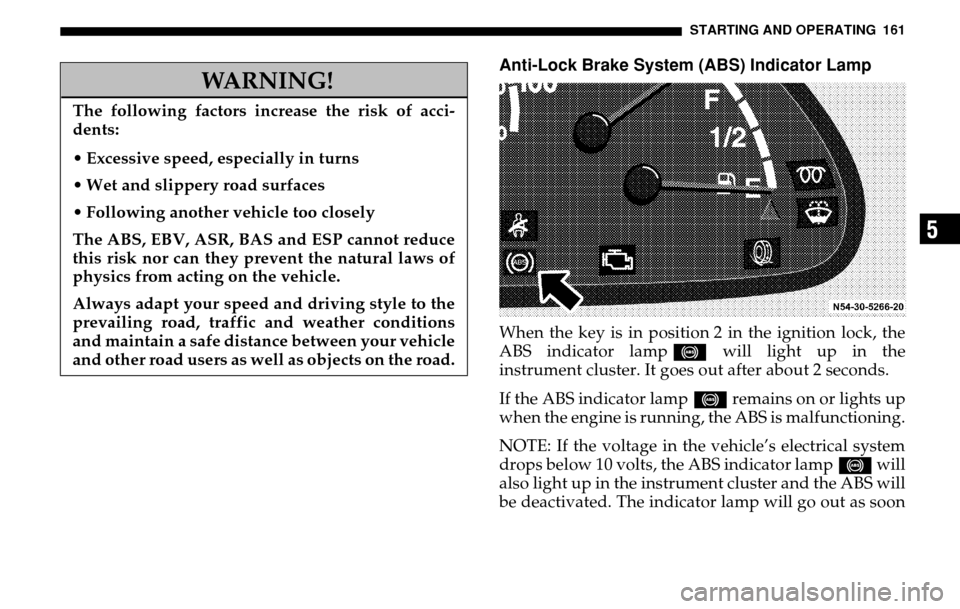
Anti-Lock Brake System (ABS) Indicator LampWhen the key is in position 2 in the ignition lock, the
ABS indicator lamp - will light up in the
instrument cluster. It goes out after about 2 seconds.
If the ABS indicator lamp - remains on or lights up
when the engine is running, the ABS is malfunctioning.
NOTE: If the voltage in the vehicle’s electrical system
drops below 10 volts, the ABS indicator lamp - will
also light up in the instrument cluster and the ABS will
be deactivated. The indicator lamp will go out as soon
WARNING!
The following factors increase the risk of acci-
dents:
Excessive speed, especially in turns
Wet and slippery road surfaces
Following another vehicle too closely
The ABS, EBV, ASR, BAS and ESP cannot reduce
this risk nor can they prevent the natural laws of
physics from acting on the vehicle.
Always adapt your speed and driving style to the
prevailing road, traffic and weather conditions
and maintain a safe distance between your vehicle
and other road users as well as objects on the road.
Page 162 of 288

162 STARTING AND OPERATINGas the voltage reaches this level again
– the ABS is then
reactivated.
If ABS malfunctions, the other driving safety systems
are deactivated. The handling and braking
characteristics of your vehicle change. The other
braking and driving systems still function normally.
I
Anti-Lock Brake System (ABS)ABS prevents the wheels from locking at any speed
above about 5 mph (8 km/h), regardless of road
surface conditions. The vehicle remains steerable even
if the brakes are applied fully.
A light vibrating of the steering wheel and pulsating of
the brake pedal indicate that the ABS is working.
On slippery road surfaces, the ABS will respond even
with light brake pedal pressure because of the
increased likelihood of locking wheels. The pulsating
brake pedal can be an indication of hazardous road
conditions and works as a reminder to take extra care
while driving.
WARNING!
If the ABS indicator lamp - does not go out or
lights up again while driving, the ABS is malfunc-
tioning. If ABS malfunctions, the other driving
safety systems are deactivated. The vehicle’s brak-
ing characteristics may be affected. There is an in-
creased risk that your vehicle could skid in the
event of sharp braking. Have the malfunction
traced and repaired without delay by an autho-
rized Sprinter Dealer.
Adapt your speed and driving style to the
prevailing road, traffic and weather conditions.
Driving too fast increases the risk of an accident.
Page 163 of 288

STARTING AND OPERATING 163
5
WARNING!
Do not reduce the force applied to the brake pedal if
it is necessary to brake the vehicle further. This will
negate the main benefit of ABS – the ability to brake
without affecting the steerability of the vehicle.In the event of an emergency stop, fully depress
the brake pedal. Do not pump the brake pedal,
rather use firm, steady brake pedal pressure.
Pumping the pedal defeats the purpose of ABS
and significantly reduces braking effectiveness.
WARNING!
Anti-lock brake system (ABS) cannot prevent the
natural laws of physics from acting on the vehicle,
nor can it increase braking or steering efficiency
beyond that afforded by the condition of the vehi-
cle brakes and tires or the traction afforded.
The ABS cannot prevent accidents, including
those resulting from excessive speed in turns,
following another vehicle too closely, or
hydroplaning. Only a safe, attentive, and skillful
driver can prevent accidents.
The capabilities of an ABS equipped vehicle must
never be exploited in a reckless or dangerous
manner which could jeopardize the user’s safety
or the safety of others.
Adapt your speed and driving style to the
prevailing road, traffic and weather conditions.
Driving too fast increases the risk of an accident.
Page 164 of 288
164 STARTING AND OPERATINGElectronic Brake Force Distribution (EBD)The electronic brake force distribution (EBD) prevents
the rear wheels from being overbraked when there is
little load on the rear axle or if there is not much friction
between the tires and road (e.g., if the road is wet).
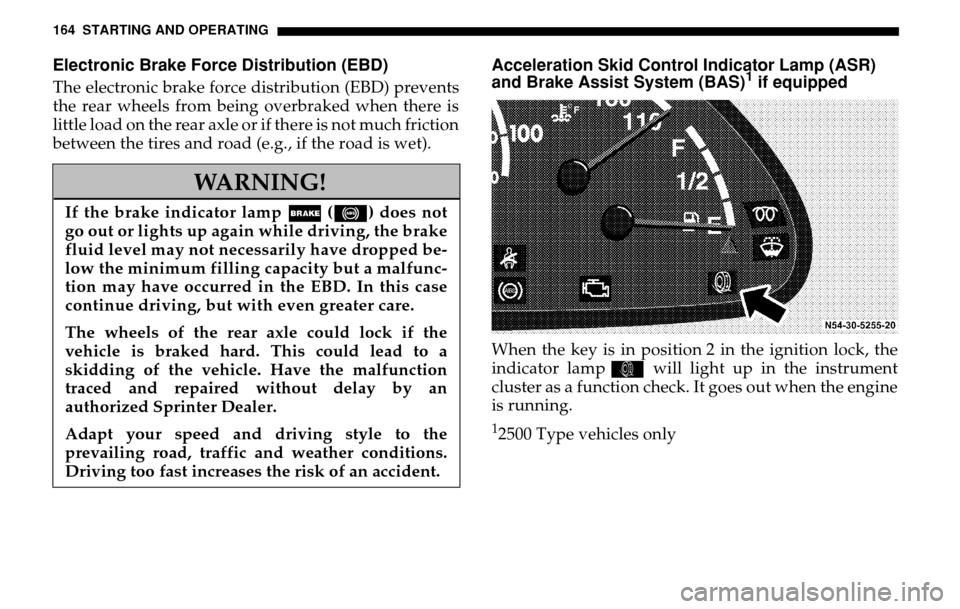
Acceleration Skid Control Indicator Lamp (ASR)
and Brake Assist System (BAS)
1if equipped
When the key is in position 2 in the ignition lock, the
indicator lamp k will light up in the instrument
cluster as a function check. It goes out when the engine
is running.12500 Type vehicles only
WARNING!
If the brake indicator lamp ; (- ) does not
go out or lights up again while driving, the brake
fluid level may not necessarily have dropped be-
low the minimum filling capacity but a malfunc-
tion may have occurred in the EBD. In this case
continue driving, but with even greater care.
The wheels of the rear axle could lock if the
vehicle is braked hard. This could lead to a
skidding of the vehicle. Have the malfunction
traced and repaired without delay by an
authorized Sprinter Dealer.
Adapt your speed and driving style to the
prevailing road, traffic and weather conditions.
Driving too fast increases the risk of an accident.
Page 165 of 288

STARTING AND OPERATING 165
5
If the indicator lamp k remains on or lights up
when the engine is running, the acceleration skid
control (ASR) or the brake assist system (BAS) is
malfunctioning.
Then the ASR will be switched off automatically.
NOTE: If the ABS is malfunctioning or the voltage in
the vehicle’s electrical system drops below 10 volts, the
indicator lamp k will also light up in the instrument
cluster and the ASR and the BAS will be deactivated.
The indicator lamp will go out as soon as the voltage
reaches this level again or the ABS is operational again– the ASR and the BAS are then reactivated.
If a malfunction is present in the acceleration skid
control (ASR), the engine’s power output may be
reduced.
WARNING!
If the indicator lamp k remains on, the acceler-
ation skid control (ASR) or the brake assist system
(BAS) is malfunctioning .
Your vehicle’s handling characteristics can
change. Drive with extra caution.
Have the malfunction traced and repaired as soon
as possible by an authorized Sprinter Dealer.