light switch DODGE SPRINTER 2005 1.G Owner's Manual
[x] Cancel search | Manufacturer: DODGE, Model Year: 2005, Model line: SPRINTER, Model: DODGE SPRINTER 2005 1.GPages: 288, PDF Size: 27.89 MB
Page 129 of 288
UNDERSTANDING YOUR INSTRUMENT PANEL 129
4
HEATER BOOSTER
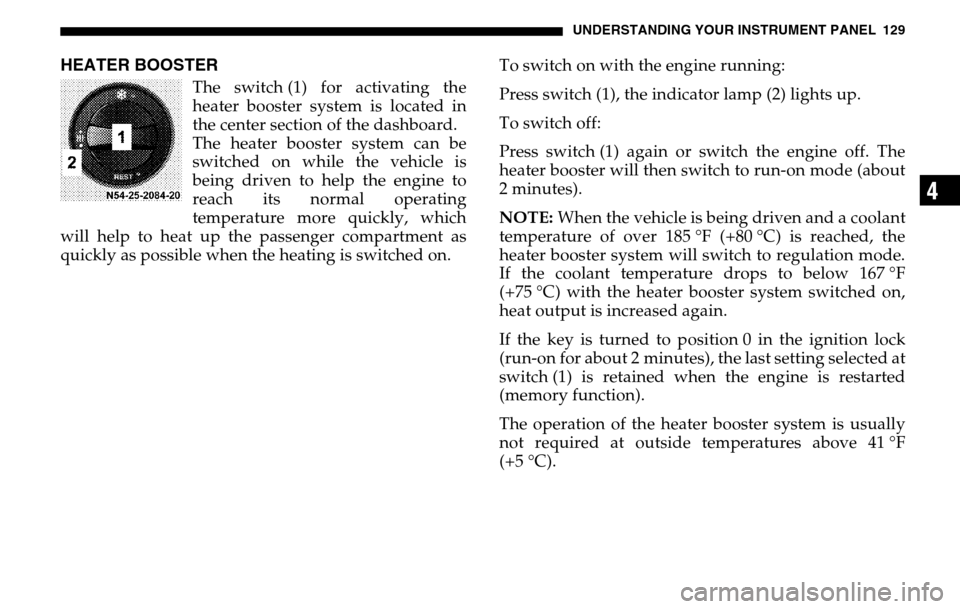
The switch (1) for activating the
heater booster system is located in
the center section of the dashboard.
The heater booster system can be
switched on while the vehicle is
being driven to help the engine to
reach its normal operating
temperature more quickly, which
will help to heat up the passenger compartment as
quickly as possible when the heating is switched on. To switch on with the engine running:
Press switch (1), the indicator lamp (2) lights up.
To switch off:
Press switch (1) again or switch the engine off. The
heater booster will then switch to run-on mode (about
2minutes).
NOTE:
When the vehicle is being driven and a coolant
temperature of over 185 °F (+80 °C) is reached, the
heater booster system will switch to regulation mode.
If the coolant temperature drops to below 167 °F
(+75 °C) with the heater booster system switched on,
heat output is increased again.
If the key is turned to position 0 in the ignition lock
(run-on for about 2 minutes), the last setting selected at
switch (1) is retained when the engine is restarted
(memory function).
The operation of the heater booster system is usually
not required at outside temperatures above 41 °F
(+5 °C).
Page 132 of 288
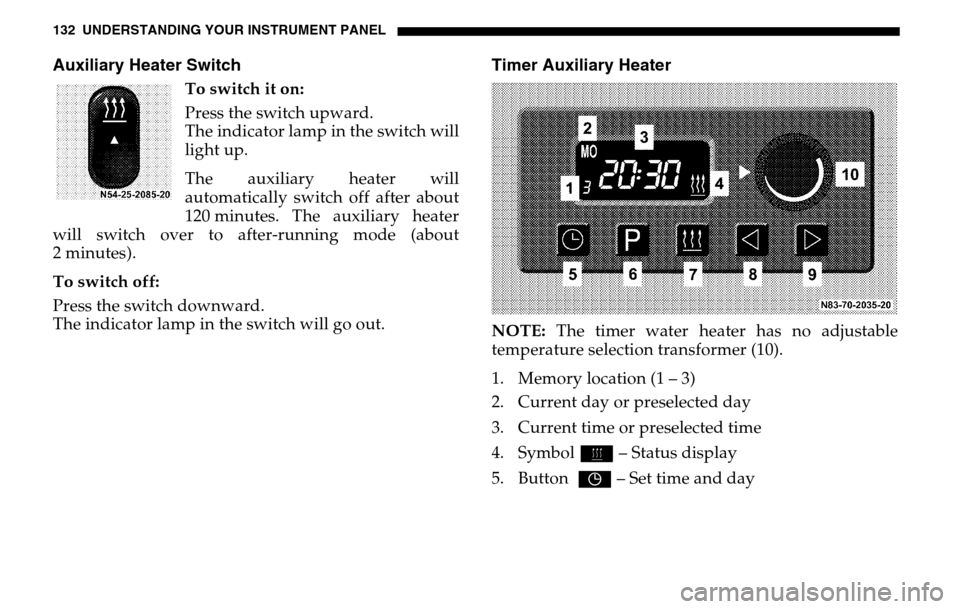
132 UNDERSTANDING YOUR INSTRUMENT PANELAuxiliary Heater Switch
To switch it on:
Press the switch upward.
The indicator lamp in the switch will
light up.
The auxiliary heater will
automatically switch off after about
120 minutes. The auxiliary heater
will switch over to after-running mode (about
2minutes).
To switch off:
Press the switch downward.
The indicator lamp in the switch will go out.
Timer Auxiliary HeaterNOTE: The timer water heater has no adjustable
temperature selection transformer (10).
1. Memory location (1 – 3)
2. Current day or preselected day
3. Current time or preselected time
4. Symbol ö – Status display
5. Button ” – Set time and day
Page 133 of 288

UNDERSTANDING YOUR INSTRUMENT PANEL 133
4
6. ButtonH – Select memory (1 – 3), activate
preselected time
7. Button ö – Switch on heater
8. Button ý – Set time, day, and preselected time;
shorten heating period (min. 1 minute)
9. Button þ – Set time, day, and preselected time;
lengthen heating period (max. 120 minutes)
10. Air Heater only, adjustable temperature selection transformer – adjustment range from 50 °F to 86 °F
(+10 °C to +30 °C)
NOTE: All symbols and digits in the display will flash
if the battery voltage has been interrupted over a
longer period of time. The timer must be reset.
The heater cannot be switched on until the time of day
has been set.
The timer lights up when the heater is switched on. Switching the Auxiliary Heater On and Off - Ignition
Off
To switch it on:
Press button
ö.
The vehicle-side blower automatically switches on.
Display: Symbol ö and remaining heating period.
The remaining heating period can be lengthened by
using the button þ (max. of 120 minutes); it may be
shortened by using the button ý (min. of 1 minute).
To switch off:
Press button ö again.
The blower inside the vehicle automatically switches
off. The auxiliary heater will automatically switch off
after about 3 minutes.
Display: Current time and current day of the week
(about 15 seconds).
Switching the Auxiliary Heater On and Off - Ignition
On
To switch it on:
Press the button ö.
Page 137 of 288

UNDERSTANDING YOUR INSTRUMENT PANEL 137
4
NOTE: Only on vehicles with automatic heater
control/regulated air conditioner:
Before switching on the heater or entering the switch-
on time, the temperature control (1) must be set to
maximum heater output (as illustrated).
Set the air distribution control (3) as required between
Y and Z .AUXILIARY HEAT EXCHANGER IN LOAD
COMPARTMENT, ONLY WITH AUXILIARY HEATER
(OPTIONAL)
The auxiliary heat exchanger switch
is located on the right next to the
steering column. To switch on at blower speed 1:
Press the upper section, the left-hand indicator lamp in
the switch lights up.
To switch on at blower speed 2:
Press the lower section, the right-hand indicator lamp
in the switch lights up.
To switch off :
Press the switch to the middle position.
Operation is only possible when the key is turned to
position 2 in the ignition lock.
NOTE:
The auxiliary heat exchanger in the load
compartment should be switched off at coolant
temperatures below 176 °F (+80 °C) to quickly de-fog
and de-ice the windshield and front side windows.
Page 143 of 288
STARTING AND OPERATING 143
5
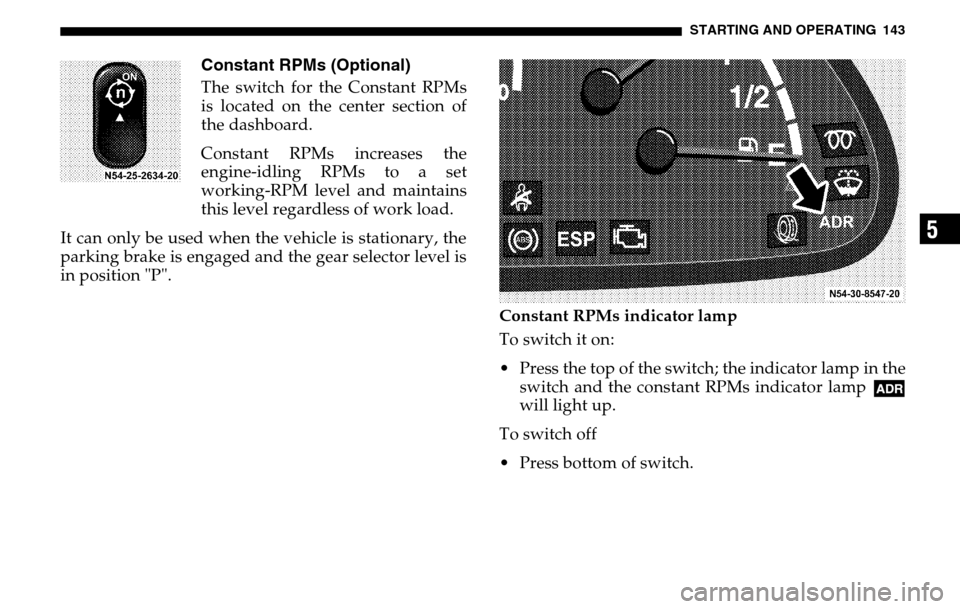
Constant RPMs (Optional)The switch for the Constant RPMs
is located on the center section of
the dashboard.
Constant RPMs increases the
engine-idling RPMs to a set
working-RPM level and maintains
this level regardless of work load.
It can only be used when the vehicle is stationary, the
parking brake is engaged and the gear selector level is
in position "P".
Constant RPMs indicator lamp
To switch it on:
Press the top of the switch; the indicator lamp in the switch and the constant RPMs indicator lamp
will light up.
To switch off
Press bottom of switch.
Page 165 of 288

STARTING AND OPERATING 165
5
If the indicator lamp k remains on or lights up
when the engine is running, the acceleration skid
control (ASR) or the brake assist system (BAS) is
malfunctioning.
Then the ASR will be switched off automatically.
NOTE: If the ABS is malfunctioning or the voltage in
the vehicle’s electrical system drops below 10 volts, the
indicator lamp k will also light up in the instrument
cluster and the ASR and the BAS will be deactivated.
The indicator lamp will go out as soon as the voltage
reaches this level again or the ABS is operational again– the ASR and the BAS are then reactivated.
If a malfunction is present in the acceleration skid
control (ASR), the engine’s power output may be
reduced.
WARNING!
If the indicator lamp k remains on, the acceler-
ation skid control (ASR) or the brake assist system
(BAS) is malfunctioning .
Your vehicle’s handling characteristics can
change. Drive with extra caution.
Have the malfunction traced and repaired as soon
as possible by an authorized Sprinter Dealer.
Page 169 of 288

STARTING AND OPERATING 169
5
To deactivate the ASR:– Press the upper section of the switch – the warning
lamp
v in the speedometer lights up.
Traction control continues to cut in if, for example, a
wheel on one side of the vehicle reaches its limit of
adhesion. The wheel is then braked to increase the
vehicle’s overall traction.
The warning lamp v will flash in the speedometer
at any speed when a tire reaches its limit of adhesion
and spins.
To activate the ASR:
– Press the upper section of the switch again
– the
warning lamp v in the speedometer goes out.
Brake Assist System (BAS) (vehicle type 2500 only)The Brake Assist System (BAS) operates in emergency
situations. If you apply the brakes very quickly, the
BAS automatically provides full brake boost, thereby
potentially reducing braking distance.
Apply continuous full braking pressure until the
emergency braking situation is over.
The ABS will prevent the wheels from locking.
When you release the brake pedal, the brakes function
again as normal. The BAS is then deactivated.
WARNING!
If the indicator lamp k remains on, a malfunc-
tion may not only have occurred in the ASR sys-
tem but also in the BAS.
The handling and braking characteristics of your
vehicle change. Drive with extra caution.
Have the malfunction traced and repaired as soon
as possible by an authorized Sprinter Dealer.
Page 170 of 288
170 STARTING AND OPERATINGFor the indicator lamp k refer to
"Indicator Lamp
Acceleration Skid Control (ASR) and Brake Assist
System (BAS)
" .
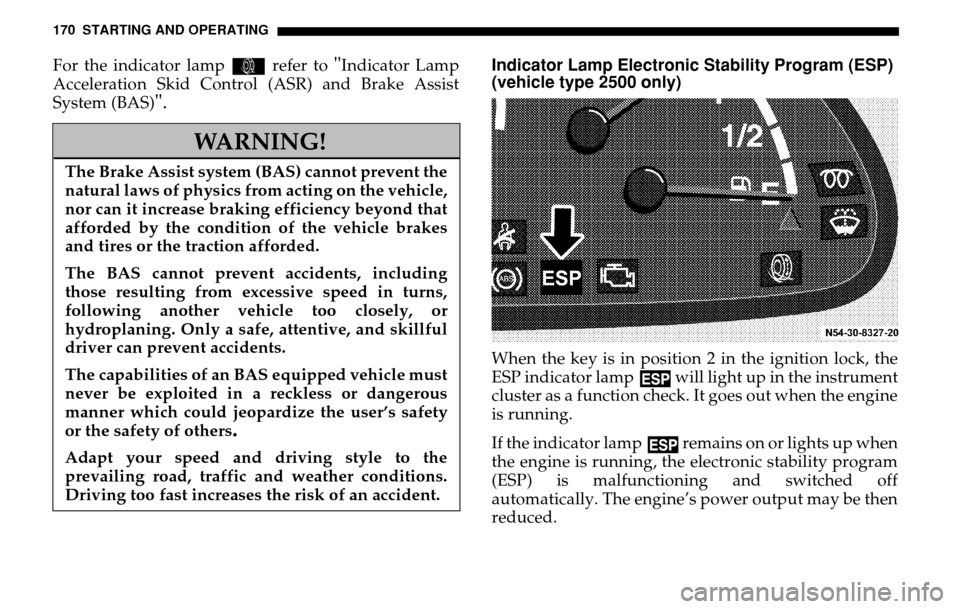
Indicator Lamp Electronic Stability Program (ESP)
(vehicle type 2500 only)When the key is in position 2 in the ignition lock, the
ESP indicator lamp will light up in the instrument
cluster as a function check. It goes out when the engine
is running.
If the indicator lamp remains on or lights up when
the engine is running, the electronic stability program
(ESP) is malfunctioning and switched off
automatically. The engine’s power output may be then
reduced.
WARNING!
The Brake Assist system (BAS) cannot prevent the
natural laws of physics from acting on the vehicle,
nor can it increase braking efficiency beyond that
afforded by the condition of the vehicle brakes
and tires or the traction afforded.
The BAS cannot prevent accidents, including
those resulting from excessive speed in turns,
following another vehicle too closely, or
hydroplaning. Only a safe, attentive, and skillful
driver can prevent accidents.
The capabilities of an BAS equipped vehicle must
never be exploited in a reckless or dangerous
manner which could jeopardize the user’s safety
or the safety of others
.
Adapt your speed and driving style to the
prevailing road, traffic and weather conditions.
Driving too fast increases the risk of an accident.
Page 189 of 288

STARTING AND OPERATING 189
5
Towing a TrailerThere are many different laws, including speed limit
restrictions, having to do with trailer towing. Make
sure that your vehicle-trailer combination will be legal,
not only for where you reside, but also for where you
will be driving. A good source for this information can
be the police or local authorities.
Before you start driving with the trailer, check the
trailer hitch, break-away switch, safety chains,
electrical connections, lighting and tires. Also adjust
the mirrors to permit unobstructed view beyond rear
of trailer.
If the trailer has electric brakes, start your vehicle and
trailer moving slowly, and then apply only the trailer
brake controller by hand to be sure the brakes are
working properly.
When towing a trailer, check occasionally to be sure
that the load is secure, and that lighting and trailer
brakes (if so equipped) are functioning properly.
Always secure items in the trailer to prevent load shifts
while driving. Take into consideration that when towing a trailer, the
handling characteristics are different and less stable
from those when operating the vehicle without a
trailer. It is important to avoid sudden maneuvers. The
vehicle and trailer combination is heavier, and
therefore is limited in acceleration and climbing ability,
and requires longer stopping distances. It is more
p r o n e t o r e a c t i n g t o s i d e w i n d g u s t s , a n d r e q u i r es m o r e
sensitive steering input.
In order to gain skill and an understanding of the
vehicle’s behavior, you should practice turning, stopping
and backing up in an area which is free from traffic.If possible, do not brake abruptly, but rather engage
the brake slightly at first to
permit the trailer to activate
its brake. Then increase the braking force.
Page 196 of 288
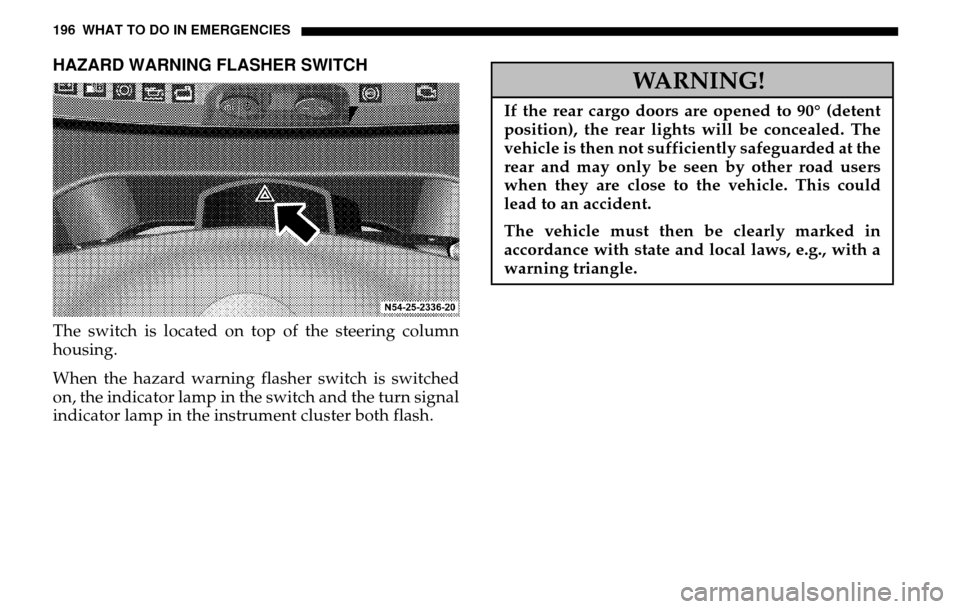
196 WHAT TO DO IN EMERGENCIESHAZARD WARNING FLASHER SWITCHThe switch is located on top of the steering column
housing.
When the hazard warning flasher switch is switched
on, the indicator lamp in th e switch and the turn signal
indicator lamp in the inst rument cluster both flash.
WARNING!
If the rear cargo doors are opened to 90° (detent
position), the rear lights will be concealed. The
vehicle is then not sufficiently safeguarded at the
rear and may only be seen by other road users
when they are close to the vehicle. This could
lead to an accident.
The vehicle must then be clearly marked in
accordance with state and local laws, e.g., with a
warning triangle.