wheel DODGE SPRINTER 2005 1.G Owner's Manual
[x] Cancel search | Manufacturer: DODGE, Model Year: 2005, Model line: SPRINTER, Model: DODGE SPRINTER 2005 1.GPages: 288, PDF Size: 27.89 MB
Page 168 of 288
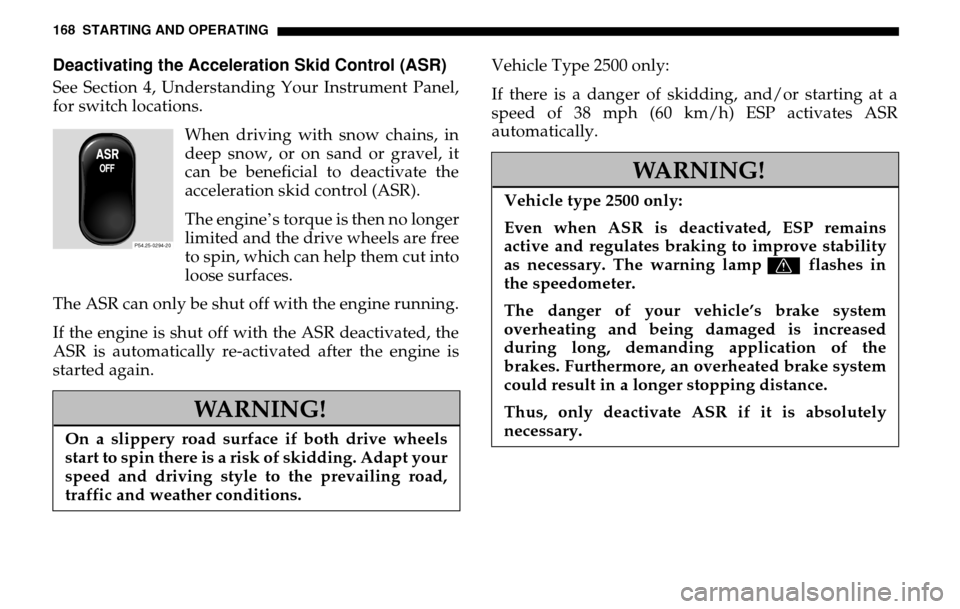
168 STARTING AND OPERATINGDeactivating the Acceleration Skid Control (ASR)See Section 4, Understanding Your Instrument Panel,
for switch locations. When driving with snow chains, in
deep snow, or on sand or gravel, it
can be beneficial to deactivate the
acceleration skid control (ASR).
The engine ’s torque is then no longer
limited and the drive wheels are free
to spin, which can help them cut into
loose surfaces.
The ASR can only be shut off with the engine running.
If the engine is shut off with the ASR deactivated, the
ASR is automatically re-activated after the engine is
started again. Vehicle Type 2500 only:
If there is a danger of skidding, and/or starting at a
speed of 38 mph (60 km/h) ESP activates ASR
automatically.
WARNING!
On a slippery road surface if both drive wheels
start to spin there is a risk of skidding. Adapt your
speed and driving style to the prevailing road,
traffic and weather conditions.
P54.25-0294-20
WARNING!
Vehicle type 2500 only:
Even when ASR is deactivated, ESP remains
active and regulates braking to improve stability
as necessary. The warning lamp
v flashes in
the speedometer.
The danger of your vehicle’s brake system
overheating and being damaged is increased
during long, demanding application of the
brakes. Furthermore, an overheated brake system
could result in a longer stopping distance.
Thus, only deactivate ASR if it is absolutely
necessary.
Page 169 of 288

STARTING AND OPERATING 169
5
To deactivate the ASR:– Press the upper section of the switch – the warning
lamp
v in the speedometer lights up.
Traction control continues to cut in if, for example, a
wheel on one side of the vehicle reaches its limit of
adhesion. The wheel is then braked to increase the
vehicle’s overall traction.
The warning lamp v will flash in the speedometer
at any speed when a tire reaches its limit of adhesion
and spins.
To activate the ASR:
– Press the upper section of the switch again
– the
warning lamp v in the speedometer goes out.
Brake Assist System (BAS) (vehicle type 2500 only)The Brake Assist System (BAS) operates in emergency
situations. If you apply the brakes very quickly, the
BAS automatically provides full brake boost, thereby
potentially reducing braking distance.
Apply continuous full braking pressure until the
emergency braking situation is over.
The ABS will prevent the wheels from locking.
When you release the brake pedal, the brakes function
again as normal. The BAS is then deactivated.
WARNING!
If the indicator lamp k remains on, a malfunc-
tion may not only have occurred in the ASR sys-
tem but also in the BAS.
The handling and braking characteristics of your
vehicle change. Drive with extra caution.
Have the malfunction traced and repaired as soon
as possible by an authorized Sprinter Dealer.
Page 171 of 288

STARTING AND OPERATING 171
5
NOTE: If the ABS is malfunctioning or the voltage in
the vehicle’s electrical system drops below 10 volts, the
indicator lamp will also light up in the instrument
cluster and the ESP will be deactivated. The indicator
lamp will go out as soon as the voltage reaches this
level again or the ABS is operational again
– the ESP is
then reactivated.
Electronic Stability Program (ESP) (vehicle type
2500 only)The Electronic Stability Program (ESP) monitors the
vehicle’s traction (force of adhesive friction between
the tires and the road surface) and handling.
The ESP recognizes when a wheel is spinning or if the
vehicle starts to skid. By applying brakes to the
appropriate wheel and by limiting engine output, the
ESP works to stabilize the vehicle. The ESP is especially
useful while driving off and on wet or slippery road
surfaces.
The warning lamp v in the speedometer flashes
when the ESP is engaged, refer also to
"Warning Lamp
Acceleration Skid Control (ASR) and Electronic
Stability Program (ESP)
".
If wheels with tires of a different size than those offered
by an authorized Sprinter Dealer are used, the correct
operation of the ESP cannot be guaranteed.
WARNING!
If the ESP indicator lamp remains on, the
electronic stability program (ESP) is malfunction-
ing. The vehicle stability will no longer be auto-
matically regulated in good time.
The danger that your vehicle breaks into a skid, is
increased in certain driving situations. Drive with
extra caution.
Have the ESP repaired as soon as possible by an
authorized Spinter Dealer.
Page 172 of 288
172 STARTING AND OPERATING
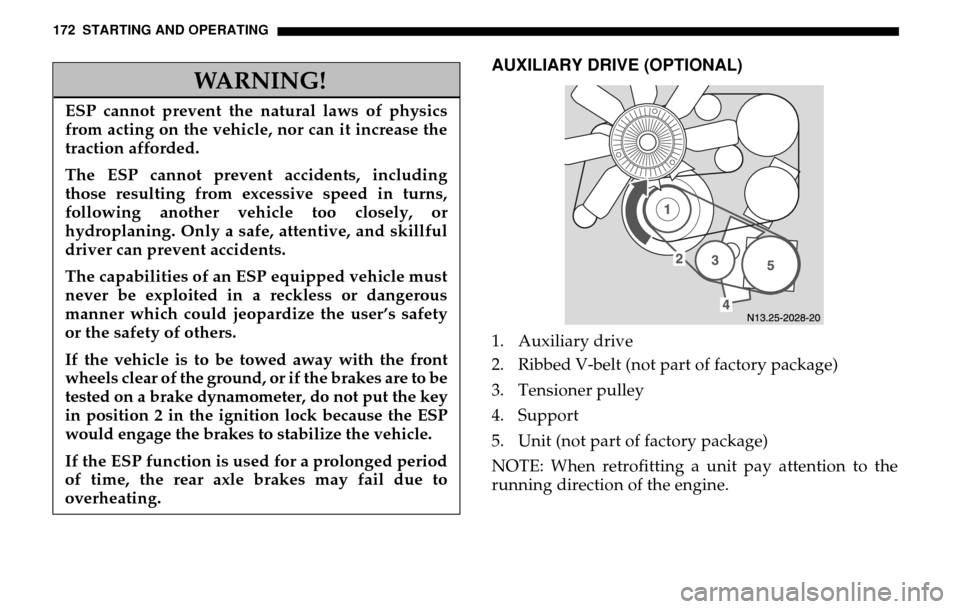
AUXILIARY DRIVE (OPTIONAL)1. Auxiliary drive
2. Ribbed V-belt (not part of factory package)
3. Tensioner pulley
4. Support
5. Unit (not part of factory package)
NOTE: When retrofitting a unit pay attention to the
running direction of the engine.
WARNING!
ESP cannot prevent the natural laws of physics
from acting on the vehicle, nor can it increase the
traction afforded.
The ESP cannot prevent accidents, including
those resulting from excessive speed in turns,
following another vehicle too closely, or
hydroplaning. Only a safe, attentive, and skillful
driver can prevent accidents.
The capabilities of an ESP equipped vehicle must
never be exploited in a reckless or dangerous
manner which could jeopardize the user’s safety
or the safety of others.If the vehicle is to be towed away with the front
wheels clear of the ground, or if the brakes are to be
tested on a brake dynamometer, do not put the key
in position 2 in the ignition lock because the ESP
would engage the brakes to stabilize the vehicle.If the ESP function is used for a prolonged period
of time, the rear axle brakes may fail due to
overheating.
Page 173 of 288
STARTING AND OPERATING 173
5
STEERINGWhen the engine is not running, there is no power
assistance for the steering. Greater force will be
required to steer the vehicle.WHEELS AND TIRESCheck tires regularly for even tread wear, tread depth
(note legal requirements) and signs of external
damage.
Only use wheels and tires of the same size, make and
pattern.
Do not install tires that are not approved for the size
and type of wheel installed or the vehicle itself. Only
use those wheel sizes which were delivered to you by
your authorized Sprinter Dealer.
Use only wheels and tires which have been tested and
approved by the vehicle manufacturer. Break in new tires at moderate speeds for a distance of
about 65 miles (about 100 km).
CAUTION!
Power take off must not exceed 10 kW. Exceeding
the power take off may cause damage to the
auxiliary drive and/or ribbed V-belt.
WARNING!
Fitting other wheel sizes to the vehicle will change
the vehicle’s handling characteristics and may
lead to an accident resulting in severe personal in-
juries, death and property damage.
Only certain tires meeting the tire size/load/speed
rating specifications contained in the Tire
Pressure Tables at the end of this chapter are
certified to conform to FMVSS 120 for the Sprinter
vehicle at this time. Please check your side walls
of your originally equipped tires for specific
makes/sizes, and speed load ratings when you
need to replace your tires.
To prevent accident, injury or possible death, use
only the correct tires for your tire replacement.
Do not use retreaded/ remolded tires. This process
does not always permit previous damage to be
detected. Therefore vehicle safety cannot be
guaranteed if retreaded/remolded tires are fitted
.
Page 174 of 288
174 STARTING AND OPERATING
WARNING!
In order to avoid losing a wheel and in order to re-
duce the risk of fatal or serious injuries or vehicle
damage, please follow these safety instructions:
Always replace wheel bolts that are damaged or rusted.
Never apply oil or grease to wheel bolts.
If a wheel hub thread is damaged, you must not
drive the vehicle. Consult a qualified specialist
workshop.
Be sure to use correct mounting bolts. Check tightness of wheel bolts or nuts regularly and
retighten with a torque wrench, if necessary.
Tighten wheel bolts or nuts in a cross-pattern
sequence.
After changing a wheel, the wheel bolts or nuts must be tightened once the vehicle has been
driven for about 30 miles (50 km).
If new or repainted wheels are fitted, the wheel
bolts or nuts must be retightened again after about
600 to 3,000 miles (about 1,000 to 5,000 km).
WARNING!
Sprinter tire valves are tested and approved under
rough operating conditions. The installation of
additional hub caps or other wheel simulators
could cause damage to the tire valve and lead to a
loss of tire pressure at the valve stem.
Do not install any of these parts on your Sprinter
vehicle. To help ensure safe and reliable
operation of your Sprinter vehicle, only use parts
and accessories tested and approved by the
vehicle manufacturer for your Sprinter vehicle.
Page 176 of 288

176 STARTING AND OPERATINGThe vehicle’s safety on the road depends to a great
extent on tire condition and correct tire pressure.
If tire pressures are too high or too low, handling
characteristics will be adversely affected and fuel
consumption and tire wear will increase. Check tire
pressures regularly (each time the vehicle is refueled).
Check tire pressures (including the spare wheel) with
the tires cold. The pressure difference between the tires
on a single axle should not exceed 1.5 psi (10 kPa). If
tire pressure in individual tires is too low: check the
valves, wheels and tires for signs of leaks.
After a period of fast driving, or in hot weather, tire
pressures can increase by as much as 14.5 psi (100 kPa).
Never release air from a warm tire or else the tire
pressure will be too low. NOTE:
Tire pressure changes by about 1.5 psi (10 kPa)
for every 18
°F (+10
°C) change in air temperature. For
this reason, do not release pressure from tires when
they are warm.
Remember to allow for this when checking tire
pressures indoors, particularly in winter.
Example:
Room temperature: about 68
°F (+20
°C)
Outside temperature: about 32
°F (0
°C)
Required tire pressure, specified tire pressure 3 psi
(20 kPa).
Information on tires can be obtained from any
authorized Sprinter Dealer.
WARNING!
Correct the tire pressures before loading the
vehicle fully. If the tire pressure is too low driving
safety and tire mileage are decreased.
Page 179 of 288

STARTING AND OPERATING 179
5
SNOW CHAINSInstall snow chains on rear wheels only. Install snow
chains on exterior wheel in vehicles with double tires.
Comply with the manufacturer’s installation
instructions.
NOTE: Vehicles with snow chains installed are only to
be driven on a snow-covered surface. The snow chains
must be removed on road surfaces free of snow.FUEL REQUIREMENTSUse only commercially available vehicular diesel fuels
No. 2 or No. 1 (ASTM D 975 No. 2-D or No. 1-D).
NOTE: Because of its better quality the manufacturer
recommends the use of commercially available
vehicular diesel fuel No. 2.
For information on cold weather operation, contact
your authorized Sprinter Dealer. If diesel fuels are used with a sulphur content
exceeding 0.5 % by weight, engine oil change intervals
must be shortened. Please contact your Sprinter Dealer
to obtain the necessary information.
Refueling from drums or canisters may lead to the fuel
becoming contaminated. This in turn can cause faults
in the fuel system. Always f
ilter the fuel before adding
it to the vehicle’s tank.
WARNING!
Marine diesel fuel, Bio diesel fuel, heating oil or
the like must not be used.
Do not blend diesel fuel with marine diesel fuel,
Bio diesel fuel or heating oil.
The use of such non-approved fuels or blending
diesel fuel may result in malfunction or cause
engine damage. Damage or malfunctions
resulting from poor fuel quality or from blending
specific fuel additives are not covered by the
Sprinter Warranty.
Page 182 of 288

182 STARTING AND OPERATINGNOTE: Only fill the fuel tank until the fill nozzle cuts
off, do not overfill.
NOTE: Holder on the inside of the fuel filler flap only
for cargo/passenger vans.
CapacityFuel tank including reserve fuel about 26.4 US gal
(100 l).PROGRAMMED TOP SPEED (OPTIONAL)NOTE: The top speed of this vehicle can be
electronically limited to a speed between 19 mph
(30 km / h) and 82 mph (132 km / h). The vehicle’s
electronic speed controller should be programmed
only by a qualified technician by an authorized
Sprinter Dealer.
When programming the electronic speed controller,
the circumference of the specific tires actually mounted
on the vehicle must be determined and that
circumference must be correctly programmed into the
vehicle’s electronic speed controller. It is critical that
the correct tire circumference be programmed
accurately into the vehicle’s electronic speed
controller. Accurate tire circumference information
should be confirmed each time the electronic speed
controller is programmed and each time new wheels or
tires are mounted on the vehicle.
WARNING!
Always handle fuel with great care.
Shut off the engine and the auxiliary heater before
refueling.
Fuel is flammable and explosive. Keep open
flames away from the fuel.
Refrain from smoking as well as use of any
electrical equipment (such as cell phones). This
also applies to places where the characteristic
smell of fuel is evident.
If diesel fumes are noticed inside the vehicle, have
the cause traced and rectified immediately by an
authorized Sprinter Dealer.
Page 187 of 288

STARTING AND OPERATING 187
5
Vehicle and Trailer Weights and RatingsGross Vehicle Weight Rating (GVWR) is the maximum
permissible vehicle weight: 8,550 lbs (3,878 kgs),
9,990 lbs (4,531 kgs) or 10,200 lbs (4,627 kgs).
NOTE: The weight of your Sprinter is indicated on the
type plate. For type plate, see Identification Labels.
Gross Vehicle Weight (GVW): comprises weight of
vehicle including fuel, tools, spare wheel, installed
accessories, passengers, cargo and trailer tongue. It
must never exceed the GVWR.
Gross Axle Weight Rating (GAWR) is the maximum
permissible axle weight: Gross Trailer Weight (GTW) is the maximum
permissible trailer weight to be towed:
5,000 lbs. (2,260 kgs)
Trailer Tongue Weight Rating (TWR) is the maximum
permissible weight of the trailer tongue:
500 lbs. (225 kgs) limit for Sprinter approved hitch
receiver.
Loading a TrailerWhen loading a trailer, you should observe that
neither the permissible GTW, nor the GVWR are
exceeded.
Maximum permissible values are listed on the safety
compliance certification labels for the vehicle and for
the trailer to be towed. The lowest value listed must be
selected when determining how the vehicle and trailer
are loaded.
We recommend loading the trailer in such a manner
that it has a tongue weight (TW) between 10% and 15%
of the GTW.
The tongue weight at the hitch ball must be added to
the GVW to prevent exceeding your Sprinter tow
vehicle’s rear GAWR.
Type GVWR GAWR (FA) GAWR (RA)
2500
C/HC / SHC 8,550 lbs
3,878 kgs 3,860 lbs
(1,751 kgs) 5,360 lbs
(2,431 kgs)
3500
C/HC / SHC 9,990 lbs
4,531 kgs 3,860 lbs
(1,751 kgs) 7,060 lbs
(3,202 kgs)
10,200 lbs 4,627 kgs 3,860 lbs
(1,751 kgs) 7,060 lbs
(3,202 kgs)