air condition DODGE SPRINTER 2007 2.G User Guide
[x] Cancel search | Manufacturer: DODGE, Model Year: 2007, Model line: SPRINTER, Model: DODGE SPRINTER 2007 2.GPages: 393, PDF Size: 7.61 MB
Page 138 of 393
137 Controls in detail
Tempmatic
3
\1To reduce: turn the temperature selec-
tor control counterclockwise.
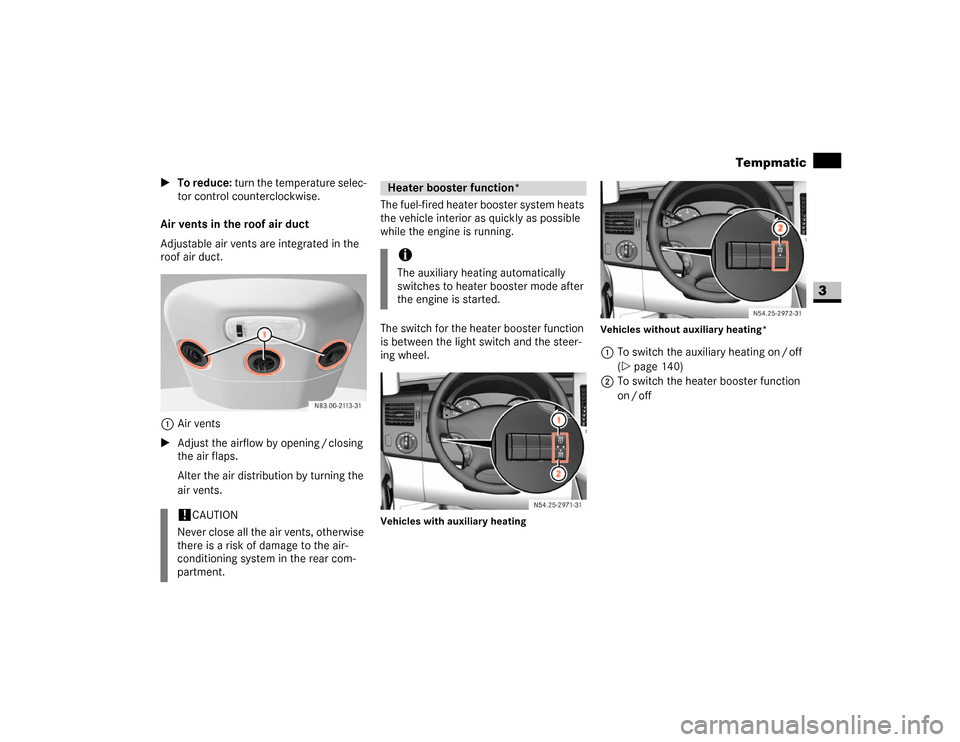
Air vents in the roof air duct
Adjustable air vents are integrated in the
roof air duct.
1Air vents
\1Adjust the airflow by opening / closing
the air flaps.
Alter the air distribution by turning the
air vents.The fuel-fired heater booster system heats
the vehicle interior as quickly as possible
while the engine is running.
The switch for the heater booster function
is between the light switch and the steer-
ing wheel.
Vehicles with auxiliary heatingVehicles without auxiliary heating*
1To switch the auxiliary heating on / off
(\2page 140)
2To switch the heater booster function
on / off
!
CAUTION
Never close all the air vents, otherwise
there is a risk of damage to the air-
conditioning system in the rear com-
partment.
Heater booster function*iThe auxiliary heating automatically
switches to heater booster mode after
the engine is started.
N54.25-2926-31
N54.25-2927-31
Page 171 of 393
170 Controls in detailFeatures
3
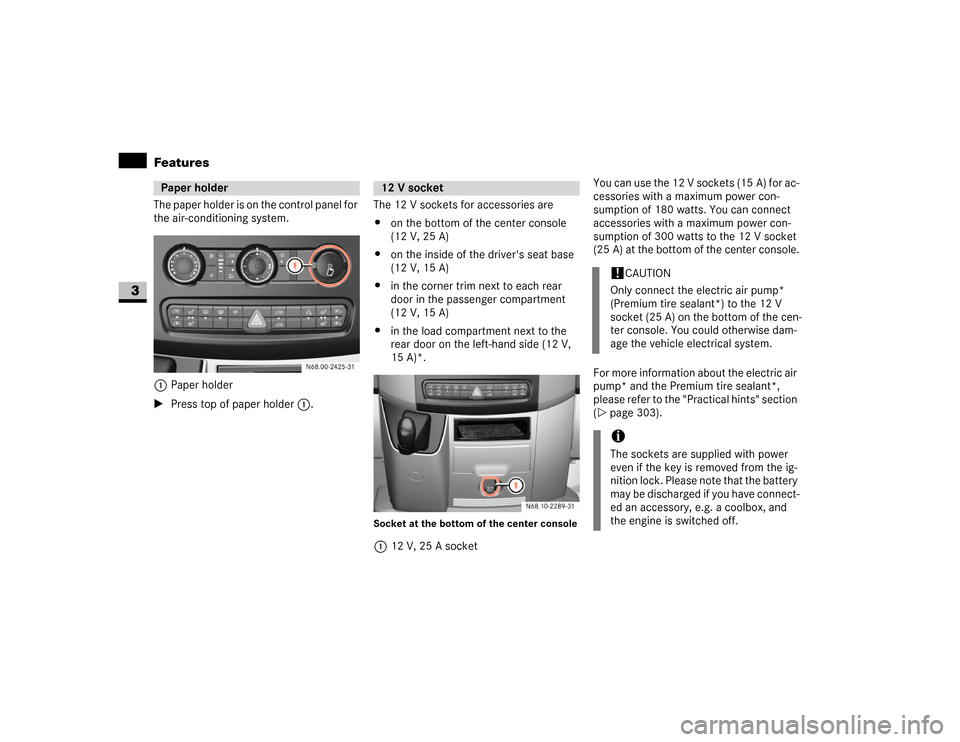
The paper holder is on the control panel for
the air-conditioning system. 1Paper holder
\1Press top of paper holder1.The 12 V sockets for accessories are
\4on the bottom of the center console
(12 V, 25 A)
\4on the inside of the driver's seat base
(12 V, 15 A)
\4in the corner trim next to each rear
door in the passenger compartment
(12 V, 15 A)
\4in the load compartment next to the
rear door on the left-hand side (12 V,
15 A)*.
Socket at the bottom of the center console112 V, 25 A socketYou can use the 12 V sockets (15 A) for ac-
cessories with a maximum power con-
sumption of 180 watts. You can connect
accessories with a maximum power con-
sumption of 300 watts to the 12 V socket
(25 A) at the bottom of the center console.
For more information about the electric air
pump* and the Premium tire sealant*,
please refer to the "Practical hints" section
(\2page 303).
Paper holder
N68.00-2425-31
12 V socket
!
CAUTION
Only connect the electric air pump*
(Premium tire sealant*) to the 12 V
socket (25 A) on the bottom of the cen-
ter console. You could otherwise dam-
age the vehicle electrical system.
iThe sockets are supplied with power
even if the key is removed from the ig-
nition lock. Please note that the battery
may be discharged if you have connect-
ed an accessory, e.g. a coolbox, and
the engine is switched off.
Page 180 of 393
179 Operation
Driving tips
4
Always secure items in the trailer to pre-
vent load shifts while driving.
Take into consideration that when towing a
trailer, the handling characteristics are dif-
ferent and less stable from those when op-
erating the vehicle without a trailer. It is
important to avoid sudden maneuvers.
The vehicle and trailer combination is
heavier, and therefore is limited in acceler-
ation and climbing ability, and requires
longer stopping distances. It is more prone
to reacting to side wind gusts, and requires
more sensitive steering input.
In order to gain skill and an understanding
of the vehicle’s behavior, you should prac-
tice turning , st opping and backing up in a n
area which is free from traffic.
If possible, do not brake abruptly, but rath-
er engage the brake slightly at first to per-
mit the trailer to activate its brake. Then
increase the braking force.
Warning
G
Take into consideration that when towing a
trailer, the handling characteristics are dif-
ferent and less stable from those when op-
erating the vehicle without a trailer.
It is important to avoid sudden maneuvers.
Sudden maneuvers may lead to loss of con-
trol over the vehicle-trailer combination.
This could cause an accident resulting in
property damage or injury to you or others.!
CAUTION
If the transmission hunts between
gears on inclines, manually shift to a
lower gear (select
"4", "3", "2" or
"1").
A lower gear and reduction of speed re-
duces the chance of the engine over-
loading and / or overheating.
When going down a long hill, shift into
a lower gear and use the engine’s brak-
ing effect. Avoid riding the brakes, thus
overheating the vehicle and trailer
brakes.
If the engine coolant rises to an ex-
tremely high temperature (coolant tem-
perature needle approaching the red
zone) when the air conditioner is on,
turn off the air conditioner. Engine
coolant heat can be additionally vented
by opening the windows, switching the
climate control fan speed to high and
setting the temperature control to the
maximum hot position.
Extreme care must be exercised since
your vehicle with a trailer will require
additional passing distance ahead than
when driving without a trailer. Because
your vehicle and trailer is longer than
your vehicle alone, you will also need to
go much farther ahead of the passed
vehicle before you can return to your
lane.
Page 182 of 393
181 Operation
Driving tips
4
Check regularly, e.g. weekly or when refu-
eling:
\4the vehicle lighting
\4the condition of the tires (\2page 201)
and the tire pressures (\2page 210)
\4the engine oil level (\2page 187)
\4the brake fluid level (\2page 192)
\4the fluid level in the windshield washer
system / headlamp cleaning system
reservoir (\2page 193)
\4the contamination level of the rear air-
conditioning air cleaner (\2page 240)
Your vehicle is equipped with monolithic-
type catalytic converters, an important el-
ement in conjunction with the oxygen sen-
sors to achieve substantial control of the
pollutants in the exhaust emissions. Keep
your vehicle in proper operating condition
by following our recommended mainte-
nance instructions as outlined in your Ser-
vice Booklet.Your vehicle is equipped with an oxidation
catalyst, an important element in conjunc-
tion with the oxygen sensors to achieve
substantial control of the pollutants in the
exhaust emissions. Keep your vehicle in
proper operating condition by following
our recommended maintenance instruc-
tions as outlined in your Service Booklet.Regular checksCatalytic converter (gasoline engine)
!
CAUTION
To prevent damage to the catalytic con-
verters, only use premium unleaded
gasoline in this vehicle.
Any noticeable irregularities in engine
operation should be repaired promptly.
Otherwise, excessive unburned fuel
may reach the catalytic converter,
causing it to overheat and potentially
start a fire.
Warning
G
As with any vehicle, do not idle, park or op-
erate this vehicle in areas where combusti-
ble materials such as grass, hay, or leaves
can come into contact with the hot exhaust
system, as these materials could be ignited
and cause a vehicle fire.
Oxidation catalyst (diesel engine)Warning
G
As with any vehicle, do not idle, park or op-
erate this vehicle in areas where combusti-
ble materials such as grass, hay, or leaves
can come into contact with the hot exhaust
system, as these materials could be ignited
and cause a vehicle fire.
Page 202 of 393
201 Operation
Tires and wheels
4
Cuts and punctures in radial tires are re-
pairable only in the tread area because of
side wall flexing. Consult an authorized tire
dealer for radial tire repairs.\4Only use sets of tires and rims of the
same type and make.
\4Tires must be of the correct size for the
rim.
\4Break in new tires for approximately
65 miles (100 km) at moderate
speeds.
\4Regularly check the tires and rims for
damage. Dented or bent rims can
cause tire inflation pressure loss or
damage to the tire beads.
\4If the vehicle is heavily loaded, check
tire inflation pressure and correct as
required.
\4Do not allow your tires to wear down
too far. Adhesion properties on wet
roads are sharply reduced at tread
depths under
1/8in (3 mm) for sum-
mer tires and
1/6in (4 mm) for winter
tires.
Radial-ply tiresWarning
G
Combining radial ply tires with other types
of tires on your Sprinter vehicle will change
the vehicle’s handling characteristics and
may lead to an accident resulting in death,
severe personal injuries and property dam-
age. Always use radial ply tires in sets of 4
(or 6, in case of vehicles with dual rear
wheels).
Never combine them with other types of
tires.
Tire valves (snap-in valves)Warning
G
Sprinter tire valves are tested and approved
under rough operating conditions.
The installation of additional hub caps or
other wheel simulators could cause damage
to the tire valve and lead to a loss of tire
pressure at the valve stem.
Do not install any of these parts on your
Sprinter vehicle. To help ensure safe and re-
liable operation of your Sprinter vehicle,
only use parts and accessories tested and
approved by the vehicle manufacturer for
your Sprinter vehicle.!
CAUTION
For safety reasons, the following tire
valves from the Schrader company
must be used on the vehicles:
\4TR 600 for vehicle model type 2500
\4TR 418 for vehicle model type 3500
Other tire valves could be damaged by
the specified tire pressures.Important guidelines
Page 213 of 393
212 OperationTires and wheels
4
The placard lists the recommended cold
tire inflation pressures for all load conditi-
ons up to the maximum permissible weight
limits (GAWR). The tire inflation pressures
listed apply to the tires installed as original
equipment.
Important notes on tire inflation pres-
sure
Tire temperature and tire inflation pressure
are also increased while driving, depending
on the driving speed and the tire load.
Tire inflation pressure changes by approxi-
mately 1.5 psi (0.1 bar) per 18 °F (10 °C)
of air temperature change. Keep this in mind when checking tire inflation pressure
where the temperature is different from
the outside temperature.
For example:
If the inside temperature is 68 °F (20 °C)
and the outside temperature is 32 °F
(0 °C) then the cold tire inflation pressure
should be increased by 3 psi (0.2 bar),
which equals 1.5 psi (0.1 bar) for every
18 °F (10 °C) for this outside temperature
condition.
Check tire pressures more often if subject
to a wide range of outdoor temperatures,
as tire pressures vary with temperature
changes.Warning
G
If the tire inflation pressure repeatedly
drops:
\4Check the tires for punctures from for-
eign objects.
\4Check to see whether air is leaking from
the valves or from around the rim.
Warning
G
Tire pressure may increase during opera-
tion.
Never reduce this normal pressure build up
or your tire pressure will be too low.
Underinflated tires wear excessively and/or
unevenly, adversely affect handling and fuel
economy, and are more likely to fail from be-
ing overheated.
Page 229 of 393
228 OperationTires and wheels
4
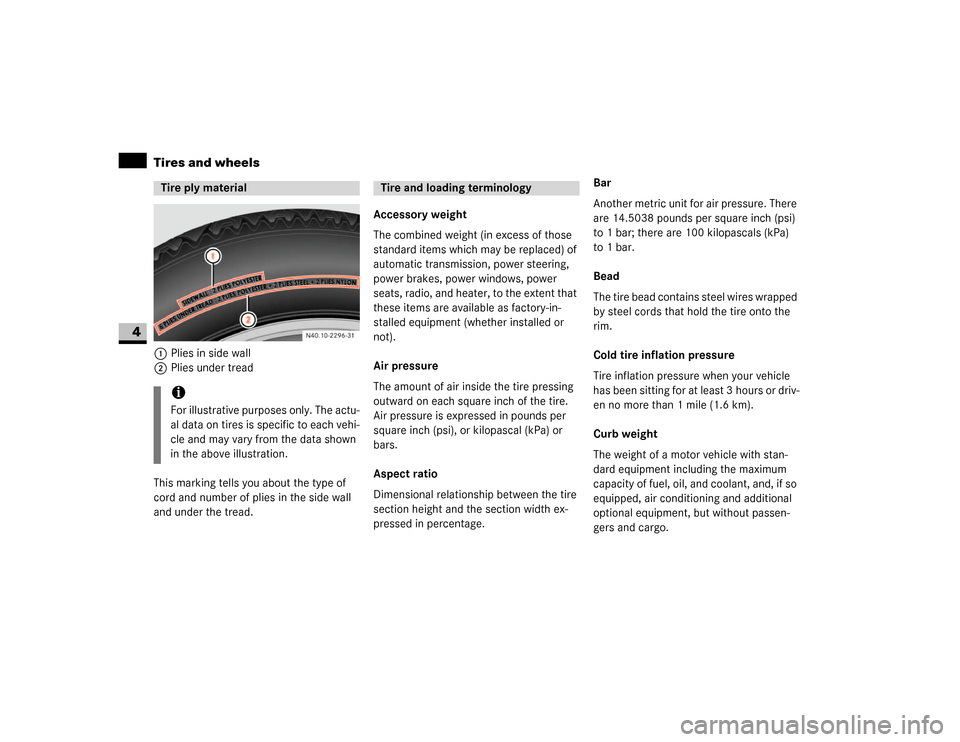
1Plies in side wall
2Plies under tread
This marking tells you about the type of
cord and number of plies in the side wall
and under the tread.Accessory weight
The combined weight (in excess of those
standard items which may be replaced) of
automatic transmission, power steering,
power brakes, power windows, power
seats, radio, and heater, to the extent that
these items are available as factory-in-
stalled equipment (whether installed or
not).
Air pressure
The amount of air inside the tire pressing
outward on each square inch of the tire.
Air pressure is expressed in pounds per
square inch (psi), or kilopascal (kPa) or
bars.
Aspect ratio
Dimensional relationship between the tire
section height and the section width ex-
pressed in percentage.Bar
Another metric unit for air pressure. There
are 14.5038 pounds per square inch (psi)
to 1 bar; there are 100 kilopascals (kPa)
to 1 bar.
Bead
The tire bead contains steel wires wrapped
by steel cords that hold the tire onto the
rim.
Cold tire inflation pressure
Tire inflation pressure when your vehicle
has been sitting for at least 3 hours or driv-
en no more than 1 mile (1.6 km).
Curb weight
The weight of a motor vehicle with stan-
dard equipment including the maximum
capacity of fuel, oil, and coolant, and, if so
equipped, air conditioning and additional
optional equipment, but without passen-
gers and cargo.Tire ply materialiFor illustrative purposes only. The actu-
al data on tires is specific to each vehi-
cle and may vary from the data shown
in the above illustration.
Tire and loading terminology
Page 230 of 393
229 Operation
Tires and wheels
4
DOT (D
epartment O
f T
ransportation)
A tire branding symbol which denotes that
the tire meets the requirements of the
U.S. Department of Transportation.
GAWR (G
ross A
xle W
eight R
ating)
The GAWR is the maximum permissible
axle weight. The gross vehicle weight on
each axle must never exceed the GAWR for
the front and rear axle indicated on the
certification label located on the driver’s
door B-pillar.
GTW (G
ross T
railer W
eight)
The GTW is the weight of the trailer plus
the weight of all cargo, equipment, luggage
etc. loaded on the trailer.GVW (G
ross V
ehicle W
eight)
The GVW comprises the weight of the vehi-
cle including fuel, tools, spare wheel, in-
stalled accessories, passengers and cargo
and, if applicable, trailer tongue load. The
GVW must never exceed the GVWR indicat-
ed on the certification label located on the
driver’s door B-pillar.
GVWR (G
ross V
ehicle W
eight R
ating)
This is the maximum permissible vehicle
weight of the fully loaded vehicle (weight of
the vehicle including all options, passen-
gers, fuel, and cargo and, if applicable,
trailer tongue load). It is indicated on the
certification label located on the driver’s
door B-pillar.
Kilopascal (kPa)
The metric unit for air pressure. There are
6.9kPa to 1psi; another metric unit for air
pressure is bars. there are 100 kilopascals
(kPa) to 1 bar.Maximum load rating
The maximum load in kilograms and
pounds that can be carried by the tire.
Maximum loaded vehicle weight
The sum of curb weight, accessory weight,
vehicle capacity weight and production op-
tions weight.
Maximum tire inflation pressure
This number is the greatest amount of air
pressure that should ever be put in the tire
under normal driving conditions.
Normal occupant weight
The number of occupants the vehicle is de-
signed to seat, multiplied by 68 kilograms
(150 lbs).
Occupant distribution
The distribution of occupants in a vehicle
at their designated seating positions.
Page 231 of 393
230 OperationTires and wheels
4
Production options weight
The combined weight of those installed
regular production options weighing over
5 lbs (2.3 kilograms) in excess of those
standard items which they replace, not
previously considered in curb weight or ac-
cessory weight, including heavy duty
brakes, ride levelers, roof rack, heavy duty
battery, and special trim.
PSI (P
ounds per S
quare I
nch)
A standard unit of measure for air pres-
sure. Another metric unit for air pressure is
bar or kilopascal (kPa).
Recommended tire inflation pressure
Recommended tire inflation pressure list-
ed on the placard located on driver’s door
B-pillar for normal driving conditions. Pro-
vides best handling, tread life and riding
comfort.Rim
A metal support for a tire or a tire and tube
assembly upon which the tire beads are
seated.
Side wall
The portion of a tire between the tread and
the bead.
TIN (T
ire I
dentification N
umber)
Unique identifier which facilitates efforts
by tire manufacturers to notify purchasers
in recall situations or other safety matters
concerning tires and gives purchases the
means to easily identify such tires. The TIN
is comprised of the “manufacturer’s identi-
fication mark”, “tire size”, “tire type code”
and “date of manufacture”.
Tire load rating
Numerical code associated with the maxi-
mum load a tire can support.Tire ply composition and material used
This indicates the number of plies or the
number of layers of rubber-coated fabric in
the tire tread and side wall. Tire manufac-
turers also must indicate the ply materials
in the tire and side wall, which include
steel, nylon, polyester, and others.
Tire speed rating
Part of tire designation; indicates the
speed range for which a tire is approved.
Traction
Force exerted by the vehicle on the road
via the tires. The amount of grip provided.
Tread
The portion of a tire that comes into con-
tact with the road.
Treadwear Indicators
Narrow bands, sometimes called
“wear bars” that show across the tread of
a tire when only
1/16
in (1.6 mm) of tread
remains.
Page 236 of 393
235 Operation
Winter driving
4
Drive with particular care on icy roads.
Avoid sudden acceleration, steering move-
ments and braking.If it seems likely that the vehicle is about to
enter a skid or cannot be stopped at a low
speed:
\4Move the selector lever to position N.
\4Try to maintain control of the vehicle
using light corrective steering.
Road salt may adversely affect braking ef-
ficiency. It may therefore be necessary to
apply the brakes more forcefully in order to
achieve the same braking force as normal.
Apply the brakes regularly when making
longer journeys on gritted or salted roads.
This will have the effect of restoring the
brakes to their normal level of perfor-
mance.
When stopping the vehicle after traveling
on roads that have been salted, check that
the brakes are fully functional before pro-
ceeding further.
Warning
G
If you use your spare tire when winter tires
are fitted on the other wheels, be aware that
the difference in tire characteristics may im-
pair turning stability and overall driving sta-
bility may be reduced. Adapt your driving
style accordingly.
Have the spare tire replaced with a winter
tire at the nearest authorized Sprinter Deal-
er.iWhen they have been removed, store
wheels and tires in a cool, dry, and if
possible dark place. Protect the tires
from oil, grease, and gasoline / diesel.
Driving in winterWarning
G
Downshifting to brake could cause the drive
wheels to lose grip on a slippery surface due
to the increased difference in speed be-
tween the engine and the drive wheels at
this time.
Do not downshift for additional engine brak-
ing on a slippery surface. Use the service
brake in accordance with road conditions.
Only downshift to a lower gear when travel-
ing at a low engine speed.