engine oil DODGE SPRINTER 2007 2.G User Guide
[x] Cancel search | Manufacturer: DODGE, Model Year: 2007, Model line: SPRINTER, Model: DODGE SPRINTER 2007 2.GPages: 393, PDF Size: 7.61 MB
Page 189 of 393
188 OperationEngine
4
Checking the engine oil level in the dis-
play
In vehicles with diesel engines, you can
view the engine oil level in the display.
When the oil is being checked, the vehicle
must
\4be standing level
\4be at normal operating temperature
\4have been standing with the engine
switched off for at least five minutes\1Switch on the ignition (\2page 67).
The display is activated.
Vehicles without steering wheel buttons
\1Press the menu button on the in-
strument cluster repeatedly until you
see the P symbol in the display.
The
--:--
display flashes during the
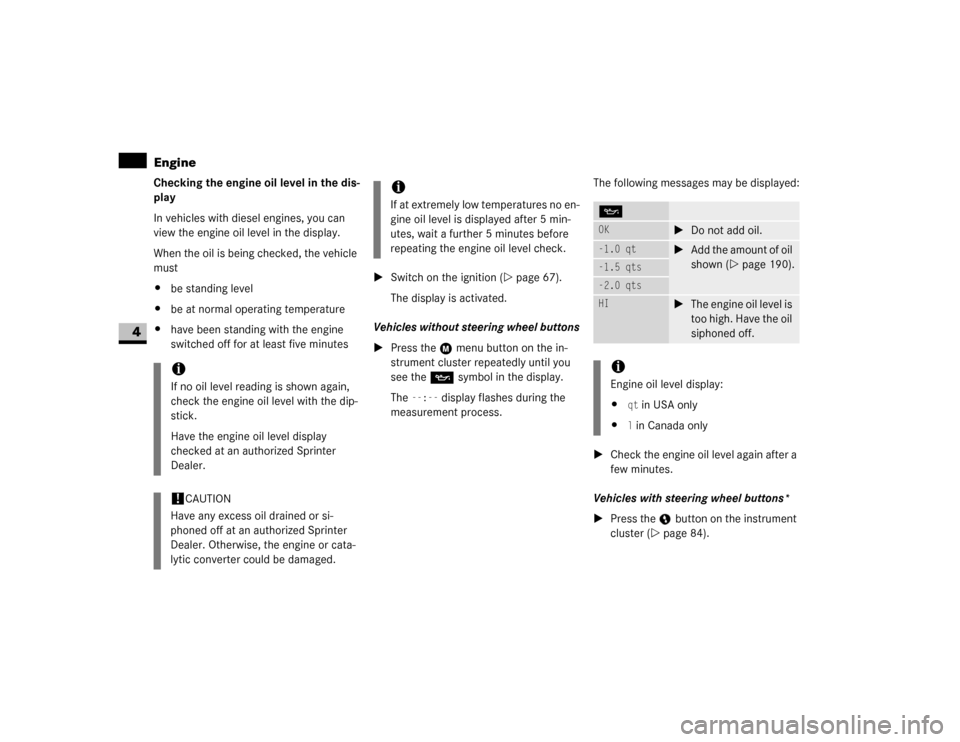
measurement process.The following messages may be displayed:
\1Check the engine oil level again after a
few minutes.
Vehicles with steering wheel buttons*
\1Press the button on the instrument
cluster (\2page 84).
iIf no oil level reading is shown again,
check the engine oil level with the dip-
stick.
Have the engine oil level display
checked at an authorized Sprinter
Dealer.!
CAUTION
Have any excess oil drained or si-
phoned off at an authorized Sprinter
Dealer. Otherwise, the engine or cata-
lytic converter could be damaged.
iIf at extremely low temperatures no en-
gine oil level is displayed after 5 min-
utes, wait a further 5 minutes before
repeating the engine oil level check.
POK
\1Do not add oil.
-1.0 qt
\1Add the amount of oil
shown (\2page 190).
-1.5 qts-2.0 qtsHI
\1The engine oil level is
too high. Have the oil
siphoned off.
iEngine oil level display:
\4
qt in USA only
\4l in Canada only
Page 190 of 393
189 Operation
Engine
4
\1The following message is displayed for
the duration of the measurement pro-
cess:
N
Engine oil level Measuring in
progress
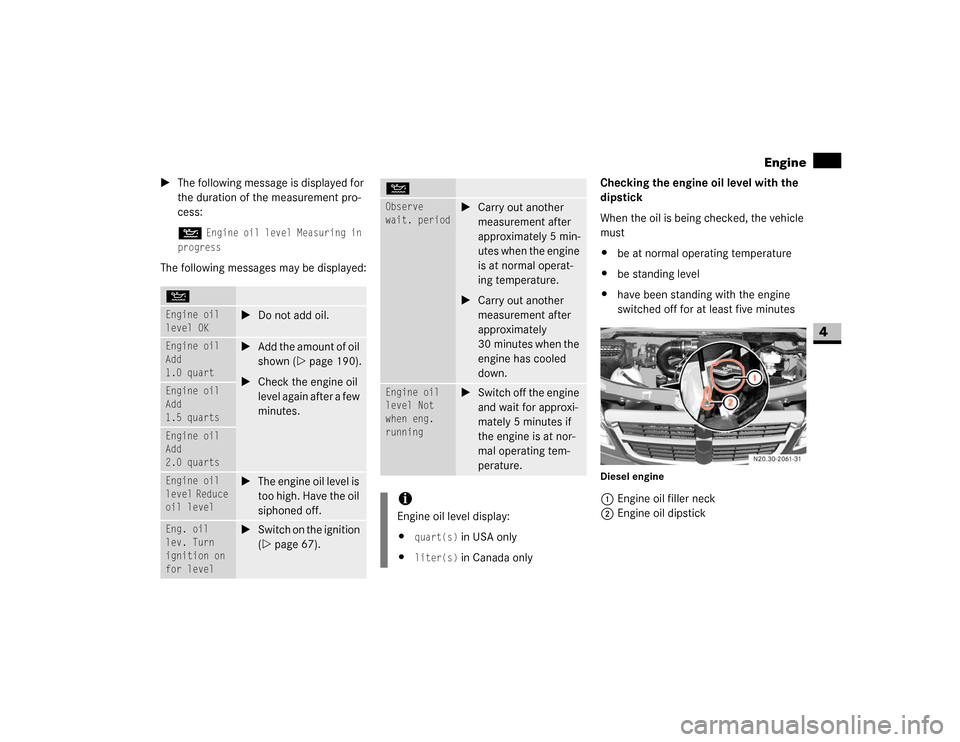
The following messages may be displayed:Checking the engine oil level with the
dipstick
When the oil is being checked, the vehicle
must
\4be at normal operating temperature
\4be standing level
\4have been standing with the engine
switched off for at least five minutes
Diesel engine1Engine oil filler neck
2Engine oil dipstick
NEngine oil
level OK
\1Do not add oil.
Engine oil
Add
1.0 quart
\1Add the amount of oil
shown (\2page 190).
\1Check the engine oil
level again after a few
minutes.
Engine oil
Add
1.5 quartsEngine oil
Add
2.0 quartsEngine oil
level Reduce
oil level
\1The engine oil level is
too high. Have the oil
siphoned off.
Eng. oil
lev. Turn
ignition on
for level
\1Switch on the ignition
(\2page 67).
Observe
wait. period
\1Carry out another
measurement after
approximately 5 min-
utes when the engine
is at normal operat-
ing temperature.
\1Carry out another
measurement after
approximately
30 minutes when the
engine has cooled
down.
Engine oil
level Not
when eng.
running
\1Switch off the engine
and wait for approxi-
mately 5 minutes if
the engine is at nor-
mal operating tem-
perature.
iEngine oil level display:
\4
quart(s)
in USA only
\4
liter(s)
in Canada only
N
Page 191 of 393
190 OperationEngine
4
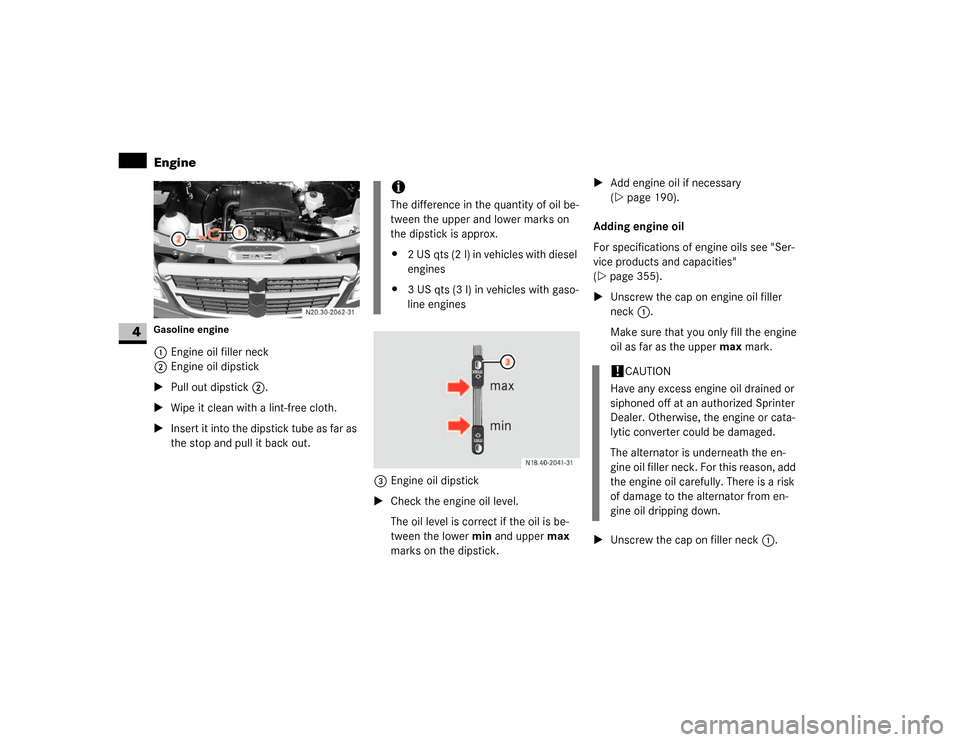
Gasoline engine1Engine oil filler neck
2Engine oil dipstick
\1Pull out dipstick2.
\1Wipe it clean with a lint-free cloth.
\1Insert it into the dipstick tube as far as
the stop and pull it back out.
3Engine oil dipstick
\1Check the engine oil level.
The oil level is correct if the oil is be-
tween the lower min and upper max
marks on the dipstick.\1Add engine oil if necessary
(\2page 190).
Adding engine oil
For specifications of engine oils see "Ser-
vice products and capacities"
(\2page 355).
\1Unscrew the cap on engine oil filler
neck1.
Make sure that you only fill the engine
oil as far as the upper max mark.
\1Unscrew the cap on filler neck1.
iThe difference in the quantity of oil be-
tween the upper and lower marks on
the dipstick is approx.
\42 US qts (2 l) in vehicles with diesel
engines
\43 US qts (3 l) in vehicles with gaso-
line engines
N18.00-2041-31
!
CAUTION
Have any excess engine oil drained or
siphoned off at an authorized Sprinter
Dealer. Otherwise, the engine or cata-
lytic converter could be damaged.
The alternator is underneath the en-
gine oil filler neck. For this reason, add
the engine oil carefully. There is a risk
of damage to the alternator from en-
gine oil dripping down.
Page 192 of 393
191 Operation
Engine
4
The expansion tank is in the engine com-
partment. Only add coolant with the vehi-
cle standing on a level surface and with the
engine switched off. The coolant tempera-
ture must have dropped below 122 °F
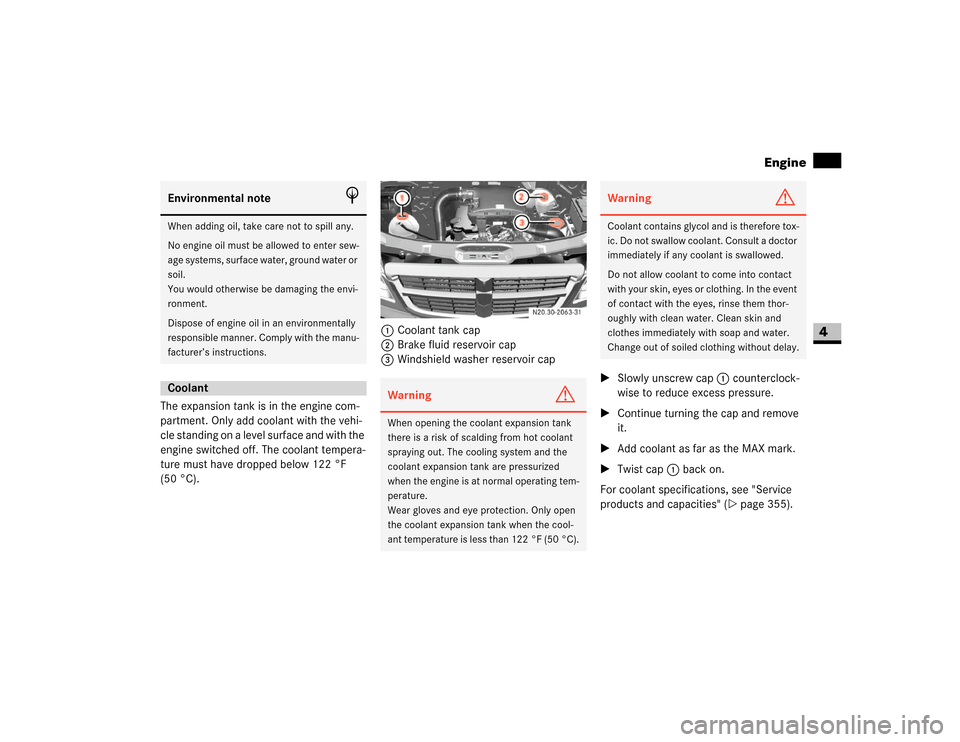
(50 °C).1Coolant tank cap
2Brake fluid reservoir cap
3Windshield washer reservoir cap
\1Slowly unscrew cap1 counterclock-
wise to reduce excess pressure.
\1Continue turning the cap and remove
it.
\1Add coolant as far as the MAX mark.
\1Twist cap1 back on.
For coolant specifications, see "Service
products and capacities" (\2page 355).Environmental note
H
When adding oil, take care not to spill any.
No engine oil must be allowed to enter sew-
age systems, surface water, ground water or
soil.
You would otherwise be damaging the envi-
ronment.
Dispose of engine oil in an environmentally
responsible manner. Comply with the manu-
facturer’s instructions.Coolant
Warning
G
When opening the coolant expansion tank
there is a risk of scalding from hot coolant
spraying out. The cooling system and the
coolant expansion tank are pressurized
when the engine is at normal operating tem-
perature.
Wear gloves and eye protection. Only open
the coolant expansion tank when the cool-
ant temperature is less than 122 °F (50 °C).
N20.30-2063-31
Warning
G
Coolant contains glycol and is therefore tox-
ic. Do not swallow coolant. Consult a doctor
immediately if any coolant is swallowed.
Do not allow coolant to come into contact
with your skin, eyes or clothing. In the event
of contact with the eyes, rinse them thor-
oughly with clean water. Clean skin and
clothes immediately with soap and water.
Change out of soiled clothing without delay.
Page 194 of 393
193 Operation
Engine
4
For specifications of brake fluid, see
"Service products and capacities"
(\2page 362).The windshield washer reservoir is in the
engine compartment. It holds approx.
7.4 US qt (7.0 l).
On vehicles with a headlamp cleaning sys-
tem, this is also supplied from the wind-
shield washer reservoir.
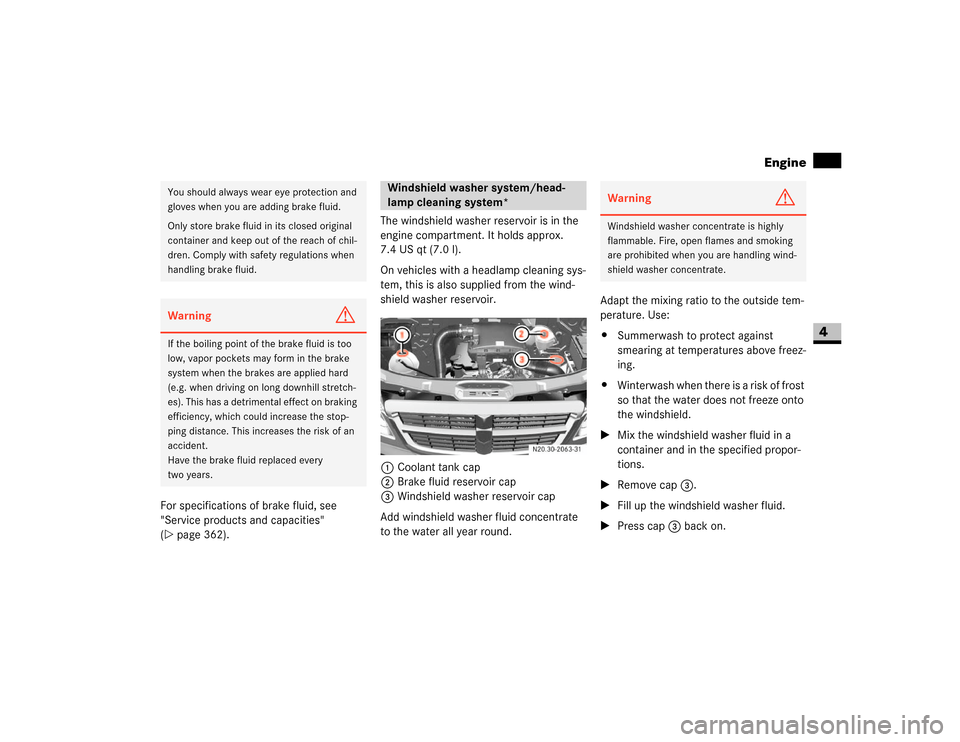
1Coolant tank cap
2Brake fluid reservoir cap
3Windshield washer reservoir cap
Add windshield washer fluid concentrate
to the water all year round.Adapt the mixing ratio to the outside tem-
perature. Use:
\4Summerwash to protect against
smearing at temperatures above freez-
ing.
\4Winterwash when there is a risk of frost
so that the water does not freeze onto
the windshield.
\1Mix the windshield washer fluid in a
container and in the specified propor-
tions.
\1Remove cap3.
\1Fill up the windshield washer fluid.
\1Press cap3 back on.You should always wear eye protection and
gloves when you are adding brake fluid.
Only store brake fluid in its closed original
container and keep out of the reach of chil-
dren. Comply with safety regulations when
handling brake fluid.Warning
G
If the boiling point of the brake fluid is too
low, vapor pockets may form in the brake
system when the brakes are applied hard
(e.g. when driving on long downhill stretch-
es). This has a detrimental effect on braking
efficiency, which could increase the stop-
ping distance. This increases the risk of an
accident.
Have the brake fluid replaced every
two years.
Windshield washer system/head-
lamp cleaning system*
N20.30-2063-31
Warning
G
Windshield washer concentrate is highly
flammable. Fire, open flames and smoking
are prohibited when you are handling wind-
shield washer concentrate.
Page 195 of 393
194 OperationEngine
4
Check assemblies regularly for leaks. In
the event of fluid loss (e.g. spots of oil un-
der the vehicle when it has been parked),
have the cause traced and rectified imme-
diately at an authorized Sprinter Dealer
which has the necessary specialist knowl-
edge and tools to carry out the work re-
quired.
The manufacturer recommends that you
use an authorized Sprinter Dealer for this
purpose. All work relevant to safety or on
safety-related systems must be carried out
at an authorized Sprinter Dealer.Vehicle assemblies
Page 235 of 393
234 OperationWinter driving
4
\3 Winter drivingHave your vehicle winterproofed at the
onset of winter at an authorized Sprinter
Dealer. This service includes the following:
\4Oil change, if the current engine oil
used has not been approved for winter
use
\4The antifreeze / anti-corrosion concen-
tration in the coolant is checked
\4The addition of a concentrated clean-
ing agent to the water in the windshield
washer system
\4Battery check
\4A tire change
You will find information about diesel fuel
for use at low outside temperatures in the
“Technical data” section (\2page 360).
Please also observe the information about
winter driving (\2page 235).Always use winter tires at temperatures
below 45°F (7°C) and whenever wintry
road conditions prevail. Winter tires should
be of the same size and type construction
as the summer tires.
Winter tires should also be operated as
printed on the tire and loading information
placard, refer to "Tires and wheels"
(\2page 199). Not all M+S rated radial-ply
tires provide special winter performance.
Make sure the tires you use show M+S and
the mountain/snowflake marking.on
the tire side wall. These tires meet specific
snow traction performance requirements
of the Rubber Manufacturers Association
(RMA) and the Rubber Association of Can-
ada (RAC) and have been designed specif-
ically for use in snow conditions. Use of
winter tires is the only way to achieve the
maximum effectiveness of the ABS, BAS,
ASR and ESP
® in winter operation.
For safe handling, make sure all winter
tires mounted are of the same make and
have the same tread design.Always observe the speed rating of the
winter tires installed on your vehicle. If the
maximum speed for which your tires are
rated is below the speed rating of your ve-
hicle, you must place a notice to this effect
where it will be seen by the driver. Such no-
tices are available at your tire dealer or any
authorized Sprinter Dealer.
\1Reactivate the tire pressure monitor.
While studded tires improve performance
on ice, skid and traction capability on wet
or dry surfaces may be poorer than that of
non-studded tires. Some states prohibit
studded tires; therefore, local laws should
be checked before using these tire types.
Winter tires
Warning
G
Winter tires with a tread depth under 1/6 in
(4 mm) must be replaced. They are no long-
er suitable for winter operation.
Page 236 of 393
235 Operation
Winter driving
4
Drive with particular care on icy roads.
Avoid sudden acceleration, steering move-
ments and braking.If it seems likely that the vehicle is about to
enter a skid or cannot be stopped at a low
speed:
\4Move the selector lever to position N.
\4Try to maintain control of the vehicle
using light corrective steering.
Road salt may adversely affect braking ef-
ficiency. It may therefore be necessary to
apply the brakes more forcefully in order to
achieve the same braking force as normal.
Apply the brakes regularly when making
longer journeys on gritted or salted roads.
This will have the effect of restoring the
brakes to their normal level of perfor-
mance.
When stopping the vehicle after traveling
on roads that have been salted, check that
the brakes are fully functional before pro-
ceeding further.
Warning
G
If you use your spare tire when winter tires
are fitted on the other wheels, be aware that
the difference in tire characteristics may im-
pair turning stability and overall driving sta-
bility may be reduced. Adapt your driving
style accordingly.
Have the spare tire replaced with a winter
tire at the nearest authorized Sprinter Deal-
er.iWhen they have been removed, store
wheels and tires in a cool, dry, and if
possible dark place. Protect the tires
from oil, grease, and gasoline / diesel.
Driving in winterWarning
G
Downshifting to brake could cause the drive
wheels to lose grip on a slippery surface due
to the increased difference in speed be-
tween the engine and the drive wheels at
this time.
Do not downshift for additional engine brak-
ing on a slippery surface. Use the service
brake in accordance with road conditions.
Only downshift to a lower gear when travel-
ing at a low engine speed.
Page 238 of 393
237 Operation
Maintenance and servicing
4
\3 Maintenance and servicing
Mechanical elements and the lubricants
used for them must be carefully matched.
For this reason, only brands tested and ap-
proved by the manufacturer should be
used. Please contact your Sprinter Dealer
to obtain the necessary information. No lu-
bricant additives should be used.
The use of such additives could affect your
warranty rights. Information is available
from any authorized Sprinter Dealer.
For specifications of engine oils, coolant
and brake fluid, see "Service products and
capacities" (\2page 355) and contact your
authorized Sprinter Dealer.
Observe the information on spare parts in
the “Technical data” section
(\2page 352).
Warning
G
Before carrying out maintenance operations
and repairs, please make sure that you read
the relevant sections of the technical docu-
mentation, such as:
\4Operating instructions and workshop in-
formation
Familiarize yourself in advance in particular
with legal requirements, such as:
\4Safety at work and accident prevention
regulations.
You may otherwise fail to recognize dangers
and could injure yourself or others.
When working underneath the vehicle, you
must place the vehicle on stands with suffi-
cient load-bearing capacity.
Never use the vehicle jack instead. There is
a risk that the vehicle jack could give way
and the vehicle could drop, seriously injuring
yourself or others, or causing damage to
property.
The jack is only designed to raise the vehicle
for a short time.
Always have the maintenance work carried
out and checked at an authorized Sprinter
Dealer which has the necessary specialist
knowledge and tools to carry out the work
required.
The manufacturer recommends that you use
an authorized Sprinter Dealer for this pur-
pose. In particular, work relevant to safety
or on safety-related systems must be car-
ried out at an authorized Sprinter Dealer.
Service products
Page 239 of 393
238 OperationMaintenance and servicing
4
ASSYST, the A
ctive S
ervice Syst
em, in-
forms you when the next service is due.
A service that is due is displayed about a
month or 1900 miles (3000 km) in ad-
vance. A message is then displayed while
the vehicle is in motion or the ignition is
switched on.
Service due date display
Vehicles with steering wheel buttons
The following messages may be displayed:
\49
Service A in .. days
\49
Service A in .. miles
(km)
\49
Service A due now
The letters
A or
B indicate the type of ser-
vice that is due.
Warning
G
If handled incorrectly, service products can
constitute a health risk for people and an en-
vironmental hazard.
Always observe relevant guidelines for han-
dling, storing and disposing of service prod-
ucts.
Active Service System (ASSYST)*!
CAUTION
Periods when the battery is disconnect-
ed will not be recorded by ASSYST. To
make sure that you have the vehicle
serviced at the correct time, you should
therefore subtract periods when the
battery is disconnected from the days
shown.
The service indicator does not provide
information about the engine oil level.
The service indicator should not, there-
fore, be confused with theP engine
oil level display.
iThe service due date is displayed in
days or kilometers, depending on the
total distance driven.
The time between the individual service
due dates depends on your style of
driving. You can increase this by:
\4driving with care and at a moderate
engine speed
\4avoiding short journeys where the
engine does not reach the operat-
ing temperature