spare tire DODGE SPRINTER 2007 2.G User Guide
[x] Cancel search | Manufacturer: DODGE, Model Year: 2007, Model line: SPRINTER, Model: DODGE SPRINTER 2007 2.GPages: 393, PDF Size: 7.61 MB
Page 236 of 393
235 Operation
Winter driving
4
Drive with particular care on icy roads.
Avoid sudden acceleration, steering move-
ments and braking.If it seems likely that the vehicle is about to
enter a skid or cannot be stopped at a low
speed:
\4Move the selector lever to position N.
\4Try to maintain control of the vehicle
using light corrective steering.
Road salt may adversely affect braking ef-
ficiency. It may therefore be necessary to
apply the brakes more forcefully in order to
achieve the same braking force as normal.
Apply the brakes regularly when making
longer journeys on gritted or salted roads.
This will have the effect of restoring the
brakes to their normal level of perfor-
mance.
When stopping the vehicle after traveling
on roads that have been salted, check that
the brakes are fully functional before pro-
ceeding further.
Warning
G
If you use your spare tire when winter tires
are fitted on the other wheels, be aware that
the difference in tire characteristics may im-
pair turning stability and overall driving sta-
bility may be reduced. Adapt your driving
style accordingly.
Have the spare tire replaced with a winter
tire at the nearest authorized Sprinter Deal-
er.iWhen they have been removed, store
wheels and tires in a cool, dry, and if
possible dark place. Protect the tires
from oil, grease, and gasoline / diesel.
Driving in winterWarning
G
Downshifting to brake could cause the drive
wheels to lose grip on a slippery surface due
to the increased difference in speed be-
tween the engine and the drive wheels at
this time.
Do not downshift for additional engine brak-
ing on a slippery surface. Use the service
brake in accordance with road conditions.
Only downshift to a lower gear when travel-
ing at a low engine speed.
Page 237 of 393
236 OperationWinter driving
4
Use "Class U" chains, or other traction aids
that meet SAE Type "U" specifications.
Snow chains must be the proper size for
the vehicle, as recommended by the chain
manufacturer. They should only be driven
on snow-covered roads at speeds not to
exceed 30 mph (50 km / h). Remove
chains as soon as possible when driving on
roads without snow.Please observe the following guidelines
when using snow chains:
\4Snow chains should only be used on
rear wheels. In vehicles with dual rear
wheels, they should be mounted on the
exterior wheels. Follow the manufac-
turer’s mounting instructions.
\4Only use snow chains that are ap-
proved by the vehicle manufacturer.
For approved snow chains, please con-
tact your authorized Sprinter Dealer.
\4Use of snow chains may be prohibited
depending on location. Always check
local and state laws before mounting
snow chains.
To avoid damage to your vehicle, tires or
chains, observe the following precautions:
\4Because of limited chain clearance be-
tween tires and other suspension com-
ponents, it is important that only
chains in good condition are used. Bro-
ken chains can cause serious vehicle
damage. Stop the vehicle immediately if noise occurs that could suggest chain
breakage. Remove the damaged parts
of the chain before further use.
\4Install chains as tightly as possible and
then retighten after driving about 1/2
mile (0.8 km).
\4Do not exceed 30 mph (50 km/h).
\4Drive cautiously and avoid severe turns
and large bumps, especially with a
loaded vehicle.
\4Do not install tire chains on front
wheels.
\4Do not drive for a prolonged period on
dry pavement.
\4Observe the tire chain manufacturer’s
instructions on method of installation,
operating speed, and conditions for us-
age. Always use the lower suggested
operating speed of the chain manufac-
turer if different than the speed recom-
mended by the manufacturer.Snow chains!
CAUTION
Use snow chains on rear wheels only.
Some tire sizes do not leave adequate
clearance for snow chains. To help
avoid serious damage to your vehicle or
tires, use of snow chains is not permis-
sible with the spare wheel.
iWhen driving with snow chains, you
may wish to deactivate the ASR
(\2page 44) before setting the vehicle
in motion. This will improve the vehi-
cle’s traction.
Page 280 of 393
279 Practical hints
What to do if ...
5
Warning!
G
Each tire, including the spare (if provided),
should be checked monthly when cold and
inflated to the inflation pressure recom-
mended by the vehicle manufacturer on the
vehicle placard or the tire inflation pressure
label. (If your vehicle has tires of a different
size than the size indicated on the vehicle
placard or the tire inflation pressure label,
you should determine the proper tire infla-
tion pressure for those tires).
As an added safety feature, your vehicle has
been equipped with a Tire Pressure Monitor-
ing System (TPMS) that illuminates a low tire
pressure telltale when one or more of your
tires is significantly underinflated. Accord-
ingly, when the low tire pressure telltale illu-
minates, you should stop and check your
tires as soon as possible, and inflate them to
the proper pressure. Driving on a significant-
ly underinflated tire causes the tire to over-
heat and can lead to tire failure.
Underinflation also reduces fuel efficiency
and tire tread life, and may affect the vehi-
cle’s handling and stopping ability. Please
note that the TPMS is not a substitute for
proper tire maintenance, and it is the driv-
er’s responsibility to maintain correct tire
pressure, even if underinflation has not
reached the level to trigger illumination of
the TPMS low tire pressure telltale.
USA only:
Your vehicle has also been equipped with a
TPMS malfunction indicator to indicate
when the system is not operating properly.
The TPMS malfunction indicator is com-
bined with the low tire pressure telltale.
When the system detects a malfunction, the
telltale will flash for approximately 1 minute
and then remain continuously illuminated.
This sequence will continue upon subse-
quent vehicle start-ups as long as the mal-
function exists. When the malfunction
indicator is illuminated, the system may not
be able to detect or signal low tire pressure
as intended.
TPMS malfunctions may occur for a variety
of reasons, including the installation of in-
compatible replacement or alternate tires or
wheels on the vehicle that prevent the TPMS
from functioning properly. Always check the
TPMS malfunction telltale after replacing
one or more tires or wheels on your vehicle
to ensure that the replacement or alternate
tires and wheels allow the TPMS to continue
to function properly.
Page 283 of 393
282 Practical hintsDisplay messages
5
Display messages
Possible cause / result
Possible solution
N
There is insufficient or no oil in the engine.
There is a risk of engine damage.
\1Stop your vehicle as soon as it is safe
to do so.
\1Switch off the engine.
\1Check the engine oil level using the
dipstick (\2page 189).
\1If the oil level is correct, have the
malfunction rectified immediately at
an authorized Sprinter Dealer.
\1If there is insufficient or no oil in the
engine, have the vehicle towed to an
authorized Sprinter Dealer.
NOThe message is displayed for 30 seconds.TPMSThe message is also displayed after
30 seconds.
The TPMS is malfunctioning.
\1Have the TPMS checked at an autho-
rized Sprinter Dealer as soon as pos-
sible.
The tire pressure monitor is not receiving
signals from one or more wheels because:
\4a wheel was replaced with the spare
wheel, which is not equipped with a
wheel electronics unit
\4the maximum temperature in one of the
wheel electronics units has been ex-
ceeded
\4one of the wheel electronics units is mal-
functioning
\1Have wheels with wheel electronics
units mounted at an authorized
Sprinter Dealer.
Page 288 of 393
287 Practical hints
Display messages
5
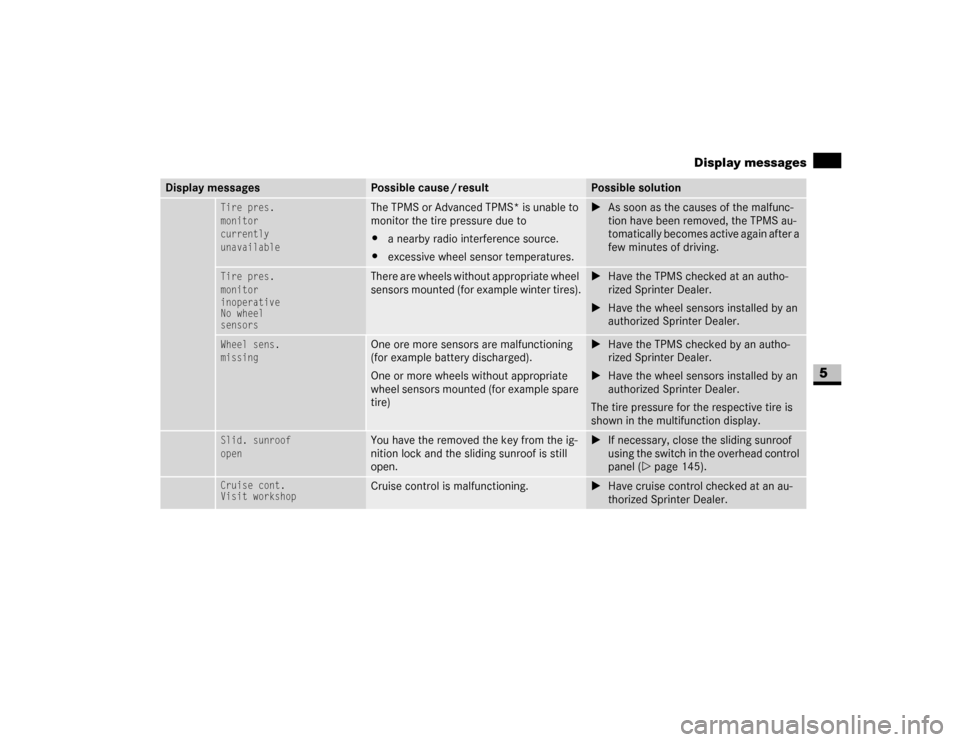
Tire pres.
monitor
currently
unavailable
The TPMS or Advanced TPMS* is unable to
monitor the tire pressure due to
\4a nearby radio interference source.
\4excessive wheel sensor temperatures.
\1As soon as the causes of the malfunc-
tion have been removed, the TPMS au-
tomatically becomes active again after a
few minutes of driving.
Tire pres.
monitor
inoperative
No wheel
sensors
There are wheels without appropriate wheel
sensors mounted (for example winter tires).
\1Have the TPMS checked at an autho-
rized Sprinter Dealer.
\1Have the wheel sensors installed by an
authorized Sprinter Dealer.
Wheel sens.
missing
One ore more sensors are malfunctioning
(for example battery discharged).
One or more wheels without appropriate
wheel sensors mounted (for example spare
tire)
\1Have the TPMS checked by an autho-
rized Sprinter Dealer.
\1Have the wheel sensors installed by an
authorized Sprinter Dealer.
The tire pressure for the respective tire is
shown in the multifunction display.
Slid. sunroof
open
You have the removed the key from the ig-
nition lock and the sliding sunroof is still
open.
\1If necessary, close the sliding sunroof
using the switch in the overhead control
panel (\2page 145).
Cruise cont.
Visit workshop
Cruise control is malfunctioning.
\1Have cruise control checked at an au-
thorized Sprinter Dealer.
Display messages
Possible cause / result
Possible solution
Page 302 of 393
301 Practical hints
Where will I find...?
5
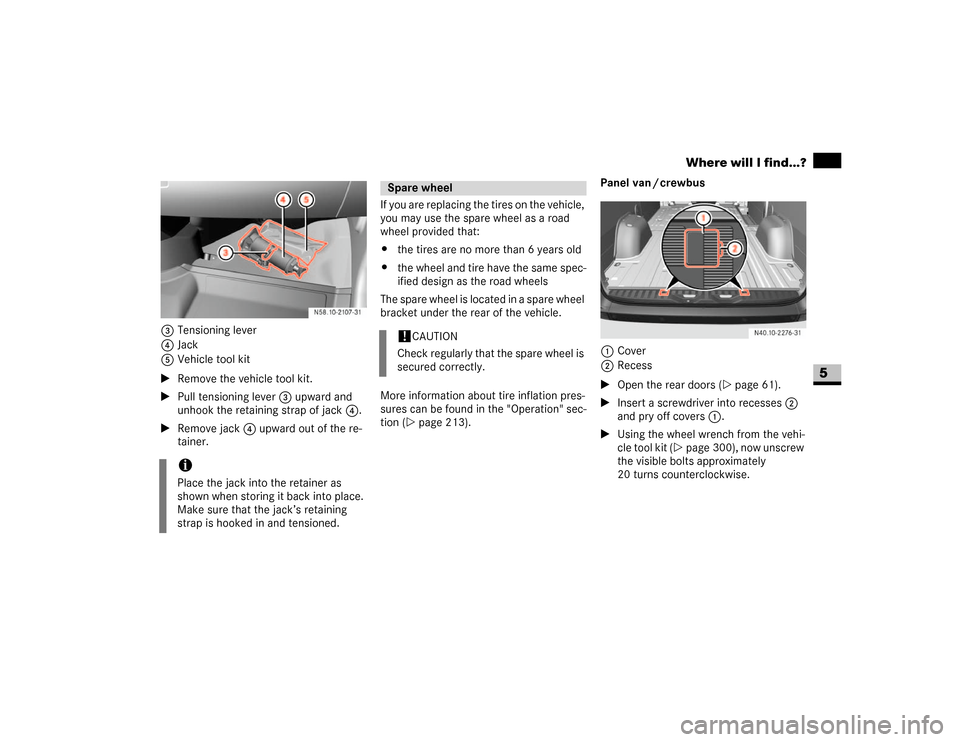
3Tensioning lever
4Jack
5Vehicle tool kit
\1Remove the vehicle tool kit.
\1Pull tensioning lever3 upward and
unhook the retaining strap of jack4.
\1Remove jack4 upward out of the re-
tainer.If you are replacing the tires on the vehicle,
you may use the spare wheel as a road
wheel provided that:
\4the tires are no more than 6 years old
\4the wheel and tire have the same spec-
ified design as the road wheels
The spare wheel is located in a spare wheel
bracket under the rear of the vehicle.
More information about tire inflation pres-
sures can be found in the "Operation" sec-
tion (\2page 213).Panel van / crewbus
1Cover
2Recess
\1Open the rear doors (\2page 61).
\1Insert a screwdriver into recesses2
and pry off covers1.
\1Using the wheel wrench from the vehi-
cle tool kit (\2page 300), now unscrew
the visible bolts approximately
20 turns counterclockwise.
iPlace the jack into the retainer as
shown when storing it back into place.
Make sure that the jack’s retaining
strap is hooked in and tensioned.
Spare wheel!
CAUTION
Check regularly that the spare wheel is
secured correctly.
Page 304 of 393
303 Practical hints
Where will I find...?
5
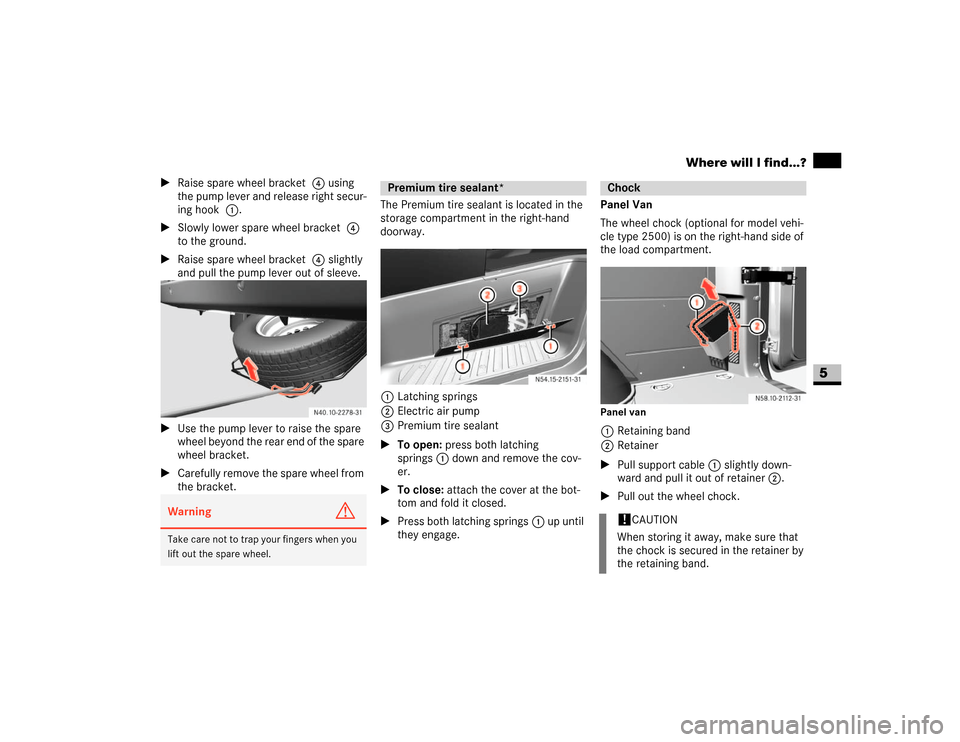
\1Raise spare wheel bracket 4 using
the pump lever and release right secur-
ing hook 1.
\1Slowly lower spare wheel bracket 4
to the ground.
\1Raise spare wheel bracket 4 slightly
and pull the pump lever out of sleeve.
\1Use the pump lever to raise the spare
wheel beyond the rear end of the spare
wheel bracket.
\1Carefully remove the spare wheel from
the bracket.The Premium tire sealant is located in the
storage compartment in the right-hand
doorway.
1Latching springs
2Electric air pump
3Premium tire sealant
\1To open: press both latching
springs1 down and remove the cov-
er.
\1To close: attach the cover at the bot-
tom and fold it closed.
\1Press both latching springs1 up until
they engage.Panel Van
The wheel chock (optional for model vehi-
cle type 2500) is on the right-hand side of
the load compartment.
Panel van1Retaining band
2Retainer
\1Pull support cable 1 slightly down-
ward and pull it out of retainer 2.
\1Pull out the wheel chock.
Warning
G
Take care not to trap your fingers when you
lift out the spare wheel.
Premium tire sealant*
Chock!
CAUTION
When storing it away, make sure that
the chock is secured in the retainer by
the retaining band.
Page 321 of 393
320 Practical hintsFlat tire
5
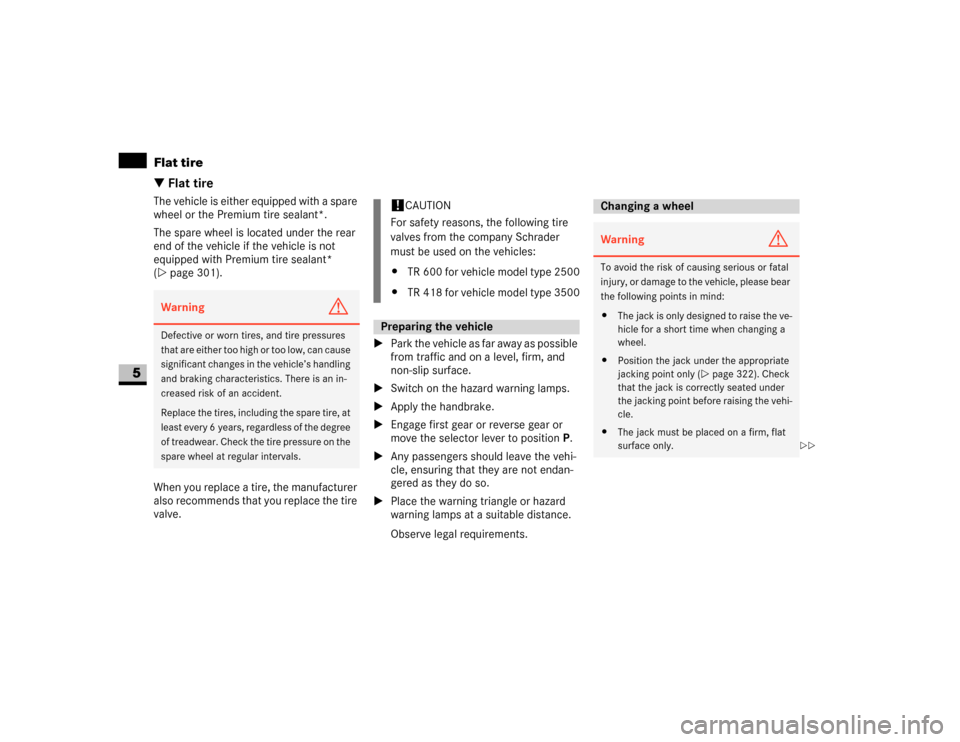
\3 Flat tireThe vehicle is either equipped with a spare
wheel or the Premium tire sealant*.
The spare wheel is located under the rear
end of the vehicle if the vehicle is not
equipped with Premium tire sealant*
(\2page 301).
When you replace a tire, the manufacturer
also recommends that you replace the tire
valve.\1Park the vehicle as far away as possible
from traffic and on a level, firm, and
non-slip surface.
\1Switch on the hazard warning lamps.
\1Apply the handbrake.
\1Engage first gear or reverse gear or
move the selector lever to positionP.
\1Any passengers should leave the vehi-
cle, ensuring that they are not endan-
gered as they do so.
\1Place the warning triangle or hazard
warning lamps at a suitable distance.
Observe legal requirements.Warning
G
Defective or worn tires, and tire pressures
that are either too high or too low, can cause
significant changes in the vehicle’s handling
and braking characteristics. There is an in-
creased risk of an accident.
Replace the tires, including the spare tire, at
least every 6 years, regardless of the degree
of treadwear. Check the tire pressure on the
spare wheel at regular intervals.
!
CAUTION
For safety reasons, the following tire
valves from the company Schrader
must be used on the vehicles:
\4TR 600 for vehicle model type 2500
\4TR 418 for vehicle model type 3500
Preparing the vehicle
Changing a wheelWarning
G
To avoid the risk of causing serious or fatal
injury, or damage to the vehicle, please bear
the following points in mind:
\4The jack is only designed to raise the ve-
hicle for a short time when changing a
wheel.
\4Position the jack under the appropriate
jacking point only (\2page 322). Check
that the jack is correctly seated under
the jacking point before raising the vehi-
cle.
\4The jack must be placed on a firm, flat
surface only.
\2\2
Page 322 of 393
321 Practical hints
Flat tire
5
Preparing the vehicle
Prepare the vehicle as described
(\2page 320).
\1Prevent the vehicle from rolling away
using chocks or similar.
On a level road:
\1Place the chocks in front of and behind
the wheel diagonally opposite to the
wheel that is to be changed.
\1Take the vehicle tool kit and the jack
from the footwell on the co-driver’s
side (\2page 300).
\1Remove the spare wheel from the
spare wheel bracket (\2page 301).
\1For wheels with wheel bolts remove the
wheel cover.
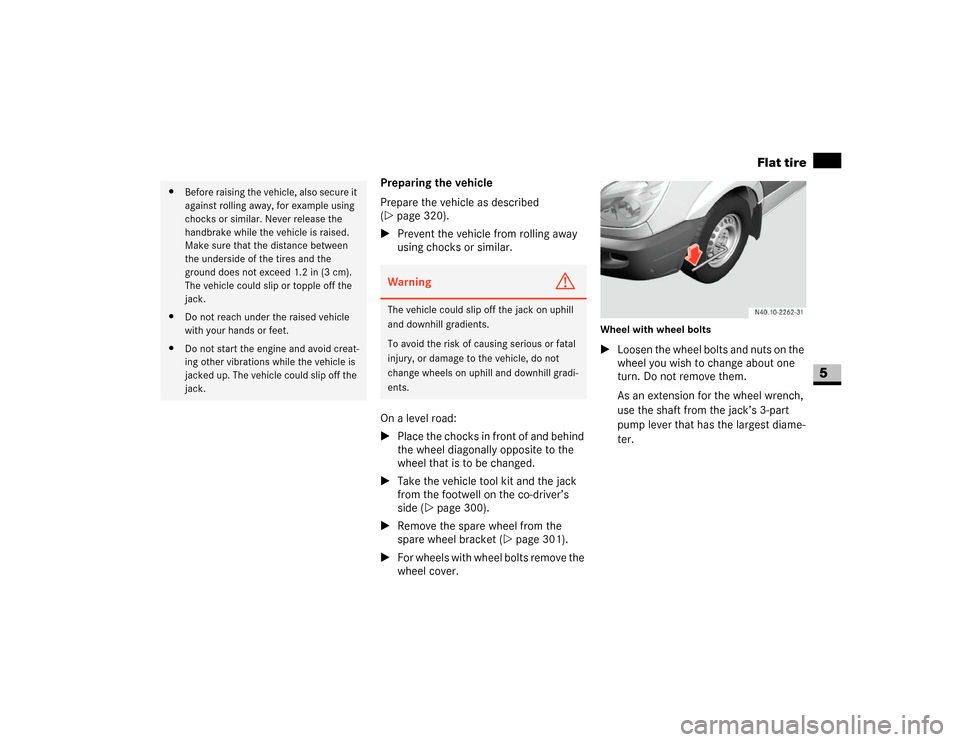
Wheel with wheel bolts\1Loosen the wheel bolts and nuts on the
wheel you wish to change about one
turn. Do not remove them.
As an extension for the wheel wrench,
use the shaft from the jack’s 3-part
pump lever that has the largest diame-
ter.
\4Before raising the vehicle, also secure it
against rolling away, for example using
chocks or similar. Never release the
handbrake while the vehicle is raised.
Make sure that the distance between
the underside of the tires and the
ground does not exceed 1.2 in (3 cm).
The vehicle could slip or topple off the
jack.
\4Do not reach under the raised vehicle
with your hands or feet.
\4Do not start the engine and avoid creat-
ing other vibrations while the vehicle is
jacked up. The vehicle could slip off the
jack.
Warning
G
The vehicle could slip off the jack on uphill
and downhill gradients.
To avoid the risk of causing serious or fatal
injury, or damage to the vehicle, do not
change wheels on uphill and downhill gradi-
ents.
N40.10-2162-31
Page 325 of 393
324 Practical hintsFlat tire
5
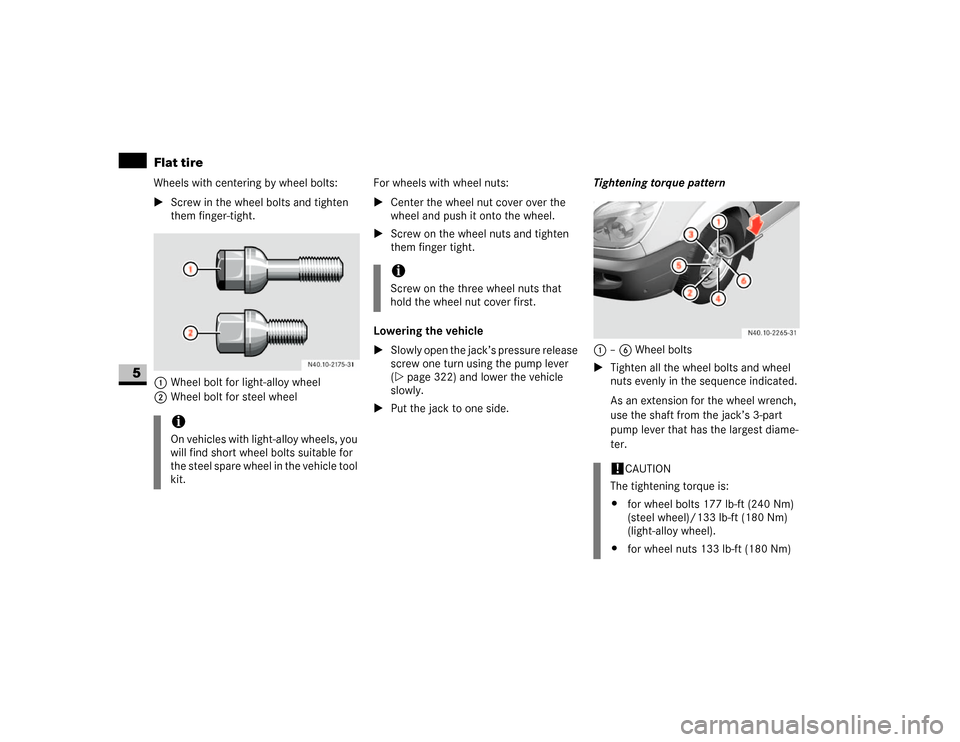
Wheels with centering by wheel bolts:
\1Screw in the wheel bolts and tighten
them finger-tight.
1Wheel bolt for light-alloy wheel
2Wheel bolt for steel wheelor wheels with wheel nuts:
For wheels with wheel nuts:
\1Center the wheel nut cover over the
wheel and push it onto the wheel.
\1Screw on the wheel nuts and tighten
them finger tight.
Lowering the vehicle
\1Slowly open the jack’s pressure release
screw one turn using the pump lever
(\2page 322) and lower the vehicle
slowly.
\1Put the jack to one side.Tightening torque pattern
1 – 6 Wheel bolts
\1Tighten all the wheel bolts and wheel
nuts evenly in the sequence indicated.
As an extension for the wheel wrench,
use the shaft from the jack’s 3-part
pump lever that has the largest diame-
ter.
iOn vehicles with light-alloy wheels, you
will find short wheel bolts suitable for
the steel spare wheel in the vehicle tool
kit.N40.10-2175-31
iScrew on the three wheel nuts that
hold the wheel nut cover first.
!
CAUTION
The tightening torque is:
\4for wheel bolts 177 lb-ft (240 Nm)
(steel wheel)/133 lb-ft (180 Nm)
(light-alloy wheel).
\4for wheel nuts 133 lb-ft (180 Nm)