change wheel DODGE SPRINTER 2007 2.G Owner's Manual
[x] Cancel search | Manufacturer: DODGE, Model Year: 2007, Model line: SPRINTER, Model: DODGE SPRINTER 2007 2.GPages: 393, PDF Size: 7.61 MB
Page 202 of 393
201 Operation
Tires and wheels
4
Cuts and punctures in radial tires are re-
pairable only in the tread area because of
side wall flexing. Consult an authorized tire
dealer for radial tire repairs.\4Only use sets of tires and rims of the
same type and make.
\4Tires must be of the correct size for the
rim.
\4Break in new tires for approximately
65 miles (100 km) at moderate
speeds.
\4Regularly check the tires and rims for
damage. Dented or bent rims can
cause tire inflation pressure loss or
damage to the tire beads.
\4If the vehicle is heavily loaded, check
tire inflation pressure and correct as
required.
\4Do not allow your tires to wear down
too far. Adhesion properties on wet
roads are sharply reduced at tread
depths under
1/8in (3 mm) for sum-
mer tires and
1/6in (4 mm) for winter
tires.
Radial-ply tiresWarning
G
Combining radial ply tires with other types
of tires on your Sprinter vehicle will change
the vehicle’s handling characteristics and
may lead to an accident resulting in death,
severe personal injuries and property dam-
age. Always use radial ply tires in sets of 4
(or 6, in case of vehicles with dual rear
wheels).
Never combine them with other types of
tires.
Tire valves (snap-in valves)Warning
G
Sprinter tire valves are tested and approved
under rough operating conditions.
The installation of additional hub caps or
other wheel simulators could cause damage
to the tire valve and lead to a loss of tire
pressure at the valve stem.
Do not install any of these parts on your
Sprinter vehicle. To help ensure safe and re-
liable operation of your Sprinter vehicle,
only use parts and accessories tested and
approved by the vehicle manufacturer for
your Sprinter vehicle.!
CAUTION
For safety reasons, the following tire
valves from the Schrader company
must be used on the vehicles:
\4TR 600 for vehicle model type 2500
\4TR 418 for vehicle model type 3500
Other tire valves could be damaged by
the specified tire pressures.Important guidelines
Page 213 of 393
212 OperationTires and wheels
4
The placard lists the recommended cold
tire inflation pressures for all load conditi-
ons up to the maximum permissible weight
limits (GAWR). The tire inflation pressures
listed apply to the tires installed as original
equipment.
Important notes on tire inflation pres-
sure
Tire temperature and tire inflation pressure
are also increased while driving, depending
on the driving speed and the tire load.
Tire inflation pressure changes by approxi-
mately 1.5 psi (0.1 bar) per 18 °F (10 °C)
of air temperature change. Keep this in mind when checking tire inflation pressure
where the temperature is different from
the outside temperature.
For example:
If the inside temperature is 68 °F (20 °C)
and the outside temperature is 32 °F
(0 °C) then the cold tire inflation pressure
should be increased by 3 psi (0.2 bar),
which equals 1.5 psi (0.1 bar) for every
18 °F (10 °C) for this outside temperature
condition.
Check tire pressures more often if subject
to a wide range of outdoor temperatures,
as tire pressures vary with temperature
changes.Warning
G
If the tire inflation pressure repeatedly
drops:
\4Check the tires for punctures from for-
eign objects.
\4Check to see whether air is leaking from
the valves or from around the rim.
Warning
G
Tire pressure may increase during opera-
tion.
Never reduce this normal pressure build up
or your tire pressure will be too low.
Underinflated tires wear excessively and/or
unevenly, adversely affect handling and fuel
economy, and are more likely to fail from be-
ing overheated.
Page 232 of 393
231 Operation
Tires and wheels
4
TWR (T
ongue W
eight R
ating)
Maximum permissible weight on the trailer
tongue.
Uniform tire quality grading standards
A tire information system that provides
consumers with ratings for a tire’s traction,
temperature and treadwear. Ratings are
determined by tire manufacturers using
government testing procedures. The rat-
ings are molded into the side wall of the
tire.
Vehicle capacity weight
Rated cargo and luggage load plus
68 kilograms (150 lbs) times the vehicle’s
designated seating capacity.
Vehicle maximum load on the tire
Load on an individual tire that is deter-
mined by distributing to each axle its share
of the maximum loaded vehicle weight and
dividing it by two.
Tires on the front and rear axles of vehicles
operate at different loads and perform dif-
ferent steering, driving and braking func-
tions. For these reasons, they wear at unequal rates, and develop irregular wear
patterns. These effects can be reduced by
timely rotation of tires.
The benefits of rotation are especially
worthwhile with aggressive tread designs
such as those on On/Off Road type tires.
Rotation will increase tread life, help to
maintain mud, snow, and wet traction lev-
els, and contribute to a smooth ride.
If applicable to your vehicle’s tire configu-
ration, tires can be rotated according to
the tire manufacturer’s recommended in-
tervals in the tire manufacturer’s warranty
pamphlet located in your vehicle literature
portfolio. If none is available, tires should
be rotated every 10,000 miles
(16,000 km), or sooner if necessary, ac-
cording to the degree of tire wear.
The same rotation (spinning) direction
must be maintained when mounted, see
"Direction of rotation" (\2page 204).
Rotate tires before the characteristic tire
wear pattern becomes visible (shoulder
wear on front tires and tread center wear
on rear tires).
Rotating tiresWarning
G
Rotate front and rear wheels only if they are
of the same dimension.
Changing the tire dimension for an axle
\4could cause the tire to come into con-
tact with the vehicle body or axle parts.
Damage to the tire or the vehicle may be
the result.
\4could result in changes to steering, han-
dling, and braking of your Sprinter vehi-
cle. This can cause unpredictable
handling and stress to steering and sus-
pension components. You could lose
control and have an accident resulting in
serious injury or death.
\4could result in tire overloading and fail-
ure, if the tires' load index are not iden-
tical. You could lose control and have an
accident.
Page 233 of 393
232 OperationTires and wheels
4
The reasons for any rapid or unusual wear
should be corrected prior to rotation being
performed.
Thoroughly clean the mounting face of
wheels and brake disks, i.e. the inner side
of the wheels/tires, during each rotation.
Check for and ensure proper tire inflation
pressure, refer to "Recommended tire in-
flation pressure" (\2page 210).
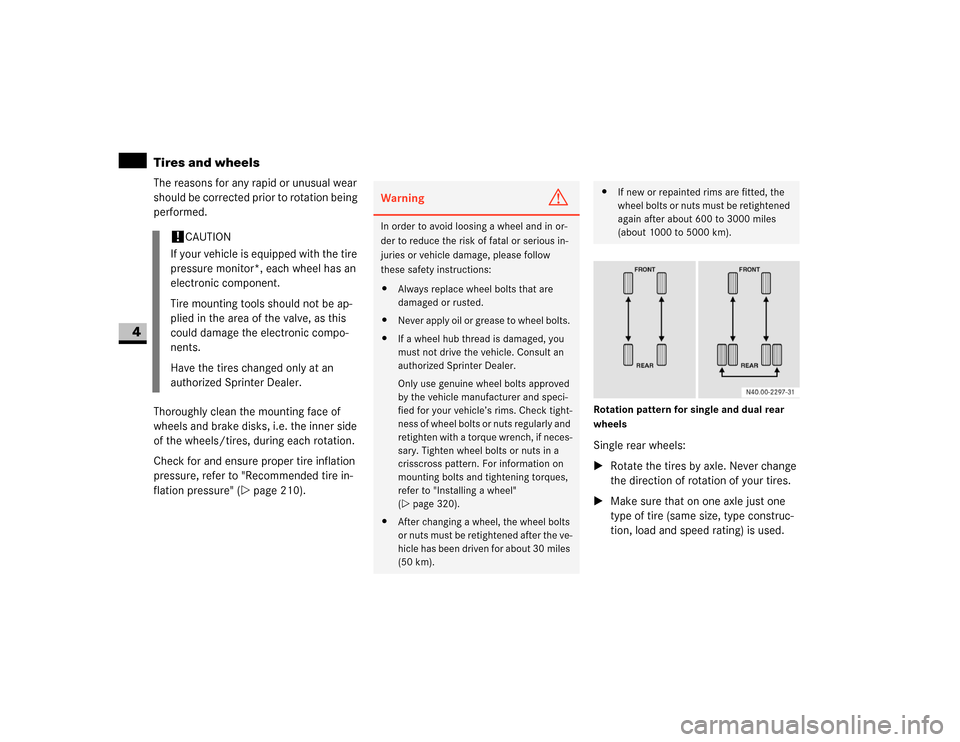
Rotation pattern for single and dual rear
wheelsSingle rear wheels:
\1Rotate the tires by axle. Never change
the direction of rotation of your tires.
\1Make sure that on one axle just one
type of tire (same size, type construc-
tion, load and speed rating) is used.
!
CAUTION
If your vehicle is equipped with the tire
pressure monitor*, each wheel has an
electronic component.
Tire mounting tools should not be ap-
plied in the area of the valve, as this
could damage the electronic compo-
nents.
Have the tires changed only at an
authorized Sprinter Dealer.
Warning
G
In order to avoid loosing a wheel and in or-
der to reduce the risk of fatal or serious in-
juries or vehicle damage, please follow
these safety instructions:
\4Always replace wheel bolts that are
damaged or rusted.
\4Never apply oil or grease to wheel bolts.
\4If a wheel hub thread is damaged, you
must not drive the vehicle. Consult an
authorized Sprinter Dealer.
Only use genuine wheel bolts approved
by the vehicle manufacturer and speci-
fied for your vehicle’s rims. Check tight-
ness of wheel bolts or nuts regularly and
retighten with a torque wrench, if neces-
sary. Tighten wheel bolts or nuts in a
crisscross pattern. For information on
mounting bolts and tightening torques,
refer to "Installing a wheel"
(\2page 320).
\4After changing a wheel, the wheel bolts
or nuts must be retightened after the ve-
hicle has been driven for about 30 miles
(50 km).
\4If new or repainted rims are fitted, the
wheel bolts or nuts must be retightened
again after about 600 to 3000 miles
(about 1000 to 5000 km).
Page 234 of 393
233 Operation
Tires and wheels
4
Dual rear wheels:
\1Rotate front tires by axle and the outer
rear tire side to side if there is no ap-
proved direction of rotation.
The tires used on dual wheel assem-
blies should be matched for wear to
prevent overloading one tire in a set.
\1To check if tires are even, lay a straight
edge across all four tires.
The straight edge should touch all the
tires.
For information on wheel change, see the
“Practical hints” section (\2page 320).
!
CAUTION
3500 dual rear tires have only one ap-
proved direction of rotation. This is to
accommodate the asymmetrical de-
sign (tread pattern) of the ON/OFF
road tire and the use of Outline White
Letter (OWL) tires.
When replacing a flat tire, the spare tire
may have to be remounted on the rim
or installed at a different location to
maintain the correct placement of the
tire on the wheel relative to the tire/
wheel position on the vehicle. For ex-
ample, if the spare is used to replace an
outer rear tire it will have to remounted
on the rim so that the wheel is dished
inward.
That way the tread design of asymmet-
rical tires and the white writing of the
OWL tires will maintain proper position.
Page 235 of 393
234 OperationWinter driving
4
\3 Winter drivingHave your vehicle winterproofed at the
onset of winter at an authorized Sprinter
Dealer. This service includes the following:
\4Oil change, if the current engine oil
used has not been approved for winter
use
\4The antifreeze / anti-corrosion concen-
tration in the coolant is checked
\4The addition of a concentrated clean-
ing agent to the water in the windshield
washer system
\4Battery check
\4A tire change
You will find information about diesel fuel
for use at low outside temperatures in the
“Technical data” section (\2page 360).
Please also observe the information about
winter driving (\2page 235).Always use winter tires at temperatures
below 45°F (7°C) and whenever wintry
road conditions prevail. Winter tires should
be of the same size and type construction
as the summer tires.
Winter tires should also be operated as
printed on the tire and loading information
placard, refer to "Tires and wheels"
(\2page 199). Not all M+S rated radial-ply
tires provide special winter performance.
Make sure the tires you use show M+S and
the mountain/snowflake marking.on
the tire side wall. These tires meet specific
snow traction performance requirements
of the Rubber Manufacturers Association
(RMA) and the Rubber Association of Can-
ada (RAC) and have been designed specif-
ically for use in snow conditions. Use of
winter tires is the only way to achieve the
maximum effectiveness of the ABS, BAS,
ASR and ESP
® in winter operation.
For safe handling, make sure all winter
tires mounted are of the same make and
have the same tread design.Always observe the speed rating of the
winter tires installed on your vehicle. If the
maximum speed for which your tires are
rated is below the speed rating of your ve-
hicle, you must place a notice to this effect
where it will be seen by the driver. Such no-
tices are available at your tire dealer or any
authorized Sprinter Dealer.
\1Reactivate the tire pressure monitor.
While studded tires improve performance
on ice, skid and traction capability on wet
or dry surfaces may be poorer than that of
non-studded tires. Some states prohibit
studded tires; therefore, local laws should
be checked before using these tire types.
Winter tires
Warning
G
Winter tires with a tread depth under 1/6 in
(4 mm) must be replaced. They are no long-
er suitable for winter operation.
Page 246 of 393
245 Operation
Cleaning and care of the vehicle
4
\1Clean the camera lens 1 using water
and a soft cloth only.
Be careful not to apply wax to the camera
lens 1 when waxing the vehicle. If neces-
sary, remove the wax using shampoo with
plenty of water.!
Do not use dry, coarse or hard cloths
and aggressive cleaning agents. Do not
scrub or use high pressure. You will other-
wise scratch or damage the lens or the ca-
mera.
If you clean the vehicle with a high-pressu-
re cleaner or steam cleaner, maintain a mi-
nimum distance of 1.6 ft (50 cm) to the
rear view camera. To prevent damage, do
not aim directly at the rear view camera or
at the microphone openings on the under-
side of the rear view camera.
Plastic trimsLight soiling
\1Wipe plastic parts with a damp, lint-
free cloth (e.g. a micro-fiber cloth).
Heavy soiling
\1Wipe plastic parts with a damp, lint-
free cloth (e.g. a micro-fiber cloth). Dashboard and padded boss of the
steering wheel
\1Moisten a clean and lint-free cloth with
water and clean the plastic parts and
the dashboard.
\1Use a mild soap solution for particularly
stubborn dirt.!
CAUTION
Do not use dry, coarse or hard cloths
and do not scrub. You will otherwise
scratch or damage the surfaces.
!
CAUTION
Use a low-foaming grease solvent (e.g.
washing-up liquid) diluted in water as a
cleaning agent.
The surface color may temporarily
change shade during cleaning. Simply
wait for the surface to dry.
!
CAUTION
Use a solvent-free and non-caustic
cleaning agent. The manufacturer
recommends that you use a
Mercedes-Benz product.
The surface color may temporarily
change shade during cleaning. Simply
wait for the surface to dry.
Warning
G
Do not use cleaners or cockpit care sprays
containing solvents to clean the dashboard
or the padded boss of the steering wheel.
Cleaners containing solvents can make the
surface porous, which could lead to serious
injuries if plastic parts were to come loose
when an airbag is triggered.
Page 264 of 393

263 Practical hints
What to do if ...
5
The speed cannot be set with cruise con-
trol* activated
1.
The display is showing a message of high pri-
ority and cannot therefore show a change in
speed.
\1Proceed as instructed by the mes-
sage in the display.
\1Deactivate cruise control* if neces-
sary.
1Only on vehicles with steering wheel buttons.Problem
Possible cause / result
Suggested solutions
Page 270 of 393
269 Practical hints
What to do if ...
5
#
-
k
6
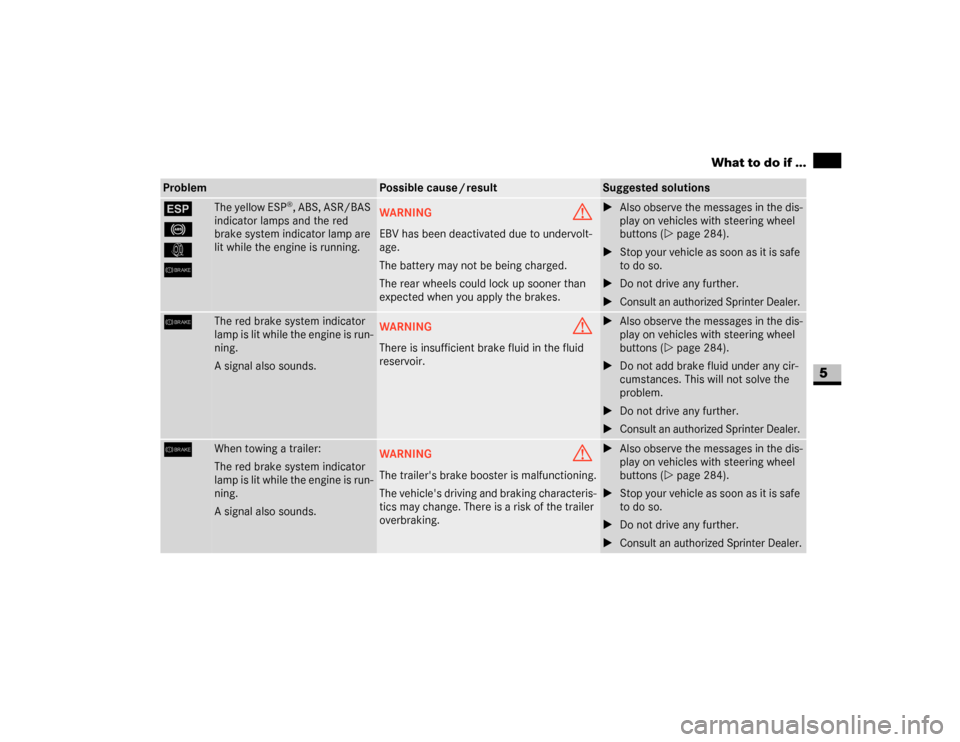
The yellow ESP
®, ABS, ASR/BAS
indicator lamps and the red
brake system indicator lamp are
lit while the engine is running.
WARNING
G
EBV has been deactivated due to undervolt-
age.
The battery may not be being charged.
The rear wheels could lock up sooner than
expected when you apply the brakes.
\1Also observe the messages in the dis-
play on vehicles with steering wheel
buttons (\2page 284).
\1Stop your vehicle as soon as it is safe
to do so.
\1Do not drive any further.
\1Consult an authorized Sprinter Dealer.
6
The red brake system indicator
lamp is lit while the engine is run-
ning.
A signal also sounds.
WARNING
G
There is insufficient brake fluid in the fluid
reservoir.
\1Also observe the messages in the dis-
play on vehicles with steering wheel
buttons (\2page 284).
\1Do not add brake fluid under any cir-
cumstances. This will not solve the
problem.
\1Do not drive any further.
\1Consult an authorized Sprinter Dealer.
6
When towing a trailer:
The red brake system indicator
lamp is lit while the engine is run-
ning.
A signal also sounds.
WARNING
G
The trailer's brake booster is malfunctioning.
The vehicle's driving and braking characteris-
tics may change. There is a risk of the trailer
overbraking.
\1Also observe the messages in the dis-
play on vehicles with steering wheel
buttons (\2page 284).
\1Stop your vehicle as soon as it is safe
to do so.
\1Do not drive any further.
\1Consult an authorized Sprinter Dealer.
Problem
Possible cause / result
Suggested solutions
Page 296 of 393
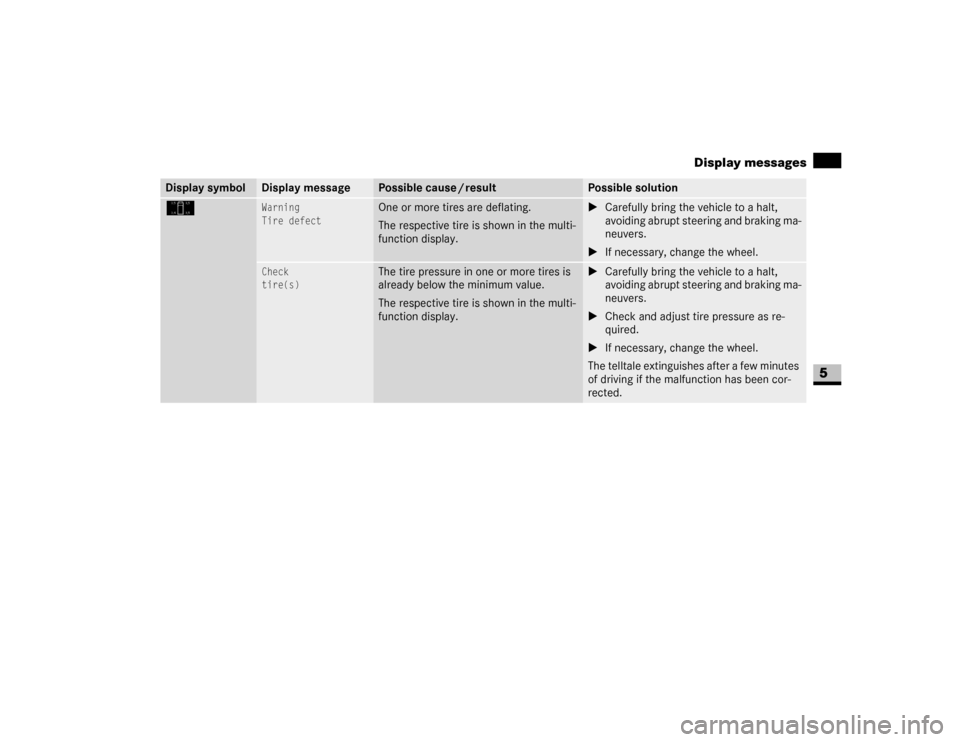
295 Practical hints
Display messages
5
C
Warning
Tire defect
One or more tires are deflating.
The respective tire is shown in the multi-
function display.
\1Carefully bring the vehicle to a halt,
avoiding abrupt steering and braking ma-
neuvers.
\1If necessary, change the wheel.
Check
tire(s)
The tire pressure in one or more tires is
already below the minimum value.
The respective tire is shown in the multi-
function display.
\1Carefully bring the vehicle to a halt,
avoiding abrupt steering and braking ma-
neuvers.
\1Check and adjust tire pressure as re-
quired.
\1If necessary, change the wheel.
The telltale extinguishes after a few minutes
of driving if the malfunction has been cor-
rected.
Display symbol
Display message
Possible cause / result
Possible solution