weight DODGE SPRINTER 2007 2.G Owners Manual
[x] Cancel search | Manufacturer: DODGE, Model Year: 2007, Model line: SPRINTER, Model: DODGE SPRINTER 2007 2.GPages: 393, PDF Size: 7.61 MB
Page 4 of 393
3 Introduction
\3 Environmental protection
In this manual, whenever you see instruc-
tions to discard materials, you should first
attempt to reclaim and recycle them. To
preserve our environment, follow appropri-
ate environmental rules and regulations
when disposing of materials.
Environmental note
H
DaimlerChrysler’s declared policy is one of
comprehensive environmental protection.
The objectives are for the natural resources
which form the basis of our existence on this
planet to be used sparingly and in a manner
which takes the requirements of both nature
and humanity into account.
You too can contribute to environmental
protection by operating your vehicle in an
environmentally-responsible manner.
Fuel consumption and engine, transmission,
brake and tire wear depend on the two fol-
lowing factors:
\4Operating conditions of your vehicle
\4Your personal driving style
You can influence both factors.
Observe the following notes:
Operating conditions
\4Avoid driving short distances as this in-
creases fuel consumption.
\4Make sure that the tire pressures are al-
ways correct.
\4Do not carry any unnecessary weight
in / on the vehicle.
\4Keep an eye on the vehicle’s fuel con-
sumption.
\4Remove roof racks once you no longer
need them.
\4A regularly serviced vehicle will contrib-
ute to environmental protection. You
should therefore adhere to the specified
service intervals.
\4Always have maintenance work carried
out at an authorized Sprinter Dealer.
Personal driving style
\4Do not depress the accelerator pedal
when starting the engine.
\4Do not warm up the engine when the ve-
hicle is stationary.
\4Adopt an anticipatory style of driving
and keep a sufficient distance from oth-
er vehicles.
\4Avoid frequent, sudden acceleration.
\4Switch off the engine in stationary traf-
fic.
Environmental concerns and recom-
mendations
Page 71 of 393
70 Controls in detailSeats
3
Seat suspension adjustment*
The seat suspension must be adjusted to
your body weight.
\1Relieve the load on the seat.
\1Select your body weight 88 to 165 lbs
(40 to 120 kg) using thumbwheel6
for optimal seat suspension.
The seat suspension becomes harder
as the load on the seat increases.
Vertical lock*
If the seat bounces up and down frequent-
ly, you can engage the seat in its lowest po-
sition.
\1Turn lever7 downward.
The next time the seat bounces, it will
engage in its lowest position.
\1Turn lever7 upward to release the
seat from the vertical lock.
The seat can now move up and down
again.Swivelling front seats*
The driver’s and co-driver’s seat can be ro-
tated by 180° to be opposite of the direc-
tion of travel.The seats engage in the direction of travel
or opposite the direction of travel as well
as at 50° pointing towards the exit.
!
When rotating the seats, make sure the-
re is sufficient space. If necessary, move
the seat fore or aft to avoid colliding with
adjacent add-on parts.
Fold the handbrake lever down as far as it
will go. You could otherwise damage the
handbrake or the handbrake lever.
i
Move the co-driver’s seat forward as far
as it will go before rotating it (\2page 69).
\1Make sure the handbrake is applied
and the handbrake lever is folded down
as far as it will go (\2page 115).
\1Set the steering wheel so that there is
sufficient clearance for turning and ad-
justing the driver’s seat (\2page 76).
Warning
G
Only adjust the seats when the vehicle is
stationary and the handbrake is applied. You
could otherwise lose control of the vehicle
as a result of the seat moving and cause an
accident.Warning
G
The driver’s and co-driver’s seat must be ad-
justed and properly engaged in the direction
of travel for driving. Otherwise you will not
be able to operate the vehicle safely.The restraint systems in your vehicle will
only function as intended when the driver’s
and co-driver’s seat are engaged in the di-
rection of travel.
Warning
G
Make sure nobody can become trapped
when unlocking and turning the seats. Never
hold your hands under the seat or near mo-
veable parts when turning the seats.
Page 157 of 393
156 Controls in detailTransporting
3
\3 Transporting
For more information about the maximum
roof load and roof carrier systems, please
refer to the "Technical data" section
(\2page 351).
Loading guidelinesWarning
G
Secure and position a load as described in
the loading guidelines. Otherwise, the load
could slide or be thrown around in the event
of strong braking maneuvers, sudden chang-
es of direction or poor road conditions,
thereby injuring you or others. The same ap-
plies to dismantled seats if left inside the ve-
hicle.
Please note that loads increase the risk of
injury during an accident even if you comply
with all loading guidelines.
Observe the notes in the "Securing a load"
section (\2page 158).Warning
G
Do not exceed the vehicle's permissible
gross weight or the permissible axle loads
when loading the vehicle or carrying addi-
tional passengers.
If you exceed the vehicle's permissible axle
loads or the maximum permissible gross
weight when transporting items or carrying
passengers, tire stability and driving safety
are reduced. The vehicle's driving and steer-
ing characteristics would be greatly altered.
Braking and stopping distances would
be significantly longer.
Your vehicle's driving, steering and braking
characteristics change as the vehicle's
gross weight increases or its center of grav-
ity is raised.
Always ensure that loads are distributed
correctly and adapt your driving style in ac-
cordance with the load.Warning
G
After an accident, have a damaged load
compartment floor or damaged load sur-
face, the lashing eyes and lashing materials
inspected by a specialist workshop having
the necessary technical expertise and tools
to carry out the required work.
The manufacturer recommends that you use
an authorized Sprinter Dealer for this pur-
pose. In particular, work relevant to safety
or on safety-related systems must be car-
ried out at a qualified specialist workshop. !
CAUTION
If you are using a roof carrier system,
observe the maximum roof load and
maximum load-bearing capacity of the
roof carrier system.
Page 158 of 393
157 Controls in detail
Transporting
3
Before loading
\1Check the tire pressures and correct
them if necessary (\2page 213).
\1Clean the load compartment floor.
The load compartment floor must be
dry, cleanly swept and free of oil and
dust to reduce the risk of the load slip-
ping.
\1If necessary, place anti-slip mats on the
load compartment floor.During loading
\1Observe the maximum permissible axle
loads and permissible gross weight for
the vehicle.
\1Observe the notes on load distribution
(\2page 158).
\1Secure the load (\2page 158). All
country-specific legal requirements
must be observed.Checks after loading
\1Securing a load: before each journey
and at regular intervals during longer
journeys, check whether the load is
properly secured and take additional
securing measures, if necessary.
\1Doors: close the sliding doors and rear
doors.
\1Tire pressure: adjust the tire pressure
in accordance with the vehicle's load
(\2page 213).
\1Driving characteristics: adapt your
driving style to the load.
!
CAUTION
As soon as the anti-slip mats start to
show signs of permanent deformation,
squashed areas or tears/holes, they
are unsuitable for securing loads and
must be replaced.
!
CAUTION
In passenger vans with the maximum
number of seats, the maximum payload
would cause the permissible rear axle
load to be exceeded.
iBear in mind that your vehicle's unlad-
en weight is increased by the installa-
tion of optional equipment and
accessories.
Warning
G
Make sure that the sliding doors and rear
doors are always closed when the engine is
running.
Otherwise, exhaust fumes could enter the
vehicle interior and poison you.
Page 161 of 393
160 Controls in detailTransporting
3
\1Always attach the lashing net or tarps
to all available lashing points. While do-
ing so, make sure that the mounting
hooks cannot open unintentionally.Warning
G
Do not carry out any modifications or repairs
to the lashing points, the lashing eyes or the
lashing materials. The load or the lashing
points could accidentally come loose and
cause serious injury to you or others as well
as damage to property.
Distribute loads evenly between the lashing
points or lashing eyes.
Observe the loading guidelines.iLoose loads should be secured with an
approved lashing net or tarp.
!
CAUTION
Observe the data on the maximum
load-bearing capacity of the individual
lashing points
(\2
page 371).
During full-braking applications, for ex-
ample, forces can be involved that are
much greater than the weight force of
the load.
Always use several lashing points in or-
der to distribute force absorption, and
make sure that the lashing points have
an equal load.
iIf your vehicle has load rails in the floor,
you should position locking rods imme-
diately in front of and behind the load.
The locking rods absorb possible shift-
ing forces directly.
Warning
G
If you tension the lashing straps between
the side walls or between a side wall and the
load compartment floor, the permissible
load for the lashing rails, lashing points or
lashing eyes could be exceeded in the event
of strong braking, sudden changes of direc-
tion or an accident.
The load would no longer be secured, which
could result in serious injuries caused by the
load slipping.
For this reason, do not tension a lashing
strap between the side walls or between a
side wall and the load compartment floor.
Only locking bars or rods may be installed
between the load rails near the side walls.
Observe the operating instructions issued
by the locking bar or locking rod manufac-
turer.
Page 162 of 393
161 Controls in detail
Transporting
3
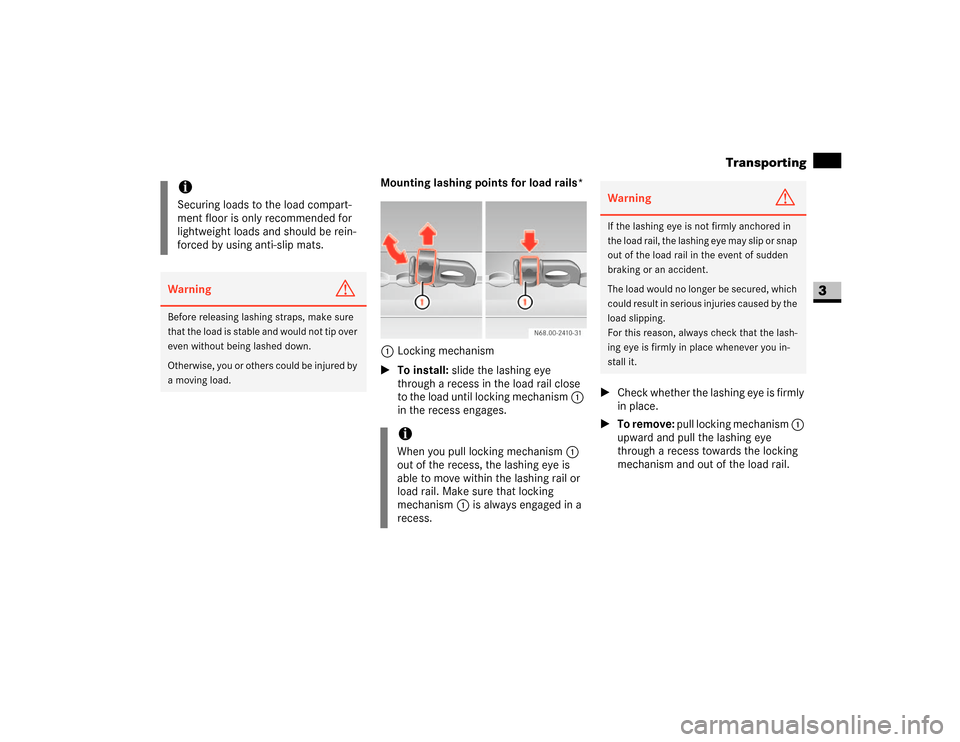
Mounting lashing points for load rails*
1Locking mechanism
\1To install: slide the lashing eye
through a recess in the load rail close
to the load until locking mechanism 1
in the recess engages.\1Check whether the lashing eye is firmly
in place.
\1To remove: pull locking mechanism 1
upward and pull the lashing eye
through a recess towards the locking
mechanism and out of the load rail.
iSecuring loads to the load compart-
ment floor is only recommended for
lightweight loads and should be rein-
forced by using anti-slip mats.Warning
G
Before releasing lashing straps, make sure
that the load is stable and would not tip over
even without being lashed down.
Otherwise, you or others could be injured by
a moving load.
iWhen you pull locking mechanism1
out of the recess, the lashing eye is
able to move within the lashing rail or
load rail. Make sure that locking
mechanism1 is always engaged in a
recess.
Warning
G
If the lashing eye is not firmly anchored in
the load rail, the lashing eye may slip or snap
out of the load rail in the event of sudden
braking or an accident.
The load would no longer be secured, which
could result in serious injuries caused by the
load slipping.
For this reason, always check that the lash-
ing eye is firmly in place whenever you in-
stall it.
Page 177 of 393
176 OperationDriving tips
4
Vehicle and trailer weights and ratings
Gross Vehicle Weight Rating (GVWR) is the
maximum permissible vehicle weight:
\48550 lbs (3880 kg) for vehicle model
type 2500
\49990 lbs (4530 kg), or 11030 lbs
(5003 kg) for vehicle model type 3500
GVWR (G
ross V
ehicle W
eight R
ating)
The total allowable weight of the vehicle.
All occupants, all cargo, and the trailer
tongue load must never exceed the GVWR.
GAWR (G
ross A
xle W
eight R
ating)
The total allowable weight that can be
carried by a single axle (front (FA) or rear
(RA)).
GCWR (G
ross C
ombination W
eight
R
ating)
The total allowable weight of vehicle and
trailer when weighed in combination inclu-
ding a 150 lbs (68 kg) allowance for the
presence of a driver.GTW (G
ross T
railer W
eight)
The maximum permissible trailer weight to
be towed.
TWR (T
railer Tongue W
eight R
ating)
The maximum permissible weight of the
trailer tongue (limit for Sprinter approved
hitch receiver).
For the permissible weights and ratings,
refer to the following table.
Trailer towing
!
CAUTION
Cargo vans with a long wheelbase of
170.3 in (4325 mm) and an overall
vehicle length of 289.1 in (7344 mm)
have a reduced GTW and TWR.
iThe GVWR and the front/rear GAWR of
your vehicle are indicated on the
certification label.!
CAUTION
For vehicle model type 3500, the allow-
able GCWR is less than the combined
maximum weight of the GVWR and the
GTW. Exceeding the GCWR can cause
damage to the drive train, the transmis-
sion, or the trailer hitch*.
Thus, the permissible values for GVWR
and/or the GTW are reduced when
either the trailer or the vehicle is fully
laden. you may therefore only partly
load the vehicle and/or the trailer.
Page 178 of 393
177 Operation
Driving tips
4
1Cargo vans with a long wheelbase of 170.3in (4325 mm) and an overall vehicle length of 289.1 in (7344 mm) only.
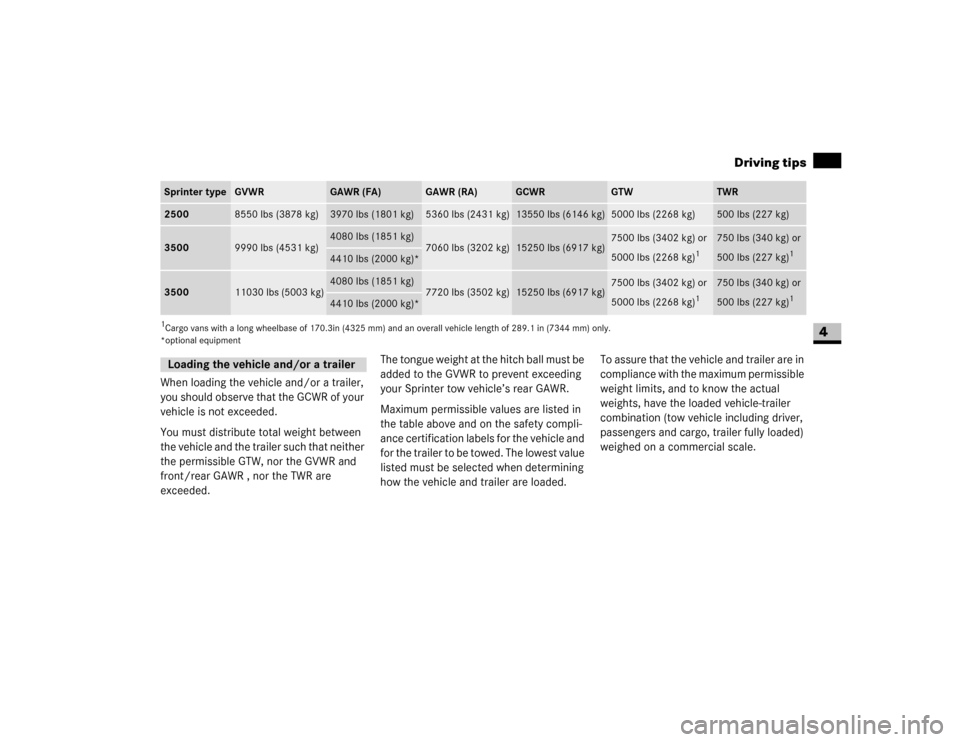
*optional equipmentWhen loading the vehicle and/or a trailer,
you should observe that the GCWR of your
vehicle is not exceeded.
You must distribute total weight between
the vehicle and the trailer such that neither
the permissible GTW, nor the GVWR and
front/rear GAWR , nor the TWR are
exceeded.The tongue weight at the hitch ball must be
added to the GVWR to prevent exceeding
your Sprinter tow vehicle’s rear GAWR.
Maximum permissible values are listed in
the table above and on the safety compli-
ance certification labels for the vehicle and
for the trailer to be towed. The lowest value
listed must be selected when determining
how the vehicle and trailer are loaded.To assure that the vehicle and trailer are in
compliance with the maximum permissible
weight limits, and to know the actual
weights, have the loaded vehicle-trailer
combination (tow vehicle including driver,
passengers and cargo, trailer fully loaded)
weighed on a commercial scale.Sprinter type
GVWR
GAWR (FA)
GAWR (RA)
GCWR
GTW
TWR
2500
8550 lbs (3878 kg)
3970 lbs (1801 kg)
5360 lbs (2431 kg)
13550 lbs (6146 kg)
5000 lbs (2268 kg)
500 lbs (227 kg)
3500
9990 lbs (4531 kg)
4080 lbs (1851 kg)
7060 lbs (3202 kg)
15250 lbs (6917 kg)
7500 lbs (3402 kg) or
5000 lbs (2268 kg)
1
750 lbs (340 kg) or
500 lbs (227 kg)
1
4410 lbs (2000 kg)*
3500
11030 lbs (5003 kg)
4080 lbs (1851 kg)
7720 lbs (3502 kg)
15250 lbs (6917 kg)
7500 lbs (3402 kg) or
5000 lbs (2268 kg)
1
750 lbs (340 kg) or
500 lbs (227 kg)
1
4410 lbs (2000 kg)*
Loading the vehicle and/or a trailer
Page 179 of 393
178 OperationDriving tips
4
Attaching a trailer
Please observe the maximum permitted
trailer dimensions (width and length).
Most states and all Canadian provinces re-
quire safety chains between your tow vehi-
cle and the trailer. The chains should be
crisscrossed under the trailer tongue. They
must be attached to the hitch receiver, and
not to the vehicle’s bumper or axle. Be sure
to leave enough slack in the chains to per-
mit turning corners.Towing a trailer
There are many different laws, including
speed limit restrictions, having to do with
trailer towing. Make sure that your vehicle-
trailer combination will be legal, not only
for where you reside, but also for where
you will be driving. A good source for this
information can be the police or local au-
thorities.
Before you start driving with the trailer,
check the trailer hitch, break-away switch,
safety chains, electrical connections, light-
ing and tires. Also adjust the mirrors to
permit an unobstructed view beyond the
rear of the trailer.
If the trailer has electric brakes, start your
vehicle and trailer moving slowly, and then
apply only the trailer brake controller by
hand to be sure that the brakes are work-
ing properly.
When towing a trailer, check occasionally
to be sure that the load is secure, and that
lighting and trailer brakes (if so equipped)
are functioning properly.
iMost states and all Canadian provinces
require a separate brake system at var-
ious trailer weights.
Warning
G
Do not connect a trailer brake system (if
trailer is so equipped) directly to the vehi-
cle’s hydraulic brake system as your vehicle
is equipped with antilock brakes. If you do,
neither the vehicle’s brakes nor the trailer’s
brakes will function properly. This could
cause an accident resulting in property dam-
age, injury or death to you or others.
The provided vehicle electrical wiring har-
ness for trailer towing has a brake signal
wire for hook-up to a brake controller.
Most states and all Canadian provinces re-
quire a break-away switch on trailers with a
separate brake system. The switch activates
the trailer brakes in the possible event that
the trailer might separate from the tow vehi-
cle.
You should consider using a trailer sway
control system. For further information, see
your authorized Sprinter Dealer.
Page 206 of 393
205 Operation
Tires and wheels
4
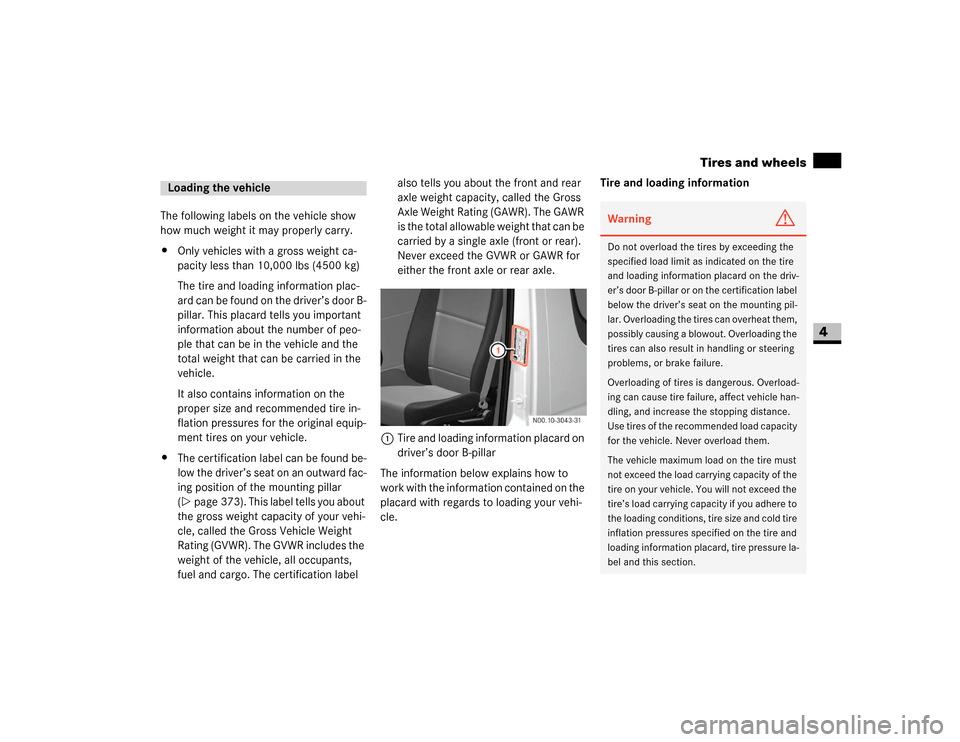
The following labels on the vehicle show
how much weight it may properly carry.
\4Only vehicles with a gross weight ca-
pacity less than 10,000 lbs (4500 kg)
The tire and loading information plac-
ard can be found on the driver’s door B-
pillar. This placard tells you important
information about the number of peo-
ple that can be in the vehicle and the
total weight that can be carried in the
vehicle.
It also contains information on the
proper size and recommended tire in-
flation pressures for the original equip-
ment tires on your vehicle.
\4The certification label can be found be-
low the driver’s seat on an outward fac-
ing position of the mounting pillar
(\2page 373). This label tells you about
the gross weight capacity of your vehi-
cle, called the Gross Vehicle Weight
Rating (GVWR). The GVWR includes the
weight of the vehicle, all occupants,
fuel and cargo. The certification label also tells you about the front and rear
axle weight capacity, called the Gross
Axle Weight Rating (GAWR). The GAWR
is the total allowable weight that can be
carried by a single axle (front or rear).
Never exceed the GVWR or GAWR for
either the front axle or rear axle.
1Tire and loading information placard on
driver’s door B-pillar
The information below explains how to
work with the information contained on the
placard with regards to loading your vehi-
cle.Tire and loading informationLoading the vehicle
Warning
G
Do not overload the tires by exceeding the
specified load limit as indicated on the tire
and loading information placard on the driv-
er’s door B-pillar or on the certification label
below the driver’s seat on the mounting pil-
lar. Overloading the tires can overheat them,
possibly causing a blowout. Overloading the
tires can also result in handling or steering
problems, or brake failure.
Overloading of tires is dangerous. Overload-
ing can cause tire failure, affect vehicle han-
dling, and increase the stopping distance.
Use tires of the recommended load capacity
for the vehicle. Never overload them.
The vehicle maximum load on the tire must
not exceed the load carrying capacity of the
tire on your vehicle. You will not exceed the
tire’s load carrying capacity if you adhere to
the loading conditions, tire size and cold tire
inflation pressures specified on the tire and
loading information placard, tire pressure la-
bel and this section.