warning DODGE SPRINTER 2008 2.G Owners Manual
[x] Cancel search | Manufacturer: DODGE, Model Year: 2008, Model line: SPRINTER, Model: DODGE SPRINTER 2008 2.GPages: 666, PDF Size: 14.11 MB
Page 374 of 666
372 OperationTires and wheels
4
\1
Make sure the tire inflation pressure
of all four tires is correct, using the
tire and loading information placard
1 or the tire inflation pressure placard
located on the driver’s door B-pillar
(
\2
page 362).
In addition to the placard also con-
sult the tire inflation pressure table
(
\2
page 628).
Warning
G
It is the driver’s responsibility to calibrate
the TPMS on the recommended cold infla-
tion pressure. Underinflated tires affect
the ability to steer or brake the vehicle.
You might lose control over the vehicle.1. For vehicles with a gross weight capacity less
than 10 000 lbs (4 536 kg) (USA only).
iReactivate the TPMS after adjusting
the tire inflation pressure to the infla-
tion pressure recommended for the
vehicle operating condition. Tire
pressure should only be adjusted on
cold tires. Observe the recommend-
ed tire inflation pressure on the tire
and loading information placard on
the driver’s door B-pillar
(\2
page 354).
nf_BA.book Page 372 Friday, January 25, 2008 3:53 PM
Page 376 of 666
374 OperationTires and wheels
4
The TPMS only functions on wheels that
are equipped with the proper electronic
sensors. It monitors the tire inflation
pressure, as selected by the driver, in all
four tires. A warning is issued to alert
you to a decrease in pressure in one or
more of the tires.
Tire pressure inquiries are made using
the multifunction display. The present
inflation pressures are displayed only af-
ter a few minutes’ travel time.
\1
Switch on the ignition (
\2
page 111).
\1
Press the
j
or
k
button until
the current inflation pressures for
each tire appear in the multifunction
display. If the telltale flashes for 60 seconds
and then stays illuminated, the TPMS
system itself is not operating proper-
ly.
iCanada only:
The Tire Pressure Monitoring System
(TPMS) is equipped with a low tire
pressure telltale in the instrument
cluster (
\2
page 20). If the telltale il-
luminates, one or more of your tires
is significantly underinflated.
iPossible differences between the
readings of a tire pressure gauge of
an air hose, e.g. gas station equip-
ment, and the vehicle’s control sys-
tem can occur. Usually the readings
issued by the control system are
more precise.
nf_BA.book Page 374 Friday, January 25, 2008 3:53 PM
Page 377 of 666
375 Operation
Tires and wheels
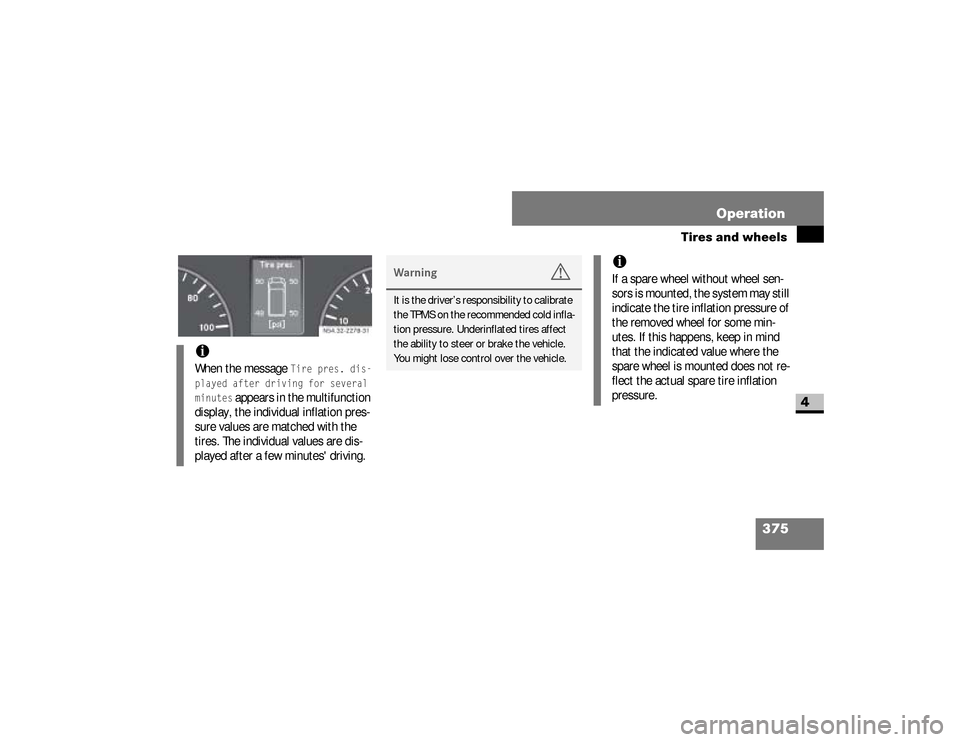
4 i
When the message
Tire pres. dis-
played after driving for several
minutes
appears in the multifunction
display, the individual inflation pres-
sure values are matched with the
tires. The individual values are dis-
played after a few minutes' driving.54.32-2278-31
Warning
G
It is the driver’s responsibility to calibrate
the TPMS on the recommended cold infla-
tion pressure. Underinflated tires affect
the ability to steer or brake the vehicle.
You might lose control over the vehicle.
iIf a spare wheel without wheel sen-
sors is mounted, the system may still
indicate the tire inflation pressure of
the removed wheel for some min-
utes. If this happens, keep in mind
that the indicated value where the
spare wheel is mounted does not re-
flect the actual spare tire inflation
pressure.
nf_BA.book Page 375 Friday, January 25, 2008 3:53 PM
Page 378 of 666
376 OperationTires and wheels
4
Warning
G
The TPMS does not warn you against in-
correctly selected tire inflation pressure
and does not warn you when the tire pres-
sure is not properly selected for the re-
spective vehicle load. It warns you only
when the pressure of one or more tires
decreases significantly below the refer-
ence inflation pressure which was stored
at the time of calibration of the TPMS af-
ter you inflated the tires.Always ensure that you recalibrate the
TPMS after you have inflated the tires to
the recommended cold inflation pressure.
Continued
Warning (Continued)
G
Always adjust the tire inflation pressure
according to the tire and loading informa-
tion placard on the driver’s door B-pillar.Underinflated tires wear excessively and/
or unevenly, adversely affect handling and
fuel economy, and are more likely to fail
from being overheated.Overinflated tires can adversely affect
handling and ride comfort, wear unevenly,
increase stopping distance, and result in
sudden deflation (blowout) because they
are more likely to become punctured or
damaged by road debris, potholes etc.
Continued
Warning (Continued)
G
The TPMS is not able to issue a warning
due to a sudden dramatic loss of pressure
(e.g. tire blowout caused by a foreign ob-
ject). In this case bring the vehicle to a
halt by carefully applying the brakes and
avoiding abrupt steering maneuvers.
nf_BA.book Page 376 Friday, January 25, 2008 3:53 PM
Page 379 of 666
377 Operation
Tires and wheels
4
Warning
G
Each tire, including the spare (if provided),
should be checked monthly when cold
and inflated to the inflation pressure rec-
ommended by the vehicle manufacturer
on the vehicle placard or the tire inflation
pressure label. (If your vehicle has tires of
a different size than the size indicated on
the vehicle placard or the tire inflation
pressure label, you should determine the
proper tire inflation pressure for those
tires).
Continued
Warning (Continued)
G
As an added safety feature, your vehicle
has been equipped with a Tire Pressure
Monitoring System (TPMS) that illumi-
nates a low tire pressure telltale when one
or more of your tires is significantly under-
inflated. Accordingly, when the low tire
pressure telltale illuminates, you should
stop and check your tires as soon as pos-
sible, and inflate them to the proper pres-
sure. Driving on a significantly
underinflated tire causes the tire to over-
heat and can lead to tire failure.
Continued
Warning (Continued)
G
Underinflation also reduces fuel efficiency
and tire tread life, and may affect the ve-
hicle’s handling and stopping ability.
Please note that the TPMS is not a substi-
tute for proper tire maintenance, and it is
the driver’s responsibility to maintain cor-
rect tire pressure, even if underinflation
has not reached the level to trigger illumi-
nation of the TPMS low tire pressure tell-
tale.
Continued
nf_BA.book Page 377 Friday, January 25, 2008 3:53 PM
Page 380 of 666
378 OperationTires and wheels
4
Warning (Continued)
G
USA only:Your vehicle has also been equipped with a
TPMS malfunction indicator to indicate when
the system is not operating properly. The
TPMS malfunction indicator is combined
with the low tire pressure telltale. When the
system detects a malfunction, the telltale will
flash for approximately 1 minute and then re-
main continuously illuminated. This se-
quence will continue upon subsequent
vehicle start-ups as long as the malfunction
exists. When the malfunction indicator is illu-
minated, the system may not be able to de-
tect or signal low tire pressure as intended.
Continued
Warning (Continued)
G
TPMS malfunctions may occur for a vari-
ety of reasons, including the installation
of incompatible replacement or alternate
tires or wheels on the vehicle that prevent
the TPMS from functioning properly. Al-
ways check the TPMS malfunction telltale
after replacing one or more tires or
wheels on your vehicle to ensure that the
replacement or alternate tires and wheels
allow the TPMS to continue to function
properly.
iIf a condition causing the TPMS to
malfunction develops, it may take up
to 10 minutes for the system to sig-
nal a malfunction using the TPMS
telltale flashing and illumination se-
quence.
The telltale extinguishes after driving
a few minutes if the malfunction has
been corrected.iOperating radio transmission equip-
ment (e.g. wireless headsets, two-way
radios) in or near the vehicle could
cause the TPMS to malfunction
nf_BA.book Page 378 Friday, January 25, 2008 3:53 PM
Page 381 of 666
379 Operation
Tires and wheels
4
Reactivating the Advanced TPMSThe TPMS must be reactivated when you
have adjusted the tire inflation pressure
to a new level (e.g. because of different
load or driving conditions). The TPMS is
then recalibrated to the current tire in-
flation pressures.
\1
Make sure the tire inflation pressure
of all four tires is correct, using the
tire and loading information placard
1
or the tire inflation pressure placard
located on the driver’s door B-pillar
(
\2
page 362).
Warning!
G
It is the driver’s responsibility to calibrate
the TPMS on the recommended cold infla-
tion pressure. Underinflated tires affect
the ability to steer or brake the vehicle.
You might lose control over the vehicle.
1. For vehicles with a gross weight capacity less
than 10 000 lbs (4 536 kg) (USA only).
iReactivate the TPMS after adjusting
the tire inflation pressure to the infla-
tion pressure recommended for the
vehicle operating condition. Tire in-
flation pressure should only be adju-
sted on cold tires. Observe the
recommended tire inflation pressure
on the tire and loading information
placard
1 or on the tire inflation pres-
sure placard on the driver’s door B-
pillar (\2
page 362).
nf_BA.book Page 379 Friday, January 25, 2008 3:53 PM
Page 383 of 666
381 Operation
Tires and wheels
4
1. Safety 2. Economy
Improper inflation pressures can cause
uneven wear patterns to develop across
the tire tread. These abnormal wear pat-
terns will reduce tread life resulting in a
need for earlier tire replacement. Under-
inflation also increases tire rolling resis-
tance and results in higher fuel
consumption.
Warning
G
Follow recommended tire inflation pres-
sures.
Do not underinflate tires. Underinflated
tires wear excessively and/or unevenly, ad-
versely affect handling and fuel economy,
and are more likely to fail from being over-
heated.
Do not overinflate tires. Overinflated tires
can adversely affect handling and ride com-
fort, wear unevenly, increase stopping dis-
tance, and result in sudden deflation
(blowout) because they are more likely to
become punctured or damaged by road de-
bris, potholes etc.
Warning
G
Improperly inflated tires are dangerous
and can cause accidents.
Unequal tire inflation pressures can
cause steering problems. You could lose
control of your vehicle.
Unequal tire inflation pressures from one
side of the vehicle to the other can cause
the vehicle to drift to the right or left. Al-
ways drive with each tire inflated to the
recommended cold tire inflation pres-
sure.
nf_BA.book Page 381 Friday, January 25, 2008 3:53 PM
Page 387 of 666
385 Operation
Tires and wheels
4
The commercial vehicle tires based on
European standards may have an addi-
tional value in the parentheses (as illus-
trated). In such cases, the value
preceding the parentheses is valid for
European countries and the parenthe-
sized for the USA and Canada.
Refer also to "Maximum tire load"
(\2
page 390) where the maximum load
associated with the load index is indicat-
ed in kg and lbs.
Warning
G
The tire load rating must always be at
least half of the GAWR of your vehicle.
Otherwise, tire failure may be the result
which may cause an accident and/or se-
rious personal injury to you or others.
Always replace rims and tires with the
same designation, manufacturer and type
as shown on the original part.
Warning
G
Do not overload the tires by exceeding the
specified load limit as indicated on the
placard located on the driver’s door B-pil-
lar. Overloading the tires can overheat
them, possibly causing a blowout. Over-
loading the tires can also result in han-
dling or steering problems, or brake
failure.iTire load rating
6
and tire speed
rating
7
are also referred to as “ser-
vice description”.
nf_BA.book Page 385 Friday, January 25, 2008 3:53 PM
Page 388 of 666
386 OperationTires and wheels
4
Tire speed ratingThe tire speed rating
6
indicates the
approved maximum speed for the tire.
The commercial vehicle tires based on
European standards may have an addi-
tional index in the parentheses. In such
cases, the index preceding the paren-
theses is valid for European countries
and the parenthesized for the USA and
Canada.
Warning
G
Even when permitted by law, never oper-
ate a vehicle at speeds greater than the
maximum speed rating of the tires.
Exceeding the maximum speed for which
tires are rated can lead to sudden tire fail-
ure, causing loss of vehicle control and
possibly resulting in an accident and/or
personal injury and possible death, for
you and for others.
iAlways observe the speed rating of
the winter tires installed on your
Sprinter vehicle. If the maximum
speed for which your tires are rated
is below the speed rating of your
Sprinter vehicle, you must place a
notice to this effect where it will be
seen by the driver.
Such notices are available at your
tire dealer or any authorized Sprinter
Dealer.
nf_BA.book Page 386 Friday, January 25, 2008 3:53 PM