load capacity DODGE SPRINTER 2008 2.G User Guide
[x] Cancel search | Manufacturer: DODGE, Model Year: 2008, Model line: SPRINTER, Model: DODGE SPRINTER 2008 2.GPages: 666, PDF Size: 14.11 MB
Page 357 of 666
355 Operation
Tires and wheels
4
Load limit informationLocate the statement “The combined
weight of occupants and cargo should
never exceed XXX kg or XXX lbs.”
2
on
the tire and loading information placard.
The combined weight of all occupants,
cargo/luggage and trailer tongue load (if
applicable) should never exceed the
weight referenced in that statement.
Steps for determining correct load
limitFor vehicles with a gross weight capacity
less than 10,000 lbs (4536 kg) only.
The following steps have been devel-
oped as required of all manufacturers
under Title 49, Code of U.S. Federal Reg-
ulations, Part 575 pursuant to the “Na-
tional Traffic and Motor Vehicle Safety
Act of 1966”.Step 1
\1
Locate the statement “The combined
weight of occupants and cargo
should never exceed XXX kg or
XXX lbs.” on your vehicle’s placard.
Step 2
\1
Determine the combined weight of
the driver and passengers that will
be riding in your vehicle.
Step 3
\1
Subtract the combined weight of the
driver and passengers from XXX kg
or XXX lbs.
nf_BA.book Page 355 Friday, January 25, 2008 3:53 PM
Page 358 of 666
356 OperationTires and wheels
4
Step 4\1
The resulting figure equals the avail-
able amount of cargo and luggage
load capacity. For example, if the
“XXX” amount equals 1400 lbs and
there will be five 150 lbs passengers
in your vehicle, the amount of avail-
able cargo and luggage load capacity
is 650 lbs (1400-750 (5 x150) =
650 lbs).
Step 5
\1
Determine the combined weight of
luggage and cargo being loaded on
the vehicle. That weight may not safely exceed the available cargo
and luggage load capacity calculated
in step 4.
Step 6 (if applicable)
\1
If your vehicle will be towing a trailer,
load from your trailer will be trans-
ferred to your vehicle. Consult this
manual to determine how this reduc-
es the available cargo and luggage
load capacity of your vehicle.
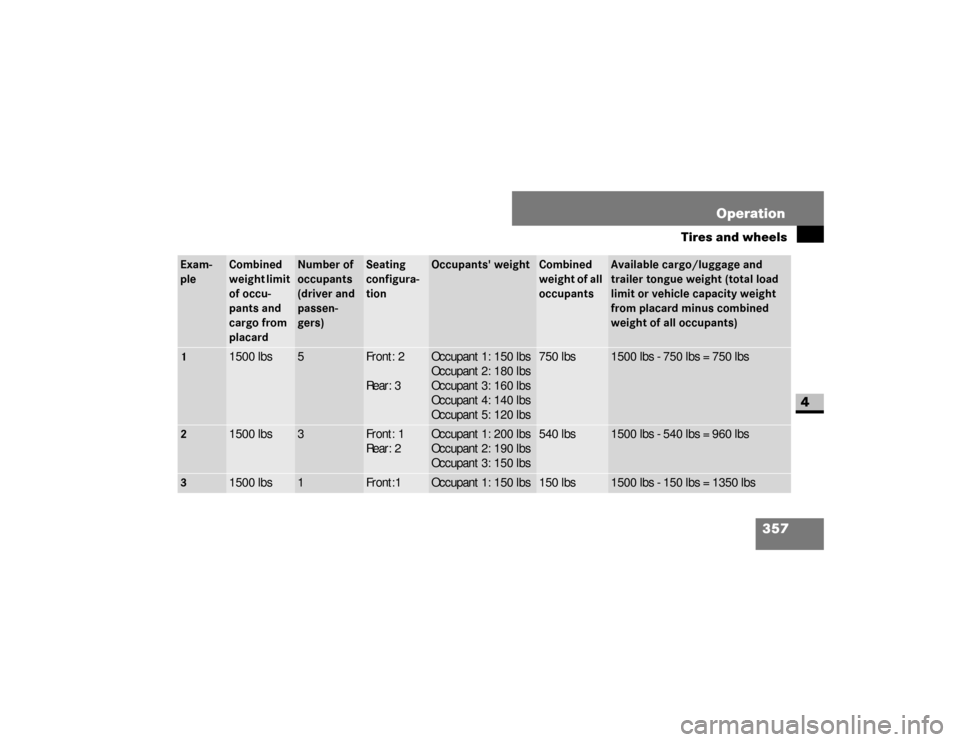
The following table shows examples on
how to calculate total load, cargo load
and towing capacities with varying seat-
ing configurations and number and size
of occupants. The following examples
use a load limit of 1500 lbs.
This is for illustrative purposes only
. Make sure
you are using the actual load limit for
your vehicle stated on the vehicle’s tire
and loading information placard
(
\2
page 354).
The higher the weight of all occupants,
the less cargo and luggage load capacity
is available.
nf_BA.book Page 356 Friday, January 25, 2008 3:53 PM
Page 359 of 666
357 Operation
Tires and wheels
4
Exam-
ple
Combined
weight limit
of occu-
pants and
cargo from
placard
Number of
occupants
(driver and
passen-
gers)
Seating
configura-
tion
Occupants' weight
Combined
weight of all
occupants
Available cargo/luggage and
trailer tongue weight (total load
limit or vehicle capacity weight
from placard minus combined
weight of all occupants)
1
1500 lbs
5
Front: 2
Rear: 3
Occupant 1: 150 lbs
Occupant 2: 180 lbs
Occupant 3: 160 lbs
Occupant 4: 140 lbs
Occupant 5: 120 lbs
750 lbs
1500 lbs - 750 lbs = 750 lbs
2
1500 lbs
3
Front: 1
Rear: 2
Occupant 1: 200 lbs
Occupant 2: 190 lbs
Occupant 3: 150 lbs
540 lbs
1500 lbs - 540 lbs = 960 lbs
3
1500 lbs
1
Front:1
Occupant 1: 150 lbs
150 lbs
1500 lbs - 150 lbs = 1350 lbs
nf_BA.book Page 357 Friday, January 25, 2008 3:53 PM
Page 360 of 666
358 OperationTires and wheels
4
Certification labelEven after careful determination of the
combined weight of all occupants, cargo
and the trailer tongue load (if applicable)
as to not exceed the permissible load
limit, you must make sure that your vehi-
cle never exceeds the Gross Vehicle
Weight Rating (GVWR) and the Gross
Axle Weight Rating (GAWR) for either the
front or rear axle and the Gross Combi-
nation Weight Rating (GCWR) (if applica-
ble).
Under a maximum loaded vehicle condi-
tion, gross axle weight ratings (GAWR’s)
for the front and rear axles must not be
exceeded. USA only - for vehicles with a gross
weight capacity less than 10,000 lbs
(4536 kg) only:
To determine the maximum loading con-
ditions of your vehicle, locate the state-
ment "The combined weight of
occupants and cargo should never ex-
ceed XXX kg or XXX lbs." on the tire and
loading information placard. The com-
bined weight of occupants, cargo/lug-
gage and trailer tongue weight (if
applicable) should never exceed the
weight referenced here.
You can obtain the GVWR, the front/rear
GAWR and the GCWR from the certifica-
tion label. The certification label can be found below the driver’s seat on an out-
ward facing position of the mounting pil-
lar (
\2
page 632).
For more information on the trailer
tongue load, refer to "Trailer tongue
load".
Gross Vehicle Weight Rating (GVWR):
The total weight of the vehicle, all occu-
pants, all cargo, and the trailer tongue
load must never exceed the GVWR.
Gross Axle Weight Rating (GAWR):
The total allowable weight that can be
carried by a single axle (front (FA) or rear
(RA)).
nf_BA.book Page 358 Friday, January 25, 2008 3:53 PM
Page 362 of 666
360 OperationTires and wheels
4
To assure that your vehicle does not ex-
ceed the maximum permissible weight
limits (GVWR and GAWR for front and
rear axle and GCWR), have the loaded
vehicle (including driver, passengers and
all cargo and, if applicable, trailer fully
loaded) weighed on a suitable commer-
cial scale.
Trailer tongue loadThe tongue load (tongue weight at the
hitch ball) of any trailer is an important
weight to measure because it affects the
load you can carry in your vehicle. If a
trailer is towed, the tongue load must be
added to the weight of all occupants
riding and any cargo you are carrying in
the vehicle to prevent exceeding your
Sprinter tow vehicle’s rear GAWR. The
tongue load is 10% of the trailer weight
and everything loaded in it.For example, if the trailer tongue load
equals 140 lbs (63.5 kg) and the deter-
mined available cargo/luggage and trail-
er tongue weight equals 500 lbs (227
kg), the amount of available cargo and
luggage load capacity is 360 lbs (500 –
140 = 360 lbs) (163.5 kg (227 – 63.5 =
163.5 kg)).
For further information on vehicle and
trailer weights and ratings, loading a
trailer and trailer towing, see “Trailer
towing” (
\2
page303).
nf_BA.book Page 360 Friday, January 25, 2008 3:53 PM
Page 363 of 666
361 Operation
Tires and wheels
4
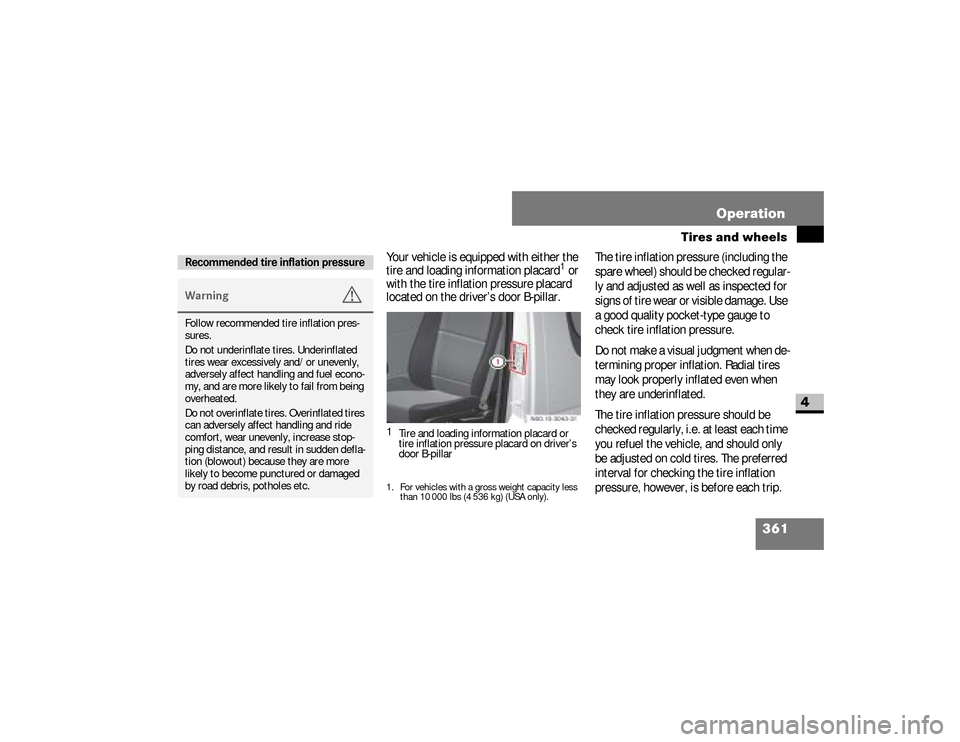
Your vehicle is equipped with either the
tire and loading information placard
1 or
with the tire inflation pressure placard
located on the driver’s door B-pillar.The tire inflation pressure (including the
spare wheel) should be checked regular-
ly and adjusted as well as inspected for
signs of tire wear or visible damage. Use
a good quality pocket-type gauge to
check tire inflation pressure.
Do not m a ke a vis ua l ju dgm ent when de -
termining proper inflation. Radial tires
may look properly inflated even when
they are underinflated.
The tire inflation pressure should be
checked regularly, i.e. at least each time
you refuel the vehicle, and should only
be adjusted on cold tires. The preferred
interval for checking the tire inflation
pressure, however, is before each trip.
Recommended tire inflation pressureWarning
G
Follow recommended tire inflation pres-
sures.
Do not underinflate tires. Underinflated
tires wear excessively and/or unevenly,
adversely affect handling and fuel econo-
my, and are more likely to fail from being
overheated.
Do not overinflate tires. Overinflated tires
can adversely affect handling and ride
comfort, wear unevenly, increase stop-
ping distance, and result in sudden defla-
tion (blowout) because they are more
likely to become punctured or damaged
by road debris, potholes etc.
1. For vehicles with a gross weight capacity less
than 10 000 lbs (4 536 kg) (USA only).1
Tire and loading information placard or
tire inflation pressure placard on driver’s
door B-pillar
nf_BA.book Page 361 Friday, January 25, 2008 3:53 PM
Page 365 of 666
363 Operation
Tires and wheels
4
The placard lists the recommended cold
tire inflation pressures for all load condi-
tions up to the maximum permissible
weight limits (GAWR). The tire inflation
pressures listed apply to the tires in-
stalled as original equipment.
Important notes on tire inflation
pressure
iThe data shown on the tire and loa-
ding information placard
1and on the
tire inflation pressure placard is for il-
lustrative purposes only. Tire data is
specific to each vehicle and may vary
from the data shown in the illustrati-
on below. Refer to your vehicle’s pla-
card for actual data specific to your
vehicle.
1 For vehicles with a gross weight capacity less
than 10 000 lbs (4 536 kg) (USA only).
Warning
G
If the tire inflation pressure repeatedly
drops:
\4Check the tires for punctures from
foreign objects.
\4Check to see whether air is leaking
from the valves or from around the
rim.
nf_BA.book Page 363 Friday, January 25, 2008 3:53 PM
Page 374 of 666
372 OperationTires and wheels
4
\1
Make sure the tire inflation pressure
of all four tires is correct, using the
tire and loading information placard
1 or the tire inflation pressure placard
located on the driver’s door B-pillar
(
\2
page 362).
In addition to the placard also con-
sult the tire inflation pressure table
(
\2
page 628).
Warning
G
It is the driver’s responsibility to calibrate
the TPMS on the recommended cold infla-
tion pressure. Underinflated tires affect
the ability to steer or brake the vehicle.
You might lose control over the vehicle.1. For vehicles with a gross weight capacity less
than 10 000 lbs (4 536 kg) (USA only).
iReactivate the TPMS after adjusting
the tire inflation pressure to the infla-
tion pressure recommended for the
vehicle operating condition. Tire
pressure should only be adjusted on
cold tires. Observe the recommend-
ed tire inflation pressure on the tire
and loading information placard on
the driver’s door B-pillar
(\2
page 354).
nf_BA.book Page 372 Friday, January 25, 2008 3:53 PM
Page 381 of 666
379 Operation
Tires and wheels
4
Reactivating the Advanced TPMSThe TPMS must be reactivated when you
have adjusted the tire inflation pressure
to a new level (e.g. because of different
load or driving conditions). The TPMS is
then recalibrated to the current tire in-
flation pressures.
\1
Make sure the tire inflation pressure
of all four tires is correct, using the
tire and loading information placard
1
or the tire inflation pressure placard
located on the driver’s door B-pillar
(
\2
page 362).
Warning!
G
It is the driver’s responsibility to calibrate
the TPMS on the recommended cold infla-
tion pressure. Underinflated tires affect
the ability to steer or brake the vehicle.
You might lose control over the vehicle.
1. For vehicles with a gross weight capacity less
than 10 000 lbs (4 536 kg) (USA only).
iReactivate the TPMS after adjusting
the tire inflation pressure to the infla-
tion pressure recommended for the
vehicle operating condition. Tire in-
flation pressure should only be adju-
sted on cold tires. Observe the
recommended tire inflation pressure
on the tire and loading information
placard
1 or on the tire inflation pres-
sure placard on the driver’s door B-
pillar (\2
page 362).
nf_BA.book Page 379 Friday, January 25, 2008 3:53 PM
Page 393 of 666
391 Operation
Tires and wheels
4
For more information on tire load rating,
refer to "Tire size designation, load and
speed rating" (
\2
page 383).
For information on calculating total and
cargo load capacities, refer to "Tire and
loading information" (
\2
page 352).
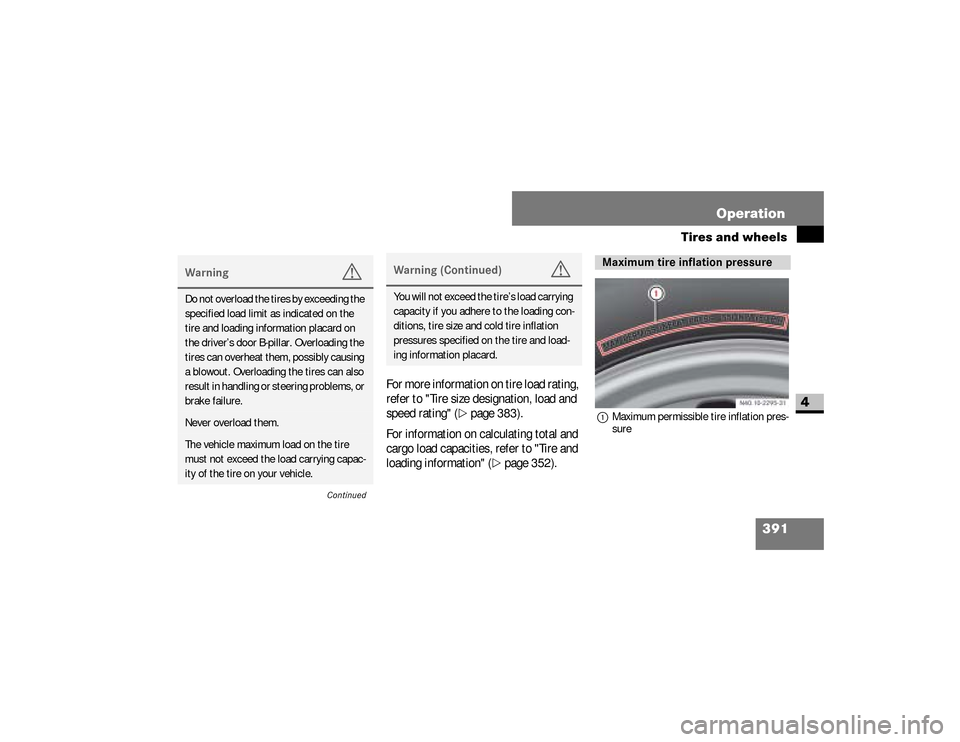
1Maximum permissible tire inflation pres-
sure
Warning
G
Do not overload the tires by exceeding the
specified load limit as indicated on the
tire and loading information placard on
the driver’s door B-pillar. Overloading the
tires can overheat them, possibly causing
a blowout. Overloading the tires can also
result in handling or steering problems, or
brake failure.Never overload them.The vehicle maximum load on the tire
must not exceed the load carrying capac-
ity of the tire on your vehicle.
Continued
Warning (Continued)
G
You will not exceed the tire’s load carrying
capacity if you adhere to the loading con-
ditions, tire size and cold tire inflation
pressures specified on the tire and load-
ing information placard.
Maximum tire inflation pressure
nf_BA.book Page 391 Friday, January 25, 2008 3:53 PM