wheel DODGE SPRINTER 2008 2.G User Guide
[x] Cancel search | Manufacturer: DODGE, Model Year: 2008, Model line: SPRINTER, Model: DODGE SPRINTER 2008 2.GPages: 666, PDF Size: 14.11 MB
Page 49 of 666
47 Safety
Occupant safety
2
Warning (Continued)
G
\4Vehicle occupants should wear their
seat belt correctly at all times and
lean back against the backrest, which
should be positioned as upright as
possible. The head restraints should
support the back of the head at about
eye level.\4Move the passenger’s seat as far to
the rear as possible, especially if a
child is secured in a restraint system
installed on this seat.
Continued
Warning (Continued)
G
\4On vehicles with a passenger’s air-
bag, it is not permitted to secure a
rearward-facing child restraint sys-
tem to the passenger’s seat
(\2page 56). Children in a rearward-
facing child restraint system must be
secured on a suitable rear seat.\4Do not lean forward, for example over
the padded boss of the steering
wheel, especially when the vehicle is
in motion.
Continued
Warning (Continued)
G
\4Only hold the steering wheel by the
outer rim. This allows the airbag to in-
flate fully. If you hold the inside of the
steering wheel, you could be injured if
the airbag were to be triggered.\4Do not put your feet on the dash-
board.\4Do not lean on the doors from inside
the vehicle.\4Make sure that no persons, animals
or objects are present between the
vehicle occupants and the deploy-
ment range of the airbags.
Continued
nf_BA.book Page 47 Friday, January 25, 2008 3:53 PM
Page 50 of 666
48 SafetyOccupant safety
2
Your vehicle is equipped with the follow-
ing airbags, depending on the equip-
ment version:\4
Driver’s front airbag, located in the
steering wheel
\4
Passenger’s front airbag, located
above the glove box
\4
Thorax sidebags* in the outer sides
of the driver’s seat and the passen-
ger’s individual seat
\4
Windowbags* in the side of the roof
frame between the A and B-pillars
Each airbag's cover is marked with the
letters "SRS/AIRBAG" or "AIRBAG".
How airbags workAn airbag inflates within milliseconds.
The
1
warning lamp in the instru-
ment cluster comes on.
Airbag inflation slows down and restricts
the movement of the vehicle occupant.
Warning (Continued)
G
\4Do not cover the padded boss of the
steering wheel, the passenger’s air-
bag cover, the windowbag cover or
the thorax / sidebag cover with film or
other material. Do not affix any badg-
es or stickers to these areas.\4Do not hang any hard objects, for ex-
ample coat hangers, on the grab han-
dles or coat hooks.\4Do not place any items in the storage
compartment above the passenger’s
airbag if they protrude from the com-
partment. The passenger’s airbag
must be able to inflate unimpeded.The risk of injuries from an airbag cannot
be entirely ruled out due to the high speed
at which the airbag is required to inflate.
iIf the airbags are triggered, you will
hear a bang and a small amount of
dust may also be released. The bang
will not damage your hearing and the
dust does not constitute a health
hazard.
nf_BA.book Page 48 Friday, January 25, 2008 3:53 PM
Page 52 of 666
50 SafetyOccupant safety
2
Front airbagsThe front airbags are designed to in-
crease protection to the driver’s and
passenger’s/passengers' head and
chest.
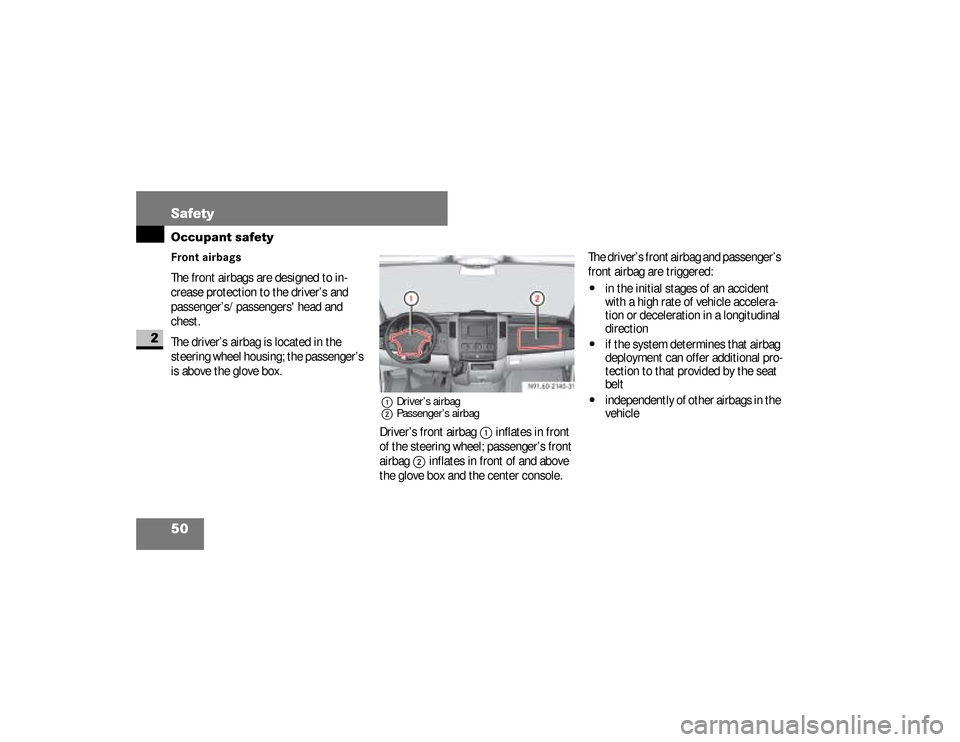
The driver’s airbag is located in the
steering wheel housing; the passenger’s
is above the glove box.
1Driver’s airbag
2Passenger’s airbagDriver’s front airbag
1
inflates in front
of the steering wheel; passenger’s front
airbag
2
inflates in front of and above
the glove box and the center console.The driver’s front airbag and passenger’s
front airbag are triggered:
\4
in the initial stages of an accident
with a high rate of vehicle accelera-
tion or deceleration in a longitudinal
direction
\4
if the system determines that airbag
deployment can offer additional pro-
tection to that provided by the seat
belt
\4
independently of other airbags in the
vehicle N91.60-2140-31
nf_BA.book Page 50 Friday, January 25, 2008 3:53 PM
Page 72 of 666
70 SafetyDriving safety systems
2
ABS regulates the brake pressure in
such a way that the wheels do not lock
when you brake. This allows you to con-
tinue steering when braking.
ABS works from a speed of about 3 mph
(5 km/h) upwards, regardless of road
surface conditions.
ABS works on slippery surfaces, even
when you only brake gently.There is a malfunction if the
-
indica-
tor lamp is permanently lit while the en-
gine is running (
\2
page 466).
Despite this, the normal driving and
braking functions remain available.
iOnly use wheels with the recom-
mended tire sizes (
\2
page 623), oth-
erwise the driving safety systems will
not work correctly.
Antilock Brake System (ABS)
Warning
G
Do not depress the brake pedal several
times in quick succession (pumping). De-
press the brake firmly and evenly. Pump-
ing the brake pedal may reduce the
braking effect.
nf_BA.book Page 70 Friday, January 25, 2008 3:53 PM
Page 73 of 666
71 Safety
Driving safety systems
2
BrakingIf ABS intervenes during braking, you will
feel the steering wheel vibrate gently
and the brake pedal pulsate.
If ABS intervenes: \1
Continue to depress the brake pedal
firmly until the braking situation is
over.
For full brake application:
\1
Depress the brake pedal with maxi-
mum force.Brake Assist operates in emergency
braking situations. If you depress the
brake pedal quickly, BAS automatically
increases the brake pressure, thereby
reducing the stopping distance.
\1
Keep the brake pedal firmly de-
pressed until the emergency braking
situation is over.
ABS prevents the wheels from lock-
ing.
When you release the brake pedal, the
brakes will work as normal again. BAS is
deactivated.
Warning
G
Always adapt your driving style to the pre-
vailing road and weather conditions, and
maintain an adequately safe distance
from other road users as well as any ob-
stacles on the road.
If ABS malfunctions, the wheels could
lock when you brake. This means that the
steerability of the vehicle is restricted
during braking and the stopping distance
may increase. If ABS is deactivated due to
a malfunction, BAS is also deactivated.
Brake Assist (BAS)
nf_BA.book Page 71 Friday, January 25, 2008 3:53 PM
Page 74 of 666
72 SafetyDriving safety systems
2
Vehicles without steering wheel but-
tons:
There is a malfunction if the
k
indi-
cator lamp is permanently lit while the
engine is running (
\2
page 73).ESP
® monitors driving stability and de-
tects a tendency of the vehicle to under-
steer or oversteer (skidding) in good
time. ESP
® stabilizes the vehicle by
braking individual wheels, limiting the
engine power output, and greatly assists
y o u w h e n d r i v i n g o n w e t o r s l i p p e r y r o a d
surfaces. ESP
® also stabilizes the vehi-
cle when braking.
When ESP
® intervenes, the
v
warn-
ing lamp in the speedometer flashes.
Warning
G
If BAS malfunctions, the brake system is
still available with the full brake boosting
effect. In an emergency braking situation,
however, the braking force will not be ad-
ditionally boosted automatically and the
stopping distance may increase.
Electronic Stability Program
(ESP
®)
Warning
G
Proceed as follows if the v warning
lamp in the speedometer flashes:
\4Do not deactivate ASR under any cir-
cumstances.
\4Only depress the accelerator pedal as
far as necessary when pulling away.
\4Adapt your driving style to suit the
prevailing road and weather condi-
tions.
Otherwise, the vehicle could begin to
skid.
ESP
® cannot reduce the risk of an acci-
dent if you drive too fast. ESP
® is unable
to override the laws of physics.
nf_BA.book Page 72 Friday, January 25, 2008 3:53 PM
Page 75 of 666
73 Safety
Driving safety systems
2
There is a malfunction if the
#
indica-
tor lamp is permanently lit while the en-
gine is running (
\2
page 468).
If ESP
® malfunctions, engine power out-
put may be reduced.ASR improves traction for a sustained
period, i.e. the transfer of power from
the tires to the road surface, and thus
also improves the driving stability of the
vehicle. ASR assists you when pulling
away and accelerating, especially on
smooth and slippery surfaces.
ASR brakes individual drive wheels and
limits the engine torque to prevent the
drive wheels from spinning. When ASR
intervenes, the
v
indicator lamp in
the speedometer flashes.
!
CAUTION
Only operate the vehicle briefly (max-
imum of 10 seconds) on a brake dy-
namometer. The key must be turned
to position
1 in the ignition lock dur-
ing this time. You could damage the
drive train or the brake system.
!
CAUTION
Do not operate the vehicle on a roller
dynamometer (for example for per-
formance testing). If you wish to op-
erate the vehicle on a roller
dynamometer, please consult an au-
thorized Sprinter Dealer beforehand.
You could otherwise damage the
drive train or the brake system.
Acceleration skid control (ASR)
nf_BA.book Page 73 Friday, January 25, 2008 3:53 PM
Page 76 of 666
74 SafetyDriving safety systems
2
If the road surface is not capable of pro-
viding sufficient traction, bearing in
mind the tires, load and gradient, it is
not be possible to pull away smoothly
even with ASR.
Vehicles without steering wheel but-
tons:
There is a malfunction if the
k
indi-
cator lamp is permanently lit while the
engine is running (
\2
page 73).
If ASR malfunctions, engine power out-
put may be reduced.
Activating/deactivating ASRASR is automatically activated as soon
as the engine is switched on.
It may be best to deactivate ASR in the
following situations:\4
if snow chains are being used
\4
in deep snow
\4
on sand or gravelIf you deactivate ASR:
\4
the engine’s torque is then no longer
limited and the drive wheels could
spin; the spinning wheels produce a
cutting effect for better traction
\4
traction control still intervenes by
braking if one drive wheel reaches its
grip limit, for example if the surface
under one side of the vehicle is slip-
pery. The wheel is then braked to in-
crease traction in this situation.
\4
ESP
® still intervenes to stabilize the
vehicle
nf_BA.book Page 74 Friday, January 25, 2008 3:53 PM
Page 78 of 666
76 SafetyDriving safety systems
2
EBV monitors and regulates the brake
pressure at the rear wheels to improve
driving stability during braking.There is a malfunction if the
#
, k
,
-
and
6
indicator lamps are per-
manently lit while the engine is running
(
\2
page 462).
Electronic brake force distribution
(EBV)
Warning
G
If EBV malfunctions, the brake system is
still available with the full brake boosting
effect. However, the rear wheels may
lock, for example if the brakes are applied
with maximum force. You could then lose
control of the vehicle and cause an acci-
dent. Always adapt your driving style to
the change in handling characteristics.
Have the system checked at an autho-
rized Sprinter Dealer as soon as possible.
nf_BA.book Page 76 Friday, January 25, 2008 3:53 PM
Page 80 of 666
78 SafetyAnti-theft systems
2
Switching off the alarm
\1
Insert the key into the ignition lock.
or
\1
Press the
Œ
button (
\2
page 83).
The alarm is switched off.A visual and audible alarm is triggered if
the inclination of the vehicle changes
while tow-away protection is enabled.
Enabling tow-away protectionTow-away protection is automatically
enabled approximately 20 seconds after
you lock the vehicle.Tow-away protection is automatically
deactivated when you unlock the vehi-
cle.
Deactivating the tow-away protec-
tion for transportationDeactivate tow-away protection if the
vehicle is transported or loaded onto an-
other vehicle. This will prevent false
alarms.
The button is located in the overhead
control panel.
iThe alarm system will be triggered if
the vehicle has been locked with the
key and is then unlocked from the in-
side.
Tow-away protection*iThe tow-away protection alarm is
triggered shortly before the wheel
leaves the ground if the vehicle is be-
ing jakked up on one side, for exam-
ple.
nf_BA.book Page 78 Friday, January 25, 2008 3:53 PM