tow DODGE SPRINTER 2008 2.G Owner's Manual
[x] Cancel search | Manufacturer: DODGE, Model Year: 2008, Model line: SPRINTER, Model: DODGE SPRINTER 2008 2.GPages: 666, PDF Size: 14.11 MB
Page 260 of 666
258 Controls in detailDriving systems
3
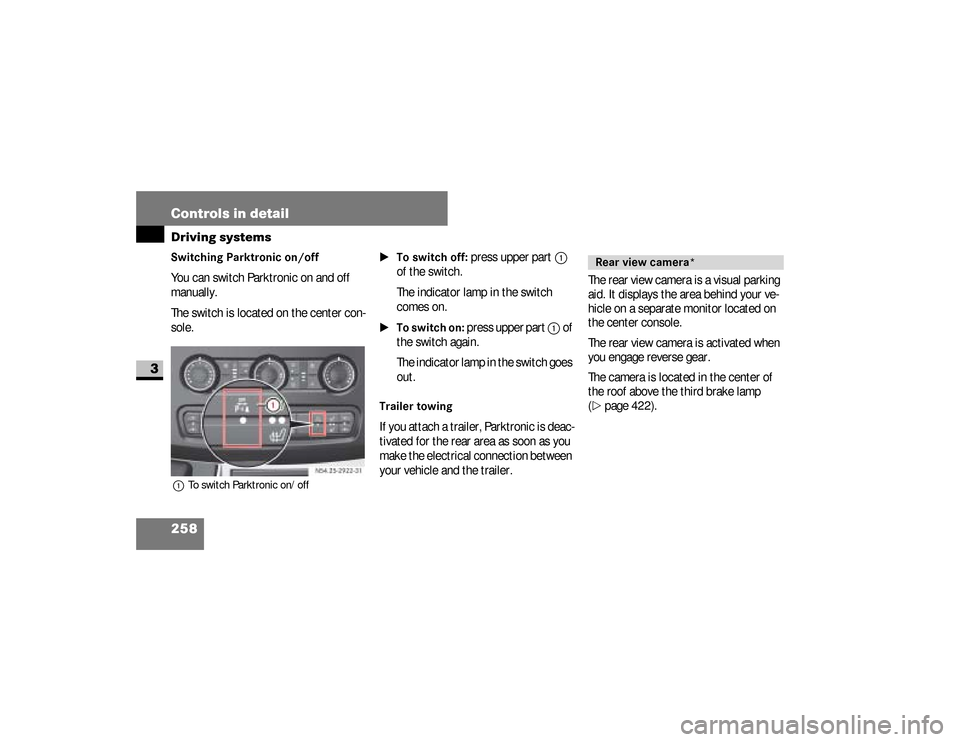
Switching Parktronic on/off You can switch Parktronic on and off
manually.
The switch is located on the center con-
sole.1To switch Parktronic on/off
\1To switch off:
press upper part
1
of the switch.
The indicator lamp in the switch
comes on.
\1To switch on:
press upper part
1
of
the switch again.
The indicator lamp in the switch goes
out.
Trailer towingIf you attach a trailer, Parktronic is deac-
tivated for the rear area as soon as you
make the electrical connection between
your vehicle and the trailer.The rear view camera is a visual parking
aid. It displays the area behind your ve-
hicle on a separate monitor located on
the center console.
The rear view camera is activated when
you engage reverse gear.
The camera is located in the center of
the roof above the third brake lamp
(
\2
page 422). N54.25-2922-31Rear view camera*
nf_BA.book Page 258 Friday, January 25, 2008 3:53 PM
Page 287 of 666
285 Controls in detail
Transporting
3
\1
Check whether the lashing eye is
firmly in place.
\1To remove:
pull locking mechanism
1
upward and pull the lashing eye
through a recess towards the locking
mechanism and out of the load rail.
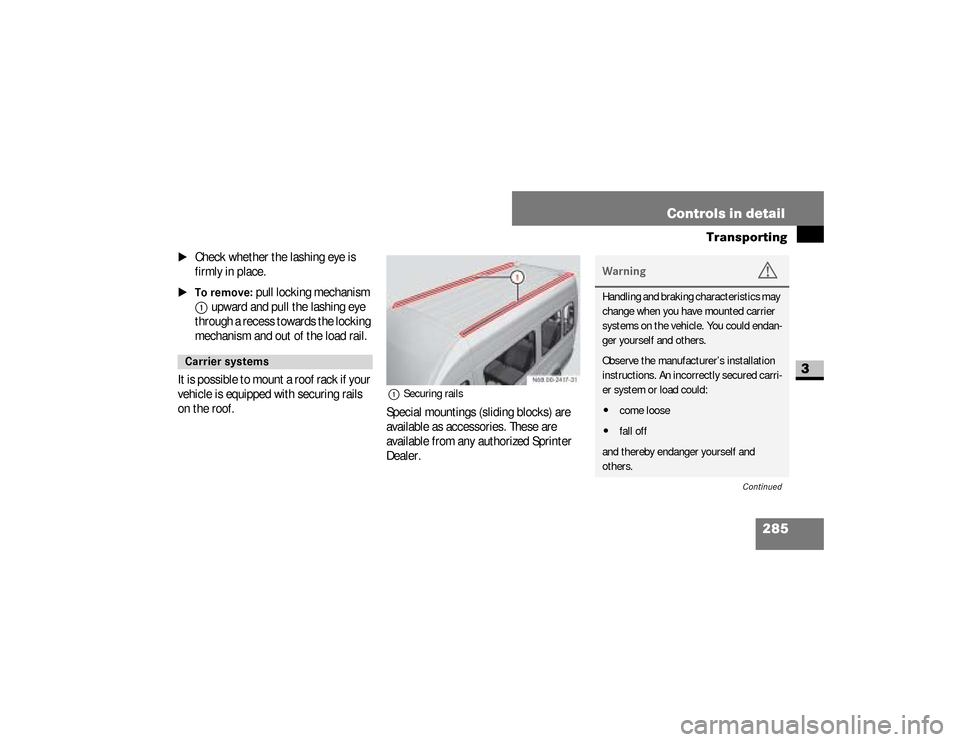
It is possible to mount a roof rack if your
vehicle is equipped with securing rails
on the roof.
1Securing railsSpecial mountings (sliding blocks) are
available as accessories. These are
available from any authorized Sprinter
Dealer.
Carrier systems
Warning
G
Handling and braking characteristics may
change when you have mounted carrier
systems on the vehicle. You could endan-
ger yourself and others.Observe the manufacturer’s installation
instructions. An incorrectly secured carri-
er system or load could:\4come loose\4fall offand thereby endanger yourself and
others.
Continued
nf_BA.book Page 285 Friday, January 25, 2008 3:53 PM
Page 288 of 666
286 Controls in detailTransporting
3
Only install roof racks that have been
approved or recommended for Sprinter
vehicles. These are available in any au-
thorized Sprinter Dealer.Observe the instructions in the “Opera-
tion” section (
\2
page 303).
Warning (Continued)
G
Observe the maximum roof loads
(\2page 630), the maximum axle load
and the maximum load-bearing capacity
of the roof rack.!
CAUTION
Make sure that:
the securing bolts for the roof
rack are tightened to a torque of
6.0 – 7.4 lb-ft (8 – 10 Nm) in the slid-
ing blocks provided
the bolts do not make contact with
the rails when tightened
the sliding blocks are not positioned
near the plastic caps
the sliding blocks have the correct
cross-section
the securing rails are free of dirt on
the inside
the securing bolts are retightened
evenly after approximately 300 miles
(500 km)
This will help to avoid damage to the
vehicle.
!
CAUTION
If you wish to retrofit securing rails,
have them installed at a qualified
specialist workshop which has the
necessary specialist knowledge and
tools to carry out the work required.
You could otherwise damage the ve-
hicle.
The manufacturer recommends that
you use an authorized Sprinter Deal-
er for this purpose.
Trailer towing
nf_BA.book Page 286 Friday, January 25, 2008 3:53 PM
Page 305 of 666
303 Operation
Driving tips
4
\3 Driving tipsFor information about driving in winter
and with snow chains, see “Winter driv-
ing” (
\2
page 404).
Transporting your vehicle by rail may be
subject to certain restrictions or require
special measures to be taken in some
countries due to varying tunnel heights
and loading standards.
You can obtain information at any
authorized Sprinter Dealer.
Trailer hitches*Only install a trailer hitch receiver ap-
proved for your vehicle. For information
on availability and installation, please
see your authorized Sprinter Dealer.
The bumpers on your vehicle are not de-
signed for use with clamp-type hitches.
Do not attach rental hitches or other
bumper-type hitches to them.
To reduce the possibility of damage, re-
move the hitch ball adaptor from the re-
ceiver when not in use.
Rail transport
Trailer towingWarning
G
Failure to use proper equipment and driv-
ing technique can result in a loss of vehi-
cle control when towing a trailer.
Improper towing or failure to follow the in-
structions contained in this guide can re-
sult in serious injury.
Follow the guidelines below carefully to
assure safe trailer operation.
Ask your authorized Sprinter Dealer if you
require an explanation of information con-
tained in this guide.
nf_BA.book Page 303 Friday, January 25, 2008 3:53 PM
Page 306 of 666
304 OperationDriving tips
4
Electrical connections*The Sprinter Vehicle is available with a
variety of pre-installed conditions (lines
and turn signal indicator and brake mod-
ule installed and / or not installed). Make
sure that the correct trailer hitch receiv-
er kit is used. For further information,
please see your authorized Sprinter
Dealer.
In order to prevent possible damage to
the vehicle’s electrical system by incor-
rectly installing the trailer wiring plug,
we recommend having the harness con-
nected at an authorized Sprinter Dealer.
GVWR (G
ross V
ehicle W
eight R
ating)
The total allowable weight of the vehicle.
All occupants, all cargo, and the trailer
tongue load must never exceed the
GVWR.GAWR (G
ross A
xle W
eight R
ating)
The total allowable weight that can be
c a r r i e d b y a s i n g l e a x l e ( f r o n t ( F A ) o r r e a r
(RA)).
GCWR (G
ross C
ombination W
eight
R
ating)The total allowable weight of vehicle and
trailer when weighed in combination in-
cluding a 150 lbs (68 kg) allowance for
the presence of a driver.GTW (G
ross T
railer W
eight)
The maximum permissible trailer weight
to be towed.TWR (T
railer T
ongue W
eight R
ating)
The maximum permissible weight of the
trailer tongue (limit for Sprinter Vehicle
approved hitch receiver).
Vehicle and trailer weights and
ratings
nf_BA.book Page 304 Friday, January 25, 2008 3:53 PM
Page 309 of 666
307 Operation
Driving tips
4
When loading the a trailer, you should
observe that the GCWR of your vehicle is
not exceeded.
You must distribute total weight be-
tween the vehicle and the trailer such
that neither the permissible GTW, nor
the GVWR and front/rear GAWR , nor
the TWR are exceeded.
The tongue weight at the hitch ball must
be added to the GVWR to prevent ex-
ceeding your Sprinter tow vehicle’s rear
GAWR.Maximum permissible values are listed
on the safety compliance certification la-
bels for the vehicle and for the trailer to
be towed. The lowest value listed must
be selected when determining how the
vehicle and trailer are loaded. For more
information, refer to “Vehicle and trailer
weights and ratings” (
\2
page 304).
Checking weights of vehicle and
trailerTo assure that the tow vehicle and trailer
are in compliance with the maximum
permissible weight limits, and to know
the actual weights, have the loaded vehi-
cle-trailer combination (tow vehicle in-cluding driver, passengers and cargo,
trailer fully loaded) weighed on a com-
mercial scale.
Check the vehicle’s front and rear Gross
Axle Weight (GAW), the GTW, the TW and
the Gross Combination Weight (GCW).
The values as measured must not be ex-
ceeded, according to the weights listed
under “Vehicle and trailer weights and
ratings” (
\2
page 304).
Loading the vehicle and/or a
trailer
nf_BA.book Page 307 Friday, January 25, 2008 3:53 PM
Page 310 of 666
308 OperationDriving tips
4
Attaching a trailerPlease observe the maximum permitted
trailer dimensions (width and length).
Most states and all Canadian provinces
require safety chains between your tow
vehicle and the trailer. The chains should
be crisscrossed under the trailer tongue.
They must be attached to the hitch re-
ceiver, and not to the vehicle’s bumper
or axle. Be sure to leave enough slack in
the chains to permit turning corners.
iMost states and all Canadian prov-
inces require a separate brake sys-
tem at various trailer weights.
Warning
G
Do not connect a trailer brake system (if
trailer is so equipped) directly to the vehi-
cle’s hydraulic brake system as your vehi-
cle is equipped with antilock brakes. If
you do, neither the vehicle’s brakes nor
the trailer’s brakes will function properly.
This could cause an accident resulting in
property damage, injury or death to you or
others.The provided vehicle electrical wiring har-
ness for trailer towing has a brake signal
wire for hook-up to a brake controller.
Continued
Warning (Continued)
G
Most states and all Canadian provinces
require a break-away switch on trailers
with a separate brake system. The switch
activates the trailer brakes in the possible
event that the trailer might separate from
the tow vehicle.You should consider using a trailer sway
control system. For further information,
see your authorized Sprinter Dealer.
nf_BA.book Page 308 Friday, January 25, 2008 3:53 PM
Page 311 of 666
309 Operation
Driving tips
4
Towing a trailerThere are many different laws, including
speed limit restrictions, having to do
with trailer towing. Make sure that your
vehicle-trailer combination will be legal,
not only for where you reside, but also
for where you will be driving. A good
source for this information can be the
police or local authorities.
Before you start driving with the trailer,
check the trailer hitch, break-away
switch, safety chains, electrical connec-
tions, lighting and tires. Also adjust the
mirrors to permit an unobstructed view
beyond the rear of the trailer.If the trailer has electric brakes, start
your vehicle and trailer moving slowly,
and then apply only the trailer brake
controller by hand to be sure that the
brakes are working properly.
When towing a trailer, check occasional-
ly to be sure that the load is secure, and
that lighting and trailer brakes (if so
equipped) are functioning properly.
Always secure items in the trailer to pre-
vent load shifts while driving.
Take into consideration that when tow-
ing a trailer, the handling characteristics
are different and less stable from those when operating the vehicle without a
trailer. It is important to avoid sudden
maneuvers.
The vehicle and trailer combination is
heavier, and therefore is limited in accel-
eration and climbing ability, and requires
longer stopping distances. It is more
prone to reacting to side wind gusts, and
requires more sensitive steering input.
In order to gain skill and an understand-
ing of the vehicle’s behavior, you should
practice turning, stopping and backing
up in an area which is free from traffic.
nf_BA.book Page 309 Friday, January 25, 2008 3:53 PM
Page 312 of 666
310 OperationDriving tips
4
If possible, do not brake abruptly, but
rather engage the brake slightly at first
to permit the trailer to activate its brake.
Then increase the braking force.Warning
G
Take into consideration that when towing
a trailer, the handling characteristics are
different and less stable from those when
operating the vehicle without a trailer.
It is important to avoid sudden maneu-
vers. Sudden maneuvers may lead to loss
of control over the vehicle-trailer combi-
nation. This could cause an accident re-
sulting in property damage or injury to
you or others.
!
CAUTION
If the transmission hunts between
gears on inclines, manually shift to a
lower gear (select
"4", "3", "2"
or
"1"). A lower gear and reduction
of speed reduces the chance of the
engine overloading and / or over-
heating.
When going down a long hill, shift
into a lower gear and use the en-
gine’s braking effect. Avoid riding the
brakes, thus overheating the vehicle
and trailer brakes.
If the engine coolant rises to an ex-
tremely high temperature (coolant tem-
perature needle approaching the red
zone) when the air conditioner is on,
turn off the air conditioner. Engine cool-
ant heat can be additionally vented by
opening the windows, switching the cli-
mate control fan speed to high and set-
ting the temperature control to the
maximum hot position.
Extreme care must be exercised since
your vehicle with a trailer will require ad-
ditional passing distance ahead than
when driving without a trailer. Because
your vehicle and trailer is longer than
your vehicle alone, you will also need to
go much farther ahead of the passed ve-
hicle before you can return to your lane.
nf_BA.book Page 310 Friday, January 25, 2008 3:53 PM
Page 358 of 666
356 OperationTires and wheels
4
Step 4\1
The resulting figure equals the avail-
able amount of cargo and luggage
load capacity. For example, if the
“XXX” amount equals 1400 lbs and
there will be five 150 lbs passengers
in your vehicle, the amount of avail-
able cargo and luggage load capacity
is 650 lbs (1400-750 (5 x150) =
650 lbs).
Step 5
\1
Determine the combined weight of
luggage and cargo being loaded on
the vehicle. That weight may not safely exceed the available cargo
and luggage load capacity calculated
in step 4.
Step 6 (if applicable)
\1
If your vehicle will be towing a trailer,
load from your trailer will be trans-
ferred to your vehicle. Consult this
manual to determine how this reduc-
es the available cargo and luggage
load capacity of your vehicle.
The following table shows examples on
how to calculate total load, cargo load
and towing capacities with varying seat-
ing configurations and number and size
of occupants. The following examples
use a load limit of 1500 lbs.
This is for illustrative purposes only
. Make sure
you are using the actual load limit for
your vehicle stated on the vehicle’s tire
and loading information placard
(
\2
page 354).
The higher the weight of all occupants,
the less cargo and luggage load capacity
is available.
nf_BA.book Page 356 Friday, January 25, 2008 3:53 PM