flat tire DODGE SPRINTER 2008 2.G Owner's Guide
[x] Cancel search | Manufacturer: DODGE, Model Year: 2008, Model line: SPRINTER, Model: DODGE SPRINTER 2008 2.GPages: 666, PDF Size: 14.11 MB
Page 394 of 666
392 OperationTires and wheels
4
This is the maximum permissible tire in-
flation pressure for the tire.
Always follow the recommended tire in-
flation pressure (
\2
page 361) for proper
tire inflation.
iFor illustrative purposes only. The ac-
tual data on tires is specific to each
vehicle and may vary from the data
shown in the above illustration.
Warning
G
Never exceed the maximum tire inflation
pressure. Follow recommended tire infla-
tion pressures.Do not underinflate tires. Underinflated
tires wear excessively and/or unevenly,
adversely affect handling and fuel econo-
my, and are more likely to fail from being
overheated.
Continued
Warning (Continued)
G
Do not overinflate tires. Overinflated tires
can adversely affect handling and ride
comfort, wear unevenly, increase stop-
ping distance, and result in sudden defla-
tion (blowout) because they are more
likely to become punctured or damaged
by road debris, potholes etc.
nf_BA.book Page 392 Friday, January 25, 2008 3:53 PM
Page 396 of 666
394 OperationTires and wheels
4
Air pressureThe amount of air inside the tire pressing
outward on each square inch of the tire.
Air pressure is expressed in pounds per
square inch (psi), or kilopascal (kPa) or
bars.Aspect ratioDimensional relationship between the
tire section height and the section width
expressed in percentage.
BarAnother metric unit for air pressure.
There are 14.5038 pounds per square
inch (psi) to 1 bar; there are
100 kilopascals (kPa) to 1 bar.BeadThe tire bead contains steel wires
wrapped by steel cords that hold the tire
onto the rim.Cold tire inflation pressureTire inflation pressure when your vehicle
has been sitting for at least 3 hours or
driven no more than 1 mile (1.6 km).
Curb weightThe weight of a motor vehicle with stan-
dard equipment including the maximum
capacity of fuel, oil, and coolant, and, if
so equipped, air conditioning and addi-
tional optional equipment, but without
passengers and cargo.DOT (D
epartment O
f T
ransportation)
A tire branding symbol which denotes
that the tire meets the requirements of
the U.S. Department of Transportation.
nf_BA.book Page 394 Friday, January 25, 2008 3:53 PM
Page 398 of 666
396 OperationTires and wheels
4
GVWR (G
ross V
ehicle W
eight R
ating)
This is the maximum permissible vehicle
weight of the fully loaded vehicle (weight
of the vehicle including all options, pas-
sengers, fuel, and cargo and, if applica-
ble, trailer tongue load). It is indicated
on the certification label located below
the driver’s seat on the mounting pillar.Kilopascal (kPa)The metric unit for air pressure. There
are 6.9kPa to 1psi; another metric unit
for air pressure is bars. there are
100 kilopascals (kPa) to 1 bar.
Maximum load ratingThe maximum load in kg and pounds
that can be carried by the tire.Maximum loaded vehicle weightThe sum of curb weight, accessory
weight, vehicle capacity weight and pro-
duction options weight.Maximum tire inflation pressureThis number is the greatest amount of
air pressure that should ever be put in
the tire under normal driving conditions.
Normal occupant weightThe number of occupants the vehicle is
designed to seat, multiplied by 68 kg
(150 lbs).Occupant distributionThe distribution of occupants in a vehi-
cle at their designated seating positions.
nf_BA.book Page 396 Friday, January 25, 2008 3:53 PM
Page 399 of 666
397 Operation
Tires and wheels
4
Production options weightThe combined weight of those installed
regular production options weighing
over 5 lbs (2.3 kg) in excess of those
standard items which they replace, not
previously considered in curb weight or
accessory weight, including heavy duty
brakes, ride levelers, roof rack, heavy
duty battery, and special trim.PSI (P
ounds per S
quare I
nch)
A standard unit of measure for air pres-
sure. Another metric unit for air pres-
sure is bar or kilopascal (kPa).
Recommended tire inflation pressureRecommended tire inflation pressure for
normal driving conditions listed on the
tire and loading information placard
1 or
on the tire inflation pressure placard lo-
cated on the driver’s door B-pillar.
Provides best handling, tread life and
riding comfort.
RimA metal support for a tire or a tire and
tube assembly upon which the tire
beads are seated.
Side wallThe portion of a tire between the tread
and the bead.TIN (T
ire I
dentification N
umber)
Unique identifier which facilitates efforts
by tire manufacturers to notify purchas-
ers in recall situations or other safety
matters concerning tires and gives pur-
chases the means to easily identify such
tires. The TIN is comprised of the “man-
ufacturer’s identification mark”, “tire
size”, “tire type code” and “date of man-
ufacture”.
1. For vehicles with a gross weight capacity less
than 10 000 lbs (4 536 kg) (USA only).
nf_BA.book Page 397 Friday, January 25, 2008 3:53 PM
Page 403 of 666
401 Operation
Tires and wheels
4
Rotate tires before the characteristic
tire wear pattern becomes visible (shoul-
der wear on front tires and tread center
wear on rear tires).
The reasons for any rapid or unusual
wear should be corrected prior to rota-
tion being performed.
Thoroughly clean the mounting face of
wheels and brake disks, i.e. the inner
side of the wheels/tires, during each ro-
tation. Check for and ensure proper tire infla-
tion pressure, refer to "Recommended
tire inflation pressure" (
\2
page 361).
!
CAUTION
If your vehicle is equipped with the
tire pressure monitor*, each wheel
has an electronic component.
Tire mounting tools should not be ap-
plied in the area of the valve, as this
could damage the electronic compo-
nents.
Have the tires changed only at an
authorized Sprinter Dealer.
Warning
G
In order to avoid loosing a wheel and in or-
der to reduce the risk of fatal or serious
injuries or vehicle damage, please follow
these safety instructions:Always replace wheel bolts that are dam-
aged or rusted.Never apply oil or grease to wheel bolts.
Continued
nf_BA.book Page 401 Friday, January 25, 2008 3:53 PM
Page 405 of 666
403 Operation
Tires and wheels
4
\1
Make sure that on one axle just one
type of tire (same size, type con-
struction, load and speed rating) is
used.
Dual rear wheels:
\1
Rotate front tires by axle and the out-
er rear tire side to side if there is no
approved direction of rotation.
The tires used on dual wheel assem-
blies should be matched for wear to
prevent overloading one tire in a set.
\1
To check if tires are even, lay a
straight edge across all four tires.
For information on wheel change, see
the “Practical hints” section
(
\2
page 548).
!
CAUTION
3500 dual rear tires have only one
approved direction of rotation. This is
to accommodate the asymmetrical
design (tread pattern) of the ON/OFF
road tire and the use of Outline White
Letter (OWL) tires.
When replacing a flat tire, the spare
tire may have to be remounted on the
rim or installed at a different location
to maintain the correct placement of
the tire on the wheel relative to the
tire/wheel position on the vehicle.
For example, if the spare is used to
replace an outer rear tire it will have
to remounted on the rim so that the
wheel is dished inward.
That way the tread design of asym-
metrical tires and the white writing of
the OWL tires will maintain proper
position.
nf_BA.book Page 403 Friday, January 25, 2008 3:53 PM
Page 406 of 666
404 OperationWinter driving
4
\3 Winter drivingHave your vehicle winterproofed at the
onset of winter at an authorized Sprinter
Dealer. This service includes the follow-
ing:\4
Oil change, if the current engine oil
used has not been approved for win-
ter use
\4
The antifreeze / anti-corrosion con-
centration in the coolant is checked
\4
The addition of a concentrated
cleaning agent to the water in the
windshield washer system
\4
Battery check
\4
A tire changeYou will find information about diesel
fuel for use at low outside temperatures
in the “Technical data” section
(
\2
page 614).
Please also observe the information
about winter driving (
\2
page 406).
Winter tires should also be operated as
printed on the tire and loading informa-
tion placard
1 or on the tire inflation pres-
sure placard located on the driver’s door
B-pillar, refer to “Tires and wheels” (
\2
page 362). Not all M+S rated radial-
ply tires provide special winter perfor-
mance. Make sure the tires you use
show M+S and the mountain/snowflake
marking
.
on the tire side wall.
These tires meet specific snow traction
performance requirements of the Rub-
ber Manufacturers Association (RMA)
and the Rubber Association of Canada
(RAC) and have been designed specifi-
cally for use in snow conditions. Use of
winter tires is the only way to achieve
the maximum effectiveness of the ABS,
BAS, ASR and ESP
® in winter operation.
Winter tires1. For vehicles with a gross weight capacity less
than 10 000 lbs (4 536 kg) (USA only).
nf_BA.book Page 404 Friday, January 25, 2008 3:53 PM
Page 421 of 666
419 Operation
Cleaning and care of the vehicle
4
After using an automatic car wash, wipe
off wax from the windshield and the wip-
er blades. This prevents smears and re-
duces wiping noises which can be
caused by residue on the windshield.High-pressure cleaners\1
The minimum distance that must be
maintained between the vehicle and
the nozzle of the high-pressure
cleaner is:\4
approximately 2.2 ft (70 cm) for
round-spray jets
\4
approximately 1 ft (30 cm) for
25° flat-spray jets and concen-
trated-power jets
\1
Move the high-pressure cleaner noz-
zle around when cleaning your vehi-
cle.
!
CAUTION
Do not use high-pressure cleaners
with round-spray jets for cleaning the
tires. You could otherwise damage
the tires. Have damaged tires re-
placed.
!
CAUTION
To avoid damage, do not aim directly
at the
\4
door joints, brake hoses, electri-
cal components, connectors or
seals
\4
the rear view camera* or the
microphone openings on the un-
derside of the rear view camera*.
\4
Maintain a minimum distance of
1.6 ft (50 cm).
nf_BA.book Page 419 Friday, January 25, 2008 3:53 PM
Page 431 of 666
429 Practical hints
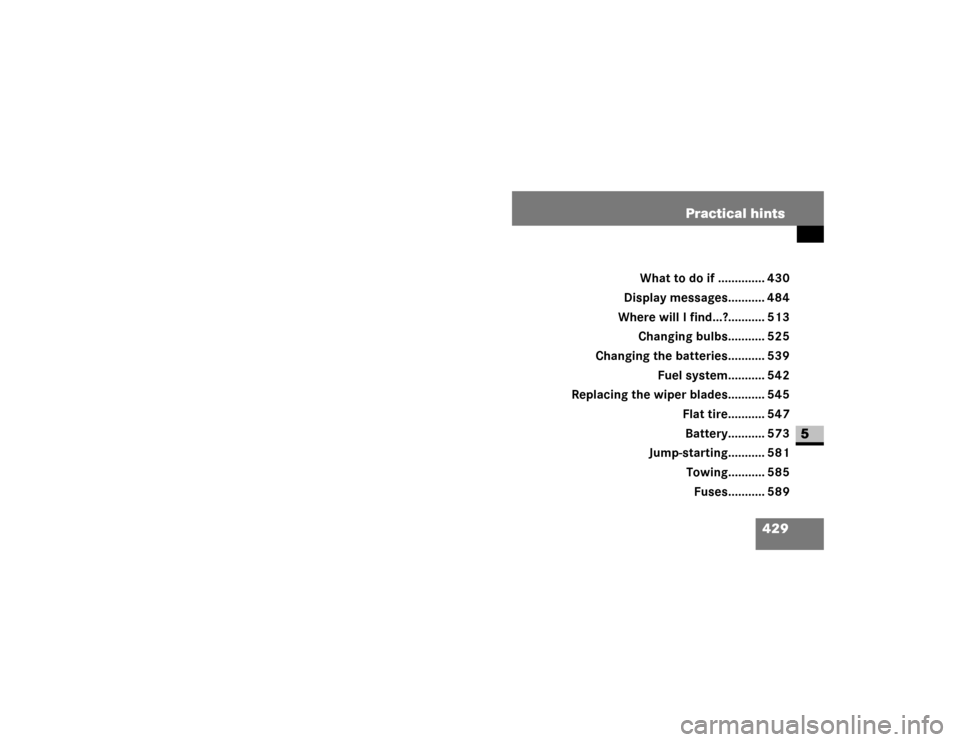
5 Practical hints
What to do if .............. 430
Display messages........... 484
Where will I find...?........... 513
Changing bulbs........... 525
Changing the batteries........... 539
Fuel system........... 542
Replacing the wiper blades........... 545
Flat tire........... 547
Battery........... 573
Jump-starting........... 581
Towing........... 585
Fuses........... 589
nf_BA.book Page 429 Friday, January 25, 2008 3:53 PM
Page 480 of 666
478 Practical hintsWhat to do if ...
5
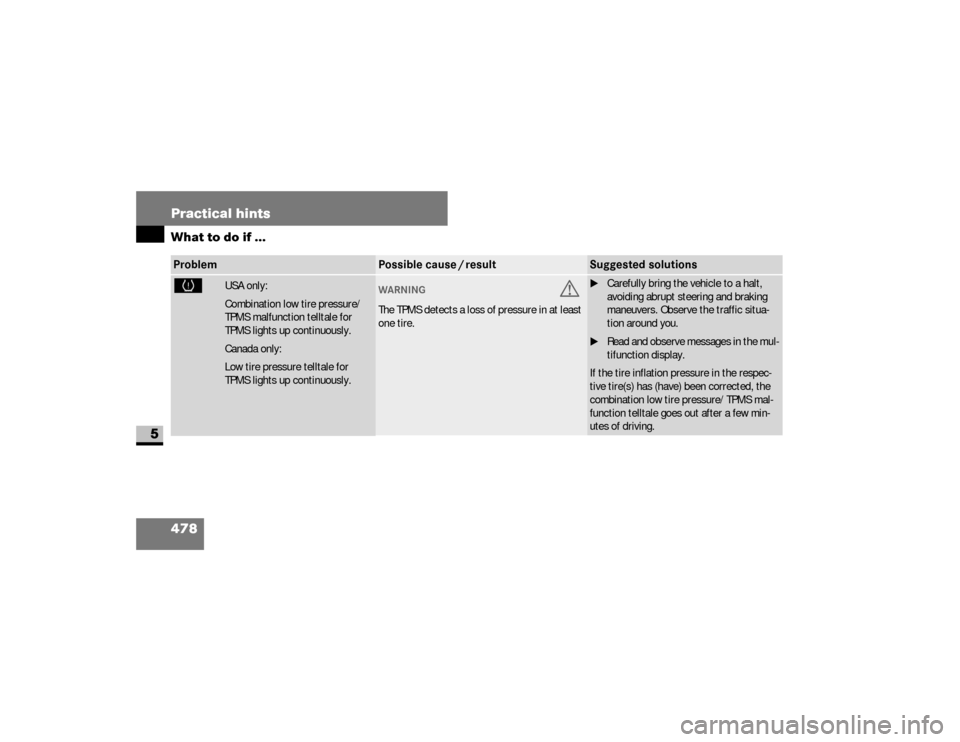
Problem
Possible cause / result
Suggested solutions
X
USA only:
Combination low tire pressure/
TPMS malfunction telltale for
TPMS lights up continuously.
Canada only:
Low tire pressure telltale for
TPMS lights up continuously.
WARNING
G
The TPMS detects a loss of pressure in at least
one tire.
\1Carefully bring the vehicle to a halt,
avoiding abrupt steering and braking
maneuvers. Observe the traffic situa-
tion around you.
\1Read and observe messages in the mul-
tifunction display.
If the tire inflation pressure in the respec-
tive tire(s) has (have) been corrected, the
combination low tire pressure/TPMS mal-
function telltale goes out after a few min-
utes of driving.
nf_BA.book Page 478 Friday, January 25, 2008 3:53 PM