Bearing nut DODGE TRUCK 1993 Service Repair Manual
[x] Cancel search | Manufacturer: DODGE, Model Year: 1993, Model line: TRUCK, Model: DODGE TRUCK 1993Pages: 1502, PDF Size: 80.97 MB
Page 1378 of 1502
•
WHEELS
AND
TIRES
22 - 9
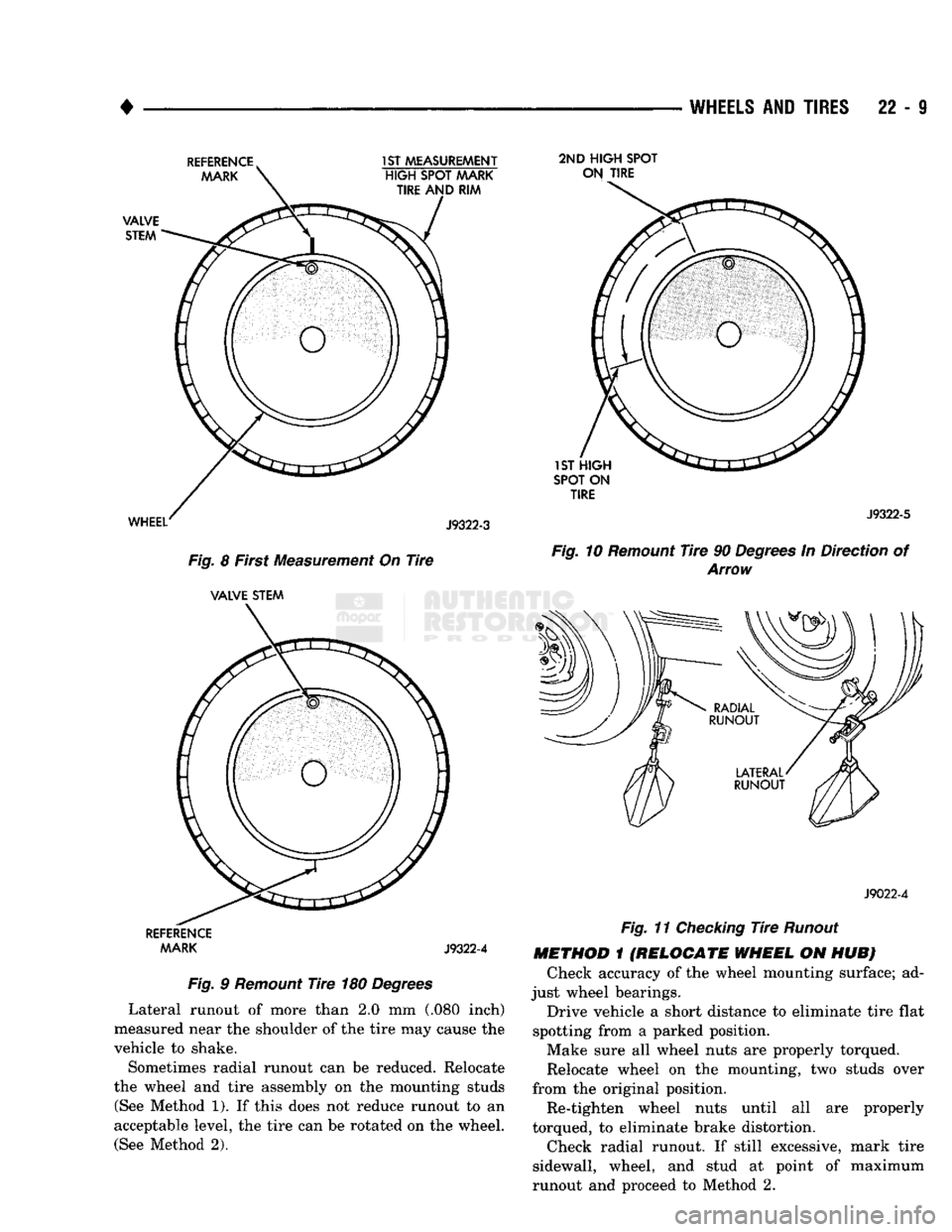
Fig.
8 First Measurement On
Tire
VALVE STEM
REFERENCE
AAARK J9322-4
Fig.
9
Remount
Tire
180
Degrees
Lateral runout of more than 2.0 mm (.080 inch)
measured near the shoulder of the tire may cause the
vehicle to shake.
Sometimes radial runout can be reduced. Relocate
the wheel and tire assembly on the mounting studs (See Method 1). If this does not reduce runout to an
acceptable level, the tire can be rotated on the wheel. (See Method 2). 2ND HIGH SPOT
ON TIRE
SPOT ON TIRE J9322-5
Fig.
10
Remount
Tire
90
Degrees
In Direction of
Arrow
J9022-4
Fig.
11
Checking
Tire
Runout
METHOD
1
(RELOCATE WHEEL
ON HUB) Check accuracy of the wheel mounting surface; ad
just wheel bearings.
Drive vehicle a short distance to eliminate tire flat
spotting from a parked position. Make sure all wheel nuts are properly torqued.
Relocate wheel on the mounting, two studs over
from the original position.
Re-tighten wheel nuts until all are properly
torqued, to eliminate brake distortion.
Check radial runout. If still excessive, mark tire
sidewall, wheel, and stud at point of maximum
runout and proceed to Method 2.
Page 1447 of 1502
24 - 10
HEATING
AND AIR
CONDITIONING
•
(3) Add 50 ml (1.7 oz.) of clean refrigerant oil
through the suction port.
(4) Install compressor.
(5) Install the suction and discharge lines to the
compressor. Use new gaskets to prevent leakage.
Tighten the line nuts to 23 N*m (200 in. lbs.) torque.
(6)
Evacuate and charge system.
OVER-ALL
PERFORMANCE
TEST
Humidity has an important bearing on the temper
ature of the air delivered to the vehicle's interior.
This is true of all air conditioning systems It is im
portant to understand the effect humidity has on the
performance of the system. When humidity is high,
the evaporator has to perform a double duty. It must lower the air temperature and the temperature of the
moisture carried in the air. Condensing the moisture
in the air transfers a great deal of heat energy into
the evaporator fins and tubing. This reduces the amount of heat the evaporator can absorb from the
air.
Evaporator capacity used to reduce the amount of
moisture in the air is not wasted. Wringing some of
the moisture out of the air entering the vehicle adds
to the comfort of the passengers. However, an owner may expect too much from their air conditioning sys
tem on humid days. A performance test is the best
way to determine whether or not the system is per
forming up to standard. This test also provides valu able clues to the possible cause of trouble.
To perform the test the air temperature in the test
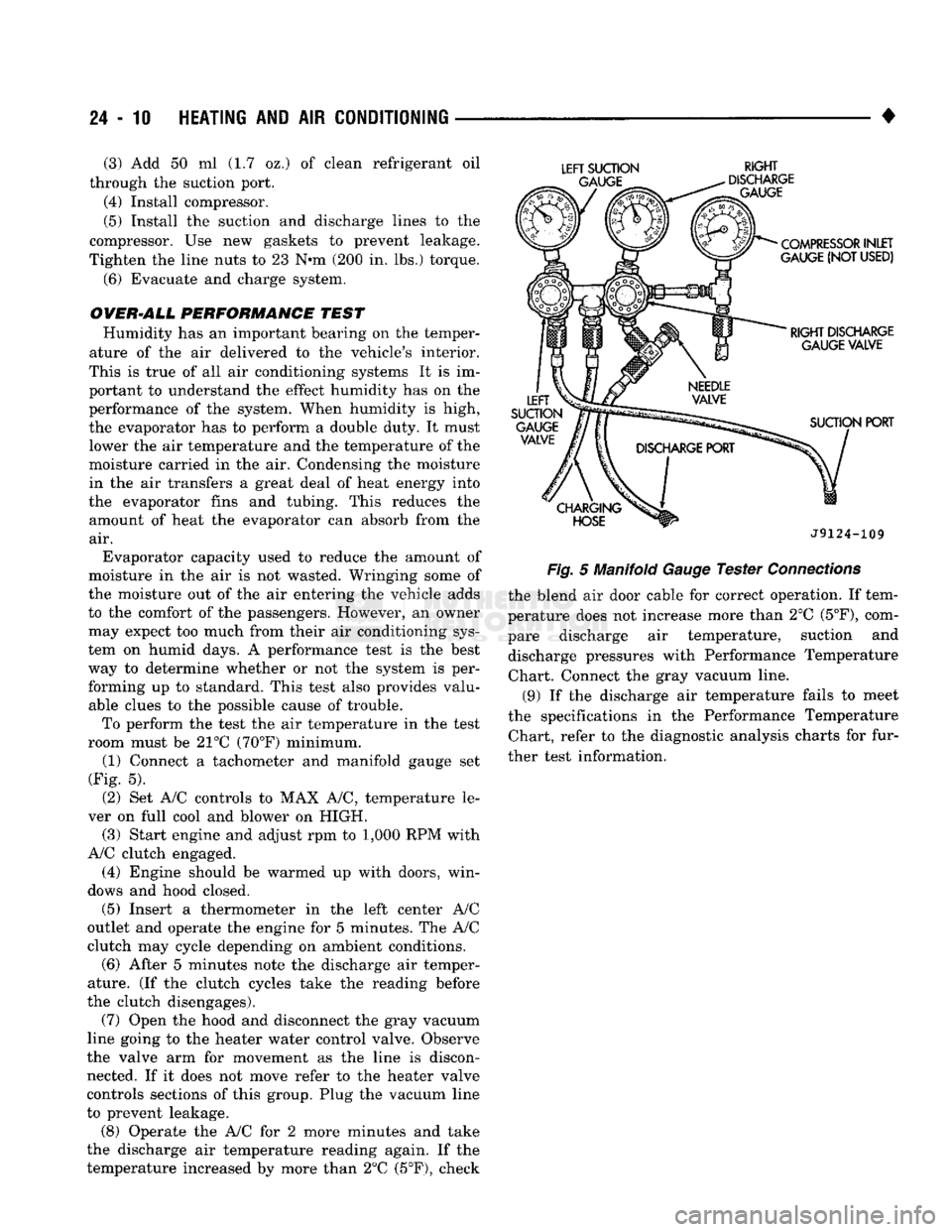
room must be 21°C (70°F) minimum. (1) Connect a tachometer and manifold gauge set
(Fig. 5).
(2) Set A/C controls to MAX A/C, temperature le
ver on full cool and blower on HIGH. (3) Start engine and adjust rpm to 1,000 RPM with
A/C clutch engaged.
(4) Engine should be warmed up with doors, win
dows and hood closed.
(5)
Insert a thermometer in the left center A/C
outlet and operate the engine for 5 minutes. The A/C
clutch may cycle depending on ambient conditions.
(6)
After 5 minutes note the discharge air temper
ature. (If the clutch cycles take the reading before
the clutch disengages).
(7) Open the hood and disconnect the gray vacuum
line going to the heater water control valve. Observe
the valve arm for movement as the line is discon nected. If it does not move refer to the heater valve
controls sections of this group. Plug the vacuum line
to prevent leakage.
(8) Operate the A/C for 2 more minutes and take
the discharge air temperature reading again. If the
temperature increased by more than 2°C (5°F), check
LEFT
SUCTION
RIGHT
J9124-109
Fig.
5 Manifold
Gauge
Tester
Connections
the blend air door cable for correct operation. If tem
perature does not increase more than 2°C
(5°F),
com
pare discharge air temperature, suction and discharge pressures with Performance Temperature Chart. Connect the gray vacuum line.
(9) If the discharge air temperature fails to meet
the specifications in the Performance Temperature Chart, refer to the diagnostic analysis charts for fur
ther test information.
Page 1451 of 1502
24 - 14
HEATING
AND AIR
CONDITIONING
•
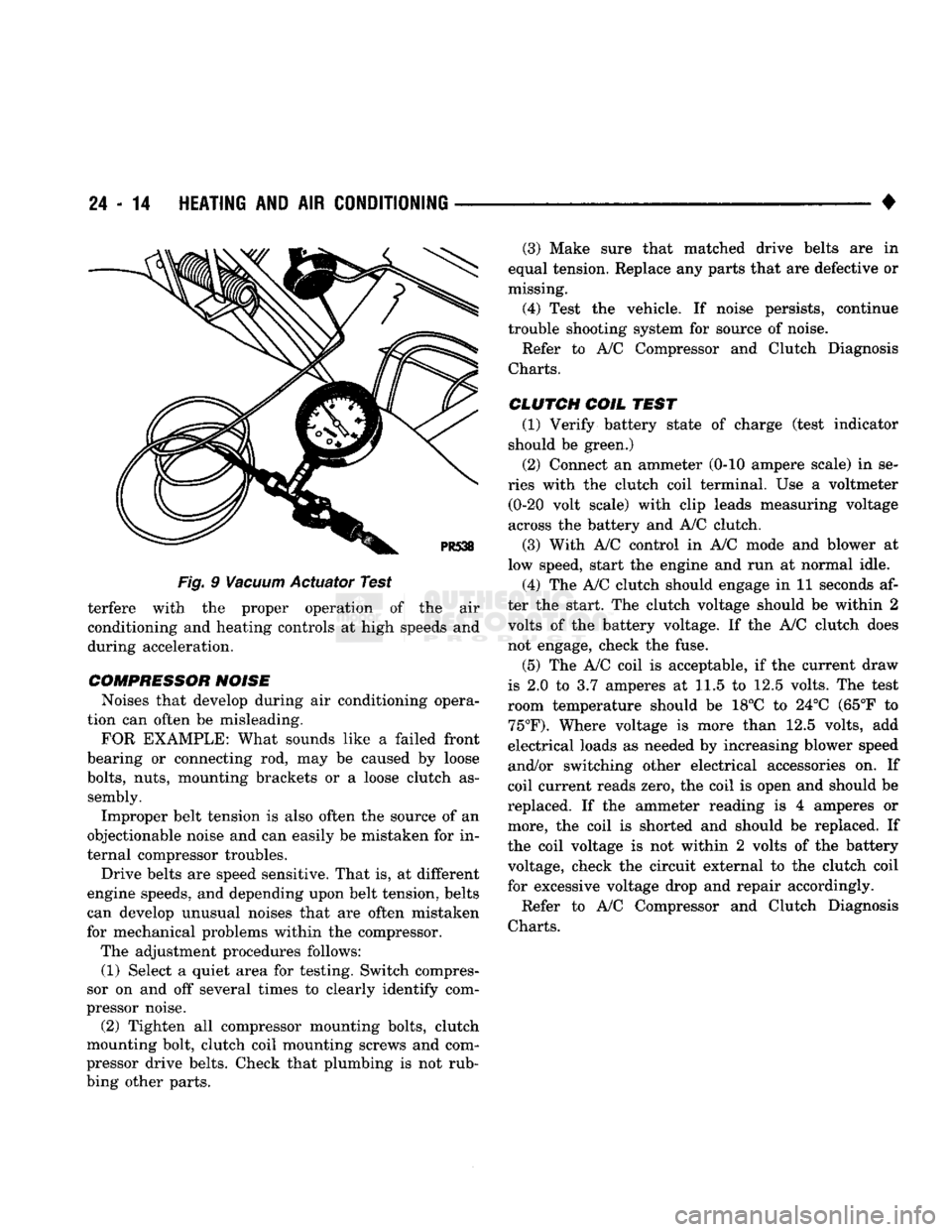
Fig.
9
Vacuum
Actuator Test terfere with the proper operation of the air
conditioning and heating controls at high speeds and
during acceleration.
COMPRESSOR NOISE Noises that develop during air conditioning opera
tion can often be misleading.
FOR EXAMPLE: What sounds like a failed front
bearing or connecting rod, may be caused by loose
bolts,
nuts, mounting brackets or a loose clutch as sembly.
Improper belt tension is also often the source of an
objectionable noise and can easily be mistaken for in
ternal compressor troubles.
Drive belts are speed sensitive. That is, at different
engine speeds, and depending upon belt tension, belts
can develop unusual noises that are often mistaken
for mechanical problems within the compressor.
The adjustment procedures follows: (1) Select a quiet area for testing. Switch compres
sor on and off several times to clearly identify com
pressor noise. (2) Tighten all compressor mounting bolts, clutch
mounting bolt, clutch coil mounting screws and com
pressor drive belts. Check that plumbing is not rub
bing other parts. (3) Make sure that matched drive belts are in
equal tension. Replace any parts that are defective or
missing.
(4) Test the vehicle. If noise persists, continue
trouble shooting system for source of noise. Refer to A/C Compressor and Clutch Diagnosis
Charts.
CLUTCH COIL
TEST
(1) Verify battery state of charge (test indicator
should be green.)
(2) Connect an ammeter (0-10 ampere scale) in se
ries with the clutch coil terminal. Use a voltmeter (0-20 volt scale) with clip leads measuring voltage
across the battery and A/C clutch.
(3) With A/C control in A/C mode and blower at
low speed, start the engine and run at normal idle.
(4) The A/C clutch should engage in 11 seconds af
ter the start. The clutch voltage should be within 2
volts of the battery voltage. If the A/C clutch does not engage, check the fuse.
(5) The A/C coil is acceptable, if the current draw
is 2.0 to 3.7 amperes at 11.5 to 12.5 volts. The test
room temperature should be 18°C to 24°C (65°F to
75°F).
Where voltage is more than 12.5 volts, add
electrical loads as needed by increasing blower speed
and/or switching other electrical accessories on. If
coil current reads zero, the coil is open and should be
replaced. If the ammeter reading is 4 amperes or more, the coil is shorted and should be replaced. If
the coil voltage is not within 2 volts of the battery
voltage, check the circuit external to the clutch coil for excessive voltage drop and repair accordingly.
Refer to A/C Compressor and Clutch Diagnosis
Charts.
Page 1459 of 1502
24 - 22
HEATING
AND AIR
CONDITIONING
•
(4)
Remove the tape or plastic plugs from all the
suction and discharge openings and install the ser
vice valves on the compressor.
(5)
Connect the clutch lead wire.
(6) Connect the negative cable to the battery.
(7)
Evacuate, charge and test the system for leaks.
MAGNETIC
CLUTCH
The magnetic clutch consists of a stationary electro
magnetic coil and a rotating pulley and plate assembly. The electromagnetic coil is retained on the com
pressor with a snap ring and is dimpled to maintain its position. The pulley and plate assembly are mounted on the
compressor shaft. When the compressor is not in operation, the pul
ley free wheels on the clutch hub bearing. When the
coil is energized the plate is magnetically engaged
with the pulley and turns the compressor shaft.
J8924-18
Fig.
3
Clutch
Front
Plate
REMOVAL
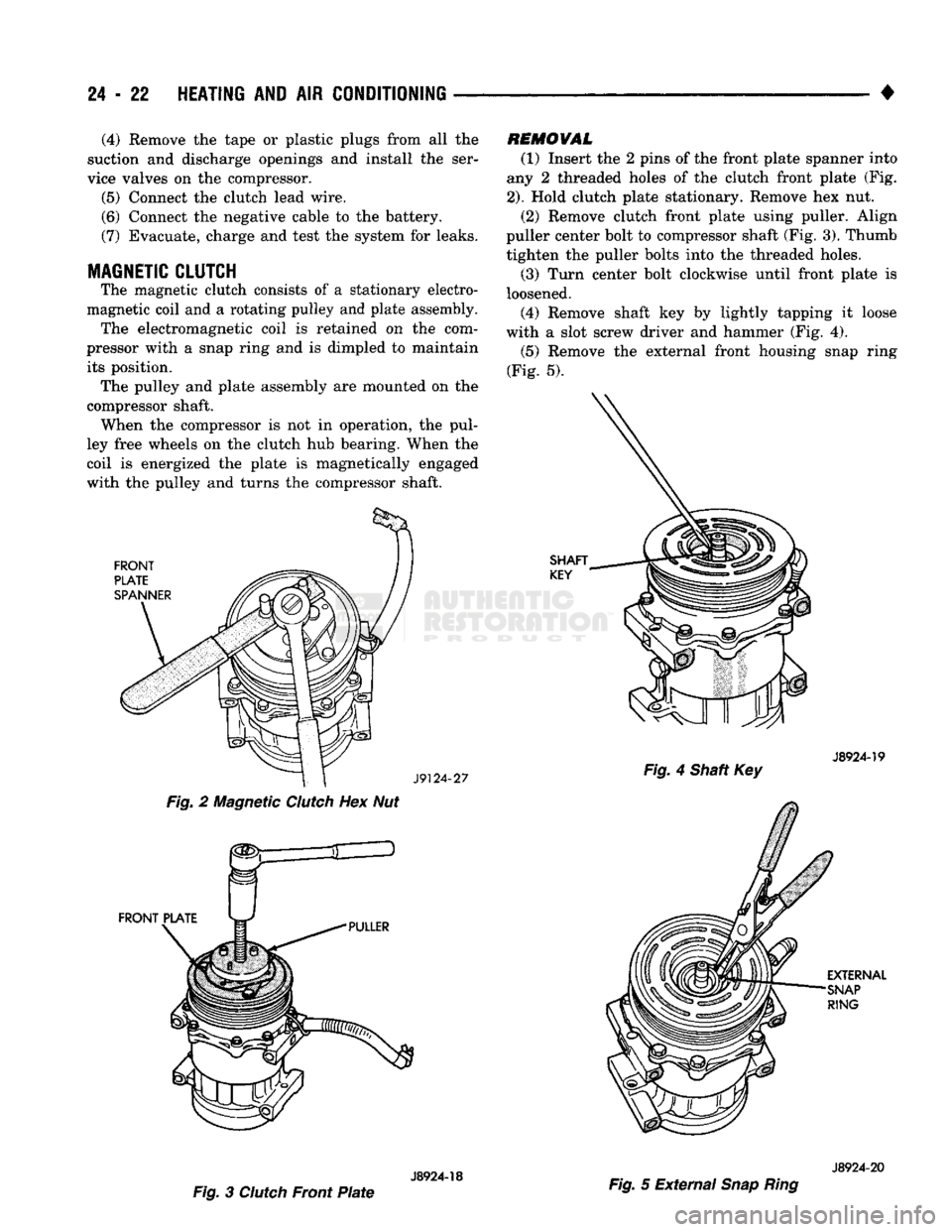
(1) Insert the 2 pins of the front plate spanner into
any 2 threaded holes of the clutch front plate (Fig.
2).
Hold clutch plate stationary. Remove hex nut. (2) Remove clutch front plate using puller. Align
puller center bolt to compressor shaft (Fig. 3). Thumb tighten the puller bolts into the threaded holes. (3) Turn center bolt clockwise until front plate is
loosened. (4) Remove shaft key by lightly tapping it loose
with a slot screw driver and hammer (Fig. 4).
(5)
Remove the external front housing snap ring
(Fig. 5).
J8924-19
Fig.
4 Shaft Key
J8924-20
Fig.
5 External
Snap Ring
Page 1461 of 1502
24 - 24
HEATING
AND AIR
CONDITIONING
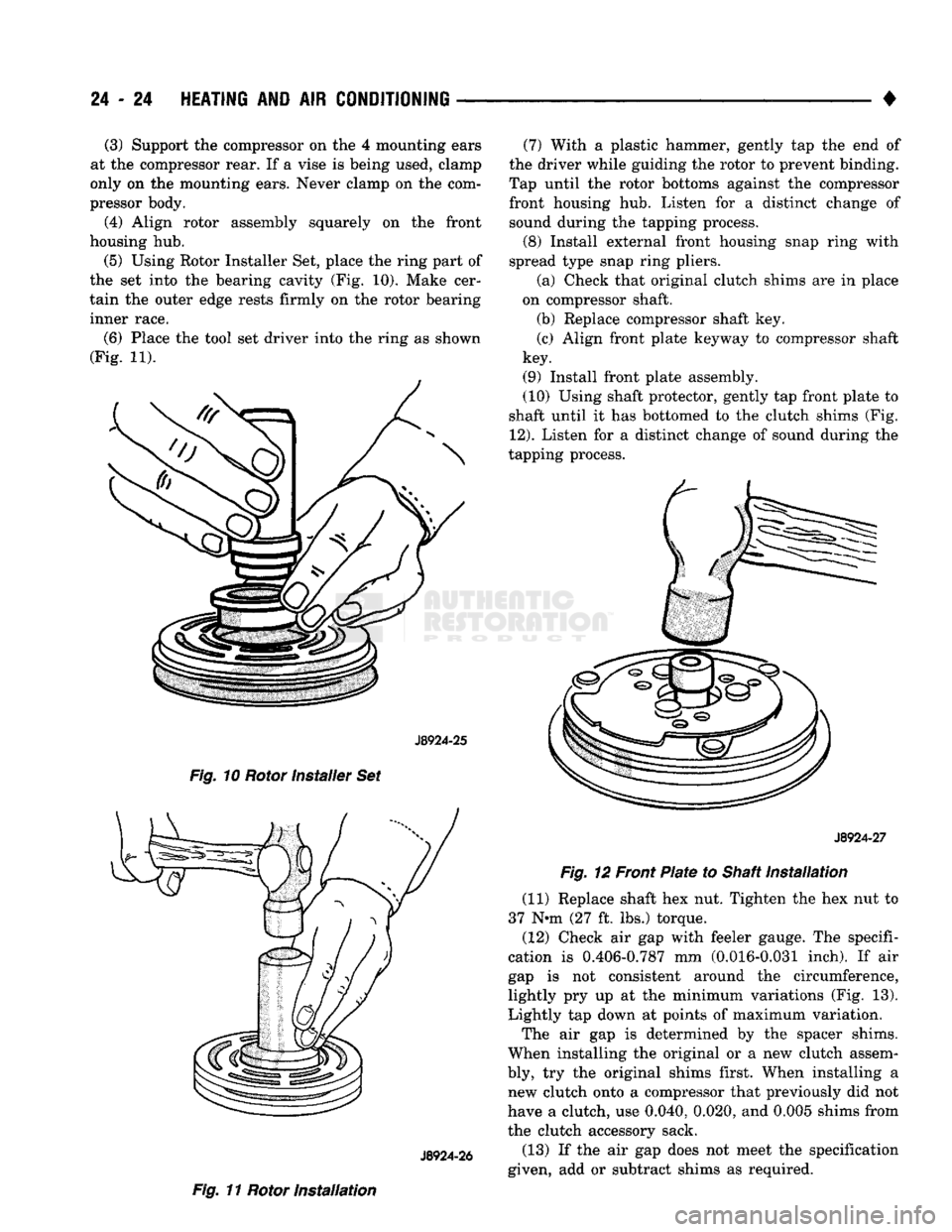
(3) Support the compressor on the 4 mounting ears
at the compressor rear. If a vise is being used, clamp
only on the mounting ears. Never clamp on the com
pressor body.
(4) Align rotor assembly squarely on the front
housing hub.
(5)
Using Rotor Installer Set, place the ring part of
the set into the bearing cavity (Fig. 10). Make cer
tain the outer edge rests firmly on the rotor bearing
inner race.
(6) Place the tool set driver into the ring as shown
(Fig. 11).
J8924-25
Fig. 10 Rotor installer Set
J8924-26
Fig. 11 Rotor Installation (7) With a plastic hammer, gently tap the end of
the driver while guiding the rotor to prevent binding.
Tap until the rotor bottoms against the compressor front housing hub. Listen for a distinct change of sound during the tapping process.
(8) Install external front housing snap ring with
spread type snap ring pliers.
(a) Check that original clutch shims are in place
on compressor shaft.
(b) Replace compressor shaft key.
(c) Align front plate keyway to compressor shaft
key.
(9) Install front plate assembly.
(10) Using shaft protector, gently tap front plate to
shaft until it has bottomed to the clutch shims (Fig.
12).
Listen for a distinct change of sound during the
tapping process.
J8924-27
Fig. 12 Front Plate to Shaft Installation
(11) Replace shaft hex nut. Tighten the hex nut to
37 N*m (27 ft, lbs.) torque.
(12) Check air gap with feeler gauge. The specifi
cation is 0.406-0.787 mm (0.016-0.031 inch). If air
gap is not consistent around the circumference,
lightly pry up at the minimum variations (Fig. 13).
Lightly tap down at points of maximum variation.
The air gap is determined by the spacer shims.
When installing the original or a new clutch assem
bly, try the original shims first. When installing a new clutch onto a compressor that previously did not
have a clutch, use 0.040, 0.020, and 0.005 shims from
the clutch accessory sack.
(13) If the air gap does not meet the specification
given, add or subtract shims as required.