sensor DODGE TRUCK 1993 Service Repair Manual
[x] Cancel search | Manufacturer: DODGE, Model Year: 1993, Model line: TRUCK, Model: DODGE TRUCK 1993Pages: 1502, PDF Size: 80.97 MB
Page 1481 of 1502
2i
- 4
EMISSION
CONTROL
SYSTEMS
•
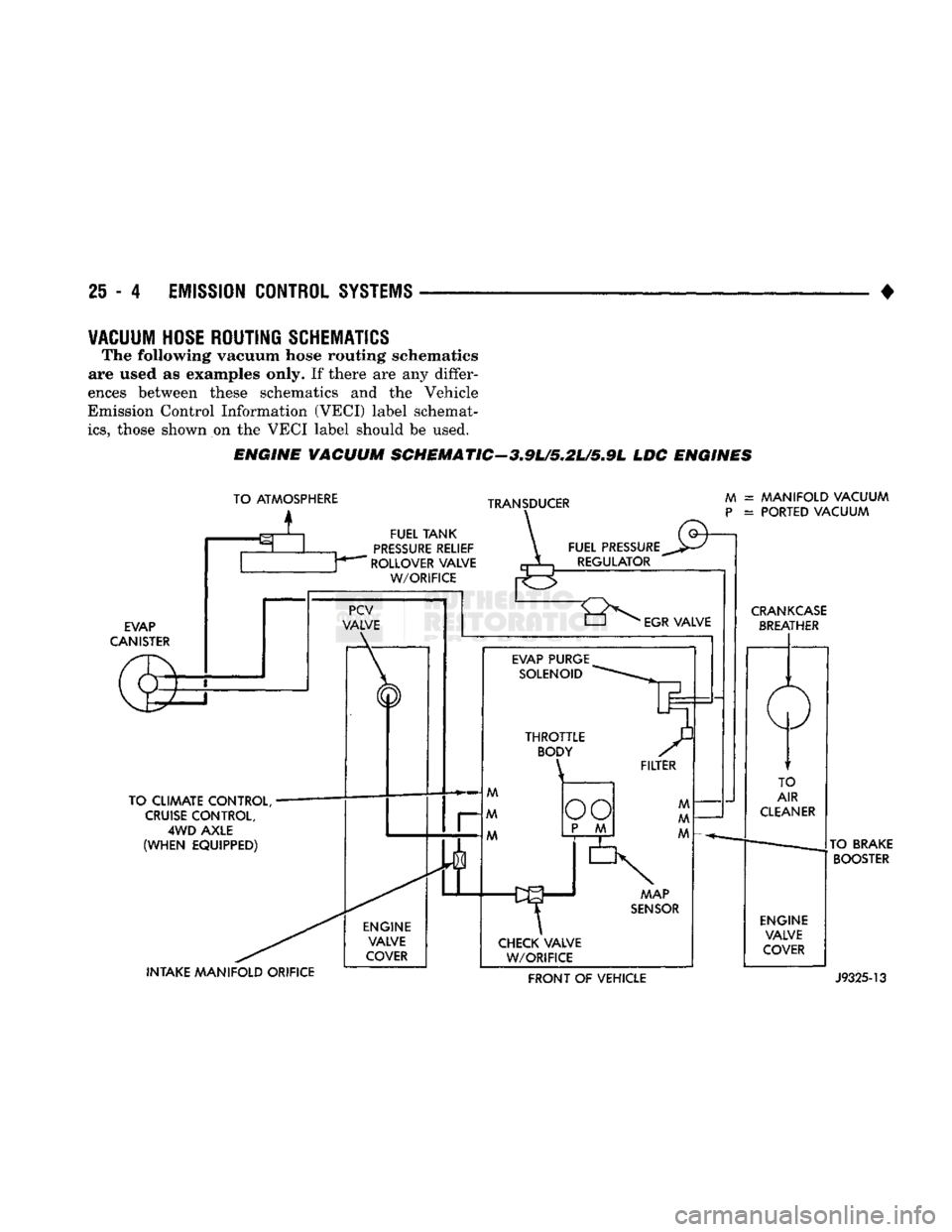
VACUUM
HOSE
ROUTING
SCHEMATICS
The following vacuum hose routing schematics
are used
as
examples only.
If
there
are any
differ
ences between these schematics
and the
Vehicle
Emission Control Information (VECI) label schemat
ics,
those shown
on the
VECI label should
be
used.
ENGINE
VACUUM
SCHEMATIC-3.9U5.2L/5.9L
LDC
ENGINES
TO ATMOSPHERE
i
TRANSDUCER
FUEL
TANK
PRESSURE
RELIEF
ROLLOVER VALVE
W/ORIFICE
EVAP
CANISTER
TO CLIMATE CONTROL,
CRUISE
CONTROL,
4WD
AXLE
(WHEN
EQUIPPED) INTAKE
MANIFOLD
ORIFICE ENGINE
VALVE
COVER FUEL PRESSURE
REGULATOR
M
P
= MANIFOLD VACUUM
= PORTED VACUUM
"8^
EGR
VALVE
EVAP PURGE SOLENOID MAP
SENSOR
CHECK VALVE W/ORIFICE
CRANKCASE
BREATHER
TO
AIR
CLEANER
ENGINE VALVE
COVER TO BRAKE
BOOSTER FRONT
OF
VEHICLE
J9325-13
Page 1487 of 1502
25-10
EMISSION
CONTROL
SYSTEMS
EXHAUST
EMISSION
CONTROLS
INDEX
page
Air Inlet—5.9L Diesel
Engine
13
Exhaust
Gas Recirculation (EGR)
Systems
10
HEATED
INLET
AIR
SYSTEM
The air filter housing mounted-heated inlet air sys
tem is no longer used on any Dodge Truck gas pow ered engine.
EXHAUST
GAS
RECIRCULATION
(EGR)
SYSTEMS
GENERAL INFORMATION The EGR system reduces oxides of nitrogen (NOx)
in the engine exhaust and helps prevent spark
knock. This is accomplished by allowing a predeter
mined amount of hot exhaust gas to recirculate and
dilute the incoming fuel/air mixture. This dilution
reduces peak flame temperature during combustion.
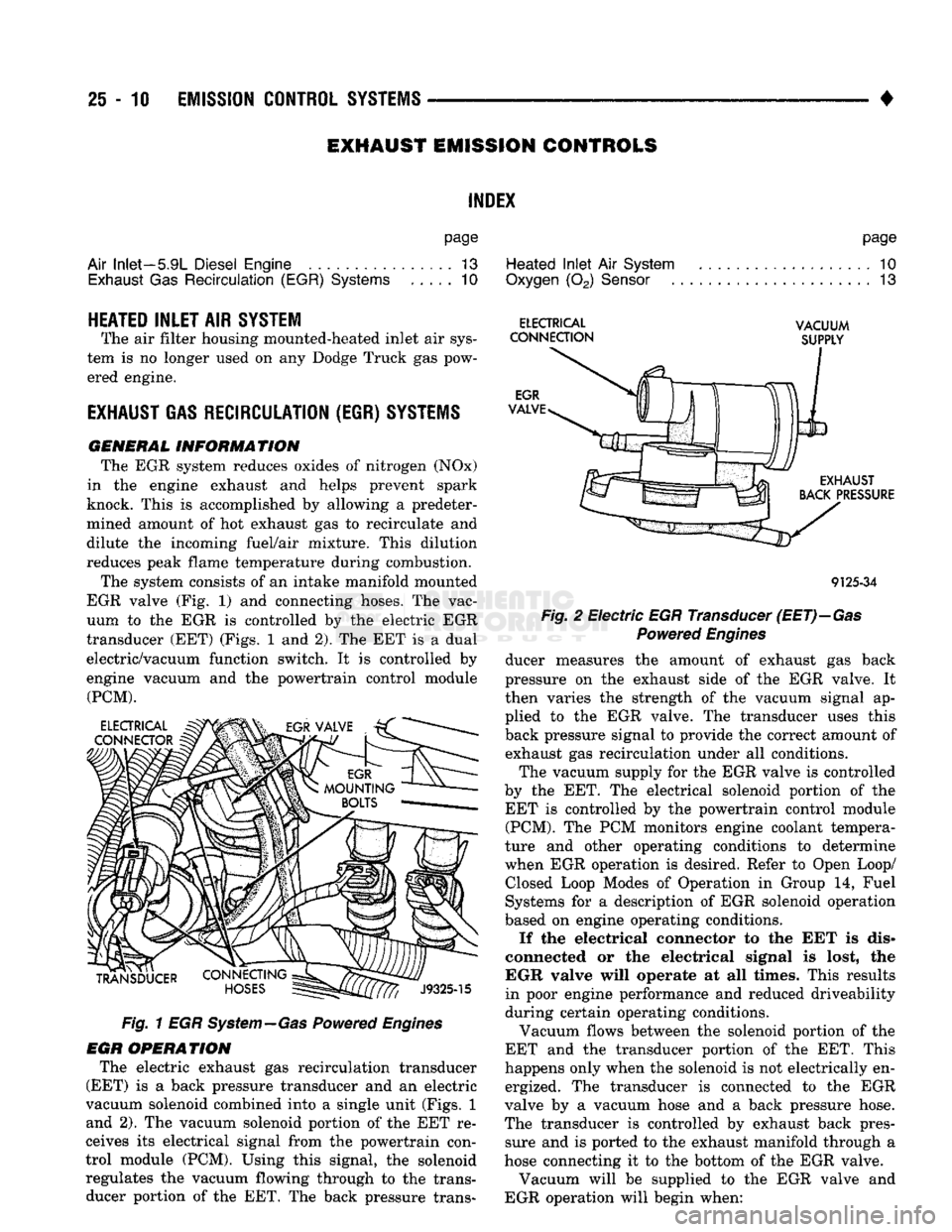
The system consists of an intake manifold mounted
EGR valve (Fig. 1) and connecting hoses. The vac
uum to the EGR is controlled by the electric EGR
transducer (EET) (Figs. 1 and 2). The EET is a dual
electric/vacuum function switch. It is controlled by
engine vacuum and the powertrain control module (PCM).
Fig. 1 EGR System—Gas Powered Engines
EGR OPERATION The electric exhaust gas recirculation transducer
(EET) is a back pressure transducer and an electric
vacuum solenoid combined into a single unit (Figs. 1 and 2). The vacuum solenoid portion of the EET re
ceives its electrical signal from the powertrain con
trol module (PCM). Using this signal, the solenoid regulates the vacuum flowing through to the trans ducer portion of the EET. The back pressure trans-
page
Heated
Inlet
Air
System
. 10
Oxygen
(02)
Sensor
13
ELECTRICAL
VACUUM
CONNECTION
SUPPLY
9125-34
Fig.
2 Electric EGR Transducer
(EET)—Gas
Powered
Engines
ducer measures the amount of exhaust gas back
pressure on the exhaust side of the EGR valve. It
then varies the strength of the vacuum signal ap
plied to the EGR valve. The transducer uses this
back pressure signal to provide the correct amount of exhaust gas recirculation under all conditions.
The vacuum supply for the EGR valve is controlled
by the EET. The electrical solenoid portion of the EET is controlled by the powertrain control module (PCM). The PCM monitors engine coolant tempera
ture and other operating conditions to determine
when EGR operation is desired. Refer to Open Loop/ Closed Loop Modes of Operation in Group 14, Fuel
Systems for a description of EGR solenoid operation
based on engine operating conditions.
If the electrical connector to the EET is dis
connected or the electrical signal is lost, the
EGR valve will operate at all times. This results
in poor engine performance and reduced driveability
during certain operating conditions.
Vacuum flows between the solenoid portion of the
EET and the transducer portion of the EET. This
happens only when the solenoid is not electrically en ergized. The transducer is connected to the EGR
valve by a vacuum hose and a back pressure hose.
The transducer is controlled by exhaust back pres sure and is ported to the exhaust manifold through a
hose connecting it to the bottom of the EGR valve.
Vacuum will be supplied to the EGR valve and
EGR operation will begin when:
Page 1488 of 1502
•
EMISSION
CONTROL
SYSTEMS
25 - 11 • The electrical solenoid portion of the EET is not
energized.
• The engine back pressure entering the EGR valve
inlet is strong enough to close the transducer bleed
valve.
If back pressure is not strong enough to close the
transducer bleed valve, the transducer will bleed off the vacuum preventing EGR operation.
When the electrical solenoid portion of the EET is
de-energized by the powertrain control module (PCM), vacuum flows to the transducer. The trans
ducer is connected to the engine exhaust system by a small hose that connects to the base of the EGR
valve.
The vacuum section of the transducer is controlled
by exhaust system back pressure. When back pres sure is high enough it will close a bleed valve in the
transducer allowing vacuum to actuate the EGR
valve. If back pressure does not close the bleed valve,
vacuum will be bled off.
For more information, refer to Group 14, Fuel Sys
tems.
Refer to the Component Removal/Installation sec
tion of this group for EGR valve replacement proce
dures.
EGR SYSTEM ON-BOARD DIAGNOSTICS
(CALIFORNIA VEHICLES
ONLY)
The powertrain control module (PCM) performs an
On-Board Diagnostic (OBD) check of the EGR system
on all California vehicles. The diagnostic system uses
the electric EGR transducer (EET) for the system
tests.
The OBD check activates only during selected en
gine/driving conditions. When the conditions are met,
the PCM energizes the EET solenoid to disable the EGR. The PCM checks for a change in the oxygen sensor signal. If the air-fuel mixture goes lean, the
PCM will attempt to enrichen the mixture. The PCM
registers a diagnostic trouble code (DTC) if the EGR system has failed or degraded. After registering a
DTC,
the PCM turns the malfunction indicator
lamp (MIL) on. (The malfunction indicator lamp was formerly referred to as the check engine lamp). The
malfunction indicator lamp indicates the need for im
mediate service.
If a malfunction is indicated by the malfunction in
dicator lamp and a DTC for the EGR system was set,
check for proper operation of EGR system. Use the
following: System Test, EGR Gas Flow Test and EGR
Diagnosis Chart.
If the EGR system tests properly, check the system
using the DRB II scan tool. For use of the DRB II,
refer to the appropriate Powertrain Diagnostics Pro cedure service manual. EGR SYSTEM SERVICE
A malfunctioning EGR system can cause engine
spark knock, sags or hesitation, rough idle, engine
stalling and poor driveability. To be sure of proper
operation of the EGR system, inspect all passages for
blockage. Check moving parts for binding. Inspect
the complete system for leaks. Replace system com ponents or hoses that are leaking.
Inspect all hose connections between throttle body,
intake manifold, EGR valve and EGR purge solenoid.
Replace any vacuum harness components that are
leaking or damaged. Refer to EGR Control System Test and EGR Gas
Flow Test to check EGR System operation.
EGR GAS FLOW TEST (1) Disconnect hose from EGR valve and connect a
hand vacuum pump to EGR valve nipple. Apply a
minimum of 12 inches vacuum the valve.
(2) The engine should now idle roughly or stall. If
this occurs, the valve is performing correctly. Proceed
to Electric EGR Transducer Test.
(3) If the engine idle speed did not change, remove
the EGR valve and inspect the valve and the exhaust passage in the manifold for blockage. Repair as nec
essary. If blockage is not present, replace the EGR
valve.
ELECTRIC EGR TRANSDUCER (EET)
TESTING ELECTRIC SOLENOID PORTION OF TRANSDUCER
(1) Bring the engine to normal operating tempera
ture.
Operate at idle speed. Test the EET as follows: (2) Check vacuum at EET vacuum source. Discon
nect the hose and attach a vacuum gauge to it.
(3) Vacuum should be a minimum of 15 inches:
• If vacuum is low, check the line for kinks, twists
or a loose connection at vacuum connector or intake
manifold.
• If vacuum is correct, remove gauge. Connect the
vacuum line and proceed to next step. (4) Check EET operation using the appropriate
Powertrain Diagnostic Procedures service manual.
Refer to this manual for use of the DRB II scan tool and repair EET as necessary.
TESTING VACUUM PORTION
OF
TRANSDUCER
(1) Disconnect the EET vacuum lines, back pres
sure line and electrical connector. Remove trans
ducer.
(2) Plug the EET EGR valve port.
(3) Apply 1-2 pounds air pressure to exhaust back
pressure port. Air pressure can be supplied with a
hand operated air pump or compressed air (regulated
to correct psi).
(4) Apply a minimum of 12 inches of vacuum to
vacuum supply port.
Replace the EET if it will not hold vacuum.
Page 1490 of 1502
EMISSION
CONTROL
SYSTEMS
25 - 13
For electrical tests
of the EET and its
circuitry,
re
fer
to the
appropriate Powertrain Diagnostic Proce dures service manual
for use of the DRB II
scan tool.
Refer
to the
Component Removal/Installation sec
tion
of
this group
for EET
replacement procedures.
OXYGEN
(02)
SENSOR
For description, operation, diagnosis
and
removal/
installation procedures
of the 02
sensor, refer
to
Group
14,
Fuel Systems.
AIR
INLET—5.9L
DIESEL
ENGINE
The diesel engine
air
inlet system consists
of the:
•
Air
filter housing
• Filter element •
Air
filter housing-to-turbocharger inlet tube
•
Air
crossover tube •
Air
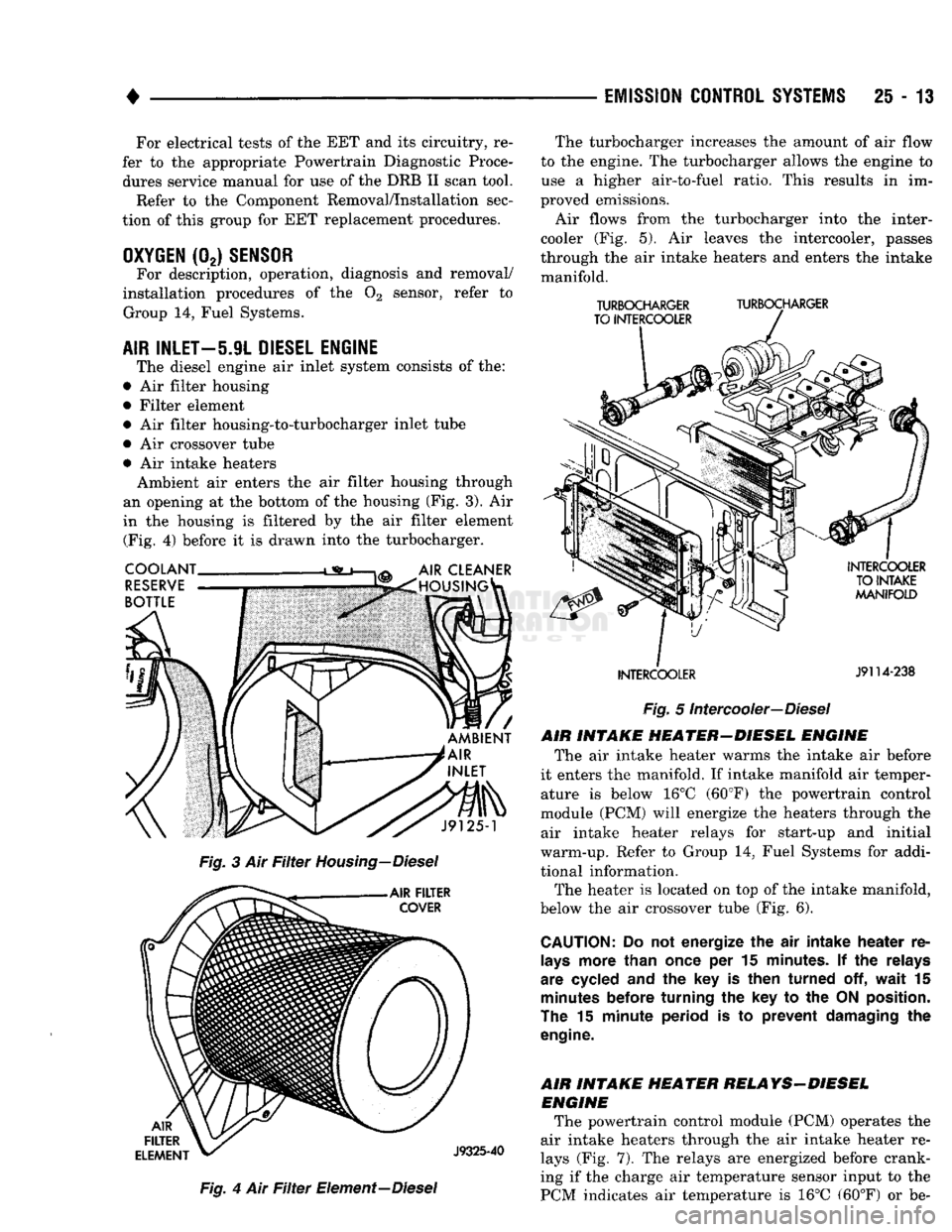
intake heaters Ambient
air
enters
the air
filter housing through
an opening
at the
bottom
of the
housing
(Fig. 3). Air
in
the
housing
is
filtered
by the air
filter element (Fig.
4)
before
it is
drawn into
the
turbocharger.
Fig.
4 Air Filter
Element—Diesel The turbocharger increases
the
amount
of air
flow
to
the
engine.
The
turbocharger allows
the
engine
to
use
a
higher air-to-fuel ratio. This results
in im
proved emissions.
Air flows from
the
turbocharger into
the
inter-
cooler
(Fig. 5). Air
leaves
the
intercooler, passes
through
the air
intake heaters
and
enters
the
intake manifold.
TURBOCHARGER
TURBOCHARGER
TO INTERCOOLER
INTERCOOLER
J9114-238
Fig.
5
Intercooler—Diesel
AIR INTAKE HEATER-DIESEL ENGINE The
air
intake heater warms
the
intake
air
before
it enters
the
manifold.
If
intake manifold
air
temper ature
is
below
16°C
(60°F)
the
powertrain control
module
(PCM)
will energize
the
heaters through
the
air intake heater relays
for
start-up
and
initial
warm-up. Refer
to
Group
14,
Fuel Systems
for
addi
tional information. The heater
is
located
on top of the
intake manifold,
below
the air
crossover tube
(Fig. 6).
CAUTION:
Do not
energize
the air
intake heater
re
lays
more than once
per 15
minutes.
If the
relays
are cycled
and the key is
then turned
off,
wait
15
minutes
before turning
the key to the
ON
position.
The
15
minute period
is to
prevent damaging
the
engine.
AIR INTAKE HEATER RELAYS-DIESEL ENGINE The powertrain control module
(PCM)
operates
the
air intake heaters through
the air
intake heater
re
lays
(Fig. 7). The
relays
are
energized before crank
ing
if the
charge
air
temperature sensor input
to the
PCM indicates
air
temperature
is 16°C
(60°F)
or be-
Page 1494 of 1502

•
EMISSION
CONTROL SYSTEMS
25 - 17
COMPONENT REMOVAL/INSTALLATION
INDEI
page
Air
Filter/Filter
Housing—Diesel Engines
17
Air
Filter/Filter
Housing—Gas Engines
17
Air
Injection
Pump
17
Air
Injection
Pump Relief Valve
18
Check
Valve—Air
Injection
Tube
18
Coolant Temperature
Sensor
. 18
EGR
Tube—Gas Powered Engines
19
EGR
Valve
19
AIR FILTER/FILTER HOUSING-GAS ENGINES
REMOVAL/INSTALLATION Remove crankcase breather/filter hose at side of air
filter housing. Remove wingnut (Fig. 1) and remove
housing from engine. Check condition of gasket at
throttle body and replace as necessary. To replace air filter element only: Remove wingnut
and air filter housing cover (Fig. 1). Clean inside of
housing before replacing filter. Housing removal is not necessary for filter replacement.
^
WING NUT
COVER
:
GASKET
| I
MOUNTING
STUD
Fig.
1 Air
Filter
Housing—Gas
Powered
Engines—Typical
page
Electric
EGR Transducer (EET)
20
EVAP
Canister
20
EVAP
Canister Purge Solenoid
20
Fuel Tank
Filler
Tube
Cap . 21
Oxygen
(02)
Sensor
21
Powertrain Control Module (PCM)
21
Pressure
Relief/Rollover Valve
21
If housing-to-throttle body mounting stud is being
installed, tighten to 10 N»m (90 in. lbs.) torque. In stall housing to engine and tighten wingnut to 1.5
N»m (15 in. lbs.) torque.
AIR FILTER/FILTER HOUSING-DIESEL ENGINES
REMO
VAL/INSTALLA
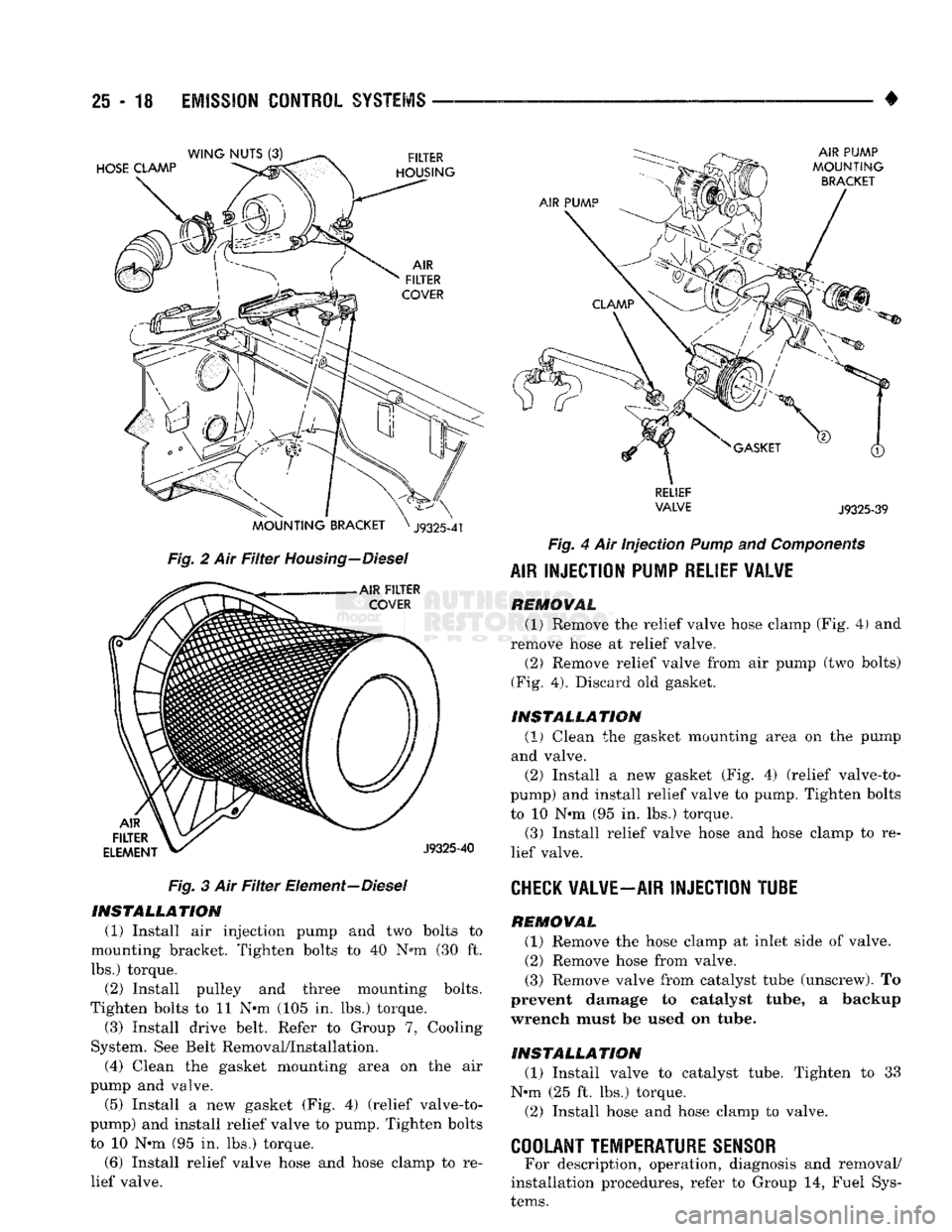
TION Remove the hose clamp at air filter housing (Fig.
2).
Remove mounting nuts and remove air filter
housing from vehicle.
To replace air filter element only: Remove hose clamp
and hose at air filter housing inlet tube. Remove three
wingnuts and air filter housing cover (Figs. 2 and 3). Clean inside of housing before replacing filter. Housing
removal is not necessary for filter replacement.
When installing a new air filter element, push el
ement into cover. Be sure it is pushed into tabs in
back of filter housing. Install wing nuts.
If housing had been removed, install mounting
nuts and tighten to 10 N»m (95 in. lbs.) torque.
AIR INJECTION PUMP
REMOVAL (1) Remove the relief valve hose clamp (Fig. 4) and
remove hose at relief valve.
(2) Remove relief valve from air pump (two bolts)
(Fig. 4). (3) Loosen (but do not remove at this time) the
three air pump pulley mounting bolts (number 2—figure 4).
(4) Relax the automatic belt tensioner and remove
the engine accessory drive belt. Refer to Group 7, Cooling System. See Belt Removal/Installation.
(5) Remove the three air pump pulley bolts and re
move pulley from pump.
(6) Remove the two air pump mounting bolts
(number
1—figure
4) and remove pump from mount
ing bracket.
Page 1495 of 1502
25
- 18
EMISSION
CONTROL
SYSTEMS
Fig. 2 Air Filter Housing—Diesel Fig. 3 Air Filter Element—Diesel INSTALLATION
(1) Install air injection pump and two bolts to
mounting bracket. Tighten bolts to 40 N*m (30 ft.
lbs.) torque. (2) Install pulley and three mounting bolts.
Tighten bolts to 11 N*m (105 in. lbs.) torque.
(3) Install drive belt. Refer to Group 7, Cooling
System. See Belt Removal/Installation.
(4) Clean the gasket mounting area on the air
pump and valve. (5) Install a new gasket (Fig. 4) (relief valve-to-
pump) and install relief valve to pump. Tighten bolts to 10 N*m (95 in. lbs.) torque.
(6) Install relief valve hose and hose clamp to re
lief valve. •
RELIEF
VALVE
J9325-39
Fig. 4 Air Injection
Pump
and
Components
AIR
INJECTION PUMP RELIEF VALVE REMOVAL
(1) Remove the relief valve hose clamp (Fig. 4) and
remove hose at relief valve.
(2) Remove relief valve from air pump (two bolts)
(Fig. 4). Discard old gasket.
INSTALLATION (1)
Clean the gasket mounting area on the pump
and valve. (2) Install a new gasket (Fig. 4) (relief valve-to-
pump) and install relief valve to pump. Tighten bolts
to 10 N*m (95 in. lbs.) torque. (3) Install relief valve hose and hose clamp to re
lief valve.
CHECK
VALVE—AIR INJECTION TUBE REMOVAL
(1) Remove the hose clamp at inlet side of valve.
(2) Remove hose from valve.
(3) Remove valve from catalyst tube (unscrew). To
prevent damage to catalyst tube, a backup
wrench must be used on tube.
INSTALLATION
(1) Install valve to catalyst tube. Tighten to 33
N«m (25 ft. lbs.) torque.
(2) Install hose and hose clamp to valve.
COOLANT TEMPERATURE SENSOR
For description, operation, diagnosis and removal/
installation procedures, refer to Group 14, Fuel Sys
tems.
Page 1498 of 1502
•
EMISSION CONTROL SYSTEMS 25 - 21 (4) Remove solenoid and its support bracket from
intake manifold (one bolt—5.2L/5.9L engine, one
nut—3.9L engine). (5) Remove EVAP canister purge solenoid from en
gine.
INSTALLATION
(1) Install EVAP canister purge solenoid and its
mounting bracket to intake manifold.
(2) Connect vacuum harness and wiring connector.
(3) Install air filter housing.
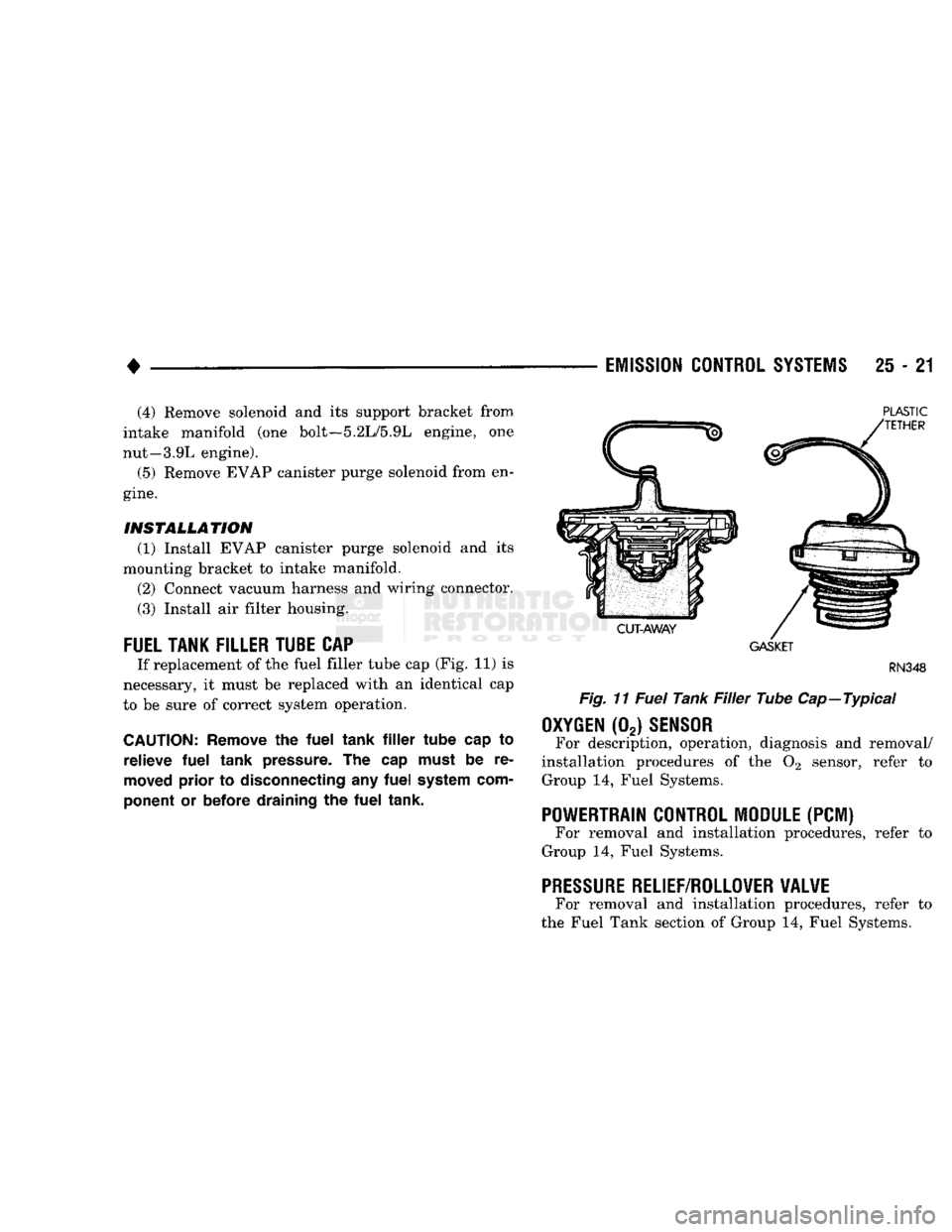
FUEL TANK FILLER TUBE CAP If replacement of the fuel filler tube cap (Fig. 11) is
necessary, it must be replaced with an identical cap
to be sure of correct system operation.
CAUTION:
Remove
the
fuel
tank
filler
tube
cap to
relieve
fuel
tank
pressure.
The cap
must
be re
moved
prior
to
disconnecting
any
fuel
system
com
ponent
or
before
draining
the
fuel
tank.
PLASTIC
GASKET
RN348
Fig.
11
Fuel
Tank
Filler
Tube Cap—Typical
OXYGEN (02) SENSOR For description, operation, diagnosis and removal/
installation procedures of the 02 sensor, refer to Group 14, Fuel Systems. POWERTRAIN CONTROL MODULE (PCM)
For removal and installation procedures, refer to
Group 14, Fuel Systems.
PRESSURE RELIEF/ROLLOWER WALWE For removal and installation procedures, refer to
the Fuel Tank section of Group 14, Fuel Systems.