Bearing DODGE TRUCK 1993 Service User Guide
[x] Cancel search | Manufacturer: DODGE, Model Year: 1993, Model line: TRUCK, Model: DODGE TRUCK 1993Pages: 1502, PDF Size: 80.97 MB
Page 57 of 1502
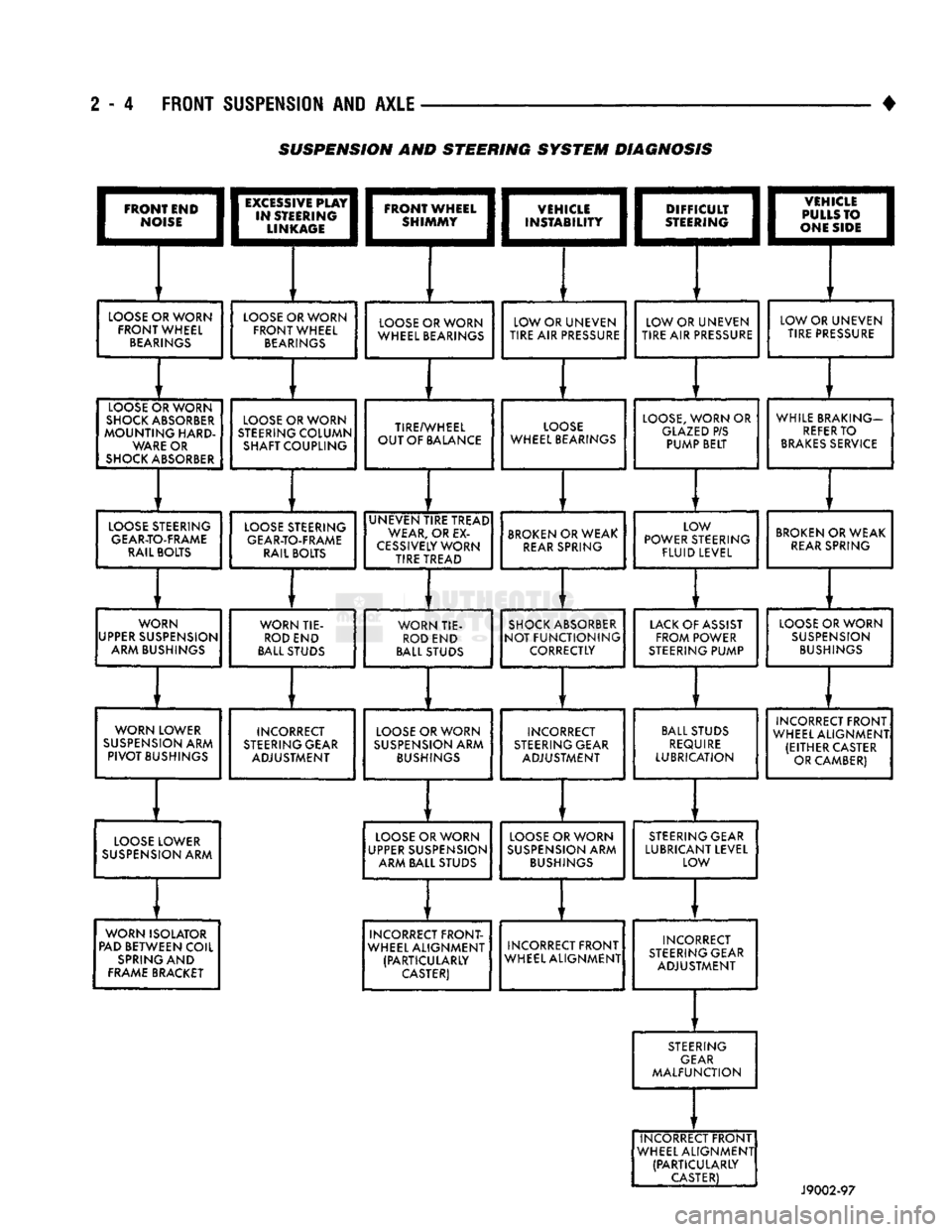
2 - 4 FRONT SUSPENSION AND AXLE
•
I
FRONT END
|
|*?£E;
LOOSE
OR WORN
FRONT WHEEL
BEARINGS
LOOSE
C
SHOCKS
MOUNTir
WAR
SHOCK
A )RWORN
JSORBER
nIG
HARD-
E
OR
BSORBER
EXCiSSIVE
PLAY
STEERING
LINKAGE
LOOSE
OR WORN
FRONT WHEEL
BEARINGS
LOOSE
C
STEERINC
SHAFT
C
)RWORN
7
COLUMN
OUPLING
DIFFICULT
STEERING
LOOSE
OR WORN
WHEEL BEARINGS
TIRE/V
OUT OF
f
VHEEL
JA
LANCE
LOW OR UNEVEN
TIRE
AIR
PRESSURE
LO(
WHEEL B
DSE
EARINGS
LOW OR UNEVEN
TIRE AIR
PRESSURE
1vsnciEi
I
1
PULLS
TO I
I
|
ONE SIDE
j
LOOSE,
WORN
OR
GLAZED
P/S PUMP BELT LOW OR UNEVEN
TIRE PRESSURE
WHILE BR
REFE
BRAKES
AKING—
R
TO
SERVICE
LOOSE
STEERING
GEAR-TO-FRAME
RAIL BOLTS
LOOSE
STEERING
GEAR-TO-FRAME
RAIL BOLTS UNEVEN TIRE TREAD
WEAR,
OR
EX
CESSIVELY
WORN TIRE TREAD
BROKEN
OR WEAK
REAR
SPRING LOW
POWER STEERING
FLUID
LEVEL
BROKEN
OR WEAK
REAR
SPRING
WORN
UPPER
SUSPENSION ARM BUSHINGS WORN TIE-
ROD
END
BALL
STUDS WORN TIE-
ROD
END
BALL
STUDS
SHOCK
ABSORBER
NOT FUNCTIONING
CORRECTLY
LACK
OF ASSIST
FROM POWER
STEERING
PUMP
LOOSE
OR WORN
SUSPENSION
BUSHINGS
WORN LOWER
SUSPENSION
ARM
PIVOT
BUSHINGS INCORRECT
STEERING
GEAR ADJUSTMENT
LOOSE
OR WORN
SUSPENSION
ARM
BUSHINGS
INCORRECT
STEERING
GEAR ADJUSTMENT
BALL
STUDS
REQUIRE
LUBRICATION INCORRECT FRONT
WHEEL ALIGNMENT (EITHER CASTER OR CAMBER)
LOOSE
LOWER
SUSPENSION
ARM
LOOSE
OR WORN
UPPER
SUSPENSION ARM BALL STUDS
LOOSE
OR WORN
SUSPENSION
ARM
BUSHINGS
STEERING
GEAR
LUBRICANT LEVEL LOW
WORN ISOLATOR
PAD
BETWEEN COIL
SPRING
AND
FRAME
BRACKET INCORRECT FRONT-
WHEEL ALIGNMENT (PARTICULARLY
CASTER)
INCORRECT FRONT
WHEEL ALIGNMENT INCORRECT
STEERING
GEAR ADJUSTMENT
STEERING
GEAR
MALFUNCTION
INCORRECT FRONT
WHEEL ALIGNMENT (PARTICULARLY
CASTER)
J9002-97
SUSPENSION AND STEERING
SYSTEM
DIAGNOSIS
Page 60 of 1502
•
FRONT
SUSPENSION
AND
AXLE
2 • 7
FRONT SUSPENSION
—2WD
VEHICLES
INDEX
page
Coil Springs
9
Lower Ball Stud
. 10
Lower Suspension
Arm 10
Lower Suspension
Arm
Bushing
11
Lower Suspension
Arm
Strut
8
Service
Information
7
Shock
Absorber
9
page
Stabilizer
Bar 8
Steering Knuckle
13
Upper Ball Stud
11
Upper Suspension
Arm 11
Upper Suspension
Arm
Bushing Replacement
. . . 12
Wheel
Hub and
Bearings
7
SERVICE
INFORMATION
Periodic lubrication of the front suspension (steer
ing) system components is required. Refer to Group 0, Lubrication And Maintenance for the service in
terval.
Rubber bushings must never be lubricated.
All front suspension components that are
cushioned by rubber should be tightened with
the suspension system at the normal height.
WHEEL
HUB
AND
BEARINGS
REMOVAL (1) Block the brake pedal in the up (non-depressed)
position.
(2) Raise and support the vehicle.
(3) Remove the wheel.
(4) Remove bolts from the disc brake caliper.
(5) Separate the disc brake caliper from the rotor.
Position and support the caliper away from the im
mediate work area. Do not allow the caliper to
hang from the brake fluid hose.
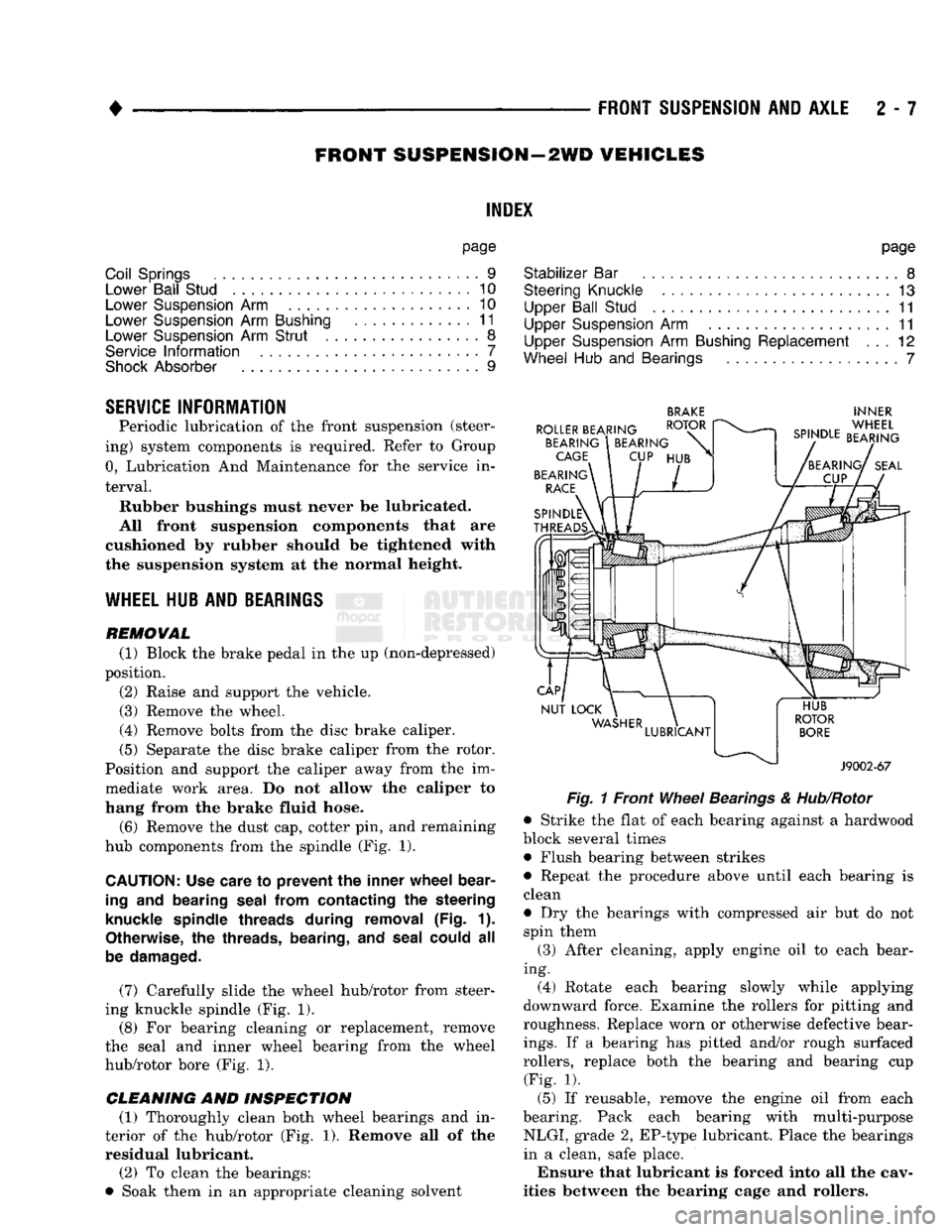
(6) Remove the dust cap, cotter pin, and remaining
hub components from the spindle (Fig. 1).
CAUTION:
Use care
to
prevent
the
inner wheel bear
ing
and
bearing seal from contacting
the
steering
knuckle spindle threads during removal
(Fig. 1).
Otherwise,
the
threads, bearing,
and
seal could
all
be damaged.
(7) Carefully slide the wheel hub/rotor from steer
ing knuckle spindle (Fig. 1).
(8) For bearing cleaning or replacement, remove
the seal and inner wheel bearing from the wheel
hub/rotor bore (Fig. 1).
CLEANING AND INSPECTION (1) Thoroughly clean both wheel bearings and in
terior of the hub/rotor (Fig. 1). Remove all of the residual lubricant.
(2) To clean the bearings:
• Soak them in an appropriate cleaning solvent
BRAKE
INNER
Fig.
1 Front
Wheel
Bearings
&
Hub/Rotor
• Strike the flat of each bearing against a hardwood
block several times • Flush bearing between strikes
• Repeat the procedure above until each bearing is
clean
• Dry the bearings with compressed air but do not spin them
(3) After cleaning, apply engine oil to each bear
ing. (4) Rotate each bearing slowly while applying
downward force. Examine the rollers for pitting and
roughness. Replace worn or otherwise defective bear
ings.
If a bearing has pitted and/or rough surfaced
rollers, replace both the bearing and bearing cup (Fig. 1).
(5) If reusable, remove the engine oil from each
bearing. Pack each bearing with multi-purpose NLGI, grade 2, EP-type lubricant. Place the bearings
in a clean, safe place.
Ensure that lubricant is forced into all the cav
ities between the bearing cage and rollers.
Page 61 of 1502
2
- 8
FRONT SUSPENSION
AND
AXLE
• INSTALLATION
(1) If a bearing and cup must be replaced, remove
the cup from the wheel hub/rotor bore (Fig. 1). Use a
brass drift or an appropriate removal tool to tap out
the cup.
(2) Install the replacement bearing cup(s) with an
appropriate installation tool. (3) Apply lubricant to surface area of the wheel
hub/rotor bore. Install the inner wheel bearing in the
hub/rotor. Install a replacement bearing seal with an appropriate seal installation tool. (4) Inspect the bearing and seal contact surfaces on
the steering knuckle spindle for burrs and/or rough ness (Fig. 1).
(5) Remove all the rough contact surfaces from the
spindle. Apply a coating of multi-purpose NLGI,
grade 2, EP-type lubricant to the spindle surface.
CAUTION: Us© care to prevent the inner
wheel
bear
ing
and bearing
seal
from contacting the steering
knuckle
spindle
threads during removal (Fig. 1).
Otherwise,
the threads, bearing, and
seal
could
be
damaged.
(6) Carefully slide the wheel hub/rotor onto the
spindle.
Install the outer wheel bearing, the washer and
nut.
(7) Tighten the nut to 41 to 54 Nnn (30 to 40 ft.
lbs.) torque while rotating the wheel hub/rotor. Stop
the hub/rotor and loosen the nut to completely re
lease the bearing preload torque. Next, tighten the
nut finger-tight, install the nut lock. Install a re
placement cotter pin.
(8) The wheel bearing adjustment (above) should
have 0.001 to 0.003 inch (0.254 to 0.0762 mm) end
play.
(9) Clean the dust cap. Apply a coating of multi
purpose NLGI, grade 2, EP-type lubricant to internal surface. Install the cap. Do not fill the dust cap with lubricant. (10) Install the brake caliper, refer to Group 5,
Brakes. (11) Install the wheel and tire, refer to Wheel and
Tire Installation in this section. Lower the vehicle.
LOWER SUSPENSION ARM STRUT
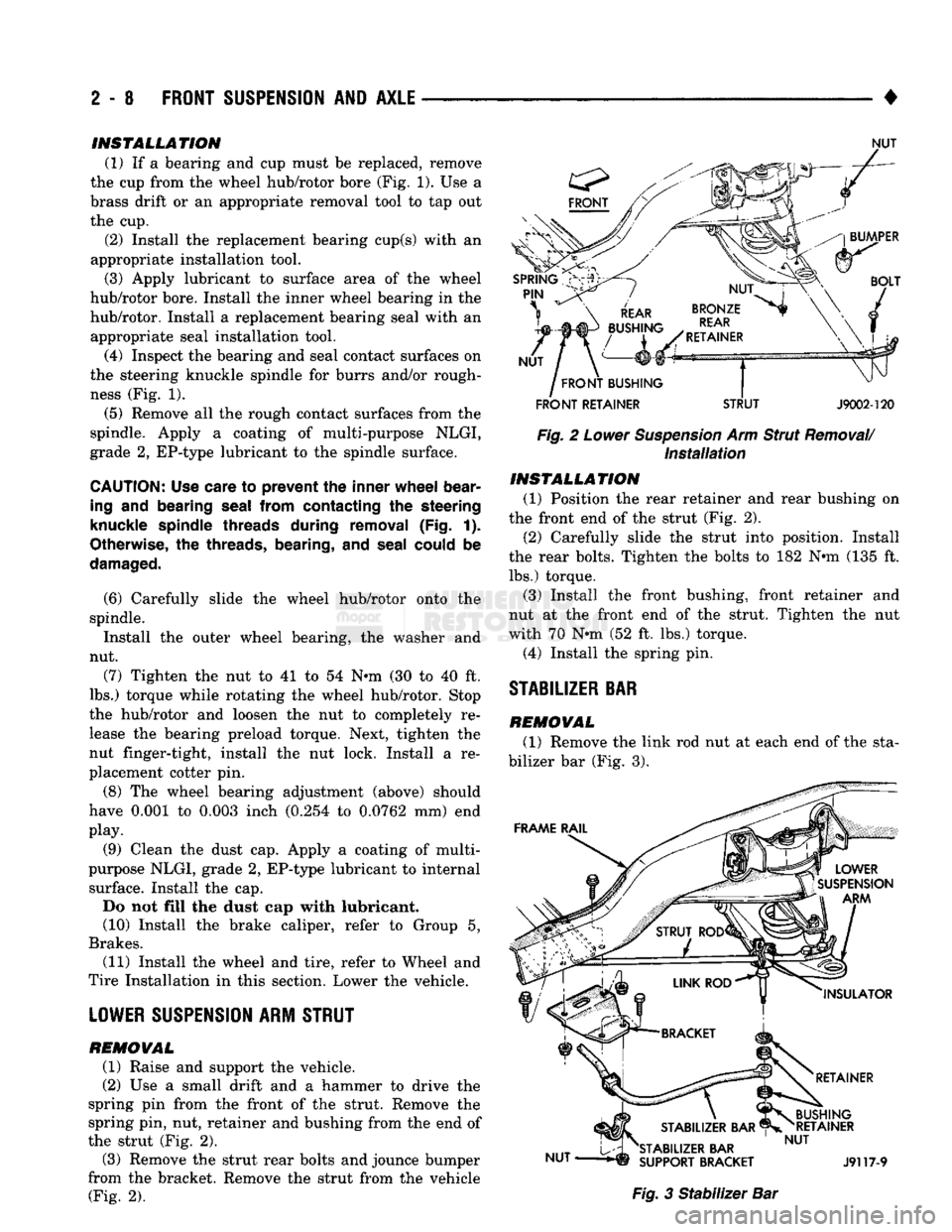
REMOVAL (1) Raise and support the vehicle.
(2) Use a small drift and a hammer to drive the
spring pin from the front of the strut. Remove the
spring pin, nut, retainer and bushing from the end of
the strut (Fig. 2).
(3) Remove the strut rear bolts and jounce bumper
from the bracket. Remove the strut from the vehicle (Fig. 2).
NUT
FRONT
RETAINER
STRUT
J9002-120
Fig. 2 Lower Suspension Arm Strut Removal/ Installation INSTALLATION
(1) Position the rear retainer and rear bushing on
the front end of the strut (Fig. 2).
(2) Carefully slide the strut into position. Install
the rear bolts. Tighten the bolts to 182 Nnn (135 ft. lbs.) torque.
(3) Install the front bushing, front retainer and
nut at the front end of the strut. Tighten the nut
with 70 Nnn (52 ft. lbs.) torque.
(4) Install the spring pin.
STABILIZER
BAR
REMOVAL
(1) Remove the link rod nut at each end of the sta
bilizer bar (Fig. 3). Fig. 3 Stabilizer Bar
Page 63 of 1502
2
- 10
FRONT SUSPENSION
AND
AXLE
• INSTALLATION
(1) Position the spring and isolation pad on the
suspension arm. Install the spring compressor tool.
Compress the spring until the lower suspension arm
can be properly positioned in the steering knuckle.
(2) Install the nuts on the ball studs. Tighten the
upper nut to 142 Nnn (105 ft. lbs.) torque. Tighten
the lower nut.
* 11/16-16 bolt, to 183 Nnn (135 ft. lbs.) torque
• 3/4-16 bolt, to 237 Nnn (175 ft. lbs.) torque Install replacement cotter pins.
(3) Install the strut.
(4) Connect the stabilizer bar.
(5) Install the shock absorber.
(6) Install the brake splash shield on the steering
knuckle. Tighten the screws to 23 Nnn (200 in. lbs.)
torque.
(7) Carefully install the hub/rotor and bearings.
(8) Install the brake caliper, refer to Group 5, Brakes.
(9) Install the wheel and tire, refer to Wheel and Tire
Installation within this section. Lower the vehicle. (10) Test the vehicle brakes and the suspension for
proper operation.
LOWER SUSPENSION
ARM
REMOVAL
(1) Follow procedure under Coil Spring Removal.
(2) Remove hex-head mounting bolt from the cross-
member. (3) Remove the lower suspension arm from vehicle.
INSTALLATION (1) Position lower suspension arm on vehicle.
(2) Install mounting bolt, tighten finger-tight.
(3) Follow procedure under Coil Spring Installa
tion.
(4) Lower the vehicle to the surface with the
wheels/tires supporting the vehicle weight. Tighten
the lower suspension arm mounting bolt to 305 Nnn (225 ft. lbs.) torque.
LOWER
BALL
STUD
INSPECTION
(1) Raise the front of the vehicle. Install safety
floor stands under both lower suspension arms as far outboard as possible. The upper suspension arms
must not contact the rebound bumpers. (2) Install a dial indicator and clamp assembly to
the lower suspension arm. (3) Position indicator plunger against knuckle arm
and zero indicator. (4) Raise and lower the wheel with a pry bar under
the center of the tire. Measure the axial movement of
the knuckle with respect to the suspension arm.
(5) If the travel of the suspension arm is 0.020
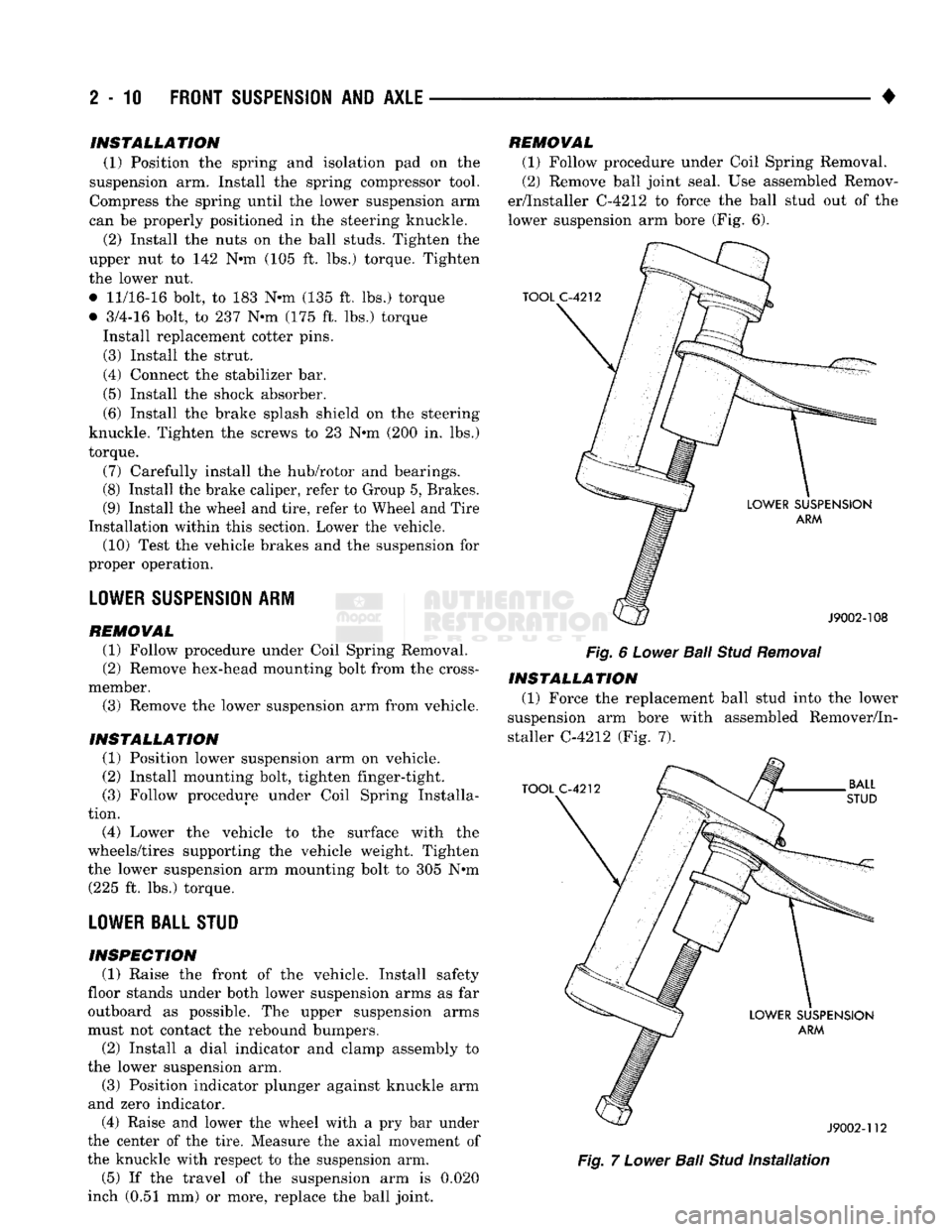
inch (0.51 mm) or more, replace the ball joint. REMOVAL
(1) Follow procedure under Coil Spring Removal.
(2) Remove ball joint seal. Use assembled Remov
er/Installer C-4212 to force the ball stud out of the
lower suspension arm bore (Fig. 6).
Fig.
6
Lower
Bail
Stud
Removal
INSTALLATION (1) Force the replacement ball stud into the lower
suspension arm bore with assembled Remover/In
staller C-4212 (Fig. 7).
Fig.
7
Lower
Ball
Stud
Installation
Page 66 of 1502
•
Fig.
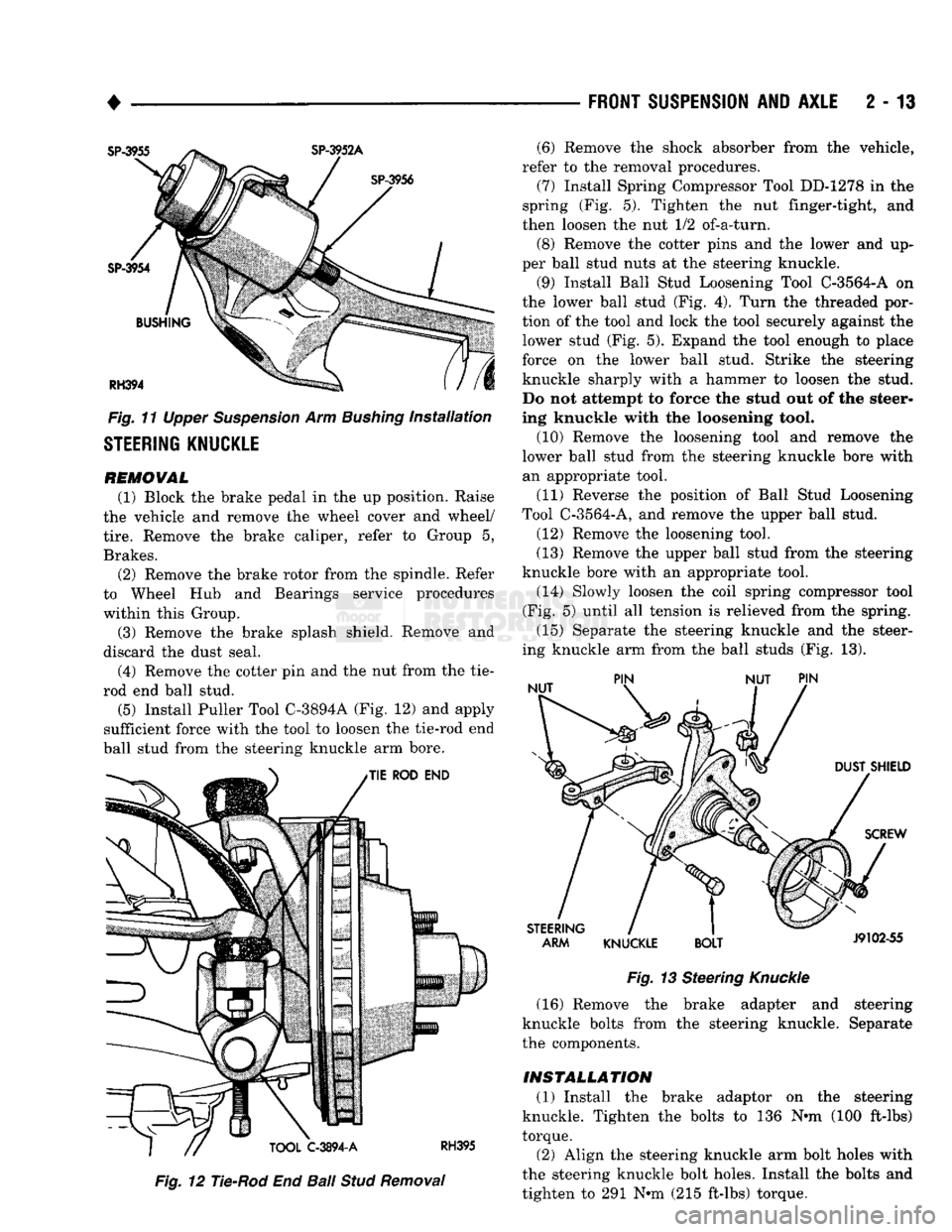
11 Upper Suspension Arm Bushing installation
STEERING KNUCKLE
REMOVAL
(1) Block the brake pedal in the up position. Raise
the vehicle and remove the wheel cover and wheel/
tire.
Remove the brake caliper, refer to Group 5,
Brakes. (2) Remove the brake rotor from the spindle. Refer
to Wheel Hub and Bearings service procedures
within this Group.
(3) Remove the brake splash shield. Remove and
discard the dust seal.
(4) Remove the cotter pin and the nut from the tie-
rod end ball stud.
(5)
Install Puller Tool C-3894A (Fig. 12) and apply
sufficient force with the tool to loosen the tie-rod end
ball stud from the steering knuckle arm bore.
Fig.
12 Tie-Rod End
Ball
Stud
Removal
FRONT SUSPENSION
AND
AXLE
2 - 13
Fig.
13 Steering
Knuckle
(16) Remove the brake adapter and steering
knuckle bolts from the steering knuckle. Separate
the components.
INSTALLATION (1) Install the brake adaptor on the steering
knuckle. Tighten the bolts to 136 Nnn (100 ft-lbs)
torque.
(2) Align the steering knuckle arm bolt holes with
the steering knuckle bolt holes. Install the bolts and
tighten to 291 Nnn (215 ft-lbs) torque. (6) Remove the shock absorber from the vehicle,
refer to the removal procedures. (7) Install Spring Compressor Tool DD-1278 in the
spring (Fig. 5). Tighten the nut finger-tight, and
then loosen the nut 1/2 of-a-turn.
(8) Remove the cotter pins and the lower and up
per ball stud nuts at the steering knuckle.
(9) Install Ball Stud Loosening Tool C-3564-A on
the lower ball stud (Fig. 4). Turn the threaded por
tion of the tool and lock the tool securely against the lower stud (Fig. 5). Expand the tool enough to place
force on the lower ball stud. Strike the steering
knuckle sharply with a hammer to loosen the stud.
Do not attempt to force the stud out of the steer
ing knuckle with the loosening tool.
(10) Remove the loosening tool and remove the
lower ball stud from the steering knuckle bore with an appropriate tool.
(11) Reverse the position of Ball Stud Loosening
Tool C-3564-A, and remove the upper ball stud.
(12) Remove the loosening tool.
(13) Remove the upper ball stud from the steering
knuckle bore with an appropriate tool. (14) Slowly loosen the coil spring compressor tool
(Fig. 5) until all tension is relieved from the spring.
(15) Separate the steering knuckle and the steer
ing knuckle arm from the ball studs (Fig. 13).
Page 70 of 1502
•
FRONT
SUSPENSION
AND
AXLE
2 - 17
MODEL
44
FRONT
AXLE
INDEX
page
Axle Shaft
and
U-Joint
Service
23
Complete Axle Removal/Installation
31
Differential
Assembly
35
Differential
Disassembly
. 32
Drain
and Refill
19
General
Information
17
Hub,
Spindle
and
Axle Shaft
20
Intermediate
Axle Shaft
30
Lubricant
17
GENERAL
INFORMATION
Model
44
front axles
(Fig. 1)
consists
of an
iron
center casting with axle shaft tubes extending from
either side. The integral type housing, hypoid gear design
has
the centerline
of the
pinion
set
below
the
centerline of
the
ring gear. The axle shaft disconnect housing
is
welded
to the
left axle shaft tube.
A
splined, two-piece axle shaft
is
located
on the
left side
and it is
engaged
or
disen
gaged
by a
shift collar.
The
collar
is
moved
by a
shift
fork controlled
by a
vacuum shift motor.
The
shift motor
is
operated
by
engine vacuum controlled
by a
switch located
at the
transfer case. The axles
are
equipped with full-floating axle
shafts,
meaning that loads
are
supported
by the
spin
dles attached
to the
steering knuckles. The removable, stamped steel cover provides
a
means
for
inspection
and
service without removing
the complete axle from
the
vehicle.
page
Pinion Gear Depth Measurement
and
Adjustment
with
Tool
Set
C-3715-B
40
Pinion Gear Depth Measurement
and
Adjustment
with
Tool
Set
D-115-44
... 38
Pinion Shaft Seal
19
Specifications
48
Steering Knuckle
Arm
31
Steering Knuckle, Upper
and
Lower Ball Studs
. . 24
Vacuum
Shift Motor
26
A small, stamped metal axle gear ratio identifica
tion
tag is
attached
to the
housing cover
via one of
the cover bolts. This
tag
also identifies
the
number
of
ring gear
and
pinion gear teeth.
The differential case
is a
one-piece design.
The dif
ferential pinion mate shaft
is
retained with
a
roll
pin. Differential bearing preload
and
ring gear back lash
are
adjusted
by the use of
shims located between
the differential bearing cones
and
case.
LUBRICANT
Multi-purpose
API GL 5
quality hypoid gear lubri
cant should
be
used
for
Model
44
axles. MOPAR
Hy
poid Gear Lubricant conforms with these specifications
and is
recommended.
CAUTION:
If a
front axle
is
submerged
in
water,
the
axle lubricant must
be
replaced immediately.
Page 73 of 1502
2
- 20
FRONT SUSPENSION
AND
AXLE
•
INSTALLATION
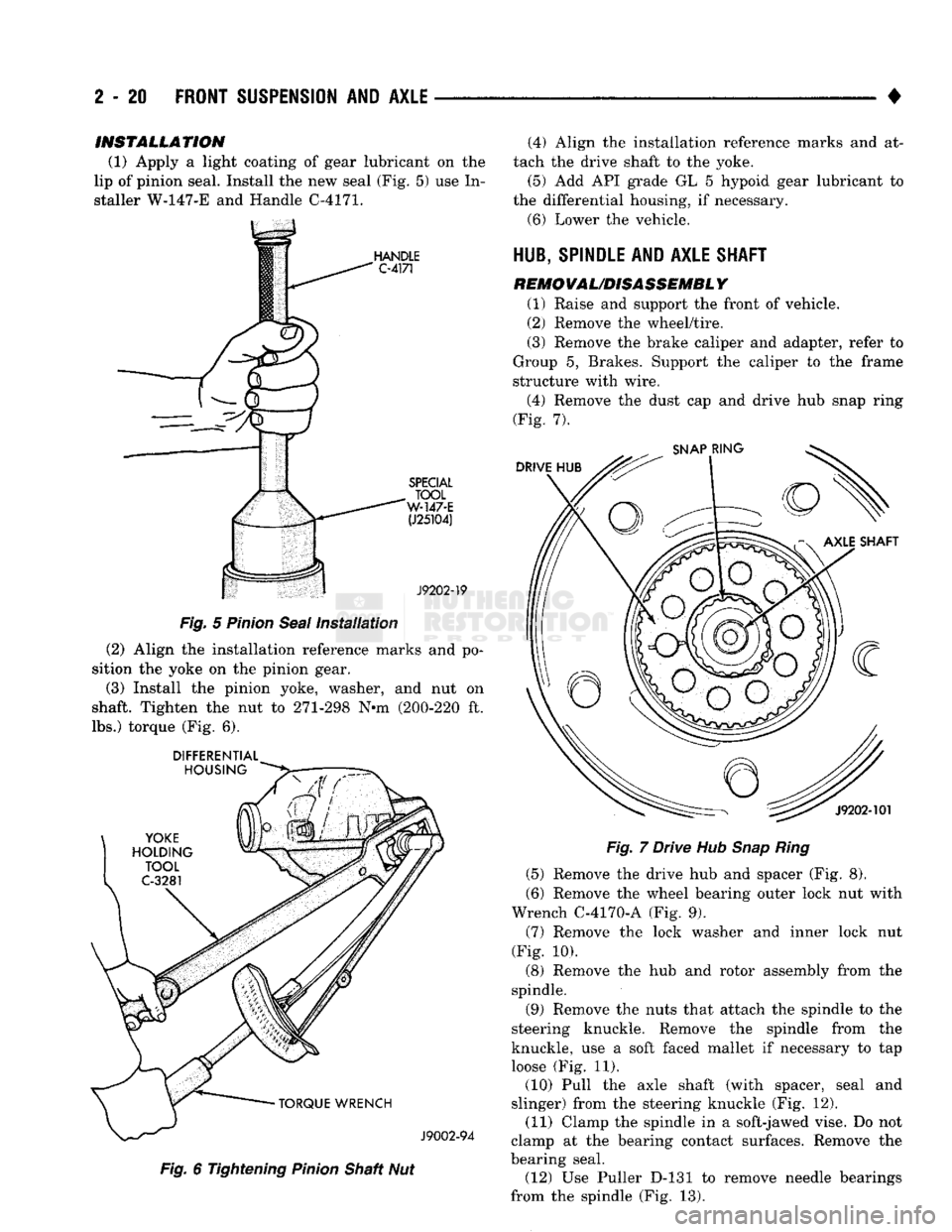
(1) Apply a light coating of gear lubricant on the
lip of pinion seal. Install the new seal (Fig. 5) use In
staller W-147-E and Handle C-4171.
Fig.
5
Pinion
Seal
Installation
(2) Align the installation reference marks and po
sition the yoke on the pinion gear.
(3) Install the pinion yoke, washer, and nut on
shaft. Tighten the nut to 271-298 N»m (200-220 ft.
lbs.) torque (Fig. 6).
DIFFERENTIAL
Fig.
6 Tightening
Pinion
Shaft Nut (4) Align the installation reference marks and at
tach the drive shaft to the yoke.
(5) Add API grade GL 5 hypoid gear lubricant to
the differential housing, if necessary.
(6) Lower the vehicle.
HUB, SPINDLE
AND
AXLE SHAFT
REMOVAL/DISASSEMBLY
(1) Raise and support the front of vehicle.
(2) Remove the wheel/tire.
(3) Remove the brake caliper and adapter, refer to
Group 5, Brakes. Support the caliper to the frame
structure with wire.
(4) Remove the dust cap and drive hub snap ring
(Fig. 7).
Fig.
7 Drive Hub
Snap Ring
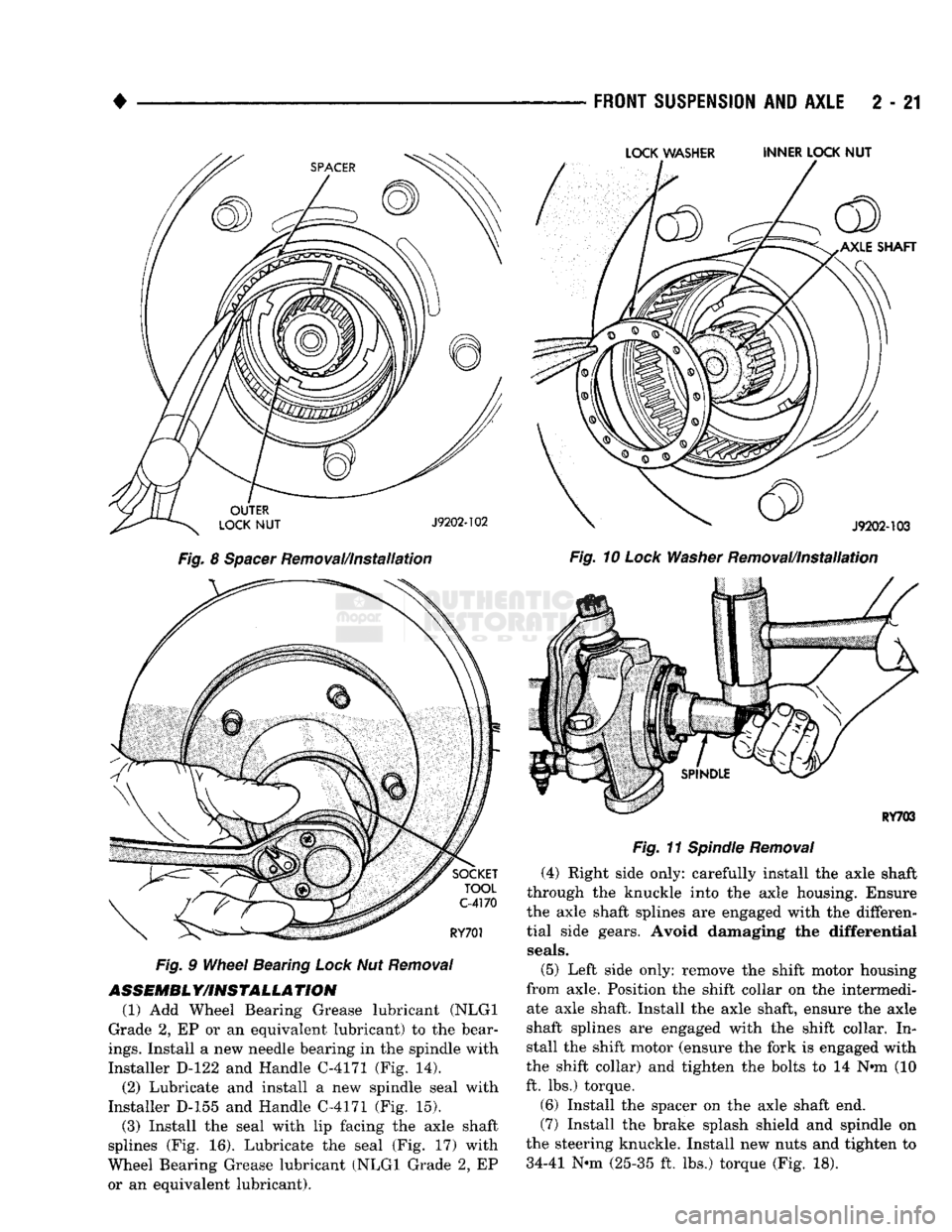
(5) Remove the drive hub and spacer (Fig. 8).
(6) Remove the wheel bearing outer lock nut with
Wrench C-4170-A (Fig. 9). (7) Remove the lock washer and inner lock nut
(Fig. 10).
(8) Remove the hub and rotor assembly from the
spindle.
(9) Remove the nuts that attach the spindle to the
steering knuckle. Remove the spindle from the
knuckle, use a soft faced mallet if necessary to tap
loose (Fig. 11).
(10) Pull the axle shaft (with spacer, seal and
slinger) from the steering knuckle (Fig. 12). (11) Clamp the spindle in a soft-jawed vise. Do not
clamp at the bearing contact surfaces. Remove the
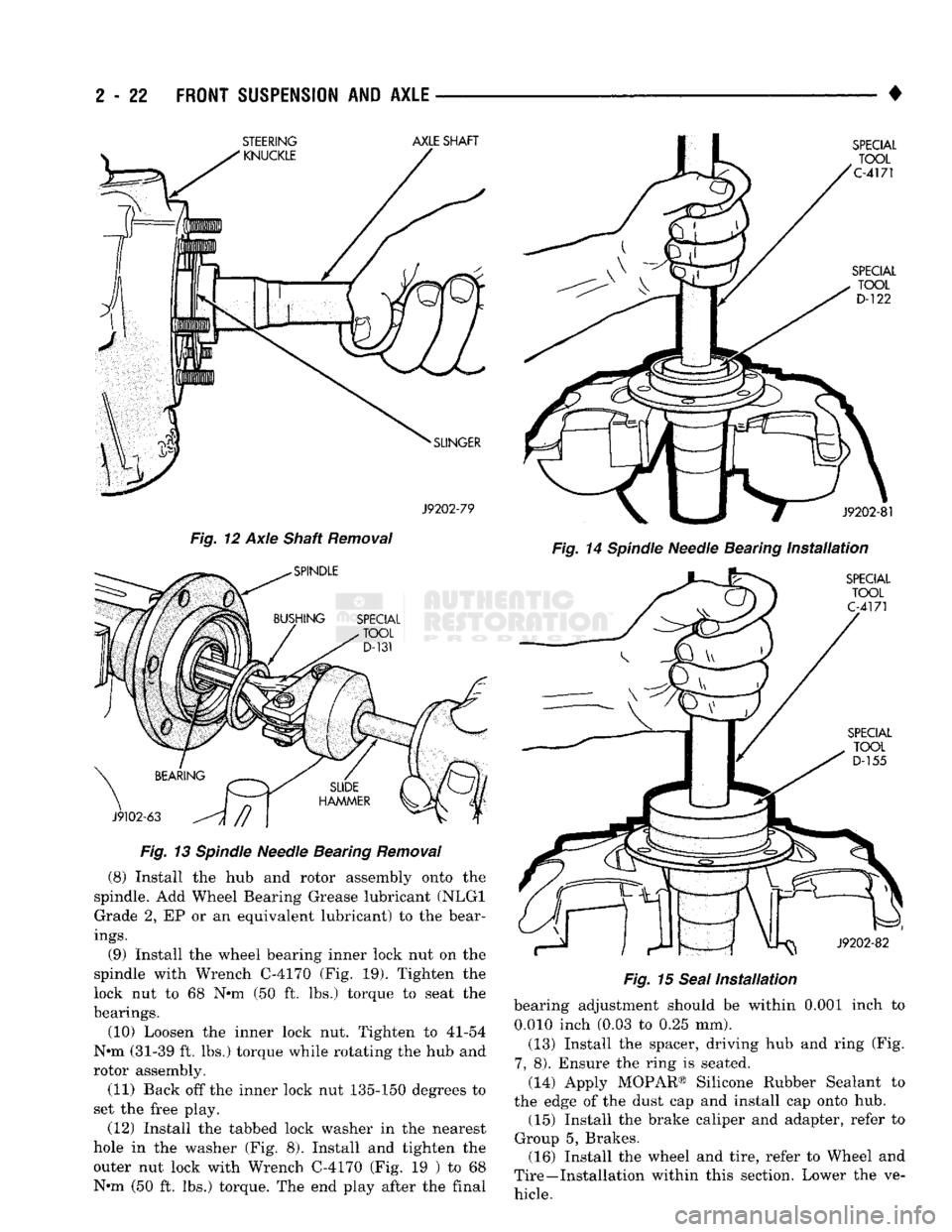
bearing seal. (12) Use Puller D-131 to remove needle bearings
from the spindle (Fig. 13).
Page 74 of 1502
•
Fig.
8
Spacer
Removal/Installation
Fig.
9
Wheel
Bearing
Lock
Nut
Removal
ASSEMBL
Y/INSTALLA
TION
(1) Add Wheel Bearing Grease lubricant (NLGI
Grade 2, EP or an equivalent lubricant) to the bear
ings.
Install a new needle bearing in the spindle with
Installer D-122 and Handle C-4171 (Fig. 14).
(2) Lubricate and install a new spindle seal with
Installer D-155 and Handle C-4171 (Fig. 15).
(3) Install the seal with lip facing the axle shaft
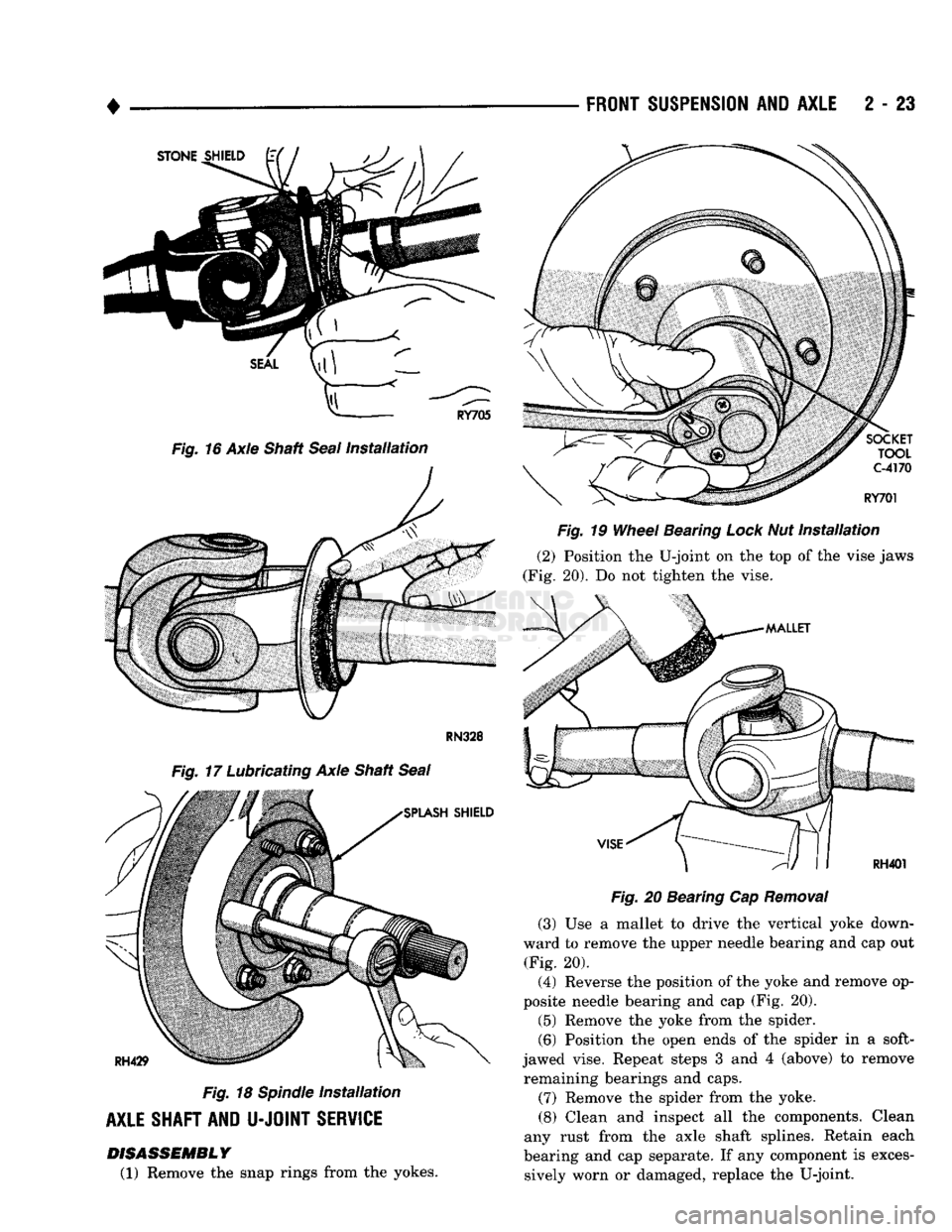
splines (Fig. 16). Lubricate the seal (Fig. 17) with
Wheel Bearing Grease lubricant (NLGI Grade 2, EP or an equivalent lubricant).
FRONT
SUSPENSION
AND
AXLE
2 - 21
LOCK
WASHER INNER LOCK
NUT
Fig.
10
Lock
Washer
Removal/Installation
Fig.
11
Spindle
Removal
(4) Right side only: carefully install the axle shaft
through the knuckle into the axle housing. Ensure
the axle shaft splines are engaged with the differen
tial side gears. Avoid damaging the differential
seals.
(5) Left side only: remove the shift motor housing
from axle. Position the shift collar on the intermedi ate axle shaft. Install the axle shaft, ensure the axle
shaft splines are engaged with the shift collar. In stall the shift motor (ensure the fork is engaged with
the shift collar) and tighten the bolts to 14 Nnn (10
ft. lbs.) torque.
(6) Install the spacer on the axle shaft end.
(7) Install the brake splash shield and spindle on
the steering knuckle. Install new nuts and tighten to 34-41 Nnn (25-35 ft. lbs.) torque (Fig. 18).
Page 75 of 1502
2
- 22
FRONT SUSPENSION
AND
AXLE
——
J9202-79
Fig. 12 Axle Shaft Removal
Fig. 13 Spindle Needle Bearing Removal (8) Install the hub and rotor assembly onto the
spindle. Add Wheel Bearing Grease lubricant (NLGI Grade 2, EP or an equivalent lubricant) to the bear
ings.
(9) Install the wheel bearing inner lock nut on the
spindle with Wrench C-4170 (Fig. 19). Tighten the
lock nut to 68 N*m (50 ft. lbs.) torque to seat the
bearings.
(10) Loosen the inner lock nut. Tighten to 41-54
N*m (31-39 ft. lbs.) torque while rotating the hub and
rotor assembly.
(11) Back off the inner lock nut 135-150 degrees to
set the free play.
(12) Install the tabbed lock washer in the nearest
hole in the washer (Fig. 8). Install and tighten the outer nut lock with Wrench C-4170 (Fig. 19 ) to 68
N«m (50 ft. lbs.) torque. The end play after the final •
Fig. 14 Spindle Needle Bearing Installation Fig. 15 Seal Installation bearing adjustment should be within 0.001 inch to
0.010 inch (0.03 to 0.25 mm).
(13) Install the spacer, driving hub and ring (Fig.
7,
8). Ensure the ring is seated.
(14) Apply MOPAR® Silicone Rubber Sealant to
the edge of the dust cap and install cap onto hub. (15) Install the brake caliper and adapter, refer to
Group 5, Brakes. (16) Install the wheel and tire, refer to Wheel and
Tire—Installation within this section. Lower the ve hicle. STEERING
AXLE
SHAFT
Page 76 of 1502
•
FRONT
SUSPENSION
AND
AXLE
2 - 23
RN328
Fig.
17 Lubricating Axle Shaft
Seal
Fig.
18
Spindle
Installation
AXLE SHAFT AND
U-JOINT
SERVICE DISASSEMBLY
(1) Remove the snap rings from the yokes.
Fig.
19
Wheel
Bearing Lock Nut
Installation
(2)
Position the U-joint on the top of the vise jaws
(Fig. 20). Do not tighten the vise.
Fig.
20 Bearing Cap
Removal
(3)
Use a mallet to drive the vertical yoke down
ward to remove the upper needle bearing and cap out (Fig. 20).
(4)
Reverse the position of the yoke and remove op
posite needle bearing and cap (Fig. 20).
(5)
Remove the yoke from the spider.
(6)
Position the open ends of the spider in a soft-
jawed vise. Repeat steps 3 and 4 (above) to remove remaining bearings and caps.
(7) Remove the spider from the yoke.
(8) Clean and inspect all the components. Clean
any rust from the axle shaft splines. Retain each
bearing and cap separate. If any component is exces sively worn or damaged, replace the U-joint.