Bearing DODGE TRUCK 1993 Service Workshop Manual
[x] Cancel search | Manufacturer: DODGE, Model Year: 1993, Model line: TRUCK, Model: DODGE TRUCK 1993Pages: 1502, PDF Size: 80.97 MB
Page 116 of 1502
•
FRONT SUSPENSION
AND
AXLE
2 - 63
THRUST
WASHER
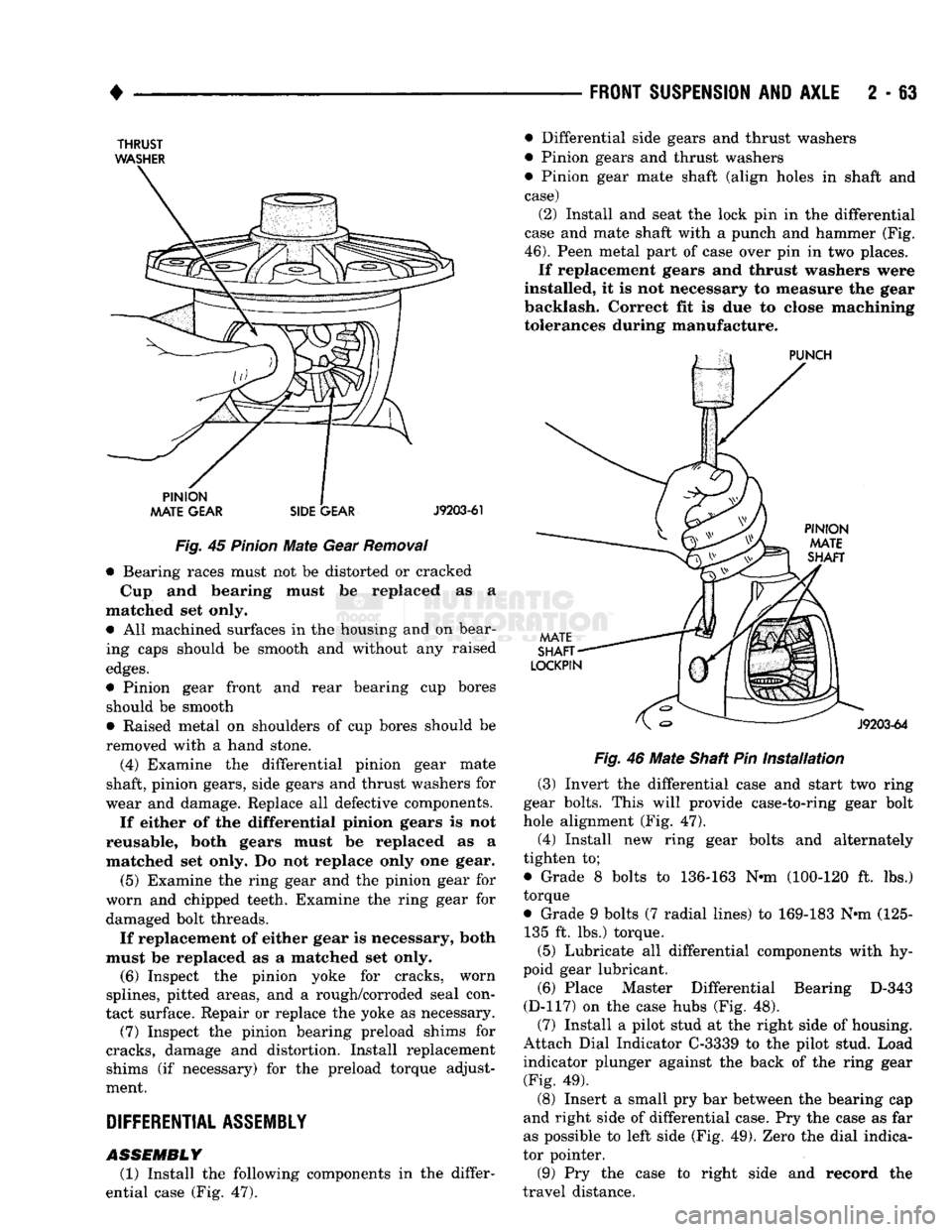
Fig.
45
Pinion
Mate
Gear
Removal
• Bearing races must not be distorted or cracked
Cup and bearing must be replaced as a
matched set only. • All machined surfaces in the housing and on bear
ing caps should be smooth and without any raised
edges.
• Pinion gear front and rear bearing cup bores should be smooth
• Raised metal on shoulders of cup bores should be
removed with a hand stone.
(4) Examine the differential pinion gear mate
shaft, pinion gears, side gears and thrust washers for
wear and damage. Replace all defective components.
If either of the differential pinion gears is not
reusable, both gears must be replaced as a
matched set only. Do not replace only one gear.
(5) Examine the ring gear and the pinion gear for
worn and chipped teeth. Examine the ring gear for damaged bolt threads.
If replacement of either gear is necessary, both
must be replaced as a matched set only. (6) Inspect the pinion yoke for cracks, worn
splines, pitted areas, and a rough/corroded seal con
tact surface. Repair or replace the yoke as necessary. (7) Inspect the pinion bearing preload shims for
cracks, damage and distortion. Install replacement shims (if necessary) for the preload torque adjust
ment.
DIFFERENTIAL
ASSEMBLY
ASSEMBLY
(1) Install the following components in the differ
ential case (Fig. 47). • Differential side gears and thrust washers
• Pinion gears and thrust washers
• Pinion gear mate shaft (align holes in shaft and
case) (2) Install and seat the lock pin in the differential
case and mate shaft with a punch and hammer (Fig.
46).
Peen metal part of case over pin in two places. If replacement gears and thrust washers were
installed, it is not necessary to measure the gear
backlash. Correct fit is due to close machining tolerances during manufacture.
Fig.
46
Mate
Shaft Pin
Installation
(3) Invert the differential case and start two ring
gear bolts. This will provide case-to-ring gear bolt
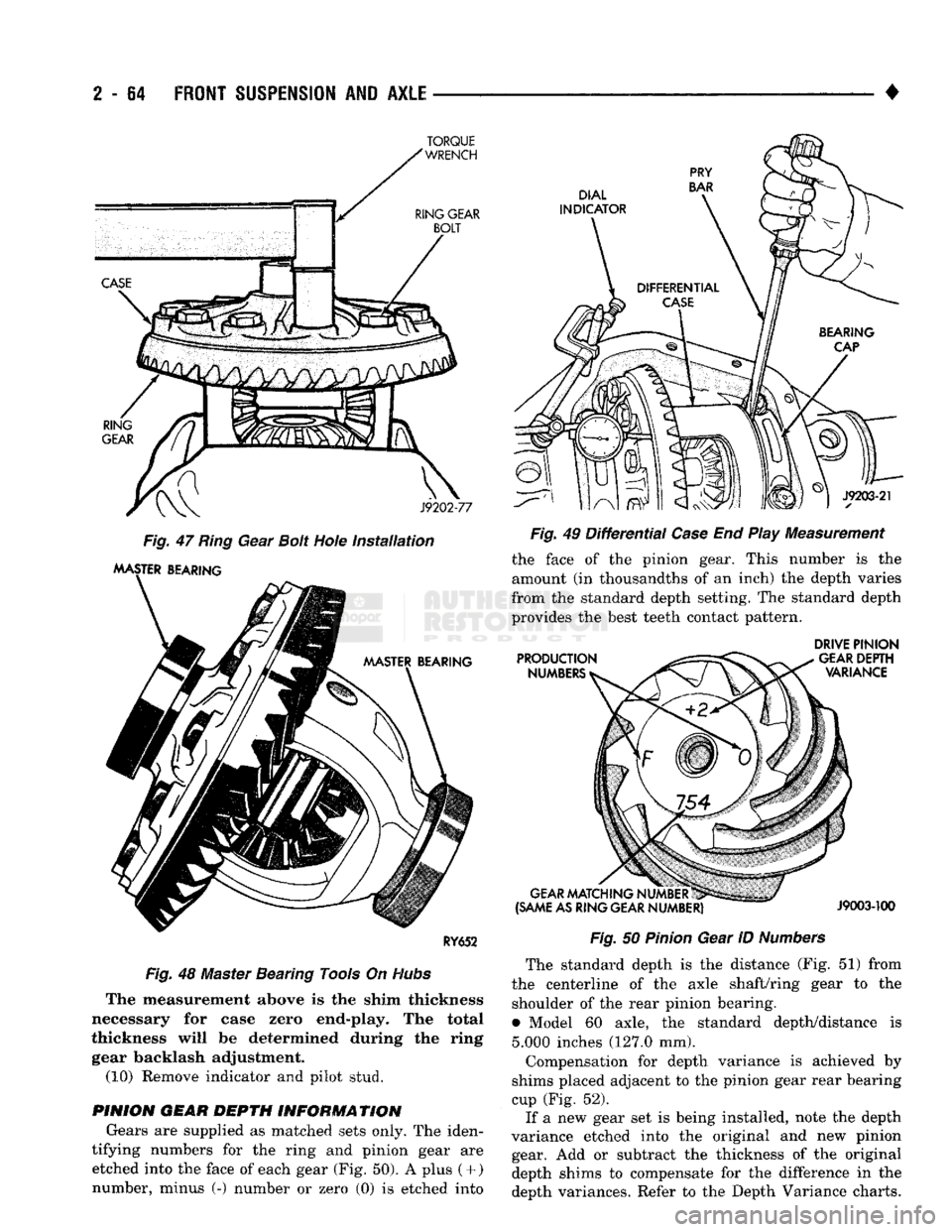
hole alignment (Fig. 47). (4) Install new ring gear bolts and alternately
tighten to;
• Grade 8 bolts to 136-163 N*m (100-120 ft. lbs.)
torque
• Grade 9 bolts (7 radial lines) to 169-183 N*m (125- 135 ft. lbs.) torque.
(5) Lubricate all differential components with hy
poid gear lubricant. (6) Place Master Differential Bearing D-343
(D-117) on the case hubs (Fig. 48). (7) Install a pilot stud at the right side of housing.
Attach Dial Indicator C-3339 to the pilot stud. Load indicator plunger against the back of the ring gear (Fig. 49).
(8) Insert a small pry bar between the bearing cap
and right side of differential case. Pry the case as far
as possible to left side (Fig. 49). Zero the dial indica
tor pointer.
(9) Pry the case to right side and record the
travel distance.
Page 117 of 1502
2
- 64
FRONT
SUSPENSION
AND
AXLE
—
Fig.
47 Ring Gear Bolt Hole
installation
MASTER BEARING
RY652
Fig.
48 Master Bearing Tools On
Hubs
The measurement above is the shim thickness
necessary for case zero end-play. The total
thickness will be determined during the ring gear backlash adjustment. (10) Remove indicator and pilot stud.
PINION GEAR DEPTH INFORMATION Gears are supplied as matched sets only. The iden
tifying numbers for the ring and pinion gear are etched into the face of each gear (Fig. 50). A plus
(
+ )
number, minus (-) number or zero (0) is etched into •
Fig.
49
Differential
Case
End Play Measurement the face of the pinion gear. This number is the
amount (in thousandths of an inch) the depth varies
from the standard depth setting. The standard depth
provides the best teeth contact pattern.
DRIVE
PINION
Fig.
50
Pinion
Gear ID
Numbers
The standard depth is the distance (Fig. 51) from
the centerline of the axle shaft/ring gear to the shoulder of the rear pinion bearing.
• Model 60 axle, the standard depth/distance is
5.000
inches (127.0 mm).
Compensation for depth variance is achieved by
shims placed adjacent to the pinion gear rear bearing
cup (Fig. 52). If a new gear set is being installed, note the depth
variance etched into the original and new pinion gear. Add or subtract the thickness of the original
depth shims to compensate for the difference in the
depth variances. Refer to the Depth Variance charts.
TORQUE
Page 119 of 1502
2
- 66
FRONT
SUSPENSION
AND
AXLE
•
PINION
GEAR
DEPTH
MEASUREMENT
AND
ADJUSTMENT
WITH
TOOL
SET
D-116 The following gear depth measurement and adjust
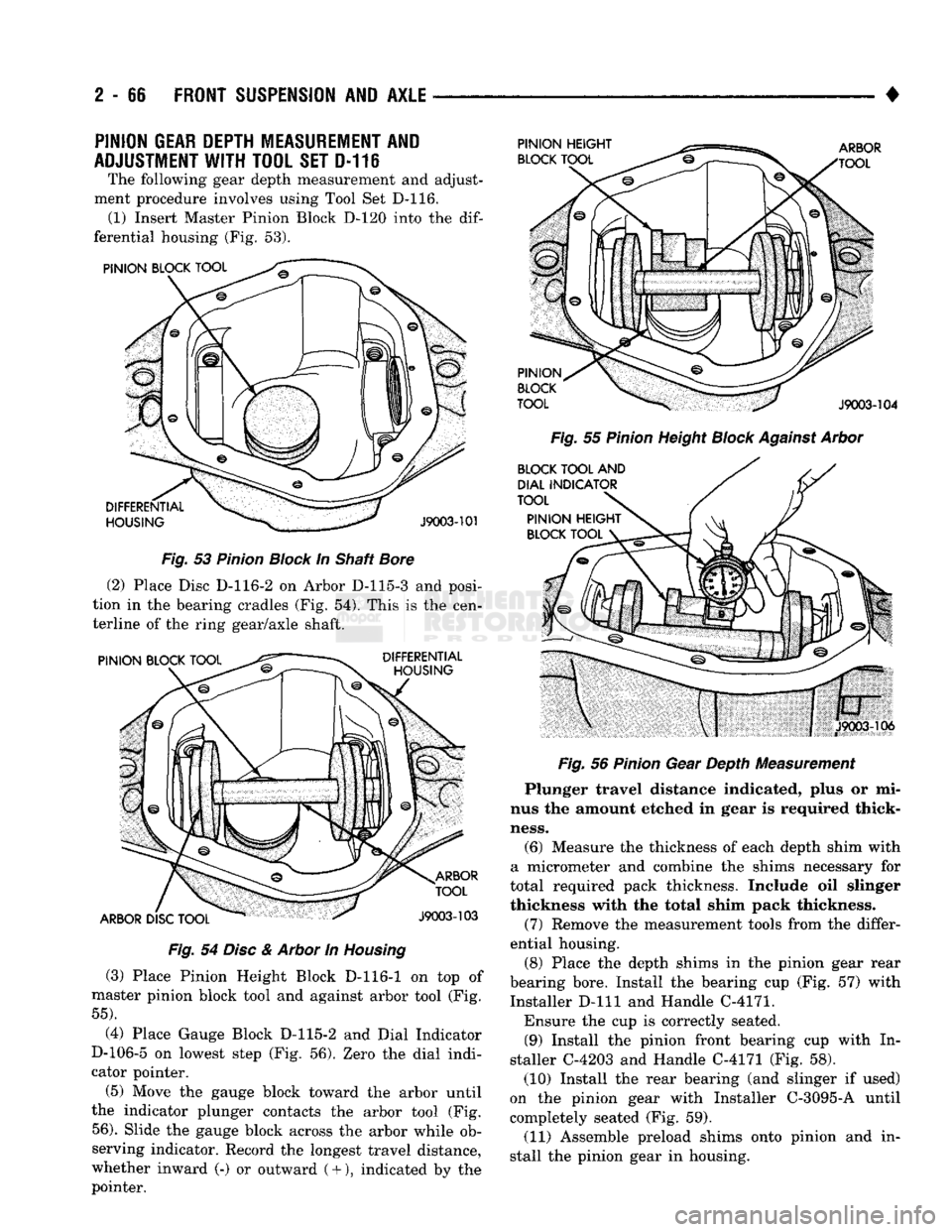
ment procedure involves using Tool Set D-116. (1) Insert Master Pinion Block D-120 into the
dif
ferential housing (Fig. 53).
Fig.
53
Pinion
Block
In Shaft
Bore
(2) Place Disc D-116-2 on Arbor D-115-3 and posi
tion in the bearing cradles (Fig. 54). This is the cen
terline of the ring gear/axle shaft.
Fig.
54
Disc
&
Arbor
In
Housing
(3) Place Pinion Height Block D-116-1 on top of
master pinion block tool and against arbor tool (Fig.
55).
(4) Place Gauge Block D-115-2 and Dial Indicator
D-106-5 on lowest step (Fig. 56). Zero the dial indi
cator pointer.
(5) Move the gauge block toward the arbor until
the indicator plunger contacts the arbor tool (Fig.
56).
Slide the gauge block across the arbor while ob
serving indicator. Record the longest travel distance,
whether inward (-) or outward
(
+ ), indicated by the
pointer.
Fig.
55
Pinion
Height
Block
Against
Arbor
Fig.
56
Pinion
Gear Depth Measurement
Plunger travel distance indicated, plus or mi
nus the amount etched in gear is required thick
ness.
(6) Measure the thickness of each depth shim with
a micrometer and combine the shims necessary for
total required pack thickness. Include oil slinger
thickness with the total shim pack thickness.
(7) Remove the measurement tools from the differ
ential housing.
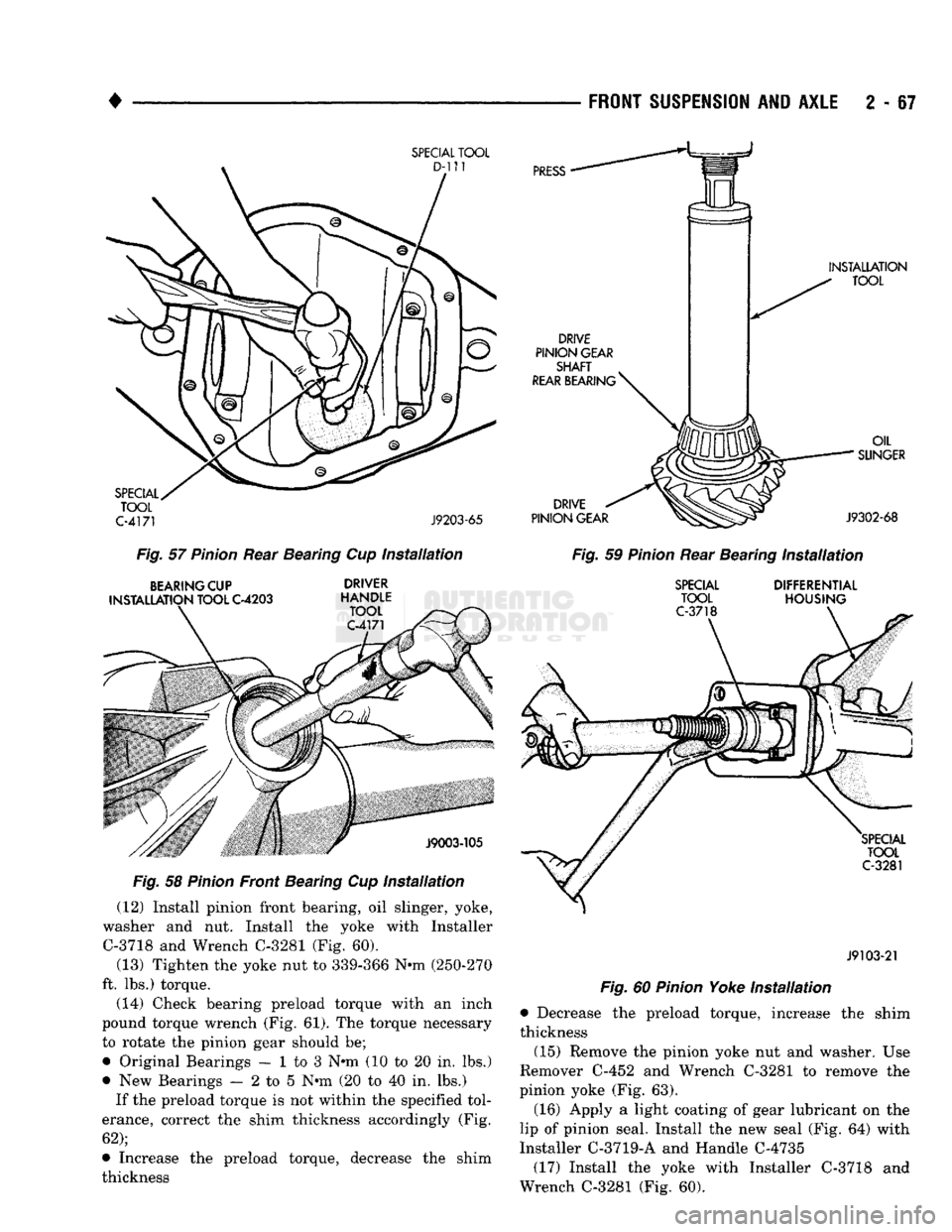
(8) Place the depth shims in the pinion gear rear
bearing bore. Install the bearing cup (Fig. 57) with
Installer D-lll and Handle C-4171.
Ensure the cup is correctly seated. (9) Install the pinion front bearing cup with In
staller C-4203 and Handle C-4171 (Fig. 58). (10) Install the rear bearing (and slinger if used)
on the pinion gear with Installer C-3095-A until
completely seated (Fig. 59).
(11) Assemble preload shims onto pinion and in
stall the pinion gear in housing.
Page 120 of 1502
•
FRONT
SUSPENSION
AND
AXLE
2 - 67
SPECIAL
TOOL
D-111
PRESS
DRIVE
PINION GEAR SHAFT
REAR
BEARING' INSTALLATION
TOOL
SPECIAL
TOOL
C-4171
J9203-65
DRIVE
PINION GEAR OIL
SUNGER
J9302-68
Fig.
57
Pinion
Rear Bearing Cup
Installation
Fig.
59
Pinion
Rear Bearing
Installation
BEARING
CUP
INSTALLATION TOOL
C-4203
DRIVER
HANDLE TOOL
C-4171
SPECIAL
TOOL
C-3718
DIFFERENTIAL
HOUSING
SPECIAL
TOOL
C-3281
Fig.
58
Pinion
Front Bearing Cup
Installation
(12) Install pinion front bearing, oil slinger, yoke,
washer and nut. Install the yoke with Installer C-3718 and Wrench C-3281 (Fig. 60).
(13) Tighten the yoke nut to 339-366 N-m (250-270
ft. lbs.) torque. (14) Check bearing preload torque with an inch
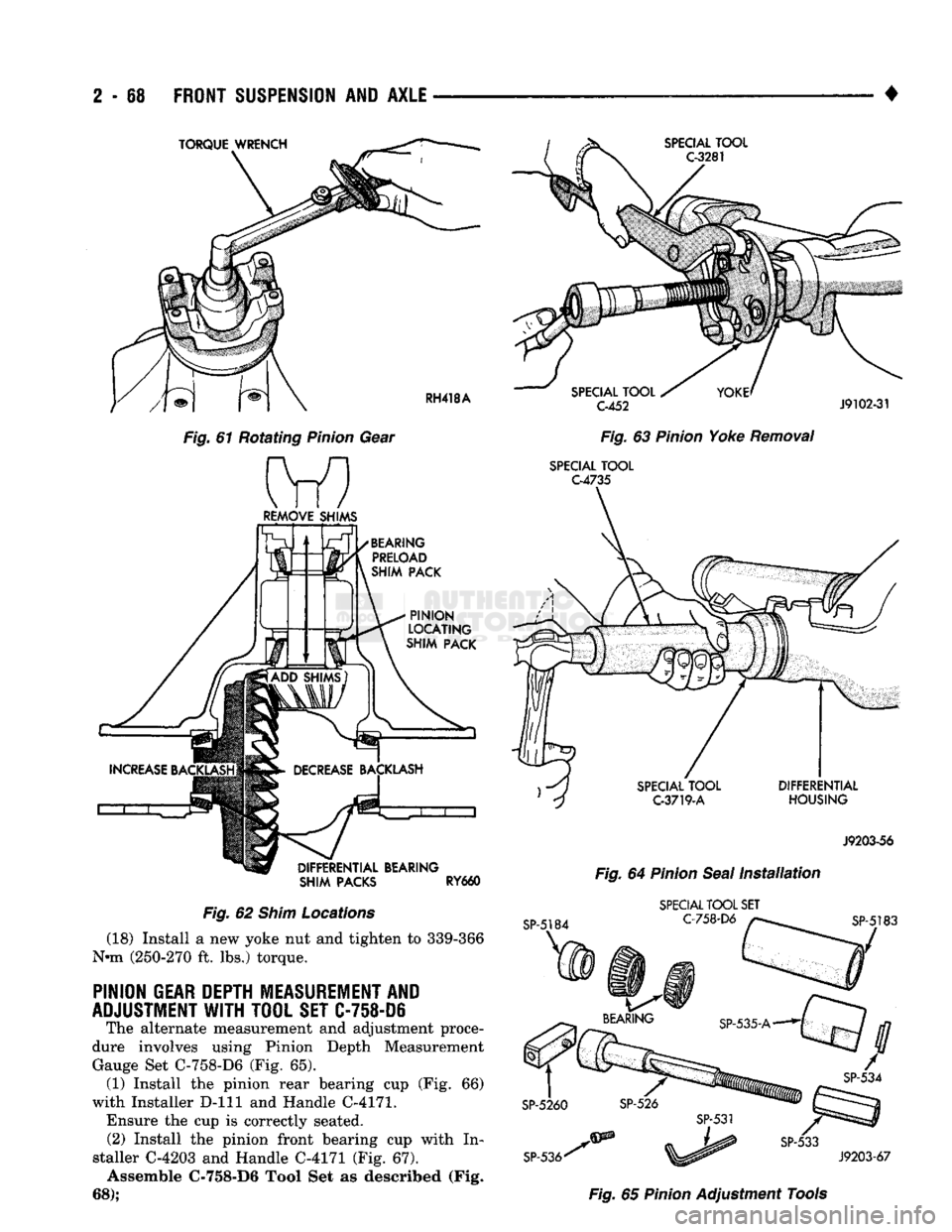
pound torque wrench (Fig. 61). The torque necessary
to rotate the pinion gear should be;
• Original Bearings — 1 to 3 N*m (10 to 20 in. lbs.)
• New Bearings — 2 to 5 N-m (20 to 40 in. lbs.) If the preload torque is not within the specified tol
erance, correct the shim thickness accordingly (Fig.
62);
• Increase the preload torque, decrease the shim
thickness
J9103-21
Fig.
60
Pinion
Yoke
Installation
• Decrease the preload torque, increase the shim
thickness (15) Remove the pinion yoke nut and washer. Use
Remover C-452 and Wrench C-3281 to remove the
pinion yoke (Fig. 63).
(16) Apply a light coating of gear lubricant on the
lip of pinion seal. Install the new seal (Fig. 64) with
Installer C-3719-A and Handle C-4735
(17) Install the yoke with Installer C-3718 and
Wrench C-3281 (Fig. 60).
Page 121 of 1502
2
- 88
FRONT
SUSPENSION
AND
AXLE
•
TORQUE WRENCH SPECIAL TOOL
C-3281
RH418A
Fig.
61 Rotating
Pinion
Gear Ml
REMOVE SHIMS
BEARING PRELOAD
SHIM
PACK
PINION
LOCATING
SHIM
PACK
DIFFERENTIAL
BEARING
SHIM PACKS
RY660
Fig.
62
Shim
Locations
(18) Install a new yoke nut and tighten to 339-366
N-m (250-270 ft. lbs.) torque.
PINION
GEAR
DEPTH
MEASUREMENT
AND
ADJUSTMENT
WITH
TOOL
SET
C-758-D6
The alternate measurement and adjustment proce
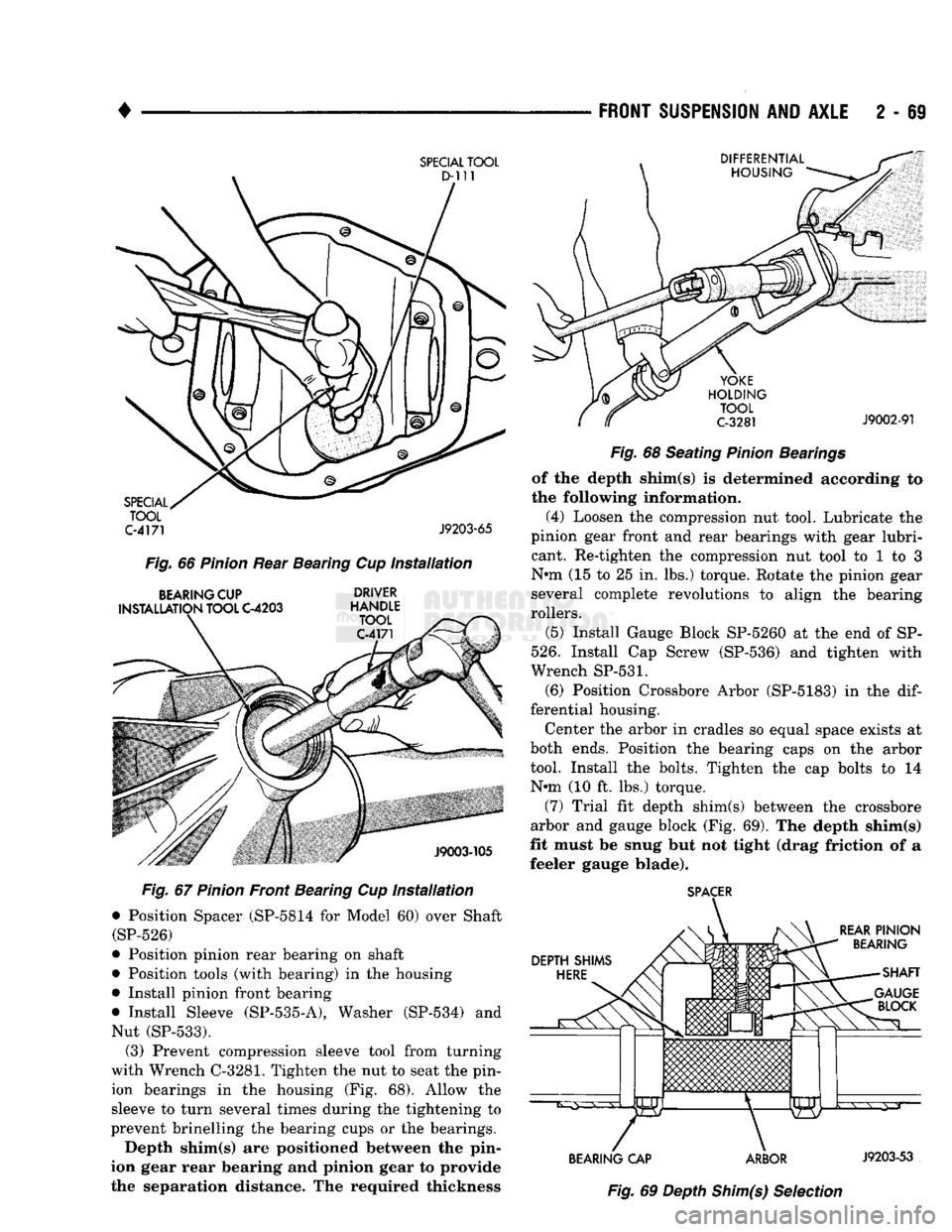
dure involves using Pinion Depth Measurement Gauge Set C-758-D6 (Fig. 65). (1) Install the pinion rear bearing cup (Fig. 66)
with Installer D-lll and Handle C-4171.
Ensure the cup is correctly seated. (2) Install the pinion front bearing cup with In
staller C-4203 and Handle C-4171 (Fig. 67). Assemble C-758-D6 Tool Set as described (Fig.
68);
SPECIAL
TOOL
C-452
J9102-31
Fig.
63
Pinion
Yoke
Removal
SPECIAL
TOOL C4735
SP-5184 C-3719-A
DIFFERENTIAL
HOUSING
J9203-56
Fig.
64
Pinion
Seal
Installation
SPECIAL
TOOL
SET C-758-D6
J9203-67
Fig.
65
Pinion
Adjustment Tools
Page 122 of 1502
•
.
C-4171 J9203-65
Fig.
66
Pinion
Rear Bearing Cup
Installation
BEARING
CUP DRIVER
INSTALLATION
TOOL
C-4203
HANDLE
Fig.
67
Pinion
Front Bearing Cup
Installation
•
Position Spacer (SP-5814 for Model 60) over Shaft
(SP-526)
•
Position pinion rear bearing on shaft
•
Position tools (with bearing) in the housing
•
Install pinion front bearing
•
Install Sleeve
(SP-535-A),
Washer (SP-534) and
Nut
(SP-533).
(3) Prevent compression sleeve tool from turning
with Wrench C-3281. Tighten the nut to seat the pin ion bearings in the housing (Fig. 68). Allow the
sleeve to turn several times during the tightening to
prevent brinelling the bearing cups or the bearings.
Depth shim(s) are positioned between the pin
ion gear rear bearing and pinion gear to provide
the separation distance. The required thickness
FRONT SUSPENSION
AND
AXLE
2 - 69
Fig.
68 Seating
Pinion
Bearings
of the depth shim(s) is determined according to
the following information.
(4) Loosen the compression nut tool. Lubricate the
pinion gear front and rear bearings with gear lubri cant. Re-tighten the compression nut tool to 1 to 3
Nnn (15 to 25 in. lbs.) torque. Rotate the pinion gear several complete revolutions to align the bearing
rollers.
(5) Install Gauge Block SP-5260 at the end of SP-
526.
Install Cap Screw (SP-536) and tighten with
Wrench
SP-531.
(6) Position Crossbore Arbor (SP-5183) in the
dif
ferential housing.
Center the arbor in cradles so equal space exists at
both ends. Position the bearing caps on the arbor
tool. Install the bolts. Tighten the cap bolts to 14 Nnn (10 ft. lbs.) torque.
(7) Trial fit depth shim(s) between the crossbore
arbor and gauge block (Fig. 69). The depth shim(s)
fit must be snug but not tight (drag friction of a
feeler gauge blade).
SPACER
BEARING CAP ARBOR
J9203-53
Fig.
69 Depth
Shim(s)
Selection
SPECIAL
TOOL
Page 123 of 1502
2
- 70
FRONT
SUSPENSION
AND
AXLE
• Depth shims are available in O.OOl-ineh incre
ments from 0.020 inch to 0.038 inch. (8) Note the etched number on the face of the drive
pinion gear (e.g., -0, -1, -2, +1, +2, etc.). The num
bers represent thousands-of-an-inch deviation from
the standard. If the number is - (negative), add that
value to the required thickness of the depth shim(s).
If the number is + (positive), subtract that value
from the thickness of the depth shim(s). If the num
ber is 0, no change is necessary.
(9) Remove the tools from the differential housing.
(10) Remove the rear bearing cup from housing
(Fig. 70) with Remover D-162 and Handle C-4171.
HAMMER
DRIVER
HANDLE
PRESS
DRIVE
PINION
GEAR SHAFT
REAR
BEARING' INSTALLATION
TOOL
DRIVE
PINION
GEAR OIL
SUNGER
J9302-68
Fig.
71
Pinion
Rear Bearing
Installation
SPECIAL
TOOL
C-3718
DIFFERENTIAL
HOUSING
J9203-58
Fig.
70 Rear Bearing Cup
Removal
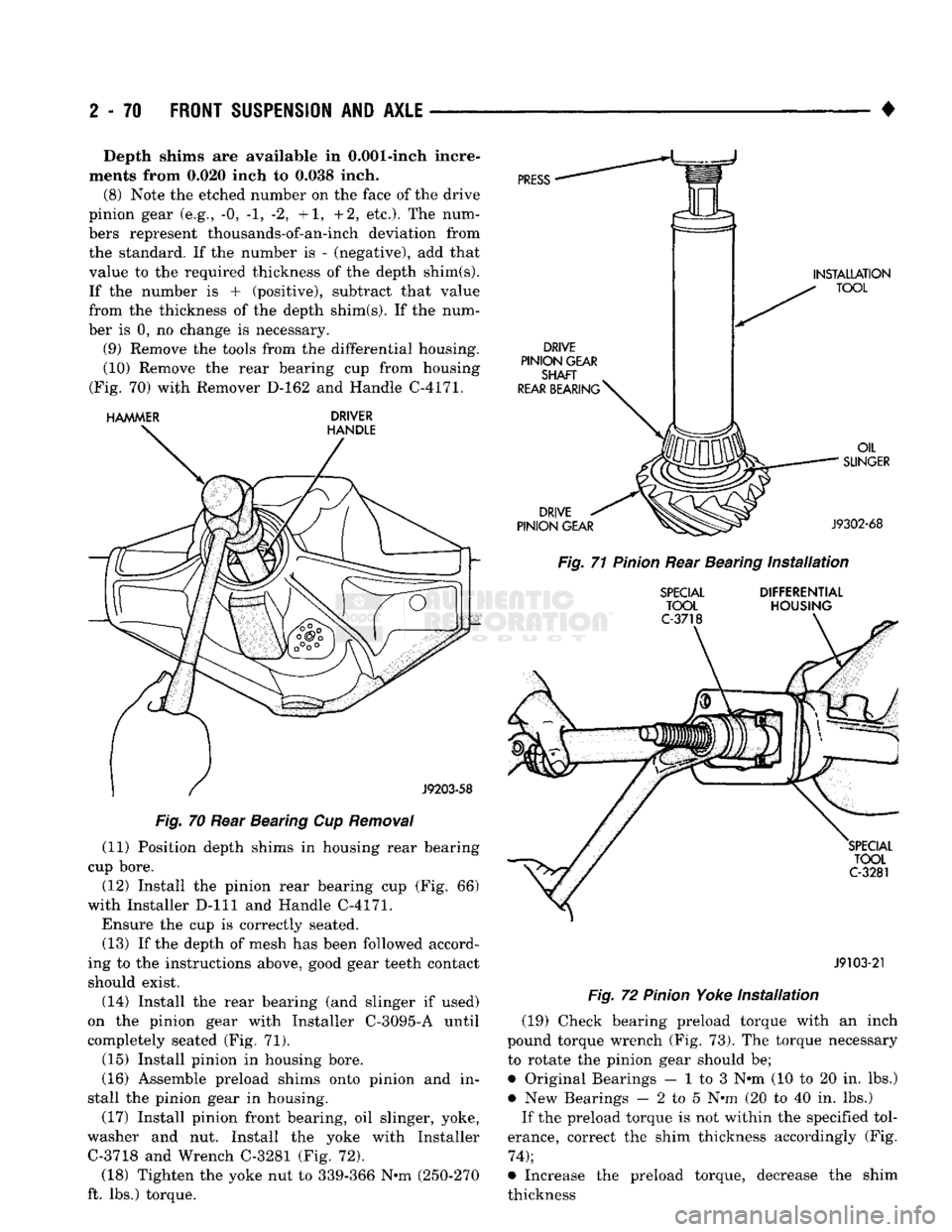
(11) Position depth shims in housing rear bearing
cup bore.
(12) Install the pinion rear bearing cup (Fig. 66)
with Installer D-lll and Handle C-4171. Ensure the cup is correctly seated. (13) If the depth of mesh has been followed accord
ing to the instructions above, good gear teeth contact should exist.
(14) Install the rear bearing (and slinger if used)
on the pinion gear with Installer C-3095-A until
completely seated (Fig. 71).
(15) Install pinion in housing bore.
(16) Assemble preload shims onto pinion and in
stall the pinion gear in housing. (17) Install pinion front bearing, oil slinger, yoke,
washer and nut. Install the yoke with Installer C-3718 and Wrench C-3281 (Fig. 72).
(18) Tighten the yoke nut to 339-366 N-m (250-270
ft. lbs.) torque.
SPECIAL
TOOL
C-3281
J9103-21
Fig.
72
Pinion
Yoke
Installation
(19) Check bearing preload torque with an inch
pound torque wrench (Fig. 73). The torque necessary to rotate the pinion gear should be;
• Original Bearings — 1 to 3 N*m (10 to 20 in. lbs.) • New Bearings — 2 to 5 N»m (20 to 40 in. lbs.) If the preload torque is not within the specified tol
erance, correct the shim thickness accordingly (Fig.
74);
• Increase the preload torque, decrease the shim
thickness
Page 124 of 1502
•
FRONT
SUSPENSION
AND
AXLE
2 - 71
TORQUE
WRENCH
SPECIAL
TOOL
G3281
RH418A
Fig.
73 Rotating
Pinion
Gear
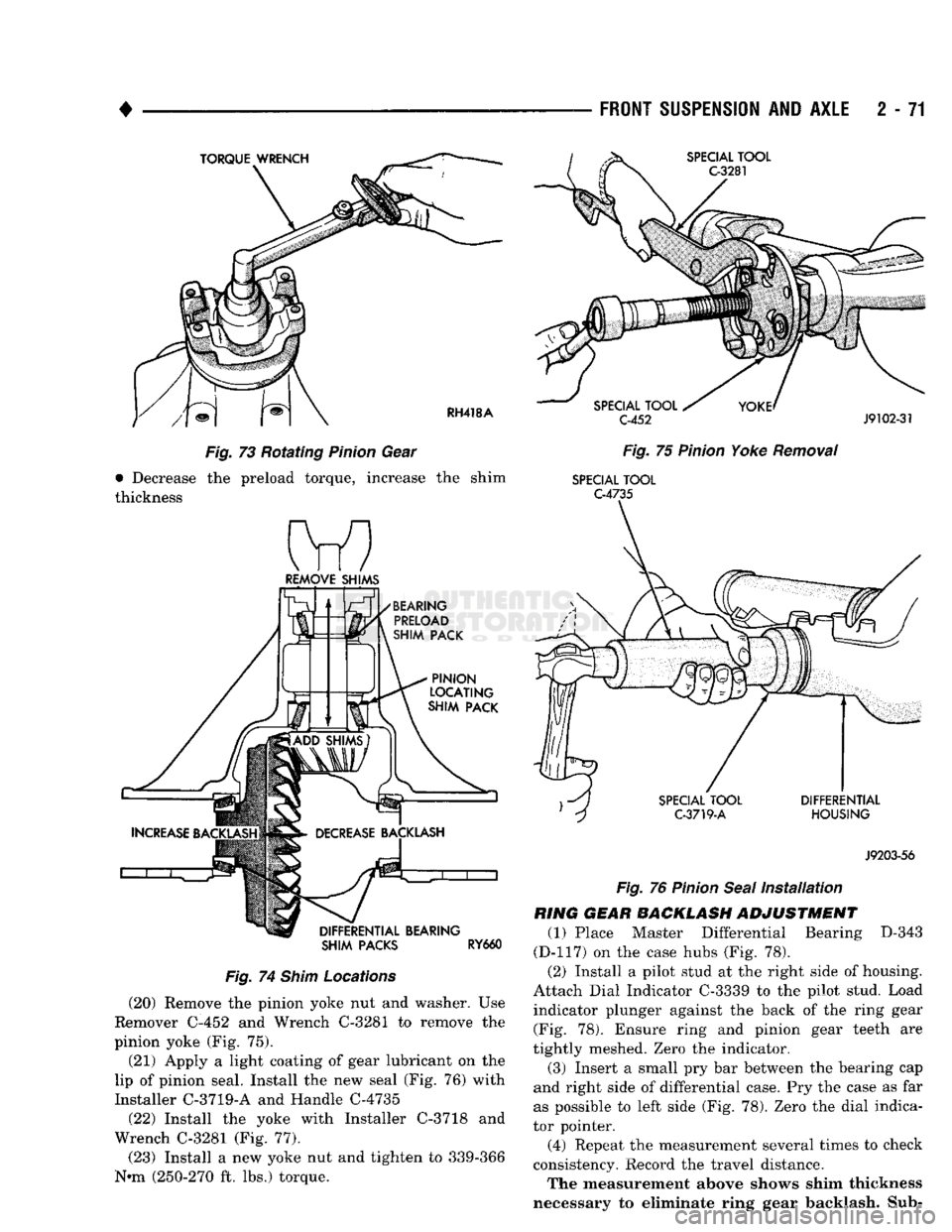
• Decrease the preload torque, increase the shim
thickness
BEARING
PRELOAD
SHIM PACK
PINION
LOCATING
SHIM PACK
DIFFERENTIAL BEARING SHIM PACKS
RY660
Fig.
74
Shim
Locations
(20) Remove the pinion yoke nut and washer. Use
Remover C-452 and Wrench C-3281 to remove the
pinion yoke (Fig. 75).
(21) Apply a light coating of gear lubricant on the
lip of pinion seal. Install the new seal (Fig. 76) with
Installer C-3719-A and Handle C-4735
(22) Install the yoke with Installer C-3718 and
Wrench C-3281 (Fig. 77).
(23) Install a new yoke nut and tighten to 339-366
N*m (250-270 ft. lbs.) torque.
SPECIAL
TOOL
C-452
J9102-31
Fig.
75
Pinion
Yoke
Removal
SPECIAL
TOOL
C-4735
SPECIAL
TOOL C-3719-A DIFFERENTIAL
HOUSING
J9203-56
Fig.
76
Pinion
Seal
Installation
RING
GEAR BACKLASH
ADJUSTMENT
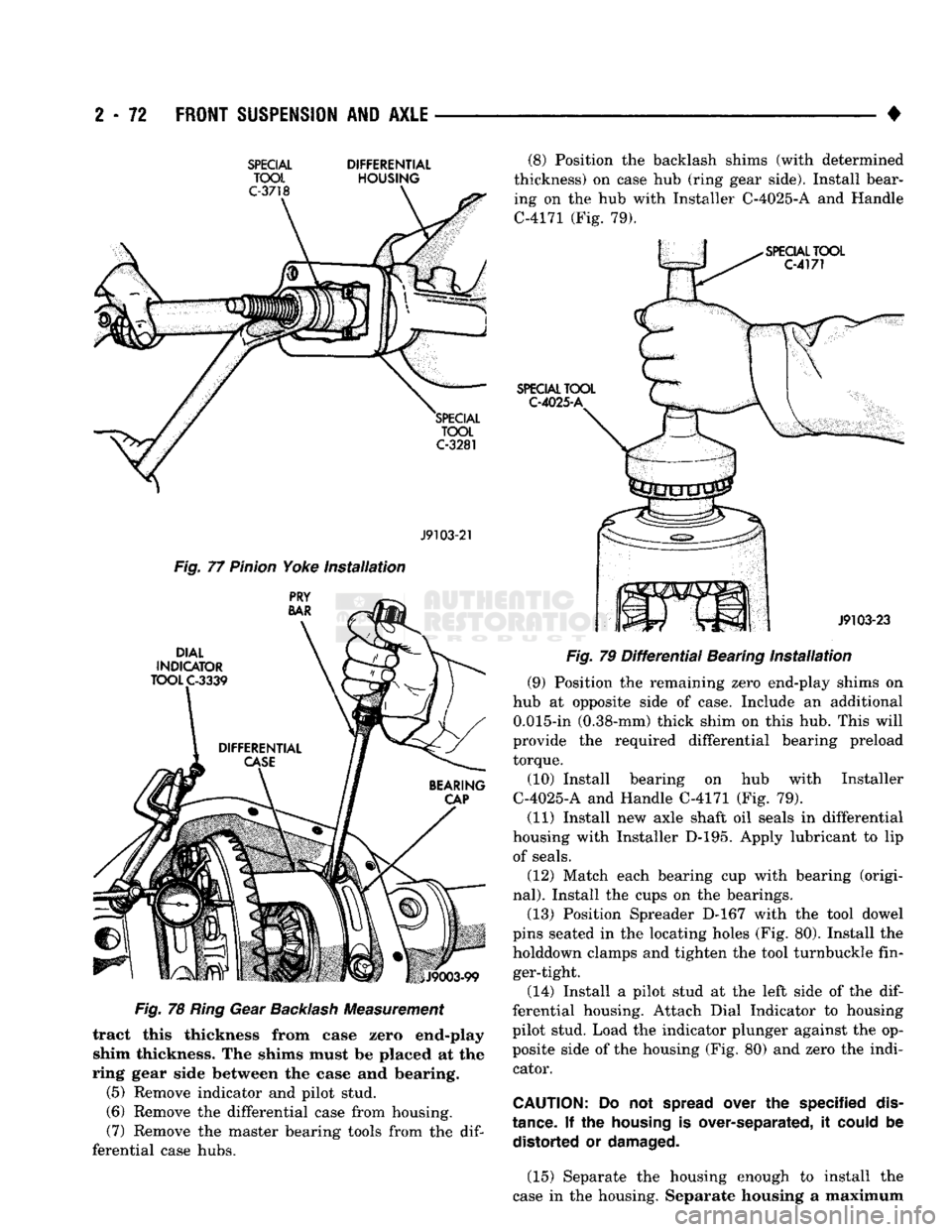
(1) Place Master Differential Bearing D-343
(D-117) on the case hubs (Fig. 78).
(2) Install a pilot stud at the right side of housing.
Attach Dial Indicator C-3339 to the pilot stud. Load indicator plunger against the back of the ring gear (Fig. 78). Ensure ring and pinion gear teeth are
tightly meshed. Zero the indicator.
(3) Insert a small pry bar between the bearing cap
and right side of differential case. Pry the case as far
as possible to left side (Fig. 78). Zero the dial indica
tor pointer.
(4) Repeat the measurement several times to check
consistency. Record the travel distance.
The measurement above shows shim thickness
necessary to eliminate ring gear backlash. Sub-
Page 125 of 1502
2
- 72
FRONT
SUSPENSION
AND
AXLE
•
SPECIAL
DIFFERENTIAL
TOOL
HOUSING
J9103-21
Fig.
77
Pinion
Yoke
Installation
Fig.
78
Ring Gear Backlash Measurement
tract this thickness
from
case zero end-play shim thickness.
The
shims must
be
placed
at the
ring gear side between
the
case
and
bearing. (5) Remove indicator
and
pilot stud.
(6)
Remove
the
differential case from housing.
(7) Remove
the
master bearing tools from
the dif
ferential case hubs. (8) Position
the
backlash shims (with determined
thickness)
on
case
hub
(ring gear side). Install bear
ing
on the hub
with Installer C-4025-A
and
Handle
C-4171
(Fig. 79).
Fig.
79
Differential Bearing
Installation
(9) Position
the
remaining zero end-play shims
on
hub
at
opposite side
of
case. Include
an
additional 0.015-in (0.38-mm) thick shim
on
this
hub.
This will
provide
the
required differential bearing preload
torque.
(10) Install bearing
on hub
with Installer
C-4025-A
and
Handle C-4171
(Fig. 79).
(11) Install
new
axle shaft
oil
seals
in
differential
housing with Installer D-195. Apply lubricant
to lip
of seals.
(12) Match each bearing
cup
with bearing (origi
nal).
Install
the
cups
on the
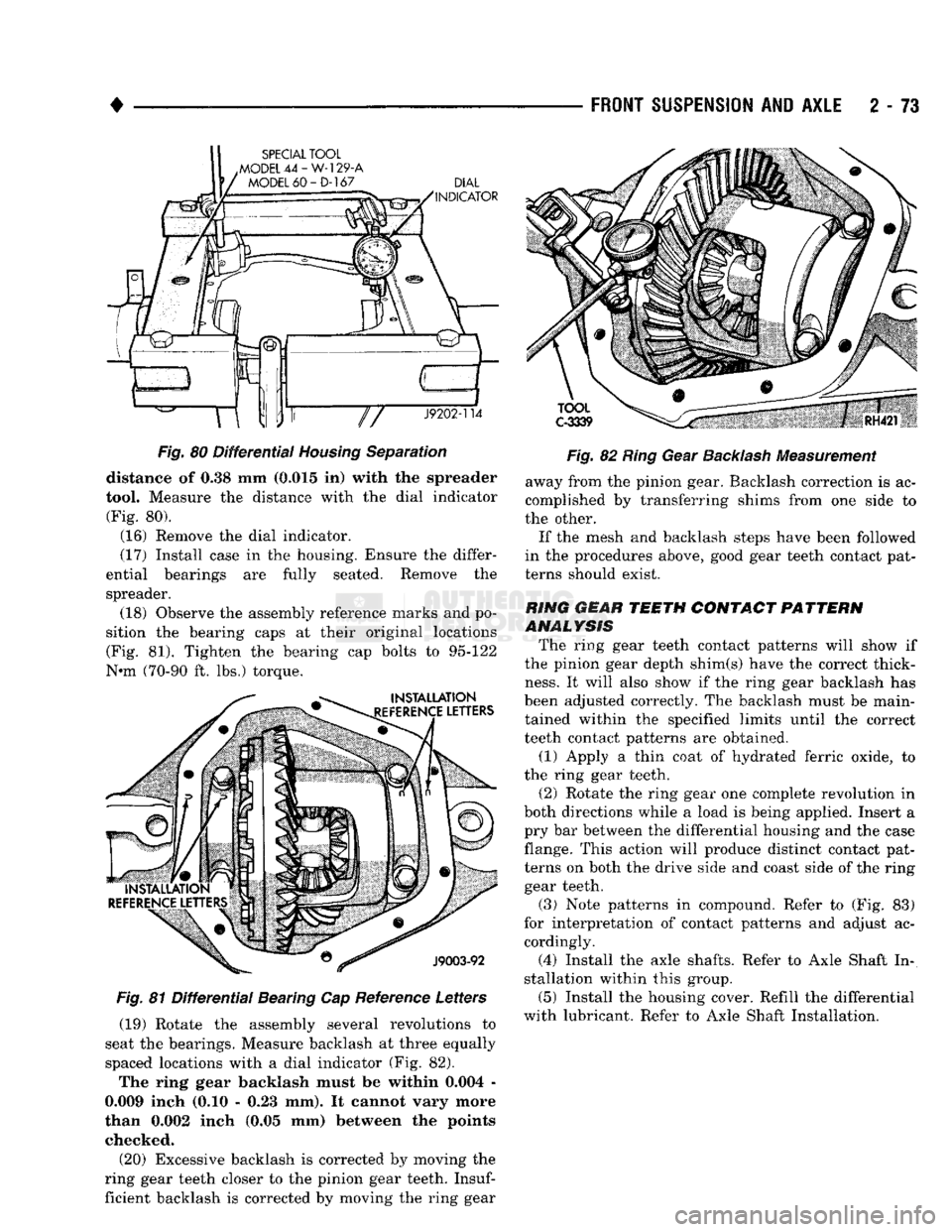
bearings. (13) Position Spreader
D-167
with
the
tool dowel
pins seated
in the
locating holes
(Fig. 80).
Install
the
holddown clamps
and
tighten
the
tool turnbuckle fin ger-tight. (14) Install
a
pilot stud
at the
left side
of the dif
ferential housing. Attach Dial Indicator
to
housing
pilot stud. Load
the
indicator plunger against
the op
posite side
of the
housing
(Fig. 80) and
zero
the
indi cator.
CAUTION:
Do not
spread
over
the
specified
dis
tance.
If the
housing
is
over-separated,
it
could
he
distorted
or
damaged.
(15) Separate
the
housing enough
to
install
the
case
in the
housing. Separate housing
a
maximum
Page 126 of 1502
•
FRONT
SUSPENSION
AND
AXLE
2 - 73
SPECIAL TOOL
.MODEL
44-W-129-A
MODEL
60 - D-167
DIAL
INDICATOR
J9202-114
TOOL
C-3339
Fig.
80
Differential
Housing
Separation
distance
of 0.38 mm
(0.015
in)
with
the
spreader
tool. Measure
the
distance with
the
dial indicator
(Fig.
80).
(16) Remove
the
dial indicator.
(17) Install case
in the
housing. Ensure
the
differ
ential bearings
are
fully seated. Remove
the
spreader.
(18) Observe
the
assembly reference marks
and po
sition
the
bearing caps
at
their original locations (Fig.
81).
Tighten
the
bearing
cap
bolts
to
95-122
Nnn (70-90
ft. lbs.)
torque.
Fig.
81
Differential
Bearing
Cap
Reference Letters (19) Rotate
the
assembly several revolutions
to
seat
the
bearings. Measure backlash
at
three equally
spaced locations with
a
dial indicator
(Fig. 82).
The ring gear backlash must
be
within 0.004
-
0.009 inch
(0.10 - 0.23 mm). It
cannot vary more
than 0.002 inch
(0.05 mm)
between
the
points checked.
(20) Excessive backlash
is
corrected
by
moving
the
ring gear teeth closer
to the
pinion gear teeth.
Insuf
ficient backlash
is
corrected
by
moving
the
ring gear
Fig.
82
Ring
Gear
Backlash
Measurement
away from
the
pinion gear. Backlash correction
is ac
complished
by
transferring shims from
one
side
to
the other.
If
the
mesh
and
backlash steps have been followed
in
the
procedures above, good gear teeth contact pat
terns should exist.
RING GEAR TEETH CONTACT PATTERN
ANALYSIS
The ring gear teeth contact patterns will show
if
the pinion gear depth shim(s) have
the
correct thick
ness.
It
will also show
if the
ring gear backlash
has
been adjusted correctly.
The
backlash must
be
main
tained within
the
specified limits until
the
correct
teeth contact patterns
are
obtained.
(1) Apply
a
thin coat
of
hydrated ferric oxide,
to
the ring gear teeth. (2) Rotate
the
ring gear
one
complete revolution
in
both directions while
a
load
is
being applied. Insert
a
pry
bar
between
the
differential housing
and the
case
flange. This action will produce distinct contact pat terns
on
both
the
drive side
and
coast side
of the
ring gear teeth.
(3) Note patterns
in
compound. Refer
to (Fig. 83)
for interpretation
of
contact patterns
and
adjust
ac
cordingly.
(4) Install
the
axle shafts. Refer
to
Axle Shaft
In
stallation within this group.
(5) Install
the
housing cover. Refill
the
differential
with lubricant. Refer
to
Axle Shaft Installation.