ECO mode DODGE TRUCK 1993 Service Repair Manual
[x] Cancel search | Manufacturer: DODGE, Model Year: 1993, Model line: TRUCK, Model: DODGE TRUCK 1993Pages: 1502, PDF Size: 80.97 MB
Page 6 of 1502
INTRODUCTION
INTRODUCTION
DESIGNATIONS,
LABELS/PLATES/DECALS,
CODES
AND DIMENSIONS/WEIGHTS .
CONTENTS
page
MEASUREMENT
AND TORQUE
... 1 SPECIFICATIONS
page
. 11
DESIGNATIONS, LABELS/PLATES/DECALS, CODES
AND
DIMENSIONS/WEIGHTS
INDEX
page
Engine
and
Transmission/Transfer
Case
Identification
2
Engine/Transmission/GVWR
4
Equipment
Identification
Plate
3
International
Vehicle Control
and
Display
Symbols
10
Major Component
Identification 3
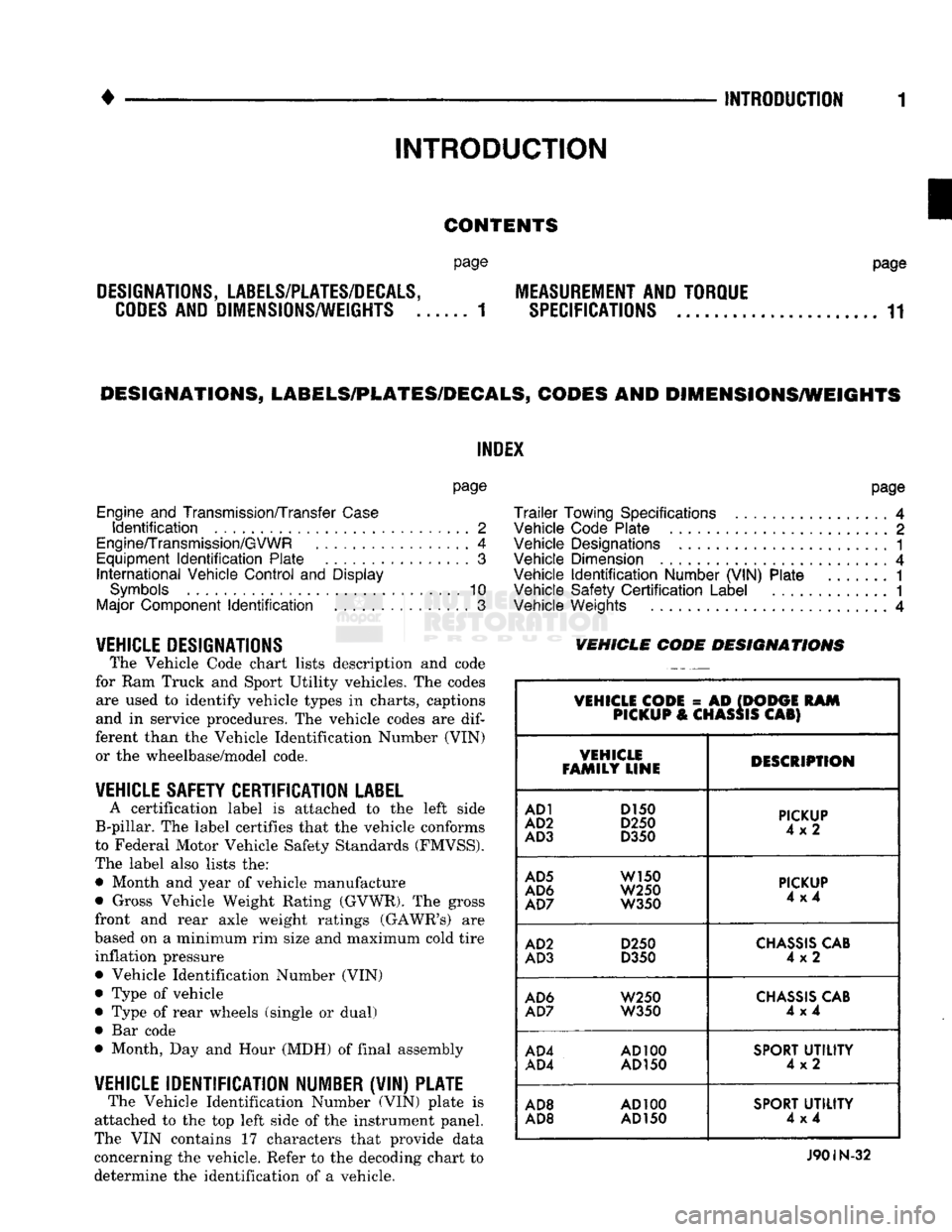
VEHICLE DESIGNATIONS The Vehicle Code chart lists description and code
for Ram Truck and Sport Utility vehicles. The codes are used to identify vehicle types in charts, captions
and in service procedures. The vehicle codes are
dif
ferent than the Vehicle Identification Number (VIN) or the wheelbase/model code.
VEHICLE SAFETY CERTIFICATION
LABEL
A certification label is attached to the left side
B-pillar. The label certifies that the vehicle conforms
to Federal Motor Vehicle Safety Standards (FMVSS).
The label also lists the: • Month and year of vehicle manufacture
• Gross Vehicle Weight Rating (GVWR). The gross
front and rear axle weight ratings (GAWR's) are
based on a minimum rim size and maximum cold tire inflation pressure Vehicle Identification Number (VIN)
Type of vehicle
Type of rear wheels (single or dual) Bar code
Month, Day and Hour (MDH) of final assembly
VEHICLE IDENTIFICATION NUMBER (VIN) PLATE The Vehicle Identification Number (VIN) plate is
attached to the top left side of the instrument panel.
The VIN contains 17 characters that provide data
concerning the vehicle. Refer to the decoding chart to
determine the identification of a vehicle.
page
Trailer
Towing Specifications
4
Vehicle Code Plate
2
Vehicle Designations
1
Vehicle Dimension
4
Vehicle
Identification
Number (VIN) Plate
1
Vehicle Safety
Certification
Label
............. 1
Vehicle Weights
4
VEHICLE CODE
DESIGNATIONS
VEHICLE CODE
= AD
(DODGE
RAM
PICKUP
&
CHASSIS
CAB)
VEHICLE
FAMILY LINE DESCRIPTION
AD1
D150
AD2
D250
AD3
D350
PICKUP
4x2
AD5
W150
AD6
W250
AD7
W350
PICKUP
4x4
AD2
D250
AD3
D350
CHASSIS
CAB
4x2
AD6
W250
AD7
W350
CHASSIS
CAB
4x4
AD4
AD100
AD4
AD150
SPORT
UTILITY
4x2
AD8
AD100
AD8 AD
150
SPORT
UTILITY
4x4
J90IN-32
Page 8 of 1502
INTRODUCTION
PRIMARY SECONDARY
PAINT PAINT VINYL ROOF
CODE VEHICLE
ORDER-
NUMBER
PAINT- PI
PROCEDURE
(2)
(1)
XXX
)
XXXXX)
X
XXX xxxxxx
X)0C xxxx xxxx xxxx xxx XXX x xxxxxxxxxxxxxxxxx
TRANSMISSION
I
VEHICLE IDENTIFICATION CODE
J
NUMBER
MARKET
U-C-B-M
CODE 90IN-3
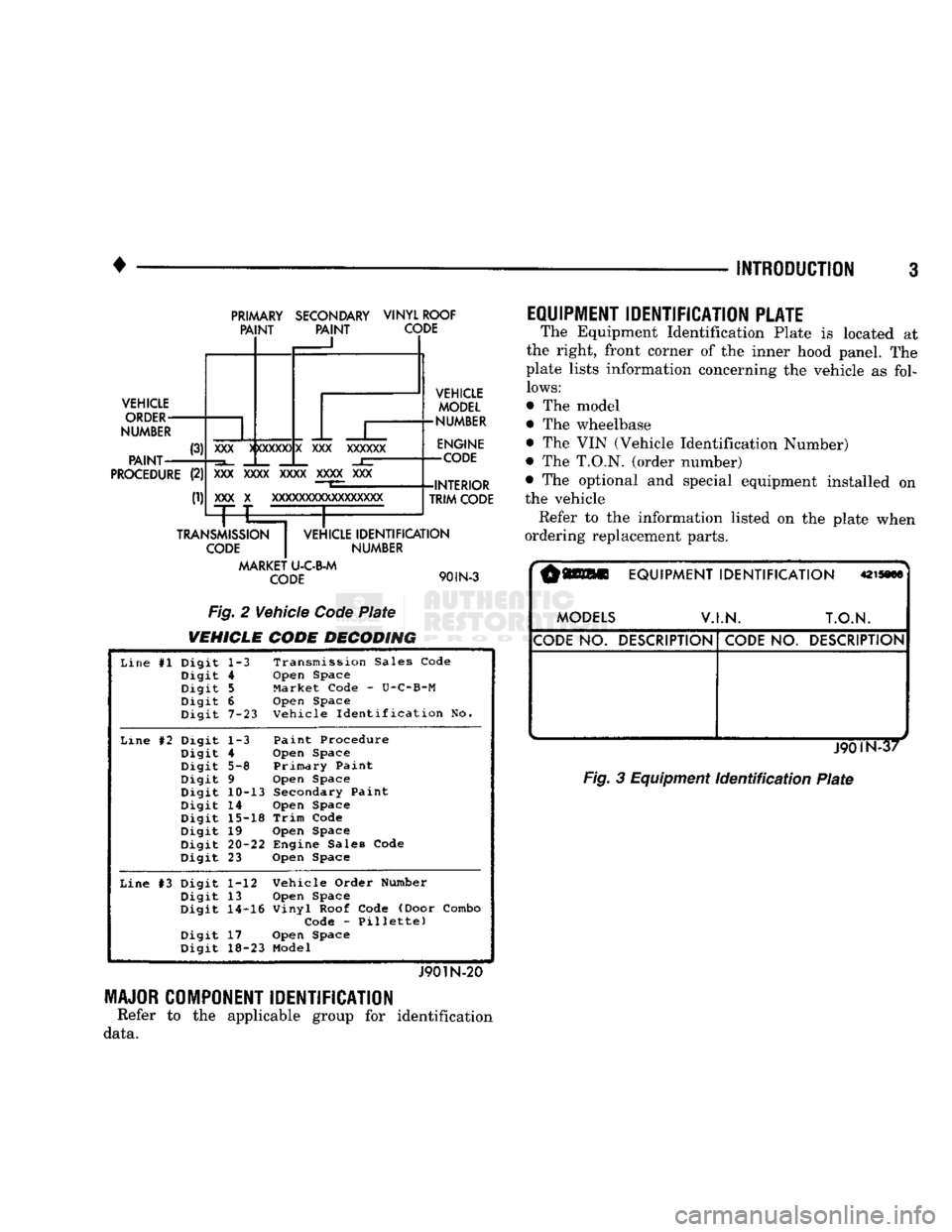
Fig. 2 Vehicle Code Plate
VEHICLE CODE DECODING
VEHICLE
MODEL
•NUMBER
ENGINE
-CODE
-INTERIOR TRIM CODE
Line #1 Digit
1-3 Transmission Sales Code
Digit 4 Open Space
Digit
5
Market Code - U-C-B-M
Digit 6 Open Space
Digit 7-23 Vehicle Identification No.
Line #2 Digit
1-3 Paint Procedure
Digit 4 Open Space
Digit 5-8 Primary Paint
Digit 9 Open Space
Digit 10-13 Secondary Paint
Digit 14 Open Space
Digit 15-18 Trim Code
Digit 19 Open Space
Digit
20-22
Engine Sales Code
Digit 23 Open Space
Line #3 Digit 1-12 Vehicle Order Number
Digit 13 Open Space
Digit 14-16 Vinyl Roof Code (Door Combo
Digit
Code - Pillette)
Digit 17 Open Space
Digit 18-23 Model
J901N-20 MAJOR COMPONENT IDENTIFICATION
Refer to the applicable group for identification
data.
EQUIPMENT IDENTIFICATION PLATE
The Equipment Identification Plate is located at
the right, front corner of the inner hood panel. The
plate lists information concerning the vehicle as fol
lows:
The model
The wheelbase
The VIN (Vehicle Identification Number)
The
T.O.N,
(order number)
The optional and special equipment installed on
the vehicle
Refer to the information listed on the plate when
ordering replacement parts.
r§Wll
EQUIPMENT
IDENTIFICATION
mmm
MODELS
V.I.N. T.O.N.
CODE
NO.
DESCRIPTION
CODE
NO.
DESCRIPTION
. ^
Fig.
3 Equipment
Identification
Plate
Page 45 of 1502
0
- 26
LUBRICATION
AND
MAINTENANCE
•
"PRESS-IN"
TYPE FILLER PLUG
RK43t
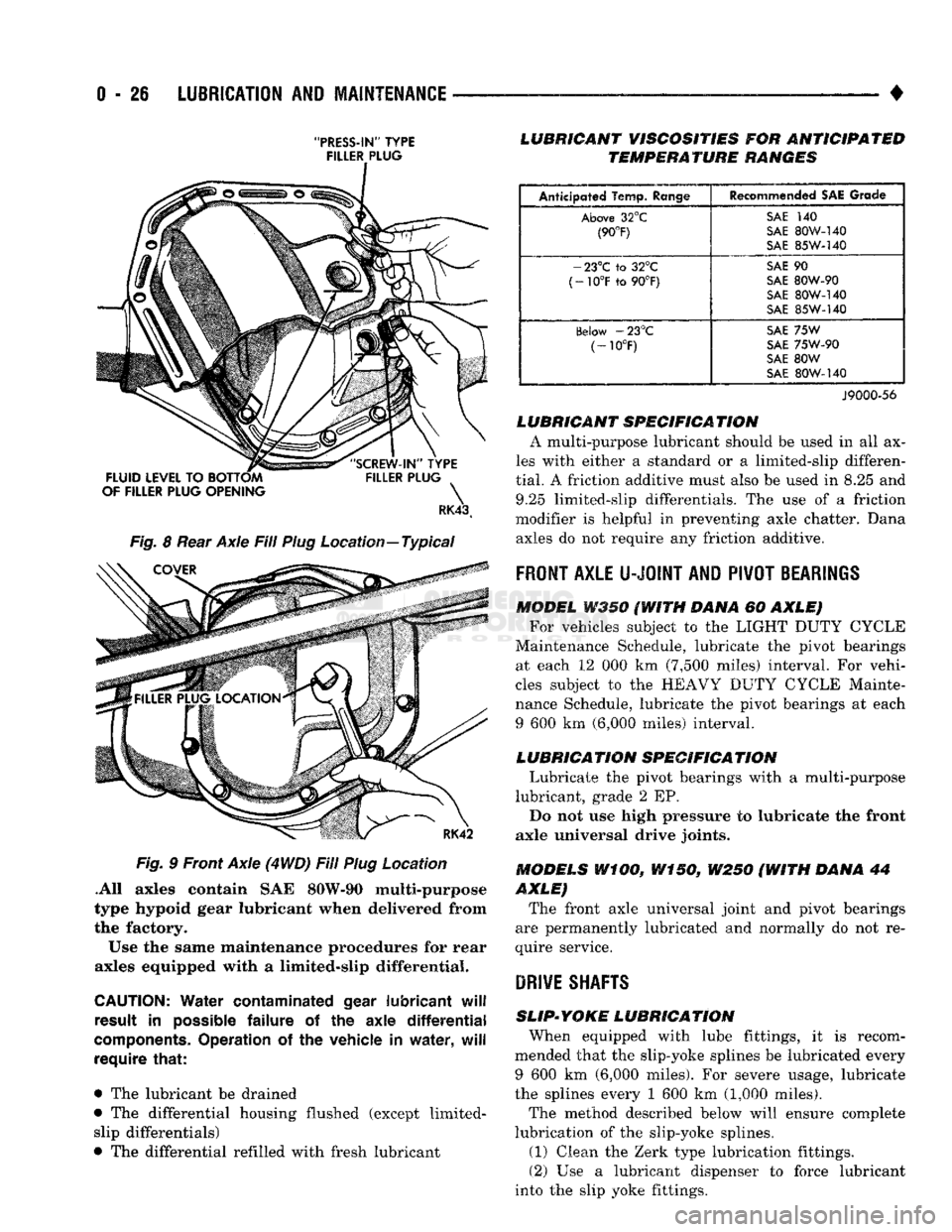
Fig.
8
Rear Axle Fill Plug Location—Typical Fig.
9
Front Axle (4
WD)
Fill Plug Location
.All axles contain
SAE
80W-90 multi-purpose
type hypoid gear lubricant when delivered from
the factory.
Use
the
same maintenance procedures
for
rear
axles equipped with
a
limited-slip differential.
CAUTION:
Water
contaminated
gear
lubricant
will
result
in
possible
failure
of the
axle
differential
components.
Operation
of the
vehicle
in
water,
will
require
that:
•
The
lubricant
be
drained
•
The
differential housing flushed (except limited- slip differentials)
•
The
differential refilled with fresh lubricant
LUBRICANT
VISCOSITIES
FOR
ANTICIPATED
TEMPERATURE
RANGES
Anticipated Temp.
Range
Recommended
SAE
Grade
Above
32°C
SAi
140
(90°F)
SAE
SOW-140
(90°F)
S\E
85W-140
-
23°C to 32°C
SAE
90
(-10°F
to 90°F)
SAE
80W-90
(-10°F
to 90°F)
SAE
80W-140
oAE
85W-140
(ielow
-23°C
SAE
75W
(-10°F)
SAE
75W-90
(-10°F)
SAE
80W
SAE
80W-I40
J9000-56
LUBRICANT
SPECIFICA
TION
A multi-purpose lubricant should
be
used
in all ax
les with either
a
standard
or a
limited-slip differen
tial.
A
friction additive must also
be
used
in 8.25 and
9.25 limited-slip differentials.
The use of a
friction
modifier
is
helpful
in
preventing axle chatter. Dana axles
do not
require
any
friction additive.
FRONT
AXLE
U-JOINT
AND
PIVOT
BEARINGS
MODEL
W350 (WITH
DANA
60
AXLE) For vehicles subject
to the
LIGHT DUTY CYCLE
Maintenance Schedule, lubricate
the
pivot bearings at each
12 000 km
(7,500 miles) interval.
For
vehi
cles subject
to the
HEAVY DUTY CYCLE Mainte
nance Schedule, lubricate
the
pivot bearings
at
each
9
600 km
(6,000 miles) interval.
LUBRICATION
SPECIFICATION
Lubricate
the
pivot bearings with
a
multi-purpose
lubricant, grade
2 EP.
Do
not use
high pressure
to
lubricate
the
front
axle universal drive joints.
MODELS
WiOO,
W150,
W250 (WITH
DANA
44
AXLE)
The front axle universal joint
and
pivot bearings
are permanently lubricated
and
normally
do not re
quire service.
DRIVE
SHAFTS
SLIP-YOKE
LUBRICATION
When equipped with lube fittings,
it is
recom
mended that
the
slip-yoke splines
be
lubricated every
9
600 km
(6,000 miles).
For
severe usage, lubricate
the splines every
1 600 km
(1,000 miles).
The method described below will ensure complete
lubrication
of the
slip-yoke splines.
(1)
Clean
the
Zerk type lubrication fittings.
(2)
Use a
lubricant dispenser
to
force lubricant
into
the
slip yoke fittings.
Page 70 of 1502
•
FRONT
SUSPENSION
AND
AXLE
2 - 17
MODEL
44
FRONT
AXLE
INDEX
page
Axle Shaft
and
U-Joint
Service
23
Complete Axle Removal/Installation
31
Differential
Assembly
35
Differential
Disassembly
. 32
Drain
and Refill
19
General
Information
17
Hub,
Spindle
and
Axle Shaft
20
Intermediate
Axle Shaft
30
Lubricant
17
GENERAL
INFORMATION
Model
44
front axles
(Fig. 1)
consists
of an
iron
center casting with axle shaft tubes extending from
either side. The integral type housing, hypoid gear design
has
the centerline
of the
pinion
set
below
the
centerline of
the
ring gear. The axle shaft disconnect housing
is
welded
to the
left axle shaft tube.
A
splined, two-piece axle shaft
is
located
on the
left side
and it is
engaged
or
disen
gaged
by a
shift collar.
The
collar
is
moved
by a
shift
fork controlled
by a
vacuum shift motor.
The
shift motor
is
operated
by
engine vacuum controlled
by a
switch located
at the
transfer case. The axles
are
equipped with full-floating axle
shafts,
meaning that loads
are
supported
by the
spin
dles attached
to the
steering knuckles. The removable, stamped steel cover provides
a
means
for
inspection
and
service without removing
the complete axle from
the
vehicle.
page
Pinion Gear Depth Measurement
and
Adjustment
with
Tool
Set
C-3715-B
40
Pinion Gear Depth Measurement
and
Adjustment
with
Tool
Set
D-115-44
... 38
Pinion Shaft Seal
19
Specifications
48
Steering Knuckle
Arm
31
Steering Knuckle, Upper
and
Lower Ball Studs
. . 24
Vacuum
Shift Motor
26
A small, stamped metal axle gear ratio identifica
tion
tag is
attached
to the
housing cover
via one of
the cover bolts. This
tag
also identifies
the
number
of
ring gear
and
pinion gear teeth.
The differential case
is a
one-piece design.
The dif
ferential pinion mate shaft
is
retained with
a
roll
pin. Differential bearing preload
and
ring gear back lash
are
adjusted
by the use of
shims located between
the differential bearing cones
and
case.
LUBRICANT
Multi-purpose
API GL 5
quality hypoid gear lubri
cant should
be
used
for
Model
44
axles. MOPAR
Hy
poid Gear Lubricant conforms with these specifications
and is
recommended.
CAUTION:
If a
front axle
is
submerged
in
water,
the
axle lubricant must
be
replaced immediately.
Page 104 of 1502
FRONT
SUSPENSION
AND
AXLE
2 - 51
LUBRICANT
Multi-purpose API GL 5 quality hypoid gear lubri
cant should be used for Model 60 axles. MOPAR Hy
poid Gear Lubricant conforms to these specifications and is recommended.
CAUTION:
If a front axle is
submerged
in
water,
the
axle lubricant
must
be replaced immediately.
DRAIN AND REFILL
(1) Drive the vehicle until the gear lubricant
reaches normal operating temperature. (2) Raise and support the vehicle.
(3) Remove the lubricant fill hole plug from the
differential housing cover. (4) Remove the differential housing cover. Allow
the original lubricant to completely drain from the
housing and axle shaft tubes. (5) With standard differential, clean the differen
tial and the housing cavity with a flushing oil (or light engine oil). This will remove the residual lubricant and foreign matter. Do not use water, steam,
kerosene or gasoline for flushing. (6) Scrape the residual gasket from the housing
and cover mating surfaces. Clean the mating sur
faces with mineral spirits. Install a new cover gas
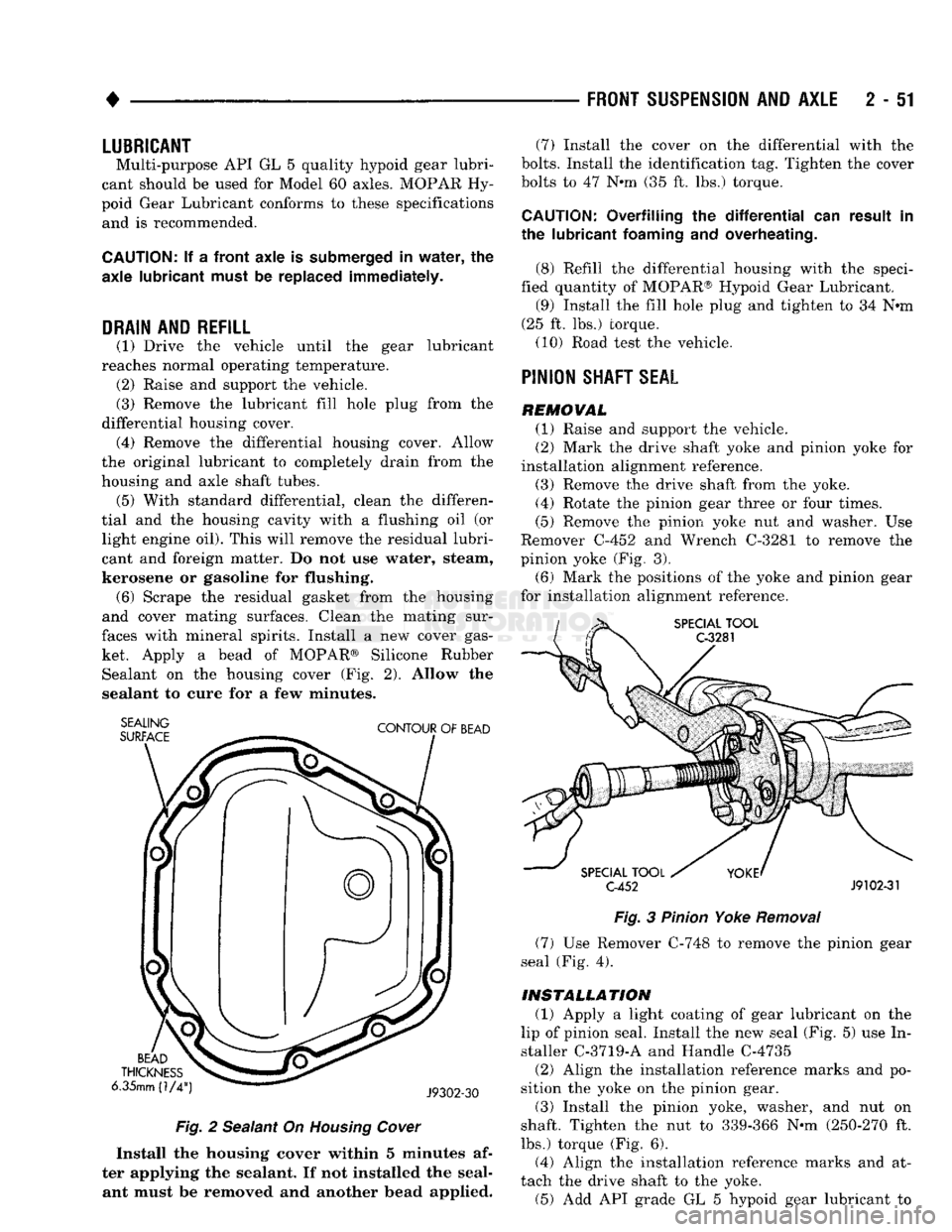
ket. Apply a bead of MOPAR® Silicone Rubber Sealant on the housing cover (Fig. 2). Allow the
sealant to cure for a few minutes.
SEALING
SURFACE
CONTOUR
OF
BEAD
BEAD
THICKNESS
6.35mm (1/4
J9302-30
Fig.
2 Sealant On
Housing
Cover
Install the housing cover within 5 minutes af
ter applying the sealant. If not installed the seal ant must be removed and another bead applied. (7) Install the cover on the differential with the
bolts.
Install the identification tag. Tighten the cover
bolts to 47 Nnn (35 ft. lbs.) torque.
CAUTION:
Overfilling the
differential
can result in
the lubricant
foaming
and overheating.
(8) Refill the differential housing with the speci
fied quantity of MOPAR® Hypoid Gear Lubricant. (9) Install the fill hole plug and tighten to 34 N«m
(25 ft. lbs.) torque. (10) Road test the vehicle.
PINION
SHAFT
SEAL
REMOVAL (1) Raise and support the vehicle.
(2) Mark the drive shaft yoke and pinion yoke for
installation alignment reference.
(3) Remove the drive shaft from the yoke.
(4) Rotate the pinion gear three or four times.
(5) Remove the pinion yoke nut and washer. Use
Remover C-452 and Wrench C-3281 to remove the
pinion yoke (Fig. 3).
(6) Mark the positions of the yoke and pinion gear
for installation alignment reference.
SPECIAL
TOOL
C-3281
SPECIAL
TOOL
C-452
J9102-31
Fig.
3
Pinion
Yoke
Removal
(7) Use Remover C-748 to remove the pinion gear
seal (Fig. 4).
INSTALLATION
(1) Apply a light coating of gear lubricant on the
lip of pinion seal. Install the new seal (Fig. 5) use In
staller C-3719-A and Handle C-4735
(2) Align the installation reference marks and po
sition the yoke on the pinion gear.
(3) Install the pinion yoke, washer, and nut on
shaft. Tighten the nut to 339-366 N-m (250-270 ft.
lbs.) torque (Fig. 6).
(4) Align the installation reference marks and at
tach the drive shaft to the yoke. (5) Add API grade GL 5 hypoid gear lubricant to
Page 113 of 1502
2
- 60
FRONT
SUSPENSION
AND
AXLE
•
Fig.
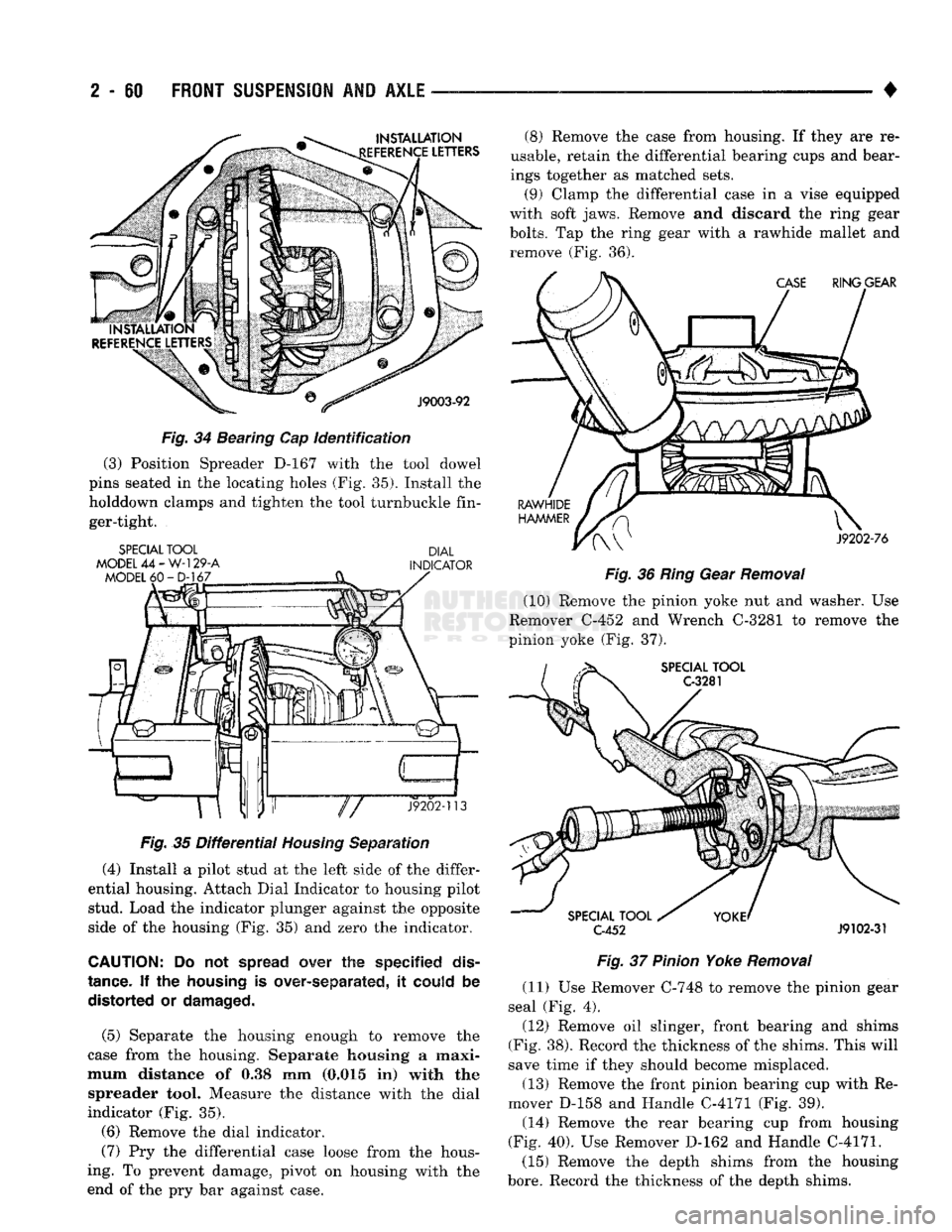
34 Bearing Cap identification (3) Position Spreader D-167 with the tool dowel
pins seated in the locating holes (Fig. 35). Install the
holddown clamps and tighten the tool turnbuckle fin ger-tight.
SPECIAL
TOOL
DIAL
MODEL
44 -
W-129-A
INDICATOR
Fig.
35
Differential
Housing
Separation (4) Install a pilot stud at the left side of the differ
ential housing. Attach Dial Indicator to housing pilot stud. Load the indicator plunger against the opposite
side of the housing (Fig. 35) and zero the indicator.
CAUTION:
Do not
spread
over the specified
dis
tance.
If the
housing
is over-separated, it
could
be distorted or
damaged.
(5) Separate the housing enough to remove the
case from the housing. Separate housing a maxi
mum distance of 0.38 mm (0.015 in) with the spreader tool. Measure the distance with the dial
indicator (Fig. 35).
(6) Remove the dial indicator.
(7) Pry the differential case loose from the hous
ing. To prevent damage, pivot on housing with the
end of the pry bar against case. (8) Remove the case from housing. If they are re
usable, retain the differential bearing cups and bear
ings together as matched sets. (9) Clamp the differential case in a vise equipped
with soft jaws. Remove and discard the ring gear
bolts.
Tap the ring gear with a rawhide mallet and remove (Fig. 36).
Fig.
36
Ring
Gear
Removal
(10) Remove the pinion yoke nut and washer. Use
Remover C-452 and Wrench C-3281 to remove the
pinion yoke (Fig. 37). C-452
J9102-31
Fig.
37
Pinion
Yoke
Removal
(11) Use Remover C-748 to remove the pinion gear
seal (Fig. 4).
(12) Remove oil slinger, front bearing and shims
(Fig. 38). Record the thickness of the shims. This will
save time if they should become misplaced.
(13) Remove the front pinion bearing cup with Re
mover D-158 and Handle C-4171 (Fig. 39). (14) Remove the rear bearing cup from housing
(Fig. 40). Use Remover D-162 and Handle C-4171.
(15) Remove the depth shims from the housing
bore.
Record the thickness of the depth shims.
Page 156 of 1502
•
REAR
SUSPENSION
AND
AXLE
3-29
WARNING: WHEN SERVICING VEHICLES
WITH
SURE-GRIP,
DO NOT
USE THE ENGINE
TO
ROTATE
THE AXLE
AND
WHEELS. BOTH REAR WHEELS MUST BE RAISED AND
THE
VEHICLE SUPPORTED.
A
SURE-GRIP AXLE
CAN
EXERT ENOUGH FORCE
(IF ONE
WHEEL
IS IN
CONTACT
WITH
THE
SUR FACE)
TO
CAUSE
THE
VEHICLE
TO
MOVE.
LUBRICATION
Multi-Purpose Gear Lubricant, as defined by MIL-
L-2105-B (API GL-5) should be used in all axles.
MOPAR Hypoid Lubricant is recommended or equiv alent. In Sure-Grip differentials 4 ounces of MOPAR Hy
poid Gear Lubricant Additive must be added with each re-fill.
It is recommended the vehicle be driven through 10
to 12 slow, figure-eight turns. This ensures the lubri cant is thoroughly pumped through the Sure-Grip
differential clutches.
MODEL 60 and 70 AXLES
INDEX
page
Axle Shaft Removal/Installation
32
Complete Axle Removal/Installation
........... 33
Differential
Assembly
38
Differential
Disassembly
34
Drain
and Refill 31
General
Information
29
Lubricant
31
GENERAL
INFORMATION
The housing (Fig. 1) consists of an iron center cast
ing with axle shaft tubes extending from either side.
The tubes are pressed in to form a one-piece axle housing. The integral type housing, hypoid gear design has
the centerline of the pinion set below the centerline of the ring gear. The axles are equipped with full-floating axle
shafts,
meaning that loads are supported by the axle
housing tubes. The full-float axle shafts are retained
by bolts attached to the hub. The hub rides on two
bearings at the outboard end of the axle tube. The axle shafts can be removed without disturbing or re
moving the wheel bearings. The wheel bearings are
opposed tapered roller bearings that are part of the
hub/drum assembly.
page
Pinion Gear Depth Measurement
and
Adjustment
with Tool Set C-758-D6 43
Pinion Gear Depth Measurement
and
Adjustment
with
Tool
Set
D-116
. 40
Pinion Shaft Seal
31
Specifications
50
Wheel Bearing Service
33
The removable, stamped steel cover provides a
means for inspection and service without removing
the complete axle from the vehicle.
A small, stamped metal axle gear ratio identifica
tion tag is attached to the housing cover via one of
the cover bolts. This tag also identifies the number of
ring and pinion teeth.
The differential case is a one-piece design. The
dif
ferential pinion mate shaft is retained with a roll
pin. Model 70 axles with the optional Powr-Lok use a
two piece differential case. Differential bearing pre load and ring gear backlash are adjusted by the use
of shims located between the differential bearing
cones and case.
Page 158 of 1502
•
REAR
SUSPENSION
AND
AXLE
3 - 31
LUBRICANT
Hypoid gear lubricant, as defined by MIL-L-2105-B
and API GL 5 is the specified lube. MOPAR Hypoid
Gear Lubricant conforms with both of these specifica
tions and is highly recommended.
CAUTION:
If a
rear
axle
is
submerged
in
water,
the
axle
lubricant
must
be
replaced
immediately,
DRAIN
AND
REFILL
(1) Drive the vehicle until the gear lubricant
reaches normal operating temperature. (2) Raise and support the vehicle. (3) Remove the lubricant fill hole plug from the
differential housing cover. (4) Remove the differential housing cover. Allow
the lubricant to completely drain from the housing and axle shaft tubes. (5) Flush the differential and the housing cavity
with a flushing oil to remove residual lubricant and
foreign matter. Do not use water,
steam,
kerosene
or
gasoline for
flushing,
(6) Scrape the residual gasket from the housing
and cover mating surfaces. Clean the mating sur
faces with mineral spirits. Install a new cover gas
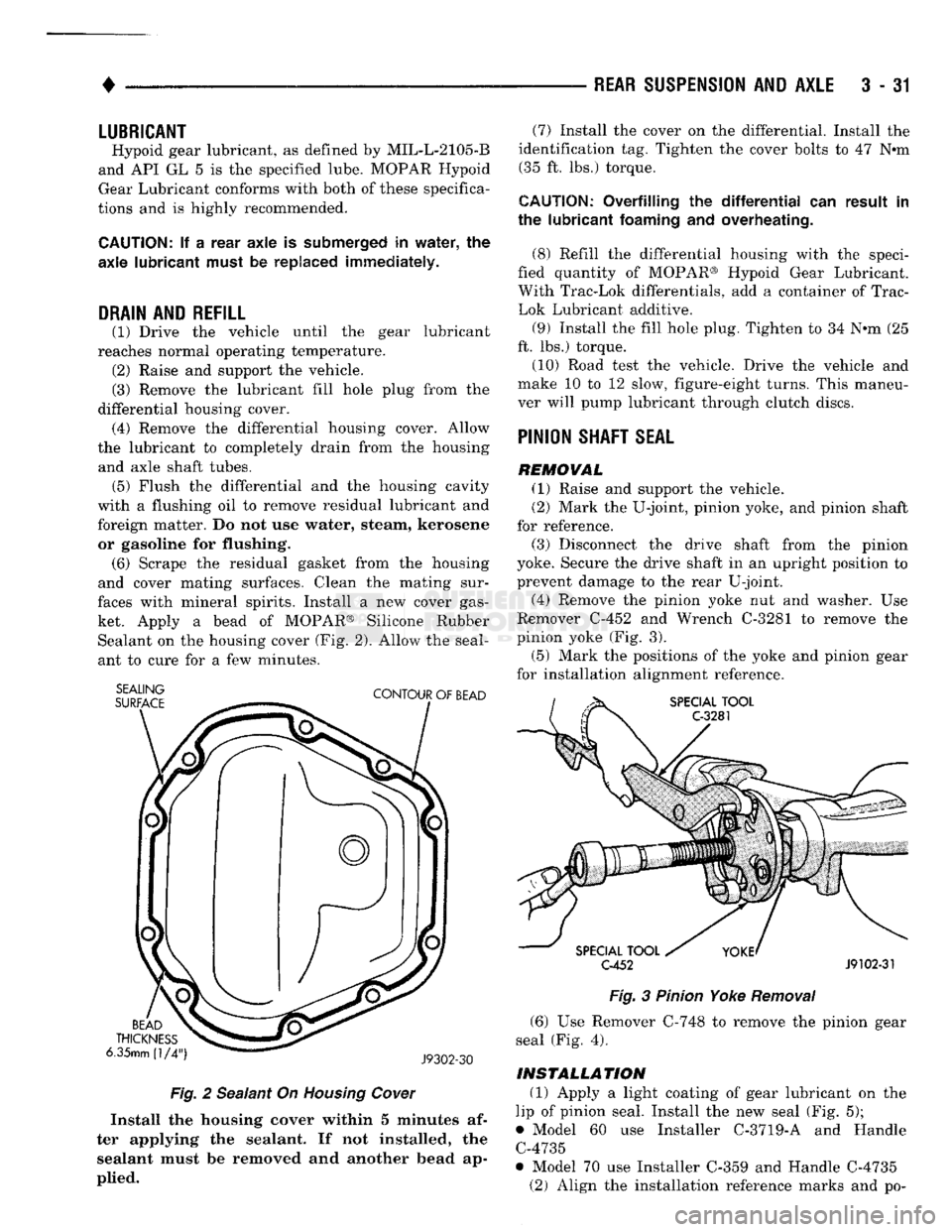
ket. Apply a bead of MOPAR® Silicone Rubber Sealant on the housing cover (Fig. 2). Allow the seal
ant to cure for a few minutes.
SEALING
SURFACE
CONTOUR
OF
BEAD
BEAD
THICKNESS
6.35mm
(1/4")
J9302-30
Fig.
2 Sealant On Housing Cower
Install
the
housing
cover
within 5
minutes
af
ter
applying
the
sealant.
If not
installed,
the
sealant
must be
removed
and another
bead
ap
plied.
(7) Install the cover on the differential. Install the
identification tag. Tighten the cover bolts to 47 Nem (35 ft. lbs.) torque.
CAUTION:
Overfilling
the differential" can
result
in
the
lubricant
foaming
and
overheating.
(8) Refill the differential housing with the speci
fied quantity of MOPAR® Hypoid Gear Lubricant.
With Trac-Lok differentials, add a container of Trac-
Lok Lubricant additive.
(9) Install the fill hole plug. Tighten to 34 N-m (25
ft. lbs.) torque.
(10) Road test the vehicle. Drive the vehicle and
make 10 to 12 slow, figure-eight turns. This maneu
ver will pump lubricant through clutch discs.
PINION
SHAFT
SEAL
REMOVAL
(1) Raise and support the vehicle.
(2) Mark the U-joint, pinion yoke, and pinion shaft
for reference.
(3) Disconnect the drive shaft from the pinion
yoke. Secure the drive shaft in an upright position to
prevent damage to the rear U-joint.
(4) Remove the pinion yoke nut and washer. Use
Remover C-452 and Wrench C-3281 to remove the
pinion yoke (Fig. 3).
(5) Mark the positions of the yoke and pinion gear
for installation alignment reference.
SPECIAL
TOOL
C-3281
SPECIAL
TOOL
C-452
J9102-31
Fig.
3 Pinion Yoke
Removal
(6) Use Remover C-748 to remove the pinion gear
seal (Fig. 4).
INSTALLATION
(1) Apply a light coating of gear lubricant on the
lip of pinion seal. Install the new seal (Fig. 5);
• Model 60 use Installer C-3719-A and Handle C-4735
• Model 70 use Installer C-359 and Handle C-4735 (2) Align the installation reference marks and po-
Page 161 of 1502
3
- 34
REAR SUSPENSION
AND
AXLE
• (4) Install the spring U-bolts and tighten the nuts
with the specified torque.
(5) Install the shock absorbers.
(6) Connect the parking brake cables.
(7) Connect the brake lines. Install the hubs and
brake drums. Adjust the wheel bearings (refer to Wheel Bearing Adjustment).
(8) Remove the block from the brake pedal. Bleed
and adjust the brakes.
(9) Connect the drive shaft to the pinion yoke with
the reference marks aligned. Tighten the U-joint clamp bolts to 21 N-m (16 ft. lbs./186 in. lbs.) torque.
(10) Install the rear wheels and tighten the lug
nuts with the specified torque (refer to Group 22,
Wheels And Tires). (11) Raise the rear of the vehicle, remove the sup
ports,
level the vehicle and position the supports. (12) Remove the fill hole plug from the differential
housing cover. Fill the differential housing to the correct level with MOPAR Hypoid Gear Lubricant, or
an equivalent product. Add 4 ounces of MOPAR Hypoid Gear Lubri
cant Additive for Trac-Lok equipped axles. (13) Install the fill hole plug. Remove the supports
and lower the vehicle. (14) Road test the vehicle to evaluate the results of
the repair.
DIFFERENTIAL
DISASSEMBLY
RE MO VA
L/DISA
SSEMBL Y
Remove the RWAL brake sensor
hold-down
bolt and pull the sensor from the differential
housing. The sensor must be removed to prevent damage when disassembling or assembling the differential components.
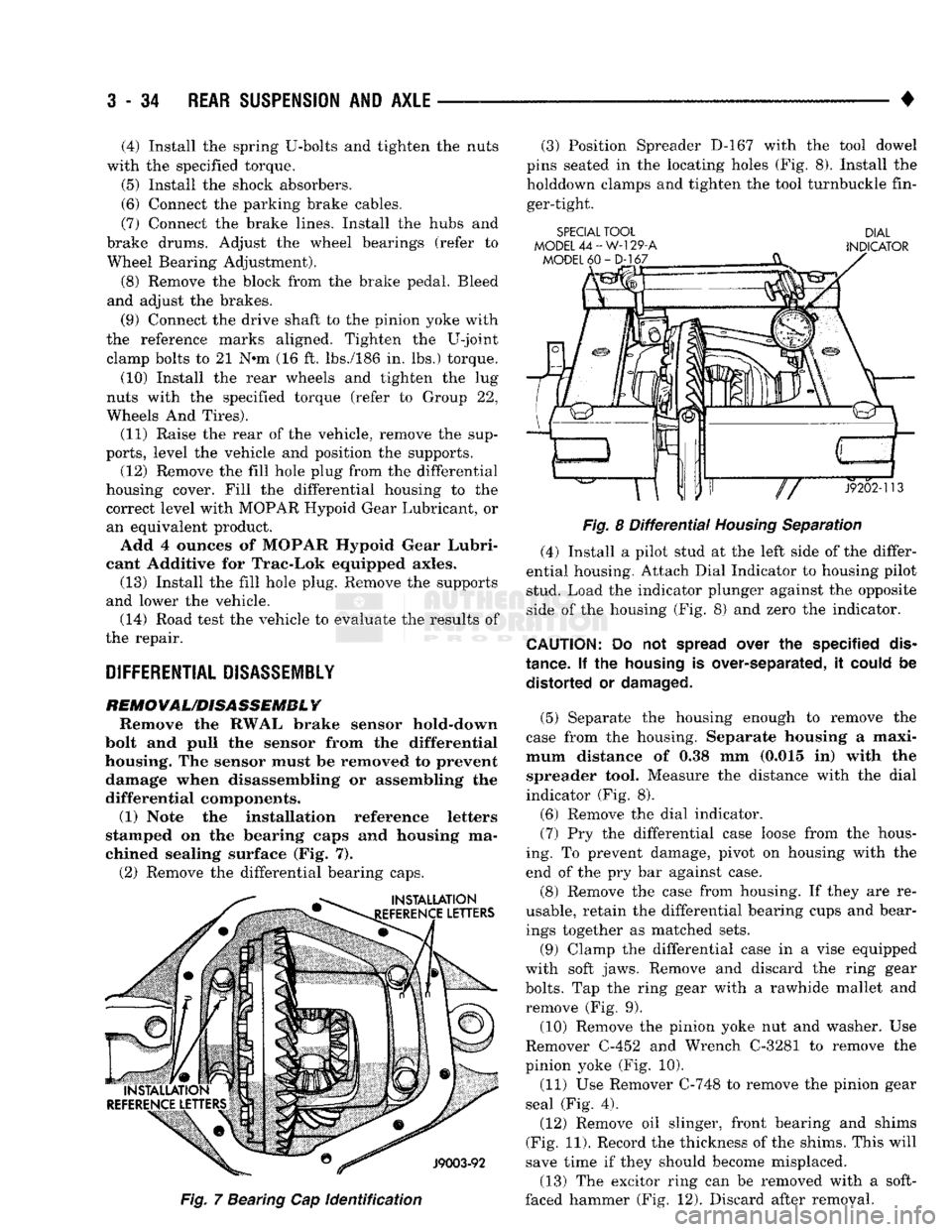
(1) Note the installation reference letters
stamped on the bearing caps and housing ma
chined sealing surface (Fig. 7). (2) Remove the differential bearing caps.
Fig.
7 Bearing Cap
identification
(3) Position Spreader D-167 with the tool dowel
pins seated in the locating holes (Fig. 8). Install the holddown clamps and tighten the tool turnbuckle fin
ger-tight.
SPECIAL TOOL DIAL
MODEL
44-W-129-A
INDICATOR
Fig.
8
Differential
Housing
Separation
(4) Install a pilot stud at the left side of the differ
ential housing. Attach Dial Indicator to housing pilot
stud. Load the indicator plunger against the opposite
side of the housing (Fig. 8) and zero the indicator.
CAUTION:
Do not
spread
over the specified
dis
tance. If the
housing
is over-separated, it
could
be distorted or
damaged.
(5) Separate the housing enough to remove the
case from the housing. Separate housing a maxi
mum distance of 0.38 mm (0.015 in) with the spreader tool. Measure the distance with the dial
indicator (Fig. 8).
(6) Remove the dial indicator. (7) Pry the differential case loose from the hous
ing. To prevent damage, pivot on housing with the
end of the pry bar against case.
(8) Remove the case from housing. If they are re
usable, retain the differential bearing cups and bear ings together as matched sets.
(9) Clamp the differential case in a vise equipped
with soft jaws. Remove and discard the ring gear
bolts.
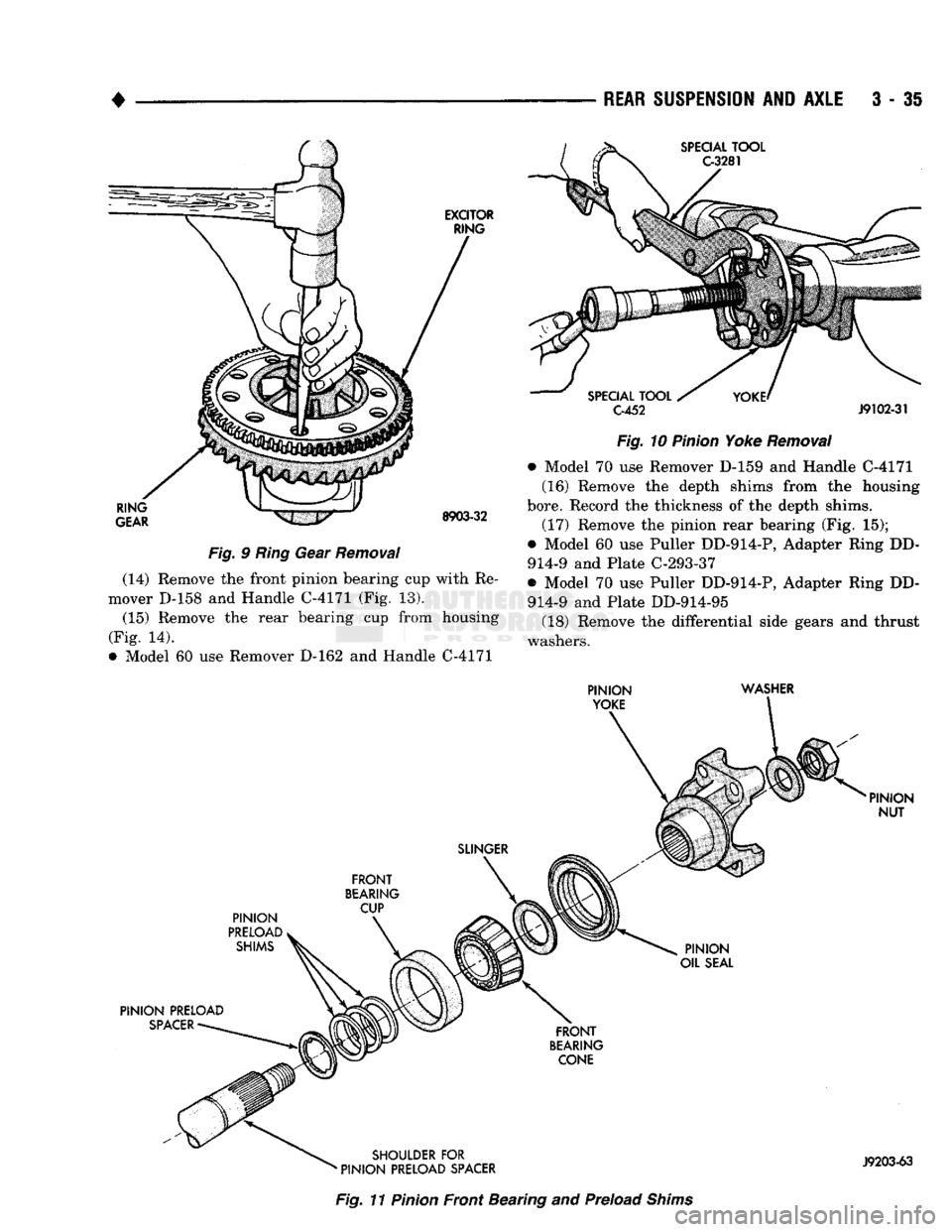
Tap the ring gear with a rawhide mallet and
remove (Fig. 9).
(10) Remove the pinion yoke nut and washer. Use
Remover C-452 and Wrench C-3281 to remove the
pinion yoke (Fig. 10).
(11) Use Remover C-748 to remove the pinion gear
seal (Fig. 4).
(12) Remove oil slinger, front bearing and shims
(Fig. 11). Record the thickness of the shims. This will
save time if they should become misplaced.
(13) The excitor ring can be removed with a soft-
faced hammer (Fig. 12). Discard after removal.
Page 162 of 1502
REAR SUSPENSION
AND
AXLE
3 - 35
SPECIAL
TOOL
C-3281
EXCITOR
RING RING
GEAR
8903-32
Fig.
9
Ring
Gear
Removal
(14) Remove the front pinion bearing cup with Re
mover D-158 and Handle C-4171 (Fig. 13).
(15) Remove the rear bearing cup from housing
(Fig.
14).
• Model 60 use Remover D-162 and Handle C-4171
SPECIAL
TOOL
C-452
J9102-31
Fig.
10
Pinion
Yoke
Removal
• Model 70 use Remover D-159 and Handle C-4171
(16) Remove the depth shims from the housing
bore.
Record the thickness of the depth shims.
(17) Remove the pinion rear bearing (Fig. 15);
• Model 60 use Puller DD-914-P, Adapter Ring DD-
914-9 and Plate C-293-37
• Model 70 use Puller DD-914-P, Adapter Ring DD-
914-9 and Plate DD-914-95 (18) Remove the differential side gears and thrust
washers.
PINION
YOKE
WASHER
SLINGER
PINION
PRELOAD
SHIMS
FRONT
BEARING
CUP
PINION
NUT
PINION
OIL
SEAL
PINION PRELOAD
SPACER
FRONT
BEARING
CONE
SHOULDER
FOR
'
PINION
PRELOAD
SPACER
J9203-63
Fig.
11
Pinion
Front Bearing and Preload
Shims