steering DODGE VIPER 2004 ZB / 2.G User Guide
[x] Cancel search | Manufacturer: DODGE, Model Year: 2004, Model line: VIPER, Model: DODGE VIPER 2004 ZB / 2.GPages: 236, PDF Size: 4.18 MB
Page 105 of 236

CAUTION!
The Anti-Lock Brake System is subject to possible
detrimental effects of electronic interference caused
by improperly installed after-market radios or tele-
phones.
WARNING!
²Anti-lock system (ABS) cannot prevent the natu-
ral laws of physics from acting on the vehicle, nor
can it increase braking or steering efficiency be-
yond that afforded by the condition of the vehicle
brakes and tires or the traction afforded.
²The ABS cannot prevent accidents, including
those resulting from excessive speed in turns,
following another vehicle too closely, or hydro-
planing. Only a safe, attentive, and skillful driver
can prevent accidents.
²The capabilities of an ABS equipped vehicle must
never be exploited in a reckless or dangerous
manner which could jeopardize the user's safety
or the safety of others.
STARTING AND OPERATING 105
5
Page 107 of 236

In the event power assist is lost for any reason (for
example, repeated brake applications with the engine
off), the brakes will still function. The effort required to
brake the vehicle will be much greater than that required
with the power system operating.
If either the front or rear hydraulic system loses normal
capability, the remaining system will still function with
some loss of overall braking effectiveness. This will be
evident by increased pedal travel during application,
greater pedal force required to slow or stop, and activa-
tion of the Brake Warning Lamp during brake use.
NOTE:Your Viper has a very high performance braking
system. The brake pads are a semi-metallic compound
which has been selected for superior fade resistance and
consistent operation. A compromise is that under some
weather and operating conditions, the brakes may squeal
slightly during light brake applications.Brake Pad Break-In
The brakes on your new Viper do not require a long
break-in period, but avoid repeated hard brake applica-
tions from high speeds during initial break-in. Also avoid
severe brake loading such as may be encountered when
descending long mountain grades.
POWER STEERING
The power assisted steering system of your vehicle
provides mechanical steering capability in the event
power assist is lost.
If for some reason the hydraulic pressure is interrupted,
it will still be possible to steer your vehicle. Under these
conditions you will observe a substantial increase in
steering effort.
STARTING AND OPERATING 107
5
Page 116 of 236

WARNING!
Overloading of your tire is dangerous. Overloading
can cause tire failure, affect vehicle handling, and
increase your stopping distance. Use tires of the
recommended load capacity for your vehicle. Never
overload them.
TIRESÐGENERAL INFORMATION
Tire Pressure
Proper tire inflation pressure is essential to the safe and
satisfactory operation of your vehicle. Three primary
areas are affected by improper tire pressure:1. SafetyÐ
WARNING!
Improperly inflated tires are dangerous and can cause
accidents.
²Under inflation increases tire flexing and can result in
tire failure.
²Over inflation reduces a tire's ability to cushion
shock. Objects on the road and chuck holes can cause
damage that results in tire failure.
²Unequal tire pressures can cause steering problems.
You could lose control of your vehicle.
²Over inflated or under inflated tires can affect vehicle
handling and can fail suddenly, resulting in loss of
vehicle control.
²Unequal tire pressures from one side of the vehicle to
the other can cause the vehicle to drift to the right or left.
Always drive with each tire inflated to the recom-
mended cold tire inflation pressure.
116 STARTING AND OPERATING
Page 123 of 236

WARNING!
²Do not use a tire, wheel size or rating other than
that specified for your vehicle. Some combina-
tions of unapproved tires and wheels may change
suspension dimensions and performance charac-
teristics, resulting in changes to steering, han-
dling, and braking of your vehicle. This can cause
unpredictable handling and stress to steering and
suspension components. You could lose control
and have an accident resulting in serious injury or
death. Use only the tire and wheel sizes with load
ratings approved for your vehicle.
²Never use a tire with a smaller load index or
capacity, other than what was originally equipped
on your vehicle. Using a tire with a smaller load
index could result in tire overloading and failure.
You could lose control and have an accident.
²Failure to equip your vehicle with tires having
adequate speed capability can result in sudden
tire failure and loss of vehicle control.
CAUTION!
Replacing original tires with tires of a different size
may result in false speedometer and odometer read-
ings.
Alignment And Balance
Poor suspension alignment may result in:
²Fast tire wear.
²Uneven tire wear, such as feathering and one-sided
wear.
²Vehicle pull to right or left.
Tires may also cause the vehicle to pull to the left or right.
Alignment will not correct this condition. See your dealer
for proper diagnosis.
STARTING AND OPERATING 123
5
Page 132 of 236

HAZARD WARNING FLASHER
The flasher switch is on the top of the steering
column, just behind the steering wheel. Depress
the flasher button and all front and rear directional
signals will flash. Depress the flasher button again to turn
the flashers off.Do not use this emergency warning system when the
vehicle is in motion. Use it when your vehicle is disabled
and is creating a safety hazard for other motorists.
If it is necessary to leave the vehicle to go for service, the
flasher system will continue to operate with the ignition
key removed.
NOTE:With extended use, the flasher may run down
your battery.
IF YOUR ENGINE OVERHEATS
In any of the following situations, you can reduce the
potential for overheating by taking the appropriate ac-
tion.
²On the highways ÐSlow down and use the highest
gear possible.
²In city traffic ÐWhile stopped, put the transmission
in neutral, but do not increase engine idle speed.
132 WHAT TO DO IN EMERGENCIES
Page 138 of 236

²Slow down during rainstorms or when roads are
slushy.
²Slow down if road has standing water or puddles.
CAUTION!
Driving your Viper through deep puddles at speeds
over 5 mph, may cause water to be ingested into the
engine. This can cause severe engine damage.
²Replace tires when tread wear indicators first become
visible.
²Keep tires properly inflated.
²Maintain enough distance between your vehicle and
the vehicle in front to avoid a collision in a sudden
stop.
FREEING A STUCK VEHICLE
If your vehicle becomes stuck in mud, sand or snow, it
can often be moved by a rocking motion. Turn your
steering wheel right and left to clear the area around the
front wheels. Then shift back and forth between Reverse
and First gear. Usually the least accelerator pedal pres-
sure to maintain the rocking motion without spinning the
wheels is most effective.
CAUTION!
Racing the engine or spinning the wheels too fast
may lead to transmission/axle overheating and fail-
ure. It can also damage the tires. Do not spin the
wheels above 30 mph (48 km/h).
138 WHAT TO DO IN EMERGENCIES
Page 142 of 236

NPower Steering (Pump And Reservoir)......161
NBody Lubrication.....................162
NFront And Rear Suspension Ball Joints......162
NSteering Linkage......................163
NBody Mechanism Lubrication.............163
NWindshield Washers...................165
NExhaust System......................165
NCooling System.......................166
NHoses And Vacuum/Vapor Harnesses.......170
NBrake System........................171
NBrake, Power Steering, And Fuel System
Hoses.............................171NBrake And Clutch Fluid.................173
NMaster Cylinder......................174
NHydraulic Clutch.....................175
NTransmission........................175
NRear Axle...........................176
NWheel Bearings.......................177
NAppearance Care.....................177
mFuses Ð Power Distribution Center..........180
mVehicle Storage........................183
mReplacement Bulbs......................186
NInterior Light Bulbs....................186
NExterior Light Bulbs...................186
142 MAINTAINING YOUR VEHICLE
Page 161 of 236
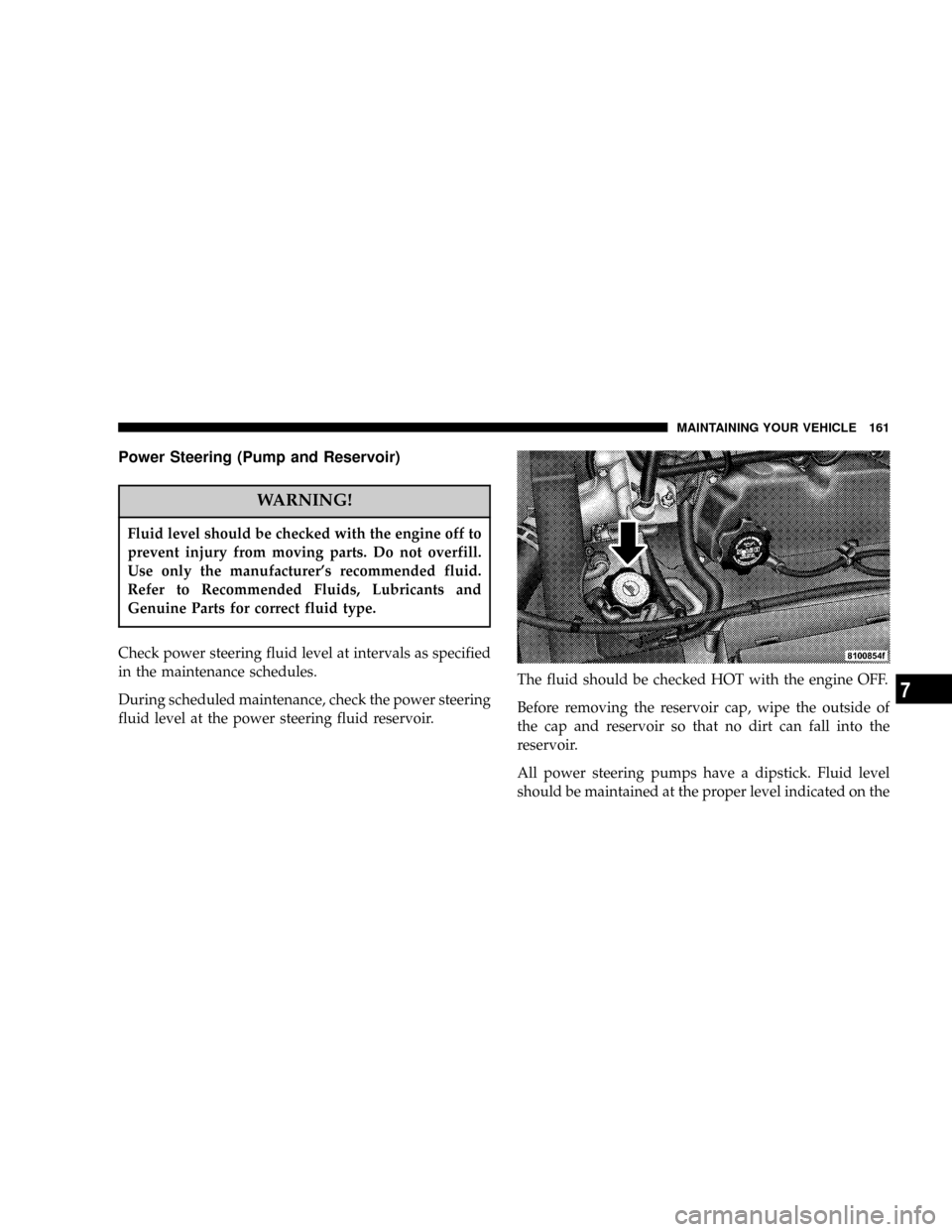
Power Steering (Pump and Reservoir)
WARNING!
Fluid level should be checked with the engine off to
prevent injury from moving parts. Do not overfill.
Use only the manufacturer's recommended fluid.
Refer to Recommended Fluids, Lubricants and
Genuine Parts for correct fluid type.
Check power steering fluid level at intervals as specified
in the maintenance schedules.
During scheduled maintenance, check the power steering
fluid level at the power steering fluid reservoir.The fluid should be checked HOT with the engine OFF.
Before removing the reservoir cap, wipe the outside of
the cap and reservoir so that no dirt can fall into the
reservoir.
All power steering pumps have a dipstick. Fluid level
should be maintained at the proper level indicated on the
MAINTAINING YOUR VEHICLE 161
7
Page 163 of 236

joints, use only special long life chassis grease, such as
Multi-Mileage Lubricant, intended for this purpose.
Steering Linkage
There are two tie rod end ball joints that require periodic
inspection. The ball joint seals should be inspected when-
ever servicing the vehicle for other reasons. Damaged
seals should be replaced to prevent leakage or contami-
nation of the grease. The seals are not serviceable by
themselves, the entire outer tie rod end needs to be
replaced.
Lubrication
The tie rod ends are lubricated for life. No periodic
lubrication is required.
Body Mechanism Lubrication
Body and other operating mechanisms and linkages
should be inspected, cleaned, and lubricated, as required,
to maintain ease of operation and to provide protection
against rust and wear.
Before the application of any lubricant, the parts con-
cerned should be wiped clean to remove dust and grit;
after lubricating, excess oil or grease should be removed.
Hood Latch
When performing other underhood services, the hood
latch release mechanism and safety catch should be
inspected, cleaned, and lubricated.
It is important to maintain proper lubrication to insure
that the hood mechanisms work properly and safely.
Multi-Purpose Lubricant, NLGI Grade 2, should be ap-
plied sparingly to all pivot and sliding contact areas.
MAINTAINING YOUR VEHICLE 163
7
Page 171 of 236

hose routing to be sure hoses do not touch any heat
source or moving component that may cause heat dam-
age or mechanical wear.
Insure nylon tubing in these areas has not melted or
collapsed.
Inspect all hose connections such as clamps and cou-
plings to make sure they are secure and no leaks are
present.
Components should be replaced immediately if there is
any evidence of degradation that could result in failure.
Brake System
To assure brake system performance, all brake system
components should be inspected periodically. Suggested
service intervals can be found in Section 8 of this manual.
WARNING!
Riding the brakes can lead to brake failure and
possibly an accident. Driving with your foot resting
or riding on the brake pedal can result in abnormally
high brake temperatures, excessive lining wear, and
possible brake damage. You wouldn't have your full
braking capacity in an emergency.
Brake, Power Steering, and Fuel System Hoses
When servicing the vehicle for scheduled maintenance,
inspect surface of hoses and nylon tubing for evidence of
heat and mechanical damage. Hard and brittle rubber,
cracking, checking, tears, cuts, abrasion, and excessive
swelling suggest deterioration of the rubber. Particular
attention should be made to examining those hose sur-
faces nearest to high heat sources, such as the exhaust
manifold.
MAINTAINING YOUR VEHICLE 171
7