engine DODGE VIPER 2004 ZB / 2.G Owner's Manual
[x] Cancel search | Manufacturer: DODGE, Model Year: 2004, Model line: VIPER, Model: DODGE VIPER 2004 ZB / 2.GPages: 236, PDF Size: 4.18 MB
Page 102 of 236
To maintain a safe speed and prolong brake life, down-
shift to maintain a safe speed when descending a steep
grade.
WARNING!
Skipping more than one gear while downshifting,
could cause you to lose control of your vehicle. You
could have an accident.
CAUTION!
If you skip more than one gear while downshifting
or downshift at too high an engine speed, you could
damage the engine, transmission, or clutch.
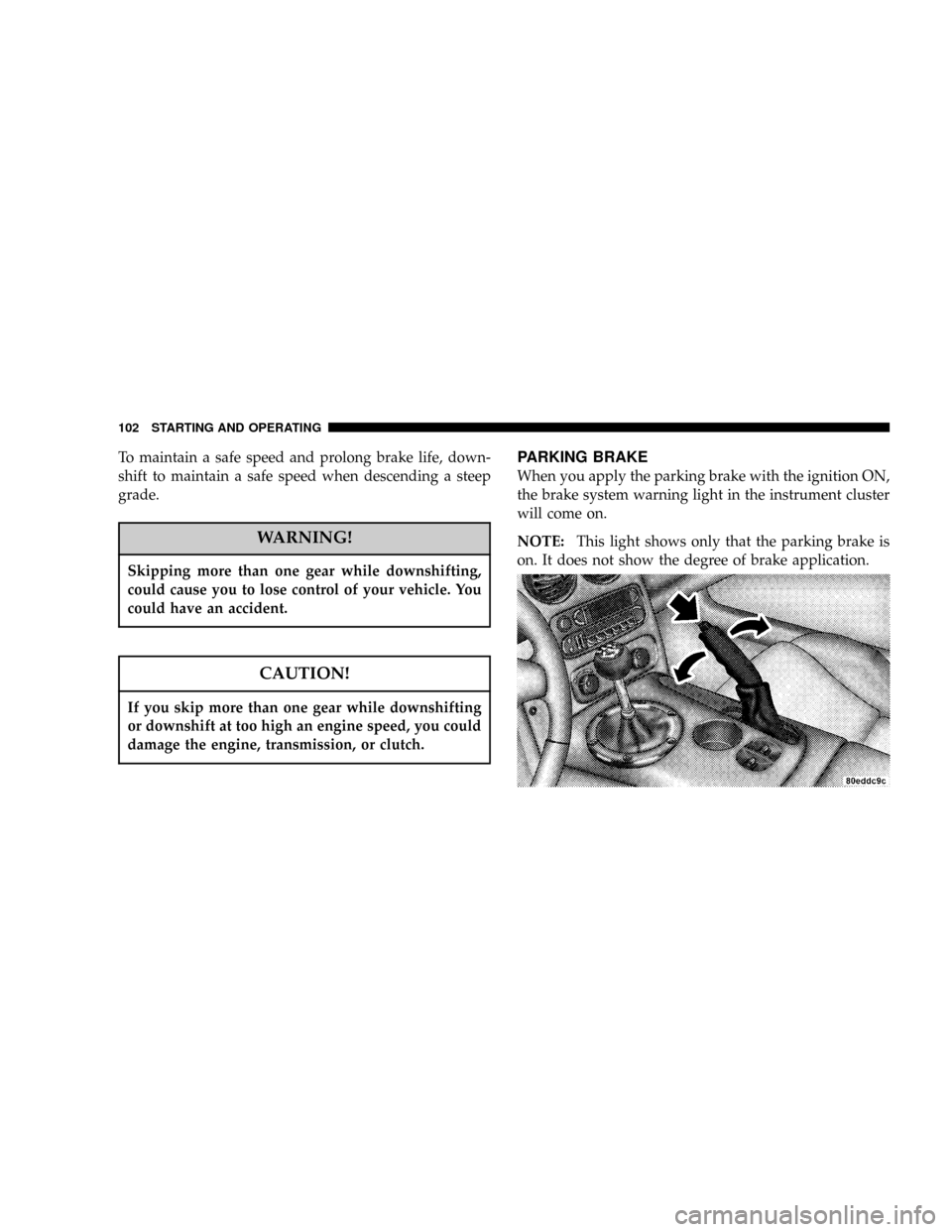
PARKING BRAKE
When you apply the parking brake with the ignition ON,
the brake system warning light in the instrument cluster
will come on.
NOTE:This light shows only that the parking brake is
on. It does not show the degree of brake application.
102 STARTING AND OPERATING
Page 107 of 236

In the event power assist is lost for any reason (for
example, repeated brake applications with the engine
off), the brakes will still function. The effort required to
brake the vehicle will be much greater than that required
with the power system operating.
If either the front or rear hydraulic system loses normal
capability, the remaining system will still function with
some loss of overall braking effectiveness. This will be
evident by increased pedal travel during application,
greater pedal force required to slow or stop, and activa-
tion of the Brake Warning Lamp during brake use.
NOTE:Your Viper has a very high performance braking
system. The brake pads are a semi-metallic compound
which has been selected for superior fade resistance and
consistent operation. A compromise is that under some
weather and operating conditions, the brakes may squeal
slightly during light brake applications.Brake Pad Break-In
The brakes on your new Viper do not require a long
break-in period, but avoid repeated hard brake applica-
tions from high speeds during initial break-in. Also avoid
severe brake loading such as may be encountered when
descending long mountain grades.
POWER STEERING
The power assisted steering system of your vehicle
provides mechanical steering capability in the event
power assist is lost.
If for some reason the hydraulic pressure is interrupted,
it will still be possible to steer your vehicle. Under these
conditions you will observe a substantial increase in
steering effort.
STARTING AND OPERATING 107
5
Page 120 of 236
Radial-Ply Tires
WARNING!
Combining radial ply tires with other types of tires
on your vehicle will cause your vehicle to handle
poorly. The instability could cause an accident. Al-
ways use radial ply tires in sets of four (or 6, in case
of trucks with dual rear wheels). Never combine
them with other types of tires.
Cuts and punctures in radial tires are repairable only in
the tread area because of sidewall flexing. Consult your
authorized tire dealer for radial tire repairs.
Compact Spare Tire Ð If Equipped
The compact spare is for temporary emergency use with
radial tires. It is engineered to be used on your style
vehicle only. Since this tire has limited tread life, the
original tire should be repaired (or replaced) and rein-
stalled at the first opportunity.
WARNING!
Temporary use spare tires are for emergency use
only. With these tires, do not drive more than 50 mph
(80 km/h). Temporary-use spare tires have a total
tread life of 3,000 miles (4 800 km). Be sure to follow
the warnings which apply to your spare. Failure to
do so could result in spare tire failure and loss of
vehicle control.
120 STARTING AND OPERATING
Page 127 of 236

FUEL REQUIREMENTS
Your vehicle is designed to meet all emis-
sion regulations and provide excellent fuel
economy when using high quality pre-
mium unleaded gasoline having an octane
rating of 93 or higher.
Light spark knock at low engine speeds is not harmful to
your engine. However, continued heavy spark knock at
high speeds can cause damage and immediate service is
required. Engine damage resulting from operating with a
heavy spark knock may not be covered by the new
vehicle warranty.
Poor quality gasoline can cause problems such as hard
starting, stalling and hesitations. If you experience these
symptoms, try another brand of ªregularº gasoline be-
fore considering service for the vehicle.Over 40 automobile manufacturers around the world
have issued and endorsed consistent gasoline specifica-
tions (the World Wide Fuel Charter, WWFC) to define
fuel properties necessary to deliver enhanced emissions,
engine performance, and durability for your vehicle. The
manufacturer recommends the use of gasolines that meet
the WWFC specifications if they are available.
Reformulated Gasoline
Many areas of the country require the use of cleaner
burning fuel referred to as Reformulated Gasoline.
Reformulated gasolines contain oxygenates, and are spe-
cially blended to reduce vehicle emissions and improve
air quality.
The manufacturer strongly supports the use of reformu-
lated gasolines. Properly blended reformulated gasolines
will provide excellent performance and durability of
engine and fuel system components.
STARTING AND OPERATING 127
5
Page 129 of 236

Sulfur In Gasoline
Your vehicle may have been designed to meet California
low emission standards on clean burning, low sulfur,
California gasoline. Gasoline sold outside of California is
allowed to have higher sulfur levels that may affect the
performance of your vehicle's catalytic converter. This
may cause the Malfunction Indicator Light or Service
Engine Soon Light to illuminate.
The illumination of this light while operating on high
sulfur gasoline does not necessarily mean your emission
system control system is malfunctioning. The manufac-
turer recommends that you try a different brand of
unleaded gasoline having lower sulfur to determine if the
problem is fuel related before returning your vehicle to
an authorized dealer for service.
NOTE:If the Malfunction Indicator light or Service
Engine Soon light is flashing, immediate service is re-
quired.
Materials Added to Fuel
All gasoline sold in the United States and Canada is
required to contain effective detergent additives. The use
of additional detergents or other additives is not needed
under normal conditions.
ADDING FUEL
The fuel tank filler tube has a restricting door about 2
inches (50mm) inside the opening. If using a portable
container, it should have a flexible nozzle long enough to
force open the restricting door.
STARTING AND OPERATING 129
5
Page 130 of 236

WARNING!
Remove the fuel tank filler tube cap (gas cap) slowly
to prevent fuel spray from the filler neck that may
cause injury. The volatility of some gasolines may
cause a buildup of pressure in the fuel tank that may
increase while you drive the vehicle. This pressure
can result in a spray of gasoline and/or vapors when
you remove the cap from a hot vehicle. Removing the
cap slowly allows the pressure to vent and prevents
fuel spray. Never have any smoking materials lit in
or near the vehicle when the fuel tank filler tube cap
(gas cap) is removed or when filling the tank. Never
fill the gas tank while the engine is running.
VEHICLE LOADING
Vehicle Loading Capacities
Front Seat Occupants....................... 2
Luggage....................... 115lbs. (51 kg)
Rated Vehicle Capacity............ 415lbs. (187kg)
TRAILER TOWING
Trailer towing with your Viper is not recommended.
130 STARTING AND OPERATING
Page 131 of 236

WHAT TO DO IN EMERGENCIES
CONTENTS
mHazard Warning Flasher..................132
mIf Your Engine Overheats.................132
mJump-Starting Procedures.................134
mDriving On Slippery Surfaces..............137NTraction............................137
mFreeing A Stuck Vehicle..................138
mTowing A Disabled Vehicle................139
6
Page 132 of 236

HAZARD WARNING FLASHER
The flasher switch is on the top of the steering
column, just behind the steering wheel. Depress
the flasher button and all front and rear directional
signals will flash. Depress the flasher button again to turn
the flashers off.Do not use this emergency warning system when the
vehicle is in motion. Use it when your vehicle is disabled
and is creating a safety hazard for other motorists.
If it is necessary to leave the vehicle to go for service, the
flasher system will continue to operate with the ignition
key removed.
NOTE:With extended use, the flasher may run down
your battery.
IF YOUR ENGINE OVERHEATS
In any of the following situations, you can reduce the
potential for overheating by taking the appropriate ac-
tion.
²On the highways ÐSlow down and use the highest
gear possible.
²In city traffic ÐWhile stopped, put the transmission
in neutral, but do not increase engine idle speed.
132 WHAT TO DO IN EMERGENCIES
Page 133 of 236

²In city trafficÐWhile moving, shift into the highest
gear possible to reduce engine RPM.
NOTE:There are steps that you can take to slow down
an impending overheat condition. If your air conditioner
is on, turn it off. The air conditioning system adds heat to
the cooling system and turning off the A/C removes this
heat. You can also turn the Temperature control to
maximum heat, the Mode control to floor, and the fan
control to High. This allows the heater core to act as a
supplement to the radiator and aids in removing heat
from the cooling system.WARNING!
A hot cooling system is dangerous. You or others
could be badly burned by steam or boiling coolant.
If your temperature gauge pointer is in the red area,
turn off the engine immediately. You may want to
call a service center for service. If you decide to look
under the hood yourself, see Section 7 of this
manual. Follow the warnings under the Radiator
Cap paragraph.
WHAT TO DO IN EMERGENCIES 133
6
Page 134 of 236

JUMP-STARTING PROCEDURES
WARNING!
²Do not attempt to push or tow your vehicle to get
it started. Unburned fuel could enter the catalytic
converter and once the engine has started, ignite
and damage the converter and vehicle. If the
vehicle has a discharged battery, booster cables
may be used to obtain a start from a booster
battery or the battery in another vehicle. This type
of start can be dangerous if done improperly, so
follow this procedure carefully.
²Take care to avoid the radiator cooling fan and
accessory drive whenever the hood is raised. You
can be hurt by the moving components.
WARNING!
²Battery fluid is a corrosive acid solution; do not
allow battery fluid to contact eyes, skin or cloth-
ing. Don't lean over battery when attaching
clamps or allow the clamps to touch each other. If
acid splashes in eyes or on skin, flush contami-
nated area immediately with large quantities of
water.
²A battery generates hydrogen gas that is flam-
mable and explosive. Keep flame or spark away
from the top of the battery. Do not use a booster
battery or any other booster source with an output
that exceeds 12 volts.
134 WHAT TO DO IN EMERGENCIES