engine DODGE VIPER 2004 ZB / 2.G Workshop Manual
[x] Cancel search | Manufacturer: DODGE, Model Year: 2004, Model line: VIPER, Model: DODGE VIPER 2004 ZB / 2.GPages: 236, PDF Size: 4.18 MB
Page 165 of 236
²Rubber bushings
²Starter bearing
²Throttle control cable
²Water pump bearings
Windshield Washers
The fluid reservoir in the right side engine compartment
should be checked for fluid level at regular intervals. Fill
the reservoir with windshield antifreeze (not radiator
antifreeze).
Exhaust System
The best protection against carbon monoxide entry into
the vehicle body is a properly maintained engine exhaust
system.
If you notice a change in the sound of the exhaust system;
or if exhaust fumes can be detected inside the vehicle; or
when the underside or side of the vehicle is damaged;have a competent mechanic inspect the complete exhaust
system and adjacent body areas for broken, damaged,
deteriorated, or mispositioned parts. Open seams or
loose connections could permit exhaust fumes to seep
into the passenger compartment. In addition, inspect the
exhaust system each time the vehicle is raised for lubri-
cation or oil change. Replace as required.
WARNING!
Exhaust gases can injure or kill. They contain carbon
monoxide which is colorless and odorless. Breathing
it can make you unconscious and can eventually
poison you.
MAINTAINING YOUR VEHICLE 165
7
Page 166 of 236
Cooling System
WARNING!
You or others can be badly burned by hot coolant or
steam from your radiator. If you see or hear steam
coming from under the hood, don't open the hood
until the radiator has had time to cool. Never try to
open a cooling system pressure cap when the radia-
tor is hot.
Inspection
Coolant protection checks should be made every 12
months (before the onset of freezing weather, where
applicable). If coolant is dirty or rusty in appearance, the
system should be drained, flushed and refilled with fresh
coolant. Check the front of the radiator for any accumu-
lation of bugs, leaves, etc.Check the coolant bottle tubing for condition and tight-
ness of connection at reserve tank and radiator. Inspect
the entire system for leaks.
NOTE:Check the front of the radiator for debris (leaves,
paper, etc.) regularly. A build up of such material could
lead to engine overheating.
Do not remove the cooling system pressure cap when the
cooling system is hot.
Cooling System Ð Drain, Flush and Refill
The cooling system should be drained, flushed and
refilled at the intervals shown on the Maintenance Sched-
ules.
If the solution is dirty and contains a considerable
amount of sediment, clean and flush with a reliable
cooling system cleaner. Follow with a thorough rinsing to
remove all deposits and chemicals. Discard old antifreeze
solution according to recommended procedure.
166 MAINTAINING YOUR VEHICLE
Page 167 of 236
Engine Coolant Disposal
Used ethylene glycol based engine coolant is a regulated
substance requiring proper disposal. Check with your
local authorities to determine the disposal rules for your
community. Do not store ethylene glycol based engine
coolant in open containers or allow it to remain in
puddles on the ground. Prevent ingestion by animals or
children. If ingested by a child, contact a physician
immediately.
Selection Of Coolant
Use only the manufacturer's recommended coolant. Re-
fer to the Recommended Fluids, Lubricants and Genuine
Parts section for the correct coolant type.
CAUTION!
Mixing of coolants other than specific (non-HOAT),
may result in engine damage that may not be cov-
ered under the new vehicle warranty, and decreased
corrosion protection. If a non-HOAT coolant is intro-
duced into the cooling system in an emergency, it
should be replaced with the specified coolant as
soon as possible.
Do not use plain water alone or alcohol base anti-
freeze products. Do not use additional rust inhibi-
tors or antirust products, as they may not be compat-
ible with the radiator coolant and may plug the
radiator.
This vehicle has not been designed for use with
Propylene Glycol based coolants. Use of Propylene
Glycol based coolants is not recommended.
MAINTAINING YOUR VEHICLE 167
7
Page 168 of 236
Adding Coolant
DO NOT remove the pressure cap when checking cool-
ant. When adding coolant or refilling system, a 50%
solution of ethylene glycol antifreeze coolant in water
should be used. Higher concentrations (not to exceed
65%) are required if temperatures below ±37ÉF are antici-
pated.
Use only high purity water such as distilled or deionized
water when mixing the water / antifreeze solution. The
use of lower quality water will reduce the amount of
corrosion protection in the engine cooling system.
NOTE:It is the owner's responsibility to maintain the
proper level of protection against freezing according to
the temperatures occurring in the area where the vehicle
is operated.WARNING!
Never add coolant to the radiator when the engine is
overheated. Do not loosen or remove pressure cap to
cool overheated engine. The coolant is under pres-
sure and severe scalding could result.
Cooling System Pressure Cap
The cap must be fully tightened to prevent loss of
coolant, and to insure that coolant will return to the
radiator from the coolant reserve tank.
The pressure cap should be inspected and cleaned if there
is any accumulation of foreign material on the sealing
surfaces.
168 MAINTAINING YOUR VEHICLE
Page 169 of 236
WARNING!
The warning words ªDO NOT OPEN HOTº on the
pressure cap are a safety precaution. Never add
coolant to the radiator when the engine is over-
heated. Do not loosen or remove the pressure cap to
cool overheated engine. Heat causes pressure to
build up in the cooling system. To prevent scalding
or injury, do not remove the pressure cap while the
system is hot or under pressure.
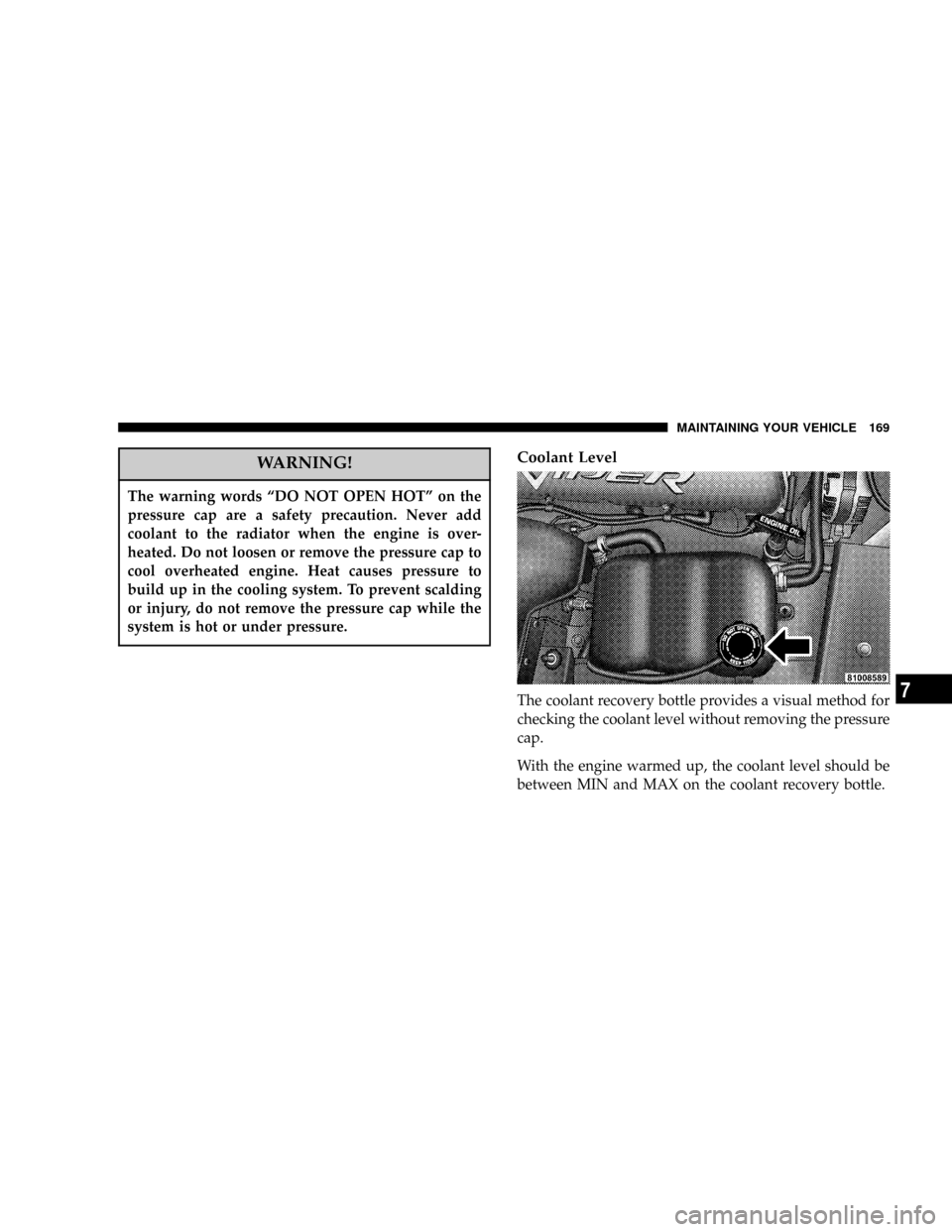
Coolant Level
The coolant recovery bottle provides a visual method for
checking the coolant level without removing the pressure
cap.
With the engine warmed up, the coolant level should be
between MIN and MAX on the coolant recovery bottle.
MAINTAINING YOUR VEHICLE 169
7
Page 170 of 236

When additional coolant is needed to maintain the
proper level, it should be added to the coolant recovery
bottle.
Points to Remember
²
Do not overfill the bottle.
²Check coolant freeze point in the coolant bottle. If
antifreeze needs to be added, contents of the coolant
bottle also must be protected against freezing.
²If frequent coolant additions are required, or if the
level in the bottle does not drop when the engine cools,
the cooling system should be pressure tested for leaks.
²Maintain coolant concentration of 50% ethylene glycol
(minimum) with recommended antifreeze for proper
corrosion protection of your engine that contains alu-
minum components.
²Make sure that the radiator and bottle overflow hoses
are not kinked or obstructed.
²Keep the front of the radiator clean. If your vehicle has
air conditioning, keep the front of the condenser clean
also.
²Do not change the thermostat for summer or winter
operation. If replacement is ever necessary, install
ONLY the correct type thermostat. Other designs may
result in unsatisfactory cooling performance.
Hoses and Vacuum/Vapor Harnesses
Inspect surfaces of hoses and nylon tubing for evidence
of heat and mechanical damage. Hard or soft spots,
brittle rubber, cracking, checking, tears, cuts, abrasions,
and excessive swelling suggest deterioration of the rub-
ber. Pay particular attention to those hoses nearest to
high heat sources such as the exhaust manifold. Inspect
170 MAINTAINING YOUR VEHICLE
Page 172 of 236

Inspect all hose clamps and couplings to make sure they
are secure and no leaks are present.
Insure nylon tubing in these areas has not melted or
collapsed.
NOTE:Often, fluids are used during assembly plant
operations to ease the assembly of hoses to couplings.
Therefore, oil wetness at the hose-coupling area is not
necessarily an indication of leakage. Actual dripping of
hot fluid when systems are under pressure (during
vehicle operation) should be noted before hose is re-
placed based on leakage.
High pressure fuel system hoses have unique material
characteristics that provide adequate sealing and resist
attack by deteriorated gasoline.Use only manufacturer specified hoses or their equiva-
lent in material and specification, in any fuel system
servicing. It is mandatory to replace all clamps that have
been loosened or removed during service.
NOTE:Inspection of brake hoses should be done when-
ever the brake system is serviced and at every engine oil
change. If there is any evidence of cracking, scuffing, or
worn spots, the hose should be replaced immediately!
Eventual deterioration of the hose can take place with
possible burst failure.
172 MAINTAINING YOUR VEHICLE
Page 173 of 236
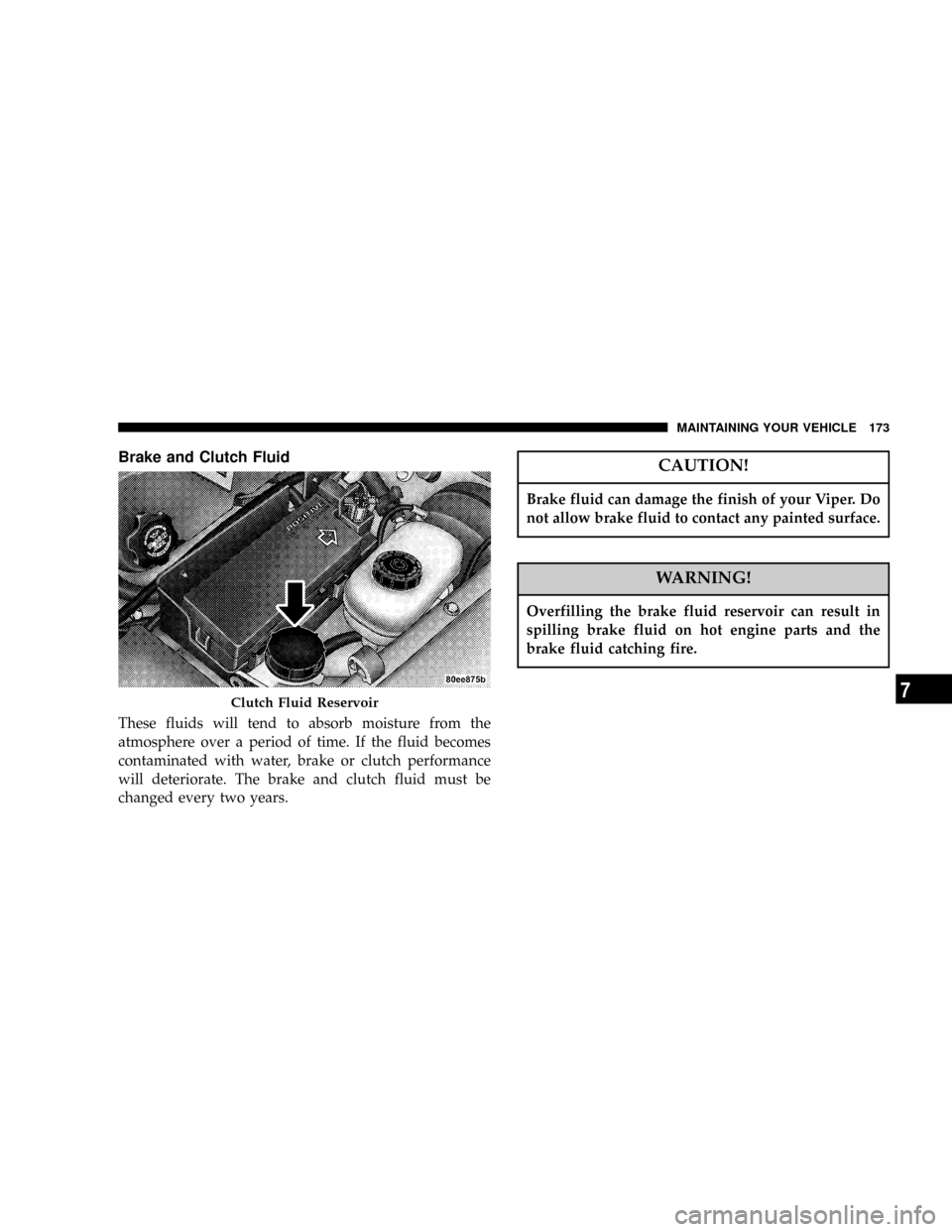
Brake and Clutch Fluid
These fluids will tend to absorb moisture from the
atmosphere over a period of time. If the fluid becomes
contaminated with water, brake or clutch performance
will deteriorate. The brake and clutch fluid must be
changed every two years.
CAUTION!
Brake fluid can damage the finish of your Viper. Do
not allow brake fluid to contact any painted surface.
WARNING!
Overfilling the brake fluid reservoir can result in
spilling brake fluid on hot engine parts and the
brake fluid catching fire.
Clutch Fluid Reservoir
MAINTAINING YOUR VEHICLE 173
7
Page 184 of 236
²If the vehicle will be subjected to freezing tempera-
tures, remove the battery and store it in a dry, well
ventilated area or place a trickle charger (1.5 Amp)
with automatic shutdown / overcharge protection
connected to the battery. Do not leave the trickle
charger hooked up to the battery without being
plugged into the 110 AC voltage outlet, because this
will result in further drain on the vehicle's battery. If
the vehicle is not going to be driven in the next 3
weeks, follow the battery recharge procedure in the
Service Manual, then disconnect the battery at the
negative terminal or use the save feature described in
Maintaining your Vehicle section under the Mainte-
nance Procedures sub-section, within Maintenance-
Free Battery.CAUTION!
Use care when disconnecting the remote positive
cable. It is connected to the battery and can short out
to any metal on the vehicle. Always tape or wrap the
exposed cable end to prevent electrical shorts.
²Disconnecting the battery causes the engine control
system to lose memory of some ªlearnedº functions,
unless using the Battery Save feature described in
Maintaining your Vehicle section under the Mainte-
nance Procedures sub-section, within Maintenance-
Free Battery. The engine may run rough when first
started after a battery disconnect until the control
module ªrelearnsº these functions.
184 MAINTAINING YOUR VEHICLE
Page 195 of 236
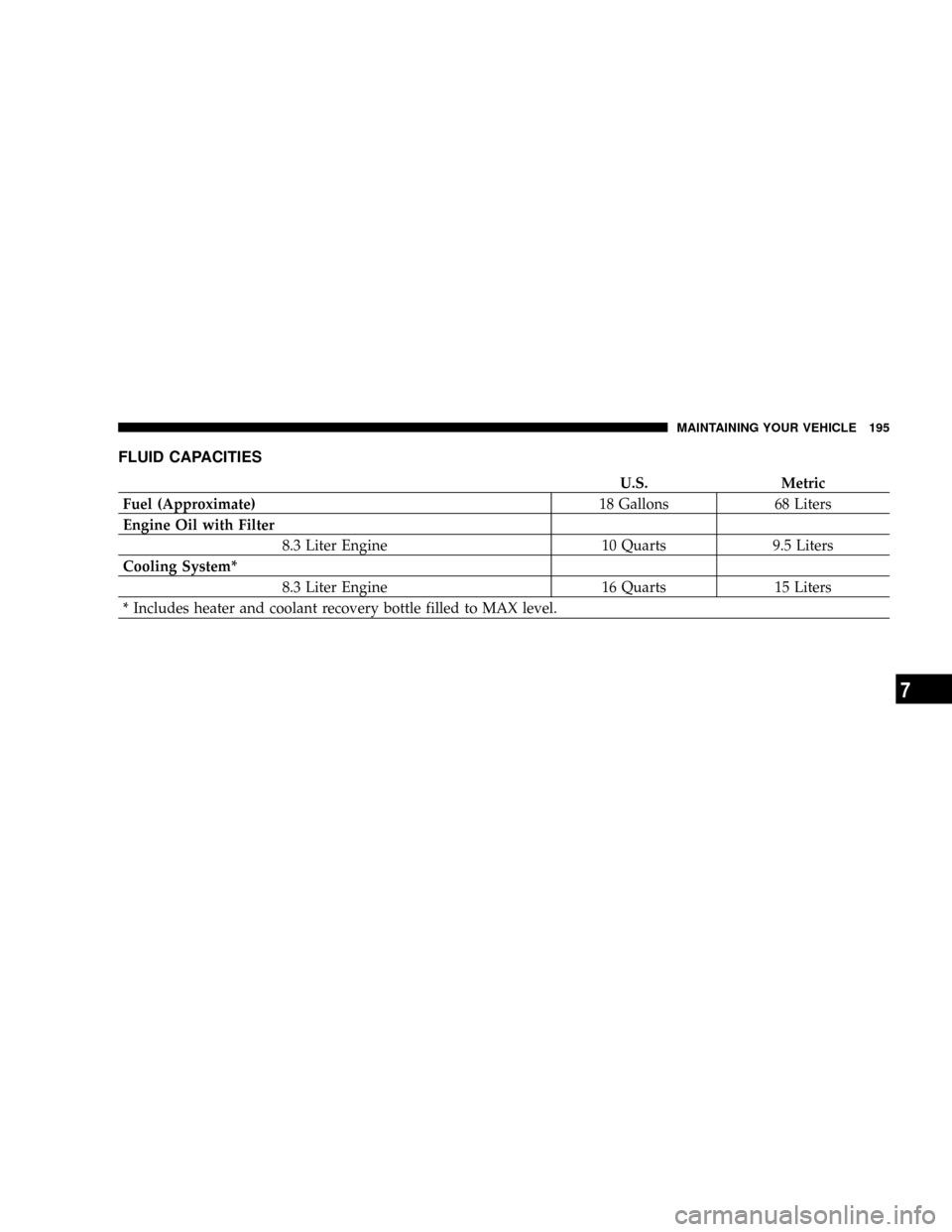
FLUID CAPACITIES
U.S. Metric
Fuel (Approximate)18 Gallons 68 Liters
Engine Oil with Filter
8.3 Liter Engine 10 Quarts 9.5 Liters
Cooling System*
8.3 Liter Engine 16 Quarts 15 Liters
* Includes heater and coolant recovery bottle filled to MAX level.
MAINTAINING YOUR VEHICLE 195
7