ECU DODGE VIPER 2008 ZB II / 2.G User Guide
[x] Cancel search | Manufacturer: DODGE, Model Year: 2008, Model line: VIPER, Model: DODGE VIPER 2008 ZB II / 2.GPages: 303, PDF Size: 2.65 MB
Page 42 of 303
The airbags work with the instrument panel knee bolsters
and the seat belts to provide improved protection for the
driver and passenger. While the seat belts are designed to
protect the driver and passenger in many types of
collisions, the airbags will deploy in moderate to severe
frontal collisions. However, even in collisions where the
airbags deploy, all occupants need the seat belts to keep
them in the right position for the airbags to protect
properly.
NOTE:The passenger airbag may not deploy if the
Occupant Classification System (refer to ªHow The Air-
bag System Worksº in this section) determines the seat is
empty or is occupied by someone that is classified in the
ªchildº category. This could be a child, a teenager, or
even a small adult. Therefore, even if the driver airbag
deploys, the passenger airbag may not deploy.
Here are some simple steps you can take to minimize
the risk of harm from a deploying airbag.1. An infant up to 1 year or approximately 20 pounds (9
kg) should never ride in the vehicle, because in the event
of a crash the rear facing child seat places them too close
to the passenger airbag.
2. An infant in rear facing child safety seat, designed for
a child up to one year or approximately 20 pounds (9 kg),
shouldNEVERride in the front seat of a vehicle
equipped with a passenger airbag, unless the airbag is
shut OFF. An airbag deployment can cause severe injury
or death to an infant in this position. Refer to ªPassenger
Airbag Disabled (PAD) Indicator Lightº in this section.
3. A child that is not big enough to wear the vehicle seat
belt properly (refer to information on Child Restraint in
this section) should be secured in a child safety seat or
booster seat.
4. An older child who does not use a child safety seat or
booster seat should ride buckled properly in their seat.
THINGS TO KNOW BEFORE STARTING YOUR VEHICLE 41
2
Page 43 of 303
5. Never allow a child to place the shoulder belt behind
them or under the arm.
6. Never allow a child to lean forward toward the
instrument panel as a passenger airbag deployment
could cause severe injury or death to a child in this
position.
7. For a child from 1 to 12 years old: Move the passenger
seat as far back as possible. For a child from 20 to 60
pounds (9 kg to 27 kg): Secure them in the appropriate
child safety seat or booster seat. If too large for a booster
seat, the child should wear the lap/shoulder belt prop-
erly.
8. Read the instructions provided with your child re-
straint to make sure that you are using it properly.
9. Read the instructions provided with your child safety
seat or booster seat to make sure that you are using it
properly.10. All occupants should wear their lap and shoulder
belts properly.
11. Position the driver seat and passenger seat as far
away from the instrument panel as practical to allow the
airbags room to inflate. Note that the power adjustable
pedals allow for more driver's seat adjustment options.
Refer to ªAdjustable Pedalsº in Section 3 of this manual
for details.
Airbag System Components
The airbag system consists of the following:
²Occupant Restraint Controller (ORC)
²Airbag Warning Light
²Driver Airbag
²Passenger Airbag
²Passenger Airbag Off Light
42 THINGS TO KNOW BEFORE STARTING YOUR VEHICLE
Page 51 of 303
NOTE:Perchlorate Material Ð special handling may
apply. See www.dtsc.ca.gov/hazardouswaste/perchlorate.
Airbag Warning Light
You will want to have the airbags ready for
your protection in a collision. While the airbag
system is designed to be maintenance free, if
any of the following occurs, have an autho-
rized dealer service the system immediately:
²The Airbag Warning light does not come on or flickers
during the 6 to 8 seconds when the ignition switch is
first turned on.
²The light remains on or flickers after the 6 to 8 second
interval.
²The light flickers or comes on and remains on while
driving.
Child Restraint
Everyone in your vehicle needs to be buckled up all the
time Ð babies and children, too. Every state in the United
States and all Canadian provinces require small children
ride in proper restraint systems. This is the law, and you
can be prosecuted for ignoring it.
WARNING!
In a collision, an unrestrained child, even a tiny baby,
can become a missile inside the vehicle. The force
required to hold even an infant on your lap could
become so great that you could not hold the child, no
matter how strong you are. The child and others
could be injured badly. Any child riding in your
vehicle should be in a proper restraint for the child's
size.
50 THINGS TO KNOW BEFORE STARTING YOUR VEHICLE
Page 54 of 303
Here are some tips on getting the most out of your child
restraint:
²Before buying any restraint system, make sure that it
has a label certifying that it meets all applicable Safety
Standards. We also recommend that you make sure
that you can install the child restraint in the vehicle
where you will use it before you buy it.
²The restraint must be appropriate for your child's
weight and height. Check the label on the restraint for
weight and height limits.
²Carefully follow the instructions that come with the
restraint. If you install the restraint improperly, it may
not work when you need it.
²Buckle the child into the seat according to the child
restraint manufacturer's directions.
²When your child restraint is not in use, secure it in the
vehicle with the seat belt or remove it from the vehicle.Do not leave it loose in the vehicle. In a sudden stop or
collision, it could strike the occupants or seat backs
and cause serious personal injury.
Child Restraint Tether Anchor
Child restraints having tether straps and hooks
for connection to tether anchors have been
available for some time. In fact, many child
restraint manufacturers will provide add-on
tether-strap kits for some of their older products. There is
a tether strap anchor located behind the child tether
access cover behind the passenger seat.
To attach a child restraint tether strap:
1. Move the seat forward.
2. Move the seatback to its full forward position.
THINGS TO KNOW BEFORE STARTING YOUR VEHICLE 53
2
Page 56 of 303
7. Return the seatback to an upright position.
8. Install the child restraint according to the manufactur-
er's directions.
9. Remove slack from the tether strap according to the
child restraint manufacturer's directions.
WARNING!
An incorrectly anchored tether strap could lead to
increased head motion and possible injury to the
child. Use only the anchor position directly behind
the child seat to secure a child restraint top tether
strap.Installing Child Restraints Using the Vehicle Seat belt
The passenger seat belt is equipped with an automatic
locking retractor for child restraint system installation. It
is designed to keep the lap portion of the restraint held
tightly to the passenger seat. Seat belts equipped with
automatic locking retractors have a distinctive label on
the webbing. (Refer to ªAutomatic Locking Modeº in this
section for additional information).
To restrain the child seat:
1. Pull enough webbing from the retractor to allow the
belt to pass through the child restraint and insert the latch
plate into the buckle until you hear a ªclick.º
2. Grasp the shoulder portion of the belt and pull all of
the webbing out of the retractor.
3. Allow some of the webbing to retract back into the
retractor. As the belt retracts, you will hear a clicking
sound indicating that the belt is now in automatic locking
mode.
THINGS TO KNOW BEFORE STARTING YOUR VEHICLE 55
2
Page 57 of 303
4. Tighten the lap portion of the belt and allow the excess
webbing to retract back to the retractor. If it still does not
make the child restraint secure, then secure the child
restraint with the Child Restraint Tether Anchor.
NOTE:Once the belt is in automatic locking mode, you
will not be able to pull any more of the webbing out of
the retractor. In this mode, you will only be able to retract
excess webbing into the retractor to secure the child
restraint.
Transporting Pets
Deploying airbags could harm your pet. An unrestrained
pet will be thrown about and possibly injured, or injure a
passenger during panic braking or in a collision.
Pets should be restrained in pet harnesses or pet carriers
that are secured by seat belts.
BREAK-IN RECOMMENDATIONS
A long break-in period is not required for the drivetrain
(engine, transmission, and rear axle) in your new vehicle.
Following these few simple guidelines is all that is
necessary for a good break-in:
For the first 500 miles (800 km):
²Keep your vehicle speed below the legal, posted speed
limit and your engine speed below 4,000 rpm.
²Avoid driving at a constant speed, either fast or slow,
for long periods.
²Do not make any full throttle starts and avoid full
throttle acceleration.
²Use the proper gear for your speed range.
²Wait until the engine has reached normal operating
temperature before driving at the recommended maxi-
mum break-in speed.
56 THINGS TO KNOW BEFORE STARTING YOUR VEHICLE
Page 75 of 303
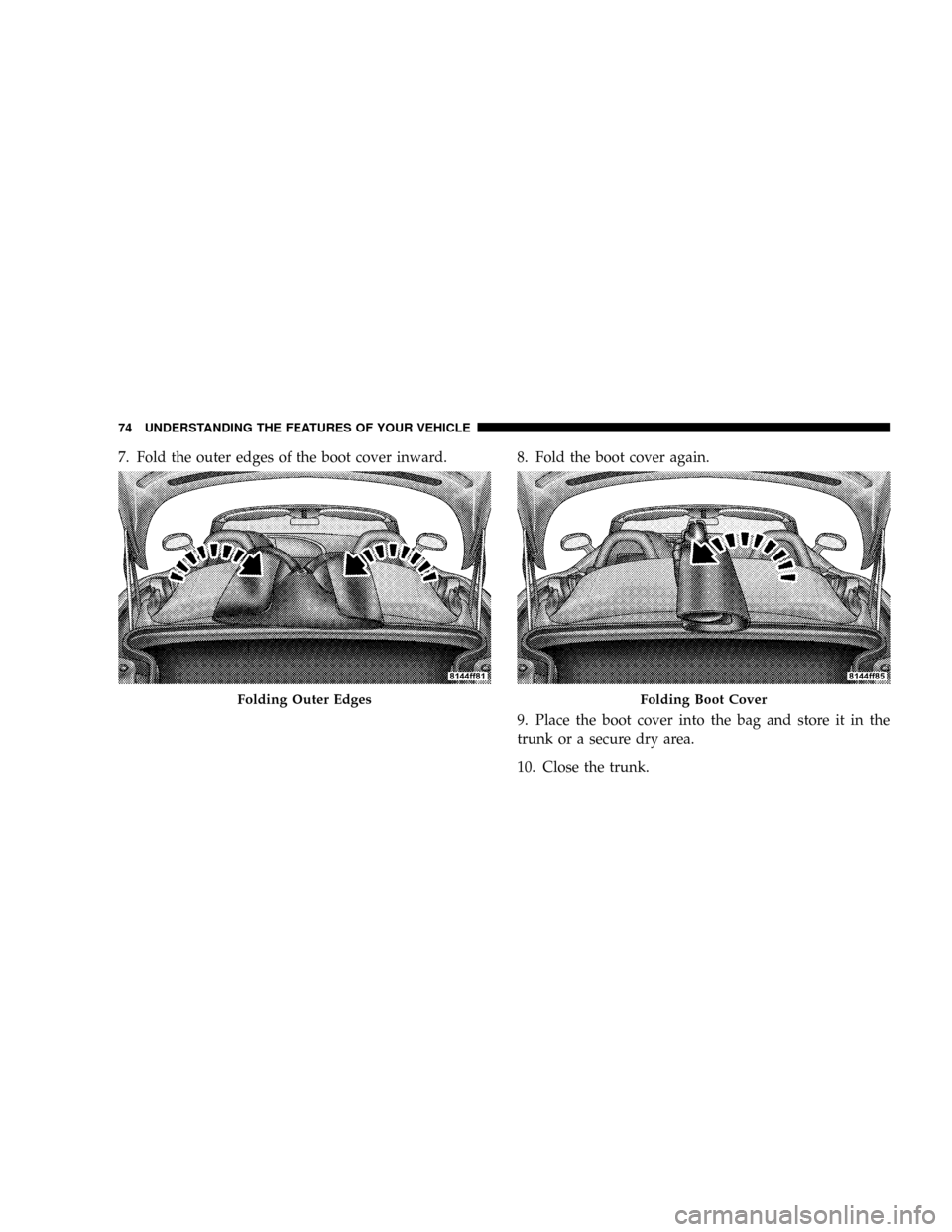
7. Fold the outer edges of the boot cover inward. 8. Fold the boot cover again.
9. Place the boot cover into the bag and store it in the
trunk or a secure dry area.
10. Close the trunk.
Folding Outer EdgesFolding Boot Cover
74 UNDERSTANDING THE FEATURES OF YOUR VEHICLE
Page 81 of 303

NOTE:Assist props will raise the hood to a normal
usage position. If greater access is required, the hood may
be pushed up at the front, raising the hood beyond the
initial opening height.
CAUTION!
Do not leave the hood open in areas where strong
gusts of wind are likely. Such a place might be by the
side of the road where large trucks pass by. Strong
gusts of wind may damage your hood. Always close
the hood in such situations.To prevent possible damage, do not slam the hood to
close it. Simply lower the hood until it is open approxi-
mately 6 inches (15 cm) and then drop it. This should
secure both latches. Never drive your vehicle unless the
hood is fully closed with both latches engaged.
WARNING!
If the hood is not fully latched, it could open when
the vehicle is moving and block your forward vision.
Be sure the hood latches are fully latched before
driving.
80 UNDERSTANDING THE FEATURES OF YOUR VEHICLE
Page 134 of 303
CAUTION!
Long periods of engine idling, especially at high
engine speeds, can cause excessive exhaust tempera-
tures, which can damage your vehicle. Do not leave
your vehicle unattended with the engine running.
Normal Starting
NOTE:
²You must disarm the security system in order to start
the engine. For details, refer to ªSecurity Alarm Sys-
temº in Section 2 of this manual
²Normal Starting of either a cold or a warm engine does
not require pumping or depressing the accelerator
pedal. However, if the engine has not started within 3
seconds, slightly depress the accelerator pedal while
continuing to crank. If the engine fails to start within
15 seconds, turn the key to the ªOFF/LOCKº position,
wait 5 seconds, then repeat the normal starting proce-
dure.
To start the engine:
1. Fully apply the parking brake.
2. Press the clutch pedal to the floor.
NOTE:The engine will not start unless the clutch pedal
is pressed to the floor.
3. Place the gear selector in NEUTRAL
4. Insert the ignition key fully into the ignition switch
STARTING AND OPERATING 133
5
Page 174 of 303
WARNING!
²Never have any smoking materials lit in or near
the vehicle when the gas cap is removed or the
tank filled.
²Never add fuel to the vehicle when the engine is
running.
²A fire may result if gasoline is pumped into a
portable container that is inside of a vehicle. You
could be burned. Always place gas containers on
the ground while filling.NOTE:
²Tighten the gas cap until you hear a ªclickingº sound.
This is an indication that the gas cap is tightened
properly. The Malfunction Indicator Light in the in-
strument cluster may turn on if the gas cap is not
secured properly. Make sure that the gas cap is tight-
ened each time the vehicle is refueled.
²If the gas cap is lost or damaged, be sure the replace-
ment cap is for use with this vehicle.
VEHICLE LOADING
Vehicle Loading Capacities
Front Seat Occupants....................... 2
Luggage....................... 115lbs. (51 kg)
Rated Vehicle Capacity............ 415lbs. (187 kg)
STARTING AND OPERATING 173
5