belt DODGE VIPER 2008 ZB II / 2.G Owner's Manual
[x] Cancel search | Manufacturer: DODGE, Model Year: 2008, Model line: VIPER, Model: DODGE VIPER 2008 ZB II / 2.GPages: 303, PDF Size: 2.65 MB
Page 64 of 303
CONVERTIBLE TOP OPERATION Ð
CONVERTIBLE MODELS ONLY
WARNING!
The convertible top does not provide the structural
protection that a reinforced metal roof does, and the
fabric top cannot be expected to prevent the ejection
of the occupants of a vehicle in a collision. Therefore,
it is important that all occupants wear their seat belts
at all times when riding in a convertible. Studies
have shown that it is generally safer to remain inside
a vehicle during a collision, than to be ejected from
the vehicle.
CAUTION!
²To insure that no damage occurs, be sure that the
vehicle is at a complete stop with the gear selector
in the Neutral position before lowering or raising
the top.
²Do not operate the convertible top with ice or
snow build-up on the top. Damage to the top may
occur.
To Lower the Top:
1. Lower the window in each door at least one inch.
2. Lower both sun visors.
UNDERSTANDING THE FEATURES OF YOUR VEHICLE 63
3
Page 79 of 303
WARNING!
²Adjusting a seat while the vehicle is moving is
dangerous. The sudden movement of the seat
could cause you to lose control. The seat belt might
not be properly adjusted and you could be injured.
Adjust the seat only while the vehicle is parked.
²Do not ride with the seatback reclined so that the
shoulder belt is no longer resting against your
chest. In a collision you could slide under the seat
belt and be seriously or even fatally injured. Use
the recliner only when the vehicle is parked.
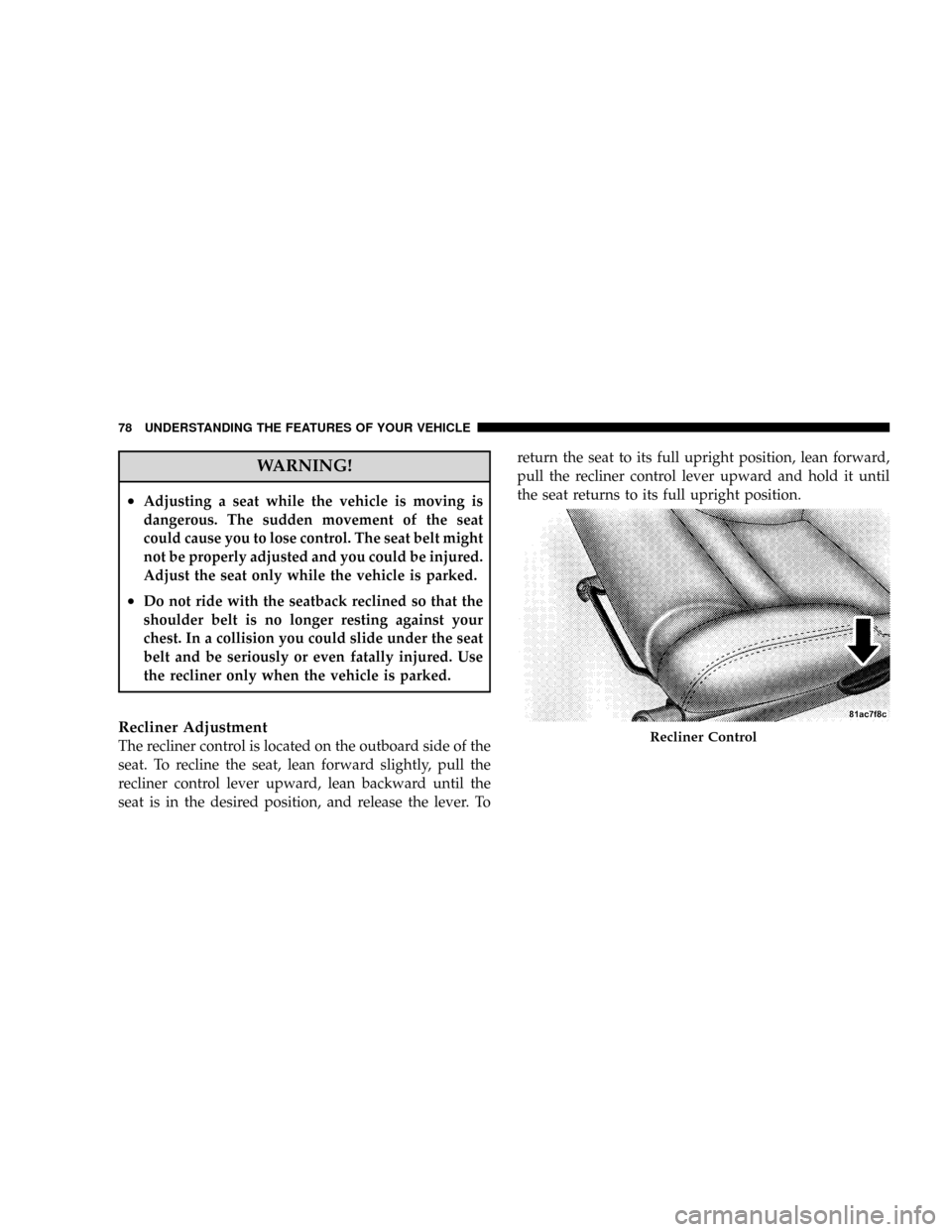
Recliner Adjustment
The recliner control is located on the outboard side of the
seat. To recline the seat, lean forward slightly, pull the
recliner control lever upward, lean backward until the
seat is in the desired position, and release the lever. Toreturn the seat to its full upright position, lean forward,
pull the recliner control lever upward and hold it until
the seat returns to its full upright position.Recliner Control
78 UNDERSTANDING THE FEATURES OF YOUR VEHICLE
Page 104 of 303
WARNING!
Do not exceed 55 mph (88 km/h) if the LOW Tire
indicator is activated. Vehicle handling and braking
may be reduced. You could have an accident and be
severely or fatally injured.
Seat Belt Reminder Light
If the driver does not buckle their seat belt and
vehicle speed exceeds 5 mph (8 km/h), or if the
passenger does not buckle their seat belt within 10
seconds of vehicle speed exceeding 5 mph (8 km/h), the
Enhanced Warning System (Belt Alert) will alert the
occupant(s) to buckle their seat belt(s). Once triggered,
the Enhanced Warning System (Belt Alert) will flash the
Seat Belt Reminder light and chime for up to 96 seconds
to alert the occupant(s) to buckle their seat belt(s). If the
driver unbuckles their seat belt while vehicle speed isgreater than 5 mph (8 km/h), or if the passenger unbuck-
les their seat belt for more than 10 seconds while vehicle
speed is greater than 5 mph (8 km/h), the Enhanced
Warning System (Belt Alert) will reactivate. (See page 36
for more information.)
Gauges & Indicator Lights
Tachometer
This gauge shows engine speed in revolutions-
per-minute (RPM) times 1,000. Avoid excessive
engine speeds in any part of the red warning
zone, particularly when driving downhill or in
lower gears.
Skip Shift Indicator Light
This indicator is located in the Tachometer. When
the indicator light turns amber, it means that you
are being prevented from shifting the transmission from
First to Second or to Third gear. When the indictor light
turns red, it means that the tachometer gauge pointer is at
UNDERSTANDING YOUR INSTRUMENT PANEL 103
4
Page 107 of 303
Charge System Light
The red Charge System Light is located in the
Voltage Gauge. It will turn on when there is a
charging system malfunction or a possible accessory
drive belt failure.
CAUTION!
The accessory belt also drives the water pump. Op-
erating the vehicle with a failed belt can cause engine
overheating and possible severe engine damage.
SETTING THE DIGITAL CLOCK
The digital display panel on the radio displays the time in
hours and minutes. The display panel is operative when
the ignition switch is in the ON/RUN or ACC position.
Press and release the Time button on the radio to display
the time. Press and release the button a second time to
turn off the time display.
Clock Setting Procedure
1. Turn the ignition switch to the ªON/RUNº or ªACCº
position.
2. Using the point of a ballpoint pen or similar object,
press either the ªHº (Hour) or ªMº (Minute) button on
the radio. The display will show the time.
3. Press the ªHº button to set hours or the ªMº button to
set minutes. The time setting will increase each time you
press a button.
RADIO GENERAL INFORMATION
Radio Broadcast Signals
The radio will provide excellent reception under most
operating conditions. Like any system, however, car
radios have performance limitations, due to mobile op-
eration and natural phenomena, which might lead you to
believe your sound system is malfunctioning. To help
106 UNDERSTANDING YOUR INSTRUMENT PANEL
Page 133 of 303
STARTING PROCEDURES
Before starting your vehicle, adjust your seat, adjust the
inside and outside mirrors, fasten your seat belt, and if
present, instruct any other occupant to buckle their seat
belt.WARNING!
²Never leave children alone in a vehicle. Leaving
children in a vehicle unattended is dangerous for a
number of reasons. A child or others could be
injured seriously or fatally. Don't leave the keys in
the ignition. A child could operate power win-
dows, other controls, or move the vehicle.
²Do not leave animals or children inside parked
vehicles in hot weather; interior heat build up may
cause serious injury or death.
²Be sure to turn off the engine if you want to rest or
sleep in your car. Accidents can be caused by
inadvertently moving the gear selection lever or
by pressing the accelerator pedal. This may cause
excessive heat in the exhaust system, resulting in
overheating and vehicle fire, which may cause
serious or fatal injuries.
132 STARTING AND OPERATING
Page 189 of 303
WARNING!
²You should not try to start your vehicle by pushing
or towing.
²Do not connect the cable to the negative post of the
discharge battery. The resulting electrical spark
could cause the battery to explode.
²During cold weather when temperatures are be-
low freezing point, electrolyte in a discharged
battery may freeze. Do not attempt jump-starting
because the battery could rupture or explode. The
battery temperature must be brought up above
freezing point before attempting jump-start.10. Start the engine in the vehicle that has the booster
battery. Let the engine idle a few minutes.
11. Turn off the Vehicle Security System.
NOTE:The Vehicle Security System will prevent the
engine from starting.
12. Start the engine in the vehicle with the discharged
battery. If engine does not start in 15 seconds, stop
cranking engine and allow starter to cool down before
cranking again.
13. When removing the booster cables, reverse the above
sequence exactly. Be careful of the moving belts and fans.
188 WHAT TO DO IN EMERGENCIES
Page 192 of 303
MAINTAINING YOUR VEHICLE
CONTENTS
m8.4L Engine Compartment................194
mOnboard Diagnostic System (OBD II).........195
mEmissions Inspection And Maintenance
Programs............................196
mReplacement Parts......................197
mDealer Service.........................198
mMaintenance Procedures..................198
NEngine Oil..........................198
NEngine Oil Filter......................201NDrive Belts Ð Check Condition And Tension . . 202
NSpark Plugs.........................203
NEngine Air Cleaner Filter................203
NFuel Filter..........................204
NCatalytic Converter....................204
NIgnition Wiring System And Ignition
Timing.............................205
NCrankcase Emission Control System........206
NMaintenance-Free Battery................206
7
Page 203 of 303
quality filters should be used to assure most efficient
service. MopartEngine Oil Filters are a high quality oil
filter and are recommended.
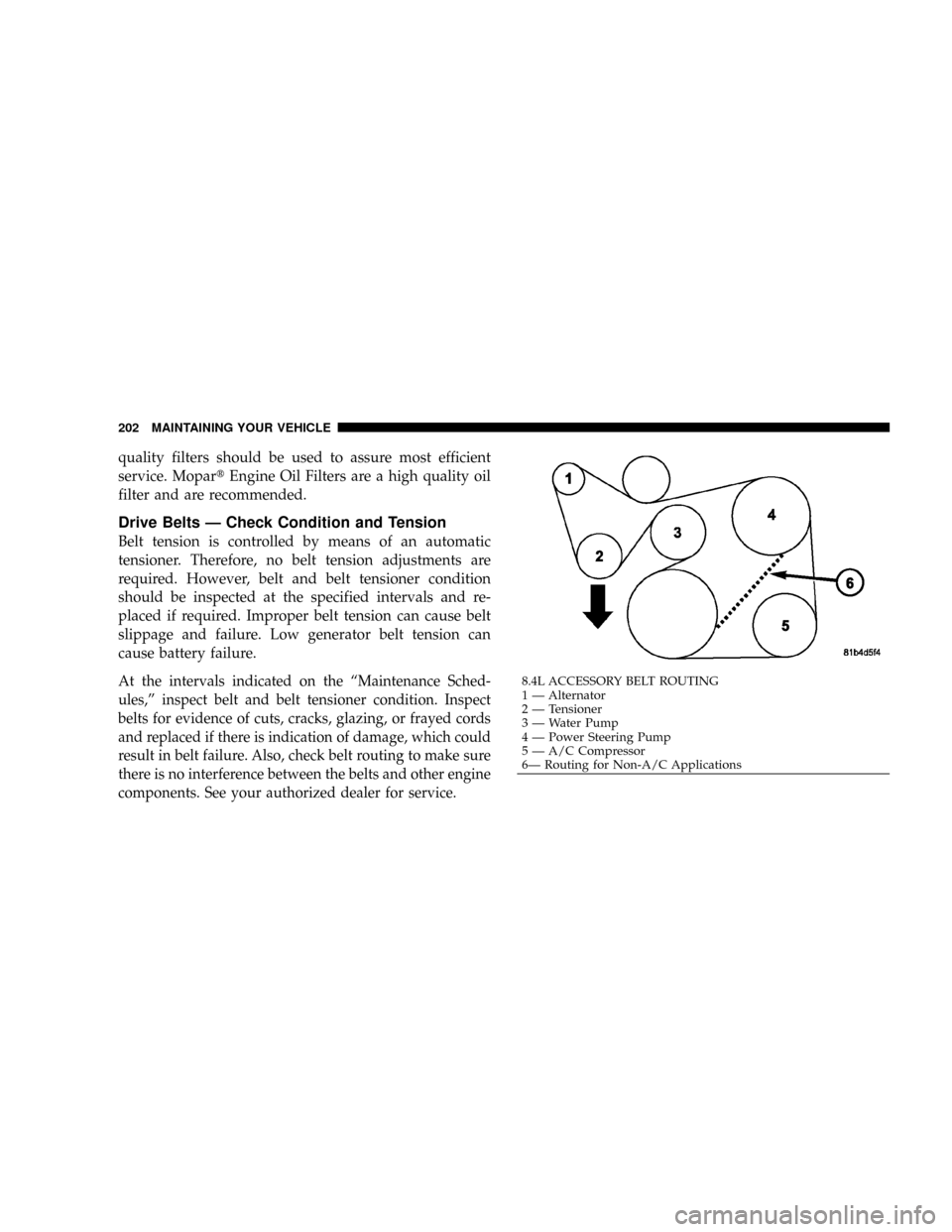
Drive Belts Ð Check Condition and Tension
Belt tension is controlled by means of an automatic
tensioner. Therefore, no belt tension adjustments are
required. However, belt and belt tensioner condition
should be inspected at the specified intervals and re-
placed if required. Improper belt tension can cause belt
slippage and failure. Low generator belt tension can
cause battery failure.
At the intervals indicated on the ªMaintenance Sched-
ules,º inspect belt and belt tensioner condition. Inspect
belts for evidence of cuts, cracks, glazing, or frayed cords
and replaced if there is indication of damage, which could
result in belt failure. Also, check belt routing to make sure
there is no interference between the belts and other engine
components. See your authorized dealer for service.8.4L ACCESSORY BELT ROUTING
1 Ð Alternator
2 Ð Tensioner
3 Ð Water Pump
4 Ð Power Steering Pump
5 Ð A/C Compressor
6Ð Routing for Non-A/C Applications 202 MAINTAINING YOUR VEHICLE
Page 213 of 303
Air Conditioner Maintenance
For best possible performance, your air conditioner
should be checked and serviced by an Authorized Dealer
at the start of each warm season. This service should
include cleaning of the condenser fins and a performance
test. Drive belt tension should also be checked at this
time.
NOTE:If A/C performance seems less then normal,
check the front of the A/C condenser (located in front of
the radiator) for dirt and insect accumulation. Clean with
a gentle water spray as required. Front end fascia protec-
tors may reduce air flow to the condenser and radiator,
reducing A/C and engine cooling performance.WARNING!
²Use only refrigerants and compressor lubricants
approved by the manufacturer for your air condi-
tioning system. Some unapproved refrigerants are
flammable and can explode, injuring you. Other
unapproved refrigerants or lubricants can cause
the system to fail, requiring costly repairs. Refer to
Section 3 of the Warranty Information book for
further warranty information.
²The air conditioning system contains refrigerant
under high pressure. To avoid risk of personal
injury or damage to the system, adding refrigerant
or any repair requiring lines to be disconnected
should be done by an experienced technician.
212 MAINTAINING YOUR VEHICLE
Page 217 of 303
Multi-Purpose Lubricant NLGI Grade 2 or equivalent
should be applied sparingly to all pivot and sliding
contact areas.
Other Body Mechanisms
The following body mechanisms should be inspected
and, if necessary, all pivot and sliding contact areas of
these components should be lubricated with a smooth
white body lubricant such as MopartSpray White Lube
or equivalent:
²Hood hinge
²D/ lid hinge
²Fuel door hinge
²Lock cylinders
²Parking brake mechanism
²Trunk/liftgate latches
²Ash tray
Points That Should Not Be Lubricated
There are many points that should not be lubricated;
some because they are permanently lubricated; some
because lubricants will be detrimental to the operating
characteristics; and some because lubricants will cause
component failures.
In particular, do not lubricate rubber bushings, since this
not only will cause them to fail, but will destroy their
necessary frictional characteristics.
Parts that should not be lubricated are as follows:
²Generator bearings
²Drive belt
²Accessory drive belt idler pulley
²Idler arm assembly
²Front wheel bearing
216 MAINTAINING YOUR VEHICLE