ignition DODGE VIPER 2008 ZB II / 2.G Service Manual
[x] Cancel search | Manufacturer: DODGE, Model Year: 2008, Model line: VIPER, Model: DODGE VIPER 2008 ZB II / 2.GPages: 303, PDF Size: 2.65 MB
Page 148 of 303
All vehicle wheels and tires must be the same size and
type as the original equipment and the tires must be
properly inflated to produce accurate signals for the
computer.
WARNING!
Significant over or under inflation of tires, or mixing
sizes of front or rear tires or wheels on the vehicle can
lead to loss of braking effectiveness.
Anti-Lock Brake Warning Light
The amber Anti-Lock Brake Warning Light will
turn on and stay on briefly as a bulb check
when the ignition is first turned on. If the light
does not turn on during starting, have it re-
paired promptly.This light also illuminates at vehicle start-up to indicate
that the ABS self-check is in process. If the light remains
on after start-up, or turns on and remains on at road
speeds, it may indicate a system malfunction or that the
system is inoperative. In this case, the system reverts to
standard non-anti-lock brakes. If this occurs, safely bring
the vehicle to a complete stop as soon as possible and
cycle the ignition key to attempt to reset the ABS. If the
light remains on, see your authorized dealer immediately
to have the system serviced. Furthermore, if the red
BRAKE warning light and the amber ABS warning light
are on, and the parking brake is fully released, see your
authorized dealer immediately.
STARTING AND OPERATING 147
5
Page 171 of 303
Materials Added to Fuel
All gasoline sold in the United States is required to
contain effective detergent additives. Use of additional
detergents or other additives are not needed under
normal conditions and they would result in additional
cost. Therefore, you should not have to add anything to
the fuel.
Fuel System Cautions
CAUTION!
Follow these guidelines to maintain your vehicle's
performance:
²The use of leaded gas is prohibited by Federal law.
Using leaded gasoline can impair engine performance,
or damage the emission control system.
²An out-of-tune engine, or certain fuel or ignition
malfunctions, can cause the catalytic converter to
overheat. If you notice a pungent burning odor or
some light smoke, your engine may be out-of-tune or
malfunctioning and may require immediate service.
Contact your dealer for service assistance.
²The use of fuel additives, which are now being sold as
octane enhancers, is not recommended. Most of these
products contain high concentrations of methanol.
Fuel system damage or vehicle performance problems
resulting from the use of such fuels or additives are not
the responsibility of the manufacturer.
NOTE:Intentional tampering with emissions control
systems can result in civil penalties being assessed
against you.
170 STARTING AND OPERATING
Page 177 of 303
HAZARD WARNING FLASHER
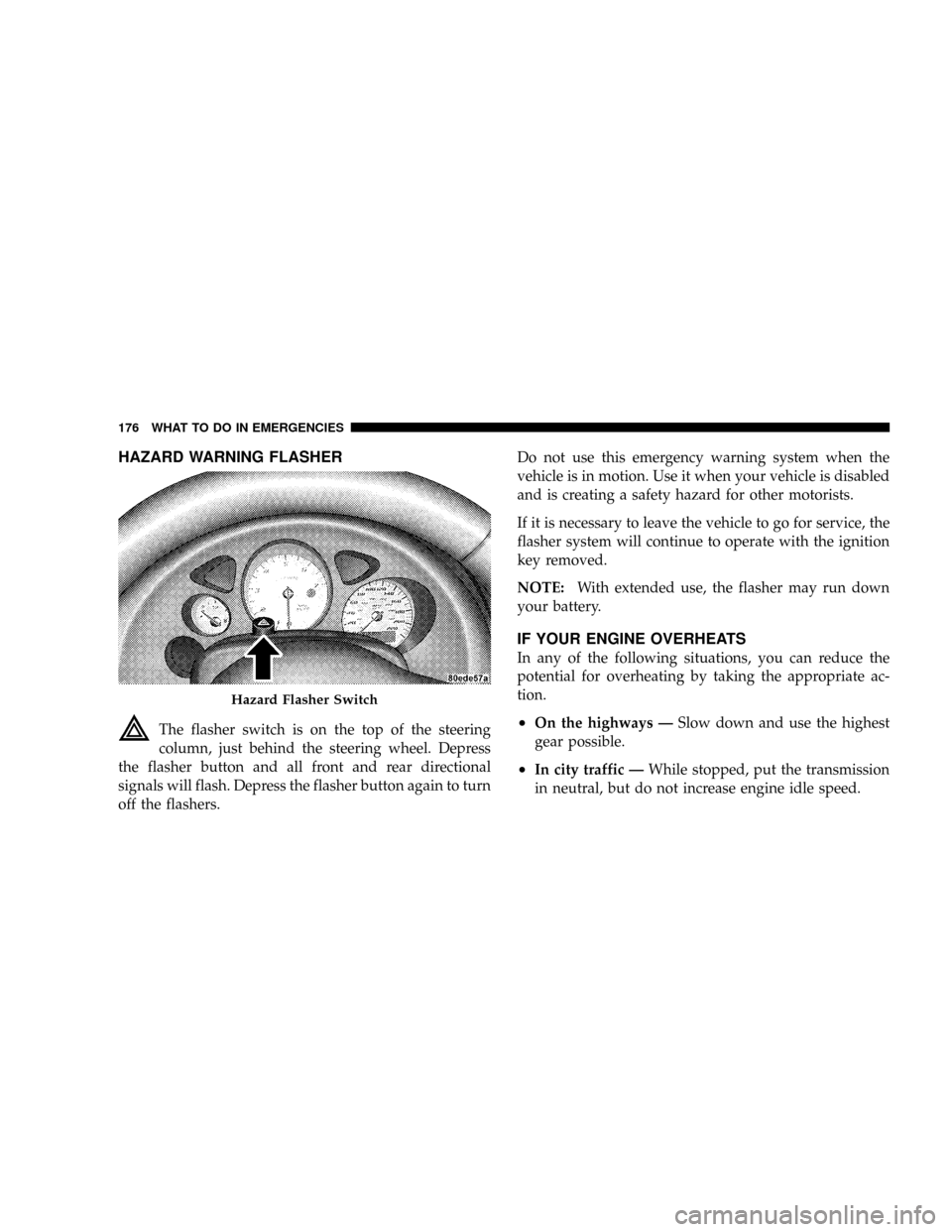
The flasher switch is on the top of the steering
column, just behind the steering wheel. Depress
the flasher button and all front and rear directional
signals will flash. Depress the flasher button again to turn
off the flashers.Do not use this emergency warning system when the
vehicle is in motion. Use it when your vehicle is disabled
and is creating a safety hazard for other motorists.
If it is necessary to leave the vehicle to go for service, the
flasher system will continue to operate with the ignition
key removed.
NOTE:With extended use, the flasher may run down
your battery.
IF YOUR ENGINE OVERHEATS
In any of the following situations, you can reduce the
potential for overheating by taking the appropriate ac-
tion.
²On the highways ÐSlow down and use the highest
gear possible.
²In city traffic ÐWhile stopped, put the transmission
in neutral, but do not increase engine idle speed.
Hazard Flasher Switch
176 WHAT TO DO IN EMERGENCIES
Page 182 of 303
6. Air Pump Hose (Black)
7. Sealant Hose (Clear with Yellow Cap)
Using the Mode Select Knob & Hoses
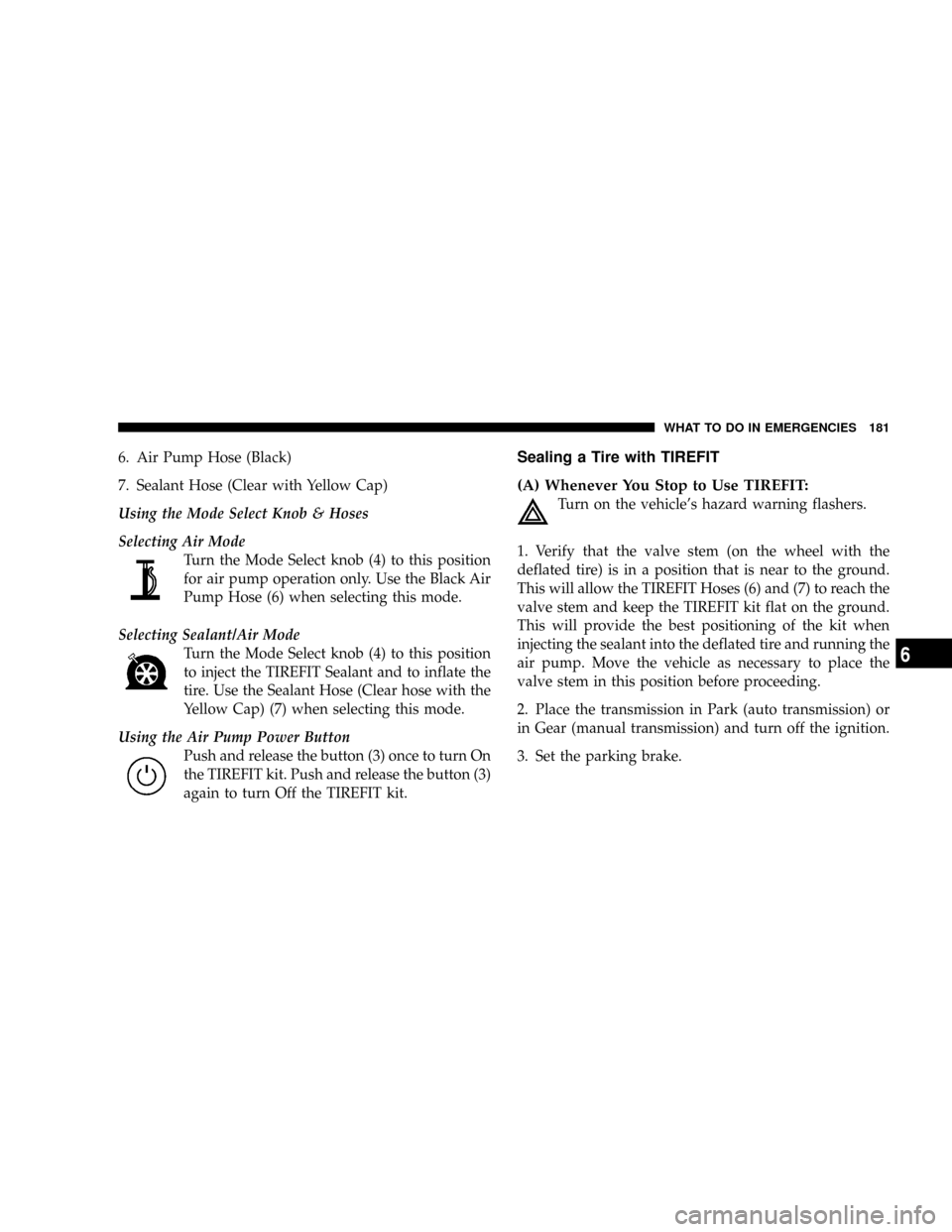
Selecting Air Mode
Turn the Mode Select knob (4) to this position
for air pump operation only. Use the Black Air
Pump Hose (6) when selecting this mode.
Selecting Sealant/Air Mode
Turn the Mode Select knob (4) to this position
to inject the TIREFIT Sealant and to inflate the
tire. Use the Sealant Hose (Clear hose with the
Yellow Cap) (7) when selecting this mode.
Using the Air Pump Power Button
Push and release the button (3) once to turn On
the TIREFIT kit. Push and release the button (3)
again to turn Off the TIREFIT kit.Sealing a Tire with TIREFIT
(A) Whenever You Stop to Use TIREFIT:
Turn on the vehicle's hazard warning flashers.
1. Verify that the valve stem (on the wheel with the
deflated tire) is in a position that is near to the ground.
This will allow the TIREFIT Hoses (6) and (7) to reach the
valve stem and keep the TIREFIT kit flat on the ground.
This will provide the best positioning of the kit when
injecting the sealant into the deflated tire and running the
air pump. Move the vehicle as necessary to place the
valve stem in this position before proceeding.
2. Place the transmission in Park (auto transmission) or
in Gear (manual transmission) and turn off the ignition.
3. Set the parking brake.
WHAT TO DO IN EMERGENCIES 181
6
Page 187 of 303
JUMP-STARTING PROCEDURES
WARNING!
²Take care to avoid the radiator cooling fans whenever the hood
is raised. They can start anytime the ignition switch is on. You
can be hurt by the fans.
²Take care to avoid the accessory drive whenever the hood is
raised. You can be hurt by the moving components.
²Do not attempt to push or tow your vehicle to get it started.
Unburned fuel could enter the catalytic converter and once the
engine has started, ignite and damage the converter and
vehicle. If the vehicle has a discharged battery, booster cables
may be used to obtain a start from a booster battery or the
battery in another vehicle. This type of start can be dangerous
if done improperly, so follow this procedure carefully.
²Battery fluid is a corrosive acid solution; do not allow battery
fluid to contact eyes, skin, or clothing. Don't lean over battery
when attaching clamps or allow the clamps to touch each
other. If acid splashes in eyes or on skin, flush contaminated
area immediately with large quantities of water.
²A battery generates hydrogen gas, which is flammable and
explosive. Keep flame or spark away from the vent holes.
²Do not use a booster battery or any other booster source with
an output that exceeds 12 volts.
NOTE:The battery is located underneath an access
panel inside the rear compartment on the left side of the
vehicle. A remote battery terminal is located in the engine
compartment for jump-starting.
1. Wear eye protection and remove any metal jewelry
such as watchbands or bracelets that might make an
inadvertent electrical contact.
2. When boost is provided by a battery in another
vehicle, park that vehicle within booster cable reach, but
without allowing the vehicles touch one another.
3. Set the parking brake, place the transmission in neu-
tral, and turn the ignition OFF on both vehicles.
4. Turn off the heater, radio, and all unnecessary electri-
cal loads.
186 WHAT TO DO IN EMERGENCIES
Page 192 of 303
MAINTAINING YOUR VEHICLE
CONTENTS
m8.4L Engine Compartment................194
mOnboard Diagnostic System (OBD II).........195
mEmissions Inspection And Maintenance
Programs............................196
mReplacement Parts......................197
mDealer Service.........................198
mMaintenance Procedures..................198
NEngine Oil..........................198
NEngine Oil Filter......................201NDrive Belts Ð Check Condition And Tension . . 202
NSpark Plugs.........................203
NEngine Air Cleaner Filter................203
NFuel Filter..........................204
NCatalytic Converter....................204
NIgnition Wiring System And Ignition
Timing.............................205
NCrankcase Emission Control System........206
NMaintenance-Free Battery................206
7
Page 197 of 303
EMISSIONS INSPECTION AND MAINTENANCE
PROGRAMS
In some localities, it may be a legal requirement to pass
an inspection of your vehicle's emissions control system.
Failure to pass could prevent vehicle registration.
For states, which have an I/M (Inspection and
Maintenance) requirement, this check verifies the
following: the MIL (Malfunction Indicator Light)
is functioning and is not on when the engine is running,
and that the OBD (On Board Diagnostic) system is ready
for testing.
Normally, the OBD system will be ready. The OBD
system maynotbe ready if your vehicle was recently
serviced, if you recently had a dead battery, or a battery
replacement. If the OBD system should be determined
not ready for the I/M test, your vehicle may fail the test.Your vehicle has a simple ignition key-actuated test,
which you can use prior to going to the test station. To
check if your vehicle's OBD system is ready, you must do
the following:
1. Insert your ignition key into the ignition switch.
2. Turn the ignition to the ON position, but do not crank
or start the engine.
3. If you crank or start the engine, you will have to start
this test over.
4. As soon as you turn your key to the ON position, you
will see your MIL symbol come on as part of a normal
bulb check.
196 MAINTAINING YOUR VEHICLE
Page 198 of 303
5. Approximately 15 seconds later, one of two things will
happen:
a. The MIL will flash for about 10 seconds and then
return to being fully illuminated until you turn off the
ignition key or start the engine. This means that your
vehicle's OBD system isnot readyand you shouldnot
proceed to the I/M station.
b. The MIL will not flash at all and will remain fully
illuminated until you turn OFF the ignition key or start
the engine. This means that your vehicle's OBD system
isreadyand you can proceed to the I/M station.
If your OBD system isnot ready,you should see your
authorized dealer or repair facility. If your vehicle was
recently serviced or had a battery failure or replacement,
you may need to do nothing more than drive your
vehicle as you normally would in order for your OBD
system to update. A recheck with the above test routine
may then indicate that the system is now ready.Regardless of whether your vehicle's OBD system is
ready or not ready, if the MIL symbol is illuminated
during normal vehicle operation, you should have your
vehicle serviced before going to the I/M station. The I/M
station can fail your vehicle because the MIL symbol is on
with the engine running.
REPLACEMENT PARTS
Use of genuine Mopartparts for normal/scheduled
maintenance and repairs is highly recommended to en-
sure the designed performance. Damage or failures
caused by the use of non-Mopartparts for maintenance
and repairs will not be covered by the manufacturer's
warranty.
MAINTAINING YOUR VEHICLE 197
7
Page 206 of 303
WARNING!
A hot exhaust system can start a fire if you park over
materials that can burn. Such materials might be
grass or leaves coming in contact with your exhaust
system. Do not park or operate your vehicle in areas
where your exhaust system can contact anything that
can burn.
In unusual situations involving grossly malfunctioning
engine operation, a scorching odor may indicate severe
and abnormal catalyst overheating. If this should occur,
safely bring the vehicle to a complete stop, shut the
engine off, and allow the vehicle to cool. Thereafter,
obtain service, including a tune-up to manufacturer's
specifications immediately.
To minimize the possibility of catalytic converter damage:
²Do not shut off the engine or interrupt the ignition
when the transmission is in gear and the vehicle is in
motion.
²Do not try to start the engine by pushing or towing the
vehicle.
²Do not idle the engine with any spark plug wires
disconnected or removed, such as when diagnostic
testing, or for prolonged periods during very rough
idling or malfunctioning operating conditions.
Ignition Wiring System and Ignition Timing
The ignition cables should be kept clean and the termi-
nals fully seated. Do not remove the nipple assemblies
from the coil towers. Cracked, damaged, or faulty cables
should be replaced. See your authorized dealer for ser-
vice.
MAINTAINING YOUR VEHICLE 205
7
Page 207 of 303
NOTE:
²Because of the plastic body shell on your vehicle,
ignition cables should be replaced with the specially
designed RFI cables available at your dealer.
²The ignition timing cannot be set on this engine.
Crankcase Emission Control System
Proper operation of this system depends on freedom
from plugging due to deposits. As vehicle mileage builds
up, the Crankcase Ventilation Valve orifice may accumu-
late deposits. If a valve is not working properly, it should
be replaced with a new orifice. DO NOT ATTEMPT TO
CLEAN THE OLD ORIFICE!
Check the ventilation hose for indication of damage or
plugging deposits and replace if necessary. See your
authorized dealer for service.
Maintenance-Free Battery
The top of the MAINTENANCE-FREE battery is perma-
nently sealed. You will never have to add water, nor is
periodic maintenance required.
The battery is located underneath an access panel inside
the rear compartment on the left side of the vehicle. A
remote battery terminal is located in the engine compart-
ment for jump-starting.
To gain access to the battery, remove the floor portion of
the rear compartment carpet.
206 MAINTAINING YOUR VEHICLE