tow DODGE VIPER 2015 VX / 3.G User Guide
[x] Cancel search | Manufacturer: DODGE, Model Year: 2015, Model line: VIPER, Model: DODGE VIPER 2015 VX / 3.GPages: 400, PDF Size: 9.59 MB
Page 223 of 400
!FUEL REQUIREMENTS..................277
▫8.4L Engine..........................277
▫Reformulated Gasoline.................278
▫Gasoline/Oxygenate Blends..............278
▫E-85 Usage In Non-Flex Fuel Vehicles.......279
▫MMT In Gasoline.....................279
▫Materials Added To Fuel................280
▫Fuel System Cautions...................280
▫Carbon Monoxide Warnings.............281
!ADDING FUEL........................282
▫Emergency Fuel Filler Door Release.........284
!TRAILER TOWING.....................286
!RECREATIONAL TOWING (BEHIND
MOTORHOME, ETC.)...................287
▫Towing This Vehicle Behind Another Vehicle
(Flat Towing With All Four Wheels On The
Ground)...........................287
!GROUND CLEARANCE.................288
5
STARTING AND OPERATING 221
Page 226 of 400
If Engine Fails To Start
CAUTION!
To prevent damage to the starter, do not crank the
engine for more than 15 seconds at a time. Wait 10 to
15 seconds before trying again.
WARNING!
•Never pour fuel or other flammable liquids into
the throttle body air inlet opening in an attempt to
start the vehicle. This could result in a flash fire
causing serious personal injury.
(Continued)
WARNING!(Continued)
•Do not attempt to push or tow your vehicle to get it
started. Unburned fuel could enter the catalytic
converter and once the engine has started, ignite
and damage the converter and vehicle. If the ve-
hicle has a discharged battery, booster cables may
be used to obtain a start from a booster battery or
the battery in another vehicle. This type of start can
be dangerous if done improperly, so follow this
procedure carefully. Refer to “Jump Starting” in
“What To Do In Emergencies” for further informa-
tion.
If the engine is flooded, it may start to run, but not have
enough power to continue running when the ENGINE
START button is released. If this occurs, continue crank-
ing up to 15 seconds with the accelerator pedal pushed
224 STARTING AND OPERATING
Page 228 of 400
Ensure the transmission is in first gear when moving
forward from a standing position.
CAUTION!
Failure to start out in first gear when moving forward
from a starting position may result in damage to the
clutch.
Shifting
Fully press the clutch pedal and lift your foot off the
accelerator pedal before shifting gears. As you release the
clutch pedal, lightly press the accelerator pedal. Damage
to the transmission or clutch may occur if you do not
fully press the clutch pedal and lift off of the accelerator
pedal when shifting.
The six-speed manual transmission has a spring that
centers the shift lever near third and fourth gear. This
spring helps you know which gear you are in when you
are shifting. Be careful when shifting from first to second
or downshifting from sixth to fifth.
The spring will try to pull the shift lever toward third and
fourth gear. Make sure you move the shift lever into
second or fifth gear. If you let the shift lever move in the
direction of the pulling, you may end shifting from first
to fourth or from sixth to third gear.
You will find it easier to use only the lower gears for most
city driving. For steady highway driving with light
accelerations, sixth gear is recommended.
Never drive with your foot resting on the clutch pedal, or
try to hold the vehicle on a hill with the clutch pedal
partially engaged. This will cause abnormal wear on the
clutch.
Never shift into REVERSE until the vehicle has come to a
complete stop.
226 STARTING AND OPERATING
Page 239 of 400
PARKING BRAKE
The parking brake should always be applied when the
driver is not in the vehicle.
WARNING!
Before leaving the vehicle, make sure you fully apply
the parking brake and shift the transmission into
REVERSE. Failure to do so may cause the vehicle to
roll and cause damage or injury.
As an added precaution when parking the vehicle, turn
the front wheels toward the curb on a downhill grade
and away from the curb on an uphill grade.
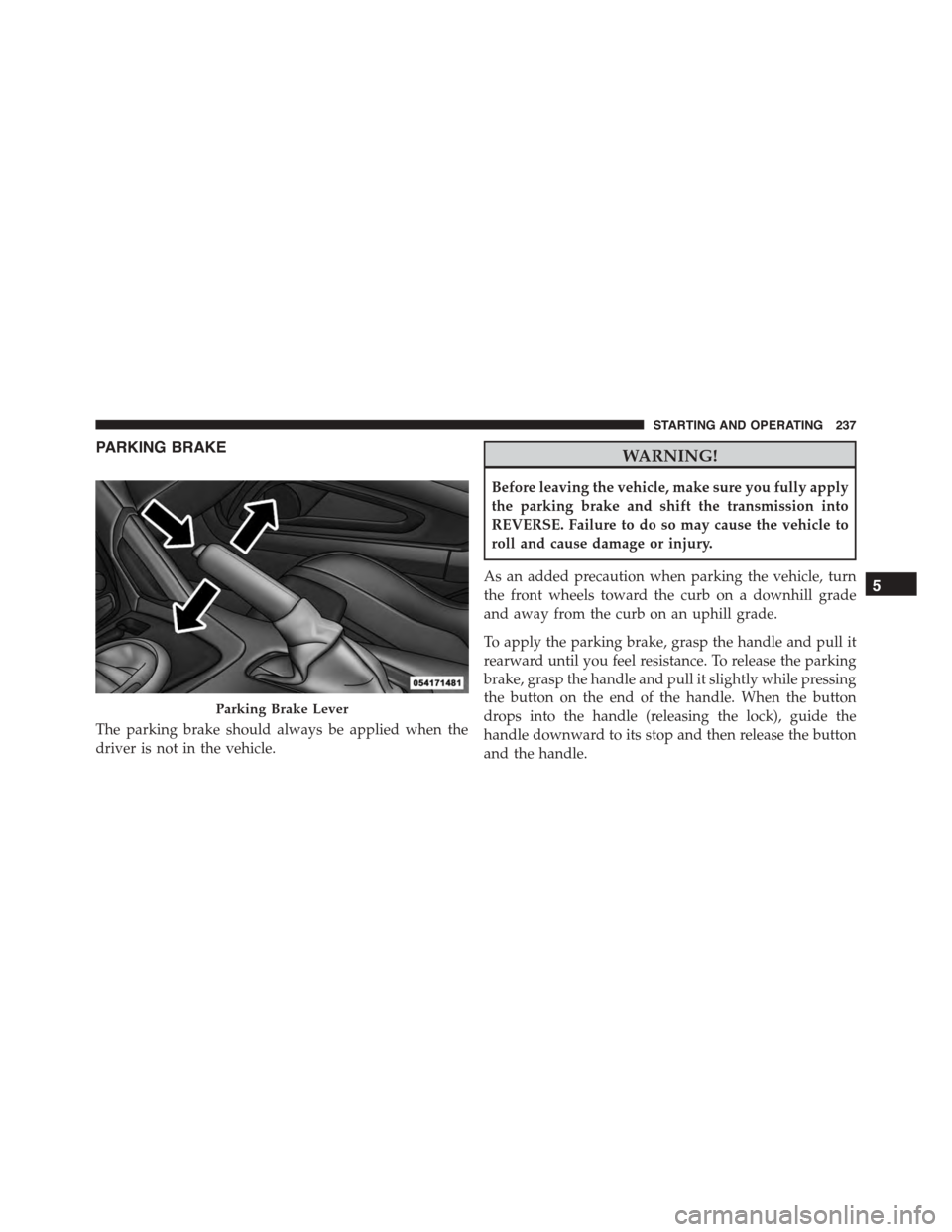
To apply the parking brake, grasp the handle and pull it
rearward until you feel resistance. To release the parking
brake, grasp the handle and pull it slightly while pressing
the button on the end of the handle. When the button
drops into the handle (releasing the lock), guide the
handle downward to its stop and then release the button
and the handle.
Parking Brake Lever
5
STARTING AND OPERATING 237
Page 257 of 400
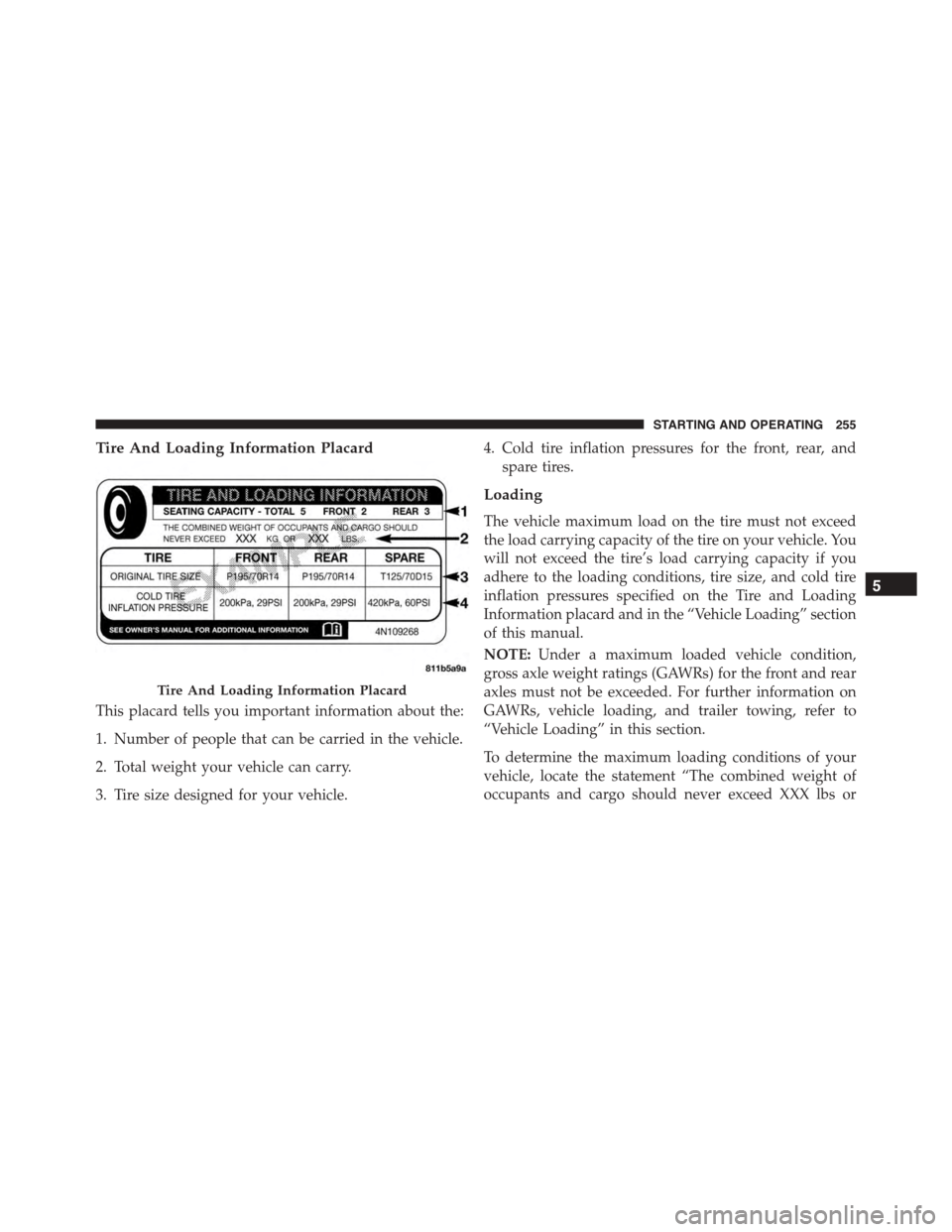
Tire And Loading Information Placard
This placard tells you important information about the:
1. Number of people that can be carried in the vehicle.
2. Total weight your vehicle can carry.
3. Tire size designed for your vehicle.
4. Cold tire inflation pressures for the front, rear, and
spare tires.
Loading
The vehicle maximum load on the tire must not exceed
the load carrying capacity of the tire on your vehicle. You
will not exceed the tire’s load carrying capacity if you
adhere to the loading conditions, tire size, and cold tire
inflation pressures specified on the Tire and Loading
Information placard and in the “Vehicle Loading” section
of this manual.
NOTE:Under a maximum loaded vehicle condition,
gross axle weight ratings (GAWRs) for the front and rear
axles must not be exceeded. For further information on
GAWRs, vehicle loading, and trailer towing, refer to
“Vehicle Loading” in this section.
To determine the maximum loading conditions of your
vehicle, locate the statement “The combined weight of
occupants and cargo should never exceed XXX lbs or
Tire And Loading Information Placard
5
STARTING AND OPERATING 255
Page 258 of 400
XXX kg” on the Tire and Loading Information placard.
The combined weight of occupants, cargo/luggage and
trailer tongue weight (if applicable) should never exceed
the weight referenced here.
Steps For Determining Correct Load Limit
1. Locate the statement “The combined weight of occu-
pants and cargo should never exceed XXX lbs or
XXX kg” on your vehicle’s placard.
2. Determine the combined weight of the driver and
passengers that will be riding in your vehicle.
3. Subtract the combined weight of the driver and pas-
sengers from XXX lbs or XXX kg.
4. The resulting figure equals the available amount of
cargo and luggage load capacity. For example, if
“XXX” amount equals 1,400 lbs (635 kg) and there will
be five 150 lb (68 kg) passengers in your vehicle, the
amount of available cargo and luggage load capacity
is 650 lbs (295 kg) (since 5 x 150 lbs (68 kg) = 750 lbs
(340 kg), and 1400 lbs (635 kg) – 750 lbs (340 kg) =
650 lbs [295 kg]).
5. Determine the combined weight of luggage and cargo
being loaded on the vehicle. That weight may not
safely exceed the available cargo and luggage load
capacity calculated in step 4.
NOTE:
•If your vehicle will be towing a trailer, load from your
trailer will be transferred to your vehicle. The follow-
ing table shows examples on how to calculate total
load, cargo/luggage, and towing capacities of your
vehicle with varying seating configurations and num-
ber and size of occupants. This table is for illustration
purposes only and may not be accurate for the seating
and load carry capacity of your vehicle.
•For the following example, the combined weight of
occupants and cargo should never exceed 865 lbs
(392 kg).
256 STARTING AND OPERATING
Page 266 of 400
While studded tires improve performance on ice, skid
and traction capability on wet or dry surfaces may be
poorer than that of non-studded tires. Some states pro-
hibit studded tires; therefore, local laws should be
checked before using these tire types.
Run Flat Tires — If Equipped
Run Flat tires allow you the capability to drive 50 miles
(80 km) at 50 mph (80 km/h) after a rapid loss of inflation
pressure. This rapid loss of inflation is referred to as the
Run Flat mode. A Run Flat mode occurs when the tire
inflation pressure is of/or below 14 psi (96 kPa). Once a
Run Flat tire reaches the run flat mode it has limited
driving capabilities and needs to be replaced immedi-
ately. A Run Flat tire is not repairable.
It is not recommended driving a vehicle loaded at full
capacity or to tow a trailer while a tire is in the run flat
mode.
See the tire pressure monitoring section for more infor-
mation.
Spare Tires — If Equipped
NOTE:For vehicles equipped with Tire Service Kit
instead of a spare tire, please refer to “Tire Service Kit” in
“What To Do In Emergencies” for further information.
CAUTION!
Because of the reduced ground clearance, do not take
your vehicle through an automatic car wash with a
compact or limited-use temporary spare installed.
Damage to the vehicle may result.
Spare Tire Matching Original Equipped Tire And
Wheel — If Equipped
Your vehicle may be equipped with a spare tire and
wheel equivalent in look and function to the original
264 STARTING AND OPERATING
Page 288 of 400
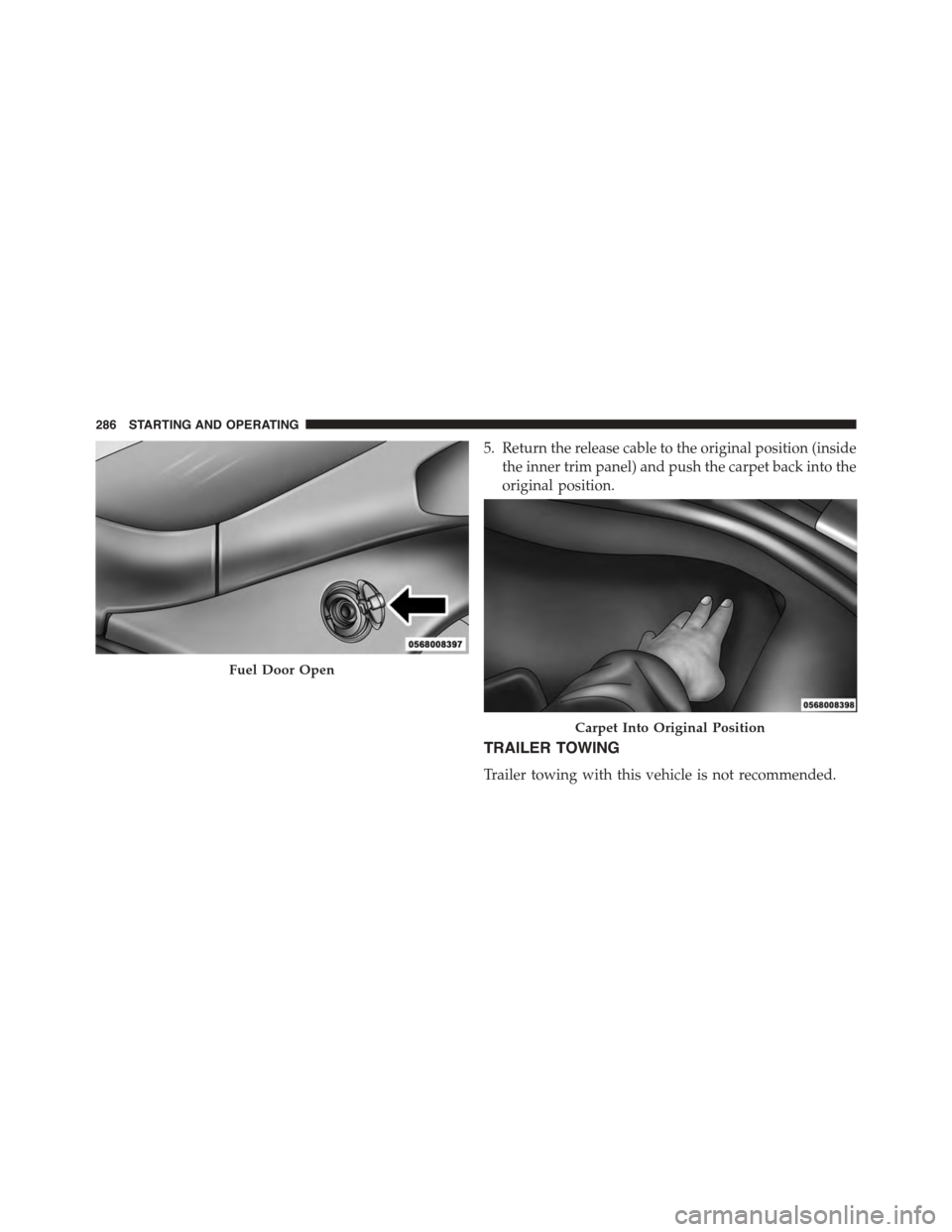
5. Return the release cable to the original position (inside
the inner trim panel) and push the carpet back into the
original position.
TRAILER TOWING
Trailer towing with this vehicle is not recommended.
Fuel Door Open
Carpet Into Original Position
286 STARTING AND OPERATING
Page 289 of 400
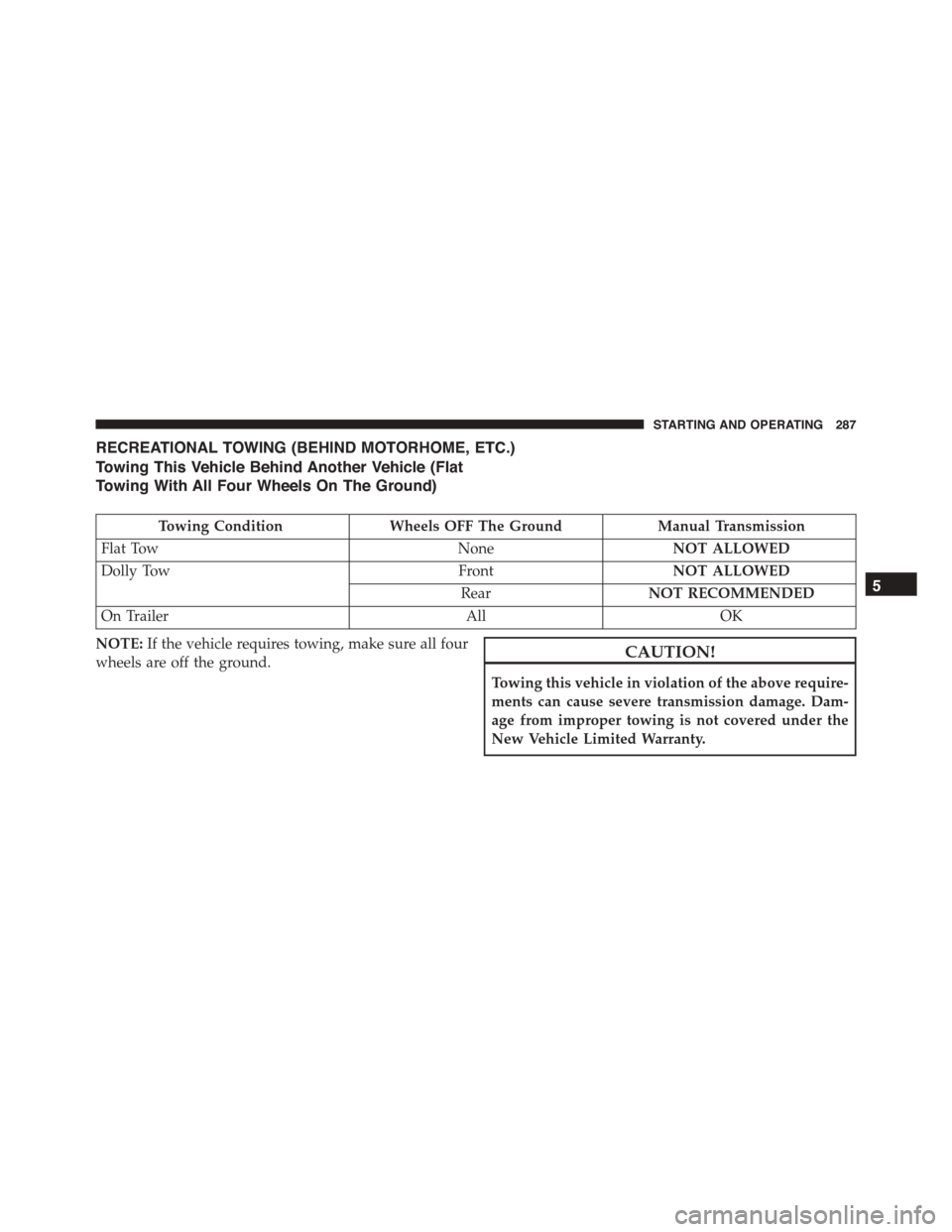
RECREATIONAL TOWING (BEHIND MOTORHOME, ETC.)
Towing This Vehicle Behind Another Vehicle (Flat
Towing With All Four Wheels On The Ground)
Towing ConditionWheels OFF The GroundManual Transmission
Flat TowNoneNOT ALLOWED
Dolly TowFrontNOT ALLOWED
RearNOT RECOMMENDED
On TrailerAllOK
NOTE:If the vehicle requires towing, make sure all four
wheels are off the ground.CAUTION!
Towing this vehicle in violation of the above require-
ments can cause severe transmission damage. Dam-
age from improper towing is not covered under the
New Vehicle Limited Warranty.
5
STARTING AND OPERATING 287
Page 291 of 400
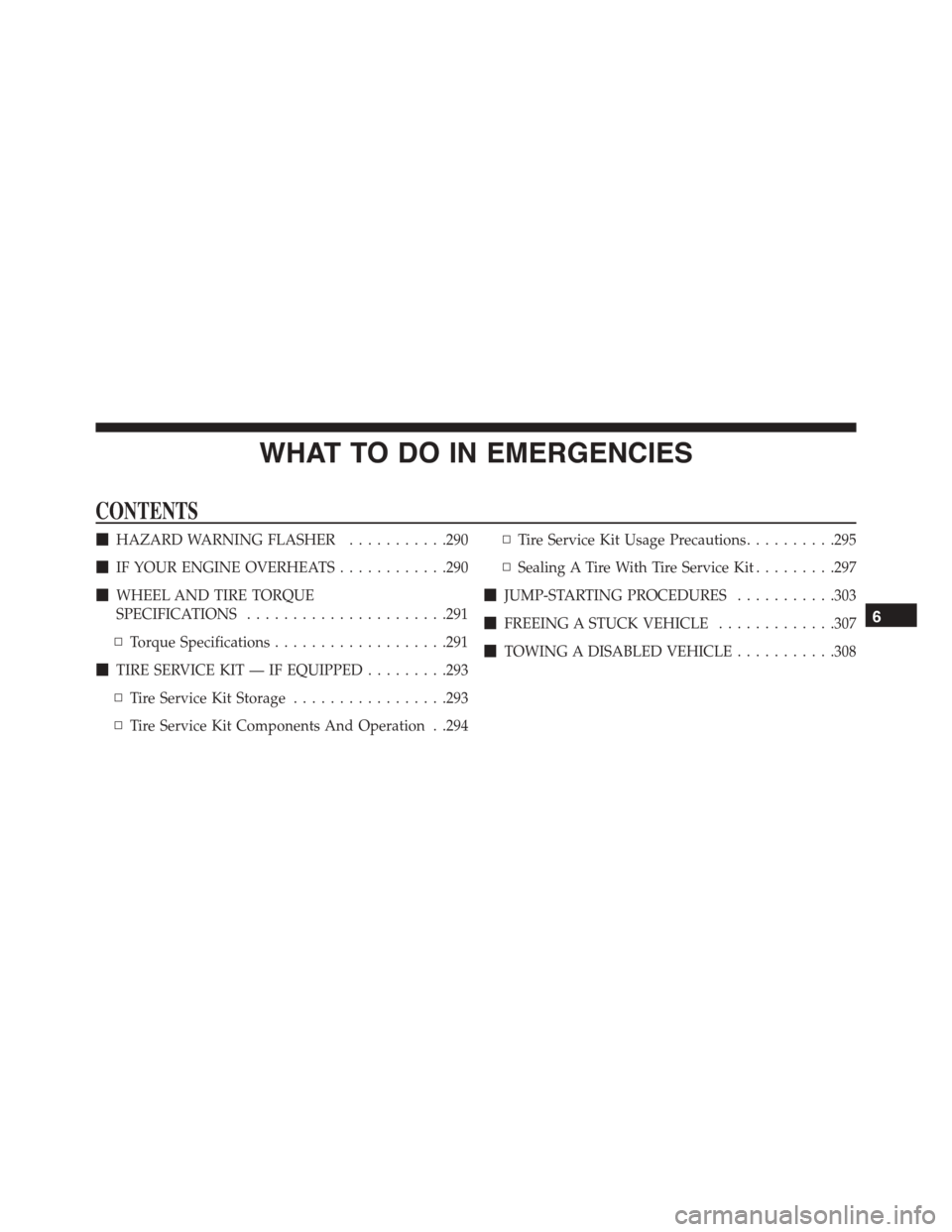
WHAT TO DO IN EMERGENCIES
CONTENTS
!HAZARD WARNING FLASHER...........290
!IF YOUR ENGINE OVERHEATS............290
!WHEEL AND TIRE TORQUE
SPECIFICATIONS......................291
▫Torque Specifications...................291
!TIRE SERVICE KIT — IF EQUIPPED.........293
▫Tire Service Kit Storage.................293
▫Tire Service Kit Components And Operation . .294
▫Tire Service Kit Usage Precautions..........295
▫Sealing A Tire With Tire Service Kit.........297
!JUMP-STARTING PROCEDURES...........303
!FREEING A STUCK VEHICLE.............307
!TOWING A DISABLED VEHICLE...........308
6