warning DODGE VIPER 2015 VX / 3.G Owner's Manual
[x] Cancel search | Manufacturer: DODGE, Model Year: 2015, Model line: VIPER, Model: DODGE VIPER 2015 VX / 3.GPages: 400, PDF Size: 9.59 MB
Page 48 of 400
WARNING!
•Being too close to the steering wheel or instrument
panel during Advanced Front Air Bag deployment
could cause serious injury, including death. Air
bags need room to inflate. Sit back, comfortably
extending your arms to reach the steering wheel or
instrument panel.
•Never place a rear-facing child restraint in front of
an air bag. A deploying Passenger Advanced Front
Air Bag can cause death or serious injury to a child
12 years or younger, including a child in a rear-
facing child restraint.
•Only use a rear-facing child restraint in a vehicle
with a rear seat.
Advanced Front Air Bag Features
The Advanced Front Air Bag system has multistage
driver and front passenger air bags. This system provides
output appropriate to the severity and type of collision as
determined by the Occupant Restraint Controller (ORC),
which may receive information from the front impact
sensors or other system components.
The first stage inflator is triggered immediately during an
impact that requires air bag deployment. A low energy
output is used in less severe collisions. A higher energy
output is used for more severe collisions.
This vehicle may be equipped with driver and/or front
passenger seat track position sensors that may adjust the
inflation rate of the Advanced Front Air Bags based upon
seat position.
This vehicle may be equipped with a driver and/or front
passenger seat belt buckle switch that detects whether
the driver or front passenger seat belt is buckled. The seat
belt buckle switch may adjust the inflation rate of the
Advanced Front Air Bags.
46 THINGS TO KNOW BEFORE STARTING YOUR VEHICLE
Page 49 of 400
Advanced Air Bag Features
This vehicle has an Occupant Classification System
(“OCS”) in the right front passenger seat. The OCS is
designed to deactivate the front Passenger Advanced
Front Air Bag for an unoccupied seat and for occupants
classified in a category other than a properly seated
adult. This could be a child, teenager, or even an adult.
The Passenger Air Bag Disable (“PAD”) Indicator Light
(an amber light located in the center of the instrument
panel) tells the driver and front passenger when the
Passenger Advanced Front Air Bag is deactivated. The
PAD Indicator Light illuminates the words “PASSENGER
AIR BAG OFF” to show that the Passenger Advanced
Front Air Bag will not inflate during a collision.
WARNING!
•No objects should be placed over or near the air
bag on the instrument panel or steering wheel,
because any such objects could cause harm if the
vehicle is in a collision severe enough to cause the
air bags to inflate.
•Do not put anything on or around the air bag
covers or attempt to open them manually. You may
damage the air bags and you could be injured
because the air bags may no longer be functional.
The protective covers for the air bag cushions are
designed to open only when the air bags are
inflating.
(Continued)
2
THINGS TO KNOW BEFORE STARTING YOUR VEHICLE 47
Page 50 of 400
WARNING!(Continued)
•Relying on the air bags alone could lead to more
severe injuries in a collision. The air bags work
with your seat belt to restrain you properly. In
some collisions, air bags won’t deploy at all. Al-
ways wear your seat belts even though you have air
bags.
Advanced Front Air Bag Operation
Advanced Front Air Bags are designed to provide addi-
tional protection by supplementing the seat belts. Ad-
vanced Front Air Bags are not expected to reduce the risk
of injury in rear, side, or rollover collisions. The Ad-
vanced Front Air Bags will not deploy in all frontal
collisions, including some that may produce substantial
vehicle damage — for example, some pole collisions,
truck underrides, and angle offset collisions.
On the other hand, depending on the type and location of
impact, Advanced Front Air Bags may deploy in crashes
with little vehicle front-end damage but that produce a
severe initial deceleration.
Because air bag sensors measure vehicle deceleration
over time, vehicle speed and damage by themselves are
not good indicators of whether or not an air bag should
have deployed.
Seat belts are necessary for your protection in all colli-
sions, and also are needed to help keep you in position,
away from an inflating air bag.
When the ORC detects a collision requiring the Ad-
vanced Front Air Bags, it signals the inflator units. A large
quantity of non-toxic gas is generated to inflate the
Advanced Front Air Bags.
The steering wheel hub trim cover and the upper right
side of the instrument panel separate and fold out of the
48 THINGS TO KNOW BEFORE STARTING YOUR VEHICLE
Page 51 of 400
way as the air bags inflate to their full size. The Advanced
Front Air Bags fully inflate in less time than it takes to
blink your eyes. The air bags then quickly deflate while
helping to restrain the driver and front passenger.
Occupant Classification System (OCS) - Front
Passenger Seat
The OCS is part of a Federally regulated safety system for
this vehicle. It is designed to deactivate the front passen-
ger Advanced Front Air Bag for an unoccupied seat and
for occupants classified in a category other than a prop-
erly seated adult. This could be a child, teenager, or even
an adult.
WARNING!
•Never place a rear-facing child restraint in front of
an air bag. A deploying Passenger Advanced Front
Air Bag can cause death or serious injury to a child
12 years or younger, including a child in a rear-
facing child restraint.
•Only use a rear-facing child restraint in a vehicle
with a rear seat.
The Occupant Classification System (OCS) consists of the
following:
•Occupant Restraint Controller (ORC)
•Occupant Classification Module (OCM) located under-
neath the front passenger seat
•Bladder located beneath the passenger seat cushion
foam
2
THINGS TO KNOW BEFORE STARTING YOUR VEHICLE 49
Page 52 of 400
•Passenger Air Bag Disabled (PAD) Indicator Light – an
amber light located in the center of the instrument
panel
•Air Bag Warning Light
Occupant Classification Module (OCM)
The Occupant Classification Module (OCM) is located
underneath the front passenger seat. The OCM uses
input from the Bladder to determine the front passen-
ger ’s most probable classification. The OCM communi-
cates this information to the ORC. The ORC may deacti-
vate the Passenger Advanced Front Air Bag deployment
based on occupant classification.
Bladder
The Bladder is located beneath the passenger seat cush-
ion foam. The Bladder sends signals to the OCM for
classifying the occupant in the front passenger seat. Any
weight on the seat will be sensed by the Bladder. In order
for the OCS to operate as designed, it is important for the
front passenger to be seated properly and properly
wearing the seat belt. Properly seated passengers are:
•Sitting upright
•Facing forward
•Sitting in the center of the seat with their feet comfort-
ably on or near the floor
•Sitting with their back against the seat back and the
seat back in an upright position
50 THINGS TO KNOW BEFORE STARTING YOUR VEHICLE
Page 57 of 400

WARNING!
•If the PAD Indicator Light remains illuminated for
an adult passenger, have an authorized dealer ser-
vice the air bag system immediately. Failure to do
so may cause serious injury or death. If the PAD
Indicator Light is illuminated with the words
“PASSENGER AIR BAG OFF” the Passenger Ad-
vanced Front Air Bag will not inflate in the event of
a collision.
•Never place a rear facing infant seat in front of a
Passenger Advanced Front Air Bag. A deploying
passenger Advanced Front Air Bag can cause death
or serious injury to a child 12 years or younger,
including a child in a rear-facing child restraint.
•Only use a rear-facing child restraint in a vehicle
with a rear seat.
Lighter Weight Passengers (Including Small
Adults)
When a lighter weight passenger, including a small adult,
occupies the passenger seat, the Passenger Advanced
Front Air Bag may be deactivated. Therefore, the Passen-
ger Advanced Front Air Bag may or may not deploy for
a lighter weight passenger, including a small adult (de-
pending on size), who is seated in the front passenger
seat. This does not mean that the OCS is working
improperly.
The driver and passenger must always pay attention to
the Passenger Air Bag Disable (PAD) System. The PAD
Indicator Light tells you whether the Passenger Ad-
vanced Front Air Bag is activated or deactivated. If the
PAD Indicator Light is illuminated with the words “PAS-
SENGER AIR BAG OFF,” the Passenger Advanced Front
Air Bag may not inflate in the event of a collision. If the
2
THINGS TO KNOW BEFORE STARTING YOUR VEHICLE 55
Page 58 of 400
PAD Indicator Light is illuminated with the words “PAS-
SENGER AIR BAG OFF” when an adult is in the front
passenger seat, the front passenger must reposition his/
her body in the seat until the PAD Indicator Light goes
out. This means that the Passenger Advanced Front Air
Bag is activated. Failure to be properly seated in the
passenger seat may prevent the passenger air bag from
deploying.
WARNING!
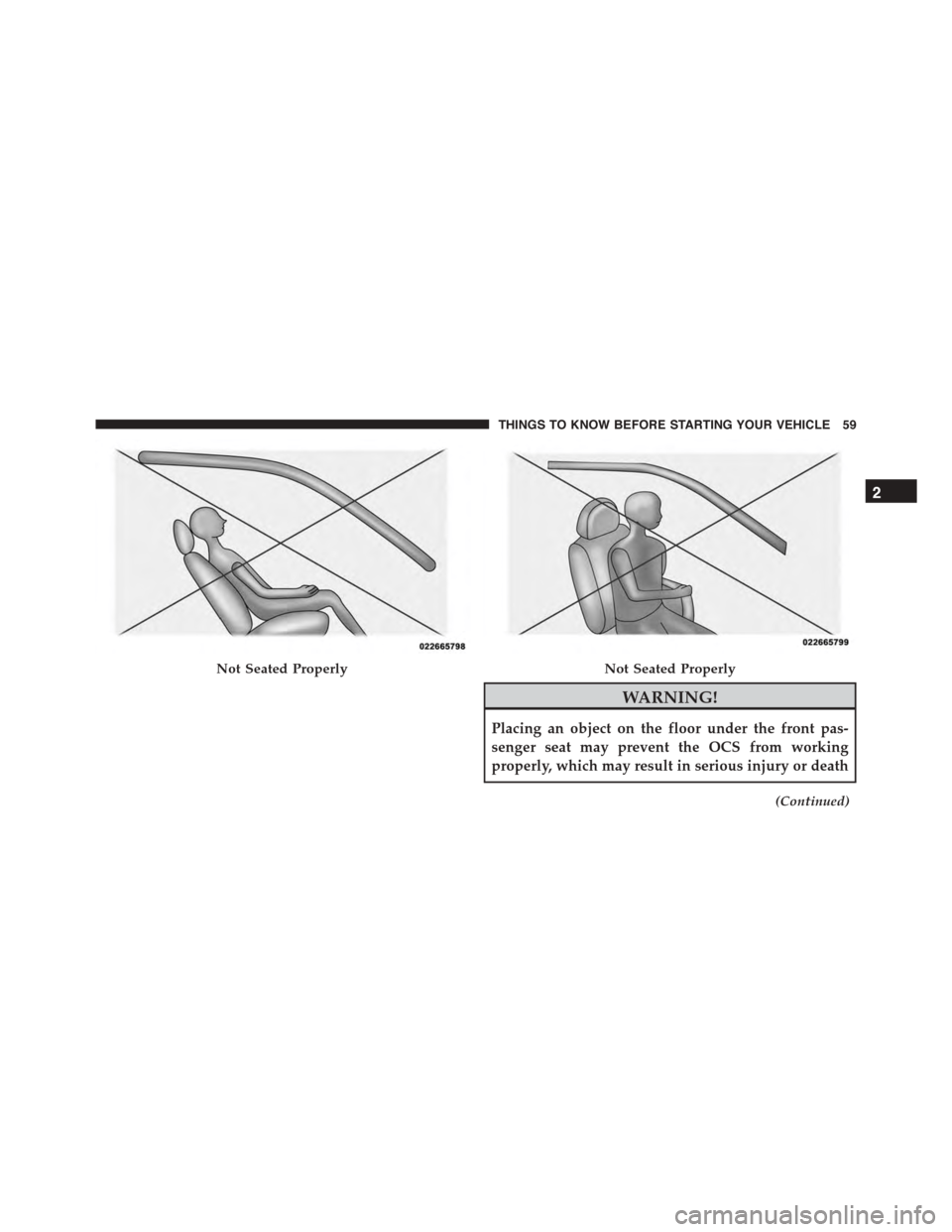
Occupants in the front passenger seat sitting improp-
erly may deactivate the Passenger Advanced Front
Air Bag. This may result in serious injury or death in
a collision. Always wear your seat belt and sit prop-
erly, with the seat back in an upright position, your
back against the seat back, sitting upright, facing
forward, in the center of the seat, with your feet
comfortably on or near the floor.
Do Not Decrease The Passenger ’s Total Seated
Weight On The Passenger Seat
The front passenger ’s seated weight must be properly
positioned on the front passenger seat. Failure to do so
may result in serious injury or death. The OCS deter-
mines the most probable classification of the occupant
that it detects. The OCS bladder will detect the front
passenger ’s decreased seated weight, which may result
in deactivation of the Passenger Advanced Front Air Bag
in a collision and serious injury or death may result. This
does not mean that the OCS is working improperly.
Decreasing the front passenger ’s seated weight on the
front passenger seat may result in deactivation of the
Passenger Advanced Front Air Bag. Examples of im-
proper front passenger seating include:
•The front passenger ’s weight is transferred to another
part of the vehicle (like the door, arm rest or instru-
ment panel)
56 THINGS TO KNOW BEFORE STARTING YOUR VEHICLE
Page 61 of 400
WARNING!
Placing an object on the floor under the front pas-
senger seat may prevent the OCS from working
properly, which may result in serious injury or death
(Continued)
Not Seated ProperlyNot Seated Properly
2
THINGS TO KNOW BEFORE STARTING YOUR VEHICLE 59
Page 62 of 400
WARNING!(Continued)
in a collision. Do not place any objects on the floor
under the front passenger seat.
The Air Bag Warning Lightin the instrument panel
will turn on whenever the OCS is unable to classify the
front passenger seat status will illuminate whenever
the OCS is unable to classify the front passenger seat
status or when there is a fault present in the OCS
WARNING!
•Ignoring the Air Bag Warning Light in your instru-
ment panel could mean you won’t have the air bags
to protect you in a collision. If the light does not
come on as a bulb check when the ignition is first
placed in the on position, and stays on after you
start the vehicle, or if it comes on as you drive, have
an authorized dealer service the air bag system
immediately.
•If there is a fault present in the OCS, both the PAD
Indicator Light and the Air Bag Warning Light will
illuminate to show that the Passenger Advanced
Front Air Bag is deactivated. Should this occur, the
Passenger Advanced Front Air Bag will remain
deactivated until the fault is cleared. This indicates
that you should take the vehicle to an authorized
dealer for service immediately.
60 THINGS TO KNOW BEFORE STARTING YOUR VEHICLE
Page 63 of 400
The passenger seat assembly contains critical OCS com-
ponents that may affect Passenger Advanced Front Air
Bag inflation. In order for the OCS to properly classify a
front seat passenger, the OCS components must function
as designed.
The following requirements must be strictly followed:
•Do not modify the front passenger seat assembly or
components in any way.
•Do not use prior or future model year seat covers or
cushions not designated by FCA US LLC for the
specific model being repaired. Always use the correct
seat cover and cushion specified for the vehicle.
•Do not replace the seat cover or cushion with an
aftermarket seat cover or cushion.
•Do not add a secondary seat cover or mat.
•At no time should any supplemental restraint system
(SRS) component or SRS related component or fastener
be modified or replaced with any part except those
which are approved by FCA US LLC.
If the seat, trim cover, or cushion needs service for any
reason, take the vehicle to your authorized dealer. Only
FCA US LLC approved seat accessories may be used.
WARNING!
Unapproved modifications or service procedures to
the passenger seat assembly, its related components,
seat cover or cushion may inadvertently change the
air bag deployment in case of a frontal collision. This
could result in death or serious injury to the front
passenger if the vehicle is involved in a collision. A
modified vehicle may not comply with required
Federal Motor Vehicle Safety Standards (FMVSS)
(Continued)
2
THINGS TO KNOW BEFORE STARTING YOUR VEHICLE 61