service DODGE VIPER 2015 VX / 3.G Repair Manual
[x] Cancel search | Manufacturer: DODGE, Model Year: 2015, Model line: VIPER, Model: DODGE VIPER 2015 VX / 3.GPages: 400, PDF Size: 9.59 MB
Page 335 of 400
WARNING!
Riding the brakes can lead to brake failure and
possibly an accident. Driving with your foot resting
or riding on the brake pedal can result in abnormally
high brake temperatures, excessive lining wear, and
possible brake damage. You would not have your full
braking capacity in an emergency.
Master Cylinder – Brake Fluid Level Check
Check the fluid level in the master cylinder immediately
if the brake system warning light indicates system fail-
ure.
Check the fluid level in the master cylinder when per-
forming underhood services.
Clean the top of the master cylinder area before removing
the cap. If necessary, add fluid to bring the fluid level up
to the requirements described on the brake fluid reser-
voir.
Overfilling of fluid is not recommended because it may
cause leaking in the system.
With disc brakes, fluid level can be expected to fall as the
brake pads wear. However, low fluid level may be caused
by a leak and a checkup may be needed.
Use only the manufacturer’s recommended brake fluid.
Refer to “Fluids, Lubricants, and Genuine Parts” in
“Maintaining Your Vehicle” for further information. Use
of a brake fluid that may have a lower initial boiling
point or unidentified as to specification, may result in
sudden brake failure during hard prolonged braking.
7
MAINTAINING YOUR VEHICLE 333
Page 337 of 400
brake fluid must be changed at the intervals specified in
the “Maintenance Schedule.” Refer to “Maintenance
Schedule” for further information. See your authorized
dealer for service.
Manual Transmission
Transmission Fluid Level Check
Check the fluid in the transmission when performing
other underbody services.
Check the fluid level by removing the fill plug located on
the left side of the transmission. The fluid level should be
approximately 1/4 in (6.4 mm) below the bottom of the
fill hole. Add fluid, if necessary, to maintain the proper
level. Refer to “Fluids, Lubricants, and Genuine Parts” in
“Maintaining Your Vehicle” for further information.
NOTE: DO NOToverfill transmission, damage can
occur.
CAUTION!
Using a transmission fluid other than the manufac-
turer’s recommended fluid may cause deterioration
in transmission shift quality and/or damage to the
transmission. Refer to “Fluids, Lubricants, and
Genuine Parts” in this section for fluid specifica-
tions.
Change Transmission Fluid
Refer to “Maintenance Schedule” for the proper mainte-
nance intervals. If contaminated with water, change the
fluid immediately. See your authorized dealer for service.
Hydraulic Clutch
Master Cylinder – Clutch Fluid Level Check
The clutch hydraulic system is fed by a segregated
volume of fluid within the brake system master cylinder
reservoir. In the event of leakage or wear, use only the
7
MAINTAINING YOUR VEHICLE 335
Page 338 of 400
manufacturer’s recommended brake fluid. Refer to “Flu-
ids, Lubricants, and Genuine Parts” in “Maintaining Your
Vehicle” for further information.
Rear Axle
Axle Lubricant Level Check
Check the exterior of the axle for evidence of gear oil
leakage every 12 months or 6,000 miles (10 000 km). This
check should be made with the vehicle level and on the
ground or raised on an axle and wheel type hoist. The
axle lubricant level should be between the bottom of the
filler plug and a point approximately 3/8 inch (9.5 mm)
below the filler plug. If adding axle lubricant, use only
the manufacturer’s recommended axle lubricant. Refer to
“Fluids, Lubricants, and Genuine Parts” in “Maintaining
Your Vehicle” for further information.
CAUTION!
Using axle fluid other than the manufactured recom-
mended fluid may cause a shudder/noise issue. refer
to “Fluids Lubes and Genuine Parts” in “ Maintain-
ing Your Vehicle” for further information.
Change Axle Lubricant
Refer to “Maintenance Schedule” for the proper mainte-
nance intervals. Change the lubricant immediately if
contaminated with water. See your authorized dealer for
service.
Appearance Care And Protection From Corrosion
Protection Of Body And Paint From Corrosion
Vehicle body care requirements vary according to geo-
graphic locations and usage. Chemicals that make roads
passable in snow and ice, and chemicals that are sprayed
on trees and road surfaces during other seasons, are
336 MAINTAINING YOUR VEHICLE
Page 344 of 400
CAUTION!
Use care when approaching parking blocks, tall
speed bumps and garage curbs. These surfaces can
damage your splitter.
Use caution when driving up to sloped surfaces or over
speed bumps. Approaching a speed bump or a slope at a
slight angle may improve your clearance.
CAUTION!
•Hard contact with steep ramps may cause damage
to your splitter.
•Replace rub strips when they are worn down to 1/8
inch (3 mm) on the front edge. This will avoid
damage to the carbon fiber panel.
FUSES
WARNING!
•When replacing a blown fuse, always use an ap-
propriate replacement fuse with the same amp
rating as the original fuse. Never replace a fuse
with another fuse of higher amp rating. Never
replace a blown fuse with metal wires or any other
material. Failure to use proper fuses may result in
serious personal injury, fire and/or property dam-
age.
•Before replacing a fuse, make sure that the ignition
is off and that all the other services are switched off
and/or disengaged.
•If the replaced fuse blows again, contact an autho-
rized dealer.
(Continued)
342 MAINTAINING YOUR VEHICLE
Page 354 of 400
•If the vehicle will be subjected to freezing tempera-
tures, either remove the battery and store it in a dry,
well ventilated area or connect a trickle charger (1.5
Amp) with automatic shutdown / overcharge protec-
tion to the battery. However, do not leave the trickle
charger hooked up to the battery without being
plugged in to a 110 Volt AC outlet, as this will result in
further drain on the vehicle’s battery. If the vehicle is
not going to be driven in the next three weeks, perform
the battery recharge procedure in the Service Manual.
Then, either disconnect the battery at the negative
terminal or use the “Battery Save Feature” to conserve
battery power. Refer to “Maintenance Procedures/
Battery Save Feature” in “Maintaining Your Vehicle”
for further information.
•Cover the vehicle whenever possible to prevent acci-
dental damage to the finish.
NOTE:Disconnecting the battery causes the engine con-
trol system to lose memory of some “learned” functions.
After reconnecting the battery, the engine may run rough
until the control module “relearns” these functions. Us-
ing the Battery Save Feature will prevent the engine
controller from loosing its memory.
CAUTION!
Use care when disconnecting the remote positive
cable. It is connected to the battery and can short out
to any metal on the vehicle. Always tape or wrap the
exposed cable end to prevent electrical shorts.
352 MAINTAINING YOUR VEHICLE
Page 355 of 400
Check the battery every four to six weeks to ensure that
the voltage is above 12.10 Volts. The voltage will drop
more rapidly in hot temperatures. If battery voltage
drops below 12.10 Volts, follow the battery recharge
procedure in the Service Manual.
NOTE:To help prevent the battery from discharging
during shorter periods of inactivity, perform the follow-
ing:
1. Make sure that the liftgate, hood, doors, windows are
completely closed.
2. Make sure that Remote Keyless Entry (RKE) transmit-
ter is operating and that the battery is good.
3. Make sure that the HOOD, LIFTGATE, and DOOR
switches are in adjustment. Perform the quick system
check, which follows:
Use the remote transmitter to set the alarm. If the alarm
SET light comes on and flashes, the system is operating
properly. If not, there is a problem with a switch or the
system. See your authorized dealer for service.
If you plan to store the vehicle longer than 30 days, we
recommend using Hibernation Mode to conserve bat-
tery power. Refer to “Hibernation Mode” in Mainte-
nance Procedures for further information.7
MAINTAINING YOUR VEHICLE 353
Page 356 of 400
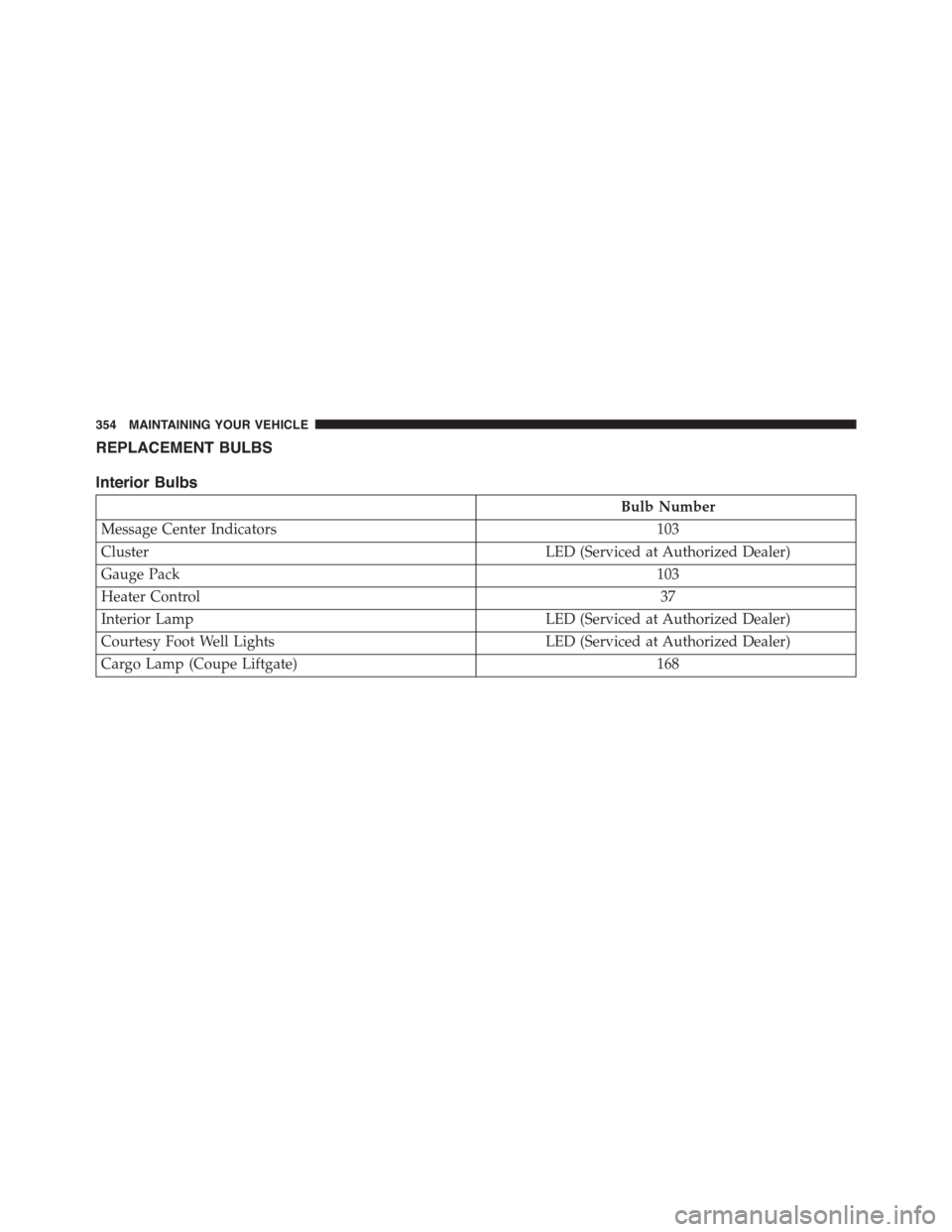
REPLACEMENT BULBS
Interior Bulbs
Bulb Number
Message Center Indicators103
ClusterLED (Serviced at Authorized Dealer)
Gauge Pack103
Heater Control37
Interior LampLED (Serviced at Authorized Dealer)
Courtesy Foot Well LightsLED (Serviced at Authorized Dealer)
Cargo Lamp (Coupe Liftgate)168
354 MAINTAINING YOUR VEHICLE
Page 357 of 400
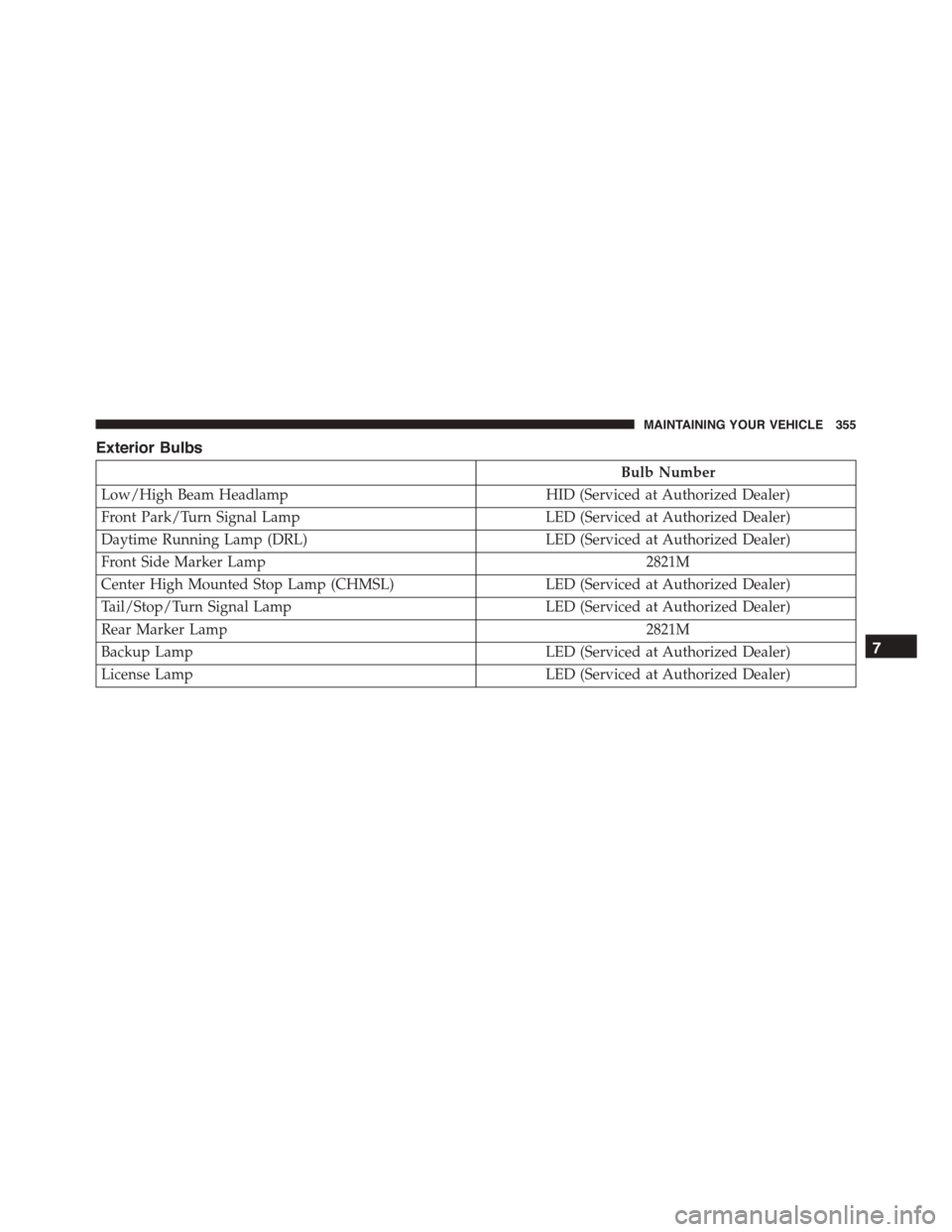
Exterior Bulbs
Bulb Number
Low/High Beam HeadlampHID (Serviced at Authorized Dealer)
Front Park/Turn Signal LampLED (Serviced at Authorized Dealer)
Daytime Running Lamp (DRL)LED (Serviced at Authorized Dealer)
Front Side Marker Lamp2821M
Center High Mounted Stop Lamp (CHMSL)LED (Serviced at Authorized Dealer)
Tail/Stop/Turn Signal LampLED (Serviced at Authorized Dealer)
Rear Marker Lamp2821M
Backup LampLED (Serviced at Authorized Dealer)
License LampLED (Serviced at Authorized Dealer)
7
MAINTAINING YOUR VEHICLE 355
Page 364 of 400
MAINTENANCE SCHEDULES
The Scheduled Maintenance services listed in this
manual must be done at the times or mileages specified
to protect your vehicle warranty and ensure the best
vehicle performance and reliability. More frequent main-
tenance may be needed for vehicles in severe operating
conditions, such as dusty areas and very short trip
driving. Inspection and service should also be done
anytime a malfunction is suspected.
NOTE: Under no circumstances should oil change in-
tervals exceed 6,000 miles (10 000 km) or six months,
whichever comes first.
CAUTION!
Failure to perform the required maintenance items
may result in damage to the vehicle.
At Each Stop For Fuel
•Check the engine oil level about five minutes after a
fully warmed engine is shut off. Checking the oil level
while the vehicle is on level ground will improve the
accuracy of the oil level reading. Add oil only when
the level is at or below the ADD or MIN mark.
•Check the windshield washer solvent and add if
required.
362 MAINTENANCE SCHEDULES
Page 365 of 400
Once A Month
•Check tire pressure and look for unusual wear or
damage. Rotate tires at the first sign of irregular wear,
even if it occurs before your next scheduled service.
•Inspect the battery, and clean and tighten the terminals
as required.
•Check the fluid levels of the coolant reservoir, brake
master cylinder, power steering, and transmission, and
add as needed.
•Check all lights and all other electrical items for correct
operation.
At Each Oil Change
•Change the engine oil filter.
•Inspect the exhaust system.
NOTE:Also, inspect the exhaust system if you notice a
change in the sound of the exhaust system, or if the
exhaust fumes can be detected inside the vehicle.
•Inspect the brake hoses.
•Inspect the suspension components.
•Lubricate door hinges and check springs.
•Check the engine coolant level, hoses, and clamps.
•Check power steering fluid level.
8
MAINTENANCE SCHEDULES 363