wheel FIAT 124 SPIDER 2016 2.G Owner's Manual
[x] Cancel search | Manufacturer: FIAT, Model Year: 2016, Model line: 124 SPIDER, Model: FIAT 124 SPIDER 2016 2.GPages: 216, PDF Size: 3.1 MB
Page 101 of 216
LIMITATIONS TO SRS AIR
BAG
In severe collisions such as those
described in "SRS Air Bag deployment
criteria" paragraph, the applicable SRS
air bag equipment will deploy.
However, in some accidents, the
equipment may not deploy depending
on the type of collision and its severity.
Limitations to front / near front
collision detection
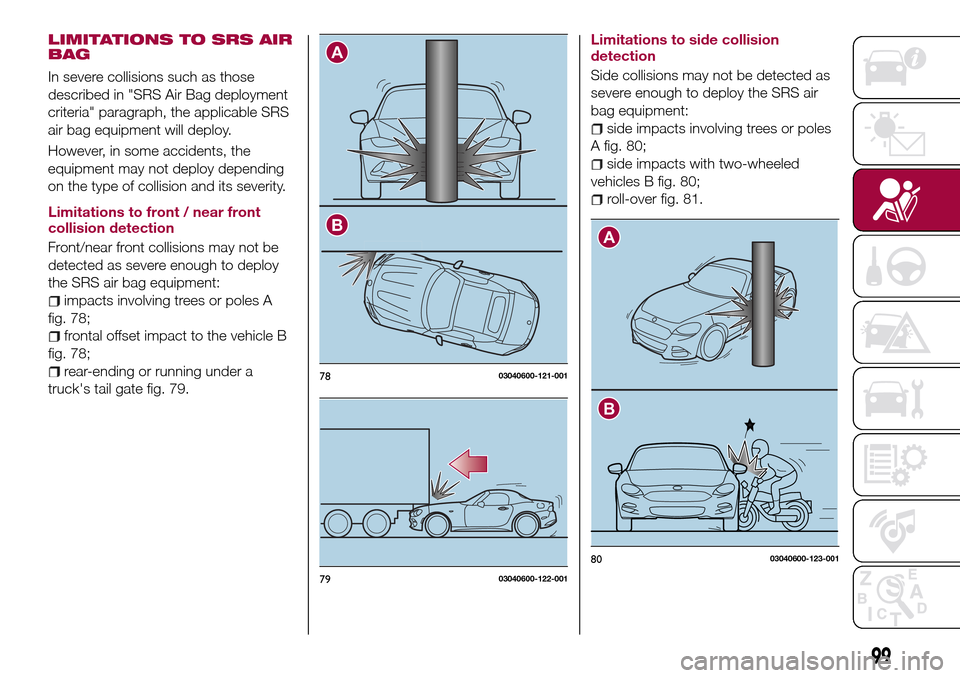
Front/near front collisions may not be
detected as severe enough to deploy
the SRS air bag equipment:
impacts involving trees or poles A
fig. 78;
frontal offset impact to the vehicle B
fig. 78;
rear-ending or running under a
truck's tail gate fig. 79.Limitations to side collision
detection
Side collisions may not be detected as
severe enough to deploy the SRS air
bag equipment:
side impacts involving trees or poles
A fig. 80;
side impacts with two-wheeled
vehicles B fig. 80;
roll-over fig. 81.
A
B
7803040600-121-001
7903040600-122-001
A
B
8003040600-123-001
99
Page 105 of 216
WARNING
112)Seat belts must be worn in air bag
equipped vehicles. Depending only on the
air bags for protection during an accident
is dangerous. Alone, air bags may not
prevent serious injuries. The appropriate air
bags can be expected to inflate only in the
first accident, such as frontal, near frontal
or side collisions that are at least
moderate. Vehicle occupants should
always wear seat belts.
113)Always make sure the passenger air
bag deactivation OFF indicator light is
illuminated when using a child restraint
system. Seating a child in a child-restraint
system that is installed on the passenger
seat with the passenger air bag
deactivation OFF indicator light not
illuminated is extremely dangerous. In an
accident, an air bag could inflate and
cause serious injuries or even death to the
child seated in the child restraint system.
Always make sure the passenger air bag
deactivation OFF indicator light is
illuminated.114)EXTREME HAZARD! Never use a
rear-facing child-restraint system on the
passenger seat with an air bag that could
deploy. NEVER use a rearward facing child
restraint on a seat protected by an ACTIVE
AIR BAG in front of it, DEATH or SERIOUS
INJURY to the CHILD can occur. Even in a
moderate collision, the child-restraint
system can be hit by a deploying air bag
and moved violently backward resulting in
serious injury or death to the child. If your
vehicle is equipped with on passenger
occupant classification system, always
make sure the passenger air bag
deactivation OFF indicator light is
illuminated.
115)Do not sit too close to the driver and
passenger air bags. Sitting too close to the
driver and passenger air bag modules or
placing hands or feet on them is extremely
dangerous. The driver and passenger air
bags inflate with great force and speed.
Serious injuries could occur if someone is
too close. The driver should always hold
onto only the rim of the steering wheel. The
passenger should keep both feet on the
floor. Seat occupants should adjust their
seats as far back as possible and always
sit upright against the seat backs with seat
belts worn properly.116)Do not sit too close to a door or lean
against doors in vehicles with side air bags.
Sitting too close to the side air bag
modules or placing hands on them is
extremely dangerous. A side air bag
inflates with great force and speed directly
out of the outer shoulder of the seat and
expands along the door on the side the car
is hit. Serious injury could occur if someone
is sitting too close to the door or leaning
against a window in the seats.
Furthermore, sleeping up against the door
or hanging out the driver-side window while
driving could block the side air bag and
eliminate the advantages of supplementary
protection. Give the side air bags room to
work by sitting in the center of the seat
while the vehicle is moving with seat belts
worn properly.
117)Sit in the center of the seat and wear
seat belts properly. Sitting too close to the
side air bag modules or placing hands on
them, or sleeping up against the door or
hanging out the windows is extremely
dangerous. The side air bags inflate with
great force and speed directly expanding
along the door on the side the car is hit.
Serious injury could occur if someone is
sitting too close to the door. Give the side
air bags room to work by sitting in the
center of the seat while the vehicle is
moving with seat belts worn properly.
118)Do not attach objects on or around
the area where driver and passenger air
bags deploy. Attaching an object to the
driver and passenger air bag modules or
placing something in front of them is
dangerous. In an accident, an object could
interfere with air bag inflation and injure the
occupants.
103
Page 107 of 216
126)Do not operate a vehicle with
damaged air bag/seat belt pretensioner
system components. Expended or
damaged air bag/seat belt pretensioner
system components must be replaced
after any collision which caused them to
deploy or damage them. Only a trained
expert repairer, we recommend a Fiat
Dealership that can fully evaluate these
systems to see that they will work in any
subsequent accident. Driving with an
expended or damaged air bag or
pretensioner unit will not afford you the
necessary protection in the event of any
subsequent accident which could result in
serious injury or death.
127)Do not remove interior air bag parts.
Removing any components such as the
seats, front instrument panel, the steering
wheel, containing air bag parts or sensors
is dangerous. These parts contain essential
air bag components. The air bag could
accidentally activate and cause serious
injuries. Always have a Fiat Dealership
remove these parts.128)Do not allow an occupant in the
passenger's seat to sit with a posture
which makes it difficult for the passenger
occupant classification sensor to detect
the occupant correctly. Sitting in the
passenger's seat with a posture which
makes it difficult for the passenger
occupant classification sensor to detect
the occupant correctly is dangerous. If the
passenger occupant classification sensor
cannot detect the occupant sitting on the
passenger's seat correctly, the passenger
front and side air bags and pretensioner
system may not operate (deploy) or they
may operate (deploy) accidentally. The
passenger will not have the supplementary
protection of the air bags or the accidental
operation (deployment) of the air bags
could result in serious injury or death.129)Under the following conditions, the
passenger occupant classification sensor
cannot detect a passenger sitting on the
passenger's seat correctly and the
deployment/non-deployment of the air
bags cannot be controlled as indicated in
the passenger air bag deactivation
indicator light on/off condition chart. For
example: luggage or other items placed
under the passenger seat or between the
passenger seat and driver seat that push
up the passenger seat bottom / An object,
such as a seat cushion, is put on the
passenger's seat or between the
passenger's back and the seat back / A
seat cover is put on the passenger's seat /
Luggage or other items are placed on the
seat with the child in the child restraint
system / The seat is washed / Liquids are
spilled on the seat / The passenger seat is
moved backward, pushing into luggage or
other items placed behind it / Luggage or
other items are placed between the
passenger seat and driver seat / An electric
device is put on the passenger's seat. The
passenger front and side air bags and seat
belt pretensioner systems will deactivate if
the passenger air bag deactivation OFF
indicator light turns on.
IMPORTANT
22)To assure proper deployment of the
front air bag and to prevent damage to the
sensor in the seat cushion: do not place
sharp objects on the seat cushion or leave
heavy luggage on them. Do not spill any
liquids on the seats or under the seats.
105
Page 112 of 216
Brake Assist
During emergency braking situations
when it is necessary to depress the
brake pedal with greater force, the
brake assist system provides braking
assistance, thus enhancing braking
performance.
When the brake pedal is depressed
hard or depressed more quickly, the
brakes apply more firmly.
NOTE When the brake pedal is
depressed hard or depressed more
quickly, the pedal will feel softer but the
brakes will apply more firmly. This is a
normal effect of the brake assist
operation and does not indicate a
malfunction.
NOTE When the brake pedal is
depressed hard or depressed more
quickly, a motor/pump operation noise
may be heard. This is a normal effect of
the brake assist and does not indicate a
malfunction.
NOTE The brake assist equipment does
not supersede the functionality of the
vehicle's main braking system.
WARNING
133)In the case of parking manoeuvres on
roads on a gradient, the front wheels must
be steered towards the pavement (when
parking downhill), or in the opposite
direction if the vehicle is parked uphill. If the
vehicle is parked on a steep slope, it is
advisable to block the wheels with a wedge
or stone.
134)Never leave children unattended in
the vehicle. Keep away the key when
leaving the vehicle and take it with you.
135)Do not drive with worn disc pads.
Driving with worn disc pads is dangerous.
The brakes could fail and cause a serious
accident. As soon as you hear a
screeching noise contact a Fiat Dealership.
MANUAL
TRANSMISSION
136) 137) 138)
25)
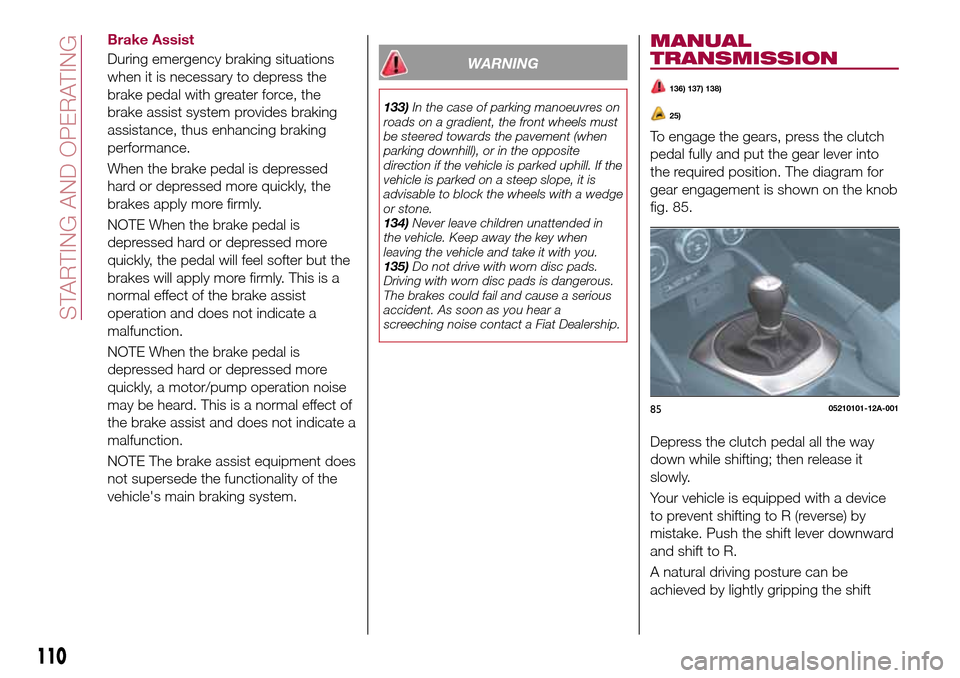
To engage the gears, press the clutch
pedal fully and put the gear lever into
the required position. The diagram for
gear engagement is shown on the knob
fig. 85.
Depress the clutch pedal all the way
down while shifting; then release it
slowly.
Your vehicle is equipped with a device
to prevent shifting to R (reverse) by
mistake. Push the shift lever downward
and shift to R.
A natural driving posture can be
achieved by lightly gripping the shift
8505210101-12A-001
110
STARTING AND OPERATING
Page 114 of 216
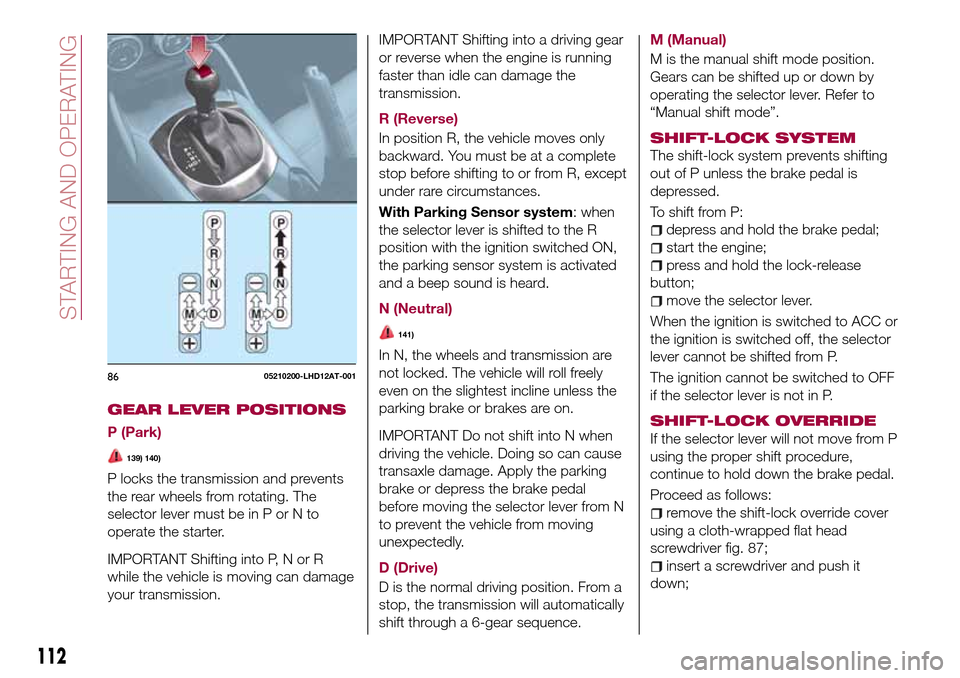
GEAR LEVER POSITIONS
P (Park)
139) 140)
P locks the transmission and prevents
the rear wheels from rotating. The
selector lever must be in P or N to
operate the starter.
IMPORTANT Shifting into P, N or R
while the vehicle is moving can damage
your transmission.IMPORTANT Shifting into a driving gear
or reverse when the engine is running
faster than idle can damage the
transmission.
R (Reverse)
In position R, the vehicle moves only
backward. You must be at a complete
stop before shifting to or from R, except
under rare circumstances.
With Parking Sensor system: when
the selector lever is shifted to the R
position with the ignition switched ON,
the parking sensor system is activated
and a beep sound is heard.
N (Neutral)
141)
In N, the wheels and transmission are
not locked. The vehicle will roll freely
even on the slightest incline unless the
parking brake or brakes are on.
IMPORTANT Do not shift into N when
driving the vehicle. Doing so can cause
transaxle damage. Apply the parking
brake or depress the brake pedal
before moving the selector lever from N
to prevent the vehicle from moving
unexpectedly.
D (Drive)
D is the normal driving position. From a
stop, the transmission will automatically
shift through a 6-gear sequence.M (Manual)
M is the manual shift mode position.
Gears can be shifted up or down by
operating the selector lever. Refer to
“Manual shift mode”.
SHIFT-LOCK SYSTEM
The shift-lock system prevents shifting
out of P unless the brake pedal is
depressed.
To shift from P:
depress and hold the brake pedal;
start the engine;
press and hold the lock-release
button;
move the selector lever.
When the ignition is switched to ACC or
the ignition is switched off, the selector
lever cannot be shifted from P.
The ignition cannot be switched to OFF
if the selector lever is not in P.
SHIFT-LOCK OVERRIDE
If the selector lever will not move from P
using the proper shift procedure,
continue to hold down the brake pedal.
Proceed as follows:
remove the shift-lock override cover
using a cloth-wrapped flat head
screwdriver fig. 87;
insert a screwdriver and push it
down;
8605210200-LHD12AT-001
112
STARTING AND OPERATING
Page 119 of 216
SPEED LIMITER
(where provided)
148) 149)
The speed limiter can be set between
30 km/h and 200 km/h.
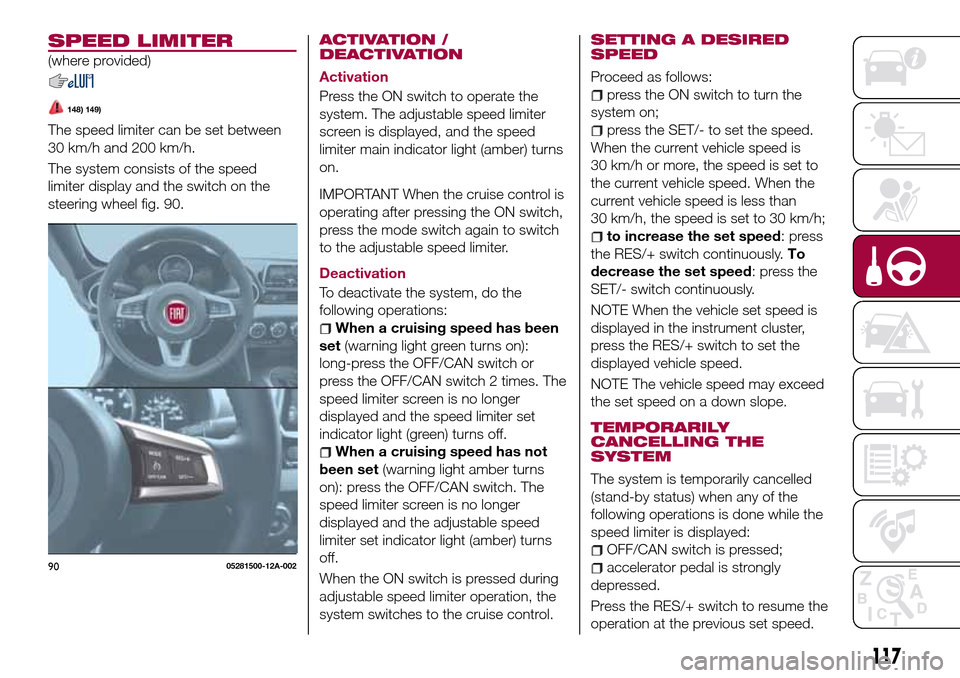
The system consists of the speed
limiter display and the switch on the
steering wheel fig. 90.
ACTIVATION /
DEACTIVATION
Activation
Press the ON switch to operate the
system. The adjustable speed limiter
screen is displayed, and the speed
limiter main indicator light (amber) turns
on.
IMPORTANT When the cruise control is
operating after pressing the ON switch,
press the mode switch again to switch
to the adjustable speed limiter.
Deactivation
To deactivate the system, do the
following operations:
When a cruising speed has been
set(warning light green turns on):
long-press the OFF/CAN switch or
press the OFF/CAN switch 2 times. The
speed limiter screen is no longer
displayed and the speed limiter set
indicator light (green) turns off.
When a cruising speed has not
been set(warning light amber turns
on): press the OFF/CAN switch. The
speed limiter screen is no longer
displayed and the adjustable speed
limiter set indicator light (amber) turns
off.
When the ON switch is pressed during
adjustable speed limiter operation, the
system switches to the cruise control.
SETTING A DESIRED
SPEED
Proceed as follows:
press the ON switch to turn the
system on;
press the SET/- to set the speed.
When the current vehicle speed is
30 km/h or more, the speed is set to
the current vehicle speed. When the
current vehicle speed is less than
30 km/h, the speed is set to 30 km/h;
to increase the set speed: press
the RES/+ switch continuously.To
decrease the set speed: press the
SET/- switch continuously.
NOTE When the vehicle set speed is
displayed in the instrument cluster,
press the RES/+ switch to set the
displayed vehicle speed.
NOTE The vehicle speed may exceed
the set speed on a down slope.
TEMPORARILY
CANCELLING THE
SYSTEM
The system is temporarily cancelled
(stand-by status) when any of the
following operations is done while the
speed limiter is displayed:
OFF/CAN switch is pressed;
accelerator pedal is strongly
depressed.
Press the RES/+ switch to resume the
operation at the previous set speed.9005281500-12A-002
117
Page 125 of 216
IMPORTANT The guide lines are fixed
on the screen. They are not
synchronized with the driver’s actions
on the steering wheel. Always use the
utmost caution and check the area
behind the vehicle and the surrounding
area with your own eyes when
reversing.
REAR VIEW MONITOR
OPERATION
NOTE Images displayed on the monitor
from the rear view parking camera are
reversed images (mirror images).
Give due consideration to the above
warnings before you use the rear-view
monitor:
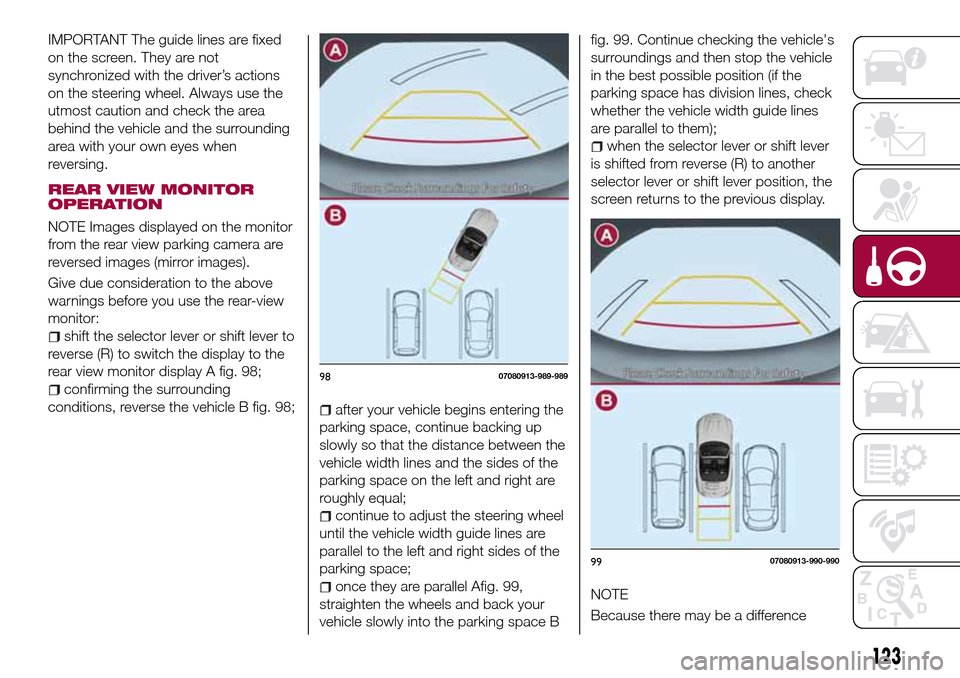
shift the selector lever or shift lever to
reverse (R) to switch the display to the
rear view monitor display A fig. 98;
confirming the surrounding
conditions, reverse the vehicle B fig. 98;
after your vehicle begins entering the
parking space, continue backing up
slowly so that the distance between the
vehicle width lines and the sides of the
parking space on the left and right are
roughly equal;
continue to adjust the steering wheel
until the vehicle width guide lines are
parallel to the left and right sides of the
parking space;
once they are parallel Afig. 99,
straighten the wheels and back your
vehicle slowly into the parking space Bfig. 99. Continue checking the vehicle's
surroundings and then stop the vehicle
in the best possible position (if the
parking space has division lines, check
whether the vehicle width guide lines
are parallel to them);
when the selector lever or shift lever
is shifted from reverse (R) to another
selector lever or shift lever position, the
screen returns to the previous display.
NOTE
Because there may be a difference
9807080913-989-989
9907080913-990-990
123
Page 133 of 216
REPLACING EXTERIOR
LIGHT BULBS
Headlights (low beam)
(versions with halogen bulb)
Proceed as follows:
if you are changing the right bulb,
start the engine, turn the steering wheel
all the way to the right, and turn off
engine. If you are changing the left bulb,
turn the steering wheel to the left;
make sure the headlight switch is off;
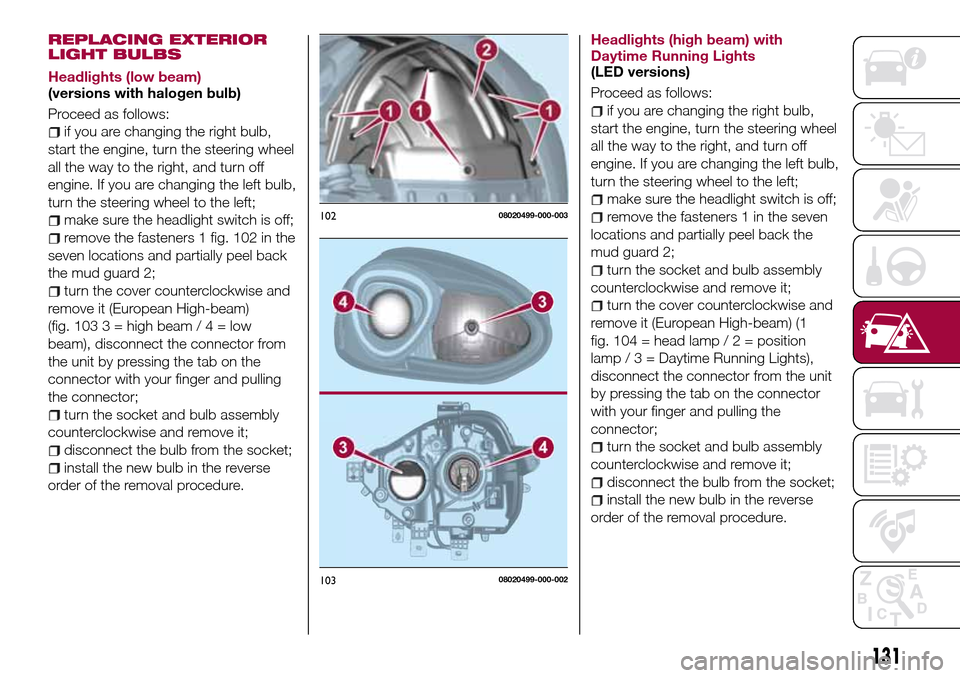
remove the fasteners 1 fig. 102 in the
seven locations and partially peel back
the mud guard 2;
turn the cover counterclockwise and
remove it (European High-beam)
(fig. 103 3 = high beam/4=low
beam), disconnect the connector from
the unit by pressing the tab on the
connector with your finger and pulling
the connector;
turn the socket and bulb assembly
counterclockwise and remove it;
disconnect the bulb from the socket;
install the new bulb in the reverse
order of the removal procedure.Headlights (high beam) with
Daytime Running Lights
(LED versions)
Proceed as follows:
if you are changing the right bulb,
start the engine, turn the steering wheel
all the way to the right, and turn off
engine. If you are changing the left bulb,
turn the steering wheel to the left;
make sure the headlight switch is off;
remove the fasteners 1 in the seven
locations and partially peel back the
mud guard 2;
turn the socket and bulb assembly
counterclockwise and remove it;
turn the cover counterclockwise and
remove it (European High-beam) (1
fig. 104 = head lamp/2=position
lamp/3=Daytime Running Lights),
disconnect the connector from the unit
by pressing the tab on the connector
with your finger and pulling the
connector;
turn the socket and bulb assembly
counterclockwise and remove it;
disconnect the bulb from the socket;
install the new bulb in the reverse
order of the removal procedure.
10208020499-000-003
10308020499-000-002
131
Page 134 of 216
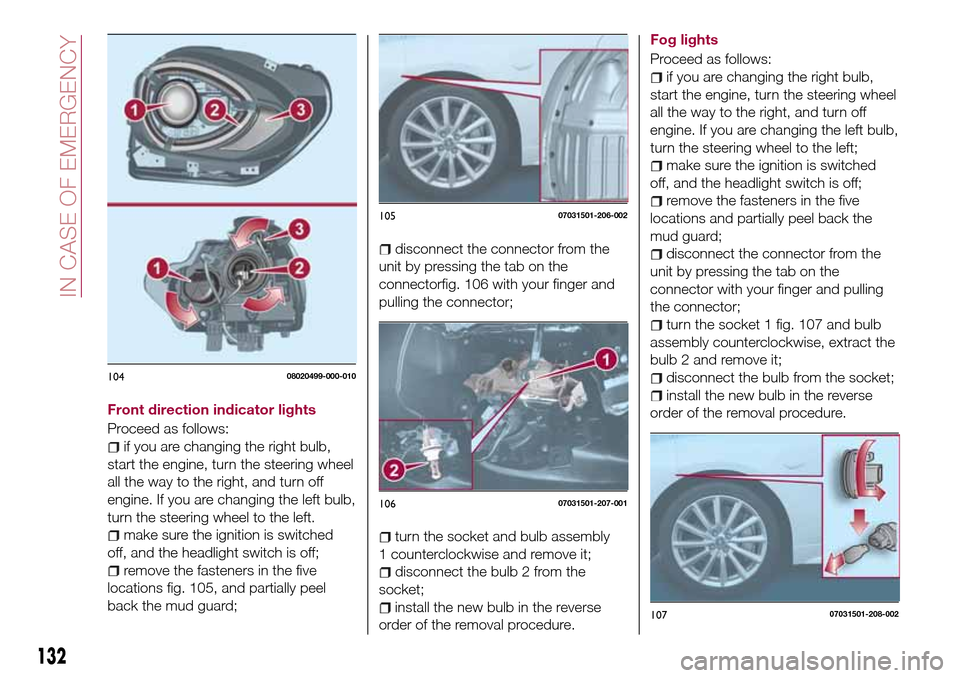
Front direction indicator lights
Proceed as follows:
if you are changing the right bulb,
start the engine, turn the steering wheel
all the way to the right, and turn off
engine. If you are changing the left bulb,
turn the steering wheel to the left.
make sure the ignition is switched
off, and the headlight switch is off;
remove the fasteners in the five
locations fig. 105, and partially peel
back the mud guard;
disconnect the connector from the
unit by pressing the tab on the
connectorfig. 106 with your finger and
pulling the connector;
turn the socket and bulb assembly
1 counterclockwise and remove it;
disconnect the bulb 2 from the
socket;
install the new bulb in the reverse
order of the removal procedure.Fog lights
Proceed as follows:
if you are changing the right bulb,
start the engine, turn the steering wheel
all the way to the right, and turn off
engine. If you are changing the left bulb,
turn the steering wheel to the left;
make sure the ignition is switched
off, and the headlight switch is off;
remove the fasteners in the five
locations and partially peel back the
mud guard;
disconnect the connector from the
unit by pressing the tab on the
connector with your finger and pulling
the connector;
turn the socket 1 fig. 107 and bulb
assembly counterclockwise, extract the
bulb 2 and remove it;
disconnect the bulb from the socket;
install the new bulb in the reverse
order of the removal procedure.
10408020499-000-010
10507031501-206-002
10607031501-207-001
10707031501-208-002
132
IN CASE OF EMERGENCY
Page 135 of 216
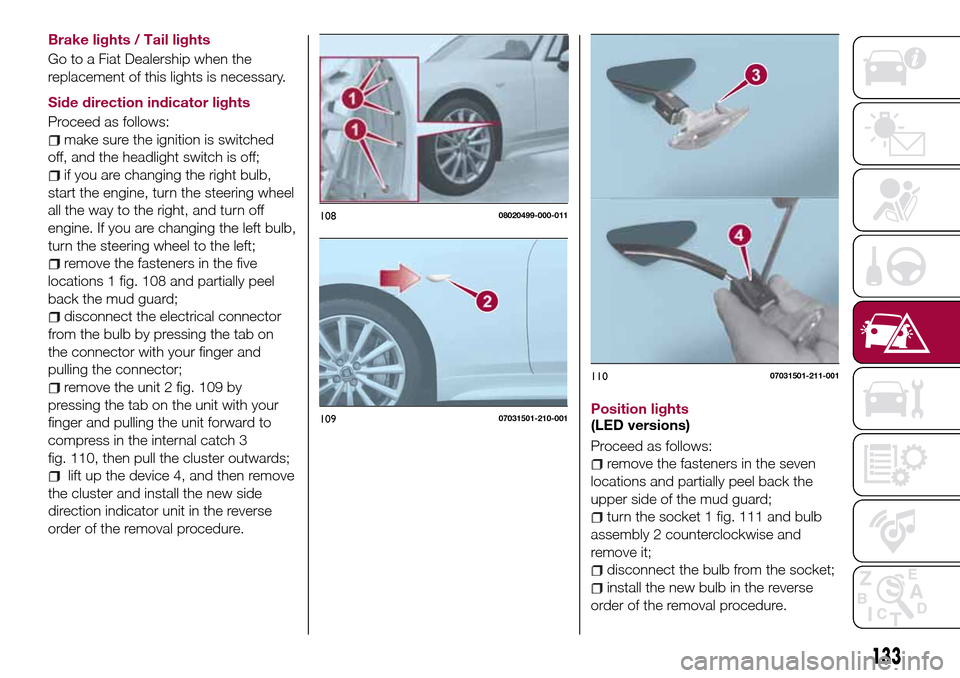
Brake lights / Tail lights
Go to a Fiat Dealership when the
replacement of this lights is necessary.
Side direction indicator lights
Proceed as follows:
make sure the ignition is switched
off, and the headlight switch is off;
if you are changing the right bulb,
start the engine, turn the steering wheel
all the way to the right, and turn off
engine. If you are changing the left bulb,
turn the steering wheel to the left;
remove the fasteners in the five
locations 1 fig. 108 and partially peel
back the mud guard;
disconnect the electrical connector
from the bulb by pressing the tab on
the connector with your finger and
pulling the connector;
remove the unit 2 fig. 109 by
pressing the tab on the unit with your
finger and pulling the unit forward to
compress in the internal catch 3
fig. 110, then pull the cluster outwards;
lift up the device 4, and then remove
the cluster and install the new side
direction indicator unit in the reverse
order of the removal procedure.Position lights
(LED versions)
Proceed as follows:remove the fasteners in the seven
locations and partially peel back the
upper side of the mud guard;
turn the socket 1 fig. 111 and bulb
assembly 2 counterclockwise and
remove it;
disconnect the bulb from the socket;
install the new bulb in the reverse
order of the removal procedure.
10808020499-000-011
10907031501-210-001
11007031501-211-001
133