wheel FIAT 124 SPIDER 2016 2.G Owner's Guide
[x] Cancel search | Manufacturer: FIAT, Model Year: 2016, Model line: 124 SPIDER, Model: FIAT 124 SPIDER 2016 2.GPages: 216, PDF Size: 3.1 MB
Page 145 of 216
WARNING
164)If the fuse blows again contact a Fiat
Dealership.
165)Never replace a fuse with another
with a higher amp rating; DANGER OF
FIRE.
166)Contact a Fiat Dealership if a safety
system (airbags, brakes), power unit
system (engine, gearbox) or steering
system general protection fuse blows.
167)Do not replace the main fuse and
multiplex slow blow fuse by yourself.
Contact a Fiat Dealership to perform the
replacement. Replacing these fuses by
yourself is dangerous because they are
high current fuses. Incorrect replacement
could cause an electrical shock or a short
circuit resulting in a fire.
168)Before replacing a fuse, make sure
that the ignition device is in OFF position
and that all the other services are switched
off and/or deactivated.
IMPORTANT
32)Never replace a fuse with metal wires
or anything else.
33)If it is necessary to wash the engine
compartment, take care not to directly hit
the junction unit and the window wiper
motors with the water jet.
TIRE SERVICE KIT
(where provided)
169) 170) 171) 172) 173) 174) 175)
3)
TOOL STORAGE
Your vehicle is not equipped with a
spare tire, jack and wheel brace. For
details, contact a Fiat Dealership.
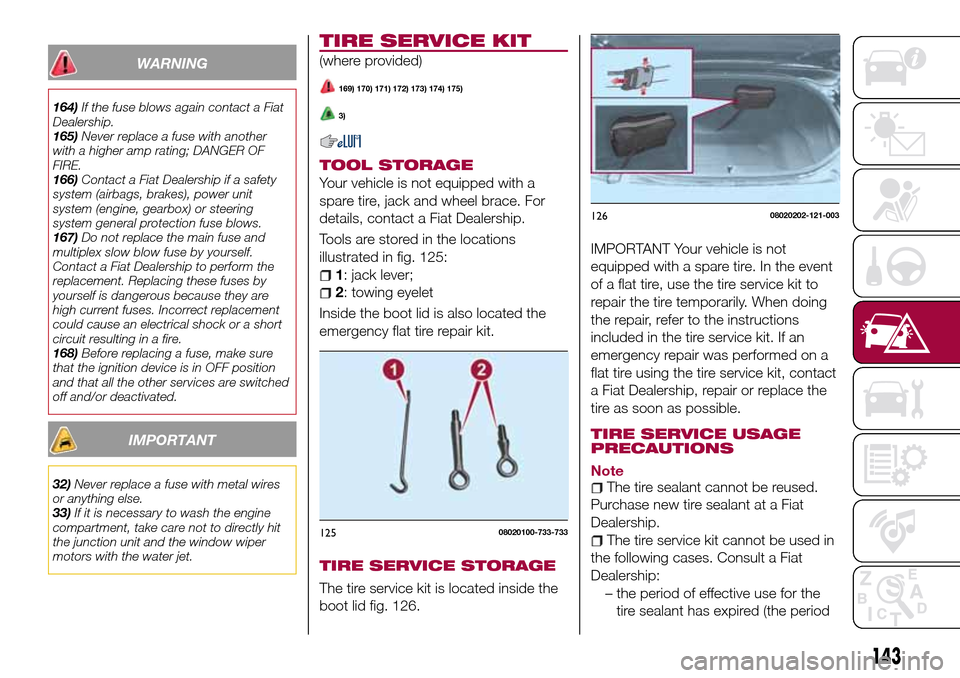
Tools are stored in the locations
illustrated in fig. 125:
1: jack lever;
2: towing eyelet
Inside the boot lid is also located the
emergency flat tire repair kit.
TIRE SERVICE STORAGE
The tire service kit is located inside the
boot lid fig. 126.
IMPORTANT Your vehicle is not
equipped with a spare tire. In the event
of a flat tire, use the tire service kit to
repair the tire temporarily. When doing
the repair, refer to the instructions
included in the tire service kit. If an
emergency repair was performed on a
flat tire using the tire service kit, contact
a Fiat Dealership, repair or replace the
tire as soon as possible.
TIRE SERVICE USAGE
PRECAUTIONS
NoteThe tire sealant cannot be reused.
Purchase new tire sealant at a Fiat
Dealership.
The tire service kit cannot be used in
the following cases. Consult a Fiat
Dealership:
– the period of effective use for the
tire sealant has expired (the period12508020100-733-733
12608020202-121-003
143
Page 146 of 216
of effectiveness is indicated on the
bottle label);
– the tear or puncture exceeds about
4 mm;
– the damage has occurred to an
area of the tire other than the tread;
– the vehicle has been driven with
nearly no air remaining in the tire;
– the tire has come off the wheel rim;
– damage to the wheel rim has
occurred;
– the tire has two or more punctures.
SEALING A TIRE WITH
TIRE SERVICE
Proceed as follows:
move the vehicle off the right-of-way
to a safe place on a level and hard
surface where the vehicle does not
obstruct traffic;
shift the shift lever to the 1 or
Reverse (R) position (manual
transmission), and shift the selector
lever to the P position (automatic
transmission);
apply the parking brake with the
brake pedal depressed and turn off the
engine;
if necessary, flash the hazard warning
lights and set up the roadside
emergency triangle;
unload passengers and cargo and
remove the tire service kit;
shake the tire sealant well. If the
bottle is shaken after the injection hose
is screwed on, tire sealant could spray
out from the injection hose. Tire sealant
contacting clothing or other objects
may be impossible to remove. Shake
the bottle before screwing on the
injection hose;
IMPORTANT The sealant hardens easily
and injecting it will be difficult under
cold weather conditions (0°C or below).
Warm the sealant inside the vehicle to
facilitate injection.
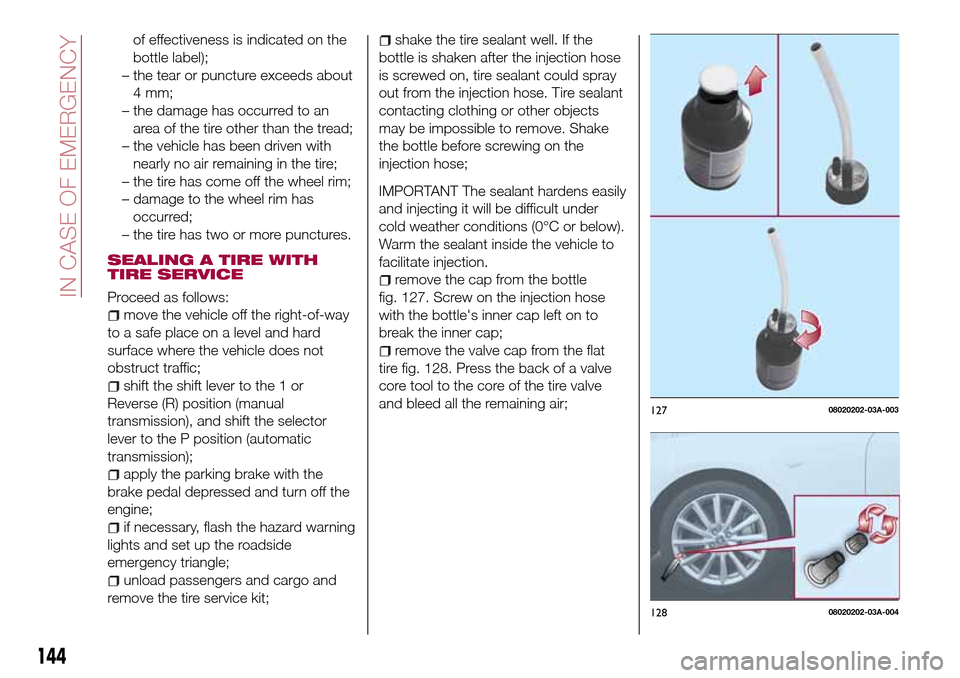
remove the cap from the bottle
fig. 127. Screw on the injection hose
with the bottle's inner cap left on to
break the inner cap;
remove the valve cap from the flat
tire fig. 128. Press the back of a valve
core tool to the core of the tire valve
and bleed all the remaining air;
12708020202-03A-003
12808020202-03A-004
144
IN CASE OF EMERGENCY
Page 149 of 216
WARNING
169)Punctures on the sides of the tire may
not be repaired. Do not use the kit if the tire
was damaged as a result of being used
when underinflated.
170)Do not adhere the speed restriction
sticker to the padded area on the steering
wheel. Adhering the speed restriction
sticker to the padded area on the steering
wheel is dangerous because the air bag
may not operate (deploy) normally resulting
in serious injury. In addition, do not adhere
the sticker to areas where warning lights or
the speedometer cannot be viewed.
171)If the tire inflation pressure has
decreased below 130 kPa (1.3 kgf/cm
2or
bar, 18.9 psi), stop driving and contact a
Fiat Dealership. The repair using the
emergency at tire repair kit was not
successful. If you see a decrease in the tire
inflation pressure, stop driving. Contact a
Fiat Dealership.
172)You must always indicate that the tyre
was repaired using the kit. Give the booklet
to the technicians who will be handling the
tire that was treated using the kit.
173)Repairs are not possible in the case of
damage to the wheel rim (bad groove
distortion causing air loss). Do not remove
foreign bodies (screws or nails) from the
tire.174)The information required by the
applicable regulation is indicated on the tire
service kit package label. Compliance with
the indications on the label is an essential
condition to ensure the safety and the
effectiveness of the tire service kit. Carefully
read the label before use, avoid improper
use. Tire service kit is subject to expiration
and must be replaced periodically. The kit
should be used by adults and cannot be
used by children.
175)Do not allow children to touch the tire
sealant: ingestion of tire sealant is
dangerous. In the event tire sealant is
accidentally swallowed, drink large
amounts of water immediately and seek
medical assistance. Tire sealant that
comes into contact with the eyes and skin
is dangerous. If tire sealant enters the eyes
or contacts the skin, flush immediately with
large amounts of water and seek medical
assistance.
IMPORTANT
3)Dispose of the bottle and the sealant
liquid properly. Have them disposed of in
compliance with national and local
regulations.
147
the emergency flat tire repair is
completed successfully if the tire
inflation pressure does not decrease.
Carefully drive the vehicle to the nearest
Fiat Dealership and have the flat tire
replaced. Replacement with a new tire
is recommended. If the tire is to be
repaired or reused, contact a Fiat
Dealership.
IMPORTANT Before checking the tire
inflation pressure using the tire pressure
gauge, turn the air compressor switch
off.
NOTEIf an emergency flat tire repair has
been performed using the tire service
kit, FCA recommends that the tire be
replaced with a new one as soon as
possible. If the tire is to be repaired or
reused, contact a Fiat Dealership.
The wheel can be reused if the
sealant adhering to it is removed.
However, replace the valve with a new
one.
Page 152 of 216
TOWING THE
VEHICLE
ATTACHING THE TOW
HOOKS
35) 36) 37)
Proceed as follows:
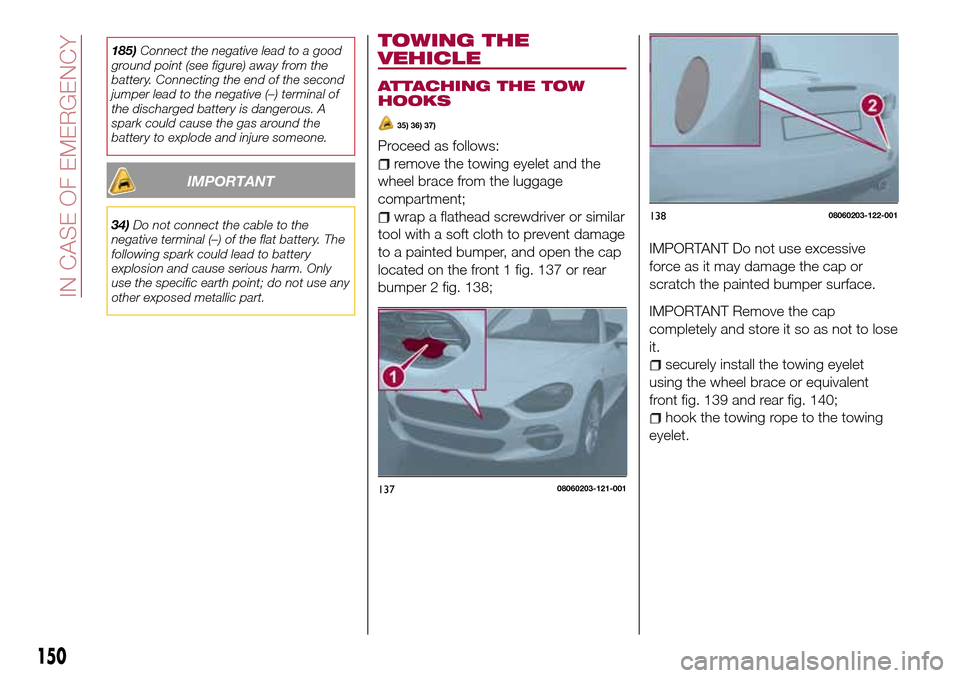
remove the towing eyelet and the
wheel brace from the luggage
compartment;
wrap a flathead screwdriver or similar
tool with a soft cloth to prevent damage
to a painted bumper, and open the cap
located on the front 1 fig. 137 or rear
bumper 2 fig. 138;
IMPORTANT Do not use excessive
force as it may damage the cap or
scratch the painted bumper surface.
IMPORTANT Remove the cap
completely and store it so as not to lose
it.
securely install the towing eyelet
using the wheel brace or equivalent
front fig. 139 and rear fig. 140;
hook the towing rope to the towing
eyelet.
13708060203-121-001
13808060203-122-001
150
IN CASE OF EMERGENCY
185)Connect the negative lead to a good
ground point (see figure) away from the
battery. Connecting the end of the second
jumper lead to the negative (–) terminal of
the discharged battery is dangerous. A
spark could cause the gas around the
battery to explode and injure someone.
IMPORTANT
34)Do not connect the cable to the
negative terminal (–) of the flat battery. The
following spark could lead to battery
explosion and cause serious harm. Only
use the specific earth point; do not use any
other exposed metallic part.
Page 154 of 216
If towing service is not available in an
emergency, the vehicle may be towed
with all four wheels on the ground using
the towing hook at the front of the
vehicle. Only tow the vehicle on paved
surfaces for short distances at low
speeds.
Follow these instructions when towing
the vehicle with all wheels on the
ground:
shift to neutral (manual transmission),
or the N position (automatic
transmission);
switch the ignition to ACC;
release the parking brake.
NOTE Remember that power assist for
the brakes and steering will not be
available when the engine is not
running.
152
IN CASE OF EMERGENCY
EMERGENCY
TOWING
TOWING DESCRIPTION
Proper lifting and towing are necessary
to prevent damage to the vehicle.
Government and local laws must be
followed.
A towed vehicle usually should have its
drive wheels (rear wheels) off the
ground. If excessive damage or other
conditions prevent this, use wheel
dollies.
When towing with the rear wheels on
the ground, release the parking brake.
IMPORTANT Do not tow the vehicle
pointed backward with driving wheels
on the ground. This may cause internal
damage to the transmission.
IMPORTANT Do not tow with sling-type
equipment. This could damage your
vehicle. Use wheel-lift or flatbed
equipment.
Page 155 of 216
MAINTENANCE AND CARE
Correct maintenance permits the
performance of the vehicle to be
maintained over time, as well as limited
running costs and safeguarding the
efficiency of the safety systems.INTRODUCTION.............154
ENGINE COMPARTMENT......160
BATTERY RECHARGING.......164
WHEELS AND TIRES..........165
BODYWORK...............167
INTERIORS................169
153
Page 159 of 216
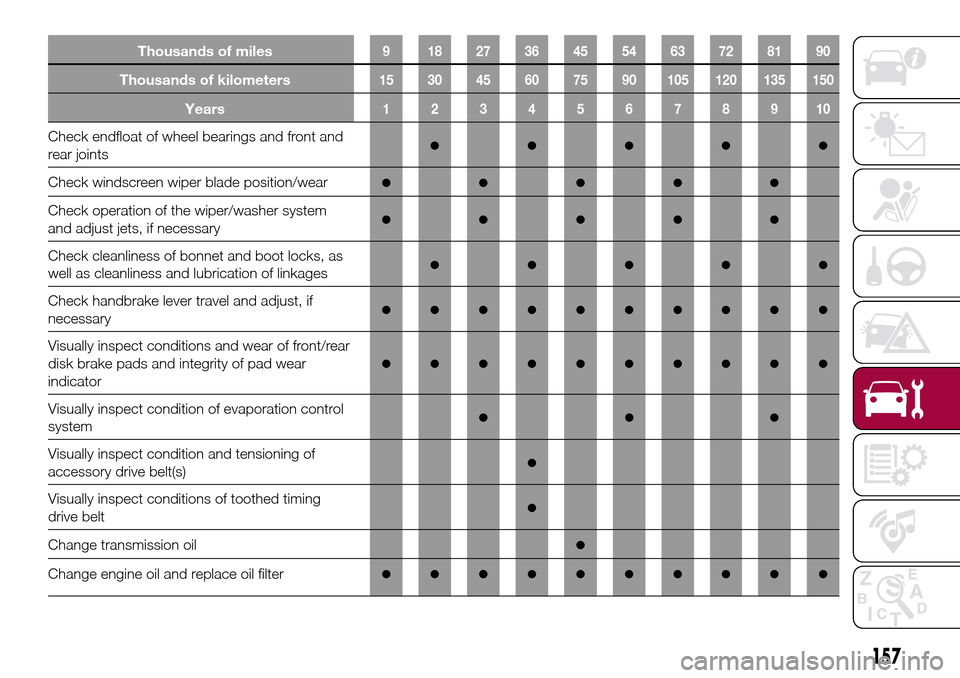
Thousands of miles9 182736455463728190
Thousands of kilometers15 30 45 60 75 90 105 120 135 150
Years12345678910
Check endfloat of wheel bearings and front and
rear joints●●●●●
Check windscreen wiper blade position/wear●●●●●
Check operation of the wiper/washer system
and adjust jets, if necessary●●●●●
Check cleanliness of bonnet and boot locks, as
well as cleanliness and lubrication of linkages●●●●●
Check handbrake lever travel and adjust, if
necessary●●●●●●●●●●
Visually inspect conditions and wear of front/rear
disk brake pads and integrity of pad wear
indicator
●●●●●●●●●●
Visually inspect condition of evaporation control
system●●●
Visually inspect condition and tensioning of
accessory drive belt(s)●
Visually inspect conditions of toothed timing
drive belt●
Change transmission oil●
Change engine oil and replace oil filter●●●●●●●●●●
157
Page 167 of 216
WHEELS AND TIRES
SAFETY INFORMATION
206) 207) 208)
49) 50)
Before embarking on a long trip, and
approximately every two weeks, check
the tire inflation pressure, including the
spare wheel, if present. Check the tires
when cold.
It is normal for the pressure to increase
when the vehicle is used due to tire
heating; for the correct tire inflation
pressure, see the "Wheels and tire
specifications" paragraph in the
"Technical specifications" chapter.
The tires must be replaced when the
tread is less than 1.6 mm thick.
REPLACING A TIRE
209)
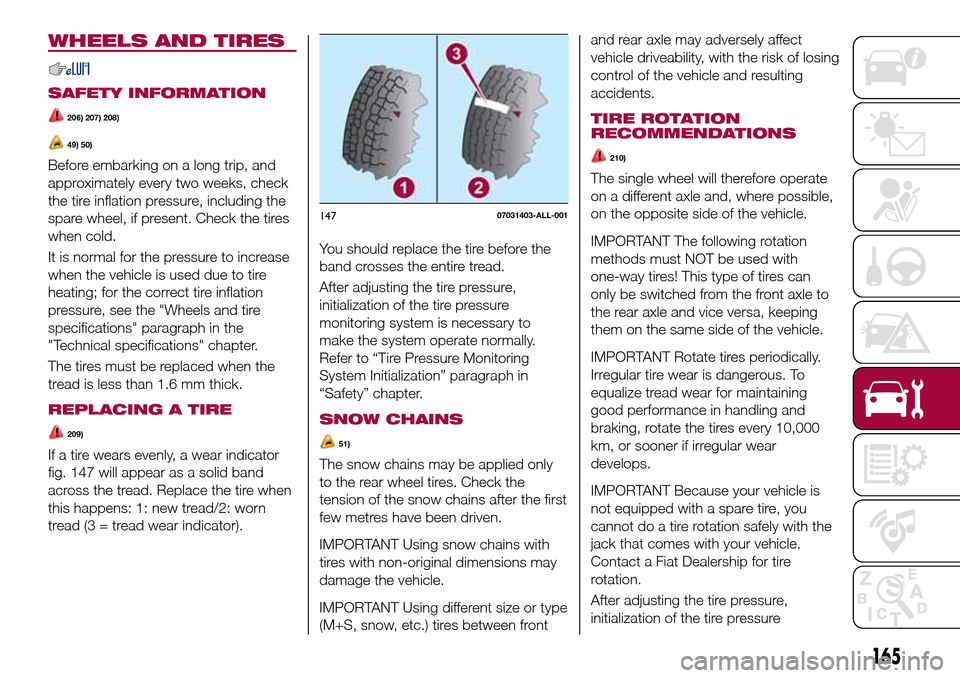
If a tire wears evenly, a wear indicator
fig. 147 will appear as a solid band
across the tread. Replace the tire when
this happens: 1: new tread/2: worn
tread (3 = tread wear indicator).You should replace the tire before the
band crosses the entire tread.
After adjusting the tire pressure,
initialization of the tire pressure
monitoring system is necessary to
make the system operate normally.
Refer to “Tire Pressure Monitoring
System Initialization” paragraph in
“Safety” chapter.
SNOW CHAINS
51)
The snow chains may be applied only
to the rear wheel tires. Check the
tension of the snow chains after the first
few metres have been driven.
IMPORTANT Using snow chains with
tires with non-original dimensions may
damage the vehicle.
IMPORTANT Using different size or type
(M+S, snow, etc.) tires between frontand rear axle may adversely affect
vehicle driveability, with the risk of losing
control of the vehicle and resulting
accidents.
TIRE ROTATION
RECOMMENDATIONS
210)
The single wheel will therefore operate
on a different axle and, where possible,
on the opposite side of the vehicle.
IMPORTANT The following rotation
methods must NOT be used with
one-way tires! This type of tires can
only be switched from the front axle to
the rear axle and vice versa, keeping
them on the same side of the vehicle.
IMPORTANT Rotate tires periodically.
Irregular tire wear is dangerous. To
equalize tread wear for maintaining
good performance in handling and
braking, rotate the tires every 10,000
km, or sooner if irregular wear
develops.
IMPORTANT Because your vehicle is
not equipped with a spare tire, you
cannot do a tire rotation safely with the
jack that comes with your vehicle.
Contact a Fiat Dealership for tire
rotation.
After adjusting the tire pressure,
initialization of the tire pressure
14707031403-ALL-001
165
Page 168 of 216
monitoring system is necessary to
make the system operate normally.
Refer to “Tire Pressure Monitoring
System Initialization” paragraph in
“Safety” chapter.
IMPORTANT Rotate unidirectional tires
and radial tires that have an
asymmetrical tread pattern or studs
only from front to rear, not from side to
side. Tire performance will be reduced if
rotated from side to side.
With limited-slip differential
(where provided)
Do not use the following:
tires not of the designated size;
tires of different sizes or types at the
same time;
tires not sufficiently inflated.
If these instructions are not followed,
the rotation of the left and right wheels
will be different and will thus apply a
constant load on the limited-slip
differential. This will cause a
malfunction.
WARNING
206)If the tires are "unidirectional", do not
switch tires from the right-hand side of the
vehicle to the left-hand side, and vice
versa. This type of tires can only be
switched from the front axle to the rear axle
and vice versa, keeping them on the same
side of the vehicle.
207)Travelling with partially or completely
flat tires can cause safety problems and
irreparable damages to the tire.
208)Always use tires that are in good
condition. Driving with worn tires is
dangerous. Reduced braking, steering, and
traction could result in an accident.
209)Replace all four tires at the same time.
Replacing just one tyre is dangerous. It
could cause poor handling and poor
braking resulting in loss of vehicle control.
FCA strongly recommends that you
replace all four tires at the same time.
210)Always use wheels of the correct size
on your vehicle. Using a wrong-sized wheel
is dangerous. Braking and handling could
be affected, leading to loss of control and
an accident.
IMPORTANT
49)Road holding depends also on the
correct tire inflating pressure.
50)If the pressure is too low the tire
overheats and this can cause it serious
damage.51)Keep your speed down when snow
chains are fitted; do not exceed 50 km/h
(30 mph). Avoid potholes, steps and
pavements and avoid driving for long
distances on roads not covered with snow
to prevent damaging the vehicle and the
road surface.
166
MAINTENANCE AND CARE
Page 172 of 216
TECHNICAL SPECIFICATIONS
Everything you may find useful for
understanding how your vehicle is
made and works is contained in this
chapter and illustrated with data, tables
and graphics.
For the enthusiasts and the technician,
but also just for those who want to
know every detail of their vehicle.IDENTIFICATION DATA.........171
ENGINE..................172
WHEEL AND TIRE
SPECIFICATIONS............173
WEIGHTS.................176
DIMENSIONS..............177
FLUID CAPACITIES...........178
FLUIDS AND LUBRICANTS......179
PERFORMANCE............182
FUEL CONSUMPTION.........183
CO EMISSIONS.............184
PRESCRIPTIONS FOR HANDLING
THE VEHICLE AT THE END OF ITS
LIFE....................185
170
TECHNICAL SPECIFICATIONS