lock FIAT 124 SPIDER 2016 2.G Owner's Guide
[x] Cancel search | Manufacturer: FIAT, Model Year: 2016, Model line: 124 SPIDER, Model: FIAT 124 SPIDER 2016 2.GPages: 216, PDF Size: 3.1 MB
Page 94 of 216
100)Do not allow a child or anyone to lean
over or against the side window of a
vehicle with side air bags. It is dangerous
to allow anyone to lean over or against the
side window, the area of the passenger
seat from which the side air bags deploy,
even if a child-restraint system is used. The
impact of inflation from a side air bag could
cause serious injury or death to an out of
position child. Furthermore, leaning over or
against the door could block the side air
bags and eliminate the advantages of
supplementary protection. Because the
side air bag deploys from the outer
shoulder of the seat, do not allow the child
to lean over or against the side window,
even if the child is seated in a
child-restraint system.
101)Never use one seat belt on more than
one person at a time. Using one seat belt
for more than one person at a time is
dangerous. A seat belt used in this way
cannot spread the impact forces properly
and the two passengers could be crushed
together and seriously injured or even
killed. Never use one belt for more than
one person at a time and always operate
the vehicle with each occupant properly
restrained.
102)Use the tether and tether anchor only
for a child-restraint system. Child restraint
system anchorages are designed to
withstand only those loads imposed by
correctly installed child-restraint systems.
Under no circumstances are they to be
used for adult seat belts, harnesses, or for
attaching other items or equipment to the
vehicle.103)Always install a rear-facing child seat
in the correct seat position. Installing a
rear-facing child seat without first
consulting the table “Child restraint system
suitability for various seat positions” is
dangerous. A rear-facing child seat
installed on the wrong seat position cannot
be properly secured. In a collision, the child
could hit something or someone in the
vehicle and be seriously injured or even
killed.
104)Never use a rear-facing child-restraint
system on the passenger seat protected
by an air bag. Extreme Hazard! Do not use
a rearward facing child restraint on a seat
protected by an airbag in front of it! The
child-restraint system can be hit by the
deploying air bag and knocked out of
position. A child in the child-restraint
system could be seriously injured or killed.
If your vehicle is equipped with a
passenger occupant classification system,
always make sure the passenger air bag
deactivation OFF indicator light is
illuminated, if installing a rear-facing
child-restraint system on the passenger
seat is unavoidable.
105)Never install a front-facing child seat
in the wrong seat position: Installing a
front-facing child seat without first
consulting the table “Child restraint system
suitability for various seat positions” is
dangerous. A front-facing child seat
installed in the wrong seat position cannot
be properly secured. In a collision, the child
could hit something or someone in the
vehicle and be seriously injured or even
killed. Make sure the passenger air bag
deactivation OFF indicator light is
illuminated.106)Before installing child-restraint system
on the passenger seat, move the
passenger seat as far back as possible: In
a collision, the force of a deploying air bag
could cause serious injury or death to the
child. Make sure the passenger air bag
deactivation OFF indicator light is
illuminated.
107)Always attach the tether strap to the
correct tether anchor position. Attaching
the tether strap to the incorrect tether
anchor position is dangerous. In a collision,
the tether strap could come off and loosen
the child restraint system. If the child
restraint system moves it could result in
death or injury to the child.
108)Always route the tether strap between
the head restraint and the seat back.
Routing the tether strap on top of the head
restraint is dangerous. In a collision the
tether strap could slide off the head
restraint and loosen the child restraint
system. The child restraint system could
move which may result in death or injury to
the child.
109)Follow the manufacturer's instructions
for the use of the child-restraint system. An
unsecured child restraint system is
dangerous. In a sudden stop or a collision
it could move causing serious injury or
death to the child or other occupants.
Make sure any child restraint system is
properly secured in place according to the
manufacturer's instructions.
92
SAFETY
Page 105 of 216
WARNING
112)Seat belts must be worn in air bag
equipped vehicles. Depending only on the
air bags for protection during an accident
is dangerous. Alone, air bags may not
prevent serious injuries. The appropriate air
bags can be expected to inflate only in the
first accident, such as frontal, near frontal
or side collisions that are at least
moderate. Vehicle occupants should
always wear seat belts.
113)Always make sure the passenger air
bag deactivation OFF indicator light is
illuminated when using a child restraint
system. Seating a child in a child-restraint
system that is installed on the passenger
seat with the passenger air bag
deactivation OFF indicator light not
illuminated is extremely dangerous. In an
accident, an air bag could inflate and
cause serious injuries or even death to the
child seated in the child restraint system.
Always make sure the passenger air bag
deactivation OFF indicator light is
illuminated.114)EXTREME HAZARD! Never use a
rear-facing child-restraint system on the
passenger seat with an air bag that could
deploy. NEVER use a rearward facing child
restraint on a seat protected by an ACTIVE
AIR BAG in front of it, DEATH or SERIOUS
INJURY to the CHILD can occur. Even in a
moderate collision, the child-restraint
system can be hit by a deploying air bag
and moved violently backward resulting in
serious injury or death to the child. If your
vehicle is equipped with on passenger
occupant classification system, always
make sure the passenger air bag
deactivation OFF indicator light is
illuminated.
115)Do not sit too close to the driver and
passenger air bags. Sitting too close to the
driver and passenger air bag modules or
placing hands or feet on them is extremely
dangerous. The driver and passenger air
bags inflate with great force and speed.
Serious injuries could occur if someone is
too close. The driver should always hold
onto only the rim of the steering wheel. The
passenger should keep both feet on the
floor. Seat occupants should adjust their
seats as far back as possible and always
sit upright against the seat backs with seat
belts worn properly.116)Do not sit too close to a door or lean
against doors in vehicles with side air bags.
Sitting too close to the side air bag
modules or placing hands on them is
extremely dangerous. A side air bag
inflates with great force and speed directly
out of the outer shoulder of the seat and
expands along the door on the side the car
is hit. Serious injury could occur if someone
is sitting too close to the door or leaning
against a window in the seats.
Furthermore, sleeping up against the door
or hanging out the driver-side window while
driving could block the side air bag and
eliminate the advantages of supplementary
protection. Give the side air bags room to
work by sitting in the center of the seat
while the vehicle is moving with seat belts
worn properly.
117)Sit in the center of the seat and wear
seat belts properly. Sitting too close to the
side air bag modules or placing hands on
them, or sleeping up against the door or
hanging out the windows is extremely
dangerous. The side air bags inflate with
great force and speed directly expanding
along the door on the side the car is hit.
Serious injury could occur if someone is
sitting too close to the door. Give the side
air bags room to work by sitting in the
center of the seat while the vehicle is
moving with seat belts worn properly.
118)Do not attach objects on or around
the area where driver and passenger air
bags deploy. Attaching an object to the
driver and passenger air bag modules or
placing something in front of them is
dangerous. In an accident, an object could
interfere with air bag inflation and injure the
occupants.
103
Page 112 of 216
Brake Assist
During emergency braking situations
when it is necessary to depress the
brake pedal with greater force, the
brake assist system provides braking
assistance, thus enhancing braking
performance.
When the brake pedal is depressed
hard or depressed more quickly, the
brakes apply more firmly.
NOTE When the brake pedal is
depressed hard or depressed more
quickly, the pedal will feel softer but the
brakes will apply more firmly. This is a
normal effect of the brake assist
operation and does not indicate a
malfunction.
NOTE When the brake pedal is
depressed hard or depressed more
quickly, a motor/pump operation noise
may be heard. This is a normal effect of
the brake assist and does not indicate a
malfunction.
NOTE The brake assist equipment does
not supersede the functionality of the
vehicle's main braking system.
WARNING
133)In the case of parking manoeuvres on
roads on a gradient, the front wheels must
be steered towards the pavement (when
parking downhill), or in the opposite
direction if the vehicle is parked uphill. If the
vehicle is parked on a steep slope, it is
advisable to block the wheels with a wedge
or stone.
134)Never leave children unattended in
the vehicle. Keep away the key when
leaving the vehicle and take it with you.
135)Do not drive with worn disc pads.
Driving with worn disc pads is dangerous.
The brakes could fail and cause a serious
accident. As soon as you hear a
screeching noise contact a Fiat Dealership.
MANUAL
TRANSMISSION
136) 137) 138)
25)
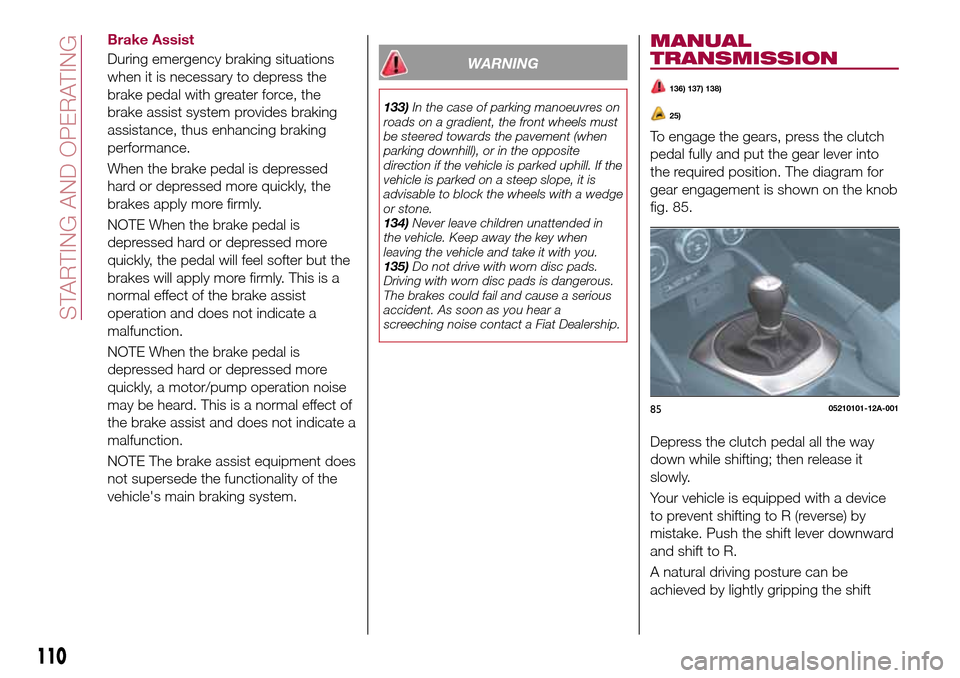
To engage the gears, press the clutch
pedal fully and put the gear lever into
the required position. The diagram for
gear engagement is shown on the knob
fig. 85.
Depress the clutch pedal all the way
down while shifting; then release it
slowly.
Your vehicle is equipped with a device
to prevent shifting to R (reverse) by
mistake. Push the shift lever downward
and shift to R.
A natural driving posture can be
achieved by lightly gripping the shift
8505210101-12A-001
110
STARTING AND OPERATING
Page 113 of 216
lever from the side without having to
rest your elbow on the center console
box.
If shifting to R is difficult, shift back into
neutral, release the clutch pedal, and try
again.
With Parking Sensor system
When the shift lever is shifted to the R
position with the ignition switched ON,
the parking sensor system is activated
and a beep sound is heard.
IMPORTANT Keep your foot off the
clutch pedal except when shifting
gears. Also, do not use the clutch to
hold the vehicle on an upgrade. Riding
the clutch will cause needless clutch
wear and damage.
IMPORTANT Do not apply any
excessive lateral force to the shift lever
when changing from 5
thto 4thgear.
This could lead to the accidental
selection of 2
ndgear, which could
result in damage to the transmission.
IMPORTANT Make sure the vehicle
comes to a complete stop before
shifting to R. Shifting to R while the
vehicle is still moving may damage the
transmission.
IMPORTANT Reverse can only be
engaged when the vehicle is completely
stationary. With the engine running, waitat least 2 seconds with the clutch pedal
fully pressed before engaging reverse to
prevent damage to the gears and
grating.
WARNING
136)Depress the clutch pedal fully to
change gear correctly. Therefore, the floor
area underneath the pedal unit must not be
obstructed in any way. Ensure that the floor
mat is always laid flat and does not
interfere with use of the pedals.
137)Do not use sudden engine braking on
slippery road surfaces or at high speeds.
Shifting down while driving on wet, snowy,
or frozen roads, or while driving at high
speeds causes sudden engine braking,
which is dangerous. The sudden change in
tyre speed could cause the tyres to skid.
This could lead to loss of vehicle control
and an accident.
138)Always leave the shift lever in 1 or R
position and set the parking brake when
leaving the vehicle unattended. Otherwise
the vehicle could move and cause an
accident.
IMPORTANT
25)Do not drive with your hand resting on
the gear lever as the force exerted, even if
slight, could lead over time to premature
wear of the gearbox internal components.
AUTOMATIC
TRANSMISSION
(where provided)
VARIOUS LOCKOUTS
To shift from P to R you must depress
the brake pedal and hold in the
lock-release button to shift (the ignition
must be switched ON).
To shift from R to N, from N to D (or D
to N), from D to M (or M to D) and from
M to + and - the selector lever can be
shifted freely into any position.
To shift from N to R and from R to P
you must hold in the lock-release
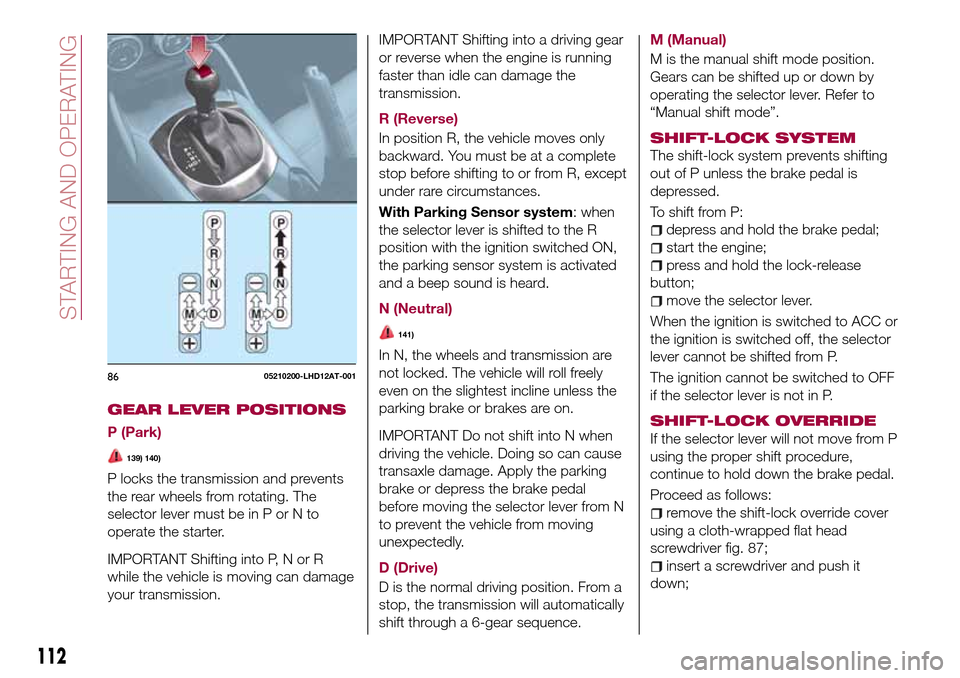
button fig. 86 to shift.
111
Page 114 of 216
GEAR LEVER POSITIONS
P (Park)
139) 140)
P locks the transmission and prevents
the rear wheels from rotating. The
selector lever must be in P or N to
operate the starter.
IMPORTANT Shifting into P, N or R
while the vehicle is moving can damage
your transmission.IMPORTANT Shifting into a driving gear
or reverse when the engine is running
faster than idle can damage the
transmission.
R (Reverse)
In position R, the vehicle moves only
backward. You must be at a complete
stop before shifting to or from R, except
under rare circumstances.
With Parking Sensor system: when
the selector lever is shifted to the R
position with the ignition switched ON,
the parking sensor system is activated
and a beep sound is heard.
N (Neutral)
141)
In N, the wheels and transmission are
not locked. The vehicle will roll freely
even on the slightest incline unless the
parking brake or brakes are on.
IMPORTANT Do not shift into N when
driving the vehicle. Doing so can cause
transaxle damage. Apply the parking
brake or depress the brake pedal
before moving the selector lever from N
to prevent the vehicle from moving
unexpectedly.
D (Drive)
D is the normal driving position. From a
stop, the transmission will automatically
shift through a 6-gear sequence.M (Manual)
M is the manual shift mode position.
Gears can be shifted up or down by
operating the selector lever. Refer to
“Manual shift mode”.
SHIFT-LOCK SYSTEM
The shift-lock system prevents shifting
out of P unless the brake pedal is
depressed.
To shift from P:
depress and hold the brake pedal;
start the engine;
press and hold the lock-release
button;
move the selector lever.
When the ignition is switched to ACC or
the ignition is switched off, the selector
lever cannot be shifted from P.
The ignition cannot be switched to OFF
if the selector lever is not in P.
SHIFT-LOCK OVERRIDE
If the selector lever will not move from P
using the proper shift procedure,
continue to hold down the brake pedal.
Proceed as follows:
remove the shift-lock override cover
using a cloth-wrapped flat head
screwdriver fig. 87;
insert a screwdriver and push it
down;
8605210200-LHD12AT-001
112
STARTING AND OPERATING
Page 115 of 216
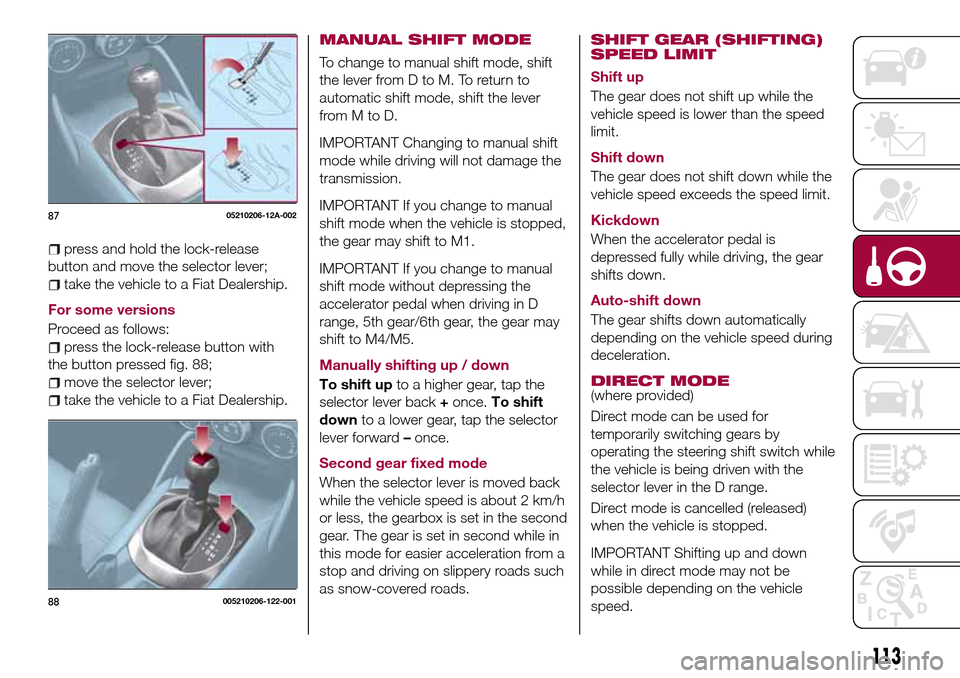
press and hold the lock-release
button and move the selector lever;
take the vehicle to a Fiat Dealership.
For some versions
Proceed as follows:
press the lock-release button with
the button pressed fig. 88;
move the selector lever;
take the vehicle to a Fiat Dealership.
MANUAL SHIFT MODE
To change to manual shift mode, shift
the lever from D to M. To return to
automatic shift mode, shift the lever
fromMtoD.
IMPORTANT Changing to manual shift
mode while driving will not damage the
transmission.
IMPORTANT If you change to manual
shift mode when the vehicle is stopped,
the gear may shift to M1.
IMPORTANT If you change to manual
shift mode without depressing the
accelerator pedal when driving in D
range, 5th gear/6th gear, the gear may
shift to M4/M5.
Manually shifting up / down
To shift upto a higher gear, tap the
selector lever back+once.To shift
downto a lower gear, tap the selector
lever forward–once.
Second gear fixed mode
When the selector lever is moved back
while the vehicle speed is about 2 km/h
or less, the gearbox is set in the second
gear. The gear is set in second while in
this mode for easier acceleration from a
stop and driving on slippery roads such
as snow-covered roads.
SHIFT GEAR (SHIFTING)
SPEED LIMIT
Shift up
The gear does not shift up while the
vehicle speed is lower than the speed
limit.
Shift down
The gear does not shift down while the
vehicle speed exceeds the speed limit.
Kickdown
When the accelerator pedal is
depressed fully while driving, the gear
shifts down.
Auto-shift down
The gear shifts down automatically
depending on the vehicle speed during
deceleration.
DIRECT MODE(where provided)
Direct mode can be used for
temporarily switching gears by
operating the steering shift switch while
the vehicle is being driven with the
selector lever in the D range.
Direct mode is cancelled (released)
when the vehicle is stopped.
IMPORTANT Shifting up and down
while in direct mode may not be
possible depending on the vehicle
speed.
8705210206-12A-002
88005210206-122-001
113
Page 122 of 216
REFUELLING THE
VEHICLE
152) 153) 154) 155) 156) 157)
Always stop the engine before
refuelling.
FUEL REQUIREMENTS
Only use premium unleaded fuel
(conforming to EN 228 specification
within E10) with a number of octanes
not lower than 95.
IMPORTANT USE ONLY UNLEADED
FUEL. Leaded fuel is harmful to the
catalytic converter and oxygen sensors
and will lead to deterioration of the
emission control system and or failures.
IMPORTANT The use of E10 fuel with
10% ethanol in Europe is safe for your
vehicle. Damage to your vehicle may
occur when ethanol exceeds this
recommendation.
IMPORTANT Never add fuel system
additives, otherwise the emission
control system could be damaged.
Contact a Fiat Dealership for details.
REFUELLING
PROCEDURE
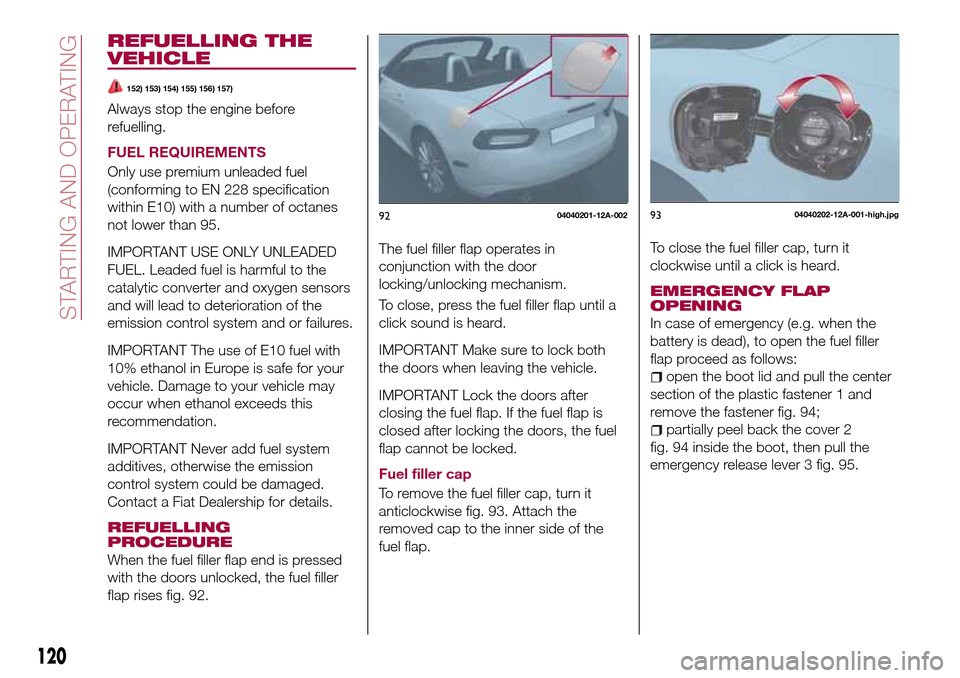
When the fuel filler flap end is pressed
with the doors unlocked, the fuel filler
flap rises fig. 92.The fuel filler flap operates in
conjunction with the door
locking/unlocking mechanism.
To close, press the fuel filler flap until a
click sound is heard.
IMPORTANT Make sure to lock both
the doors when leaving the vehicle.
IMPORTANT Lock the doors after
closing the fuel flap. If the fuel flap is
closed after locking the doors, the fuel
flap cannot be locked.
Fuel filler cap
To remove the fuel filler cap, turn it
anticlockwise fig. 93. Attach the
removed cap to the inner side of the
fuel flap.To close the fuel filler cap, turn it
clockwise until a click is heard.
EMERGENCY FLAP
OPENING
In case of emergency (e.g. when the
battery is dead), to open the fuel filler
flap proceed as follows:
open the boot lid and pull the center
section of the plastic fastener 1 and
remove the fastener fig. 94;
partially peel back the cover 2
fig. 94 inside the boot, then pull the
emergency release lever 3 fig. 95.
9204040201-12A-0029304040202-12A-001-high.jpg
120
STARTING AND OPERATING
Page 133 of 216
REPLACING EXTERIOR
LIGHT BULBS
Headlights (low beam)
(versions with halogen bulb)
Proceed as follows:
if you are changing the right bulb,
start the engine, turn the steering wheel
all the way to the right, and turn off
engine. If you are changing the left bulb,
turn the steering wheel to the left;
make sure the headlight switch is off;
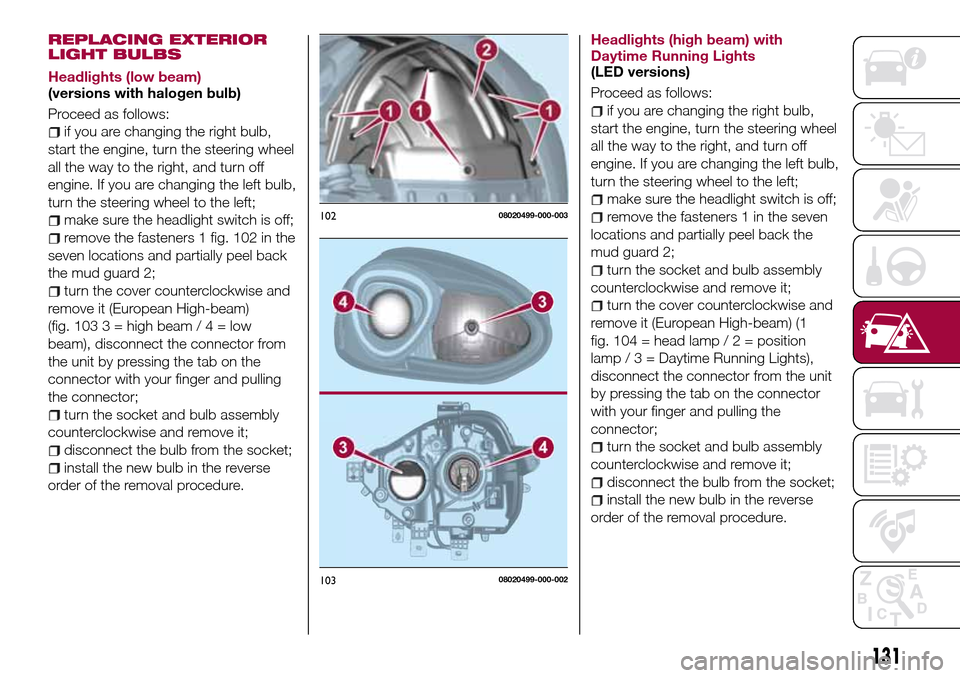
remove the fasteners 1 fig. 102 in the
seven locations and partially peel back
the mud guard 2;
turn the cover counterclockwise and
remove it (European High-beam)
(fig. 103 3 = high beam/4=low
beam), disconnect the connector from
the unit by pressing the tab on the
connector with your finger and pulling
the connector;
turn the socket and bulb assembly
counterclockwise and remove it;
disconnect the bulb from the socket;
install the new bulb in the reverse
order of the removal procedure.Headlights (high beam) with
Daytime Running Lights
(LED versions)
Proceed as follows:
if you are changing the right bulb,
start the engine, turn the steering wheel
all the way to the right, and turn off
engine. If you are changing the left bulb,
turn the steering wheel to the left;
make sure the headlight switch is off;
remove the fasteners 1 in the seven
locations and partially peel back the
mud guard 2;
turn the socket and bulb assembly
counterclockwise and remove it;
turn the cover counterclockwise and
remove it (European High-beam) (1
fig. 104 = head lamp/2=position
lamp/3=Daytime Running Lights),
disconnect the connector from the unit
by pressing the tab on the connector
with your finger and pulling the
connector;
turn the socket and bulb assembly
counterclockwise and remove it;
disconnect the bulb from the socket;
install the new bulb in the reverse
order of the removal procedure.
10208020499-000-003
10308020499-000-002
131
Page 134 of 216
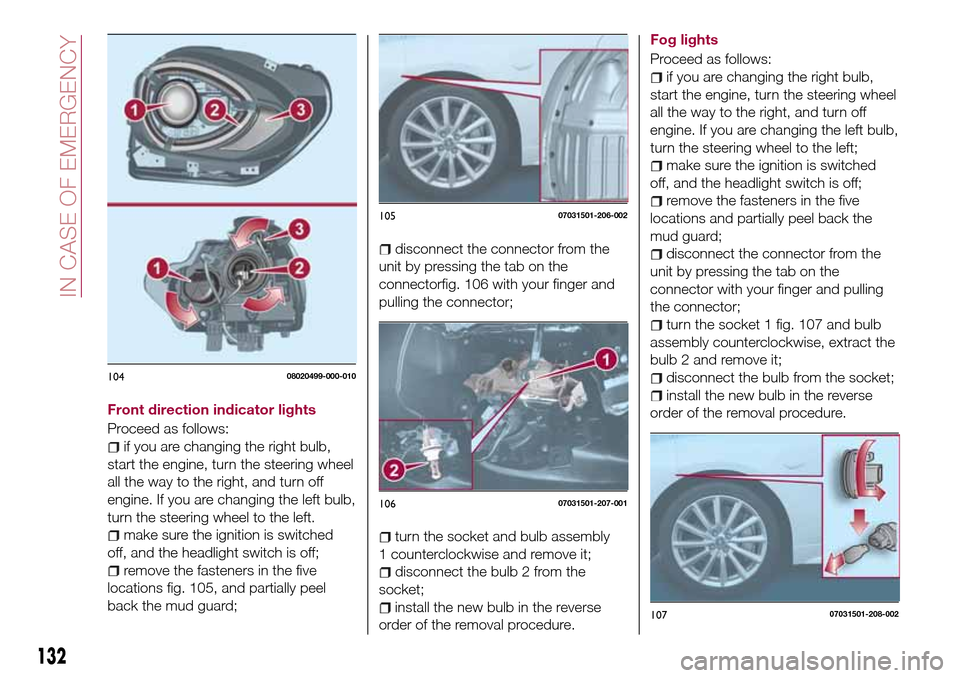
Front direction indicator lights
Proceed as follows:
if you are changing the right bulb,
start the engine, turn the steering wheel
all the way to the right, and turn off
engine. If you are changing the left bulb,
turn the steering wheel to the left.
make sure the ignition is switched
off, and the headlight switch is off;
remove the fasteners in the five
locations fig. 105, and partially peel
back the mud guard;
disconnect the connector from the
unit by pressing the tab on the
connectorfig. 106 with your finger and
pulling the connector;
turn the socket and bulb assembly
1 counterclockwise and remove it;
disconnect the bulb 2 from the
socket;
install the new bulb in the reverse
order of the removal procedure.Fog lights
Proceed as follows:
if you are changing the right bulb,
start the engine, turn the steering wheel
all the way to the right, and turn off
engine. If you are changing the left bulb,
turn the steering wheel to the left;
make sure the ignition is switched
off, and the headlight switch is off;
remove the fasteners in the five
locations and partially peel back the
mud guard;
disconnect the connector from the
unit by pressing the tab on the
connector with your finger and pulling
the connector;
turn the socket 1 fig. 107 and bulb
assembly counterclockwise, extract the
bulb 2 and remove it;
disconnect the bulb from the socket;
install the new bulb in the reverse
order of the removal procedure.
10408020499-000-010
10507031501-206-002
10607031501-207-001
10707031501-208-002
132
IN CASE OF EMERGENCY
Page 135 of 216
Brake lights / Tail lights
Go to a Fiat Dealership when the
replacement of this lights is necessary.
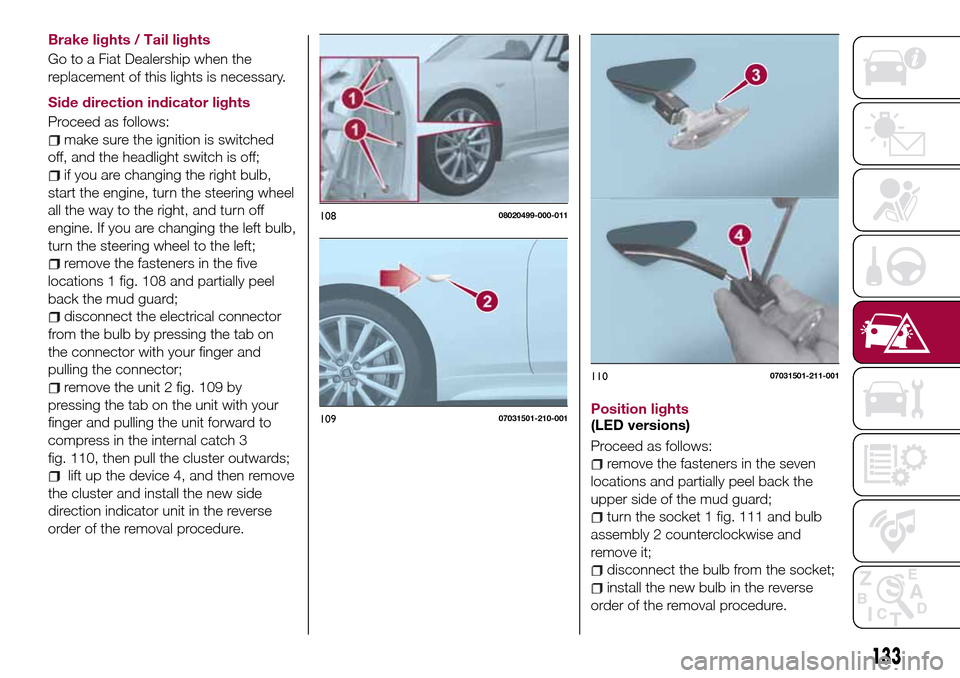
Side direction indicator lights
Proceed as follows:
make sure the ignition is switched
off, and the headlight switch is off;
if you are changing the right bulb,
start the engine, turn the steering wheel
all the way to the right, and turn off
engine. If you are changing the left bulb,
turn the steering wheel to the left;
remove the fasteners in the five
locations 1 fig. 108 and partially peel
back the mud guard;
disconnect the electrical connector
from the bulb by pressing the tab on
the connector with your finger and
pulling the connector;
remove the unit 2 fig. 109 by
pressing the tab on the unit with your
finger and pulling the unit forward to
compress in the internal catch 3
fig. 110, then pull the cluster outwards;
lift up the device 4, and then remove
the cluster and install the new side
direction indicator unit in the reverse
order of the removal procedure.Position lights
(LED versions)
Proceed as follows:remove the fasteners in the seven
locations and partially peel back the
upper side of the mud guard;
turn the socket 1 fig. 111 and bulb
assembly 2 counterclockwise and
remove it;
disconnect the bulb from the socket;
install the new bulb in the reverse
order of the removal procedure.
10808020499-000-011
10907031501-210-001
11007031501-211-001
133