lock FIAT 124 SPIDER 2016 2.G Owner's Manual
[x] Cancel search | Manufacturer: FIAT, Model Year: 2016, Model line: 124 SPIDER, Model: FIAT 124 SPIDER 2016 2.GPages: 216, PDF Size: 3.1 MB
Page 43 of 216
WARNING
51)Perform these operations only when
the car is stationary.
52)The bonnet may drop suddenly if the
supporting rod is not positioned correctly.
53)Use both hands to lift the bonnet.
Before lifting, check that the windscreen
wiper arms are not raised from the
windscreen, that the vehicle is stationary
and that the parking brake is engaged.
54)Always check that the bonnet is closed
and securely locked. A bonnet that is not
closed and securely locked is dangerous
as it could fly open while the vehicle is
moving and block the driver's vision which
could result in a serious accident.
55)With active bonnet: do not pull the
bonnet's release handle after the active
bonnet has activated. Pulling the release
handle while the active bonnet is operating
is dangerous as it will raise the bonnet
further and obstruct vision. In addition, the
bonnet cannot be lowered manually,
therefore do not attempt to forcefully push
the bonnet back down. Otherwise, it could
deform the bonnet or cause injury. If the
active bonnet has activated, always consult
an expert repairer, contact a Fiat
Dealership immediately.
CONVERTIBLE TOP
(SOFT TOP)
LOWERING THE
CONVERTIBLE TOP
IMPORTANT Do not sit on the folded
convertible top. Otherwise, the
convertible top could be damaged or
you may fall off and be injured.
Proceed as follows:
make sure the parking brake is
applied. If the engine is running, turn it
off;
make sure there are no objects
which have been placed in the area
where the convertible top is to be
retracted;
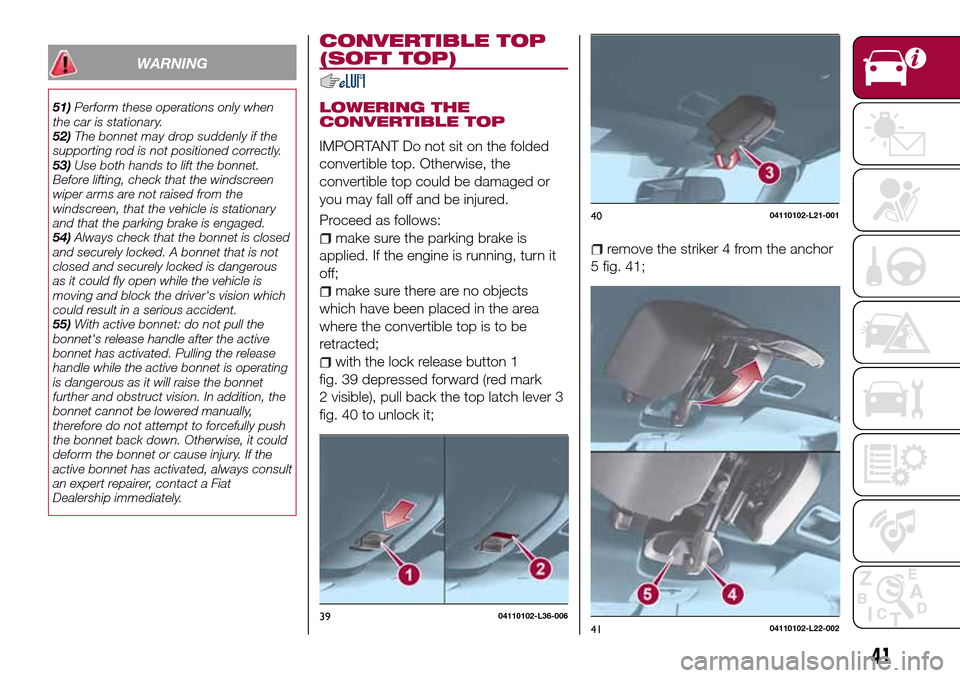
with the lock release button 1
fig. 39 depressed forward (red mark
2 visible), pull back the top latch lever 3
fig. 40 to unlock it;
remove the striker 4 from the anchor
5 fig. 41;
3904110102-L36-006
4004110102-L21-001
4104110102-L22-002
41
Page 44 of 216
IMPORTANT If the power windows do
not go down automatically, fully open
the windows.
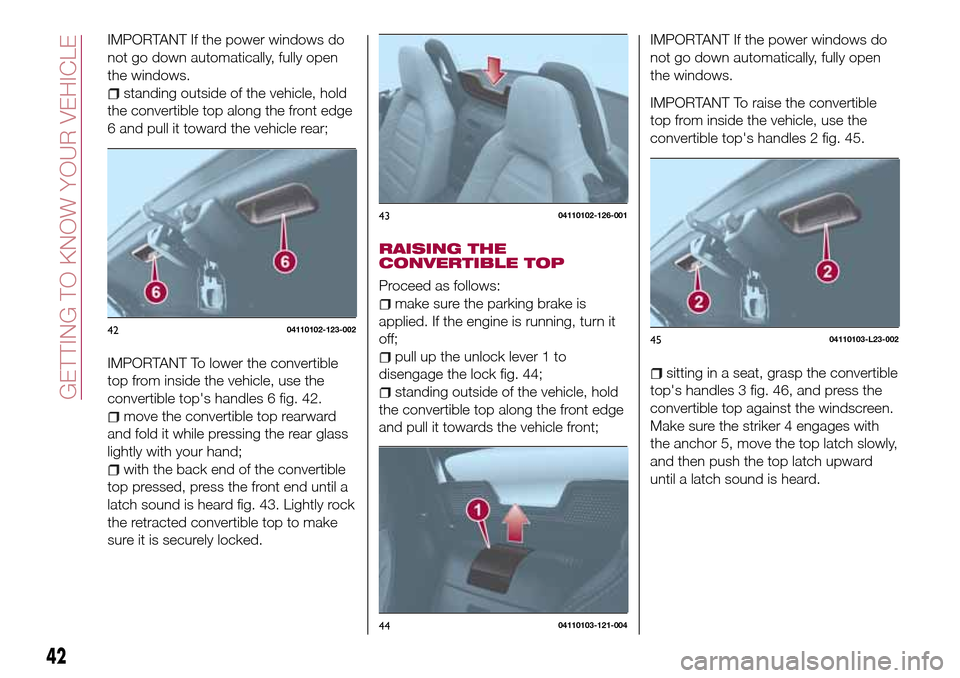
standing outside of the vehicle, hold
the convertible top along the front edge
6 and pull it toward the vehicle rear;
IMPORTANT To lower the convertible
top from inside the vehicle, use the
convertible top's handles 6 fig. 42.
move the convertible top rearward
and fold it while pressing the rear glass
lightly with your hand;
with the back end of the convertible
top pressed, press the front end until a
latch sound is heard fig. 43. Lightly rock
the retracted convertible top to make
sure it is securely locked.
RAISING THE
CONVERTIBLE TOP
Proceed as follows:
make sure the parking brake is
applied. If the engine is running, turn it
off;
pull up the unlock lever 1 to
disengage the lock fig. 44;
standing outside of the vehicle, hold
the convertible top along the front edge
and pull it towards the vehicle front;
IMPORTANT If the power windows do
not go down automatically, fully open
the windows.
IMPORTANT To raise the convertible
top from inside the vehicle, use the
convertible top's handles 2 fig. 45.
sitting in a seat, grasp the convertible
top's handles 3 fig. 46, and press the
convertible top against the windscreen.
Make sure the striker 4 engages with
the anchor 5, move the top latch slowly,
and then push the top latch upward
until a latch sound is heard.
4204110102-123-002
4304110102-126-001
4404110103-121-004
4504110103-L23-002
42
GETTING TO KNOW YOUR VEHICLE
Page 45 of 216
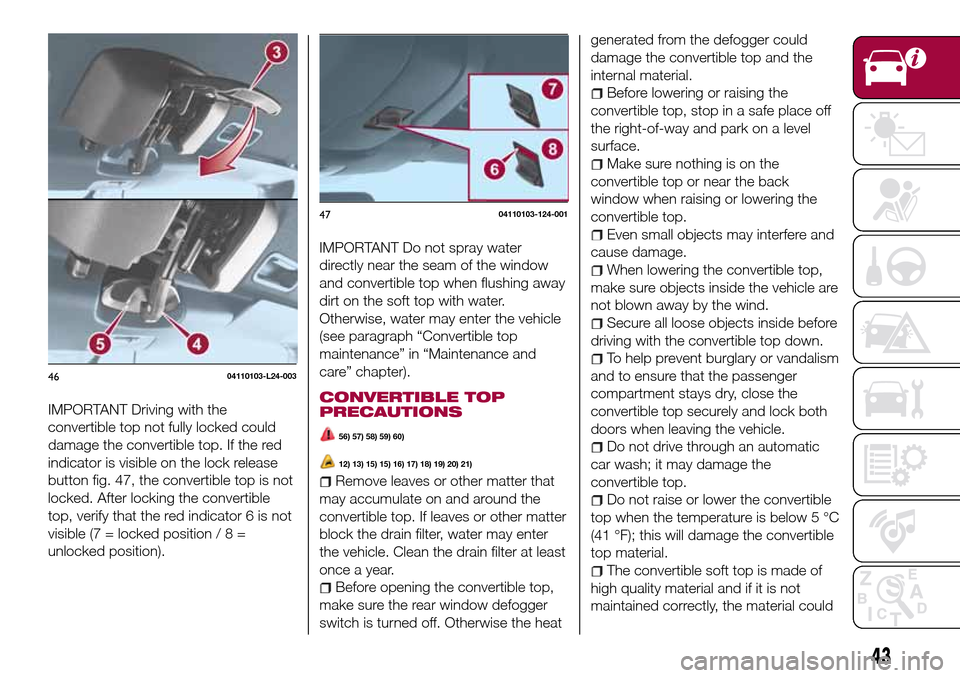
IMPORTANT Driving with the
convertible top not fully locked could
damage the convertible top. If the red
indicator is visible on the lock release
button fig. 47, the convertible top is not
locked. After locking the convertible
top, verify that the red indicator 6 is not
visible (7 = locked position/8=
unlocked position).IMPORTANT Do not spray water
directly near the seam of the window
and convertible top when flushing away
dirt on the soft top with water.
Otherwise, water may enter the vehicle
(see paragraph “Convertible top
maintenance” in “Maintenance and
care” chapter).
CONVERTIBLE TOP
PRECAUTIONS
56) 57) 58) 59) 60)
12) 13) 15) 15) 16) 17) 18) 19) 20) 21)
Remove leaves or other matter that
may accumulate on and around the
convertible top. If leaves or other matter
block the drain filter, water may enter
the vehicle. Clean the drain filter at least
once a year.
Before opening the convertible top,
make sure the rear window defogger
switch is turned off. Otherwise the heatgenerated from the defogger could
damage the convertible top and the
internal material.
Before lowering or raising the
convertible top, stop in a safe place off
the right-of-way and park on a level
surface.
Make sure nothing is on the
convertible top or near the back
window when raising or lowering the
convertible top.
Even small objects may interfere and
cause damage.
When lowering the convertible top,
make sure objects inside the vehicle are
not blown away by the wind.
Secure all loose objects inside before
driving with the convertible top down.
To help prevent burglary or vandalism
and to ensure that the passenger
compartment stays dry, close the
convertible top securely and lock both
doors when leaving the vehicle.
Do not drive through an automatic
car wash; it may damage the
convertible top.
Do not raise or lower the convertible
top when the temperature is below 5 °C
(41 °F); this will damage the convertible
top material.
The convertible soft top is made of
high quality material and if it is not
maintained correctly, the material could
4604110103-L24-003
4704110103-124-001
43
Page 46 of 216
harden, becomes stained, or have an
uneven gloss.
Do not lower the convertible top
when it's wet. If the convertible top
dries while folded, it will deteriorate and
mold.
Lowering the convertible top while
it's wet can also cause water to drip
into the cabin.
Do not raise or lower the convertible
top in a strong wind as it could damage
the convertible top or cause an
unexpected accident.
The power windows go down
automatically in conjunction with the
convertible top opening/closing.
However, this is a function for improving
the operability, and it does not mean
there is a problem. If the vehicle battery
is disconnected for vehicle maintenance
or other reasons, the power windows
will not go down automatically. If the
power windows do not go down, the
automatic open/close mechanism for
the windows must be reset.
The windblocker reduces the amount
of wind coming into the cabin from
behind when driving with the
convertible top opened.
WARNING
56)Before starting the vehicle make sure
the convertible top is correctly locked.
57)Sit in the seat with the seat belt
correctly fastened when the vehicle is
moving: standing in the vehicle, or sitting
on the convertible top storage area or
center console when the vehicle is moving
is a dangerous way to ride. During a
sudden manoeuvre or collision you could
be seriously injured or even killed.
58)Always keep your hands and fingers
away from the fastening mechanisms when
moving the convertible top: it is dangerous
to place your hands or fingers near the
fastening mechanisms. Your hands or
fingers could be caught and injured by the
mechanism.
59)Be careful while installing/removing the
soft top to prevent any damage or injury.
60)Keep children away from the area in
which the soft-top is folding while
installing/removing it.
IMPORTANT
12)Never open the soft top in presence of
snow or ice to prevent damage.
13)Loads may not be secured on the roof.
14)Bird droppings and plant resins must
be washed off the soft top immediately as
they can damage its fabric.
15)Never use high-pressure washing
systems.16)When using steam washers or
high-pressure water washers, maintain a
suitable distance and do not exceed a
maximum temperature of 60°C. Damage,
alterations and water infiltration may occur
if the distance is too small or if pressure is
too high.
17)If a water jet is used, direct away from
the edges of the fabric and the windscreen
surround to prevent water infiltration.
18)Never use alcohol, petrol, chemical
products, detergents, stain removers, wax,
solvents and “wash and polish” products.
19)Rinse immediately to remove soap to
prevent stains and blots. Repeat the
operation if needed.
20)Follow the instructions on the
waterproofing product container for perfect
results.
21)The rubber seals of the soft top must
be washed with water only. If you notice
that seals are dry or sticking, apply talcum
powder or products specifically for rubber
(silicone spray).
44
GETTING TO KNOW YOUR VEHICLE
Page 55 of 216
WARNING LIGHTS ON INSTRUMENT PANEL
Red warning lights
Warning light What it means
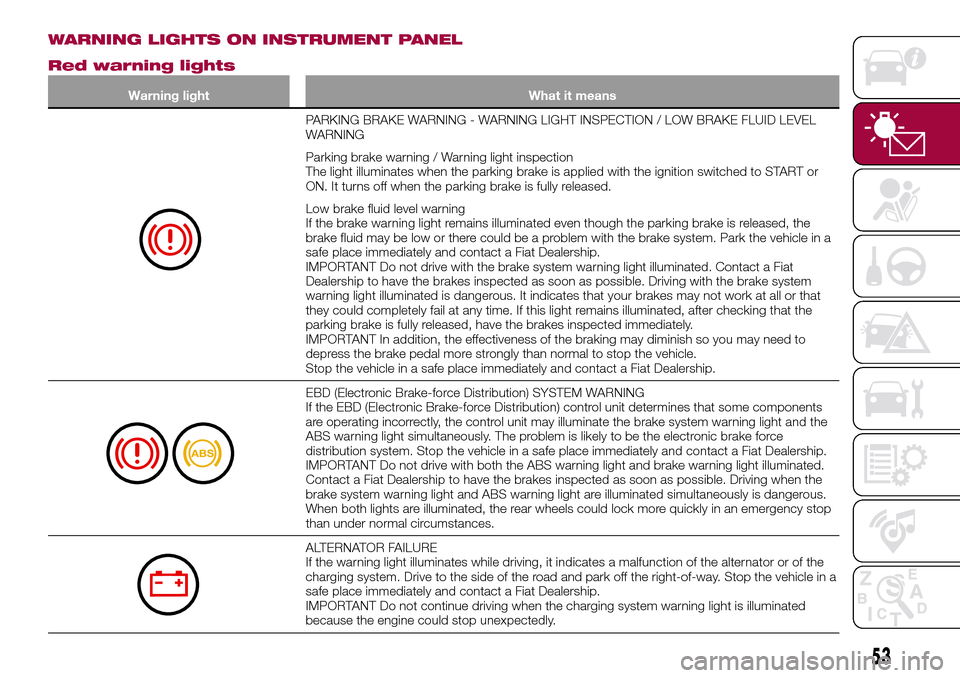
PARKING BRAKE WARNING - WARNING LIGHT INSPECTION / LOW BRAKE FLUID LEVEL
WARNING
Parking brake warning / Warning light inspection
The light illuminates when the parking brake is applied with the ignition switched to START or
ON. It turns off when the parking brake is fully released.
Low brake fluid level warning
If the brake warning light remains illuminated even though the parking brake is released, the
brake fluid may be low or there could be a problem with the brake system. Park the vehicle in a
safe place immediately and contact a Fiat Dealership.
IMPORTANT Do not drive with the brake system warning light illuminated. Contact a Fiat
Dealership to have the brakes inspected as soon as possible. Driving with the brake system
warning light illuminated is dangerous. It indicates that your brakes may not work at all or that
they could completely fail at any time. If this light remains illuminated, after checking that the
parking brake is fully released, have the brakes inspected immediately.
IMPORTANT In addition, the effectiveness of the braking may diminish so you may need to
depress the brake pedal more strongly than normal to stop the vehicle.
Stop the vehicle in a safe place immediately and contact a Fiat Dealership.
EBD (Electronic Brake-force Distribution) SYSTEM WARNING
If the EBD (Electronic Brake-force Distribution) control unit determines that some components
are operating incorrectly, the control unit may illuminate the brake system warning light and the
ABS warning light simultaneously. The problem is likely to be the electronic brake force
distribution system. Stop the vehicle in a safe place immediately and contact a Fiat Dealership.
IMPORTANT Do not drive with both the ABS warning light and brake warning light illuminated.
Contact a Fiat Dealership to have the brakes inspected as soon as possible. Driving when the
brake system warning light and ABS warning light are illuminated simultaneously is dangerous.
When both lights are illuminated, the rear wheels could lock more quickly in an emergency stop
than under normal circumstances.
ALTERNATOR FAILURE
If the warning light illuminates while driving, it indicates a malfunction of the alternator or of the
charging system. Drive to the side of the road and park off the right-of-way. Stop the vehicle in a
safe place immediately and contact a Fiat Dealership.
IMPORTANT Do not continue driving when the charging system warning light is illuminated
because the engine could stop unexpectedly.
53
Page 67 of 216
MESSAGE INDICATED ON
DISPLAY
(versions with Radio 7”)
If a message is displayed in the center
display, take appropriate action (in a
calm manner) according to the
displayed message.
If the following messages are displayed
in the centre display, a vehicle system
may be malfunctioning:
Engine Coolant Temperature
High: displays if the engine coolant
temperature has increased excessively.
Changing System Malfunction:
displays if the charging system has a
malfunction.
Temperature Warning: the
following message is displayed when
the temperature around the centre
display is high. Lowering the
temperature in the cabin or the
temperature around the centre display
by avoiding direct sunlight is
recommended.
Stop the vehicle in a safe place and
contact a Fiat Dealership.
WARNING SOUND IS
ACTIVATED
A warning sound is activated in
following cases:
Lights-on reminder;
Air Bag/seat belt pretensioner
system;
Active bonnet (where provided);
Ignition not switched off (STOP);
Key removed from vehicle;
Request switch inoperable (versions
with advanced keyless function);
Key left-in-boot compartment
(versions with advanced keyless
function);
Key left-in-vehicle (versions with
advanced keyless function);
Vehicle speed alarm (where
provided);
Tire inflation pressure warning beep
(where provided);
Outside temperature (where
provided);
Electronic steering lock;
Speed limiter (where provided);
120 km/h warning (where provided).
WARNING
61)Never tamper with the air
bag/pretensioner systems and always
contact a Fiat Dealership perform all
servicing and repairs. Self-servicing or
tampering with the systems is dangerous.
An air bag/pretensioner could accidentally
activate or become disabled causing
serious injury or death.62)Do not drive the vehicle with the active
bonnet warning light turned on or flashing.
Driving the vehicle with the active hood
warning light turned on or flashing is
dangerous as the active hood mechanism
may not activate normally and function as
intended in the event the vehicle were to
contact a pedestrian.
63)If the TPMS warning light illuminates or
flashes, or the tire pressure warning beep
sound is heard, decrease vehicle speed
immediately and avoid sudden
maneuvering and braking. If the warning
light illuminates or flashes, or the tire
pressure warning beep sound is heard, it is
dangerous to drive the vehicle at high
speeds, or perform sudden maneuvering
or braking. Vehicle drivability could worsen
and result in an accident. To determine if
you have a slow leak or a flat, pull over to a
safe position where you can check the
visual condition of the tire and determine if
you have enough air to proceed to a place
where air may be added and the system
monitored again by Fiat Dealership or a tire
repair station.
64)Do not ignore the TPMS warning light.
Ignoring the TPMS warning light is
dangerous, even if you know why it is
illuminated. Have the problem taken care of
as soon as possible before it develops into
a more serious situation that could lead to
tire failure and a dangerous accident.
65
Page 69 of 216
ACTIVE SAFETY
SYSTEMS
The vehicle has the following active
safety systems:
ABS (Anti-lock Braking System);
TCS (Traction Contol System);
DSC (Dynamic Stability Control);
Active bonnet (active pedestrian
protection).
For the operation of the systems, see
the following pages.
ABS SYSTEM (Antilock
Brake System)
65) 66) 67) 68)
The ABS control unit continuously
monitors the speed of each wheel. If
one wheel is about to lock up, the ABS
responds by automatically releasing
and reapplying that wheel's brake.
The driver will feel a slight vibration in
the brake pedal and may hear a
chattering noise from the brake system.
This is normal ABS system operation.
Continue to depress the brake pedal
without pumping the brakes.
The warning light turns on when the
system has a malfunction. Refer to
“Warning lights and messages”
paragraph in “Knowing the instrument
panel” chapter.
NOTE Braking distances may be longer
on loose surfaces (snow or gravel, forexample) which usually have a hard
foundation. A vehicle with a normal
braking system may require less
distance to stop under these conditions
because the tires will build up a wedge
of surface layer when the wheels skid.
NOTE The sound of the ABS operating
may be heard when starting the engine
or immediately after starting the vehicle,
however, it does not indicate a
malfunction.
TCS SYSTEM (Traction
Control System)
69) 70) 71)
The Traction Control System (TCS)
enhances traction and safety by
controlling engine torque and braking.
When the TCS detects driving wheel
slippage, it lowers engine torque and
operates the brakes to prevent loss of
traction.
This means that on a slick surface, the
engine adjusts automatically to provide
optimum power to the drive wheels,
limiting wheel spin and loss of traction.
The warning light turns on when the
system has a malfunction. Refer to
“Warning lights and messages”
paragraph in “Knowing the instrument
panel” chapter.TCS / DSC indicator light
The
indicator light stays on for a few
seconds when the ignition is switched
ON.
If the TCS or DSC is operating, the
indicator light flashes.
If the
light stays on, the TCS, DSC or
the brake assist system may have a
malfunction and they may not operate
correctly. Contact a Fiat Dealership.
IMPORTANT In addition to the warning
light flashing, a slight labouring sound
will come from the engine. This
indicates that the TCS/DSC is
operating properly.
IMPORTANT On slippery surfaces, such
as fresh snow, it will be impossible to
achieve high rpm when the TCS is on.
DSC SYSTEM (Dynamic
Stability Control)
72) 73) 74)
The Dynamic Stability Control (DSC)
automatically controls braking and
engine torque in conjunction with
systems such as ABS and TCS to help
control side slip when driving on
slippery surfaces, or during sudden or
evasive manoeuvring, enhancing vehicle
safety. Refer to “ABS system (Antilock
Brake System)” and “TCS system
(Traction Control System)”.
67
Page 74 of 216
indicate when the system is not
operating properly.
IMPORTANT The TPMS malfunction
indicator is combined with the low tire
pressure telltale. When the system
detects a malfunction, the telltale will
flash for approximately one minute and
then remain continuously illuminated.
This sequence will continue upon
subsequent vehicle start-ups as long as
the malfunction exists. When the
malfunction indicator is illuminated, the
system may not be able to detect or
signal low tire pressure as intended.
TPMS malfunctions may occur for a
variety of reasons, including the
installation of replacement or alternate
tires or wheels on the vehicle that
prevent the TPMS from functioning
properly. Always check the TPMS
malfunction telltale after replacing one
or more tires or wheels on your vehicle
to ensure that the replacement or
alternate tires and wheels allow the
TPMS to continue to function properly.
IMPORTANT To avoid false readings,
the system samples for a little while
before indicating a problem. As a result
it will not instantaneously register a
rapid tire deflation or blow out.
Because this system detects slight
changes in tire conditions, the timing ofthe warning may be faster or slower in
the following cases.
the size, manufacturer, or the type of
tires is different from the specification;
the size, manufacturer, or the type of
a tire is different from the others, or the
level of tire wear is excessively different
between them;
a run-flat tire (where provided),
studless tire, snow tire, or tire chains
are used;
an emergency tire is used (tire
pressure monitoring system warning
light may flash and then continue
illuminating);
a tire is repaired using the emergency
flat tire repair kit;
the tire pressure is excessively higher
than the specified pressure, or the tire
pressure is suddenly lowered for some
reason such as a tire burst during
driving;
the vehicle speed is lower than about
15 km/h (9 mph) (including when the
vehicle is stopped), or the drive period
is shorter than 5 minutes;
the vehicle is driven on an extremely
rough road or a slippery, icy road;
hard steering and rapid
acceleration/deceleration are repeated
such as during aggressive driving on a
winding road;
load on the vehicle is applied to a tire
such as by loading heavy luggage toone side of the vehicle;
system initialization has not been
implemented with the specified tire
pressure.
System error activation
When the TPMS warning light flashes,
there may be a system malfunction.
Contact a Fiat Dealership.
A system error activation may occur in
the following cases:
when there is equipment or a device
near the vehicle using the same radio
frequency as that of the tire pressure
sensors;
when a metallic device such as a
non-genuine navigation system is
equipped near the center of the
dashboard, which may block radio
signals from the tire pressure sensor to
the receiver unit;
when using the following devices in
the vehicle that may cause radio
interference with the receiver unit;
a digital device such as a personal
computer;
a current converter device such as a
DC-AC converter;
when excess snow or ice adheres to
the vehicle, especially around the
wheels;
when the tire pressure sensor
batteries are exhausted;
72
SAFETY
Page 78 of 216
SEAT BELTS
SEAT BELT
PRECAUTIONS
79) 80)
Seat belts help to decrease the
possibility of severe injury during
accidents and sudden stops. FCA
recommends that the driver and
passengers always wear seat belts.
All the seats have lap/shoulder belts.
These belts have retractors with inertia
locks that keep them out of the way
when not in use.
The locks allow the belts to remain
comfortable on users, but they will lock
in position during a collision.
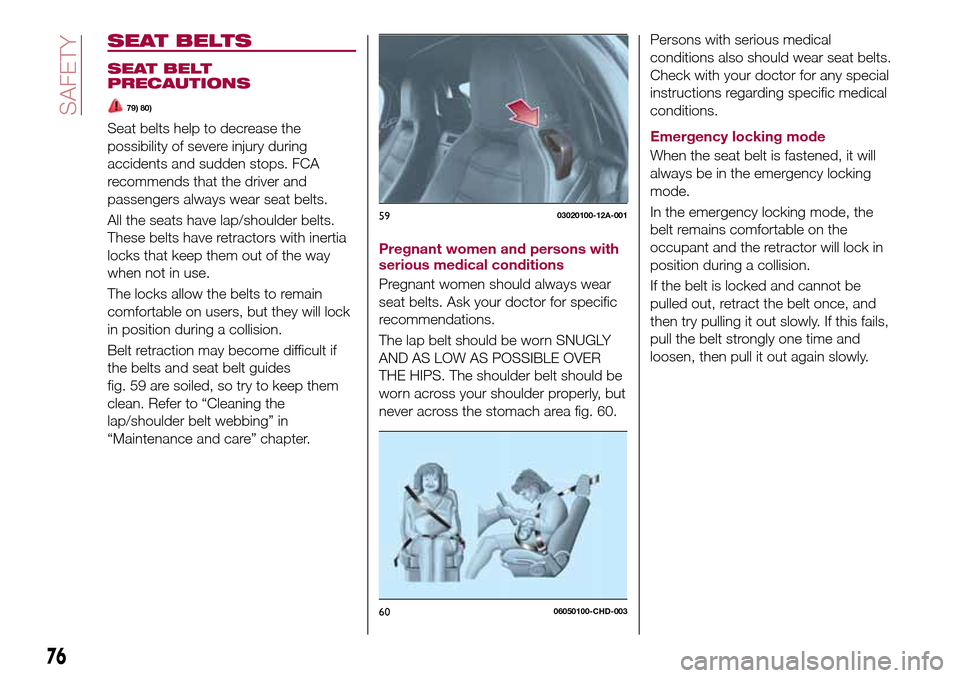
Belt retraction may become difficult if
the belts and seat belt guides
fig. 59 are soiled, so try to keep them
clean. Refer to “Cleaning the
lap/shoulder belt webbing” in
“Maintenance and care” chapter.Pregnant women and persons with
serious medical conditions
Pregnant women should always wear
seat belts. Ask your doctor for specific
recommendations.
The lap belt should be worn SNUGLY
AND AS LOW AS POSSIBLE OVER
THE HIPS. The shoulder belt should be
worn across your shoulder properly, but
never across the stomach area fig. 60.Persons with serious medical
conditions also should wear seat belts.
Check with your doctor for any special
instructions regarding specific medical
conditions.
Emergency locking mode
When the seat belt is fastened, it will
always be in the emergency locking
mode.
In the emergency locking mode, the
belt remains comfortable on the
occupant and the retractor will lock in
position during a collision.
If the belt is locked and cannot be
pulled out, retract the belt once, and
then try pulling it out slowly. If this fails,
pull the belt strongly one time and
loosen, then pull it out again slowly.
5903020100-12A-001
6006050100-CHD-003
76
SAFETY
Page 92 of 216
held, the seat will move suddenly and
could cause injury.
Proceed as follows:
open the convertible top;
make sure the ignition is switched
off;
slide the passenger seat as far back
as possible. You may need to move the
seat forward slightly and recline the
back of the seat, in order to assist in
the fittment of some child-restraint
systems;
make sure the seatback is securely
latched by pushing it back until it is fully
locked;
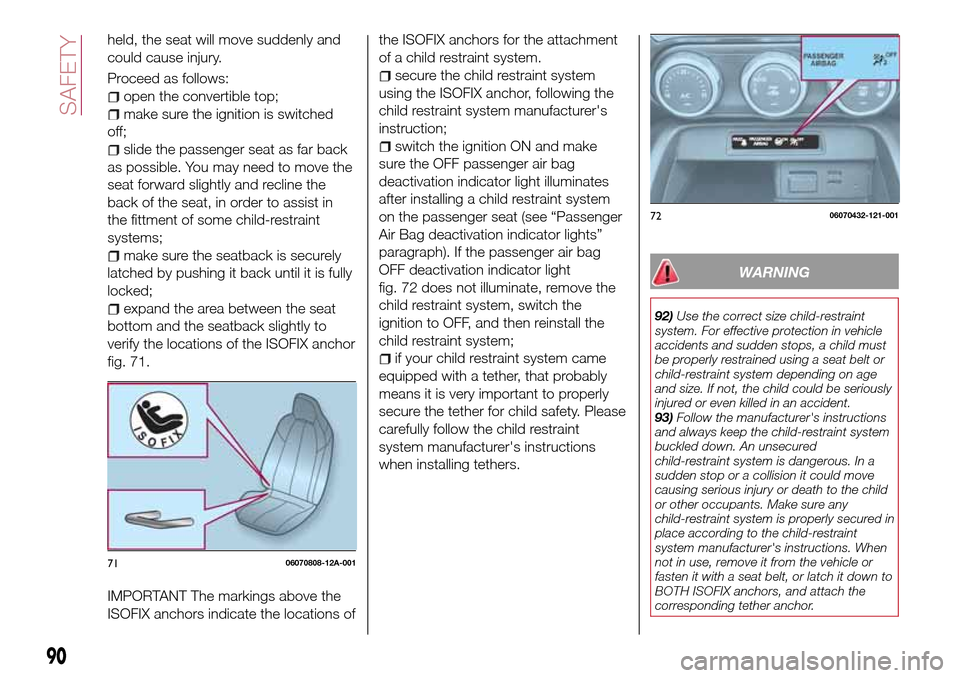
expand the area between the seat
bottom and the seatback slightly to
verify the locations of the ISOFIX anchor
fig. 71.
IMPORTANT The markings above the
ISOFIX anchors indicate the locations ofthe ISOFIX anchors for the attachment
of a child restraint system.
secure the child restraint system
using the ISOFIX anchor, following the
child restraint system manufacturer's
instruction;
switch the ignition ON and make
sure the OFF passenger air bag
deactivation indicator light illuminates
after installing a child restraint system
on the passenger seat (see “Passenger
Air Bag deactivation indicator lights”
paragraph). If the passenger air bag
OFF deactivation indicator light
fig. 72 does not illuminate, remove the
child restraint system, switch the
ignition to OFF, and then reinstall the
child restraint system;
if your child restraint system came
equipped with a tether, that probably
means it is very important to properly
secure the tether for child safety. Please
carefully follow the child restraint
system manufacturer's instructions
when installing tethers.
WARNING
92)Use the correct size child-restraint
system. For effective protection in vehicle
accidents and sudden stops, a child must
be properly restrained using a seat belt or
child-restraint system depending on age
and size. If not, the child could be seriously
injured or even killed in an accident.
93)Follow the manufacturer's instructions
and always keep the child-restraint system
buckled down. An unsecured
child-restraint system is dangerous. In a
sudden stop or a collision it could move
causing serious injury or death to the child
or other occupants. Make sure any
child-restraint system is properly secured in
place according to the child-restraint
system manufacturer's instructions. When
not in use, remove it from the vehicle or
fasten it with a seat belt, or latch it down to
BOTH ISOFIX anchors, and attach the
corresponding tether anchor.
7106070808-12A-001
7206070432-121-001
90
SAFETY