light FIAT 124 SPIDER 2016 2.G Workshop Manual
[x] Cancel search | Manufacturer: FIAT, Model Year: 2016, Model line: 124 SPIDER, Model: FIAT 124 SPIDER 2016 2.GPages: 216, PDF Size: 3.1 MB
Page 81 of 216
SBA SYSTEM
(Seat Belt Alert)
SEAT BELT WARNING
LIGHT
The LED on dashboard trim turns on if
the driver or passenger's seat is
occupied and the seat belt is not
fastened with the ignition switched ON.
If the driver or passenger's seat belt is
unfastened (only when the passenger
seat is occupied) and the vehicle is
driven at a speed faster than about
20 km/h, the
LED flashes. After a
short time, the LED stops flashing, but
remains illuminated.
If a seat belt remains unfastened, the
LED flashes again for a given period of
time. In this case, fasten the seat belt.
If the driver or passenger's seat belt is
unfastened after the LED turns on, and
the vehicle speed exceeds 20 km/h, the
LED flashes again.
SEAT BELT
PRETENSIONER AND
LOAD LIMITING
SYSTEMS
PRETENSIONERS
88) 89) 90) 91)
For optimum protection, the driver and
passenger seat belts are equipped with
pretensioner and load limiting systems.
For both these systems to work
properly you must wear the seat belt
properly.
When a collision is detected, the
pretensioners deploy simultaneously
with the air bags. For deployment
details, refer to the “SRS air bag
deployment criteria” paragraph in this
chapter.
The seat belt retractors remove slack
quickly as the air bags are expanding.
Any time the air bags and seat belt
pretensioners have fired they must be
replaced.
A system malfunction or operation
conditions are indicated by a warning.
Refer to “Warning lights and messages”
and “Warning sound is activated”
paragraph in “Knowing the instrument
panel” chapter.
In addition, the pretensioner system for
the passenger, like the front and side
passenger air bag, is designed to onlydeploy when the passenger occupant
classification sensor detects a
passenger sitting on the passenger's
seat. For details, refer to the passenger
occupant classification sensor.
IMPORTANT The pretensioner system
may not operate depending on the type
of the collision. For details, refer to the
“SRS Air Bag deployment criteria”
paragraph.
IMPORTANT Some smoke (non-toxic
gas) will be released when the air bags
and pretensioners deploy. This does
not indicate a fire. This gas normally
has no effect on occupants, however,
those with sensitive skin may
experience slight skin irritation. If
residue from the deployment of the air
bags or the pretensioner system gets
on the skin or in the eyes, wash it off as
soon as possible.
LOAD LIMITER
The load limiting system releases belt
webbing in a controlled manner to
reduce belt force on the occupant's
chest.
While the most severe load on a seat
belt occurs in frontal collisions, the load
limiter has an automatic mechanical
function and can activate in any
accident mode with sufficient occupant
movement.
79
Page 83 of 216
passenger seat with the air bag system
activated. In the event of an impact the
air bag activation may cause fatal
injuries to the transported child.
To reduce the chance of injuries caused
by deployment of the passenger air
bag, the passenger occupant
classification sensor work as a part of
the supplementary restraint system.
This system deactivates the passenger
front and side air bags and also the
passenger seat belt pretensioner
system when the passenger air bag
deactivation OFF indicator light
illuminates.
When an infant or small child sits on the
passenger seat, the system shuts off
the passenger front and side air bags
and seat belt pretensioner system, so
make sure the passenger air bag
deactivation OFF indicator light
illuminates. For more details, refer to
"Passenger occupant classification
sensor" in “Front Air Bags” paragraph.IMPORTANT A seat belt or
child-restraint system can become very
hot in a closed vehicle during warm
weather. To avoid burning yourself or a
child, check them before you or your
child touches them.
NOTE Your vehicle is equipped with
ISOFIX anchors for attachment of
ISOFIX child-restraint systems. When
using these anchors to secure a
child-restraint system, refer to “Using
ISOFIX anchor” paragraph in this
chapter.
81
Page 92 of 216
held, the seat will move suddenly and
could cause injury.
Proceed as follows:
open the convertible top;
make sure the ignition is switched
off;
slide the passenger seat as far back
as possible. You may need to move the
seat forward slightly and recline the
back of the seat, in order to assist in
the fittment of some child-restraint
systems;
make sure the seatback is securely
latched by pushing it back until it is fully
locked;
expand the area between the seat
bottom and the seatback slightly to
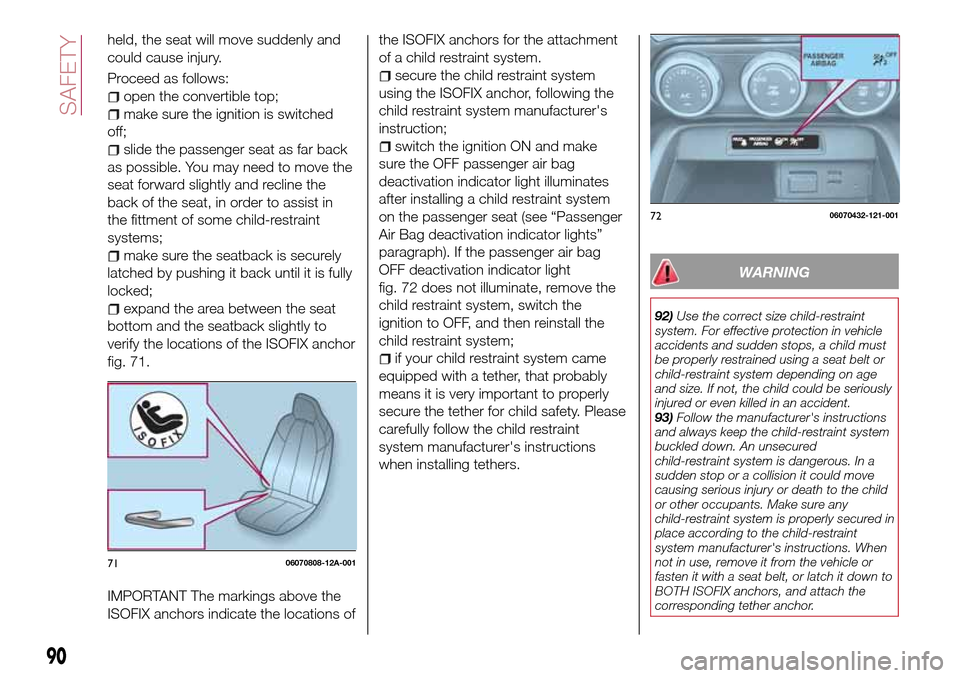
verify the locations of the ISOFIX anchor
fig. 71.
IMPORTANT The markings above the
ISOFIX anchors indicate the locations ofthe ISOFIX anchors for the attachment
of a child restraint system.
secure the child restraint system
using the ISOFIX anchor, following the
child restraint system manufacturer's
instruction;
switch the ignition ON and make
sure the OFF passenger air bag
deactivation indicator light illuminates
after installing a child restraint system
on the passenger seat (see “Passenger
Air Bag deactivation indicator lights”
paragraph). If the passenger air bag
OFF deactivation indicator light
fig. 72 does not illuminate, remove the
child restraint system, switch the
ignition to OFF, and then reinstall the
child restraint system;
if your child restraint system came
equipped with a tether, that probably
means it is very important to properly
secure the tether for child safety. Please
carefully follow the child restraint
system manufacturer's instructions
when installing tethers.
WARNING
92)Use the correct size child-restraint
system. For effective protection in vehicle
accidents and sudden stops, a child must
be properly restrained using a seat belt or
child-restraint system depending on age
and size. If not, the child could be seriously
injured or even killed in an accident.
93)Follow the manufacturer's instructions
and always keep the child-restraint system
buckled down. An unsecured
child-restraint system is dangerous. In a
sudden stop or a collision it could move
causing serious injury or death to the child
or other occupants. Make sure any
child-restraint system is properly secured in
place according to the child-restraint
system manufacturer's instructions. When
not in use, remove it from the vehicle or
fasten it with a seat belt, or latch it down to
BOTH ISOFIX anchors, and attach the
corresponding tether anchor.
7106070808-12A-001
7206070432-121-001
90
SAFETY
Page 93 of 216
94)Always secure a child in a proper
child-restraint system. Holding a child in
your arms while the vehicle is moving is
extremely dangerous. No matter how
strong the person may be, he or she
cannot hold onto a child in a sudden stop
or collision and it could result in serious
injury or death to the child or other
occupants. Even in a moderate accident,
the child may be exposed to air bag forces
that could result in serious injury or death
to the child, or the child may be slammed
into an adult, causing injury to both child
and adult.
95)Always make sure the passenger air
bag deactivation OFF indicator light is
illuminated when using a child restraint
system. Seating a child in a child restraint
system that is installed on the passenger
seat with the passenger air bag
deactivation OFF indicator light not
illuminated is extremely dangerous. In an
accident, an air bag could inflate and
cause serious injuries or even death to the
child seated in the child restraint system.
Always make sure the passenger air bag
deactivation OFF indicator light is
illuminated.
96)Extreme Hazard! Never use a
rear-facing child-restraint system on the
passenger seat with an air bag that could
deploy: NEVER use a rearward facing child
restraint on a seat protected by an ACTIVE
AIRBAG in front of it, DEATH or SERIOUS
INJURY to the CHILD can occur. Vehicles
with a passenger air bag have a warning
label attached as shown below. This
warning label is displayed in compliance
with regulations.97)Even in a moderate collision, the
child-restraint system can be hit by a
deploying air bag and moved violently
backward resulting in serious injury or
death to the child. If your vehicle is
equipped with a passenger occupant
classification system, always make sure the
passenger air bag deactivation OFF
indicator light is illuminated, when installing
a rear-facing child restraint system on the
passenger seat.
98)Before installing child-restraint system
on the passenger seat, move the
passenger seat as far back as possible.
The rearmost position may not be suitable
for the installation of some child-restraint
systems. In a collision, the force of a
deploying air bag could cause serious
injury or death to the child. Make sure the
passenger air bag deactivation OFF
indicator light is illuminated.99)Seating a child in a child-restraint
system on the passenger seat is
dangerous under certain conditions. Your
vehicle is equipped with passenger
occupant classification sensor. Even with
the passenger occupant classification
sensor, if you must use the passenger seat
to seat a child, using a child restraint
system on the passenger seat under the
following conditions increases the danger
of the passenger air bag deploying and
could result in serious injury or death to the
child. The passenger air bag deactivation
OFF indicator light does not illuminate
when seating a child in the child-restraint
system / Luggage or other items are
placed on the seat with the child in the
child-restraint system / The seat is washed
/ Liquids are spilled on the seat / The
passenger seat is moved backward,
pushing into luggage or other items placed
behind it / Luggage or other items are
placed between the passenger seat and
driver seat / An electric device is put on the
passenger's seat / An additional electrical
device, such as a seat warmer is installed
to the surface of the passenger seat.
91
Page 94 of 216
100)Do not allow a child or anyone to lean
over or against the side window of a
vehicle with side air bags. It is dangerous
to allow anyone to lean over or against the
side window, the area of the passenger
seat from which the side air bags deploy,
even if a child-restraint system is used. The
impact of inflation from a side air bag could
cause serious injury or death to an out of
position child. Furthermore, leaning over or
against the door could block the side air
bags and eliminate the advantages of
supplementary protection. Because the
side air bag deploys from the outer
shoulder of the seat, do not allow the child
to lean over or against the side window,
even if the child is seated in a
child-restraint system.
101)Never use one seat belt on more than
one person at a time. Using one seat belt
for more than one person at a time is
dangerous. A seat belt used in this way
cannot spread the impact forces properly
and the two passengers could be crushed
together and seriously injured or even
killed. Never use one belt for more than
one person at a time and always operate
the vehicle with each occupant properly
restrained.
102)Use the tether and tether anchor only
for a child-restraint system. Child restraint
system anchorages are designed to
withstand only those loads imposed by
correctly installed child-restraint systems.
Under no circumstances are they to be
used for adult seat belts, harnesses, or for
attaching other items or equipment to the
vehicle.103)Always install a rear-facing child seat
in the correct seat position. Installing a
rear-facing child seat without first
consulting the table “Child restraint system
suitability for various seat positions” is
dangerous. A rear-facing child seat
installed on the wrong seat position cannot
be properly secured. In a collision, the child
could hit something or someone in the
vehicle and be seriously injured or even
killed.
104)Never use a rear-facing child-restraint
system on the passenger seat protected
by an air bag. Extreme Hazard! Do not use
a rearward facing child restraint on a seat
protected by an airbag in front of it! The
child-restraint system can be hit by the
deploying air bag and knocked out of
position. A child in the child-restraint
system could be seriously injured or killed.
If your vehicle is equipped with a
passenger occupant classification system,
always make sure the passenger air bag
deactivation OFF indicator light is
illuminated, if installing a rear-facing
child-restraint system on the passenger
seat is unavoidable.
105)Never install a front-facing child seat
in the wrong seat position: Installing a
front-facing child seat without first
consulting the table “Child restraint system
suitability for various seat positions” is
dangerous. A front-facing child seat
installed in the wrong seat position cannot
be properly secured. In a collision, the child
could hit something or someone in the
vehicle and be seriously injured or even
killed. Make sure the passenger air bag
deactivation OFF indicator light is
illuminated.106)Before installing child-restraint system
on the passenger seat, move the
passenger seat as far back as possible: In
a collision, the force of a deploying air bag
could cause serious injury or death to the
child. Make sure the passenger air bag
deactivation OFF indicator light is
illuminated.
107)Always attach the tether strap to the
correct tether anchor position. Attaching
the tether strap to the incorrect tether
anchor position is dangerous. In a collision,
the tether strap could come off and loosen
the child restraint system. If the child
restraint system moves it could result in
death or injury to the child.
108)Always route the tether strap between
the head restraint and the seat back.
Routing the tether strap on top of the head
restraint is dangerous. In a collision the
tether strap could slide off the head
restraint and loosen the child restraint
system. The child restraint system could
move which may result in death or injury to
the child.
109)Follow the manufacturer's instructions
for the use of the child-restraint system. An
unsecured child restraint system is
dangerous. In a sudden stop or a collision
it could move causing serious injury or
death to the child or other occupants.
Make sure any child restraint system is
properly secured in place according to the
manufacturer's instructions.
92
SAFETY
Page 96 of 216
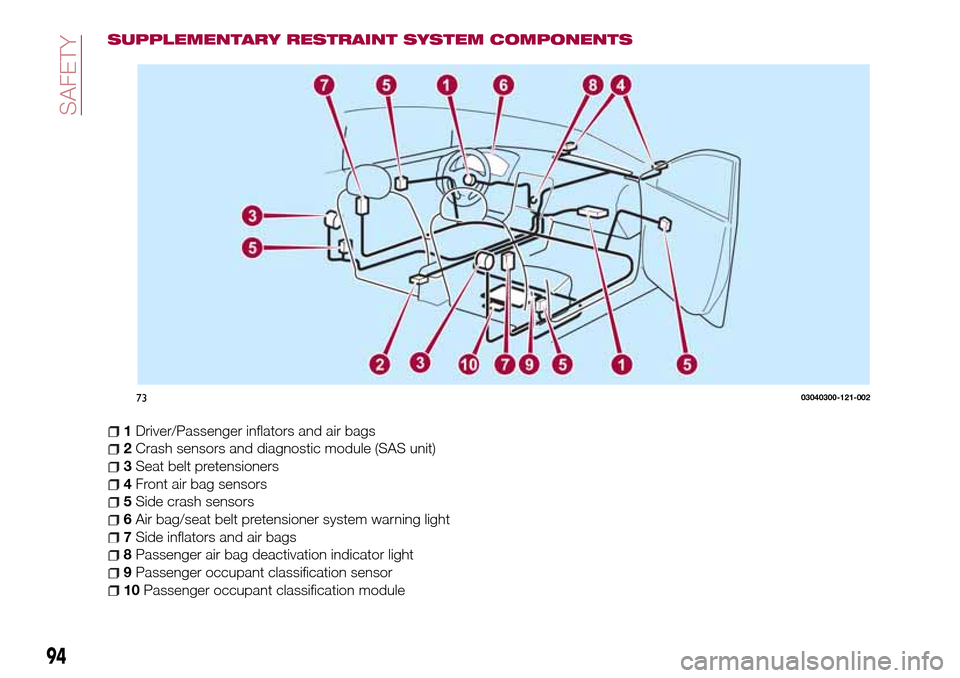
SUPPLEMENTARY RESTRAINT SYSTEM COMPONENTS
1Driver/Passenger inflators and air bags
2Crash sensors and diagnostic module (SAS unit)
3Seat belt pretensioners
4Front air bag sensors
5Side crash sensors
6Air bag/seat belt pretensioner system warning light
7Side inflators and air bags
8Passenger air bag deactivation indicator light
9Passenger occupant classification sensor
10Passenger occupant classification module
7303040300-121-002
94
SAFETY
Page 98 of 216
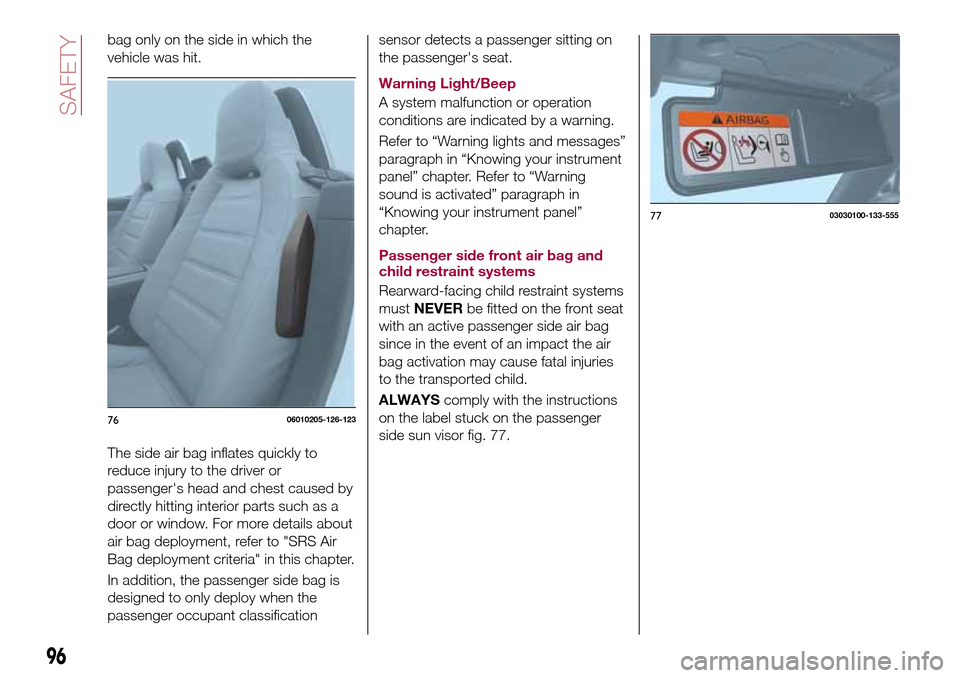
bag only on the side in which the
vehicle was hit.
The side air bag inflates quickly to
reduce injury to the driver or
passenger's head and chest caused by
directly hitting interior parts such as a
door or window. For more details about
air bag deployment, refer to "SRS Air
Bag deployment criteria" in this chapter.
In addition, the passenger side bag is
designed to only deploy when the
passenger occupant classificationsensor detects a passenger sitting on
the passenger's seat.
Warning Light/Beep
A system malfunction or operation
conditions are indicated by a warning.
Refer to “Warning lights and messages”
paragraph in “Knowing your instrument
panel” chapter. Refer to “Warning
sound is activated” paragraph in
“Knowing your instrument panel”
chapter.
Passenger side front air bag and
child restraint systems
Rearward-facing child restraint systems
mustNEVERbe fitted on the front seat
with an active passenger side air bag
since in the event of an impact the air
bag activation may cause fatal injuries
to the transported child.
ALWAYScomply with the instructions
on the label stuck on the passenger
side sun visor fig. 77.
7606010205-126-123
7703030100-133-555
96
SAFETY
Page 102 of 216
PASSENGER OCCUPANT
CLASSIFICATION
SYSTEM
128) 129)
First, please read "Supplemental
Restraint System (SRS) Precautions"
carefully.
Passenger occupant classification
sensor
Your vehicle is equipped with a
passenger occupant classification
sensor as a part of the supplementary
restraint system. This sensor is
equipped in the passenger's seat
cushion. This sensor measures the
electrostatic capacity of the
passenger's seat.
The SAS unit is designed to prevent the
passenger front and side air bags and
seat belt pretensioner system fromdeploying if the passenger air bag
deactivation indicator light turns on.
To reduce the chance of injuries caused
by deployment of the passenger air
bag, the system deactivates the
passenger front and side air bags and
also the seat belt pretensioner system
when the passenger air bag
deactivation indicator light turns on.
This system shuts off the passenger
front and side air bags and seat belt
pretensioner system, so make sure the
passenger air bag deactivation indicator
light turns on.
The air bag/seat belt pretensioner
system warning light flashes and the
passenger air bag deactivation indicator
light illuminates if the sensors have a
possible malfunction. If this happens,
the passenger front and side air bags
and seat belt pretensioner system will
not deploy.
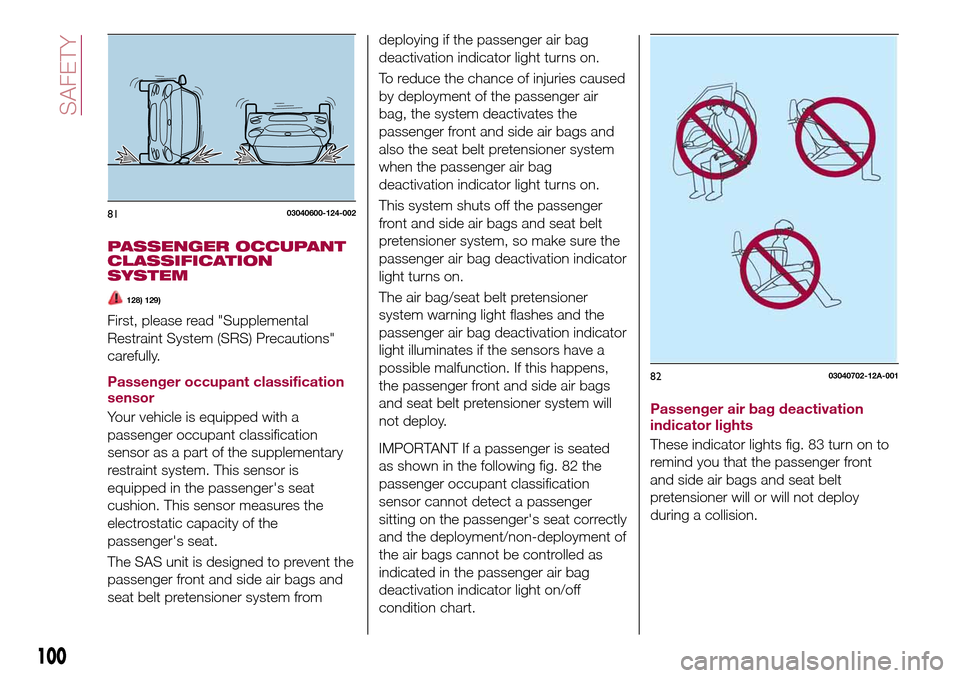
IMPORTANT If a passenger is seated
as shown in the following fig. 82 the
passenger occupant classification
sensor cannot detect a passenger
sitting on the passenger's seat correctly
and the deployment/non-deployment of
the air bags cannot be controlled as
indicated in the passenger air bag
deactivation indicator light on/off
condition chart.
Passenger air bag deactivation
indicator lights
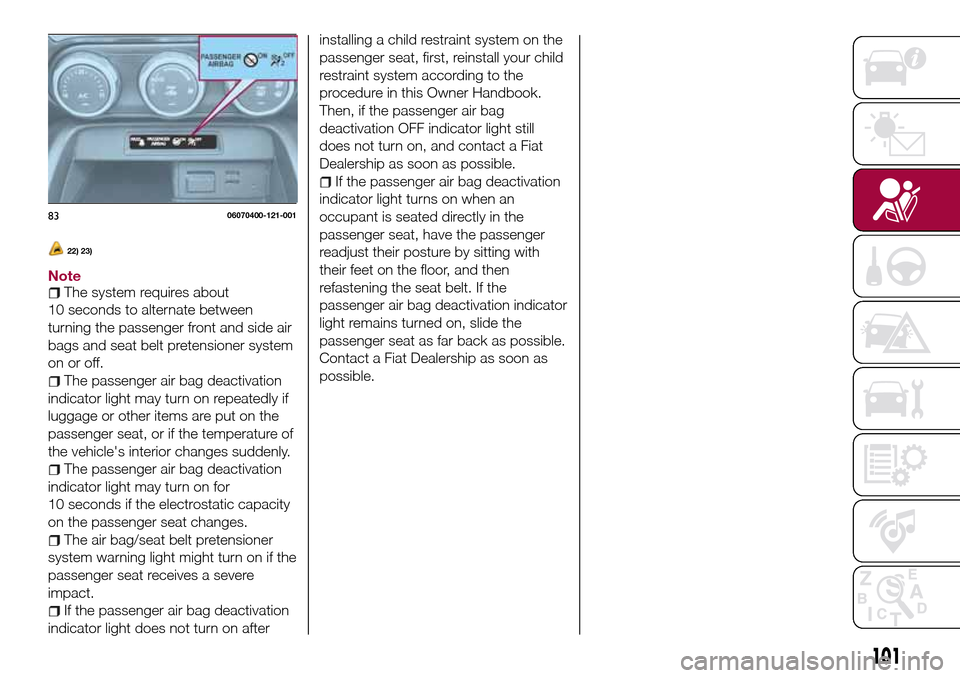
These indicator lights fig. 83 turn on to
remind you that the passenger front
and side air bags and seat belt
pretensioner will or will not deploy
during a collision.
8103040600-124-002
8203040702-12A-001
100
SAFETY
Page 103 of 216
22) 23)
NoteThe system requires about
10 seconds to alternate between
turning the passenger front and side air
bags and seat belt pretensioner system
on or off.
The passenger air bag deactivation
indicator light may turn on repeatedly if
luggage or other items are put on the
passenger seat, or if the temperature of
the vehicle's interior changes suddenly.
The passenger air bag deactivation
indicator light may turn on for
10 seconds if the electrostatic capacity
on the passenger seat changes.
The air bag/seat belt pretensioner
system warning light might turn on if the
passenger seat receives a severe
impact.
If the passenger air bag deactivation
indicator light does not turn on afterinstalling a child restraint system on the
passenger seat, first, reinstall your child
restraint system according to the
procedure in this Owner Handbook.
Then, if the passenger air bag
deactivation OFF indicator light still
does not turn on, and contact a Fiat
Dealership as soon as possible.
If the passenger air bag deactivation
indicator light turns on when an
occupant is seated directly in the
passenger seat, have the passenger
readjust their posture by sitting with
their feet on the floor, and then
refastening the seat belt. If the
passenger air bag deactivation indicator
light remains turned on, slide the
passenger seat as far back as possible.
Contact a Fiat Dealership as soon as
possible.
8306070400-121-001
101
Page 104 of 216
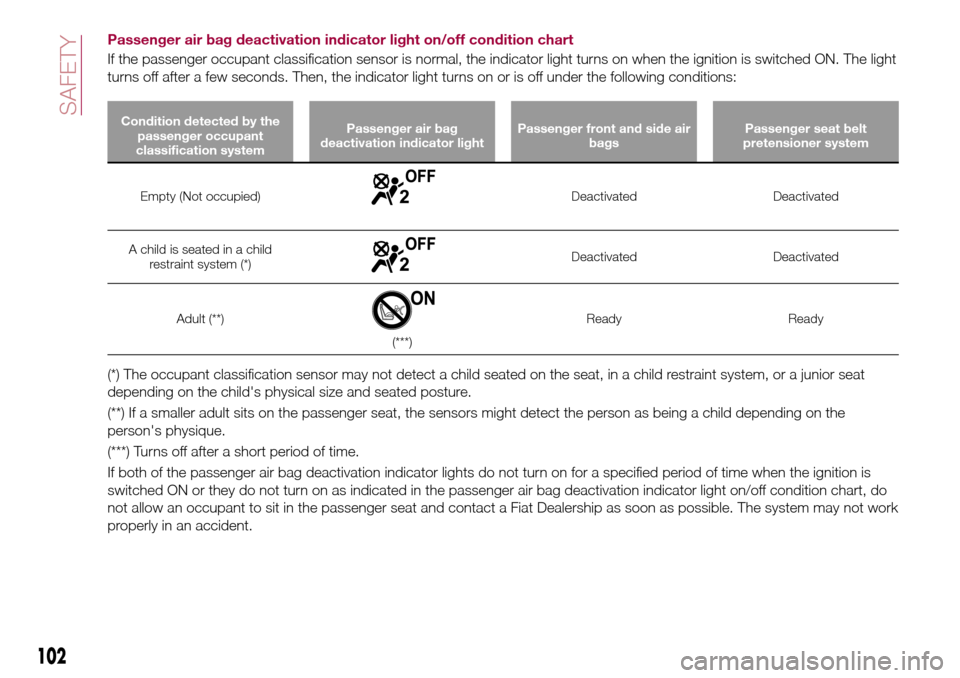
Passenger air bag deactivation indicator light on/off condition chart
If the passenger occupant classification sensor is normal, the indicator light turns on when the ignition is switched ON. The light
turns off after a few seconds. Then, the indicator light turns on or is off under the following conditions:
Condition detected by the
passenger occupant
classification systemPassenger air bag
deactivation indicator lightPassenger front and side air
bagsPassenger seat belt
pretensioner system
Empty (Not occupied)Deactivated Deactivated
A child is seated in a child
restraint system (*)
Deactivated Deactivated
Adult (**)
(***)Ready Ready
(*) The occupant classification sensor may not detect a child seated on the seat, in a child restraint system, or a junior seat
depending on the child's physical size and seated posture.
(**) If a smaller adult sits on the passenger seat, the sensors might detect the person as being a child depending on the
person's physique.
(***) Turns off after a short period of time.
If both of the passenger air bag deactivation indicator lights do not turn on for a specified period of time when the ignition is
switched ON or they do not turn on as indicated in the passenger air bag deactivation indicator light on/off condition chart, do
not allow an occupant to sit in the passenger seat and contact a Fiat Dealership as soon as possible. The system may not work
properly in an accident.
102
SAFETY