engine FIAT 124 SPIDER ABARTH 2017 2.G Owners Manual
[x] Cancel search | Manufacturer: FIAT, Model Year: 2017, Model line: 124 SPIDER ABARTH, Model: FIAT 124 SPIDER ABARTH 2017 2.GPages: 292, PDF Size: 121.25 MB
Page 266 of 292
Engine Number
The engine number label is located on
the engine.
RECOMMENDED
TIRE INFLATION
PRESSURE
On the tire label you will find the
recommended tire inflation pressure in
both psi and kPa for the tires installed
as original equipment on the vehicle.
It is very important that the inflation
pressure of the tires on your vehicle is
maintained at the recommended
pressure.
You should check the tire pressure
regularly to insure that the proper
inflation pressure is maintained.
Note:
Tire pressures listed on the vehicle
placard or tire information label indicate
the recommended cold tire inflation
pressure, measured when the tires are
cold, after the vehicle has been parked
for at least three hours. As you drive,
the temperature in the tire warms up,
increasing the tire pressure.
Always check the tire inflation
pressures on a regular basis according
to the recommended tire inflation
pressure on the tire label and in
conjunction with the information in this
Owner's Manual. Driving your vehicle
with under-inflated tires is dangerous.
Under-inflation is the most common
cause of failures in any kind of tire and
may result in severe cracking, tread
separation or “blowout”, with
unexpected loss of vehicle control and
increased risk of injury. Under-inflation
increases sidewall flexing and rolling
resistance, resulting in heat buildup
and internal damage to the tire. It
results in unnecessary tire stress,
irregular wear, loss of control and
accidents. A tire can lose up to half of
its air pressure and not appear to be
flat. It is impossible to determine
whether or not tires are properly
inflated just by looking at them.
10010107-121-002-high.jpgTire Pressure Label
264
TECHNICAL SPECIFICATIONS
Page 268 of 292
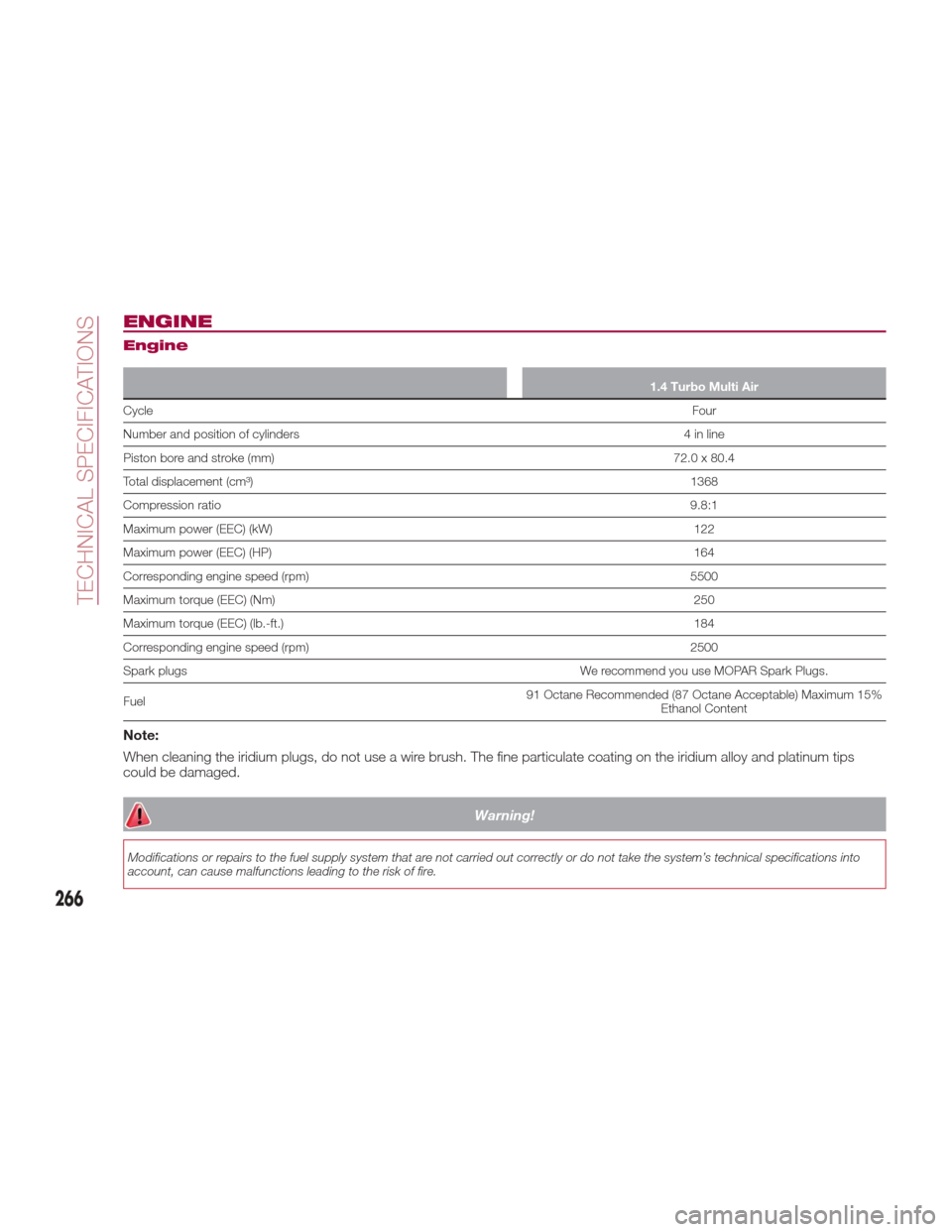
ENGINE
Engine
1.4 Turbo Multi Air
Cycle Four
Number
and position of cylinders 4 in line
Piston bore and stroke (mm) 72.0 x 80.4
Total displacement (cm³) 1368
Compression ratio 9.8:1
Maximum power (EEC) (kW) 122
Maximum power (EEC) (HP) 164
Corresponding engine speed (rpm) 5500
Maximum torque (EEC) (Nm) 250
Maximum torque (EEC) (lb.-ft.) 184
Corresponding engine speed (rpm) 2500
Spark plugs We recommend you use MOPAR Spark Plugs.
Fuel 91 Octane Recommended (87 Octane Acceptable) Maximum 15%
Ethanol Content
Note:
When cleaning the iridium plugs, do not use a wire brush. The fine particulate coating on the iridium alloy and platinum tips
could be damaged.
Warning!
Modifications or repairs to the fuel supply system that are not carried out correctly or do not take the system’s technical specifications into
account, can cause malfunctions leading to the risk of fire.
266
TECHNICAL SPECIFICATIONS
Page 269 of 292
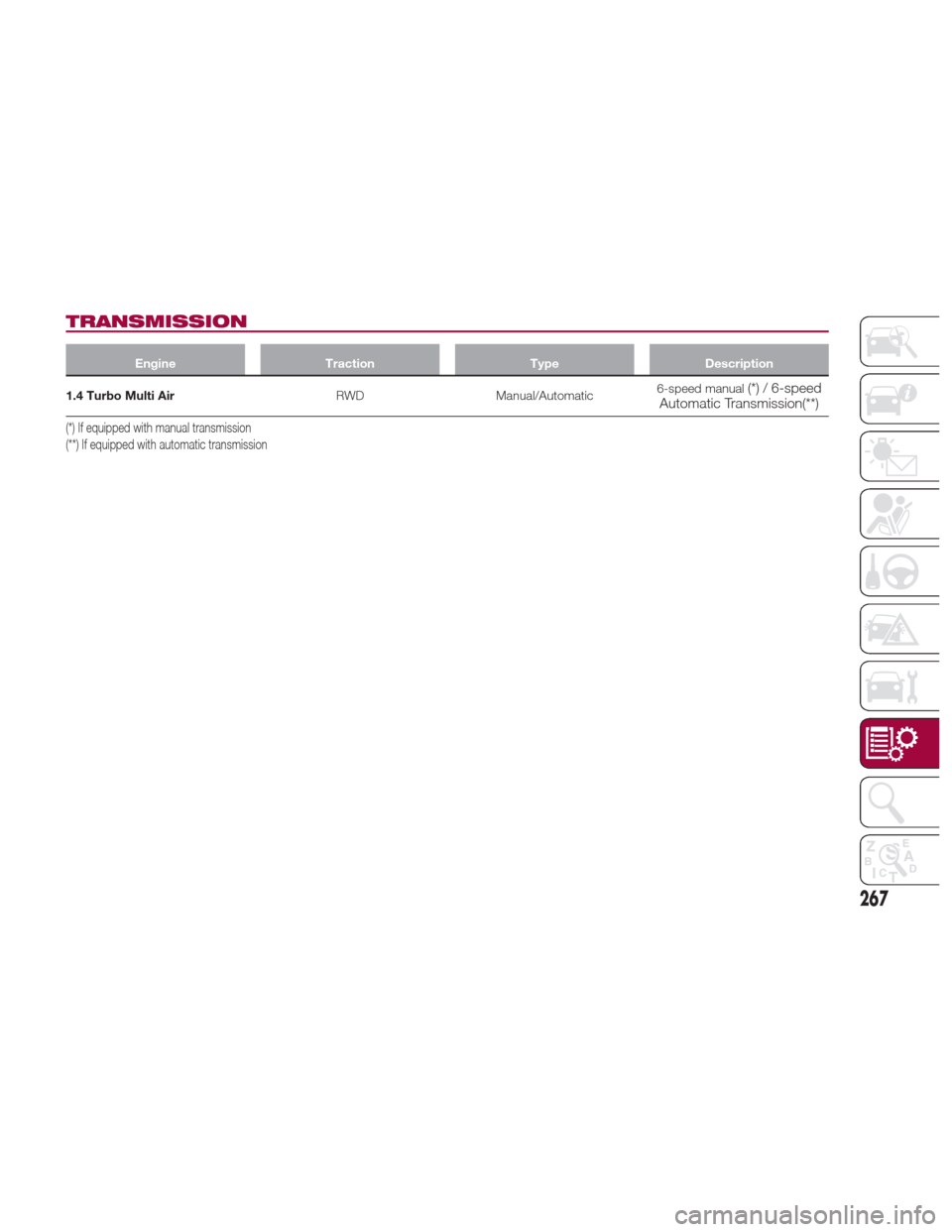
TRANSMISSION
EngineTraction TypeDescription
1.4 Turbo Multi Air R
WDManual/Automatic 6-speed manual(*) / 6-speed
Automatic Transmission(**)
(*) If equipped with manual transmission
(**) If equipped with automatic transmission
267
Page 270 of 292
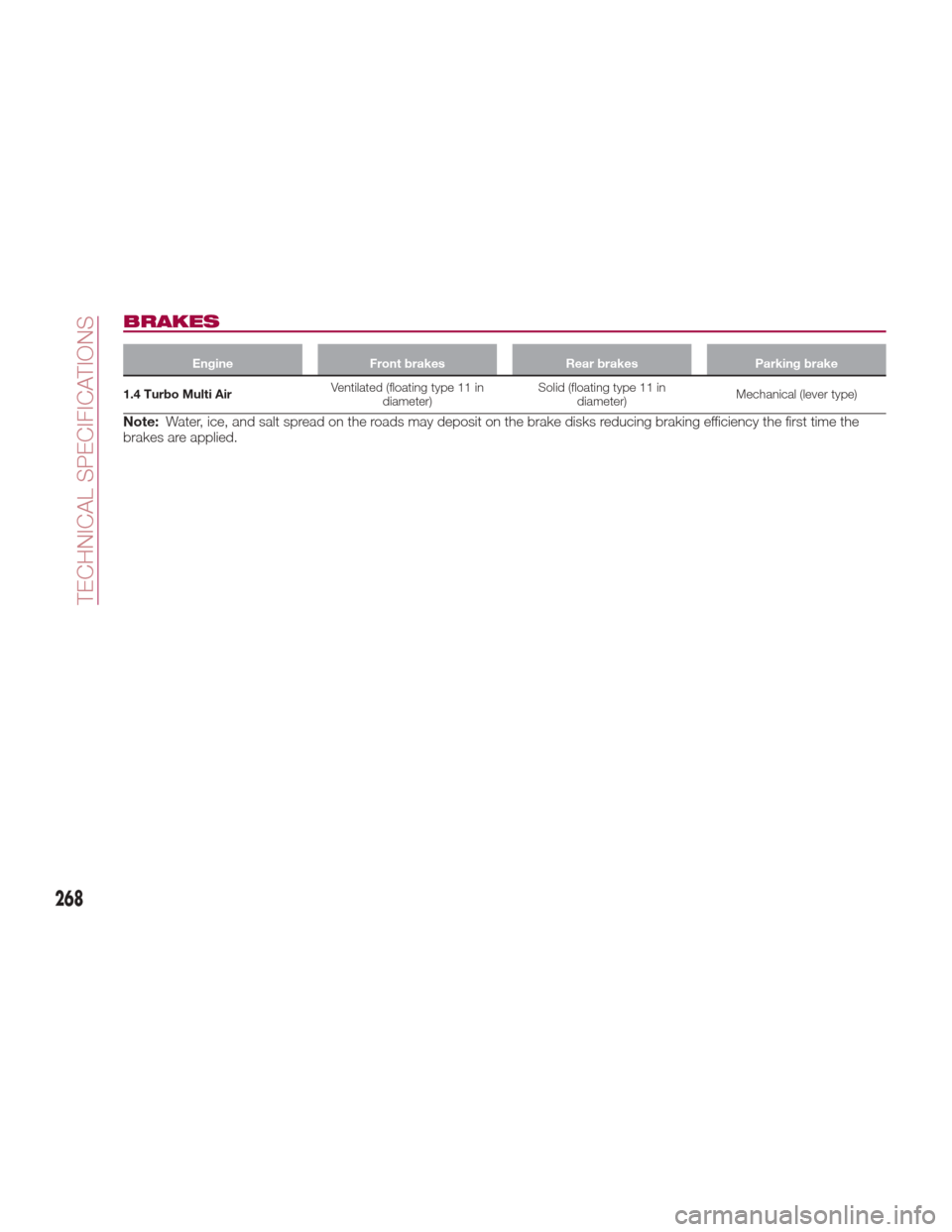
BRAKES
EngineFront brakes Rear brakesParking brake
1.4 Turbo Multi Air V
entilated (floating type 11 in
diameter) Solid (floating type 11 in
diameter) Mechanical (lever type)
Note:
Water, ice, and salt spread on the roads may deposit on the brake disks reducing braking efficiency the first time the
brakes are applied.
268
TECHNICAL SPECIFICATIONS
Page 271 of 292
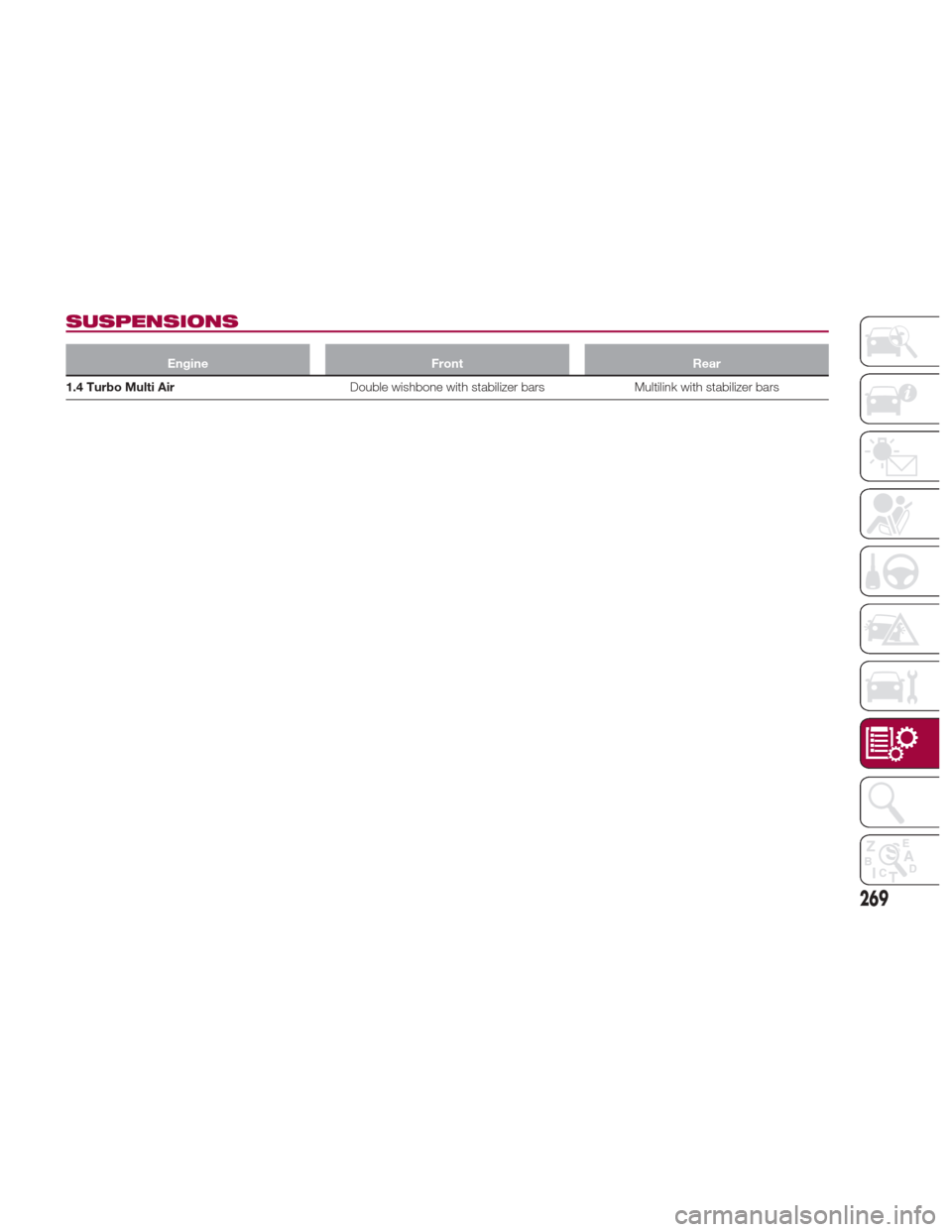
SUSPENSIONS
EngineFrontRear
1.4 Turbo Multi Air Double
wishbone with stabilizer barsMultilink with stabilizer bars
269
Page 272 of 292
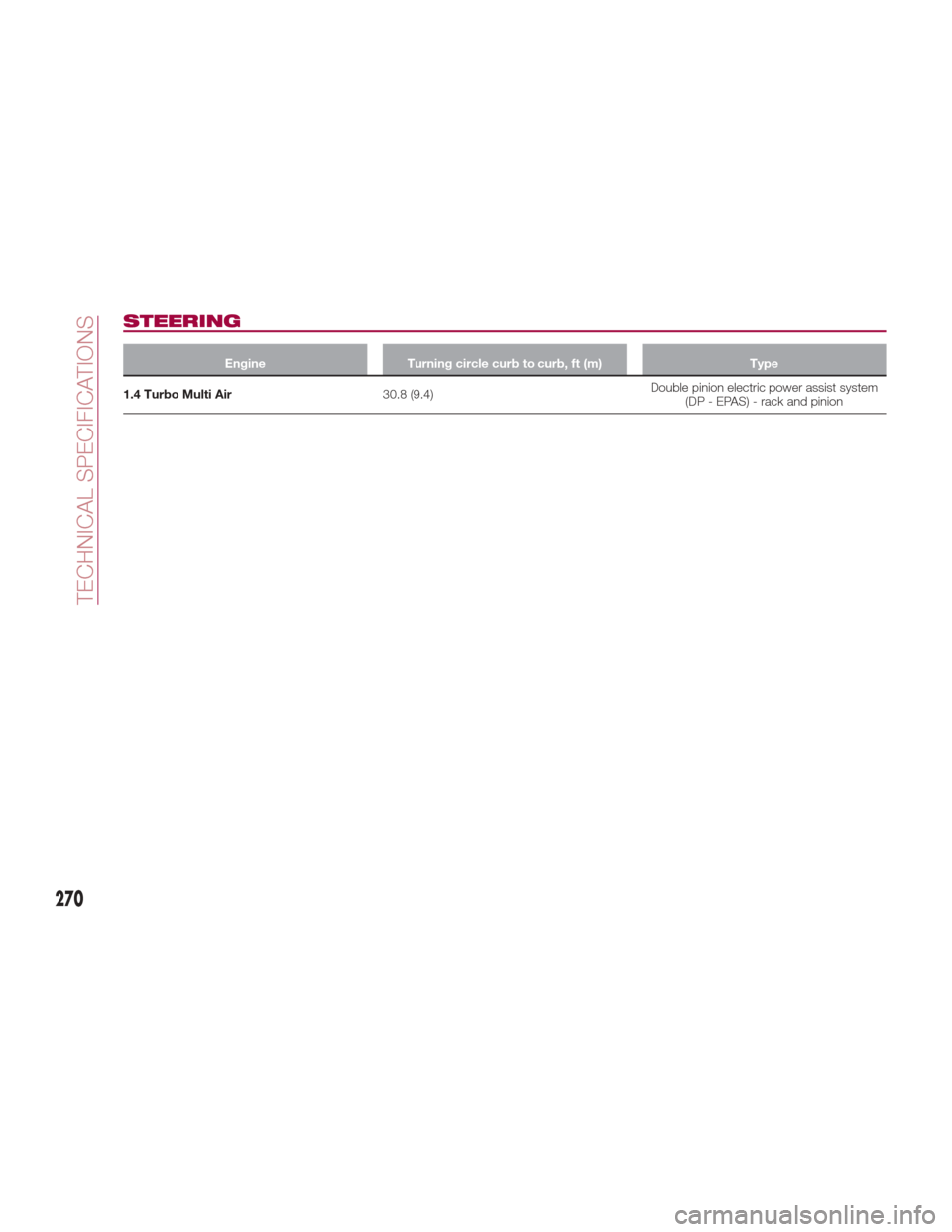
STEERING
EngineTurning circle curb to curb, ft (m) Type
1.4 Turbo Multi Air 30.8
(9.4)Double pinion electric power assist system
(DP - EPAS) - rack and pinion
270
TECHNICAL SPECIFICATIONS
Page 275 of 292
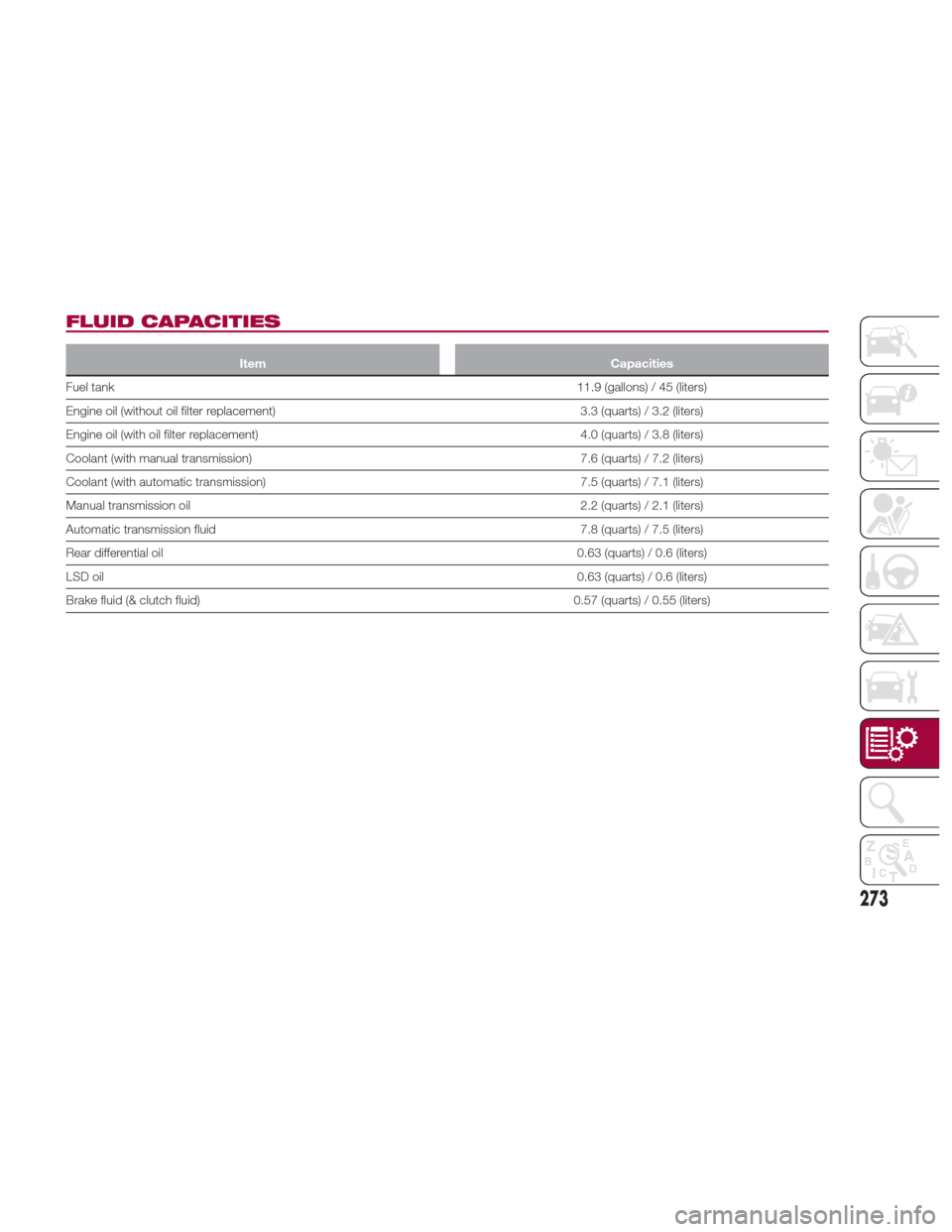
FLUID CAPACITIES
ItemCapacities
Fuel tank 11.9
(gallons) / 45 (liters)
Engine oil (without oil filter replacement) 3.3 (quarts) / 3.2 (liters)
Engine oil (with oil filter replacement) 4.0 (quarts) / 3.8 (liters)
Coolant (with manual transmission) 7.6 (quarts) / 7.2 (liters)
Coolant (with automatic transmission) 7.5 (quarts) / 7.1 (liters)
Manual transmission oil 2.2 (quarts) / 2.1 (liters)
Automatic transmission fluid 7.8 (quarts) / 7.5 (liters)
Rear differential oil 0.63 (quarts) / 0.6 (liters)
LSD oil 0.63 (quarts) / 0.6 (liters)
Brake fluid (& clutch fluid) 0.57 (quarts) / 0.55 (liters)
273
Page 276 of 292
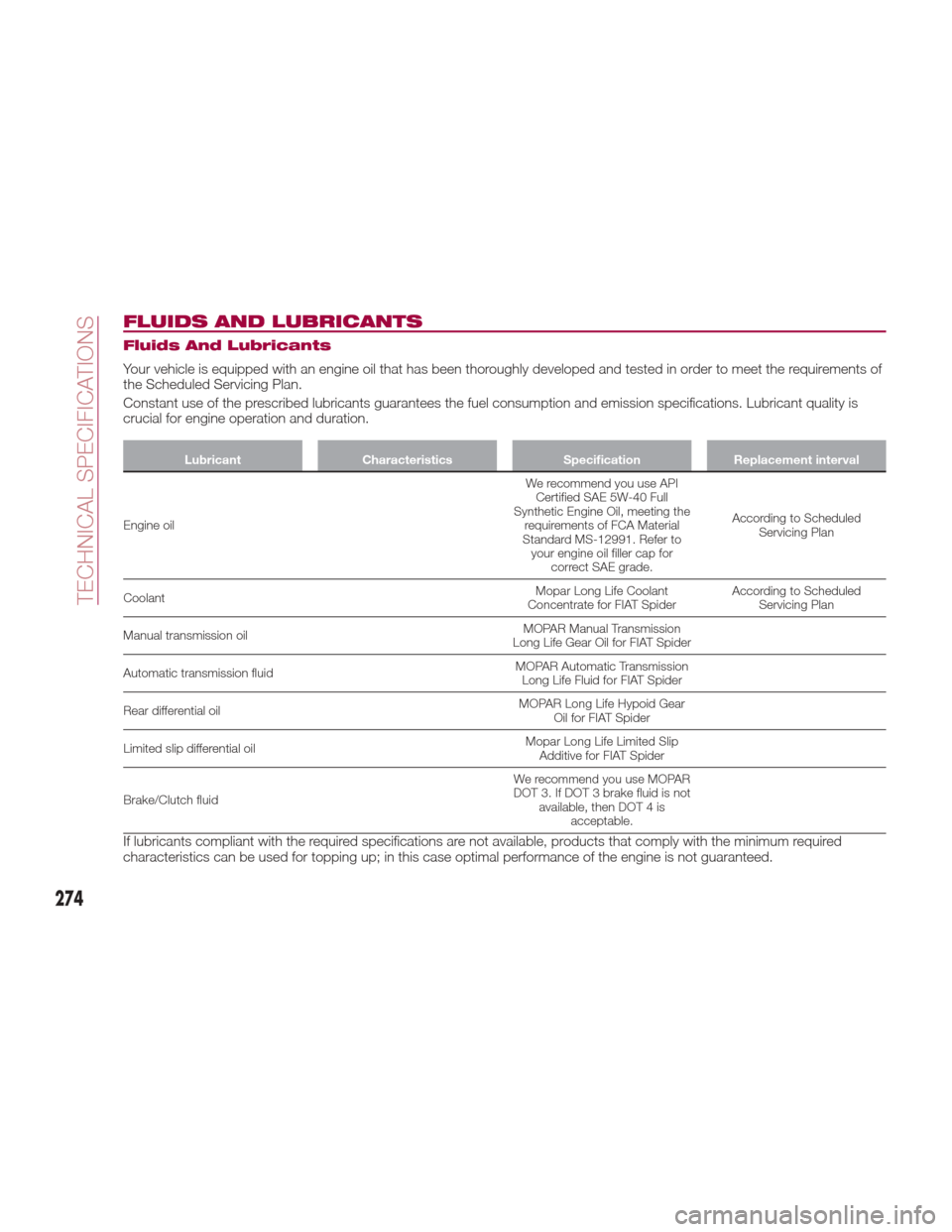
FLUIDS AND LUBRICANTS
Fluids And Lubricants
Your vehicle is equipped with an engine oil that has been thoroughly developed and tested in order to meet the requirements of
the Scheduled Servicing Plan.
Constant use of the prescribed lubricants guarantees the fuel consumption and emission specifications. Lubricant quality is
crucial for engine operation and duration.
LubricantCharacteristics SpecificationReplacement interval
Engine oil W
e recommend you use API
Certified SAE 5W-40 Full
Synthetic Engine Oil, meeting the requirements of FCA Material
Standard MS-12991. Refer to your engine oil filler cap for correct SAE grade. According to Scheduled
Servicing Plan
Coolant Mopar Long Life Coolant
Concentrate for FIAT Spider According to Scheduled
Servicing Plan
Manual transmission oil MOPAR Manual Transmission
Long Life Gear Oil for FIAT Spider
Automatic transmission fluid MOPAR Automatic Transmission
Long Life Fluid for FIAT Spider
Rear differential oil MOPAR Long Life Hypoid Gear
Oil for FIAT Spider
Limited slip differential oil Mopar Long Life Limited Slip
Additive for FIAT Spider
Brake/Clutch fluid We recommend you use MOPAR
DOT 3. If DOT 3 brake fluid is not available, then DOT 4 is acceptable.
If lubricants compliant with the required specifications are not available, products that comply with the minimum required
characteristics can be used for topping up; in this case optimal performance of the engine is not guaranteed.
274
TECHNICAL SPECIFICATIONS
Page 277 of 292
Caution!
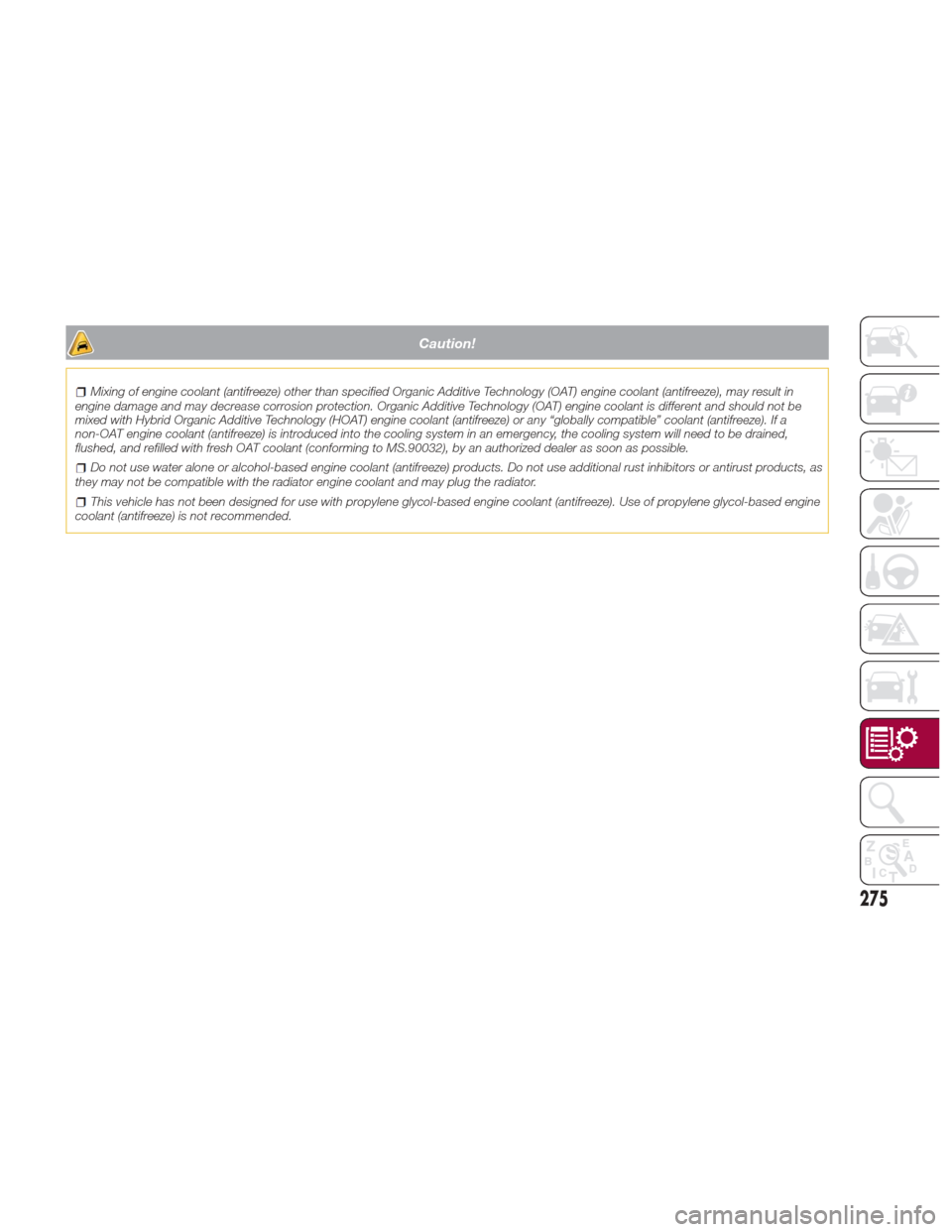
Mixing of engine coolant (antifreeze) other than specified Organic Additive Technology (OAT) engine coolant (antifreeze), may result in
engine damage and may decrease corrosion protection. Organic Additive Technology (OAT) engine coolant is different and should not be
mixed with Hybrid Organic Additive Technology (HOAT) engine coolant (antifreeze) or any “globally compatible” coolant (antifreeze). If a
non-OAT engine coolant (antifreeze) is introduced into the cooling system in an emergency, the cooling system will need to be drained,
flushed, and refilled with fresh OAT coolant (conforming to MS.90032), by an authorized dealer as soon as possible.
Do not use water alone or alcohol-based engine coolant (antifreeze) products. Do not use additional rust inhibitors or antirust products, as
they may not be compatible with the radiator engine coolant and may plug the radiator.
This vehicle has not been designed for use with propylene glycol-based engine coolant (antifreeze). Use of propylene glycol-based engine
coolant (antifreeze) is not recommended.
275
Page 280 of 292
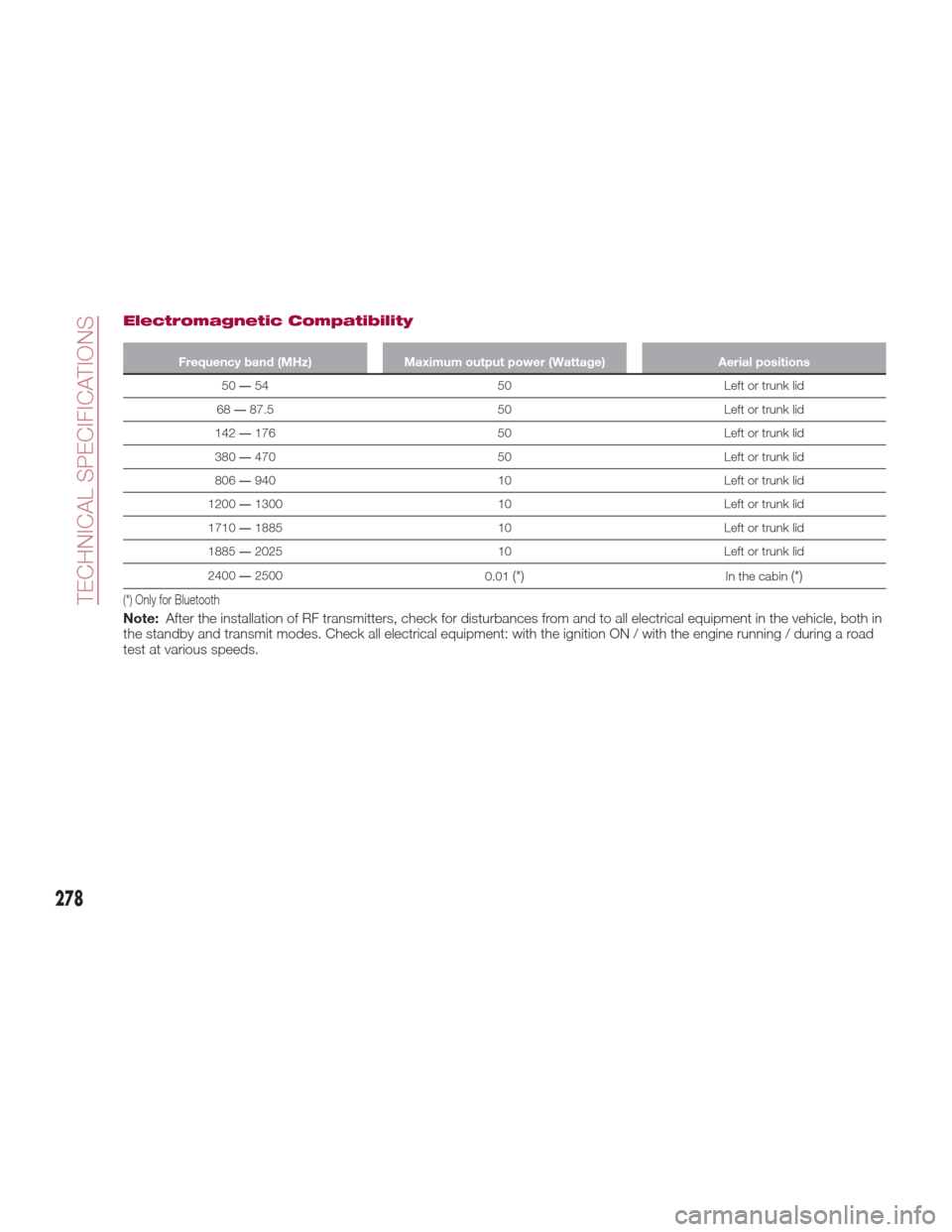
Electromagnetic Compatibility
Frequency band (MHz)Maximum output power (Wattage) Aerial positions
50 ―54
50Left or trunk lid
68 ―87.5 50Left or trunk lid
142 ―176 50Left or trunk lid
380 ―470 50Left or trunk lid
806 ―940 10Left or trunk lid
1200 ―1300 10Left or trunk lid
1710 ―1885 10Left or trunk lid
1885 ―2025 10Left or trunk lid
2400 ―2500
0.01
(*)In the cabin(*)
(*) Only for Bluetooth
Note:After the installation of RF transmitters, check for disturbances from and to all electrical equipment in the vehicle, both in
the standby and transmit modes. Check all electrical equipment: with the ignition ON / with the engine running / during a road
test at various speeds.
278
TECHNICAL SPECIFICATIONS