tail FIAT 500 1957 1.G Workshop Manual
[x] Cancel search | Manufacturer: FIAT, Model Year: 1957, Model line: 500, Model: FIAT 500 1957 1.GPages: 128, PDF Size: 9.01 MB
Page 11 of 128
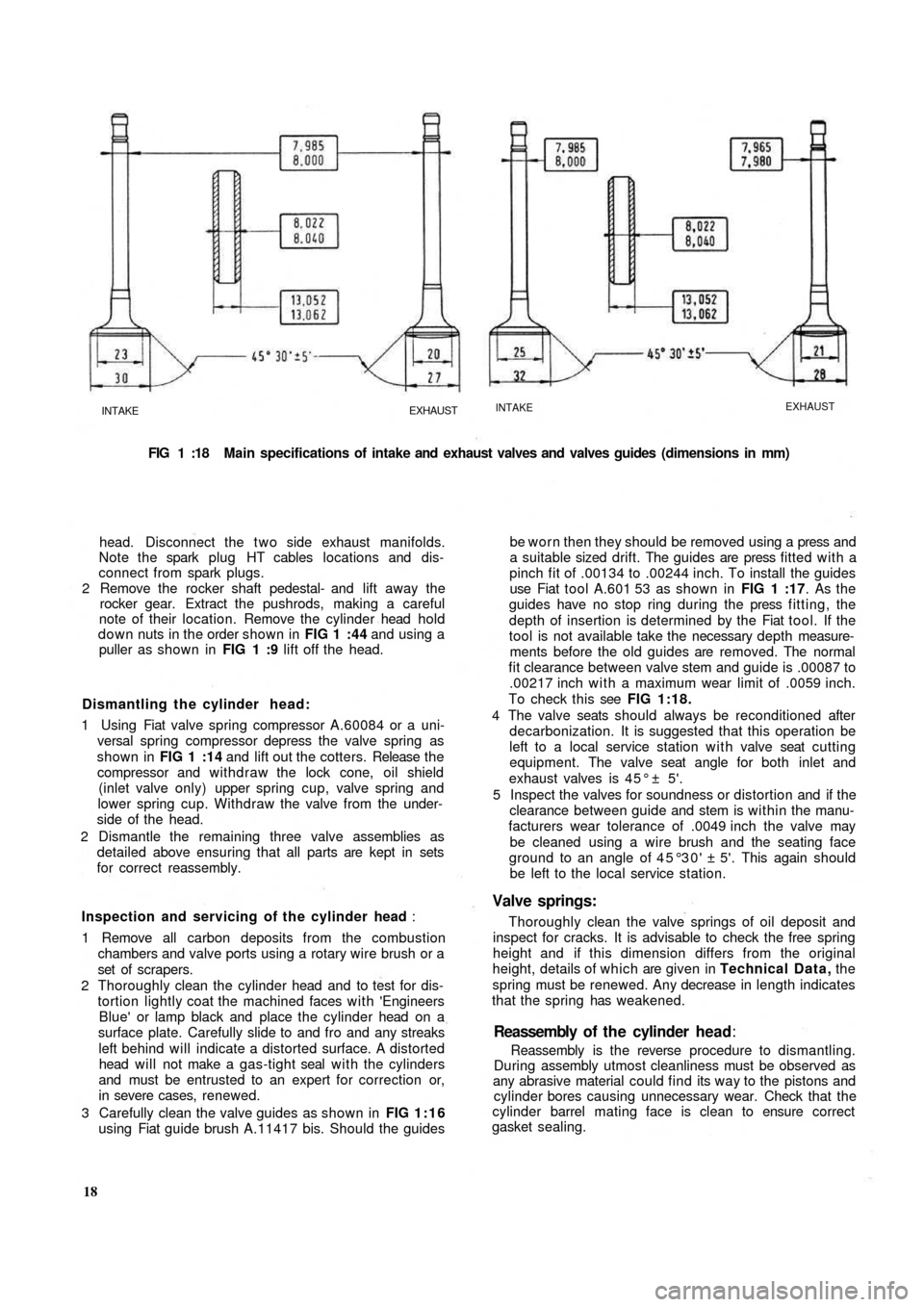
INTAKEEXHAUSTINTAKEEXHAUST
FIG 1 :18 Main specifications of intake and exhaust valves and valves guides (dimensions in mm)
head. Disconnect the t w o side exhaust manifolds.
Note the spark plug HT cables locations and dis-
connect from spark plugs.
2 Remove the rocker shaft pedestal- and lift away the
rocker gear. Extract the pushrods, making a careful
note of their location. Remove the cylinder head hold
down nuts in the order shown in FIG 1 :44 and using a
puller as shown in FIG 1 :9 lift off the head.
Dismantling the cylinder head:
1 Using Fiat valve spring compressor A.60084 or a uni-
versal spring compressor depress the valve spring as
shown in FIG 1 :14 and lift out the cotters. Release t h e
compressor and withdraw the lock cone, oil shield
(inlet valve only) upper spring cup, valve spring and
lower spring cup. Withdraw the valve from the under-
side of the head.
2 Dismantle the remaining three valve assemblies as
detailed above ensuring that all parts are kept in sets
for correct reassembly.
Inspection and servicing of the cylinder head :
1 Remove all carbon deposits from the combustion
chambers and valve ports using a rotary wire brush or a
set of scrapers.
2 Thoroughly clean the cylinder head and to test for dis-
tortion lightly coat the machined faces with 'Engineers
Blue' or lamp
black and place the cylinder head on a
surface plate. Carefully slide to and fro and any streaks
left behind will indicate a distorted surface. A distorted
head will not make a gas-tight seal with the cylinders
and must be entrusted to an expert for correction or,
in severe cases, renewed.
3 Carefully clean the valve guides as shown in FIG 1:16
using Fiat guide brush A.11417 bis. Should the guides
18Reassembly is the reverse procedure to dismantling.
During assembly utmost cleanliness must be observed as
any abrasive material could find its way to the pistons and
cylinder bores causing unnecessary wear. Check that the
cylinder barrel mating face is clean to ensure correct
gasket sealing.Reassembly of t h e cylinder head:
be worn then they should be removed using a press and
a suitable sized drift. The guides are press fitted with a
pinch fit of .00134 to .00244 inch. To install the guides
use Fiat tool A.601 53 as shown in FIG 1 :17. As the
guides have no stop ring during the press fitting, the
depth of insertion is determined by the Fiat tool. If the
tool is not available take the necessary depth measure-
ments before the old guides are removed. The normal
fit clearance between valve stem and guide is .00087 to
.00217 inch with a maximum wear limit of .0059 inch.
To check this see FIG 1:18.
4 The valve seats should always be reconditioned after
decarbonization. It is suggested that this operation be
left to a local service station with valve seat cutting
equipment. The valve seat angle for both inlet and
exhaust valves is 4 5 ° ± 5'.
5 Inspect the valves for soundness or distortion and if the
clearance between guide and stem is within the manu-
facturers wear tolerance of .0049 inch the valve may
be cleaned using a wire brush and the seating face
ground to an angle of 45°30' ± 5'. This again should
be left to the local service station.
Valve springs:
Thoroughly clean the valve springs of oil deposit and
inspect for cracks. It is advisable to check the free spring
height and if this dimension differs from the original
height, details of which are given in Technical Data, the
spring must be renewed. Any decrease in length indicates
that the spring has weakened.
Page 14 of 128
Insert a .0079 ± .00197 inch thick oil paper gasket
between the crankcase and cylinder bottom face and a
.0236 to .0275 inch thick graphitized asbestos gasket
between the cylinder and cylinder head. The compression
of the gaskets on assembly will eliminate any very small
differences between the t w o mating surfaces.
Inspection of tappet seats:
The tappet seats should be checked for scoring and
correct clearance which must not exceed .00315 inch.
Should the clearance be greater than the maximum
specified the seating may be reamed to oversize dimen-
sions as detailed in Technical Data. Tappets are avail-
able in .00197 and .00394 inch diameter oversize.
1 :9 Piston assembly
Inspection:
Before inspection the pistons must be thoroughly
cleaned and the ring grooves and piston head decarbo-
nized. Check for deep score marks and signs of distortion
or fracture especially around the skirt and piston pin areas.
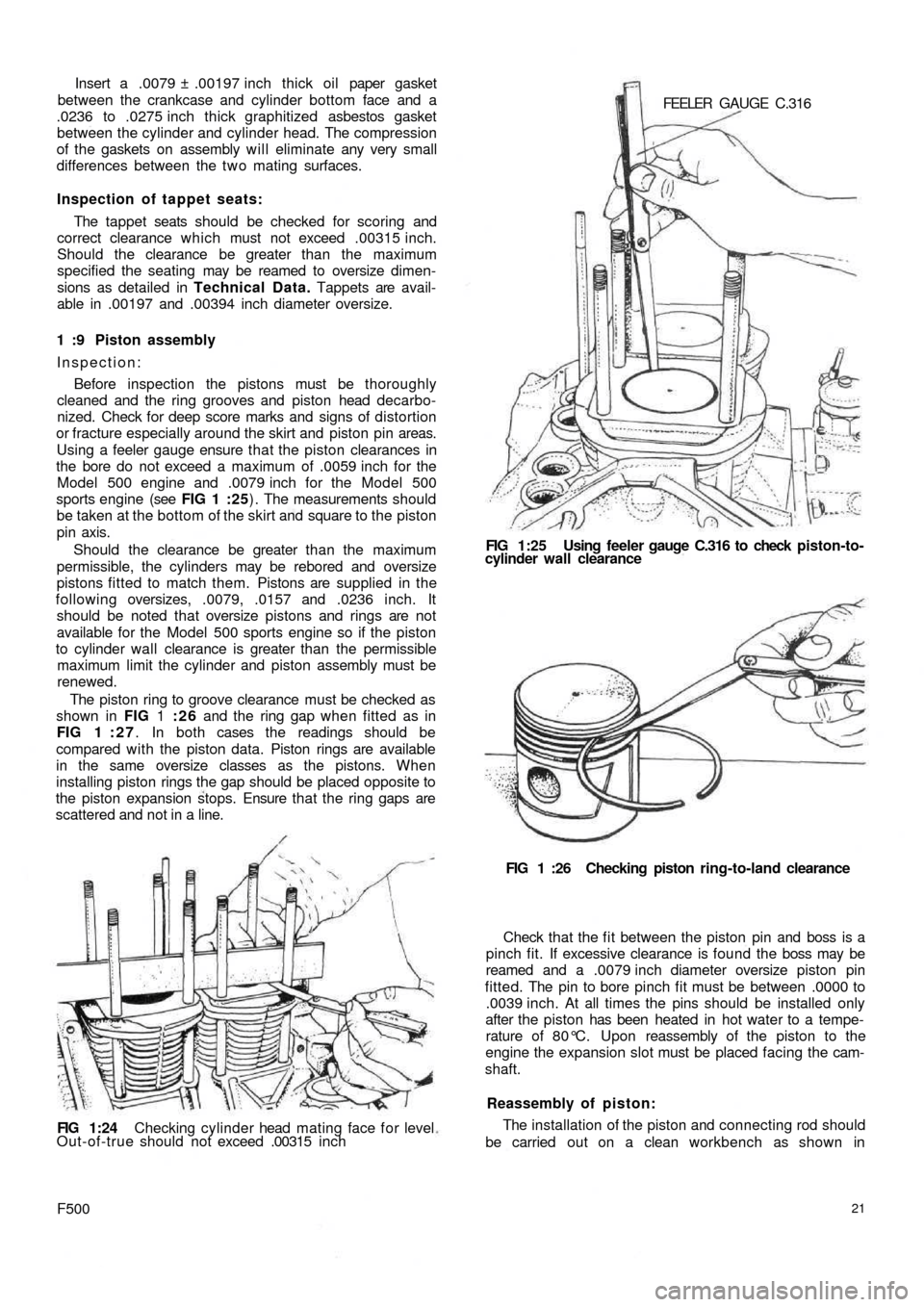
Using a feeler gauge ensure that the piston clearances in
the bore do not exceed a maximum of .0059 inch for the
Model 500 engine and .0079 inch for the Model 500
sports engine (see FIG 1 :25) . The measurements should
be taken at the bottom of the skirt and square to the piston
pin axis.
Should the clearance be greater than the maximum
permissible, the cylinders may be rebored and oversize
pistons fitted to m
atch them. Pistons are supplied in the
following oversizes, .0079, .0157 and .0236 inch. It
should be noted that oversize pistons and rings are not
available for the Model 500 sports engine so if the piston
to cylinder wall clearance is greater than the permissible
maximum limit the cylinder and piston assembly must be
renewed.
The piston ring to groove clearance must be checked as
shown in FIG 1 :26 and the ring gap when fitted as in
FIG 1 : 2 7. In both cases the readings should be
compared with the piston data. Piston rings are available
in the same oversize classes as the pistons. When
installing piston rings the gap should be placed opposite to
the piston expansion stops. Ensure that the ring gaps are
scattered and not in a line.
FIG 1:24 Checking cylinder head mating face f o r level
Out-of-true should not exceed .00315 i n c h
F50021
The installation of the piston and connecting rod should
be carried out on a clean workbench as shown in Reassembly of piston: Check that the f i t between the piston pin and boss is a
pinch fit. If excessive clearance is found the boss may be
reamed and a .0079 inch diameter oversize piston pin
fitted. The pin to bore pinch fit must be between .0000 to
.0039 inch. At all times the pins should be installed only
after the piston has been heated in hot water to a tempe-
rature of 80°C. Upon reassembly of the piston to the
engine the expansion slot must be placed facing the cam-
shaft.FIG 1 :26 Checking piston ring-to-land clearance FEELER GAUGE C.316
FIG 1:25 Using feeler gauge C.316 to check piston-to-
cylinder wall clearance
Page 15 of 128
FEELER GAUGE
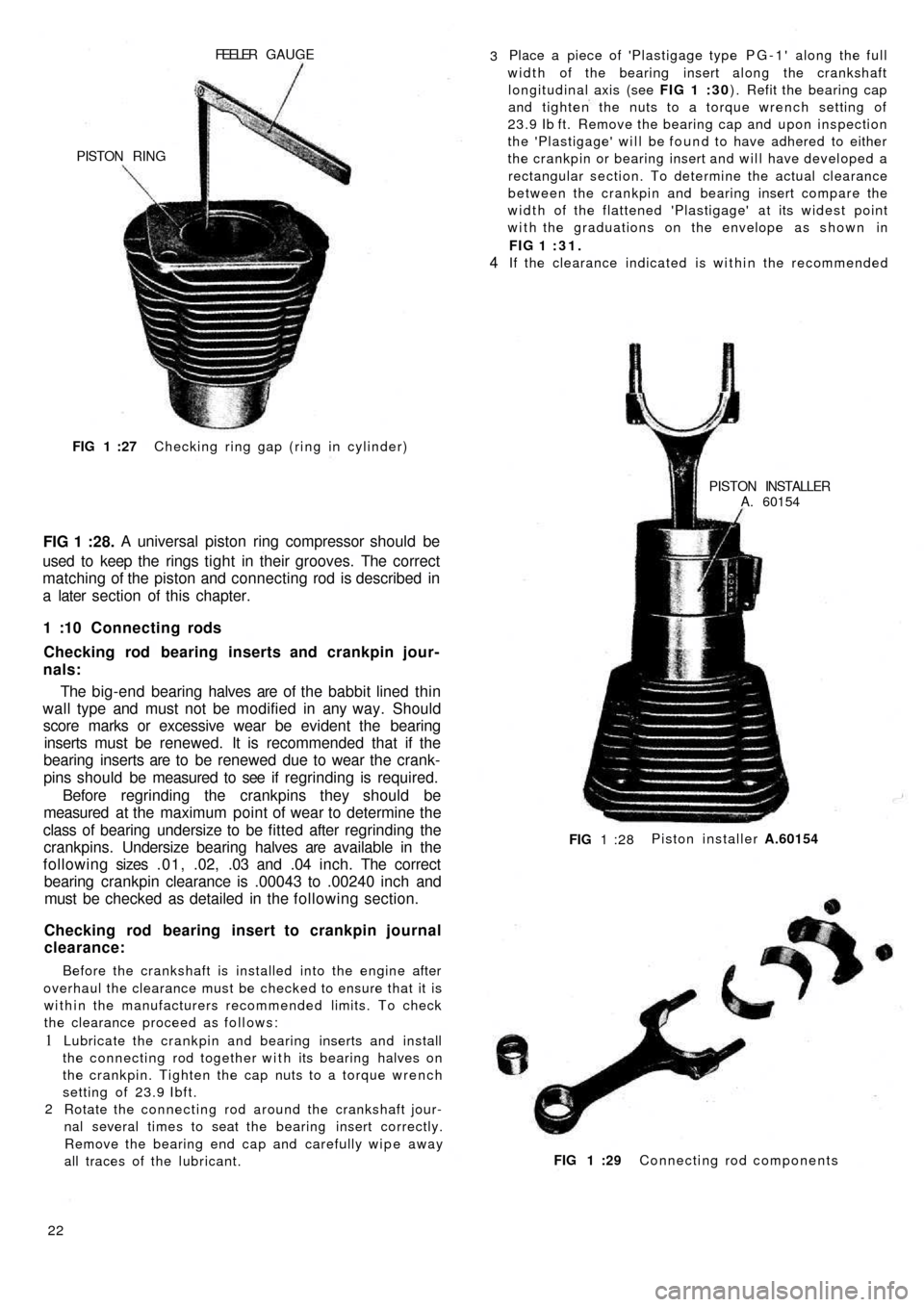
Checking ring gap (ring in cylinder) FIG 1 :27
FIG 1 :28.A universal piston ring compressor should be
used to keep the rings t i g h t in their grooves. The correct
matching of the piston and connecting rod is described in
a later section of this chapter.
1 :10 Connecting rods
Checking rod bearing inserts and crankpin jour-
nals:
The big-end bearing halves are of the babbit lined thin
wall type and must not be modified in any way. Should
score marks or excessive wear be evident the bearing
inserts must be renewed. It is recommended that if the
bearing inserts are to be renewed due to wear the crank-
pins should be measured to see if regrinding is required.
Before regrinding the crankpins they should be
measured at the maximum point of wear to determine the
class of bearing undersize to be fitted after regrinding the
crankpins. Undersize bearing halves are available in the
f o l l o w i n g sizes .01, .02, .03 and .04 inch. The correct
bearing crankpin clearance is .00043 to .00240 inch and
must be checked as detailed in the following section.
Checking rod bearing insert to crankpin journal
clearance:
Before the crankshaft is installed into the engine after
overhaul the clearance must be checked to ensure that it is
within the manufacturers recommended limits. To check
the clearance proceed as follows:
1
2Lubricate the crankpin and bearing inserts and install
the connecting rod together with its bearing halves on
the crankpin. Tighten the cap nuts to a torque wrench
setting of 23.9 Ibft.
Rotate the connecting rod around the crankshaft jour-
nal several times to seat the bearing insert correctly.
Remove the bearing end cap and carefully wipe away
all traces of the lubricant.
22FIG 1 :29 Connecting rod components Piston installer A.60154
FIG 1 :28PISTON INSTALLER
A. 60154 If the clearance indicated is within the recommended FIG 1 :31.
4
Place a piece of 'Plastigage type PG-1' along the full
width of the bearing insert along the crankshaft
longitudinal axis (see FIG 1 :30) . Refit the bearing cap
and tighten the nuts to a torque wrench setting of
23.9 Ib ft. Remove the bearing cap and upon inspection
the 'Plastigage' will be found to have adhered to either
the crankpin or bearing insert and will have developed a
rectangular section. To determine the actual clearance
between the crankpin and bearing insert compare the
width of the flattened 'Plastigage' at its widest point
with the graduations on the envelope as shown in 3
PISTON RING
Page 21 of 128
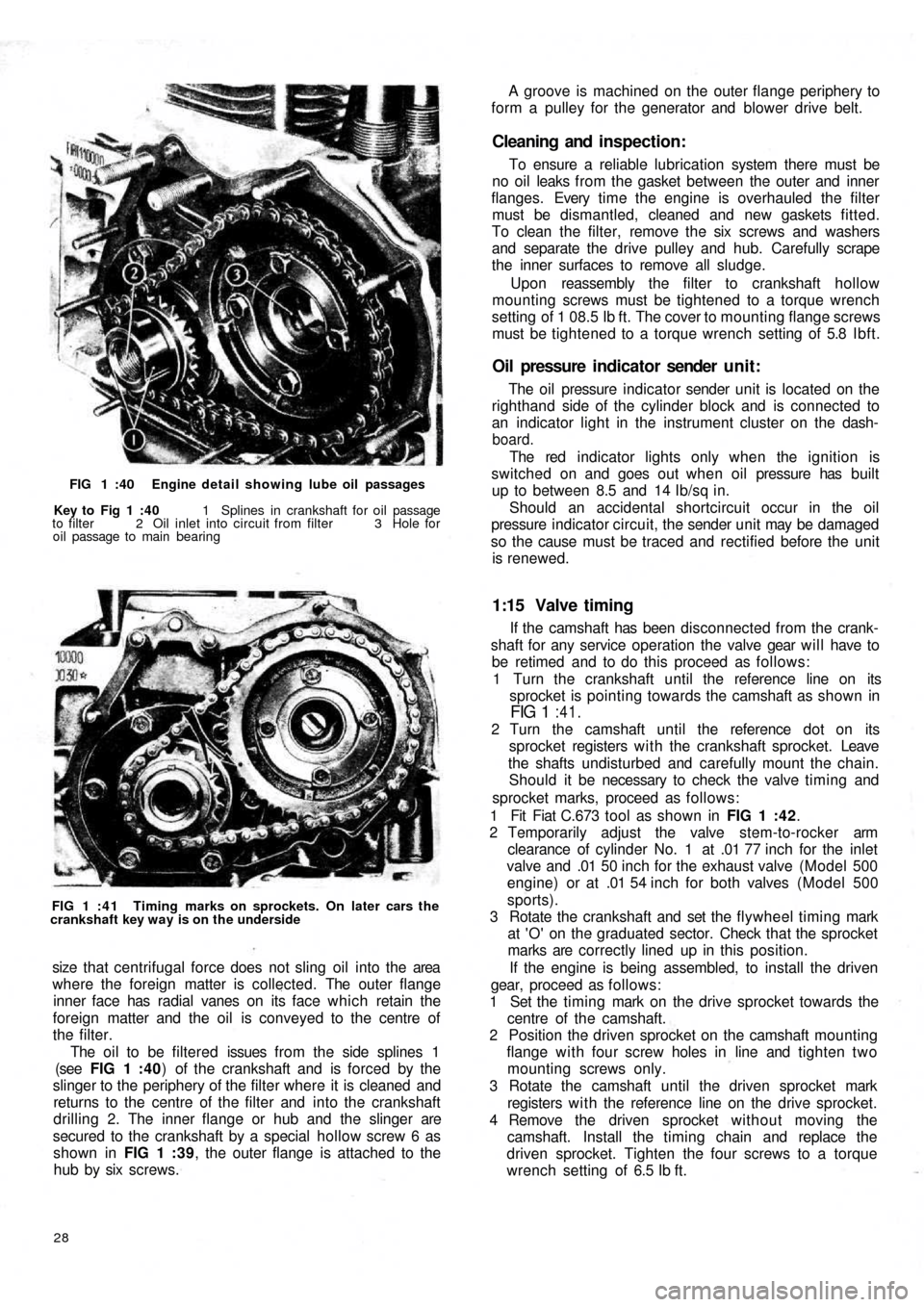
FIG 1 :40 Engine detail showing lube oil passages
Key to Fig 1 :40 1 Splines in crankshaft for oil passage
to filter 2 Oil inlet into circuit from filter 3 Hole for
oil passage to main bearing
FIG 1 : 4 1 Timing marks on sprockets. On later cars the
crankshaft key way is on the underside
size that centrifugal force does not sling oil into the area
where the foreign matter is collected. The outer flange
inner face has radial vanes on its face which retain the
foreign matter and the oil is conveyed to the centre of
the filter.
The oil to be filtered issues from the side splines 1
(see FIG 1 :40) of the crankshaft and is forced by the
slinger to the periphery of the filter where it is cleaned and
returns to the centre of the filter and into the crankshaft
drilling 2. The inner flange or hub and the slinger are
secured to the crankshaft by a special hollow screw 6 as
shown in FIG 1 :39, the outer flange is attached to the
hub by six screws.
28
If the camshaft has been disconnected from the crank-
shaft for any service operation the valve gear will have to
be retimed and to do this proceed as follows:
1 Turn the crankshaft until the reference line on its
sprocket is pointing towards the camshaft as shown in
FIG 1 :41.
2 Turn the camshaft until the reference dot on its
sprocket registers w i t h the crankshaft sprocket. Leave
the shafts undisturbed and carefully mount the chain.
Should it be necessary to check the valve timing and
sprocket marks, proceed as follows:
1 Fit Fiat C.673 tool as shown in FIG 1 :42.
2 Temporarily adjust the valve stem-to-rocker arm
clearance of cylinder No. 1 at .01 77 inch for the inlet
valve and .01 50 inch for the exhaust valve (Model 500
engine) or at .01 54 inch for both valves (Model 500
sports).
3 Rotate the crankshaft and set the flywheel timing mark
at 'O' on the graduated sector. Check that the sprocket
marks are correctly lined up in this position.
If the engine is being assembled, to install the driven
gear, proceed as follows:
1 Set the timing mark on the drive sprocket towards the
centre of the camshaft.
2 Position the driven sprocket on the camshaft mounting
flange with four screw holes in line and tighten two
mounting screws only.
3 Rotate the camshaft until the driven sprocket mark
registers w i t h the reference line on the drive sprocket.
4 Remove the driven sprocket without moving the
camshaft. Install the timing chain and replace the
driven sprocket. Tighten the four screws to a torque
wrench setting of 6.5 Ib ft.
1:15 Valve timing
The oil pressure indicator sender unit is located on the
righthand side of the cylinder block and is connected to
an indicator light in the instrument cluster on the dash-
board.
The red indicator lights only when the ignition is
switched on and goes out when o i l pressure has built
up to between 8.5 and 14 Ib/sq in.
Should an accidental shortcircuit occur in the oil
pressure indicator circuit, the sender unit may be damaged
so the cause must be traced and rectified before the unit
is renewed.
Oil pressure indicator sender unit:
To ensure a reliable lubrication system there must be
no oil leaks from the gasket between the outer and inner
flanges. Every t i m e t h e engine is overhauled the filter
must be dismantled, cleaned and new gaskets fitted.
To clean the filter, remove the six screws and washers
and separate the drive pulley and hub. Carefully scrape
the inner surfaces to remove all sludge.
Upon reassembly the filter to crankshaft hollow
mounting screws must be tightened to a torque wrench
setting of 1 08.5 Ib ft. The cover to mounting flange screws
must be tightened to a torque wrench setting of 5.8 Ibft.
Cleaning and inspection:
A groove is machined on the outer flange periphery to
form a pulley for the generator and blower drive belt.
Page 22 of 128
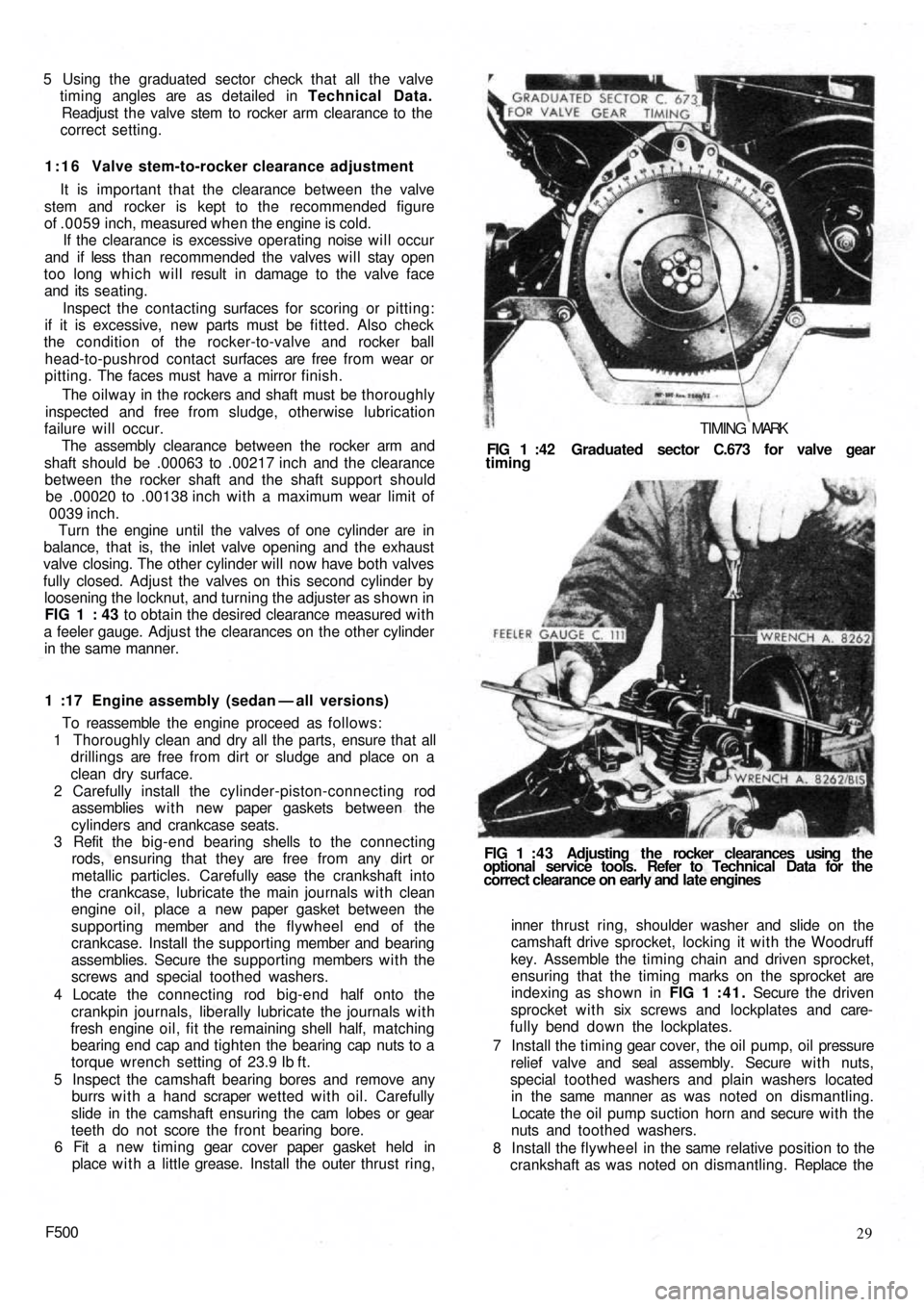
5 Using the graduated sector check that all the valve
timing angles are as detailed in Technical Data.
Readjust the valve stem to rocker arm clearance to the
correct setting.
1:16 Valve stem-to-rocker clearance adjustment
It is important that the clearance between the valve
stem and rocker is kept to the recommended figure
of .0059 inch, measured when the engine is cold.
If the clearance is excessive operating noise will occur
and if less than recommended the valves will stay open
too long which will result in damage to the valve face
and its seating.
Inspect the contacting surfaces for scoring or pitting:
if it is excessive, new parts must be fitted. Also check
the condition of the rocker-to-valve and rocker ball
head-to-pushrod contact surfaces are free from wear or
pitting. The faces must have a mirror finish.
The oilway in the rockers and shaft must be thoroughly
inspected and free from sludge, otherwise lubrication
failure will occur.
The assembly clearance between the rocker arm and
shaft should be .00063 to .00217 inch and the clearance
between the rocker shaft and the shaft support should
be .00020 to .00138 inch with a maximum wear limit of
0039 inch.
Turn the engine until the valves of one cylinder are in
balance, that is, the inlet valve opening and the exhaust
valve closing. The other cylinder will now have both valves
fully closed. Adjust the valves on this second cylinder by
loosening the locknut, and turning the
adjuster as shown in
FIG 1 : 43 to obtain the desired clearance measured with
a feeler gauge. Adjust the clearances on the other cylinder
in the same manner.
1 :17 Engine assembly (sedan — all versions)
To reassemble the engine proceed as follows:
1 Thoroughly clean and dry all the parts, ensure that all
drillings are free from dirt or sludge and place on a
clean dry surface.
2 Carefully install the cylinder-piston-connecting rod
assemblies w i t h new paper gaskets between the
cylinders and crankcase seats.
3 Refit the big-end bearing shells to the connecting
rods, ensuring that they are free from any dirt or
metallic particles. Carefully ease t h e crankshaft into
the crankcase, lubricate the main journals with clean
engine oil, place a new paper gasket between the
supporting member and the flywheel end of the
crankcase. Install the supporting member and bearing
assemblies. Secure the supporting members with the
screws and special toothed washers.
4 Locate the connecting rod big-end half onto the
crankpin journals, liberally lubricate the journals with
fresh engine oil, fit the remaining shell half, matching
bearing end cap and tighten the bearing cap nuts to a
torque wrench setting of 23.9 Ib ft.
5 Inspect the camshaft bearing bores and remove any
burrs w i t h a hand scraper wetted with oil. Carefully
slide in the camshaft ensuring the cam lobes or gear
teeth do not score the front bearing bore.
6 Fit a new timing gear cover paper gasket held in
place w i t h a little grease. Install the outer thrust ring,
F50029 inner thrust ring, shoulder washer and slide on the
camshaft drive sprocket, locking it with the Woodruff
key. Assemble the timing chain and driven sprocket,
ensuring that the timing marks on the sprocket are
indexing as shown in FIG 1 :41. Secure the driven
sprocket with six screws and lockplates and care-
fully bend down the lockplates.
7 Install the timing gear cover, the oil pump, oil pressure
relief valve and seal assembly. Secure w i t h nuts,
special toothed washers and plain washers located
in the same manner as was noted on dismantling.
Locate the oil pump suction horn and secure with the
nuts and toothed washers.
8 Install the flywheel in the same relative position to the
crankshaft as was noted on dismantling. Replace the FIG 1 : 4 3 Adjusting the rocker clearances using the
optional service tools. Refer to Technical Data for the
correct clearance on early and late engines FIG 1 :42 Graduated sector C.673 for valve gear
timing
TIMING MARK
Page 23 of 128
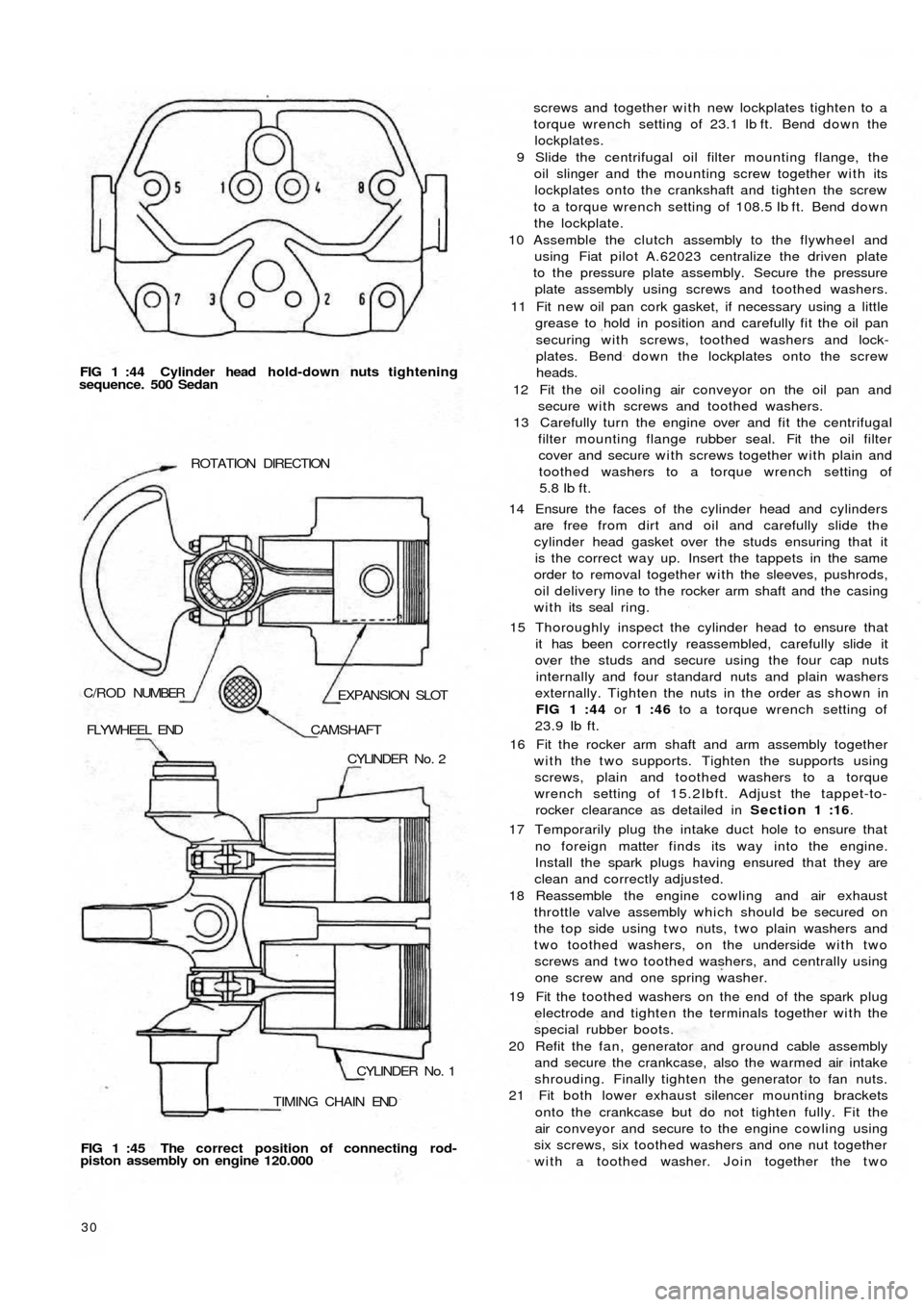
FIG 1 :44 Cylinder head h o ld-down nuts tightening
sequence. 500 Sedan
TIMING CHAIN ENDCYLINDER No. 1 CYLINDER No. 2 FLYWHEEL END
CAMSHAFT
EXPANSION SLOT C/ROD NUMBERROTATION DIRECTION
FIG 1 :45 The correct position of connecting rod-
piston assembly on engine 120.000
30
screws and together with new lockplates tighten to a
torque wrench setting of 23.1 Ib ft. Bend down the
lockplates.
9 Slide the centrifugal oil filter mounting flange, the
oil slinger and the mounting screw together with its
lockplates onto the crankshaft and tighten the screw
to a torque wrench setting of 108.5 Ib ft. Bend down
the lockplate.
10 Assemble the clutch assembly to the flywheel and
using Fiat pilot A.62023 centralize the driven plate
to the pressure plate assembly. Secure the pressure
plate assembly using screws and toothed washers.
11 Fit new oil pan cork gasket, if necessary using a little
grease to hold in position and carefully fit the oil pan
securing with screws, toothed washers and lock-
plates. Bend down the lockplates onto the screw
heads.
12 Fit the oil cooling air conveyor on the oil pan and
secure with screws and toothed washers.
13 Carefully turn the engine over and fit the centrifugal
filter mounting flange rubber seal. Fit the oil filter
cover and secure with screws together with plain and
toothed washers to a torque wrench setting of
5.8
Ib ft.
14 Ensure t h e faces of the cylinder head and cylinders
are free from dirt and oil and carefully slide the
cylinder head gasket over the studs ensuring that it
is the correct way up. Insert the tappets in the same
order to removal together with the sleeves, pushrods,
oil delivery line to the rocker arm shaft and the casing
with its seal ring.
15 Thoroughly inspect the cylinder head to ensure that
it has been correctly reassembled, carefully slide it
over the studs and secure using the four cap nuts
internally and four standard nuts and plain washers
externally. Tighten the nuts in the order as shown in
FIG 1 :44 or 1 :46 to a torque wrench setting of
23.9 Ib ft.
16 Fit the rocker arm shaft and arm assembly together
with the two supports. Tighten the supports using
screws, plain and toothed washers to a torque
wrench setting of 15.2Ibft. Adjust the tappet-to-
rocker clearance as detailed in Section 1 :16.
17 Temporarily plug the intake duct hole to ensure that
no foreign matter finds its way into the engine.
Install the spark plugs having ensured that they are
clean and correctly adjusted.
18 Reassemble the engine cowling and air
exhaust
throttle valve assembly which should be secured on
the top side using t w o nuts, t w o plain washers and
two toothed washers, on the underside with two
screws and t w o toothed washers, and centrally using
one screw and one spring washer.
19 Fit the toothed washers on the end of the spark plug
electrode and tighten the terminals together with the
special rubber boots.
20 Refit the fan, generator and ground cable assembly
and secure the crankcase, also the warmed air intake
shrouding. Finally tighten the generator to fan nuts.
21 Fit both lower exhaust silencer mounting brackets
onto the crankcase but do not tighten fully. Fit the
air conveyor and secure to the engine cowling using
six screws, six toothed washers and one nut together
with a toothed washer. Join together the t w o
Page 25 of 128
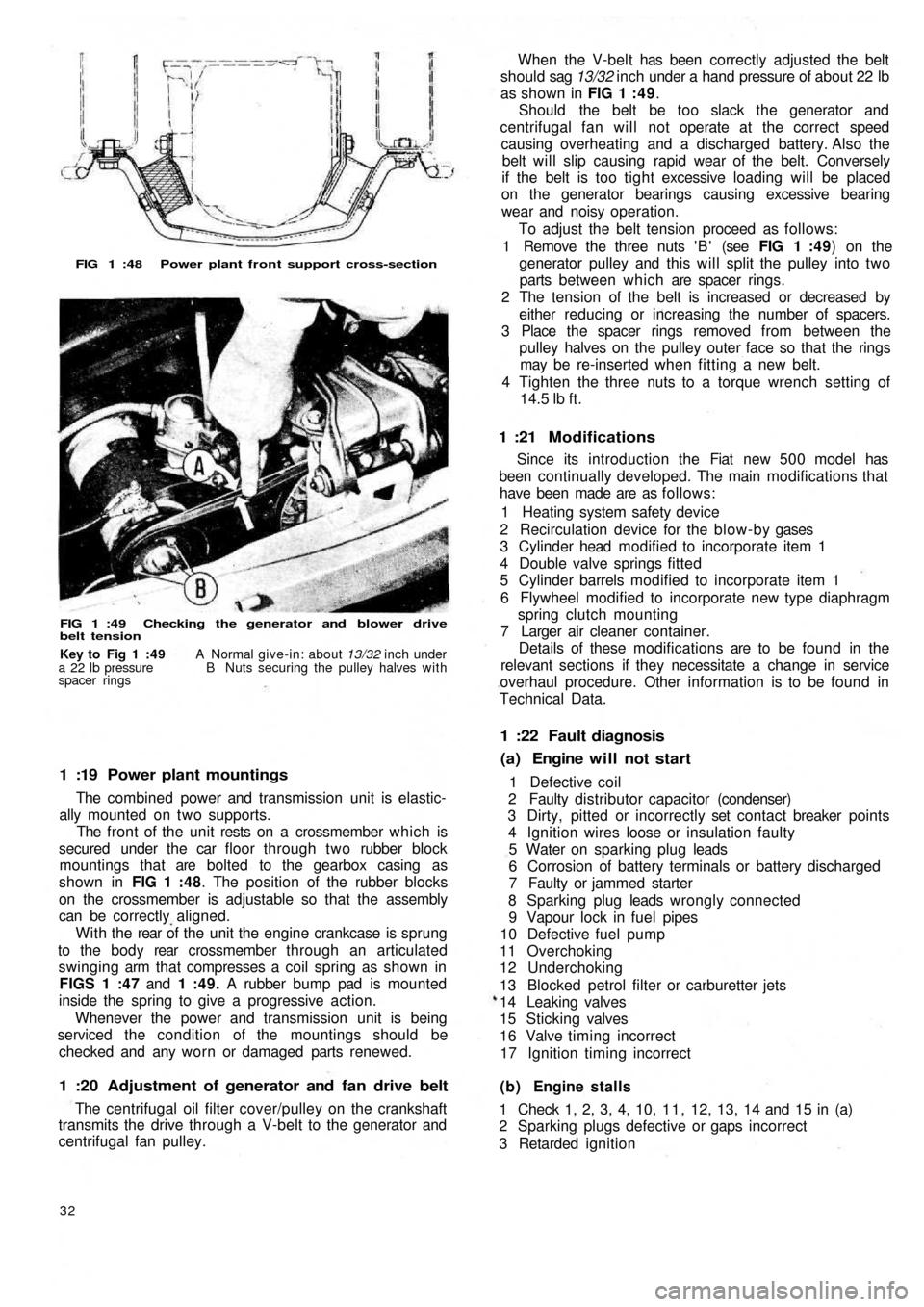
FIG 1 :48 Power plant front support cross-section
FIG 1 :49 Checking the generator and blower drive
belt tension
1 :19 Power plant mountings
The combined power and transmission unit is elastic-
ally mounted on two supports.
The front of the unit rests on a crossmember which is
secured under the car floor through two rubber block
mountings that are bolted to the gearbox casing as
shown in FIG 1 :48. The position of the rubber blocks
on the crossmember is adjustable so that the assembly
can be correctly aligned.
W i t h t h e rear of the unit the engine crankcase is sprung
to the b o d y rear crossmember through an articulated
swinging arm that compresses a coil spring as shown in
FIGS 1 :47 and 1 :49. A rubber bump pad is mounted
inside the spring to give a progressive action.
Whenever the power and transmission unit is being
serviced the condition of the mountings should be
checked and any worn or damaged parts renewed.
1 :20 Adjustment of generator and fan drive belt
The centrifugal oil filter cover/pulley on the crankshaft
transmits the drive through a V-belt to the generator and
centrifugal fan pulley.
32
(b) Engine stalls
1 Check 1, 2, 3, 4, 10, 1 1 , 12, 13, 14 and 15 in (a)
2 Sparking plugs defective or gaps incorrect
3 Retarded ignition 1 Defective coil
2 Faulty distributor capacitor (condenser)
3 Dirty, pitted or incorrectly set contact breaker points
4 Ignition wires loose or insulation faulty
5 Water on sparking plug leads
6 Corrosion of battery terminals or battery discharged
7 Faulty or jammed starter
8 Sparking plug leads wrongly connected
9 Vapour lock in fuel pipes
10 Defective fuel pump
11 Overchoking
12 Underchoking
13 Blocked petrol filter or carburetter jets
14 Leaking valves
15 Sticking valves
16 Valve timing incorrect
17 Ignition timing incorrect
(a) Engine will not start 1 :22 Fault diagnosis
Since its introduction the Fiat new 5 0 0 model has
been continually developed. The main modifications that
have been made are as follows:
1 Heating system safety device
2 Recirculation device for the blow-by gases
3 Cylinder head modified to incorporate item 1
4 Double valve springs fitted
5 Cylinder barrels modified to incorporate item 1
6 Flywheel modified to incorporate new type diaphragm
spring clutch mounting
7 Larger air cleaner container.
Details of these modifications are to be found in the
relevant sections if they necessitate a change in service
overhaul procedure. Other information is to be found in
Technical Data.
1 :21 Modifications
When the V-belt has been correctly adjusted the belt
should sag 13/32 inch under a hand pressure of about 22 lb
as shown in FIG 1 : 4 9.
Should the belt be too slack the generator and
centrifugal fan will not operate at the correct speed
causing overheating and a discharged battery. Also the
belt will slip causing rapid wear of the belt. Conversely
if the belt is too tight excessive loading will be placed
on the generator bearings causing excessive bearing
wear and noisy operation.
To adjust the belt tension proceed as follows:
1 Remove the three nuts ' B ' (see FIG 1 :49) on the
generator pulley and this will split the pulley into two
parts between which are spacer rings.
2 The tension of the belt is increased or decreased by
either reducing or increasing the number of spacers.
3 Place the spacer rings removed from between the
pulley halves on the pulley outer face so that the rings
may be re-inserted when fitting a new belt.
4 Tighten the three nuts to a torque wrench setting of
14.5
lb ft.
Key to Fig 1 :49 A Normal give-in: about 13/32 inch under
a 22 Ib pressure B Nuts securing the pulley halves with
spacer rings
Page 28 of 128
CHAPTER 2
THE FUEL SYSTEM
2:1 Description
2 : 2 Fuel pump operating principles
2 : 3 Routine maintenance
2 : 4 Pump removal, dismantling and examination
2 : 5 Reassembly, installation and adjustment
2 : 6 Carburetter operation and adjustment,
Weber 26.1MB2 : 7 Modifications
2 : 8 Carburetter operation and adjustment,
Weber 26.OC
2 :9 Air cleaner
2 : 1 0 B l o w - b y gases recirculation device
2:11 Fuel tank
2:12 Fault diagnosis
2:1 Description
All the new 500 models use a mechanical diaphragm
fuel feed pump as shown in FIG 2 : 1. Four types of
carburetter are fitted depending on the model to which
the engine is installed. Each carburetter operation and
adjustment is fully described, together with details of the
recirculation device for blow-by gases and o i l vapours.
2 : 2 Fuel pump operating principles
Refer to FIG 2 : 2. An eccentric on the rotating camshaft
actuates the operating rocker 21 via a pushrod 25 which
depresses the diaphragm 14 and so creates a depression
in the pumping chamber located in upper body 5. Under
atmospheric pressure, petrol passes through the pipeline
connection and inlet valve into the pumping chamber.
The return spring 15 then raises the diaphragm, expelling
the petrol through the outlet valve and pipeline to the
carburetter float chamber.
When the float chamber is full, the pressure in the pipe-
line and pumping chamber holds the diaphragm depressed
against the tension of the return spring.2 : 3 Routine maintenance
A poor delivery of fuel to the carburetter may be due to
a fault in the fuel pump or related lines. Periodically the
pump body screws 19 (see FIG 2 : 2) and upper cover
screw 1 should be checked for tightness. The fuel pump
lines should be disconnected and checked for freedom of
restriction, chafing and loose connections. The fuel pump
filter should be removed and cleaned periodically.
2:4 Pump removal, dismantling and examination
The pump is located on the carburetter side of the
engine crankcase (sedan) or under the generator at the
front of the crankcase (station wagon).
Removal:
1 Disconnect the fuel pipe from the tank to stop petrol
syphoning out of the tank and then release the fuel
inlet and outlet pipes from the pump body.
2 Remove the t w o nuts and washers holding pump to
crankcase.
3 Carefully lift away the pump, gaskets and insulating pad
from the crankcase (see FIG 2 : 3).
F50035
Page 29 of 128
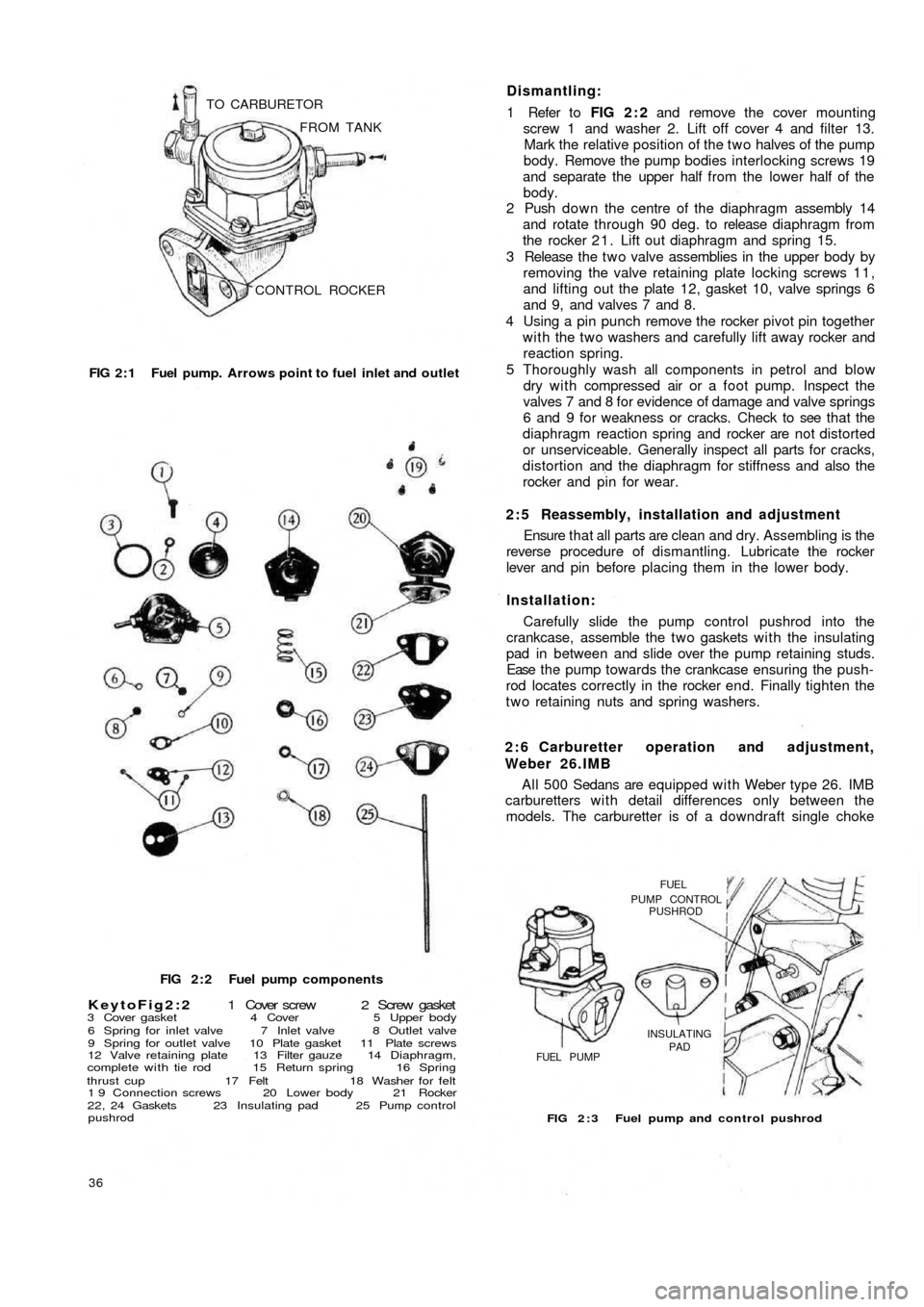
CONTROL ROCKER FROM TANK TO CARBURETOR
FIG 2 : 1 Fuel pump. Arrows point to fuel inlet and outlet
FIG 2 : 2 Fuel pump components
KeytoFig2:2 1 Cover screw 2 Screw gasket3 Cover gasket 4 Cover 5 Upper body
6 Spring for inlet valve 7 Inlet valve 8 Outlet valve
9 Spring for outlet valve 10 Plate gasket 11 Plate screws
12 Valve retaining plate 13 Filter gauze 14 Diaphragm,
complete with tie rod 15 Return spring 16 Spring
thrust cup 17 Felt 18 Washer for felt
1 9 Connection screws 20 Lower body 21 Rocker
22, 24 Gaskets 23 Insulating pad 25 Pump control
pushrod
36
FIG 2 : 3 Fuel pump and control pushrod
FUELPUMP CONTROLPUSHROD
INSULATING
PAD
FUEL PUMP
A l l 500 Sedans are equipped with Weber type 26. IMB
carburetters w i t h detail differences only between the
models. The carburetter is of a downdraft single choke 2 : 6 Carburetter operation and adjustment,
Weber 26.IMB Carefully slide the pump control pushrod into the
crankcase, assemble the t w o gaskets w i t h the insulating
pad in between and slide over the pump retaining studs.
Ease t h e p u m p towards the crankcase ensuring the push-
rod locates correctly in the rocker end. Finally tighten the
two retaining nuts and spring washers. Installation:Ensure t h a t all parts are clean and dry. Assembling is the
reverse procedure of dismantling. Lubricate the rocker
lever and pin before placing them in the lower body. 2 : 5 Reassembly, installation and adjustment 1 Refer to FIG 2 : 2 and remove the cover mounting
screw 1 and washer 2. Lift off cover 4 and filter 13.
Mark the relative position of the two halves of the pump
body. Remove the pump bodies interlocking screws 19
and separate the upper half from the lower half of the
body.
2 Push down the centre of the diaphragm assembly 14
and rotate through 90 deg. to release diaphragm from
the rocker 2 1 . Lift out diaphragm and spring 15.
3 Release the t w o valve assemblies in the upper body by
removing the valve retaining plate locking screws 1 1 ,
and lifting out the plate 12, gasket 10, valve springs 6
and 9, and valves 7 and 8.
4 Using a pin punch remove the rocker pivot pin together
w i t h the t w o washers and carefully lift away rocker and
reaction spring.
5 Thoroughly wash all components in petrol and
blow
dry with compressed air or a foot pump. Inspect the
valves 7 and 8 for evidence of damage and valve springs
6 and 9 for weakness or cracks. Check to see that the
diaphragm reaction spring and rocker are not distorted
or unserviceable. Generally inspect all parts for cracks,
distortion and the diaphragm for stiffness and also the
rocker and pin for wear. Dismantling:
Page 32 of 128
3 Engine warm-up:
As the engine begins to warm up to its normal operating
temperature, gradually push home the starting device
lever so as only to supply the engine with the richened
charge enabling the cold engine operation to be smooth
and regular. Position ' B ' (FIG 2:6).
4 Normal car driving:
Once the engine has reached its normal operating
temperature the starting device should be completely
brought out of operation by bringing the control lever to
the position 'C (FIG 2:6).
Idle speed adjustment:
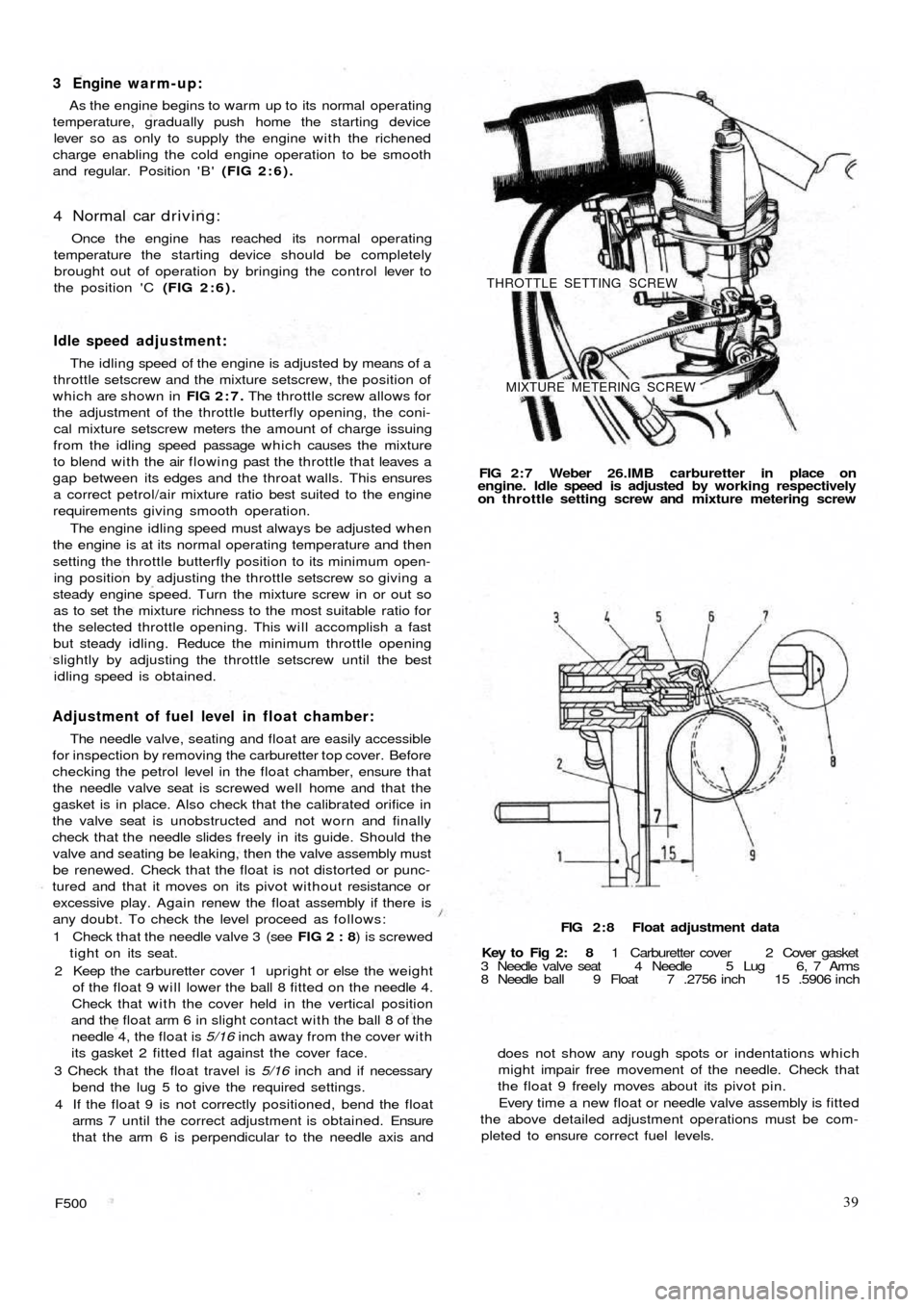
The idling speed of the engine is adjusted by means of a
throttle setscrew and the mixture setscrew, the position of
which are shown in FIG 2:7. The throttle screw allows for
the adjustment of the throttle butterfly opening, the coni-
cal mixture setscrew meters the amount of charge issuing
from the idling speed passage which causes the mixture
to blend with the air flowing past the throttle that leaves a
gap between its edges and the throat walls. This ensures
a correct petrol/air mixture ratio best suited to the engine
requirements giving smooth operation.
The engine idling speed must always be adjusted when
the engine is at its normal operating temperature and then
setting the throttle butterfly position to its minimum open-
ing position by adjusting the throttle setscrew so giving a
steady engine speed. Turn the mixture screw in or out so
as to set the mixture richness to the most suitable ratio for
the selected throttle opening. This will accomplish a fast
but steady idling. Reduce the minimum throttle opening
slightly by adjusting the throttle setscrew until the best
idling speed is obtained.
Adjustment of fuel level in float chamber:
The needle valve, seating and float are easily accessible
for inspection by removing the carburetter top cover. Before
checking the petrol level in the float chamber, ensure that
the needle valve seat is screwed well home and that the
gasket is in place. Also check that the calibrated orifice in
the valve seat is unobstructed and not worn and finally
check that the needle slides freely in its guide. Should the
valve and seating be leaking, then the valve assembly must
be renewed. Check that the float is not distorted or punc-
tured and that it moves on its pivot without resistance or
excessive play. Again renew the float assembly if there is
any doubt. To check the level proceed as follows:
1 Check that the needle valve 3 (see FIG 2 : 8) is screwed
tight on its seat.
2 Keep the carburetter cover 1 upright or else the weight
of the float 9 will lower the ball 8 fitted on the needle 4.
Check that with the cover held in the vertical position
and the float arm 6 in slight contact with the ball 8 of the
needle 4, the float is 5/16 inch away from the cover with
its gasket 2
fitted flat against the cover face.
3 Check that the float travel is 5/16 inch and if necessary
bend the lug 5 to give the required settings.
4 If the float 9 is not correctly positioned, bend the float
arms 7 until the correct adjustment is obtained. Ensure
that the arm 6 is perpendicular to the needle axis and
F50039
does not show any rough spots or indentations which
might impair free movement of the needle. Check that
the float 9 freely moves about its pivot pin.
Every time a new float or needle valve assembly is fitted
the above detailed adjustment operations must be com-
pleted to ensure correct fuel levels. FIG 2 : 8 Float adjustment data
Key to Fig 2: 8 1 Carburetter cover 2 Cover gasket
3 Needle valve seat 4 Needle 5 Lug 6, 7 Arms
8 Needle ball 9 Float 7 .2756 inch 15 .5906 inch FIG 2 : 7 Weber 26.IMB carburetter in place on
engine. Idle speed is adjusted by working respectively
on throttle setting screw and mixture metering screw
THROTTLE SETTING SCREW
MIXTURE METERING SCREW