Rear seat FIAT 500 1972 1.G Workshop Manual
[x] Cancel search | Manufacturer: FIAT, Model Year: 1972, Model line: 500, Model: FIAT 500 1972 1.GPages: 128, PDF Size: 9.01 MB
Page 2 of 128
CHAPTER 1
THE ENGINE
1 :1
1 :2
1 :3
1 :4
1 :5
1 :6
1 :7
1 :8
1:9
1 :10
1 :11Description
Engine removal (sedan—all versions)
Engine removal (station wagon)
Engine disassembly (sedan—all versions)
Engine disassembly (station wagon)
Cylinder head removal, servicing and
replacement
Timing gear overhaul
Crankcase and cylinders
Piston assembly
Connecting rods
Crankshaft and main bearings
1 :1 Description
The 'New 500' two-cylinder aircooled engine operates
on the four-stroke 'Otto Cycle' and is fitted directly to
the transmission unit which incorporates the rear drive
assembly as shown in FIG 1 :1 and FIG 1 :2.
With the power unit fitted at the rear several advantages
are obtained including better load distribution to the
wheels when the vehicle is loaded, elimination of propeller
shaft reducing the size of centre tunnel and better use of
available space.
The cylinder block comprises t w o cast iron cylinder
barrels w i t h cooling fins. The bottom of the cylinders fit
into machined seats in the aluminium crankcase.
The aluminium crankcase carries eight studs on which
are located the t w o cylinder barrels w i t h the aluminium
cylinder head on the top.
A two bush crankshaft of special cast iron is fitted into
the lower half of the crankcase. The crankshaft is
F5009 provided with a counterweight and is hollow to allow for
lubrication.
The steel connecting rods have thin wall bearing halves
on the big-end, and bronze bushes in the small-end. The
offset piston pin is of steel and retained in the piston by
two circlips.
Light alloy pistons are used and are of the taper-oval-
shaped type with a maximum diameter at the base of the
skirt, along an axis perpendicular to the piston pin. Pistons
are fitted with four rings as follows, one compression at
the top, two standard oil scraper rings and one side slotted
oil scraper ring.
The one-piece aluminium cylinder head is finned to
provide a larger cooling surface and carries the inlet and
exhaust manifolds.
The inlet passages merge into a single centralized
flange onto which is mounted the carburetter. The exhaust
passages run almost parallel to the axis of the engine. 1 :12
1 :13
1 :14
1 :15
1 :16
1 :17
1 :18
1 :19
1 :20
1 :21
1 :22Flywheel and starter ring gear
The oil pump
Lubrication, oil filter, relief valve
Valve timing
Valve stem to rocker clearance
Engine assembly (sedan—all versions)
Engine assembly (station wagon)
Power plant mounting
Adjustment of generator and fan belt drive
Modifications
Fault diagnosis
Page 18 of 128
After the crankshaft has been reground it is important
that all traces of swarf are removed by constant washing
and then drying with a non-fluffy rag.
The clearance between the main bearings and journals
must be checked before installing the crankshaft in the
engine. It should also serve as a recheck after the
crankshaft has been reground.
Measure the maximum main bearing internal
diameter and the minimum journal diameter using
accurate measuring equipment. The clearance must not
exceed .0039 inch otherwise the journals must be
reground and undersize bearings fitted.
Undersize bearings w i t h .0394 inch stock on the
internal diameter are also supplied unmounted. They
must be press fitted in the supports, the recommended
interference fit being .00039 to .00197 inch. After
pressing the bearing into the support, a hole is drilled in
the bearing in line with the location dowel hole in the
support. The hole is finished with a suitable expanding
reamer, such as Fiat U.0334, and the dowel pressed i n ,
noting that the hollow dowel fits in the flywheel end
support.
The next stage is to heat the assembly in an oven or
oil bath for a period of one hour at 150°C (302°F).
When the assembly has cooled to room temperature,
the bearing is reamed in a lathe to match the crankshaft
journal size.
3
Crankshaft oil seals:
Two inner spring rubber oil seals are located, one in a
special seat in the timing gear cover and the other in the
flywheel end of the crankshaft support and provide oil
tightness. These seals are shown in FIGS 1 :3 and 1 :34.
Whenever the engine is dismantled for overhaul these
seals should be carefully inspected for correct seating and
that the inner seal surface is not worn and that the contact
area is perfect both on the crankshaft and on the fan and
generator drive pulley hub.
Clutch shaft pilot bushing:
A self-lubricating bronze bush is fitted in the end of the
crankshaft as shown in FIG 1 :34 and provides a bearing
for the clutch shaft. Should the bush be worn use Fiat
puller A.40006/1 /2 to remove the worn bush. A new bush
should be fitted using a suitably sized drift.
1:12 Flywheel and starter ring gear
The flywheel should be inspected for wear at the clutch
driven plate contact area. It should be flat and have a
smooth finish.
The ring gear teeth should be cheeked for damage
which if evident, the ring gear must be replaced. To facili-
tate the fitting of a new ring gear on the flywheel, the new
ring gear should be heated in an oil bath to a temperature
of 80°C (176°F). Using a press gently ease the
expanded
ring gear over the flywheel and press fully home.
1:13 The oil pump
Sedan :
A helical-spur gear type oil pump is driven by the cam-
shaft through a front dog drive coupling. The gears are
F50025 To remove the pump from the engine proceed as
follows:Pump removal and reassembly:
Remove the engine rear central support from the timing
gear casing. Remove the filter cover pulley and lift
away the drive belt.
Release the hollow screw attaching the slinger and the
mounting flange of the filter on the crankshaft. Also
release the nuts fixing the timing gear cover to the
crankcase.
Remove the timing gear cover together with the oil
pump assembly and the pressure relief valve.
Lift out the oil pump suction scoop with the filter
screen attached from the sump.
Reassembly of the pump to the engine is the reverse
procedure to dismantling. 1
2
3
4
5 located in a special housing in the timing gear cover and
held in place by a cover plate. The oil pressure relief valve
is mounted on the drive gear shaft guide.
A pump suction scoop fitted with a filter screen is
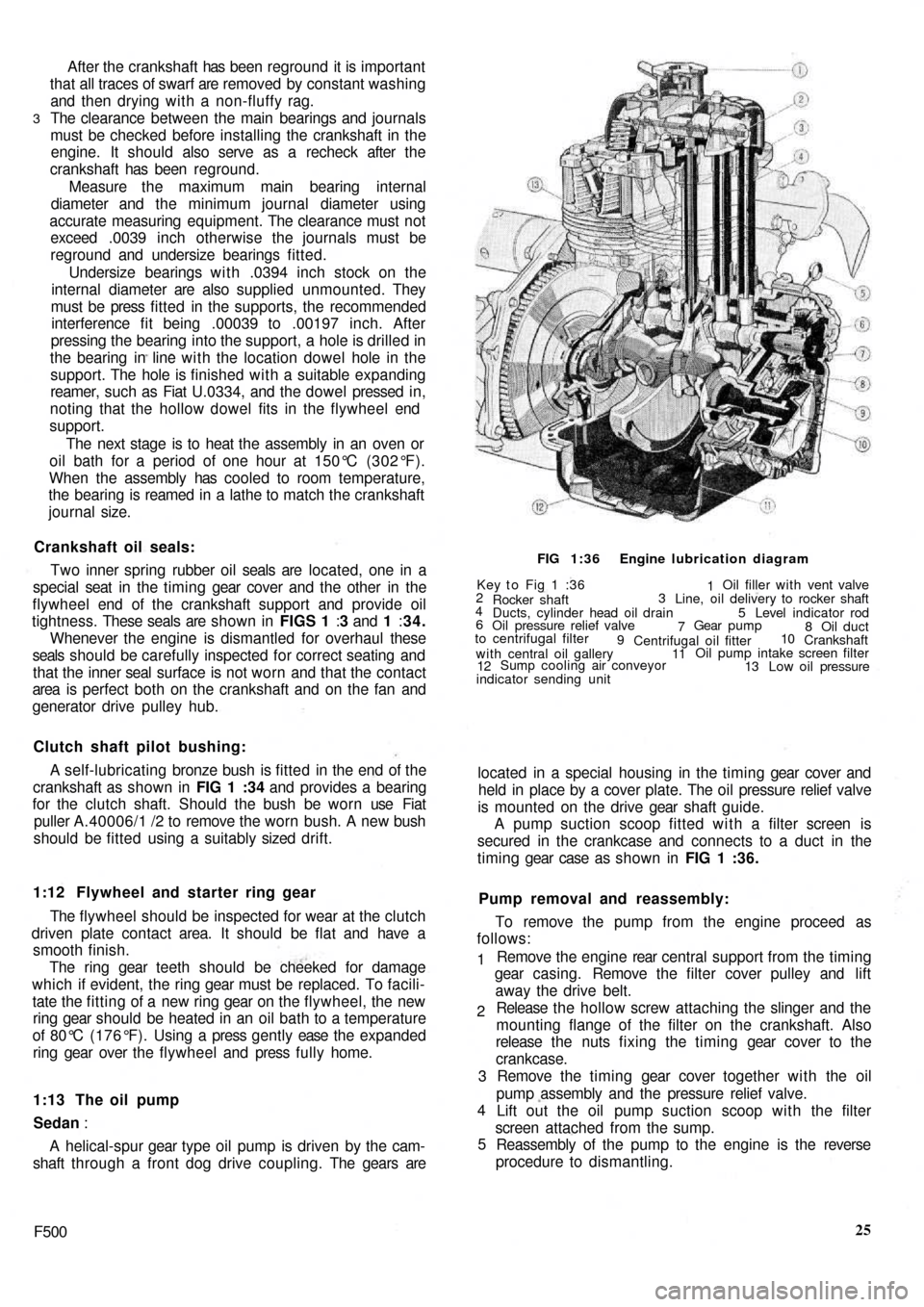
secured in the crankcase and connects to a duct in the
timing gear case as s h o w n in FIG 1 :36.
2
4
6Key t o Fig 1 :36
Rocker shaft
Ducts, cylinder head oil drain
Oil pressure relief valve
to centrifugal filter
9
with central oil gallery
12Sump cooling air conveyor
indicator sending unitOil filler with vent valve
Line, oil delivery to rocker shaft
Level indicator rod 31
5
7Gear pump
8 Oil duct
Centrifugal oil fitter
1110
Crankshaft
Oil pump intake screen filter
13 Low oil pressure FIG 1:36 Engine lubrication diagram
Page 20 of 128
Drain the oil sump to ensure that the oil does not syphon
out. Thoroughly clean the area around the pump body
(see FIG 1 :37).
Remove the end cover plate by releasing the retaining
bolts and washers. Carefully ease t h e driven gear down-
wards followed by the driving gear and shaft
Clean all parts removed and blow clean using a com-
pressed air jet. Inspect the timing gear cover pump area
for cracks or distortion. Check that the inner duct for oil
delivery to the pump is clear of obstruction. If in doubt
remove the drain plug and filler cap and use a com-
pressed air j e t to clean the passage.
Check the gear teeth for damage or excessive wear,
ensure that the drive gear is firmly attached to its spindle
and that the end cover plate is not badly scored or pitted.
Fit new parts as necessary.
Reassembly is the reverse procedure to dismantling,
taking care that all parts are assembled clean and the
end cover plate seating correctly with a new gasket. 5 43 21
1:14 Lubrication, oil filter, relief valve
Description :
The engine is pressure lubricated through a gear type
pump which is incorporated in the timing gear cover and
driven from the camshaft by dogs or gears. The lubrication
circuits are shown in FIGS 1 :36 and 1 : 37.
The pump draws oil from the sump through a suction
horn fitted with a filter screen which is fixed to the crank-
case by a d u c t in t h e timing gear cover. This
supplies oil
to the pump.
Oil passes f r o m the camshaft rear seat o n t o t h e crank-
shaft rear support where it flows into an adjacent chamber.
From here the o i l flows through ducts in the crankshaft
from end to the centrifugal oil filter. The centrifugal filter,
which also acts as a pulley for the generator and blower
drive, rotates w i t h the crankshaft.
Oil from the filter enters a passage in the crankshaft,
where it lubricates the main and connecting rod bearings
and passes f r o m a special groove in the front main
bearing and ducting in the crankcase into which is
inserted the oil pressure warning sender unit, and also
the delivery pipe for oil to the overhead valve gear.
The pushrod sleeves provide the return path for the oil
from the cylinder head and delivers oil to the tappet gear
and the camshaft cams. The tappets are suitably drilled
to allow correct circulation of the oil. The tappets are
located in t w o casting cavities, one of which com-
municates w i t h the timing gear housing and the other
one to the crankshaft front drain support drain.
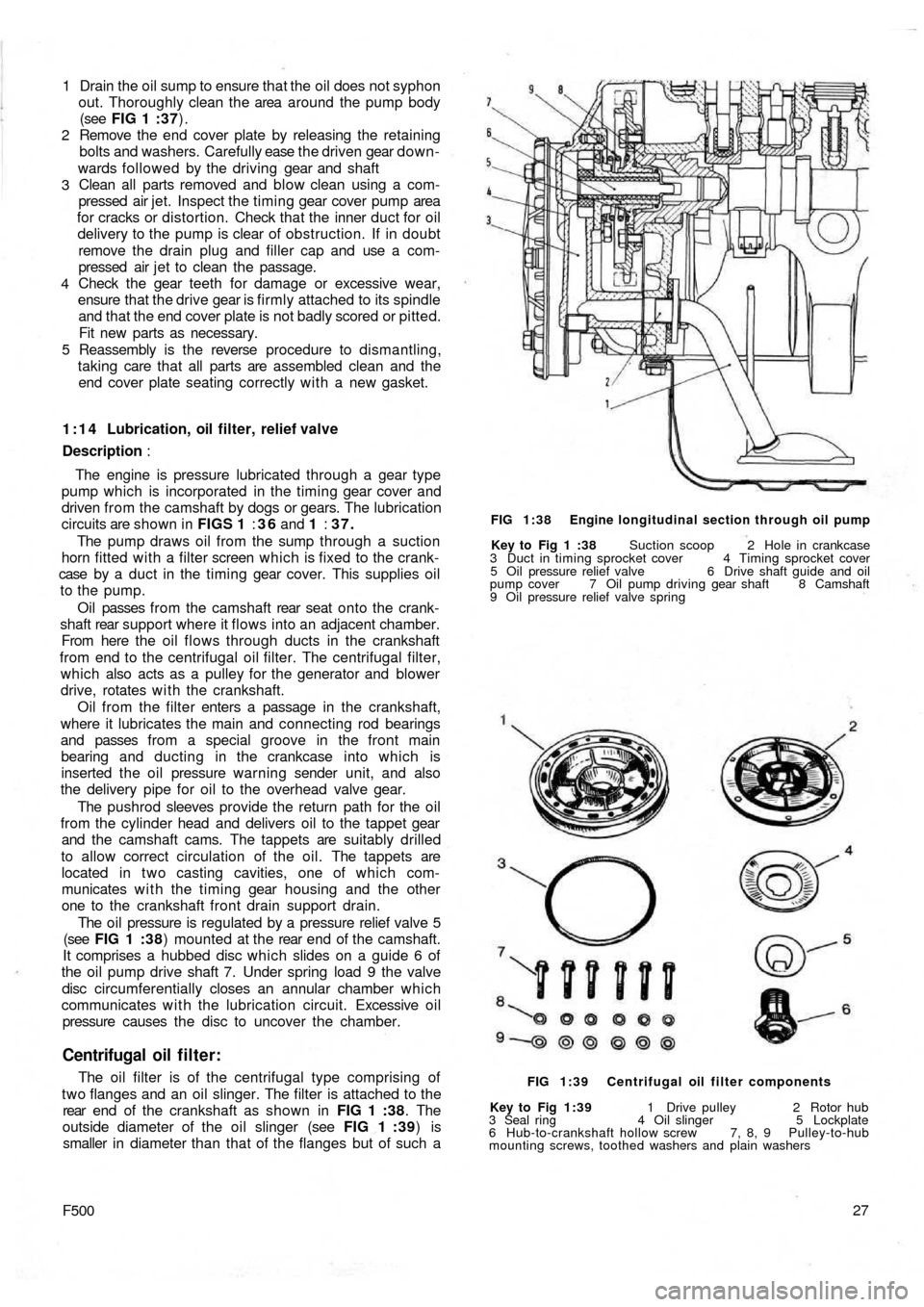
The oil pressure is regulated by a pressure relief valve 5
(see FIG 1 : 3 8) mounted at the rear end of t h e camshaft.
It comprises a hubbed disc which slides on a guide 6 of
the oil pump drive shaft 7. Under spring load 9 the valve
disc circumferentially closes an annular chamber which
communicates w i t h the lubrication circuit. Excessive o i l
pressure causes the disc to uncover the chamber.
Centrifugal oil filter:
The oil filter is of the centrifugal type comprising of
two flanges and an oil slinger. The filter is attached to the
rear end o f t h e c r a n k s h a f t a s s h o w n i n FIG 1 :38. The
outside diameter of the oil slinger (see FIG 1 :39) is
smaller in diameter than that of the flanges but of such a
F50027
Key to Fig 1:39 1 Drive pulley 2 Rotor hub
3 Seal ring 4 Oil slinger 5 Lockplate
6 Hub-to-crankshaft hollow screw 7, 8, 9 Pulley-to-hub
mounting screws, toothed washers and plain washers FIG 1:39 Centrifugal oil filter components Key to Fig 1 :38 Suction scoop 2 Hole in crankcase
3 Duct in timing sprocket cover 4 Timing sprocket cover
5 Oil pressure relief valve 6 Drive shaft guide and oil
pump cover 7 Oil pump driving gear shaft 8 Camshaft
9 Oil pressure relief valve spring FIG 1:38 Engine longitudinal section through oil pump
Page 24 of 128
sections of the air conveyor securing with seven
screws, seven toothed washers and five nuts.
22 Slide the fuel pump control rod into its seating,
assemble the insulator between oil wetted graphite
gaskets and fit the pump to the crankcase using nuts
and toothed washers.
23 Fit the air conveyor cover complete with the accelera-
tor control relay lever and rod. Secure using eight
mounting screws, eight toothed washers, eight plain
washers and eight nuts. Fit the fuel line retaining clip
which is secured by one of the air conveyor upper
screws. Install the generator and fan drive pulley
having first placed four adjusting rings between the
pulley halves and the thrust ring on the outside.
Secure the pulley to generator shaft using three
screws and three toothed washers. Fit the generator
fan drive belt.
24 Refit the carburetter having first positioned the
bakelite heat shield between the t w o oil moistened
graphite gaskets. Secure the carburetter using t w o
copper washers and t w o self-locking nuts. Fit the
exhaust silencer and secure to the exhaust manifolds
with nuts and spring washers. Place the t w o graphite
gaskets between the manifold joints. Fit both exhaust
silencer upper mounting brackets and secure them
on the top side to the brackets already in place w i t h
nuts and toothed washers on the bottom side w i t h
screws and toothed washers.
25 Carefully position the distributor at a 10 deg advance
setting and secure w i t h a
nut, plain washer and
spring washer. Fit the fuel pump to carburetter line
complete w i t h mounting bracket rubber lining and
secure the line with two clamps. If difficulty is
experienced in positioning the fuel line into the pump
or carburetter funnels it is suggested that the line
ends should be heated in hot water and thoroughly
dried before installing.
26 Install the air cleaner elbow and rubber hose assembly
on the top of the carburetter using a graphite gasket
in between and secure w i t h nuts, plain washers and
spring washers. Carefully position the air cleaner, line
and hose assembly and connect it to the elbow.
Secure the cleaner to air conveyor cover using screws
and toothed washers.
27 Fit the spark plug cables complete with the rubber
grommet for cable mounting bracket on engine
cowling and connect the cables to the distributor
and spark plugs. Fit the oil pressure gauge sender
unit together w i t h its sealing washer.
28 Install the cylinder head cover and oil breather pipe
assembly w i t h a cork gasket inserted between.
Secure w i t h self-locking nuts and fibre washers.
Connect the accelerator control relay lever rod to the
carburetter and secure with the clip.
29 Fill the oil pan with the correct grade and quantity of
oil, insert the dipstick and the engine is ready for
refitting.
1:18 Engine assembly (station wagon)
Reassembly of this engine is straightforward as it is
the reverse procedure to dismantling. It is recommended
that Sections 1 :5 and 1 :17 are studied as the assembly
technique is similar for both the horizontal and vertical
F50031 cylinder engines. The following points should however
be noted:
1 Refer to FIG 1 :45 for the correct positioning of the
connecting rod-piston assembly on the 120.000
engine.
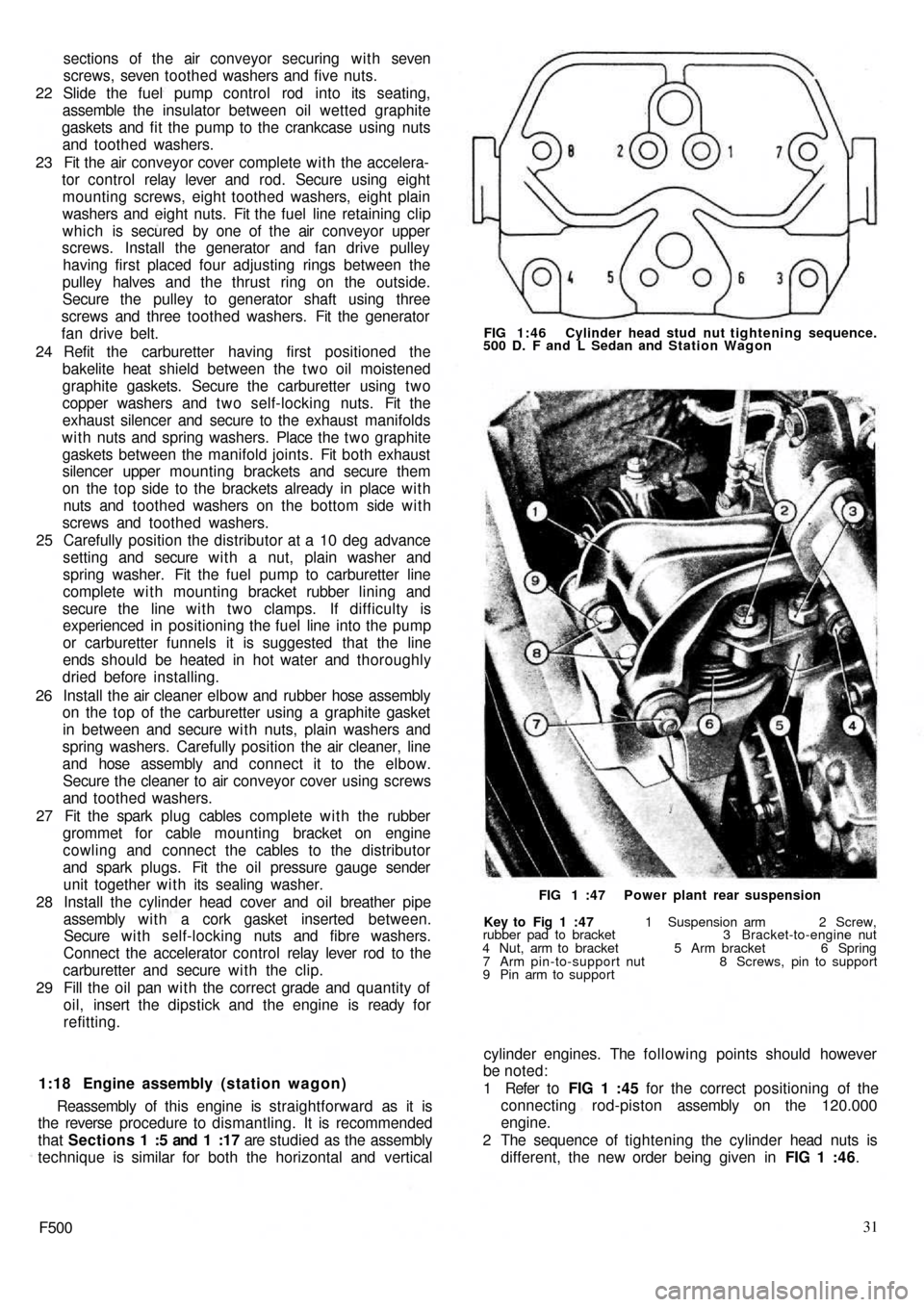
2 The sequence of tightening the cylinder head nuts is
different, the new order being given in FIG 1 :46.
Key to Fig 1 :47 1 Suspension arm 2 Screw,
rubber pad to bracket 3 Bracket-to-engine nut
4 Nut, arm to bracket 5 Arm bracket 6 Spring
7 Arm pin-to-support nut 8 Screws, pin to support
9 Pin arm to supportFIG 1 :47 Power plant rear suspension FIG 1:46 Cylinder head stud nut tightening sequence.
500 D. F and L Sedan and Station Wagon
Page 26 of 128
4 Mixture too weak
5 Water in fuel system
6 Petrol tank vent blocked
7 Incorrect valve clearance
(c) Engine idles badly
1 Check 1 and 6 in (b)
2 Air leak at manifold joints
3 Slow-running jet blocked or out of adjustment
4 Air leak in carburetter
5 Over-rich mixture
6 Worn piston rings
7 Worn valve stems or guides
8 Weak exhaust valve springs
(d) Engine misfires
1 Check 1, 2, 3, 4, 5, 8, 10, 13, 14, 1 5, 16, 17 in (a);
2, 3, 4 and 7 in (b)
2 Weak or broken valve springs
(e) Engine overheats
1 Generator and fan drive belt too loose
2 Shutter or thermostat seized in closed position
(f) Compression low
1 Check 14 and 15 in (a), 6 and 7 in (c) and 2 in (d)
2 Worn piston ring grooves
3 Scored or worn cylinder bores
(g) Engine lacks power
1 Check 3, 10, 1 1 , 13, 14, 15, 16 and 17 in (a), 2, 3, 4
and 7 in (b) 6 and 7 in (c) and 2 in (d). Also check (e)
and (f)
2 Leaking joint washers
3 Fouled sparking plugs
4 Automatic centrifugal advance not operating
(h) Burnt valves or seats
1 Check 14 and 15 in (a), 7 in (b) and 2 in (d). Alsocheck (e)
2 Excessive carbon around valve seat and head
(j) Sticking valves
1 Check 2 in (d)
2 Bent valve stem
3 Scored valve stem or guide
4 Incorrect valve clearance
(k) Excessive cylinder wear
1 Check 11 in (a) and see Chapter 4
2 Lack of oil
3 Dirty oil
4 Piston rings gummed up or broken
5 Badly fitting piston rings
6 Connecting rods bent
(l) Excessive oil consumption
1 Check 6 and 7 in (c) and check (k)
2 Ring gaps too wide
3 Oil return holes in piston choked with carbon
4 Scored cylinders
5 Oil level too high
6 External oil leaks
7 Ineffective valve stem oil seals
(m) Crankshaft and connecting rod bearing failure
1 Check 2 in (k)
2 Restricted oilways
3 Worn journals or crank pins
4 Loose bearing caps
5 Extremely low oil pressure
6 Bent connecting rod
(n) High fuel consumption (see Chapter 2)
(o) Engine vibration
1 Loose generator bolts
2 Blower blade assembly out-of-balance
3 Incorrect clearance for rear engine mounting rubber
F50033
Page 38 of 128
Air cleaner—station wagon:
A pleated paper air cleaner element is housed in a
special air intake chamber connected to the front of the
engine air cooling cowling (see FIG 4 : 2) . This chamber
will be seen located towards the rear of t h e power unit
compartment. Remove the retaining wing nut, lift off the
lid and the element can be withdrawn by lifting upwards.
2:10 Blow-by-gases recirculation device
Engine 110 F.000
All the oil vapours and blow-by-gases that are formed
in the engine crankcase are drawn to the cylinder head
cover recess 1 (see FIG 2:18). From here they travel into
the pipe 5 via a breather valve 2 which is firmly attached to
the oil filler cap 3 and the strainer 4 located in the filler
neck. The oil vapours and gases are then d r a w n back into
the duct 9 from the pipe 5 which connects the air cleaner
6 to the carburetter 7. This ensures a complete closed cir-
cuit circulation.
Engine 120.000:
From engine No. 288156 the oil vapours and blow-by-
gases instead of being exhausted to the atmosphere are
conveyed to the air cleaner and from here they are drawn
back into the combustion chambers. To ensure that an
excessive of oil vapour does not pass along the piping
with the blow-by-gases a diaphragm is fitted in the duct
in front of the breather valve 2 (see FIG 2 :18), the dia-
phragm comprising a filter gauze 11 and moveable parti-
tion 10.
It should be noted that the oil vapour strainer 4 (see
FIG 2:18) and the flame trap 8 can easily be removed
from their seating for cleaning or renewal.
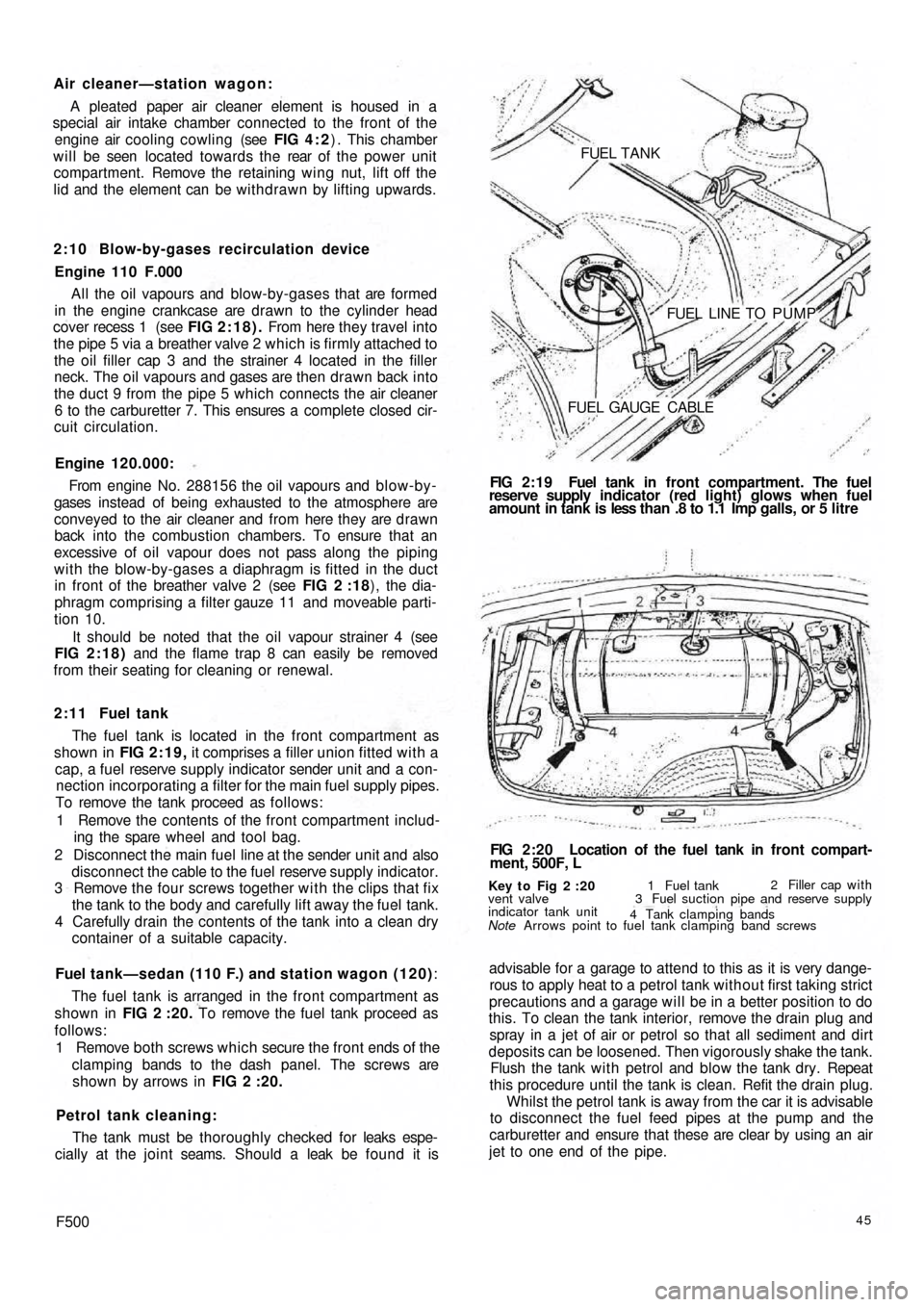
2 : 1 1 Fuel tank
The fuel tank is located in the front compartment as
shown in FIG 2:19, it comprises a filler union fitted with a
cap, a fuel reserve supply indicator sender unit and a con-
nection incorporating a filter for the main fuel supply pipes.
To remove the tank proceed as follows:
1 Remove the contents of the front compartment includ-
ing the spare wheel and tool bag.
2 Disconnect the main fuel line at the sender unit and also
disconnect the cable to the fuel reserve supply indicator.
3 Remove the four screws together w i t h the clips that fix
the tank to the body and carefully lift away the fuel tank.
4 Carefully drain the contents of the tank into a clean dry
container of a suitable capacity.
Fuel tank—sedan (110 F.) and station wagon (120):
The fuel tank is arranged in the front compartment as
shown in FIG 2 :20. To remove the fuel tank proceed as
follows:
1 Remove both screws which secure the front ends of the
clamping bands to the dash panel. The screws are
shown by arrows in FIG 2 :20.
Petrol tank cleaning:
The tank must be thoroughly checked for leaks espe-
cially at the joint seams. Should a leak be found it is
F50045
advisable for a garage to attend to this as it is very dange-
rous to apply heat to a petrol tank without first taking strict
precautions and a garage will be in a better position to do
this. To clean the tank interior, remove the drain plug and
spray in a jet of air or petrol so that all sediment and dirt
deposits can be loosened. Then vigorously shake the tank.
Flush the tank w i t h petrol and blow the tank dry. Repeat
this procedure until the tank is clean. Refit the drain plug.
Whilst the petrol tank is away from the car it is advisable
to disconnect the fuel feed pipes at the pump and the
carburetter and ensure that these are clear by using an air
jet to one end of the pipe.
Key t o Fig 2 :20
Note Arrows point to fuel tank clamping band screws vent valve
indicator tank unit1 Fuel tank2 Filler cap with
3 Fuel suction pipe and reserve supply
4 Tank clamping bands
FIG 2:20 Location of the fuel tank in front compart-
ment, 500F, L FIG 2:19 Fuel tank in front compartment. The fuel
reserve supply indicator (red light) glows when fuel
amount in tank is less than .8 to 1.1 Imp galls, or 5 litre FUEL TANK
FUEL LINE TO PUMP
FUEL GAUGE CABLE
Page 46 of 128
CHAPTER 4
THE COOLING SYSTEM
4:1
4:2
4:3Description
Air outlet thermostat and shutter
Tension adjustment4:4
4:5
4:6Heating system safety device
Maintenance
Fault diagnosis
4:1Description
Sedan:
A l l the Fiat new 500 models covered by this manual are
aircooled by the forced air circulation system from a
centrifugal blower which is mounted on the generator
output shaft. The blower fan has fourteen vanes which are
arranged at various angles to reduce operating noise
during high-speed operation. A specially designed
cowling as shown in FIGS 4 : 1 and 4:2 conveys the air
from the blower and distributes it to the various parts of
the exterior of the engine.
The main components of the air cooling system are as
follows:
1 Air intake compartment at the rear end of t h e body.
2 An elbow pipe for the admittance of incoming air.
3 A flexible air pipe connecting the elbow pipe to the
conveyor.
4 A spiral air conveyor which contains the centrifugal fan.
5 Distribution ducting for directing the air flow to various
parts of the engine.
6 A bellows type thermostat is fitted to the cowling which
operates a butterfly shutter controlling the air outlet
from the engine which ensures control of the engine
operating temperature.
F50053 When the shutter is in the open position, engine heated
air is allowed to disperse to the outside of the engine
cowling. With the shutter in its closed position, the air is
recirculated in the engine cowling so ensuring a quick
engine warm-up period.
It should be noted that by operating the heater lever
which is located on the centre tunnel at the rear seat,
warmed air flowing out from the engine cowling is passed
to the inside of the car for heating and demisting purposes.
Station wagon:
Refer to FIG 4 : 2 where it will be seen that as the engine
is located on its side underneath the luggage compartment
floor the ducting has been modified and the air intakes are
located at the rear of the side windows. A linear blower is
housed in the engine baffles and cowling and is attached
to the drive end of the generator.
The thermostat 'C' (see FIG 4 : 2) is located on the
righthand side of the engine cowling and should start
opening the engine heated air outlet shutter ' D ' when the
temperature of the air rises to 1 7 8 - 1 8 5 ° F and the shutter
should be wide open when the air is at a temperature of
196-207°F.
Page 53 of 128
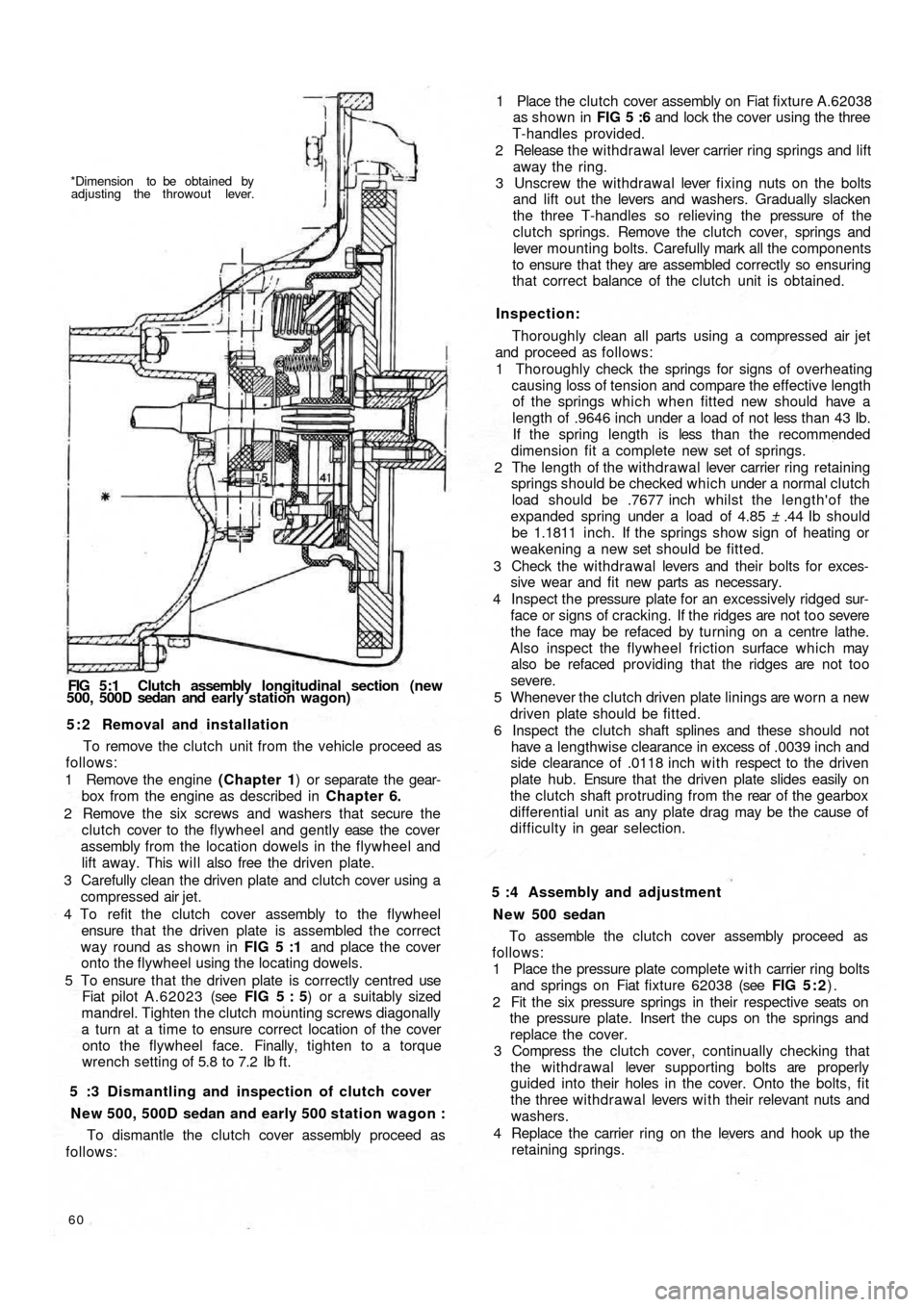
*Dimension to be obtained by
adjusting the throwout lever.
FIG 5:1 Clutch assembly longitudinal section (new
500, 500D sedan and early station wagon)
5 : 2 Removal and installation
To remove the clutch unit from the vehicle proceed as
follows:
1 Remove the engine (Chapter 1) or separate the gear-
box from the engine as described in Chapter 6.
2 Remove the six screws and washers that secure the
clutch cover to the flywheel and gently ease the cover
assembly from the location dowels in the flywheel and
lift away. This will also free the driven plate.
3 Carefully clean the driven plate and clutch cover using a
compressed air jet.
4 To refit the clutch cover assembly to the flywheel
ensure that the driven plate is assembled the correct
way round as shown in FIG 5 :1 and place the cover
onto the flywheel using the locating dowels.
5 To ensure that the driven plate is correctly centred use
Fiat pilot A.62023 (see FIG 5 : 5) or a suitably sized
mandrel. Tighten the clutch mounting screws diagonally
a turn at a time to ensure correct location of the cover
onto the flywheel face. Finally, tighten to a torque
wrench setting of 5.8 to 7.2 Ib ft.
5 :3 Dismantling and inspection of clutch cover
New 500, 500D sedan and early 500 station wagon :
To dismantle the clutch cover assembly proceed as
follows:
60
To assemble the clutch cover assembly proceed as
follows:
1 Place the pressure plate complete with carrier ring bolts
and springs on Fiat fixture 62038 (see FIG 5 : 2).
2 Fit the six pressure springs in their respective seats on
the pressure plate. Insert the cups on the springs and
replace the cover.
3 Compress the clutch cover, continually checking that
the withdrawal lever supporting bolts are properly
guided into their holes in the cover. Onto the bolts, fit
the three withdrawal levers w i t h their relevant nuts and
washers.
4 Replace the carrier ring on the levers and hook up the
retaining springs. 5 :4 Assembly and adjustment
N e w 500 sedan1 Place the clutch cover assembly on Fiat fixture A.62038
as shown in FIG 5 :6 and lock the cover using the three
T-handles provided.
2 Release the w i thdrawal lever carrier ring springs and lift
away the ring.
3 Unscrew the withdrawal lever fixing nuts on the bolts
and lift out the levers and washers. Gradually slacken
the three T-handles so relieving the pressure of the
clutch springs. Remove the clutch cover, springs and
lever mounting bolts. Carefully mark all the components
to ensure that they are assembled correctly so ensuring
that correct balance of the clutch unit is obtained.
Inspection:
Thoroughly clean all parts using a compressed air jet
and proceed as follows:
1 Thoroughly check the springs for signs of overheating
causing loss of tension and compare the effective length
of the springs which when fitted new should have a
length of .9646 inch under a load of not less than 43 Ib.
If the spring length is less t h a n t h e recommended
dimension fit a complete new set of springs.
2 The length of the withdrawal lever carrier ring retaining
springs should be checked which under a normal clutch
load should be .7677 inch whilst the length'of the
expanded spring under a load of 4.85 ± .44 Ib should
be 1.1811 inch. If the springs show sign of heating or
weakening a new set should be fitted.
3 Check the withdrawa l levers and their bolts for exces-
sive wear and fit new parts as necessary.
4 Inspect the pressure plate for an excessively ridged sur-
face or signs of cracking. If the ridges are not too severe
the face may be refaced by turning on a centre lathe.
Also inspect the flywheel friction surface which may
also be refaced providing that the ridges are not too
severe.
5 Whenever the clutch driven plate linings are worn a new
driven plate should be fitted.
6 Inspect the clutch shaft splines and these should not
have a lengthwise clearance in excess of .0039 inch and
side clearance of .0118 inch w i t h respect to the driven
plate hub. Ensure that the driven plate slides easily on
the clutch shaft protruding from the rear of the gearbox
differential unit as any plate drag may be the cause of
d i f f i c u l t y in gear selection.
Page 59 of 128
PRIMARY SHAFT-TO-CLUTCH
SHAFT MOUNTING PINCLUTCH SHAFT SEAL PRIMARY SHAFT WITH
1st, 3 r d A N D 4 t h SPEED
GEAR CLUSTER
2 n d SPEED
DRIVE GEARPRIMARY SHAFT
FRONT BALL BEARINGPRIMARY SHAFT
REAR BALL BEARING
PRIMARY
SHAFT-TO-CLUTCH
i SHAFT JOINING SLEEVEJOINING SLEEVELOCKRING
SPEED SELECTOR LEVER
CLUTCH SHAFT
LAYSHAFT WITH BEVEL PINION
SPEEDOMETER DRIVE GEAR
2 n d SPEED ENGAGEMENT
SLIDING SLEEVE
2 N D SPEED DRIVEN GEAR
LAYSHAFT FRONT BALL
BEARING
3 r d SPEED DRIVEN GEARHUB FOR
SLEEVE
3rd AND 4th/
SPEED ENGAGEMENT
SLIDING SLEEVE4 t h SPEED
DRIVEN GEARLAYSHAFT REAR ROLLER BEARING
LAYSHAFT-TO-PINION
ADJUSTMENT WASHER 1st SPEED AND)
REVERSE SLIDING GEAR
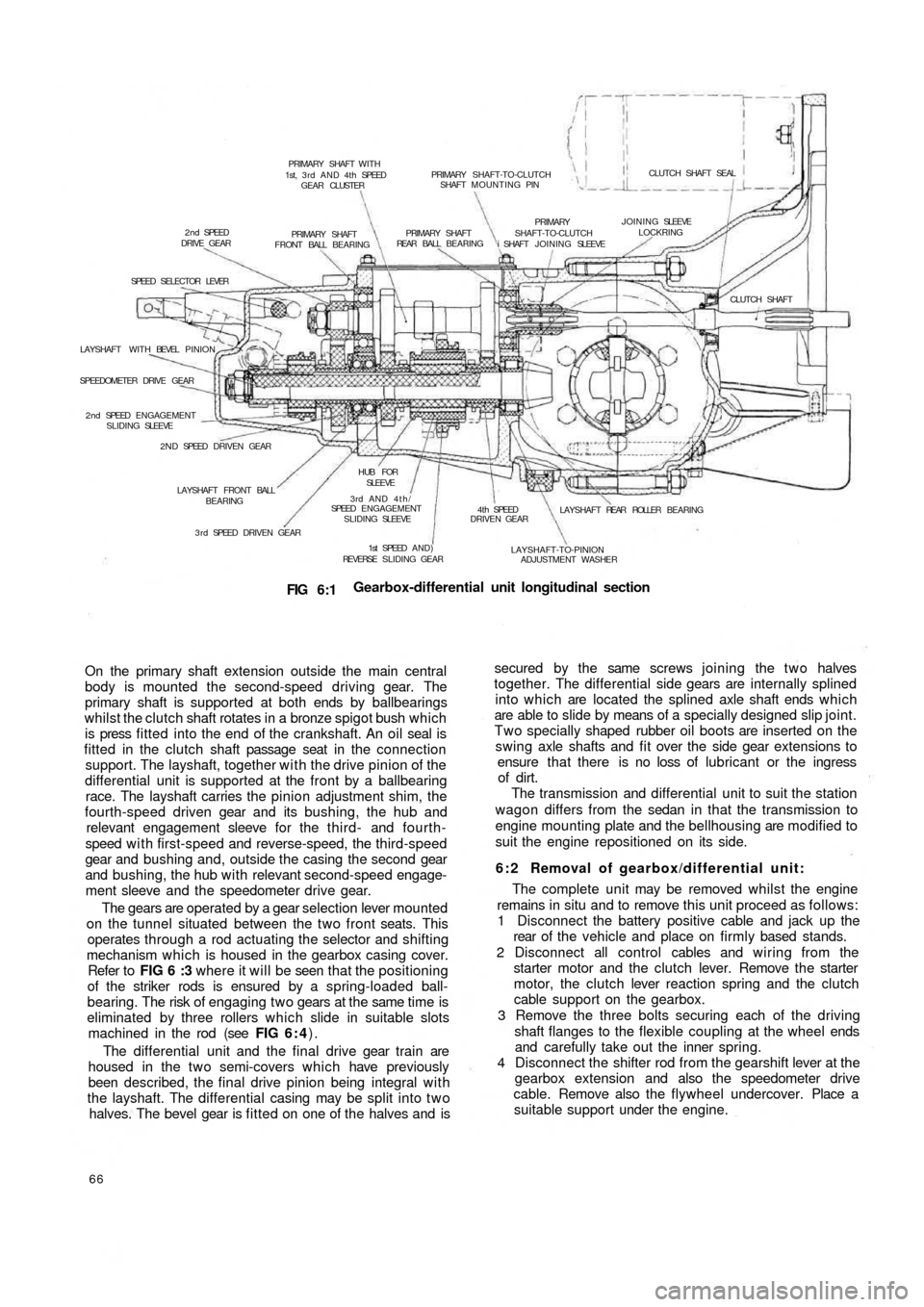
FIG 6:1Gearbox-differential unit longitudinal section
On the primary shaft extension outside the main central
body is mounted the second-speed driving gear. The
primary shaft is supported at both ends by ballbearings
whilst the clutch shaft rotates in a bronze spigot bush which
is press fitted into the end of the crankshaft. An oil seal is
fitted in the clutch shaft passage seat in the c o n n e c t i o n
support. The layshaft, together with the drive pinion of the
differential unit is supported at the front by a ballbearing
race. The layshaft carries the pinion adjustment shim, the
fourth-speed driven gear and its bushing, the hub and
relevant engagement sleeve for the t h i r d - and fourth-
speed w i t h first-speed and reverse-speed, the third-speed
gear and bushing and, outside the casing the second gear
and bushing, the hub with relevant second-speed engage-
ment sleeve and the speedometer drive gear.
The gears are operated by a gear selection lever mounted
on the tunnel situated between the two front seats. This
operates through a rod actuating the selector and shifting
mechanism which is housed in the gearbox casing cover.
Refer to FIG 6 :3 where it will be seen th a t the positioning
of the striker rods is ensured by a spring-loaded ball-
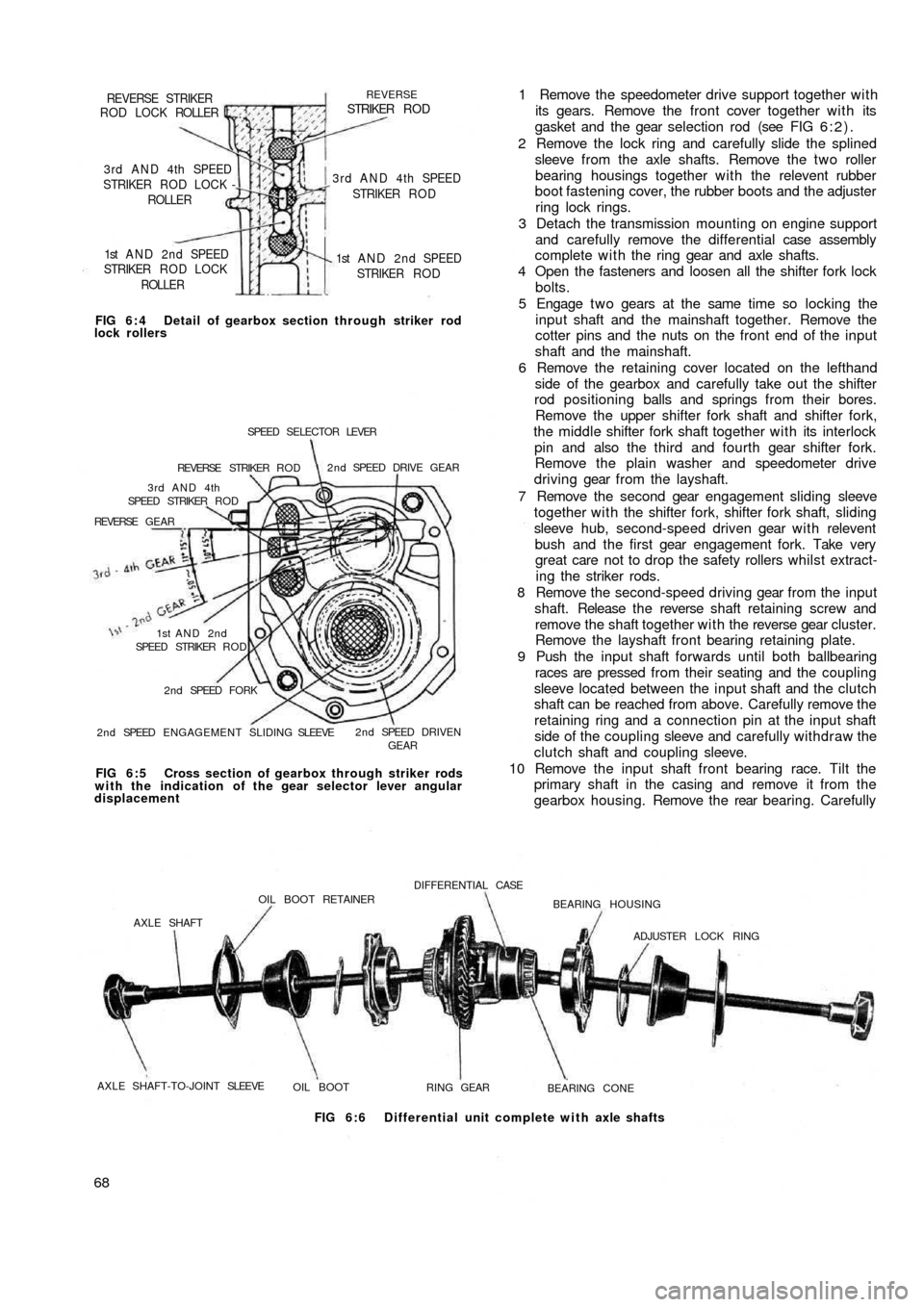
bearing. The risk of engaging two gears at the same time is
eliminated by three rollers which slide in suitable slots
machined in the rod (see FIG 6 : 4).
The differential unit and the final drive gear train are
housed in the t w o semi-covers which
have previously
been described, the final drive pinion being integral with
the layshaft. The differential casing may be split into t w o
halves. The bevel gear is fitted on one of the halves and is
66
secured by the same screws joining the two halves
together. The differential side gears are internally splined
into which are located the splined axle shaft ends which
are able to slide by means of a specially designed slip joint.
Two specially shaped rubber oil boots are inserted on the
swing axle shafts and fit over the side gear extensions to
ensure that there is no loss of lubricant or the ingress
of dirt.
The transmission and differential unit to suit the station
wagon differs from the sedan in that the transmission to
engine mounting plate and the bellhousing are modified to
suit the engine repositioned on its side.
6 : 2 Removal of gearbox/differential unit:
The complete unit may be removed whilst the engine
remains in situ and to remove this unit proceed as follows:
1 Disconnect the battery positive cable and jack up the
rear of t h e vehicle and place on firmly based stands.
2 Disconnect all control cables and wiring from the
starter motor and the clutch lever. Remove the starter
motor, the clutch lever reaction spring and the clutch
cable support on the gearbox.
3 Remove the three bolts securing each of the driving
shaft flanges to the flexible coupling at the wheel ends
and carefully take out the inner spring.
4 Disconnect the shifter rod from the gearshift lever at the
gearbox extension and also the
speedometer drive
cable. Remove also the flywheel undercover. Place a
suitable support under the engine.
Page 61 of 128
1st A N D 2 n d SPEED
STRIKER R O D LOCK
ROLLER1st A N D 2 n d SPEED
STRIKER R O D 3 r d A N D 4 t h SPEED
STRIKER R O D 3 r d A N D 4 t h SPEED
STRIKER R O D LOCK -
ROLLER REVERSE STRIKER
ROD LOCK ROLLER
REVERSESTRIKER R O D
FIG 6 : 4 Detail of gearbox section through striker rod
lock rollers
2 n d SPEED DRIVENGEAR2 n d SPEED ENGAGEMENT SLIDING SLEEVE 2 n d SPEED FORK 1st A N D 2 n d
SPEED STRIKER R O D REVERSE GEAR3rd AND 4th
SPEED STRIKER R O DREVERSE STRIKER R O D2 n d SPEED DRIVE GEAR SPEED SELECTOR LEVER
FIG 6 : 5 Cross section of gearbox through striker rods
with the indication of the gear selector lever angular
displacement
68
AXLE SHAFT-TO-JOINT SLEEVE
OIL BOOT
RING GEAR
FIG 6:6 Differential unit complete with axle shafts
BEARING CONEADJUSTER LOCK RING BEARING HOUSING DIFFERENTIAL CASE
OIL BOOT RETAINER
AXLE SHAFT
1 Remove the speedometer drive support together with
its gears. Remove the front cover together with its
gasket and the gear selection rod (see FIG 6:2).
2 Remove the lock ring and carefully slide the splined
sleeve from the axle shafts. Remove the t w o roller
bearing housings together with the relevent rubber
boot fastening cover, the rubber boots and the adjuster
ring lock rings.
3 Detach the transmission mounting on engine support
and carefully remove the differential case assembly
complete w i t h the ring gear and axle shafts.
4 Open the fasteners and loosen all the shifter fork lock
bolts.
5 Engage t w o gears at the same time so locking the
input shaft and the mainshaft together. Remove the
cotter pins and the nuts on the front end of the input
shaft and the mainshaft.
6 Remove the retaining cover located on the lefthand
side of the gearbox and carefully take out the shifter
rod positioning balls and springs from their bores.
Remove the upper shifter fork shaft and shifter fork,
the middle shifter fork shaft together with its interlock
pin and also the third and fourth gear shifter fork.
Remove the plain washer and speedometer drive
driving gear from the layshaft.
7 Remove the second gear engagement sliding sleeve
together with the shifter fork, shifter fork shaft, sliding
sleeve hub, second-speed driven gear with relevent
bush and the first gear engagement
fork. Take very
great care not to drop the safety rollers whilst extract-
ing the striker rods.
8 Remove the second-speed driving gear from the input
shaft. Release the reverse shaft retaining screw and
remove the shaft together with the reverse gear cluster.
Remove the layshaft front bearing retaining plate.
9 Push the input shaft forwards until both ballbearing
races are pressed from their seating and the coupling
sleeve located between the input shaft and the clutch
shaft can be reached from above. Carefully remove the
retaining ring and a connection pin at the input shaft
side of the coupling sleeve and carefully withdraw the
clutch shaft and coupling sleeve.
10 Remove the input shaft front bearing race. Tilt the
primary shaft in the casing and remove it from the
gearbox housing. Remove the rear bearing. Carefully