shaft FIAT 500 1973 1.G Repair Manual
[x] Cancel search | Manufacturer: FIAT, Model Year: 1973, Model line: 500, Model: FIAT 500 1973 1.GPages: 128, PDF Size: 9.01 MB
Page 106 of 128
indicates a break in the cable from the generator to
regulator. Repeat the test on terminal 67. Finally,
remove the temporary link from the generator. If the
readings are correct, test the regulator as described in
Section 11:5.
Removing generator:
1 Disconnect the leads from the generator.
2 Remove the drive belt as previously described.
3 Release t h e rear mounting bracket at the side of the
power unit.
4 Remove the air cooling ducting from around the fan
and generator area and lift away the unit.
5 Release the blower from the end of the armature shaft
and finally, the mounting bolts from the air ducting.
Dismantling generator:
1 Release the pulley self-locking nut and slide the pulley
off the armature shaft.
2 Remove the t w o Woodruff keys on armature shaft.
3 Unscrew the t w o through bolt nuts and pull out the
bolts.
4 Partially remove the commutator end head to the point
where the brushes are. s t i l l seating on the commutator.
Using a piece of hooked wire relieve the load of the
springs on the brushes by arranging the spring ends
on the brush sides. The brushes will be locked in their
holders and cannot be chipped by striking against the
armature shaft during the commutator end head
removal.
5 Gently ease the commutator and fan end heads apart
and, slide out the armature.
Servicing brushes:
Lift the brushes up in the boxes and hold them in that
position by letting each brush spring bear on the side of
its brush. Fit the commutator end bracket over the
commutator end of the armature shaft and release the
brushes by hooking up the springs using a thin screw
driver. Hold back each spring in turn and move the brush
by pulling gently on the flexible connector. If the brush
moves sluggishly remove it and polish the sides using a
smooth file. Before this operation is actually carried out it
is suggested that the brush is marked before removal so
that it is replaced in its original working position.
inch,The minimum permissible length of a brush is
so renew any t h a t are less than this figure. Test the brush
springs using a spring tension scale. New springs should
have a tension of 1.3 to 1.6 Ib. In service this value could
fall slightly before performance is affected. Always bed in
new brushes by wrapping fine sandpaper round the
commutator, pressing down on the brush and rotating
the commutator under it, or draw the paper t o o and f r o .
If new brushes are fitted always fit genuine Fiat replace-
ments.
Servicing the commutator:
A commutator in good condition should be smooth and
free from pitting or signs of the segments burning. Clean
with a rag moistened in petrol. If necessary, polish using
a fine glasspaper whilst rotating the armature. Never use
emerycloth.
If the commutator is badly worn it may be skimmed
using a centre lathe. Use a high rotational speed and take
F500113
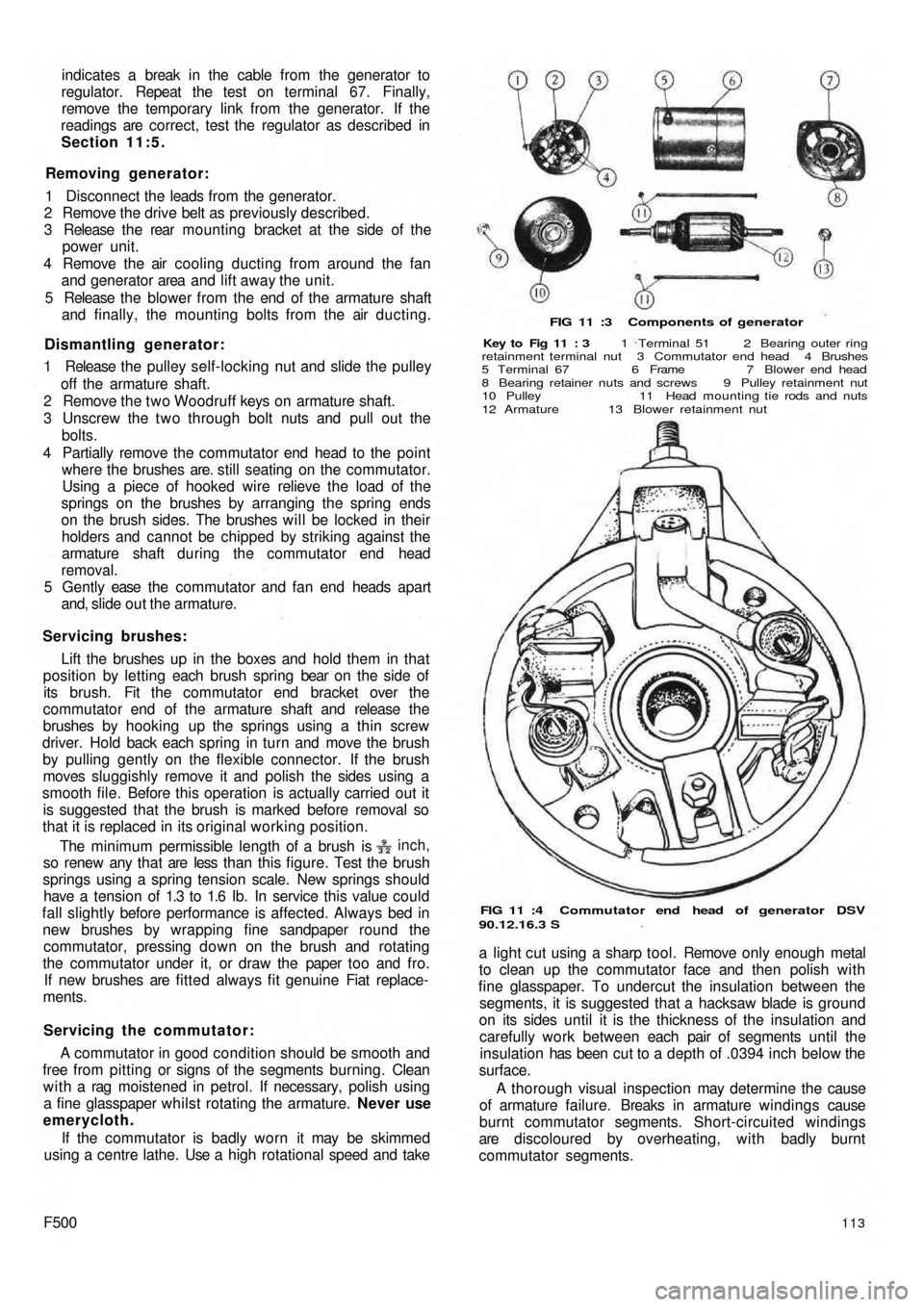
FIG 11 :3 Components of generator
Key to Fig 11 : 3 1 Terminal 51 2 Bearing outer ring
retainment terminal nut 3 Commutator end head 4 Brushes
5 Terminal 67 6 Frame 7 Blower end head
8 Bearing retainer nuts and screws 9 Pulley retainment nut
10 Pulley 11 Head mounting tie rods and nuts
12 Armature 13 Blower retainment nut
FIG 11 :4 Commutator end head of generator DSV
90.12.16.3 S
a light cut using a sharp tool. Remove only enough metal
to clean up the commutator face and then polish with
fine glasspaper. To undercut the insulation between the
segments, it is suggested that a hacksaw blade is ground
on its sides until it is the thickness of the insulation and
carefully work between each pair of segments until the
insulation has been cut to a depth of .0394 inch below the
surface.
A thorough visual inspection may determine the cause
of armature failure. Breaks in armature windings cause
burnt commutator segments. Short-circuited windings
are discoloured by overheating, with badly burnt
commutator segments.
Page 107 of 128
1
791011 8 234
11
10
16,15
14 13
1265
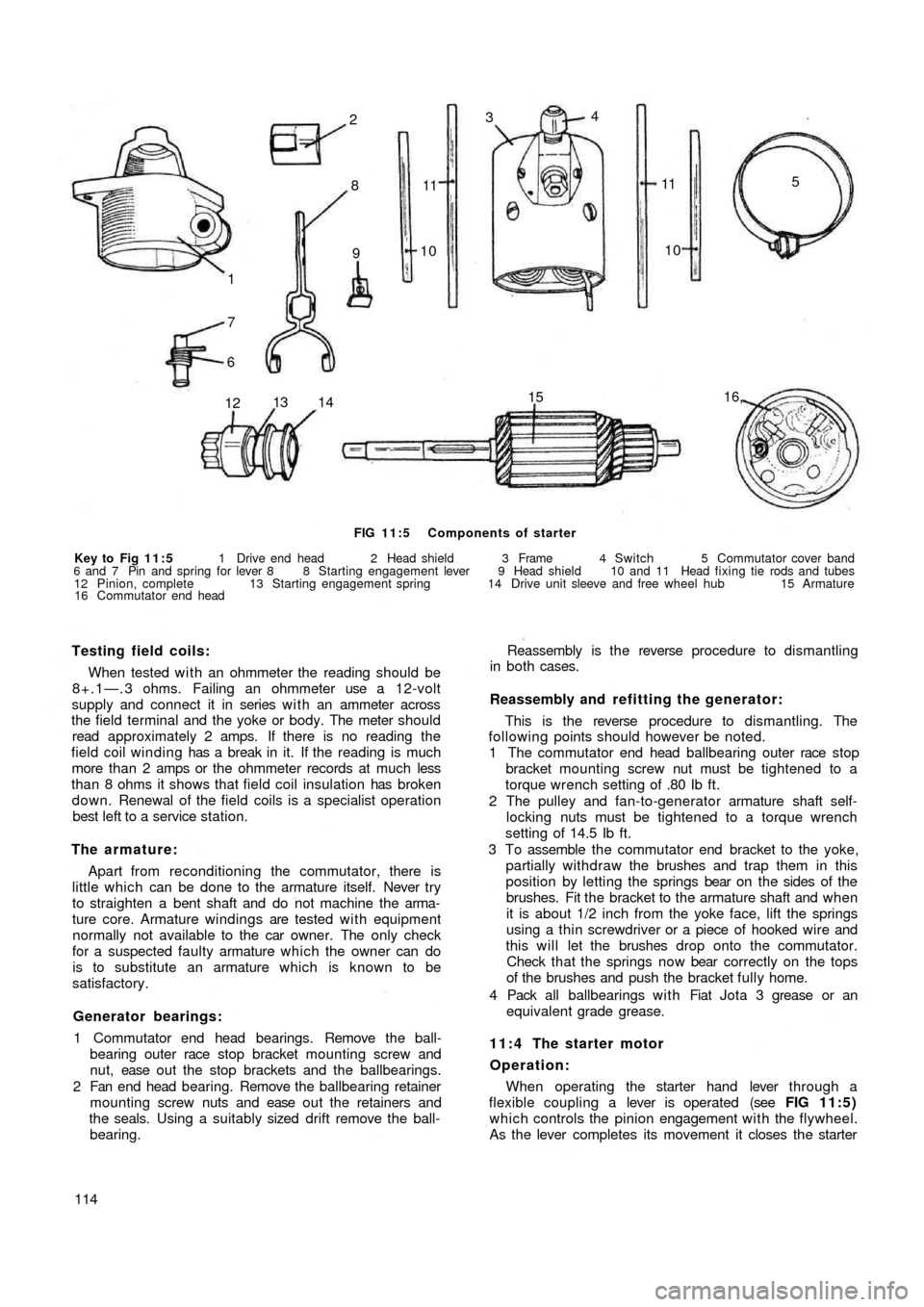
FIG 11:5 Components of starter
Key to Fig 11:5 1 Drive end head 2 Head shield 3 Frame 4 Switch 5 Commutator cover band
6 and 7 Pin and spring for lever 8 8 Starting engagement lever 9 Head shield 10 and 11 Head fixing tie rods and tubes
12 Pinion, complete 13 Starting engagement spring 14 Drive unit sleeve and free wheel hub 15 Armature
16 Commutator end head
Testing field coils:
When tested w i t h an ohmmeter the reading should be
8+.1—.3 ohms. Failing an ohmmeter use a 12-volt
supply and connect it in series w i t h an ammeter across
the field terminal and the yoke or body. The meter should
read approximately 2 amps. If there is no reading the
field coil winding has a break in it. If the reading is much
more than 2 amps or the ohmmeter records at much less
than 8 ohms it shows that field coil insulation has broken
down. Renewal of the field coils is a specialist operation
best left to a service station.
The armature:
Apart from reconditioning the commutator, there is
little which can be done to the armature itself. Never try
to straighten a bent shaft and do not machine the arma-
ture core. Armature windings are tested w i t h equipment
normally not available to the car owner. The only check
for a suspected faulty armature which the owner can do
is to substitute an armature which is known to be
satisfactory.
Generator bearings:
1 Commutator end head bearings. Remove the ball-
bearing outer race stop bracket mounting screw and
nut, ease o u t t h e stop brackets and the ballbearings.
2 Fan end head bearing. Remove the ballbearing retainer
mounting screw nuts and ease o u t t h e retainers and
the seals. Using a suitably sized drift remove the ball-
bearing.
114Reassembly is the reverse procedure to dismantling
in both cases.
Reassembly and refitting the generator:
This is the reverse procedure to dismantling. The
following points should however be noted.
1 The commutator end head ballbearing outer race stop
bracket mounting screw nut must be tightened to a
torque wrench setting of .80 Ib ft.
2 The pulley and fan-to-generator armature shaft self-
locking nuts must be tightened to a torque wrench
setting of 14.5 Ib ft.
3 To assemble the commutator end bracket to the yoke,
partially withdraw the brushes and trap them in this
position by letting the springs bear on the sides of the
brushes. Fit the bracket to the armature shaft and when
it is about 1/2 inch from the yoke face, lift the springs
using a thin screwdriver or a piece of hooked wire and
this will let the brushes drop onto the commutator.
Check that the springs now bear correctly on the tops
of the brushes and push the bracket fully home.
4 Pack all ballbearings with Fiat Jota 3 grease or an
equivalent grade grease.
11:4 The starter motor
Operation:
When operating the starter hand lever through a
flexible coupling a lever is operated (see FIG 11:5)
which controls the pinion engagement with the flywheel.
As the lever completes its movement it closes the starter
Page 108 of 128
switch contacts. The starter motor rotates driving the
engine through the pinion and ring gear. As soon as the
engine fires the starter hand lever must be released which
will open the starter switch contacts so stopping the
starter motor and the pinion will return under the action
of a spring to a neutral position.
Tests for a starter which does not operate:
Check the condition of the battery and particularly
the connections to the terminals and to earth. If the
battery is charged, switch on the lights and operate the
starter hand lever control. If the lights go dim but the
starter does not operate it shows that current is reaching
the starter motor. The probability is that the pinion of the
starter shaft is jammed in mesh due to dirty pinion splines
or a broken spring. To release the pinion engage a low
gear with the ignition switched off and rock the vehicle
backwards and forwards which should allow the pinion
to be disengaged from the flywheel ring gear. If it proves
impossible to free a jammed pinion the starter motor must
be removed for examination and repair.
If the lamps do not go dim, check the starter switch and
also check the connection between the battery and the
starter switch to ensure that they are tight and making
good electrical connection. If the starter motor still does
not work it should be removed from the power unit for
inspection.
Removing the starter:
To remove the starter motor from the power unit
proceed as follows:
1 Disconnect the positive terminal from the
battery post.
2 Release the hand lever control cable from the starter
motor engagement lever.
3 Disconnect the battery cable terminal from the starter
motor switch.
4 Remove the retaining nuts and washers holding the
starter motor to body to the transmission bellhousing
and gently ease backwards and lift away the starter
motor.
Examining the commutator and brush gear :
Refer to FIG 11:5 and remove the coverband 5. Hold
back each spring in turn and pull gently on the flexible
connection to the brush. If the brush does not move
freely remove it from its holder and polish the sides using
a fine file. Mark the brushes so that they will be replaced
in their original positions. If the brushes are so worn that
they no longer bear onto the commutator, or the brush
connector has become exposed on the running face, the
brushes must be renewed.
If the commutator is blackened it should be cleaned by
turning it against a petrol-moistened cloth. With the
brushes and commutator overhauled hold the body of the
starter motor in a vice and connect it with thick cables to a
12 volt battery. One cable should go to the starter
switch terminal and the other to the body of the starter.
The starter should run at high speed. If it does not, it
must be dismantled for further examination and testing.
F500115 Dismantling the starter:
To dismantle the starter proceed as follows:
1 Remove the coverband 5 (see FIG 11:5) and hold
back the brush springs and take out the brushes.
2 Remove the starter switch by releasing the t w o
mounting screws and lift away the switch.
3 Remove the commutator end head 16, slide off the
armature assembly from the drive unit and from the
pole shoes.
4 Release the engagement lever pin 6 and spring 7 from
the lever operating bracket on the drive end head. Lift
away the lever and withdraw the pinion assembly
complete which is shown in FIG 11:5.
Servicing the brushes
Test the brush springs with a balance, the correct
tension is 2.5 to 2.9 Ib. according to the wear of the
brushes. Fit a new spring if the tension is low.
The life of the brushes depends on the type of service
in which the vehicle is being used. In normal circum-
stances even when the starter is being used frequently,
the brushes should last more than 18,000 miles. If the
wear is found to be abnormal it will probably be found
that the commutator is either damaged or excessively
w o r n . Only Fiat replacement brushes must be used.
Testing the field coils:
Use a 12 volt bulb in one lead of a 12 volt battery.
Connect one lead to the brush connection joint to the coil
field and the other to the field coil current supply lead.
If the bulb does not light there is a break in the f i e l d coil
windings. This is not a complete test as it is still possible
for a coil to be earthed. Check this by moving the lead
from the brush connection and holding it on a clean
metal
surface on the yoke or body. If the bulb lights it shows
that the field coils are earthed.
The only sure way of curing faulty field coils is to take
the starter motor to a service station.
Examining the armature:
The armature shaft may be bent due to the starter
being operated whilst the engine is operating. Do not try
to straighten a bent shaft or machine the armature core to
obtain the correct clearance.
If the commutator is damaged or any wires or segments
have lifted from it, the assembly will have to be renewed.
Starter bearings:
Bearing bushes are of the porous bronzed type and
must not be reamed after fitting. Worn bearings should
be withdrawn by screwing a tap into them and pulling
on the tap. New bushes must be immersed in engine oil
for approximately twenty four hours before fitting. Press
them into place using a suitably sized drift which has a
spigot the length of the bearing and the diameter of the
starter shaft. When this is withdrawn after fitting, the
bore of the bush should be correct to size.
The pinion drive:
This unit is shown in FIG 11:5. The chief sources of
trouble are a dirty unit or a broken starting engagement
Page 113 of 128
WINDSHIELD WIPER
MOTOR ASSY
WIPER MOTOR SCREWS
WIPER MOTOR BRACKET
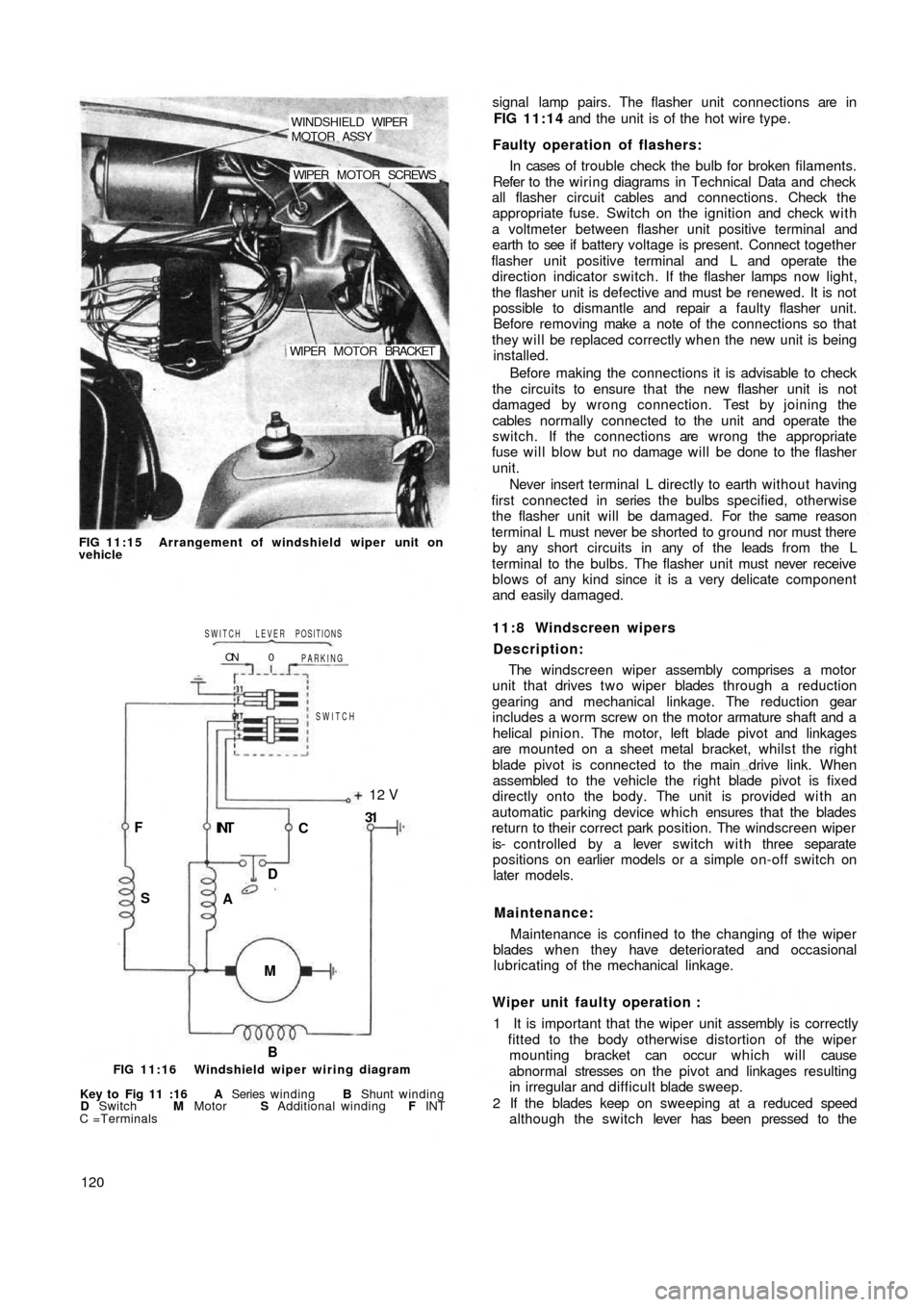
FIG 11:15 Arrangement of windshield wiper unit on
vehicle
B M INT F
SC12 V
31
D
A
SWITCH PARKING
0 ON
SWITCH LEVER POSITIONS
FIG 11:16 Windshield wiper wiring diagram
Key to Fig 11 :16 A Series winding B Shunt winding
D Switch M Motor S Additional winding F INT
C =Terminals
120signal lamp pairs. The flasher unit connections are in
FIG 11:14 and the unit is of the hot wire type.
Faulty operation of flashers:
In cases of trouble check the bulb for broken filaments.
Refer to the wiring diagrams in Technical Data and check
all flasher circuit cables and connections. Check the
appropriate fuse. Switch on the ignition and check w i t h
a voltmeter between flasher unit positive terminal and
earth to see if battery voltage is present. Connect together
flasher unit positive terminal and L and operate the
direction indicator switch. If the flasher lamps now light,
the flasher unit is defective and must be renewed. It is not
possible to dismantle and repair a faulty flasher unit.
Before removing make a note of the connections so that
they will be replaced correctly when the new unit is being
installed.
Before making the connections it is advisable to check
the circuits to ensure that the new flasher unit is not
damaged by wrong connection. Test by joining the
cables normally connected to the unit and operate the
switch. If the connections are wrong the appropriate
fuse will blow but no damage will be done to the flasher
unit.
Never insert terminal L directly to earth without having
first connected in series the bulbs specified, otherwise
the flasher unit will be damaged. For the same reason
terminal L must never be shorted to ground nor must there
by any short circuits in any of the leads from the L
terminal to the bulbs. The flasher unit must never receive
blows of any kind since it is a very delicate component
and easily damaged.
11:8 Windscreen wipers
Description:
The windscreen wiper assembly comprises a motor
unit that drives t w o wiper blades through a reduction
gearing and mechanical linkage. The reduction gear
includes a worm screw on the motor armature shaft and a
helical pinion. The motor, left blade pivot and linkages
are mounted on a sheet metal bracket, whilst the right
blade pivot is connected to the main drive link. When
assembled to the vehicle the right blade pivot is fixed
directly onto the body. The unit is provided w i t h an
automatic parking device which ensures that the blades
return to their correct park position. The w
indscreen wiper
is- controlled by a lever switch with three separate
positions on earlier models or a simple on-off switch on
later models.
Maintenance:
Maintenance is confined to the changing of the wiper
blades when they have deteriorated and occasional
lubricating of the mechanical linkage.
Wiper unit faulty operation :
1 It is important that the wiper unit assembly is correctly
fitted to the body otherwise distortion of the wiper
mounting bracket can occur which will cause
abnormal stresses on the pivot and linkages resulting
in irregular and difficult blade sweep.
2 If the blades keep on sweeping at a reduced speed
although the switch lever has been pressed to the
Page 117 of 128
Before removing an apparently faulty horn check the
wiring and connections. Check that the mounting bolts
are tight and that the horn does not foul any adjacent part.
Removal and installation:
This is a straightforward operation and the only
precaution to be taken is to ensure that the rubber gasket
bonded to the horn body does not become detached. If
the horn is renewed, before installing the new horn bond
the rubber gasket to the new unit with adhesive in
the same position as was on the original horn unit fitted.
Should the horn fail to operate the following points
should be noted.
1 Damaged horn.
2 Broken connection between battery and horn.
3 Broken connection between horn and push button on
steering wheel
4 Damaged push button mechanism.
5 Directional signal and outer lighting changeover
switch blade contact failing to make contact with the
steering wheel hub ring contact.
6 Current lead displaced from the horn blade contact on
the directional signal and outer lighting switch.
7 Distorted or broken diaphragm in horn.
8 Connections or inner windings
broken or burnt.
9 Electro-magnet contact points dirty or excessively
worn.The contacts may be adjusted by the adjusting screw
after the points have been cleaned and refaced.
To adjust the tone of the horn use a ring spanner and
screwdriver as shown in FIG 11 :23.
It is recommended that if the horn unit operation is
unreliable a new unit should be fitted rather than the
original one repaired.
11:12 Lighting and flasher switch
Description:
The two switches provide a directional signal switch
which automatically returns to the rest position once a
turn has been negotiated and the steering wheel is
brought back to the straight-ahead position. The change
over switch controls the outer lights and the headlights
flasher. The complete unit is located under the steering
wheel on the steering column.
Switch unit removal:
1 Carefully pry off the horn push button at the steering
wheel centre using a fine blade screwdriver.
2 Disconnect the positive terminal of the battery.
3 Disconnect the plug in contact in the steering wheel
hub.
4 Unscrew the steering wheel retaining nut from the
inner column and remove the steering wheel from the
shaft.
5 Slacken the bolts securing the steering column support
to the body
6 Remove the plug in contacts from the switch unit
ensuring that their correct location is noted for re-
assembly.7 Remove the switch unit from the steering column.
124
Switch unit installation:
This is the reverse procedure to dismantling. It is
advisable after installation to check that the steering
wheel when in the straight-ahead position and the
directional signal switch lever in neutral, the reference
index on the outer face of the directional signal switch
drum is in line with the index on the steering wheel hub.
This will ensure correct sequence of operation.
11:13 Fault diagnosis
(a) Battery discharged
1 Lighting circuit shorted
2 Terminals loose or dirty
3 Generator not charging
4 Regulator or cut-out units not working properly
5 Battery internally defective
(b) Insufficient charging current
1 Loose or corroded battery terminals
2 Generator driving belt slipping
(c) Battery will not hold a charge
1 Low electrolyte level
2 Battery plates sulphated
3 Electrolyte leakage from cracked casing or top sealing
compound
4 Plate separators ineffective
(d) Battery overcharged
1 Voltage regulator needs adjusting
(e) Generator output low or nil
1 Belt broken or slipping
2 Regulator unit out of adjustment
3 Worn bearings, loose pole pieces
4 Commutator worn, burned or shorted
5 Armature shaft bent or worn
6 Insulation proud between commutator segments
7 Brushes sticking, springs weak or broken
8 Field coil wires shorted, broken or burned
( f ) Starter motor lacks power or will not operate
1 Battery discharged, loose cable connections
2 Starter pinion jammed in mesh with flywheel gear
3 Starter switch faulty
4 Brushes worn or sticking, heads detached or shorting
5 Commutator dirty or worn
6 Starter shaft bent
7 Engine abnormally stiff
(g) Starter motor inoperative
1 Check 1 in (f)
2 Armature or field coils faulty
Page 122 of 128
Inner panels:
Imitation leather-lined masonite trim panels are fitted
to all versions of the new 500' models. The panels are
secured in the housing below the door window by means
of four stiff clips located at the top and seven spring clips
located at the bottom equally spaced around the panel
border. The fasteners are located in holes in the door
framework inner flange. The door framework has a plate
which should be bent downwards onto the trim panel
once it has been installed. This will ensure correct seating
of the trim panel in the door housing.
When the door trim panel is being reassembled ensure
that the tarred felt pad is cemented correctly on the door
inner flange so that any water that may seep in through to
the door interior from the window rubber weather strips
may be kept away from the trim panel which would
otherwise cause distortion and rapid deterioration.
12:4 Door handles and locks
The doors are provided with locks which are operated
by handles either from inside or outside the vehicle.
Removal of the lock is a straightforward operation but
upon reassembly the following procedure should be
followed:
1 Mount the handle assembly from the outside and
insert the washer onto the stud. Screw in the nut several
turns to allow correct handle-to-lock mating on final
fitting.
2 Arrange the locking handle dog so that it is horizontally
positioned and tighten the mounting nut.
3 Mount the lock to the door panel and secure w i t h three
screws and washers.
4 Fit the plate w i t h the t w o rubber guide blocks fastening
by the t w o screws.
Striker plates are fitted with shim adjustment to the
door pillars and are secured by three screws.
12:5 Removing window regulator and door glass
Window regulator:
Description:
The window regulator unit is of the lever and gear
control type which transmits crank movement to the
lifting lever using high ratio gears. When the operating
handle is rotated it rotates a pinion mounted on its shaft
which is in mesh w i t h a gear on the hub of which is
mounted a second pinion that meshes with the lever
toothed sector (refer to FIG 1 2 : 3) . At the end of the lever
a pin fitting locates in a guide rail mounted on the
bottom of the glass. When the crank is rotated in one or
other direction the glass is either lifted or lowered.
Regulator removal:
1 Depress the door lining panel so that the crank key may
be located. Remove the key and the crank handle.
2 Using a wide blade screwdriver prise off the trim panel
by inserting the blade between the panel and the door
frame taking care not to scratch the door paint.
3 Remove the intermediate protection lining.
F500129
FIG 12:3 Lefthand side door window regulator, viewed
from car interior
FIG 12:4 Location of window regulator in lefthand side
door panel housing
4 Release the screws securing the window regulator
to the door. Carefully tilt the regulator so as to dis-
engage the lever pin from the guide on the bottom of
the glass and lift away the regulator assembly.
Regulator reassembly:
To ensure satisfactory regulator operation carefully
lubricate the gears and the lever pin guide and also
ensure that the glass slides freely in its channels. To