steering wheel FIAT 500 2013 2.G Owner's Manual
[x] Cancel search | Manufacturer: FIAT, Model Year: 2013, Model line: 500, Model: FIAT 500 2013 2.GPages: 423, PDF Size: 9.86 MB
Page 146 of 423
▫Technical Specifications.................181
▫Quick Guide.........................182
▫General Information....................185
▫Functions And Adjustments..............186
▫Radio..............................193
▫SiriusXM Satellite Radio — If Equipped......195
▫CD Player...........................198
▫CD MP3 Player.......................200
▫Troubleshooting.......................203
!iPod®/USB/MEDIA PLAYER CONTROL —
IF EQUIPPED.........................204
!STEERING WHEEL AUDIO CONTROLS......205
▫Radio Operation......................206
▫CD Player Operation...................206
▫Operating Instructions — Hands-Free Phone
(If Equipped).........................206
!CD/DVD DISC MAINTENANCE...........206
!RADIO OPERATION AND MOBILE PHONES . .207
!CLIMATE CONTROLS...................207
▫Manual Heating And Air Conditioning......208
▫Automatic Temperature Control (ATC) —
If Equipped.........................210
▫Operating Tips.......................216
144 UNDERSTANDING YOUR INSTRUMENT PANEL
Page 207 of 423
STEERING WHEEL AUDIO CONTROLS
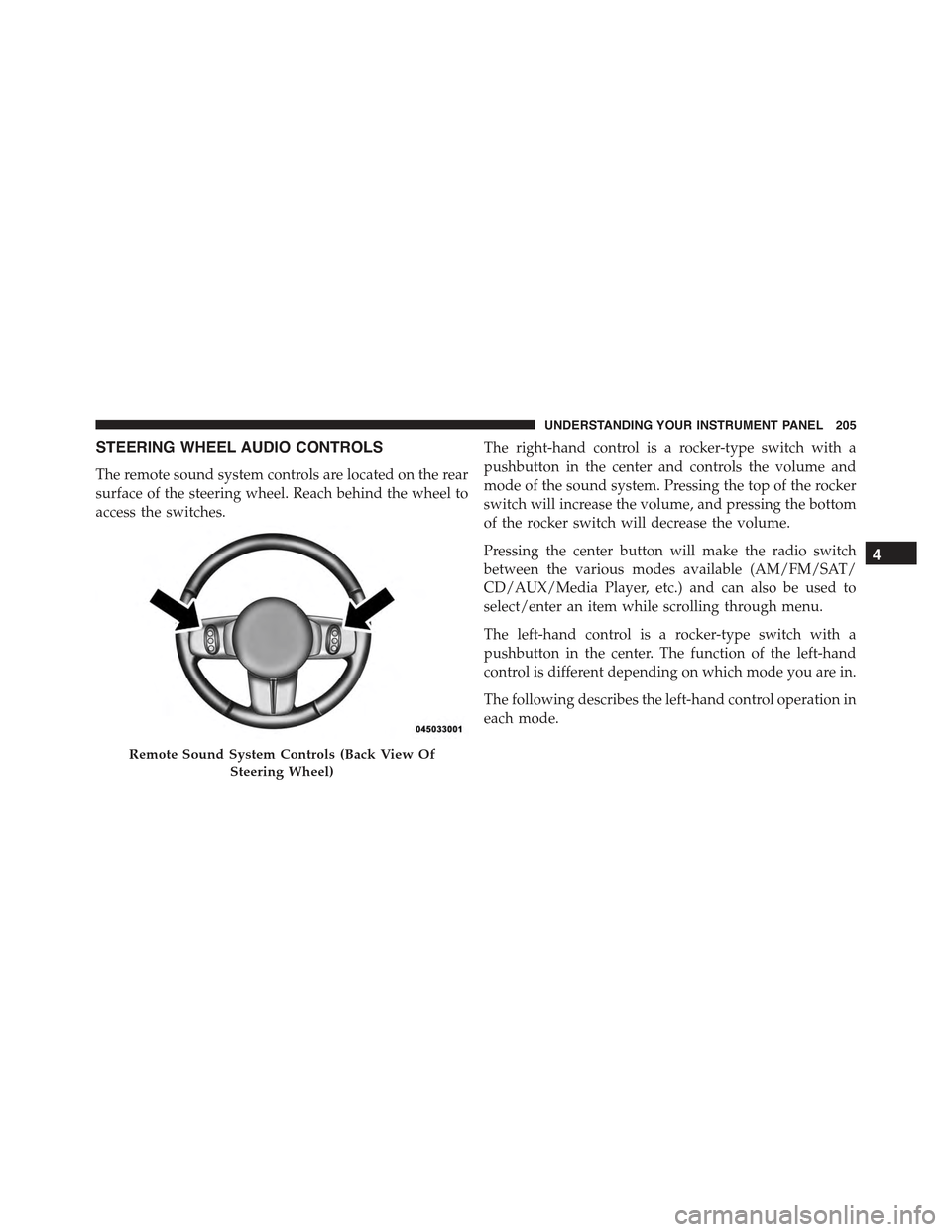
The remote sound system controls are located on the rear
surface of the steering wheel. Reach behind the wheel to
access the switches.
The right-hand control is a rocker-type switch with a
pushbutton in the center and controls the volume and
mode of the sound system. Pressing the top of the rocker
switch will increase the volume, and pressing the bottom
of the rocker switch will decrease the volume.
Pressing the center button will make the radio switch
between the various modes available (AM/FM/SAT/
CD/AUX/Media Player, etc.) and can also be used to
select/enter an item while scrolling through menu.
The left-hand control is a rocker-type switch with a
pushbutton in the center. The function of the left-hand
control is different depending on which mode you are in.
The following describes the left-hand control operation in
each mode.
Remote Sound System Controls (Back View Of
Steering Wheel)
4
UNDERSTANDING YOUR INSTRUMENT PANEL 205
Page 222 of 423
▫Acceleration.........................239
▫Traction............................239
!DRIVING THROUGH WATER.............240
▫Flowing/Rising Water..................240
▫Shallow Standing Water.................240
!POWER STEERING.....................242
!PARKING BRAKE......................244
!SPORT MODE.........................246
▫Manual Transmission – If Equipped........246
▫Automatic Transmission – If Equipped......247
!BRAKE SYSTEM.......................248
▫Four-Wheel Anti-Lock Brake System (ABS) . . .248
!ELECTRONIC BRAKE CONTROL SYSTEM . . . .249
▫Anti-Lock Brake System (ABS)............250
▫Brake Assist System (BAS)...............250
▫Traction Control System (TCS)............251
▫Hill Start Assist (HSA).................251
▫Electronic Stability Control (ESC)..........252
▫ESC Activation/Malfunction Indicator Light
And ESC OFF Indicator Light............255
!TIRE SAFETY INFORMATION.............257
▫Tire Markings........................257
▫Tire Identification Number (TIN)...........260
▫Tire Terminology And Definitions..........262
▫Tire Loading And Tire Pressure...........263
!TIRES — GENERAL INFORMATION........268
220 STARTING AND OPERATING
Page 254 of 423
WARNING!
There may be situations on minor hills (i.e., less than
8%), with a loaded vehicle, or while pulling a trailer,
when the system will not activate and slight rolling may
occur. This could cause a collision with another vehicle
or object. Always remember the driver is responsible for
braking the vehicle.
Disabling/Enabling HSA
If you wish to turn the HSA system on or off, it can be done
using the Customer Programmable Features in the Elec-
tronic Vehicle Information Center (EVIC). Refer to “Elec-
tronic Vehicle Information Center (EVIC)” in “Understand-
ing Your Instrument Panel” for further information.
Electronic Stability Control (ESC)
This system enhances directional control and stability of
the vehicle under various driving conditions. ESC cor-
rects for oversteering or understeering of the vehicle by
applying the brake of the appropriate wheel to assist in
counteracting the oversteering or understeering condi-
tion. Engine power may also be reduced to help the
vehicle maintain the desired path. ESC uses sensors in
the vehicle to determine the vehicle path intended by the
driver and compares it to the actual path of the vehicle.
When the actual path does not match the intended path,
ESC applies the brake of the appropriate wheel to assist
in counteracting the oversteer or understeer condition.
•Oversteer - when the vehicle is turning more than
appropriate for the steering wheel position.
252 STARTING AND OPERATING
Page 255 of 423
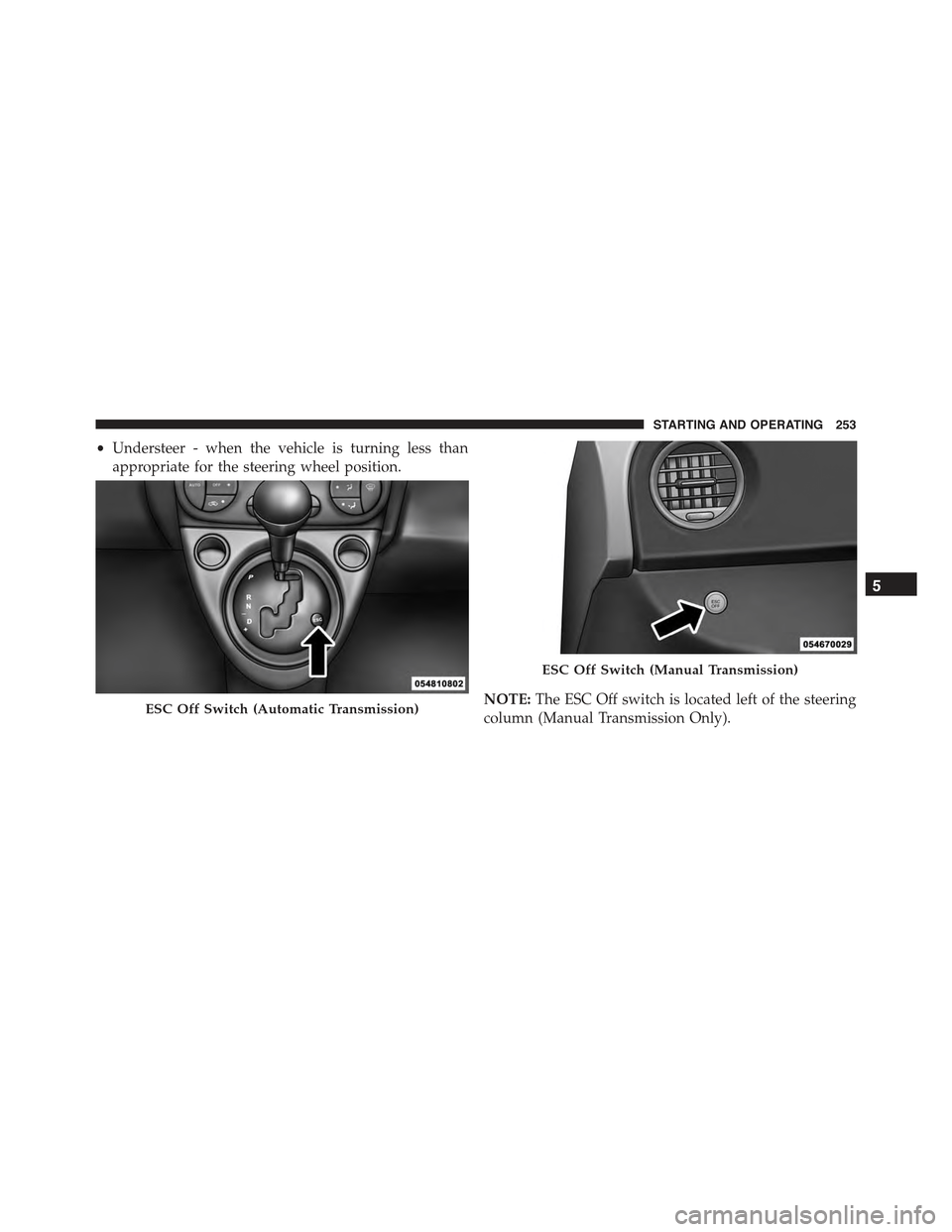
•Understeer - when the vehicle is turning less than
appropriate for the steering wheel position.
NOTE:The ESC Off switch is located left of the steering
column (Manual Transmission Only).ESC Off Switch (Automatic Transmission)
ESC Off Switch (Manual Transmission)
5
STARTING AND OPERATING 253
Page 279 of 423
WARNING!
•Do not use a tire, wheel size or rating other than
that specified for your vehicle. Some combinations
of unapproved tires and wheels may change sus-
pension dimensions and performance characteris-
tics, resulting in changes to steering, handling, and
braking of your vehicle. This can cause unpredict-
able handling and stress to steering and suspen-
sion components. You could lose control and have
a collision resulting in serious injury or death. Use
only the tire and wheel sizes with load ratings
approved for your vehicle.
•Never use a tire with a smaller load index or
capacity, other than what was originally equipped
on your vehicle. Using a tire with a smaller load
index could result in tire overloading and failure.
You could lose control and have a collision.
(Continued)
WARNING!(Continued)
•Failure to equip your vehicle with tires having
adequate speed capability can result in sudden tire
failure and loss of vehicle control.
CAUTION!
Replacing original tires with tires of a different size
may result in false speedometer and odometer read-
ings.
TIRE CHAINS
Use only compact chains, or other traction aids that meet
SAE type “Class S” specifications. Chains must be the
proper size for the vehicle, as recommended by the chain
manufacturer.
5
STARTING AND OPERATING 277
Page 326 of 423
CAUTION!
Accessories plugged into the vehicle power outlets
draw power from the vehicle’s battery, even when not
in use (i.e., cellular phones, etc.). Eventually, if
plugged in long enough without engine operation,
the vehicle’s battery will discharge sufficiently to
degrade battery life and/or prevent the engine from
starting.
FREEING A STUCK VEHICLE
If your vehicle becomes stuck in mud, sand or snow, it can
often be moved using a rocking motion. Turn the steering
wheel right and left to clear the area around the front
wheels. Then shift back and forth between DRIVE and
REVERSE (with automatic transmission) or 2nd gear and
REVERSE (with manual transmission), while gently press-
ing the accelerator. Use the least amount of accelerator pedal
pressure that will maintain the rocking motion, without
spinning the wheels, or racing the engine.
CAUTION!
Racing the engine or spinning the wheels may lead to
transmission overheating and failure. Allow the en-
gine to idle with the transmission in NEUTRAL for at
least one minute after every five rocking-motion
cycles. This will minimize overheating and reduce
the risk of transmission failure during prolonged
efforts to free a stuck vehicle.
NOTE:Press the#ESC Off#switch, to place the Electronic
Stability Control (ESC) system in#Partial Off#mode,
before rocking the vehicle. Refer to “Electronic Brake
Control” in “Starting And Operating” for further infor-
mation. Once the vehicle has been freed, press the#ESC
Off#switch again to restore#ESC On#mode.
324 WHAT TO DO IN EMERGENCIES
Page 384 of 423
Front Turn Signal, Parking And Daytime Running
Lamps
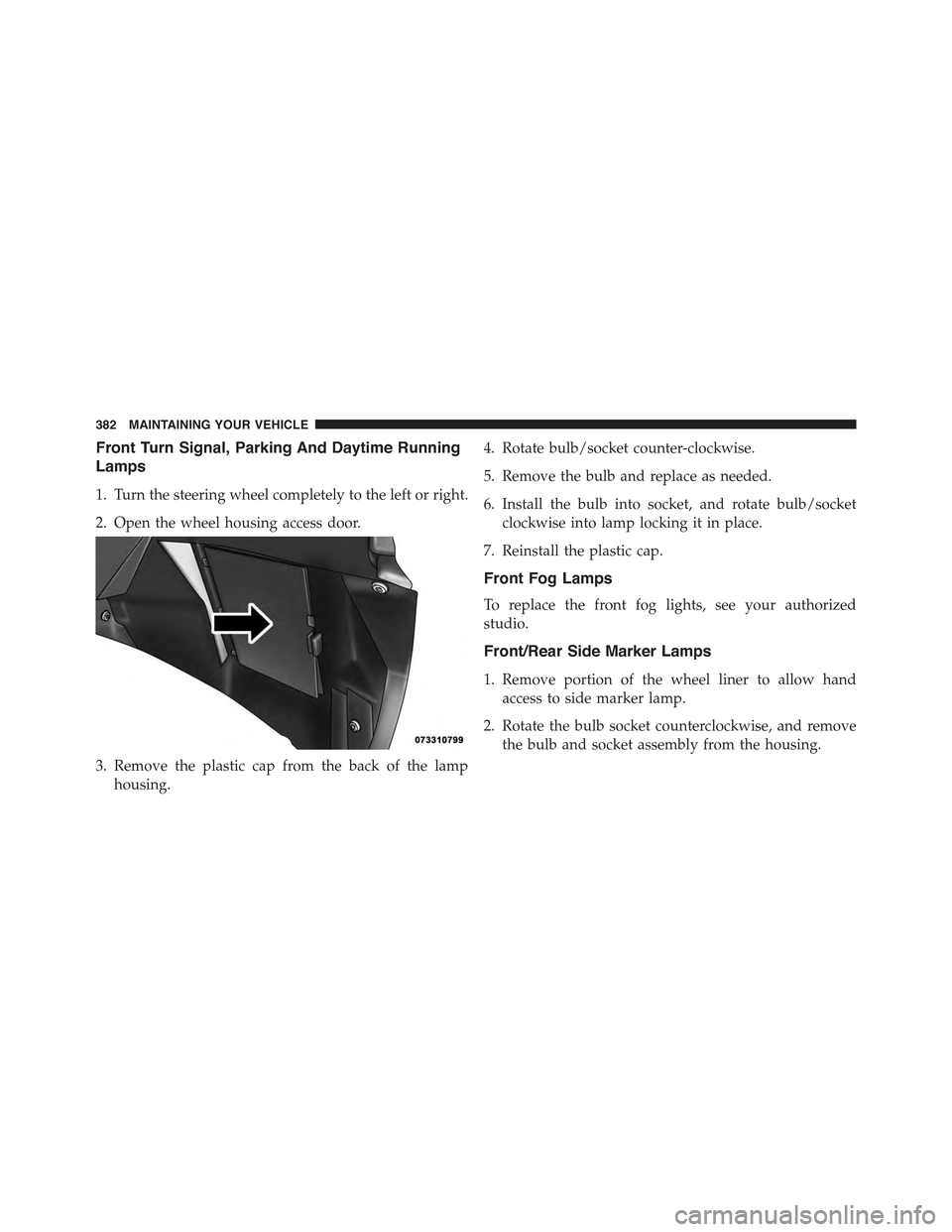
1. Turn the steering wheel completely to the left or right.
2. Open the wheel housing access door.
3. Remove the plastic cap from the back of the lamp
housing.
4. Rotate bulb/socket counter-clockwise.
5. Remove the bulb and replace as needed.
6. Install the bulb into socket, and rotate bulb/socket
clockwise into lamp locking it in place.
7. Reinstall the plastic cap.
Front Fog Lamps
To replace the front fog lights, see your authorized
studio.
Front/Rear Side Marker Lamps
1. Remove portion of the wheel liner to allow hand
access to side marker lamp.
2. Rotate the bulb socket counterclockwise, and remove
the bulb and socket assembly from the housing.
382 MAINTAINING YOUR VEHICLE
Page 419 of 423
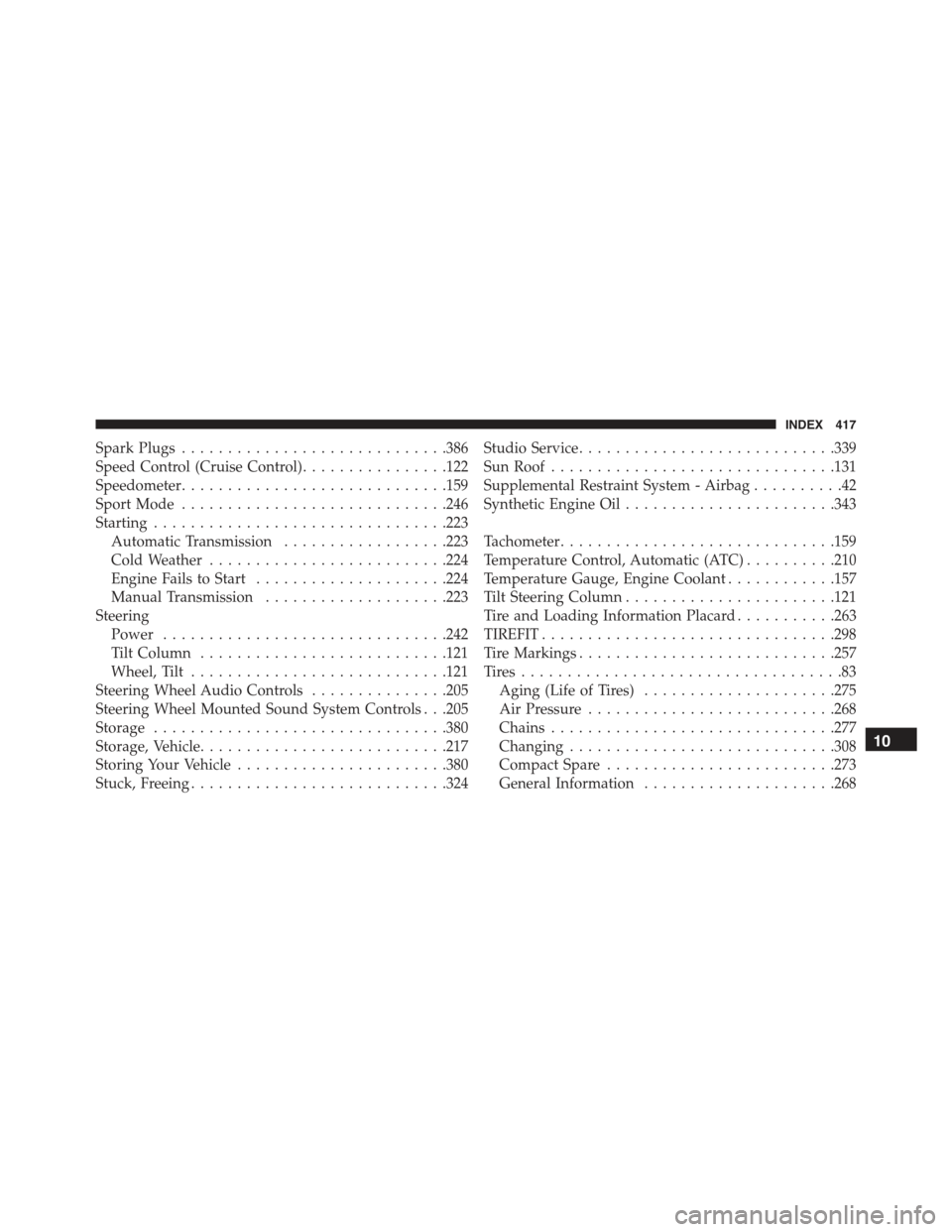
Spark Plugs.............................386
Speed Control (Cruise Control)................122
Speedometer.............................159
Sport Mode.............................246
Starting................................223
Automatic Transmission..................223
Cold Weather..........................224
Engine Fails to Start.....................224
Manual Transmission....................223
Steering
Power...............................242
Tilt Column...........................121
Wheel, Tilt............................121
Steering Wheel Audio Controls...............205
Steering Wheel Mounted Sound System Controls . . .205
Storage................................380
Storage, Vehicle...........................217
Storing Your Vehicle.......................380
Stuck, Freeing............................324
Studio Service............................339
Sun Roof...............................131
Supplemental Restraint System - Airbag..........42
Synthetic Engine Oil.......................343
Tachometer..............................159
Temperature Control, Automatic (ATC)..........210
Temperature Gauge, Engine Coolant............157
Tilt Steering Column.......................121
Tire and Loading Information Placard...........263
TIREFIT................................298
Tire Markings............................257
Ti re s . . . . . . . . . . . . . . . . . . . . . . . . . . . . . . . . . . . 8 3
Aging (Life of Tires).....................275
Air Pressure...........................268
Chains...............................277
Changing.............................308
Compact Spare.........................273
General Information.....................268
10
INDEX 417