PRESSURE FIAT 500 2017 2.G Workshop Manual
[x] Cancel search | Manufacturer: FIAT, Model Year: 2017, Model line: 500, Model: FIAT 500 2017 2.GPages: 350, PDF Size: 3.01 MB
Page 257 of 350
3. Uncoil the Air Pump Hose (7) (black in color) andscrew the fitting at the end of hose (7) onto the valve
stem.
4. Check the pressure in the tire by reading the Pressure Gauge (3).
If tire pressure is less than 19 psi (1.3 Bar):
The tire is too badly damaged. Do not attempt to drive
the vehicle further. Call for assistance.
If the tire pressure is 19 psi (1.3 Bar) or higher:
1. Push the Power Button (4) to turn on Tire Service Kit and inflate the tire to the pressure indicated on the
tire and loading information label on the driver-side
door opening.
NOTE: If the tire becomes over-inflated, push the
Deflation Button to reduce the tire pressure to the
recommended inflation pressure before continuing.
2. Disconnect the Tire Service Kit from the valve stem, reinstall the cap on the valve stem and unplug from
12 Volt outlet.
3. Place the Tire Service Kit in its proper storage area in the vehicle. 4. Have the tire inspected and repaired or replaced at
the earliest opportunity at an Authorized Dealer or
tire service center.
5. Remove the Speed Limit sticker from the instrument panel after the tire has been repaired.
6. Replace the Sealant Bottle (1) and Sealant Hose (6) assembly at your Authorized Dealer as soon as
possible. Refer to (F) “Sealant Bottle and Hose Re-
placement”.
NOTE: When having the tire serviced, advise the
Authorized Dealer or service center that the tire has
been sealed using the Tire Service Kit.
(F) Sealant Bottle And Hose Replacement:
1. Uncoil the Sealant Hose (6) (clear in color).
2. Locate the round Sealant Bottle release button in the recessed area under the sealant bottle.
3. Push the Sealant Bottle release button. The Sealant Bottle (1) will pop up. Remove the bottle and dispose
of it accordingly.
4. Clean any remaining sealant from the Tire Service Kit housing.
6
WHAT TO DO IN EMERGENCIES 255
Page 268 of 350
11. Place the deflated (flat) tire in the cargo area. Havethe tire repaired or replaced as soon as possible.
WARNING!
A loose tire thrown forward in a collision or hard
stop could injure the occupants in the vehicle. Have
the deflated (flat) tire repaired or replaced immedi-
ately.
12. Check the spare tire pressure as soon as possible. Correct the tire pressure as required.
Road Tire Installation
Vehicles Equipped With Wheel Covers
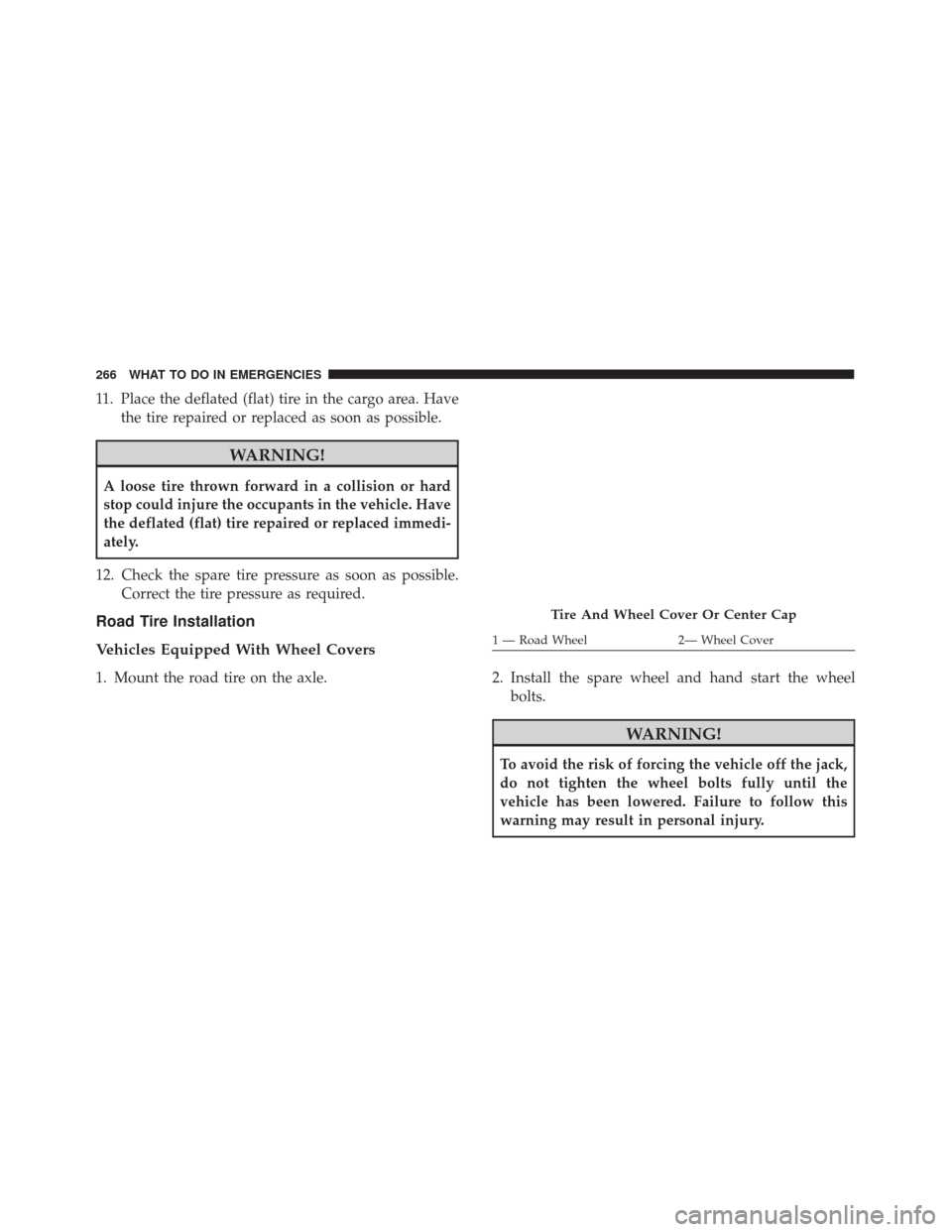
1. Mount the road tire on the axle. 2. Install the spare wheel and hand start the wheel
bolts.
WARNING!
To avoid the risk of forcing the vehicle off the jack,
do not tighten the wheel bolts fully until the
vehicle has been lowered. Failure to follow this
warning may result in personal injury.
Tire And Wheel Cover Or Center Cap
1 — Road Wheel 2— Wheel Cover
266 WHAT TO DO IN EMERGENCIES
Page 273 of 350
6. Once the engine is started, remove the jumper cablesin the reverse sequence.
Disconnecting The Jumper Cables
1. Disconnect the negative (-)jumper cable from the
engine ground (-)of the vehicle with the discharged
battery.
2. Disconnect the negative end (-)of the jumper cable
from the negative (-)post of the booster battery.
3. Disconnect the opposite end of the positive (+)
jumper cable from the positive (+)post of the booster
battery.
4. Disconnect the positive (+)end of the jumper cable
from the positive (+)post of the discharged vehicle.
If frequent jump-starting is required to start your ve-
hicle, you should have the battery and charging system
inspected at your authorized dealer.
CAUTION!
Accessories plugged into the vehicle power outlets
draw power from the vehicle’s battery, even when
not in use (i.e., cellular devices, etc.). Eventually, if
(Continued)
CAUTION! (Continued)
plugged in long enough without engine operation,
the vehicle’s battery will discharge sufficiently to
degrade battery life and/or prevent the engine from
starting.
FREEING A STUCK VEHICLE
If your vehicle becomes stuck in mud, sand or snow, it
can often be moved using a rocking motion. Turn the
steering wheel right and left to clear the area around the
front wheels. Then shift back and forth between DRIVE
and REVERSE (with automatic transmission) or 2nd
gear and REVERSE (with manual transmission), while
gently pressing the accelerator. Use the least amount of
accelerator pedal pressure that will maintain the rock-
ing motion, without spinning the wheels, or racing the
engine.
CAUTION!
Racing the engine or spinning the wheels may lead
to transmission overheating and failure. Allow the
engine to idle with the transmission in NEUTRAL
(Continued)
6
WHAT TO DO IN EMERGENCIES 271
Page 275 of 350
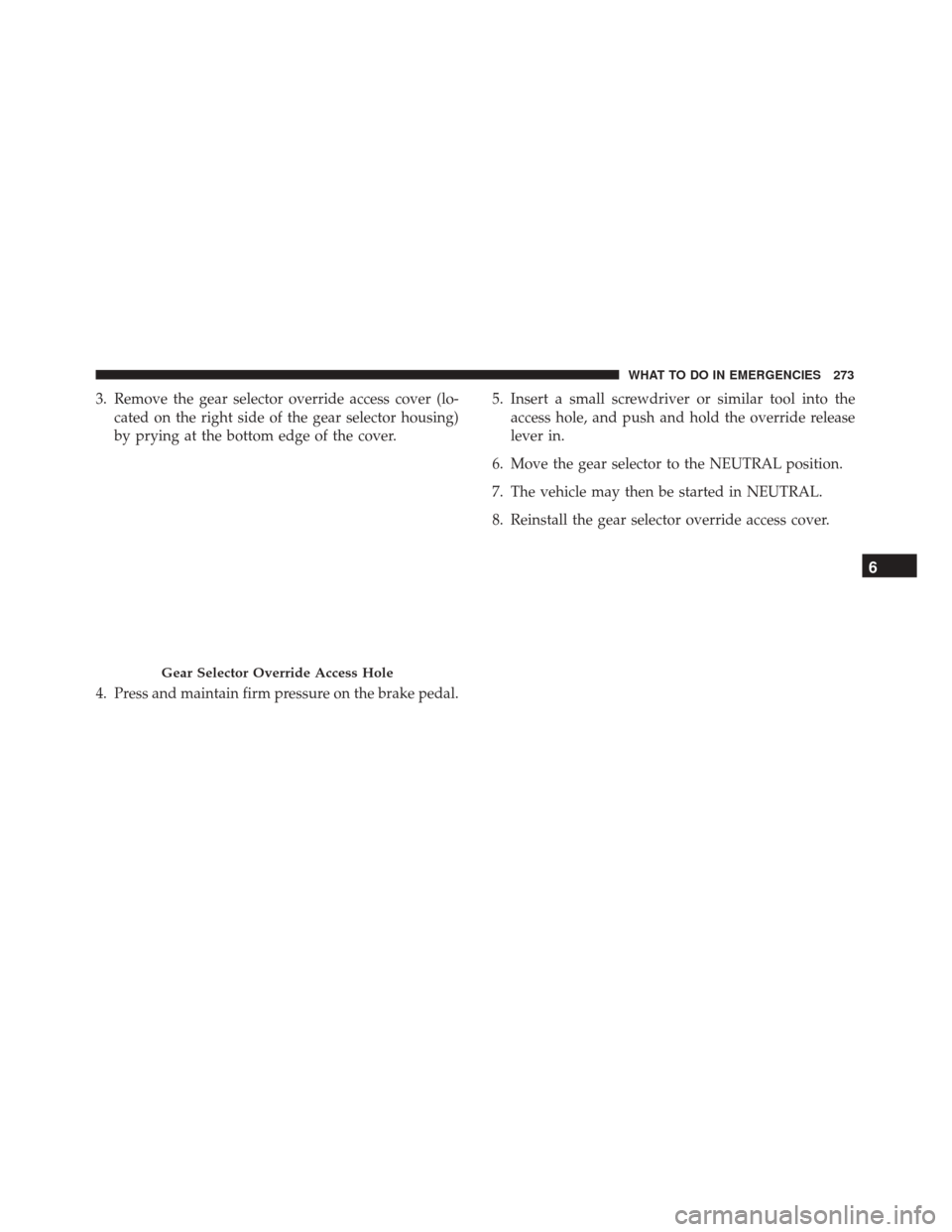
3. Remove the gear selector override access cover (lo-cated on the right side of the gear selector housing)
by prying at the bottom edge of the cover.
4. Press and maintain firm pressure on the brake pedal. 5. Insert a small screwdriver or similar tool into the
access hole, and push and hold the override release
lever in.
6. Move the gear selector to the NEUTRAL position.
7. The vehicle may then be started in NEUTRAL.
8. Reinstall the gear selector override access cover.
Gear Selector Override Access Hole
6
WHAT TO DO IN EMERGENCIES 273
Page 286 of 350
to check the engine oil level is approximately five
minutes after a fully warmed engine is shut off. Do not
check oil level before starting the engine after it has sat
overnight. Checking engine oil level when the engine is
cold will give you an incorrect reading.
Checking the oil while the vehicle is on level ground,
and approximately five minutes after a fully warmed
engine is shut off, will improve the accuracy of the oil
level readings. Maintain the oil level between the range
markings on the dipstick. The safe range is indicated by
a crosshatch zone. Adding 1 quart (0.9 Liters) of oil
when the reading is at the low end of the indicated
range will result in the oil level at the full end of the
indicator range.
CAUTION!
Do not overfill the engine with oil. Overfilling the
engine with oil will cause oil aeration, which can
lead to loss of oil pressure and an increase in oil
temperature. This loss of oil pressure and increased
oil temperature could damage your engine.
Change Engine Oil
The oil change indicator system will remind you that it
is time to take your vehicle in for scheduled mainte-
nance. Refer to the “Maintenance Schedule” for further
information.
NOTE:Under no circumstances should oil change
intervals exceed 10,000 miles (16,000 km), twelve
months or 350 hours of engine run time, whichever
comes first. The 350 hours of engine run or idle time is
generally only a concern for fleet customers.
Engine Oil Selection — 1.4L Engine
For best performance and maximum protection under
all types of operating conditions, the manufacturer only
recommends engine oils that are API Certified and meet
the requirements of FCA Material Standard MS-6395.
284 MAINTAINING YOUR VEHICLE
Page 290 of 350
Air Conditioner Maintenance
For best possible performance, your air conditioner
should be checked and serviced by an authorized dealer
at the start of each warm season. This service should
include cleaning of the condenser fins and a perfor-
mance test. Drive belt tension should also be checked at
this time.
WARNING!
•Use only refrigerants and compressor lubricants
approved by the manufacturer for your air condi-
tioning system. Some unapproved refrigerants are
flammable and can explode, injuring you. Other
unapproved refrigerants or lubricants can cause
the system to fail, requiring costly repairs. Refer
to Warranty Information Book, located on the
DVD, for further warranty information.
• The air conditioning system contains refrigerant
under high pressure. To avoid risk of personal
injury or damage to the system, adding refriger-
ant or any repair requiring lines to be discon-
nected should be done by an experienced techni-
cian.
CAUTION!
Do not use chemical flushes in your air condition-
ing system as the chemicals can damage your air
conditioning components. Such damage is not cov-
ered by the New Vehicle Limited Warranty.
Refrigerant Recovery And Recycling R134a — If
Equipped
R-134a Air Conditioning Refrigerant is a hydrofluoro-
carbon (HFC) that is endorsed by the Environmental
Protection Agency and is an ozone-saving product. How-
ever, the manufacturer recommends that air conditioning
service be performed by authorized dealer or other
service facilities using recovery and recycling equipment.
NOTE: Use only manufacturer approved A/C system
PAG compressor oil and refrigerants.
Refrigerant Recovery And Recycling R1234yf —
If Equipped
R-1234yf Air Conditioning Refrigerant is a hydro-
fluoolefine HFO that is endorsed by the Environmental
Protection Agency and is an ozone-saving product with
a low GWP (Global Warming Potential). However, the
288 MAINTAINING YOUR VEHICLE
Page 297 of 350
In unusual situations involving grossly malfunctioning
engine operation, a scorching odor may suggest severe
and abnormal catalyst overheating. If this occurs, stop
the vehicle, turn off the engine and allow it to cool.
Service, including a tune-up to manufacturer’s specifi-
cations, should be obtained immediately.
To minimize the possibility of catalytic converter dam-
age:
•Do not shut off the engine or interrupt the ignition,
when the transmission is in gear and the vehicle is in
motion.
• Do not try to start the engine by pushing or towing
the vehicle.
• Do not idle the engine with any spark plug wires
disconnected or removed, such as when diagnostic
testing, or for prolonged periods during very rough
idle or malfunctioning operating conditions.Cooling System
WARNING!
• Turn vehicle off and disconnect the fan motor
lead before working near the radiator cooling fan.
• You or others can be badly burned by hot engine
coolant (antifreeze) or steam from your radiator. If
you see or hear steam coming from under the
hood, do not open the hood until the radiator has
had time to cool. Never open a cooling system
pressure cap when the radiator or coolant bottle is
hot.
• Keep hands, tools, clothing, and jewelry away
from the radiator cooling fan when the hood is
raised. The fan starts automatically and may start
at any time, whether the engine is running or not.
• When working near the radiator cooling fan,
disconnect the fan motor lead or turn the ignition
switch to the OFF position. The fan is temperature
controlled and can start at any time the ignition
switch is in the ON position.
• You or others can be badly burned by hot engine
coolant (antifreeze) or steam from your radiator.
(Continued)
7
MAINTAINING YOUR VEHICLE 295
Page 298 of 350
WARNING!(Continued)
If you see or hear steam coming from under the
hood, do not open the hood until the radiator has
had time to cool. Never try to open a cooling
system pressure cap when the radiator is hot.
Coolant Checks
Check engine coolant (antifreeze) protection every 12
months (before the onset of freezing weather, where
applicable). If the engine coolant (antifreeze) is dirty or
rusty in appearance, the system should be drained,
flushed and refilled with fresh engine coolant (anti-
freeze). Check the front of the A/C condenser for any
accumulation of bugs, leaves, etc. If dirty, clean by
gently spraying water from a garden hose vertically
down the face of the condenser.
Cooling System — Drain, Flush And Refill
NOTE:Some vehicles require special tools to add
coolant properly. Failure to fill these systems properly
could lead to severe internal engine damage. If any
coolant is needed to be added to the system, please
contact your local authorized dealer. If the engine coolant (antifreeze) is dirty or contains
visible sediment, have an authorized dealer clean and
flush with OAT coolant (antifreeze) (conforming to
MS.90032).
Refer to the “Maintenance Schedule” for the proper
maintenance intervals.
Selection Of Coolant
Refer to “Fluids, Lubricants, And Genuine Parts” in
“Maintaining Your Vehicle” for further information.
CAUTION!
•
Mixing of engine coolant (antifreeze) other than
specified Organic Additive Technology (OAT)
engine coolant (antifreeze), may result in engine
damage and may decrease corrosion protection.
Organic Additive Technology (OAT) engine cool-
ant is different and should not be mixed with
Hybrid Organic Additive Technology (HOAT)
engine coolant (antifreeze) or any “globally com-
patible” coolant (antifreeze). If a non-OAT engine
coolant (antifreeze) is introduced into the cooling
system in an emergency, the cooling system will
(Continued)
296 MAINTAINING YOUR VEHICLE
Page 300 of 350
NOTE:
•It is the owner’s responsibility to maintain the proper
level of protection against freezing according to the
temperatures occurring in the area where the vehicle
is operated.
• Some vehicles require special tools to add coolant
properly. Failure to fill these systems properly could
lead to severe internal engine damage. If any coolant
is needed to be added to the system, please contact
your local authorized dealer.
• Mixing engine coolant (antifreeze) types is not rec-
ommended and can result in cooling system damage.
If HOAT and OAT coolant are mixed in an emer-
gency, have a authorized dealer drain, flush, and
refill with OAT coolant (conforming to MS.90032) as
soon as possible.
Cooling System Pressure Cap
The cap must be fully tightened to prevent loss of
engine coolant (antifreeze) and to ensure that engine
coolant (antifreeze) will return to the radiator from the
coolant recovery tank. The cap should be inspected and cleaned if there is any
accumulation of foreign material on the sealing sur-
faces.
WARNING!
•
Do not open hot engine cooling system. Never
add engine coolant (antifreeze) when the engine
is overheated. Do not loosen or remove the cap to
cool an overheated engine. Heat causes pressure
to build up in the cooling system. To prevent
scalding or injury, do not remove the pressure cap
while the system is hot or under pressure.
• Do not use a pressure cap other than the one
specified for your vehicle. Personal injury or
engine damage may result.
Disposal Of Used Engine Coolant
Used ethylene glycol-based engine coolant (antifreeze)
is a regulated substance requiring proper disposal.
Check with your local authorities to determine the
disposal rules for your community. To prevent ingestion
by animals or children, do not store ethylene glycol-
based engine coolant in open containers or allow it to
298 MAINTAINING YOUR VEHICLE
Page 301 of 350
remain in puddles on the ground. If ingested by a child
or pet, seek emergency assistance immediately. Clean
up any ground spills immediately.
Coolant Level
The coolant expansion bottle provides a quick visual
method for determining that the coolant level is ad-
equate. With the engine off and cold, the level of the
engine coolant (antifreeze) in the bottle should be
between the bottom and top lines marked “COLD FILL
RANGE”.
As long as the engine operating temperature is satisfac-
tory, the coolant bottle need only be checked once a
month.
When additional engine coolant (antifreeze) is needed
to maintain the proper level, it should be added to the
coolant bottle. Do not overfill.
Points To Remember
NOTE:When the vehicle is stopped after a few miles/
kilometers of operation, you may observe vapor coming
from the front of the engine compartment. This is
normally a result of moisture from rain, snow, or high
humidity accumulating on the radiator and being va-
porized when the thermostat opens, allowing hot en-
gine coolant (antifreeze) to enter the radiator.
If an examination of your engine compartment shows
no evidence of radiator or hose leaks, the vehicle may
be safely driven. The vapor will soon dissipate.
• Do not overfill the coolant expansion bottle.
• Check the coolant freeze point in the radiator and in
the coolant expansion bottle. If engine coolant (anti-
freeze) needs to be added, the contents of the coolant
expansion bottle must also be protected against freez-
ing.
• If frequent engine coolant (antifreeze) additions are
required, the cooling system should be pressure
tested for leaks.
7
MAINTAINING YOUR VEHICLE 299