towing FIAT 500 2018 Owner handbook (in English)
[x] Cancel search | Manufacturer: FIAT, Model Year: 2018, Model line: 500, Model: FIAT 500 2018Pages: 224, PDF Size: 3.89 MB
Page 14 of 224
KNOWING YOUR CAR
12
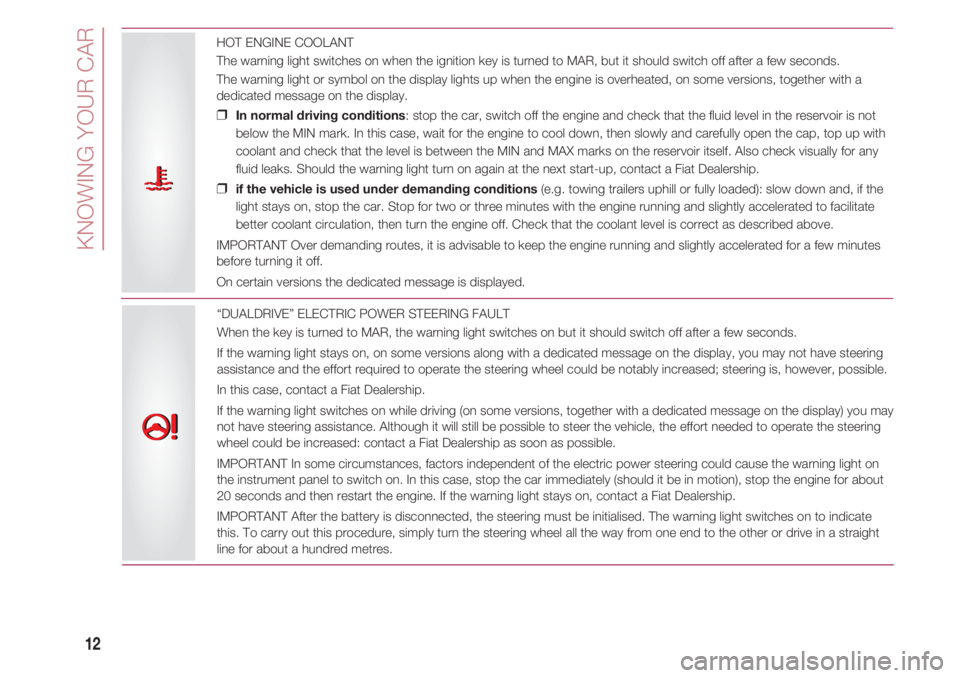
HOT ENGINE COOLANT
The warning light switches on when the ignition key is turned to MAR, but it should switch off after a few seconds.
The warning light or symbol on the display lights up when the engine is overheated, on some versions, together with a
dedicated message on the display.
❒ In normal driving conditions: stop the car, switch off the engine and check that the fluid level in the reservoir is not
below the MIN mark. In this case, wait for the engine to cool down, then slowly and carefully open the cap, top up with
coolant and check that the level is between the MIN and MAX marks on the reservoir itself. Also check visually for any
fluid leaks. Should the warning light turn on again at the next start-up, contact a Fiat Dealership.
❒ if the vehicle is used under demanding conditions (e.g. towing trailers uphill or fully loaded): slow down and, if the
light stays on, stop the car. Stop for two or three minutes with the engine running and slightly accelerated to facilitate
better coolant circulation, then turn the engine off. Check that the coolant level is correct as described above.
IMPORTANT Over demanding routes, it is advisable to keep the engine running and slightly accelerated for a few minutes
before turning it off.
On certain versions the dedicated message is displayed.uu
{{
“DUALDRIVE” ELECTRIC POWER STEERING FAULT
When the key is turned to MAR, the warning light switches on but it should switch off after a few seconds.
If the warning light stays on, on some versions along with a dedicated message on the display, you may not have steering
assistance and the effort required to operate the steering wheel could be notably increased; steering is, however, possible.
In this case, contact a Fiat Dealership.
If the warning light switches on while driving (on some versions, together with a dedicated message on the display) you may
not have steering assistance. Although it will still be possible to steer the vehicle, the effort needed to operate the steering
wheel could be increased: contact a Fiat Dealership as soon as possible.
IMPORTANT In some circumstances, factors independent of the electric power steering could cause the warning light on
the instrument panel to switch on. In this case, stop the car immediately (should it be in motion), stop the engine for about
20 seconds and then restart the engine. If the warning light stays on, contact a Fiat Dealership.
IMPORTANT After the battery is disconnected, the steering must be initialised. The warning light switches on to indicate
this. To carry out this procedure, simply turn the steering wheel all the way from one end to the other or drive in a straight
line for about a hundred metres.
Page 52 of 224
KNOWING YOUR CAR
50
iTPMS System
(indirect Tyre
Pressure
Monitoring System)
(for versions/markets, where provided)
48)
RESET PROCEDURE
The iTPMS needs an initial “self-
learning” phase (with length depending
on the driving style and road
conditions: optimal conditions being
driving on a straight road at 80 km/h
for at least 20 minutes) which starts
when the Reset procedure is carried
out.
The Reset procedure must be carried
out:
❒ each time tyre pressure is
modified;
❒ when even only one tyre is
changed;
❒ when tyres are rotated/inverted;
❒ when the space-saver wheel is
fitted.
In a few situations such as sporty
driving, particular conditions of the
road surface (e.g. icy, snowy,
unsurfaced roads...) the signalling may
be delayed or partial in detecting the
contemporary deflation of more than
one tyre.
Under special conditions (e.g. vehicle
loaded asymmetrically on one side,
towing a trailer, damaged or worn tyre,
fitting the space-saver wheel, use of
the “Fix&Go” quick tyre repair kit,
fitting snow chains, fitting different
tyres on the axles) the system may
give false indications or be temporarily
deactivated.
If the system is temporarily
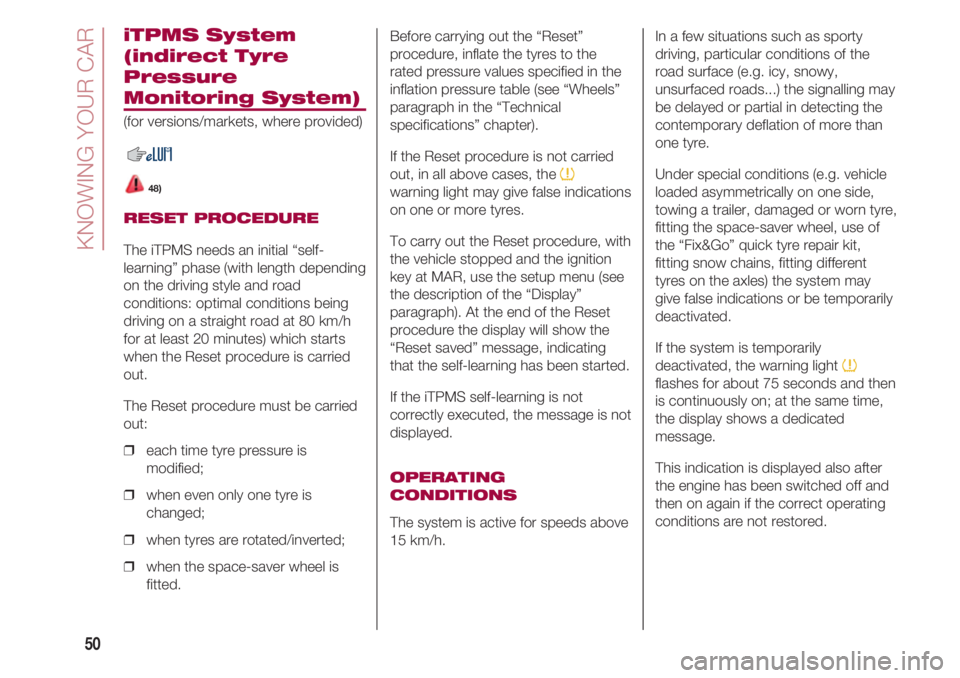
deactivated, the warning light
nflashes for about 75 seconds and then
is continuously on; at the same time,
the display shows a dedicated
message.
This indication is displayed also after
the engine has been switched off and
then on again if the correct operating
conditions are not restored. Before carrying out the “Reset”
procedure, inflate the tyres to the
rated pressure values specified in the
inflation pressure table (see “Wheels”
paragraph in the “Technical
specifications” chapter).
If the Reset procedure is not carried
out, in all above cases, the
nwarning light may give false indications
on one or more tyres.
To carry out the Reset procedure, with
the vehicle stopped and the ignition
key at MAR, use the setup menu (see
the description of the “Display”
paragraph). At the end of the Reset
procedure the display will show the
“Reset saved” message, indicating
that the self-learning has been started.
If the iTPMS self-learning is not
correctly executed, the message is not
displayed.
OPERATING
CONDITIONS
The system is active for speeds above
15 km/h.
Page 130 of 224
IN AN EMERGENCY
128
BUMP STARTING13)
Never bump start the engine by
pushing, towing or driving downhill.
This could cause fuel to flow into the
catalytic converter and damage it
beyond repair.
IMPORTANT Remember that the
brake servo and electrical power
steering system (where provided) are
not operational until the engine is
started, a greater effort will therefore
be required to press the brake pedal
or turn the steering wheel.
CHANGING A
WHEEL 32) 30)
JACK
Please note that:
❒ the jack weighs 1.76 kg;
❒ the jack requires no adjustment;
❒ the jack cannot be repaired; if it
breaks, it must be replaced with a
new one of the same type;
❒ no tool other than its cranking
device may be fitted on the jack.
SERVICING
❒ prevent any dirt from depositing on
the “worm screw”
❒ keep the “worm screw” lubricated
❒ never modify the jack.
CONDITIONS OF NON-
USE
❒ at temperatures lower than -40°C
on a sandy or muddy ground
❒ on uneven ground
❒ on a road with steep gradient
❒ in extreme weather conditions:
thunderstorms, typhoons,
hurricanes, blizzards, storms, etc.
❒ in direct contact with the engine or
to carry out repairs under the
vehicle
❒ on boats.
RAISING WITH A JACK
AND REPLACING A
WHEEL
To change a wheel, proceed as
follows:
❒ Stop the car in a position that is
not dangerous for oncoming traffic
where you can change the wheel
safely. The ground must be flat and
sufficiently compact.
❒ Turn the engine off and pull up the
handbrake.
❒ Engage first gear or reverse.
❒ Lift up the luggage compartment
mat and loosen the central locking
device A - fig. 99.
❒ Take out the tool container
B and take it near to the wheel to
be changed.
❒ Take the space-saver wheel C.
Page 147 of 224
145
TOWING THE CAR 37)
Version with Dualogic gearbox
Make sure that the gearbox is in neutral
(N) (checking that the vehicle moves
when pushed) and proceed in the
same way as for towing a normal
vehicle with a manual gearbox.
If the gearbox cannot be put in neutral,
do not tow the vehicle and contact a
Fiat Dealership.
ATTACHING THE
TOW RING
The tow ring provided with the car is
housed in the tool box under the boot
mat.
Proceed as follows:
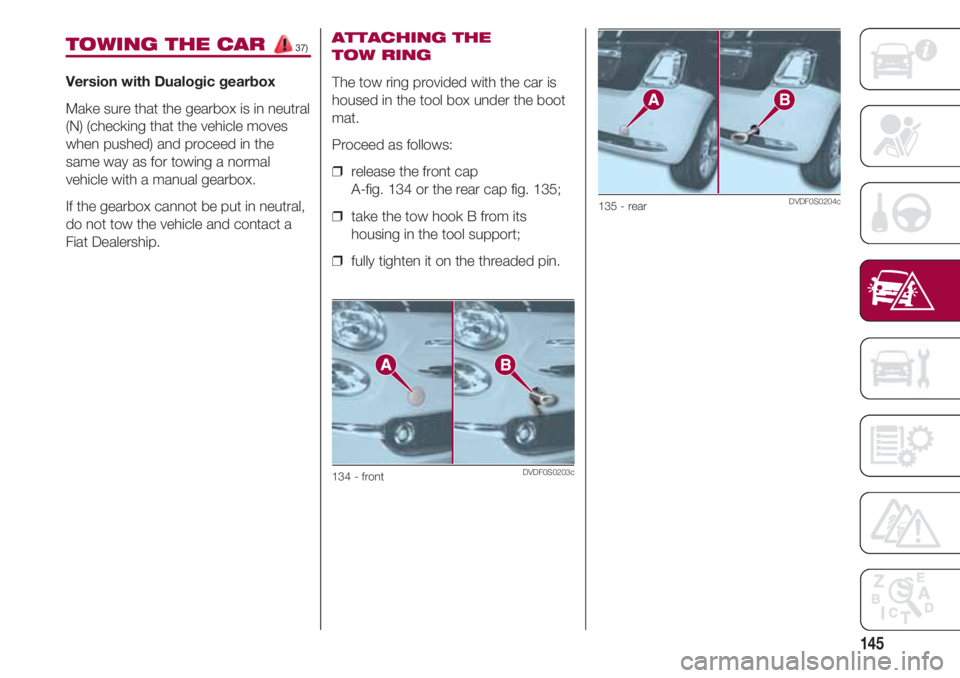
❒ release the front cap
A-fig. 134 or the rear cap fig. 135;
❒ take the tow hook B from its
housing in the tool support;
❒ fully tighten it on the threaded pin.
134 - frontDVDF0S0203c
135 - rearDVDF0S0204c
Page 149 of 224
147
SERVICING AND CARE
SCHEDULED SERVICING
Correct servicing is crucial for
guaranteeing a long life for the vehicle
under the best conditions.
For this reason, Fiat has planned a
series of checks and services at fixed
distance intervals and, for
versions/markets, where provided, at
fixed time intervals, as described in the
Scheduled Servicing Plan.
Regardless of the above, it is always
necessary to carefully follow the
instructions in the Scheduled Servicing
Plan (e.g. periodically check level of
liquids, tyre pressure, etc.).
Scheduled Servicing is offered by all
Fiat Dealerships according to fixed
time or kilometres/miles intervals.
If, during each operation, in addition to
the ones scheduled, the need arises
for further replacements or repairs,
these may be carried out with the
owner’s explicit agreement only. If your
vehicle is used frequently for towing,
the interval between one service
operation and the next should be
reduced. IMPORTANT NOTES
Scheduled Servicing interventions are
set out by the Manufacturer. Failure to
have them carried out may invalidate
the warranty.
We advise you to inform a Fiat
Dealership of any small operating
irregularities without waiting for the
next service.
Page 156 of 224
SERVICING AND CARE
154
REGULAR
INSPECTIONS
39) 22) 4)
Every 1,000 km or before long
journeys, check and, if necessary, top
up the following:
❒ engine coolant fluid level;
❒ brake fluid level;
❒ windscreen washer fluid level;
❒ tyre inflation pressure and condition;
❒ operation of lighting system
(headlights, direction indicators,
hazard warning lights, etc.);
❒ operation of the windscreen
wiper/washer system, position and
wear of the windscreen and rear
window wiper blades.
Every 3,000 km check and top up if
required: engine oil level.
You are advised to use PETRONAS
LUBRICANTS products, which have
been designed and produced
specifically for Fiat cars (see table
“Capacities” in the “Technical
specifications” section).
DEMANDING USE
OF THE CAR
If the vehicle is mainly used in one of
the following particularly harsh
conditions:
❒ trailer or caravan towing;
❒ dusty roads;
❒ short repeated distances (less than
7-8 km) and with external
temperatures below zero;
❒ engine often idling or driving long
distances at low speeds or long
periods of inactivity;
perform the following inspections more
frequently than shown on the
Scheduled Servicing Plan:
❒ check front disk brake pad
conditions and wear;
❒ Check cleanliness of bonnet and
luggage compartment locks,
cleanliness and lubrication of
linkage;❒ sight inspect the conditions of:
engine, gearbox, transmission,
pipes and hoses (exhaust -
fuel - brakes), rubber parts
(boots, sleeves, bushes, etc.);
❒ check battery charge and battery
fluid level (electrolyte);
❒ visually check the various drive belt
conditions;
❒ check and, if necessary, change
engine oil and replace oil filter;
❒ check pollen filter and replace it, if
required;
❒ check air cleaner and replace it, if
required.
Page 197 of 224
195
•Remember that the servo-brake and power steering are not
operational until the engine has been started, therefore much
effort than usual is required on the brake pedal and steering
wheel.
•For vehicles featuring a Dualogic gearbox, if the engine is not
started with a gear engaged, a warning is sounded to notify
the driver of the potential danger due to the gear being
automatically put into neutral.
•This starting procedure must be performed by expert
personnel because incorrect actions could cause electrical
discharge of considerable intensity. Furthermore, battery fluid
is poisonous and corrosive: avoid contact with skin and eyes.
Keep naked flames and lighted cigarettes away from the
battery and do not cause sparks.
•Remove any metal objects (e.g. rings, watches, bracelets),
that might cause an accidental electrical contact and cause
serious injury.
•Do not attempt to charge a frozen battery: it must be thawed
first, otherwise it may explode.
If freezing has occurred, the battery should be checked by
skilled personnel to make sure that the internal elements are
not damaged and that the body is not cracked, with the risk of
leaking poisonous and corrosive acid.
27) HANDBRAKE
• The car should be braked after a few clicks of the lever, if it is
not, contact a Fiat Dealership to have it adjusted.
• Never leave children in the unattended car. Always remove
the ignition key when leaving the car and take it out with you. • In the case of parking manoeuvres on roads on a gradient, the
front wheels must be steered towards the pavement
(when parking downhill), or in the opposite direction if the vehicle
is parked uphill. Block the wheels with a wedge or a stone if the
car is parked on a steep slope.
28) USING THE MANUAL GEARBOX
Press the clutch pedal fully to change gears correctly. It is
therefore essential that there is nothing under the pedals: make
sure the mats are lying flat and do not get in the way of the pedals.
29) TOWING TRAILERS
•The ABS with which the car is equipped will not control the
braking system of the trailer. Particular caution is required on
slippery roads.
•Do not, under any circumstances, modify the vehicle braking
system to control the trailer breaking system.
The towing braking system must be completely independent of the
vehicle’s hydraulic system.
30) SNOW TYRES
The maximum speed for snow tyres marked
“Q” is 160 km/h, while it is 190 km/h for “T” tyres and 210 km/h for
“H” tyres.
The highway code speed limits must however always be complied
with.
31) WARNING LIGHTS AND MESSAGES
•If the warning light
xturns on when travelling (on certain
versions together with the message on the display) stop the car
immediately and contact a Fiat Dealership.
(CONTINUES)
PERSONAL SAFETY
(CONTINUED)
Page 200 of 224
IMPORTANT INFORMATION AND RECOMMENDATIONS
198
PERSONAL SAFETY
(CONTINUED)
Do not use the jack for loads higher than the one shown on its
label. Never start the engine with vehicle raised. If the vehicle is
raised more than necessary, everything can become more
unstable, with the risk of the vehicle dropping violently.
Thus, lift the vehicle only as needed in order to access the
spare tyre.
33) FIX&GO QUICK TYRE REPAIR KIT
•The information required by the applicable regulation is
indicated on the Fix&Go kit package label. Carefully read the
label on the cartridge before use, avoid improper use. The kit
should be used by adults and cannot be used by children.
IMPORTANT: Do not exceed 80 km/h. Avoid sudden
acceleration or braking. The kit provides a temporary repair,
therefore the tyre must be examined and repaired by a
specialist as soon as possible. Before using the kit, ensure that
the tyre is not excessively damaged and that the rim is in good
condition, otherwise do not use it and call roadside assistance.
Do not remove foreign bodies from the tyre. Do not let the
compressor turned on for more than 20 consecutive minutes -
overheating hazard.
34) CHANGING A BULB
•Modifications or repairs to the electric system that are not
carried out properly or do not take the system technical
specifications into account can cause malfunctions leading to
the risk of fire.
•Halogen bulbs contain pressurised gas, in the case of
breakage they may burst causing glass fragments to be
projected outwards.
•Due to the high power supply voltage, gas discharge bulbs
(Xenon) should only be replaced by specialised personnel:
danger of death! Contact a Fiat Dealership.35) REPLACING FUSES
•If the replaced fuse blows again, contact a Fiat Dealership.
•Never replace a fuse with metal wires or anything else.
•Never replace a fuse with another with a higher amp rating; RISK
OF FIRE.
•If a general fuse (MEGA-FUSE, MIDI-FUSE,
MAXI-FUSE) blows contact a Fiat Dealership.
•Before replacing a fuse, make sure that the ignition key has
been removed and that all the other services are switched off
and/or disengaged.
•Contact Fiat Dealership if a safety system (airbags, brakes),
engine system
(engine, gearbox) or steering system general protection fuse
blows.
36) BATTERY RECHARGING
•Battery fluid is poisonous and corrosive:
avoid contact with your skin and eyes. The battery should be
charged in a well ventilated place, away from naked flames or
possible sources of sparks: danger of explosion and fire.
•Do not attempt to charge a frozen battery: it must be thawed
first, otherwise it may explode.
If freezing has occurred, the battery should be checked by skilled
personnel to make sure that the internal elements are not
damaged and that the body is not cracked, with the risk of leaking
poisonous and corrosive acid.
37) TOWING THE CAR
•Before tightening the ring clean the threaded housing thoroughly.
Make sure that the ring is fully fastened in the housing before
towing the car.
(CONTINUES)
Page 201 of 224
199(CONTINUES)
PERSONAL SAFETY
(CONTINUED)
• The electronic Cruise Control can be dangerous if the system is
unable to maintain a constant speed. In specific conditions speed
may be excessive, resulting in the risk of losing control of the
vehicle and causing accidents. Do not use the device in heavy
traffic or on winding, icy, snowy or slippery roads.
39) SERVICING - CHECKING FLUID LEVELS
•Never smoke while working in the engine compartment: gas
and inflammable vapours may be present, with the risk of fire.
•Be very careful when working in the engine compartment when
the engine is hot: you may get burned. Remember that when the
engine is hot, the fan may operate: danger of injury. Scarves, ties
and other loose clothing might be pulled by moving parts.
•The cooling system is pressurised. If necessary, only replace
the plug with another original or the operation of the system may
be adversely affected. Do not remove the reservoir plug when the
engine is hot: you risk scalding yourself.
•Do not travel with the windscreen washer fluid reservoir empty:
the windscreen washer is essential for improving visibility.
•Some commercial windscreen washer additives are flammable.
The engine compartment contains hot components which may
set it on fire.
•Brake fluid is poisonous and highly corrosive. In the event of
accidental contact, immediately wash the affected parts with
water and mild soap. Then rinse thoroughly. Call a doctor
immediately if swallowed.
•Symbol
πon the contain indicates a synthetic brake fluid,
which is different from a mineral fluid.
Use of a mineral type fluid will damage the special rubber seals of
the braking system beyond repair.
•Battery fluid is poisonous and corrosive. Avoid contact with skin
and eyes. Keep naked flames and sources of sparks away from
the battery: risk of explosion and fire. •Before towing, turn the ignition key to MAR and then to STOP
without removing it. The steering column will automatically lock
when the key is removed and the wheels cannot be steered.
•When towing, remember that without the help of the brake
servo and electric power steering, a greater effort is required on
the pedal and steering wheel.
•Do not use flexible cables when towing and avoid jerky
movements.
•During towing, make sure that the trailer hitch does not
damage any components it is touching.
•When towing the vehicle, you must comply with all specific
traffic regulations, both in terms of the towing device and
behaviour on the road.
•Do not start the engine while towing the car.
•The (front/rear) tow hook must be used exclusively for
roadside assistance operations.
You are allowed to tow the vehicle for short distances using an
appropriate device in accordance with the highway code (a rigid
bar), to move the vehicle on the road in readiness for towing or
transport via a breakdown vehicle.
The tow hook MUST NOT be used to tow vehicles off the road
or where there are obstacles and/or for towing operations using
cables or other non-rigid devices. In compliance with the above
conditions, towing must take place with the two vehicles (one
towing, the other towed) aligned as much as possible along the
same centre line.
38) ELECTRONIC CRUISE CONTROL
•Never move the shift lever to neutral when driving with the
device active.
• In the event of device malfunction or failure, contact a Fiat
Dealership.
Page 206 of 224
IMPORTANT INFORMATION AND RECOMMENDATIONS
204(CONTINUES)
• Warning light mwill blink for 60 seconds after starting or
during prolonged cranking to indicate a fault to the glow plug
heating system.
Use the car normally if the engine starts and go to a Fiat
Dealership as soon as possible.
• Never bump start the engine by pushing, towing or coasting
downhill. This could cause fuel to flow into the catalytic
converter and damage it beyond repair.
• Never use a fast battery-charger to start the engine as this could
damage the electronic systems of your vehicle, particularly the
ignition and engine fuel supply control units.
• Do not connect the cable to the negative terminal (–) of the flat
battery. The following spark could lead to battery explosion and
cause serious harm.
Only use the specific earth point; do not use
any other exposed metallic part.
• A quick burst on the accelerator before turning off the engine
serves absolutely no practical purpose; it wastes fuel and is
especially damaging to turbocharged engines.
14) USING THE GEARBOX: MANUAL AND DUALOGIC
• Do not drive with your hand resting on the gear lever as the
force exerted, even if slight, could lead over time to premature
wear of the gearbox internal components.
• If the gearbox is faulty, contact a Fiat Dealership as soon as
possible to have the system checked.
• Avoid keeping your hand placed on this lever in between
gear changes or Auto/Manual mode.
• Using the paddles incorrectly (paddles pushed towards the
dashboard) could break them.• In order to safeguard the efficiency of the clutch, do not use the
accelerator to keep the car still (for example:
stopped on a hill); the clutch could overheat and be damaged;
use the brake pedal and only operate the accelerator pedal when
you decide to set off.
• If the messages continue to be shown in the display, contact a
Fiat Dealership.
15) SNOW CHAINS
• Keep the vehicle’s speed down when snow chains are fitted;
never exceed 50 km/h.
• With snow chains, use the accelerator with extreme care to
prevent, or to limit as much as possible, slipping of the drive
wheels that could cause chain breakage, resulting in damage to
the car body or mechanical components.
• Avoid potholes, steps and pavements and avoid driving long
distances on roads not covered with snow to avoid damaging the
car and the roadbed.
16) POWER SOCKET
Only accessories with a maximum power of 180 W (maximum
absorption 15 A)
can be connected to the socket.
17) DIESEL FILTER
The presence of water in the supply circuit may cause severe
damage to the injection system and irregular engine operation.
If the warning light or the symbol
Eon the colour display turns
on, contact a Fiat Dealership as soon as possible to have the
system bled.
VEHICLE SAFETY
(CONTINUED)