engine coolant FIAT 500 ABARTH 2013 2.G User Guide
[x] Cancel search | Manufacturer: FIAT, Model Year: 2013, Model line: 500 ABARTH, Model: FIAT 500 ABARTH 2013 2.GPages: 388, PDF Size: 9.03 MB
Page 333 of 388
The cap should be inspected and cleaned if there is any
accumulation of foreign material on the sealing surfaces.
WARNING!
•The warning words “DO NOT OPEN HOT” on the
cooling system pressure cap are a safety precaution.
Never add engine coolant (antifreeze) when the
engine is overheated. Do not loosen or remove the
cap to cool an overheated engine. Heat causes
pressure to build up in the cooling system. To
prevent scalding or injury, do not remove the
pressure cap while the system is hot or under
pressure.
•Do not use a pressure cap other than the one
specified for your vehicle. Personal injury or en-
gine damage may result.
Disposal Of Used Engine Coolant
Used ethylene glycol-based engine coolant (antifreeze) is
a regulated substance requiring proper disposal. Check
with your local authorities to determine the disposal
rules for your community. To prevent ingestion by ani-
mals or children, do not store ethylene glycol-based
engine coolant in open containers or allow it to remain in
puddles on the ground. If ingested by a child or pet, seek
emergency assistance immediately. Clean up any ground
spills immediately.
Coolant Level
The coolant expansion bottle provides a quick visual
method for determining that the coolant level is ad-
equate. With the engine off and cold, the level of the
engine coolant (antifreeze) in the bottle should be be-
tween the bottom and top lines marked “COLD FILL
RANGE”.
7
MAINTAINING YOUR VEHICLE 331
Page 334 of 388
As long as the engine operating temperature is satisfac-
tory, the coolant bottle need only be checked once a
month.
When additional engine coolant (antifreeze) is needed to
maintain the proper level, it should be added to the
coolant bottle. Do not overfill.
Points To Remember
NOTE:When the vehicle is stopped after a few miles/
kilometers of operation, you may observe vapor coming
from the front of the engine compartment. This is nor-
mally a result of moisture from rain, snow, or high
humidity accumulating on the radiator and being vapor-
ized when the thermostat opens, allowing hot engine
coolant (antifreeze) to enter the radiator.
If an examination of your engine compartment shows no
evidence of radiator or hose leaks, the vehicle may be
safely driven. The vapor will soon dissipate.
•Do not overfill the coolant expansion bottle.
•Check the coolant freeze point in the radiator and in the
coolant expansion bottle. If engine coolant (antifreeze)
needs to be added, the contents of the coolant expansion
bottle must also be protected against freezing.
•If frequent engine coolant (antifreeze) additions are
required, the cooling system should be pressure tested
for leaks.
•Maintain engine coolant (antifreeze) concentration at a
minimum of 50% OAT coolant (conforming to MS-
12106) and distilled water for proper corrosion protec-
tion of your engine which contains aluminum compo-
nents.
•Make sure that the coolant expansion bottle overflow
hoses are not kinked or obstructed.
332 MAINTAINING YOUR VEHICLE
Page 335 of 388
•Keep the front of the radiator clean. If your vehicle is
equipped with air conditioning, keep the front of the
condenser clean.
•Do not change the thermostat for Summer or Winter
operation. If replacement is ever necessary, install
ONLY the correct type thermostat. Other designs may
result in unsatisfactory engine coolant (antifreeze)
performance, poor gas mileage, and increased emis-
sions.
Brake System
In order to assure brake system performance, all brake
system components should be inspected periodically.
Refer to the “Maintenance Schedule” for the proper
maintenance intervals.
WARNING!
Riding the brakes can lead to brake failure and
possibly a collision. Driving with your foot resting or
riding on the brake pedal can result in abnormally
high brake temperatures, excessive lining wear, and
possible brake damage. Riding the brakes may also
reduce braking capacity in an emergency.
Brake Master Cylinder
The fluid level in the master cylinder should be checked
when performing under hood services, or immediately if
the “Brake Warning Light” is on.
Be sure to clean the top of the master cylinder area before
removing the cap. If necessary, add fluid to bring the
fluid level up to the requirements described on the brake
fluid reservoir. Fluid level can be expected to fall as the
brake pads wear. The brake fluid level should be checked
7
MAINTAINING YOUR VEHICLE 333
Page 355 of 388
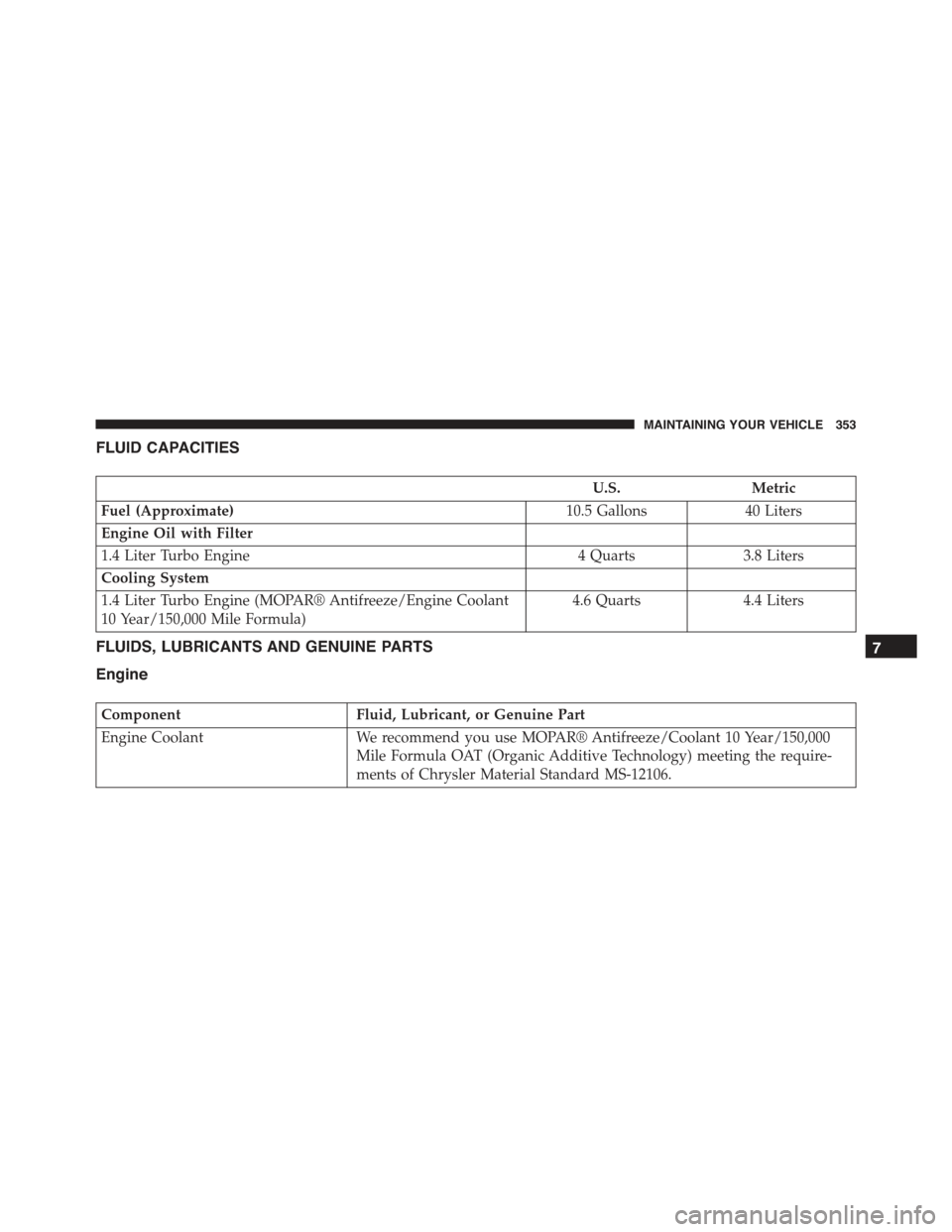
FLUID CAPACITIES
U.S.Metric
Fuel (Approximate)10.5 Gallons40 Liters
Engine Oil with Filter
1.4 Liter Turbo Engine4 Quarts3.8 Liters
Cooling System
1.4 Liter Turbo Engine (MOPAR® Antifreeze/Engine Coolant
10 Year/150,000 Mile Formula)
4.6 Quarts4.4 Liters
FLUIDS, LUBRICANTS AND GENUINE PARTS
Engine
ComponentFluid, Lubricant, or Genuine Part
Engine CoolantWe recommend you use MOPAR® Antifreeze/Coolant 10 Year/150,000
Mile Formula OAT (Organic Additive Technology) meeting the require-
ments of Chrysler Material Standard MS-12106.
7
MAINTAINING YOUR VEHICLE 353
Page 358 of 388
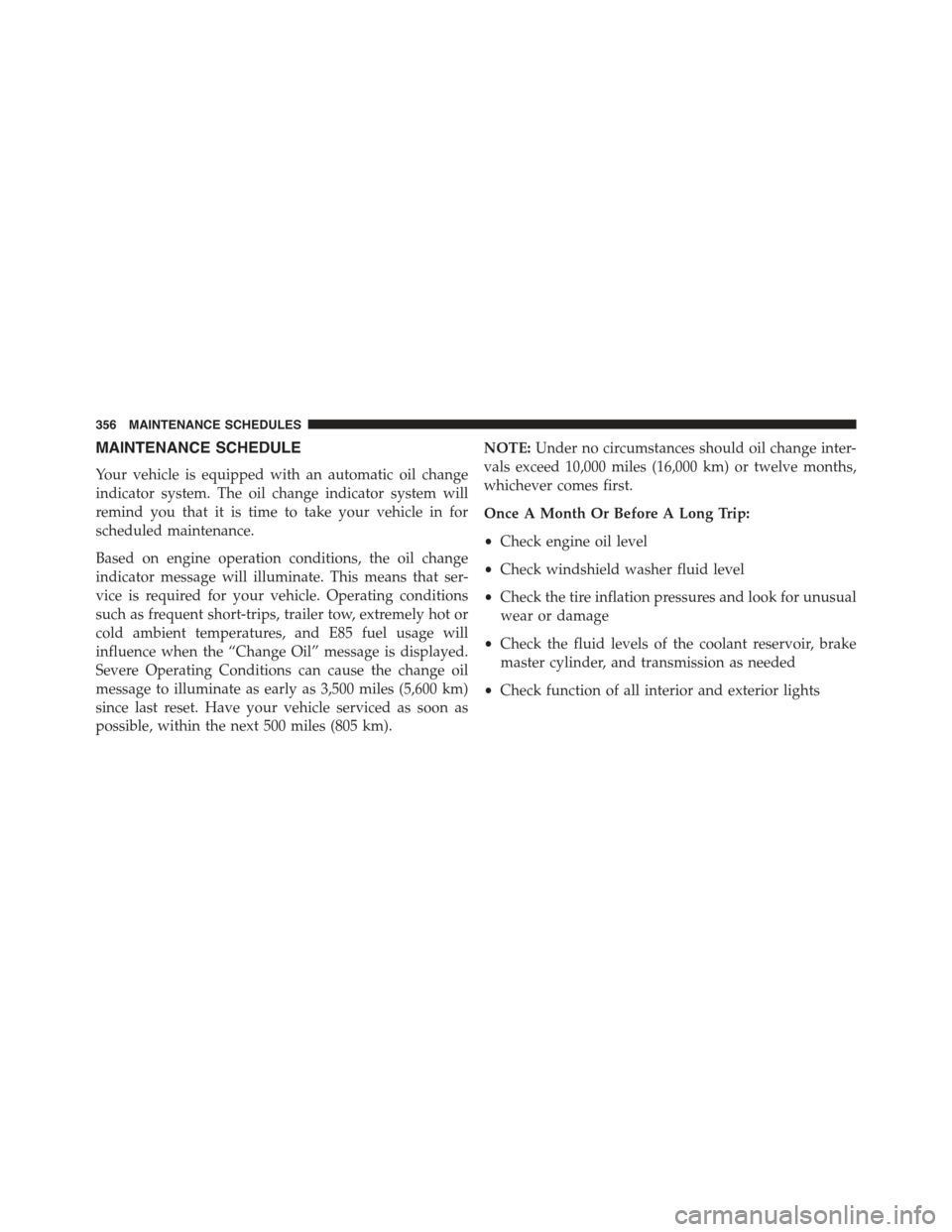
MAINTENANCE SCHEDULE
Your vehicle is equipped with an automatic oil change
indicator system. The oil change indicator system will
remind you that it is time to take your vehicle in for
scheduled maintenance.
Based on engine operation conditions, the oil change
indicator message will illuminate. This means that ser-
vice is required for your vehicle. Operating conditions
such as frequent short-trips, trailer tow, extremely hot or
cold ambient temperatures, and E85 fuel usage will
influence when the “Change Oil” message is displayed.
Severe Operating Conditions can cause the change oil
message to illuminate as early as 3,500 miles (5,600 km)
since last reset. Have your vehicle serviced as soon as
possible, within the next 500 miles (805 km).
NOTE:Under no circumstances should oil change inter-
vals exceed 10,000 miles (16,000 km) or twelve months,
whichever comes first.
Once A Month Or Before A Long Trip:
•Check engine oil level
•Check windshield washer fluid level
•Check the tire inflation pressures and look for unusual
wear or damage
•Check the fluid levels of the coolant reservoir, brake
master cylinder, and transmission as needed
•Check function of all interior and exterior lights
356 MAINTENANCE SCHEDULES
Page 361 of 388
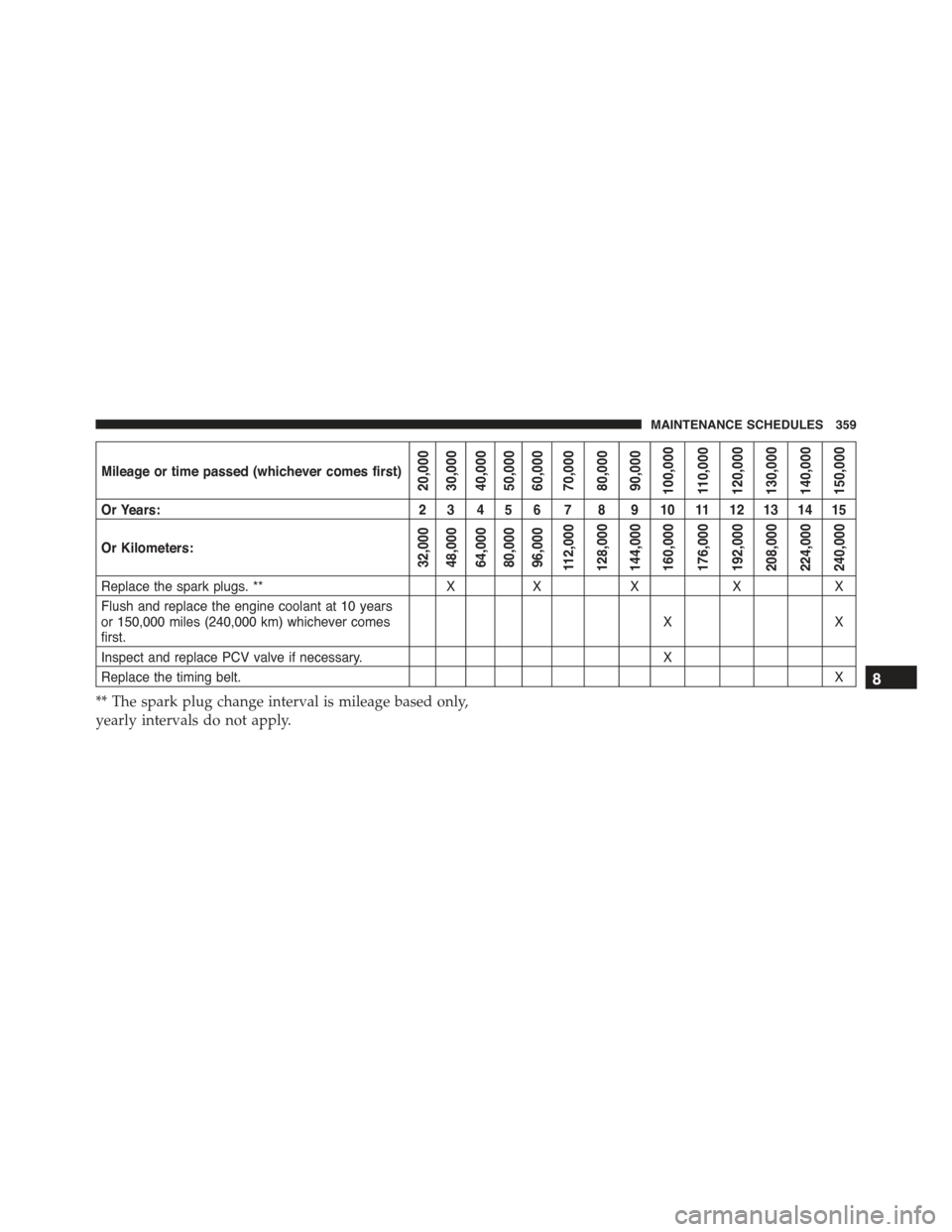
Mileage or time passed (whichever comes first)20,00030,00040,00050,00060,00070,00080,00090,000100,000110,000120,000130,000140,000150,000
Or Years:2 3 4 5 6 7 8 9 10 11 12 13 14 15
Or Kilometers:32,00048,00064,00080,00096,000112,000128,000144,000160,000176,000192,000208,000224,000240,000
Replace the spark plugs. **XXXXX
Flush and replace the engine coolant at 10 yearsor 150,000 miles (240,000 km) whichever comesfirst.XX
Inspect and replace PCV valve if necessary.X
Replace the timing belt.X
** The spark plug change interval is mileage based only,
yearly intervals do not apply.
8
MAINTENANCE SCHEDULES 359
Page 374 of 388
Adding Engine Coolant (Antifreeze)............329
Adding Fuel.............................277
Adding Washer Fluid......................324
Additives, Fuel...........................274
Airbag..................................39
Airbag Deployment........................52
Airbag Light.............................47
Airbag Maintenance........................53
Airbag, Side..............................42
Airbag, Window (Side Curtain)................43
Air Cleaner, Engine (Engine Air Cleaner Filter) . . . .316
Air Conditioner Maintenance.................318
Air Conditioning..........................206
Air Conditioning Controls...................206
Air Conditioning Filter.....................319
Air Conditioning Refrigerant.................318
Air Conditioning System....................206
Air Pressure, Tires.........................257
Alterations/Modifications, Vehicle...............8
Antifreeze (Engine Coolant)..................328
Capacities............................353
Disposal..............................331
Anti-Lock Brake System (ABS)................237
Anti-Lock Warning Light....................154
Appearance Care.........................336
Automatic Dimming Mirror...................92
Automatic Door Locks......................23
Automatic Temperature Control (ATC)..........210
Automatic Transaxle........................11
Battery.................................317
Jump Starting..........................299
Keyless Transmitter Replacement (RKE)........18
Belts, Seat...............................80
Body Mechanism Lubrication.................322
B-Pillar Location..........................252
Brake Assist System.......................239
Brake Fluid.............................354
372 INDEX
Page 375 of 388
Brake, Parking...........................234
Brakes.................................333
Brake System............................237
Anti-Lock (ABS)........................237
Master Cylinder........................333
Parking..............................234
Warning Light.........................153
Bulb Replacement.........................348
Bulbs, Light..............................83
Capacities, Antifreeze (Engine Coolant)..........353
Capacities, Fluid..........................353
Caps, Filler
Fuel.................................277
Oil (Engine)...........................315
Carbon Monoxide Warning...................79
Cargo Area Features.......................137
Car Washes.............................337
CD (Compact Disc) Player...................174
Cellular Phone...........................205
Chains, Tire.............................265
Changing A Flat Tire.......................293
Chart, Tire Sizing.........................247
Check Engine Light (Malfunction Indicator Light) . .151
Checking Your Vehicle For Safety...............78
Checks, Safety............................78
Child Restraint............................56
Clean Air Gasoline........................272
Cleaning
Wheels...............................338
Climate Control..........................205
Clutch.................................333
Clutch Fluid.............................333
Compact Disc (CD) Maintenance..............204
Connector
UCI . . . . . . . . . . . . . . . . . . . . . . . . . . . . . . . ..202
Universal Consumer Interface (UCI)..........202
Contract, Service..........................364
10
INDEX 373
Page 376 of 388
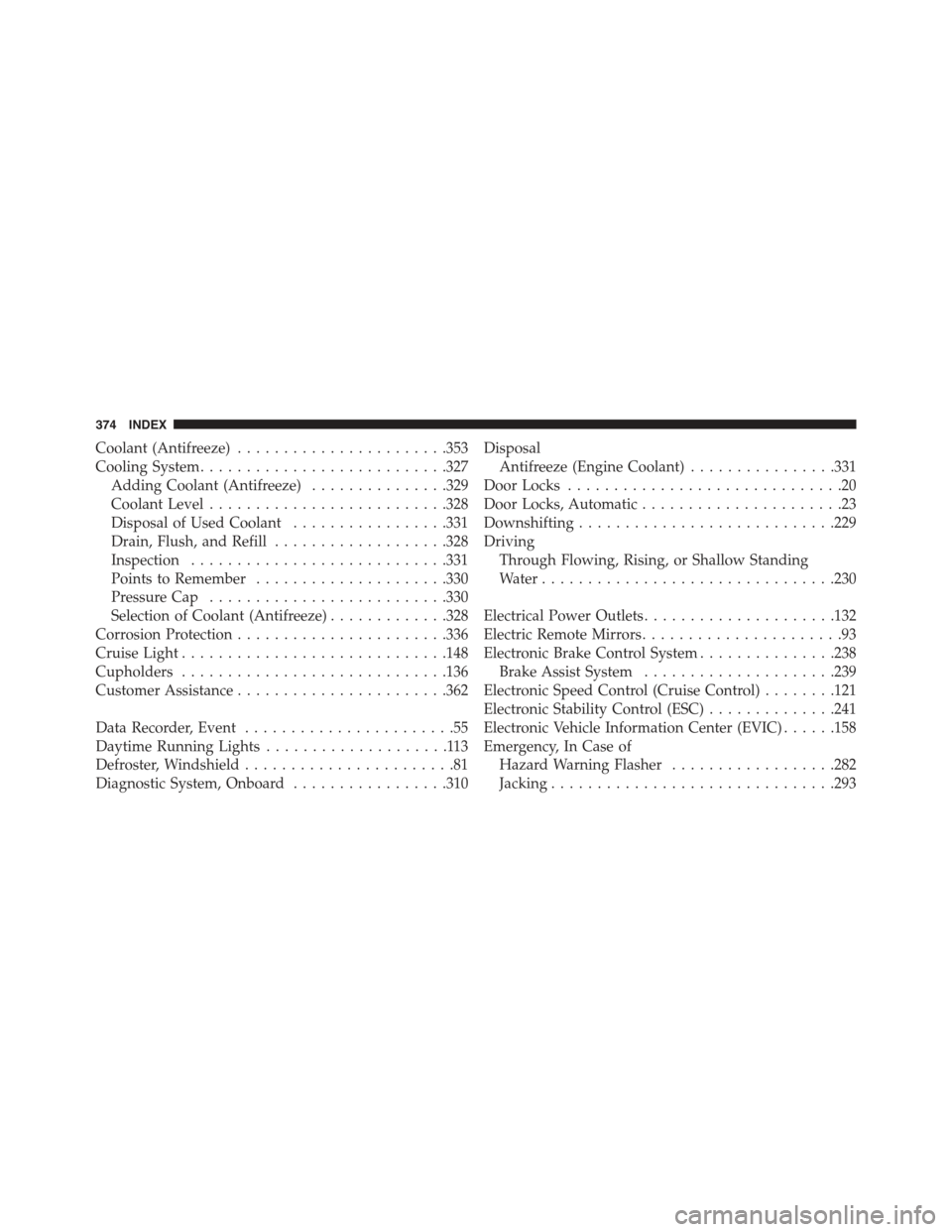
Coolant (Antifreeze).......................353
Cooling System...........................327
Adding Coolant (Antifreeze)...............329
Coolant Level..........................328
Disposal of Used Coolant.................331
Drain, Flush, and Refill...................328
Inspection............................331
Points to Remember.....................330
Pressure Cap..........................330
Selection of Coolant (Antifreeze).............328
Corrosion Protection.......................336
Cruise Light.............................148
Cupholders.............................136
Customer Assistance.......................362
Data Recorder, Event.......................55
Daytime Running Lights....................113
Defroster, Windshield.......................81
Diagnostic System, Onboard.................310
Disposal
Antifreeze (Engine Coolant)................331
Door Locks..............................20
Door Locks, Automatic......................23
Downshifting............................229
Driving
Through Flowing, Rising, or Shallow Standing
Water................................230
Electrical Power Outlets.....................132
Electric Remote Mirrors......................93
Electronic Brake Control System...............238
Brake Assist System.....................239
Electronic Speed Control (Cruise Control)........121
Electronic Stability Control (ESC)..............241
Electronic Vehicle Information Center (EVIC)......158
Emergency, In Case of
Hazard Warning Flasher..................282
Jacking...............................293
374 INDEX
Page 384 of 388
Shoulder Belts............................29
Side Airbag..............................48
Signals, Turn.............................83
Snow Chains (Tire Chains)...................265
Snow Tires..............................260
Specifications
Oil . . . . . . . . . . . . . . . . . . . . . . . . . . . . . . . . ..315
Speed Control (Cruise Control)................121
Speedometer.............................157
Sport Mode.............................236
Starting................................224
Cold Weather..........................225
Engine Fails to Start.....................226
Steering
Power...............................232
Tilt Column...........................120
Wheel, Tilt............................120
Steering Wheel Audio Controls...............203
Steering Wheel Mounted Sound System Controls . . .203
Storage................................348
Storage, Vehicle...........................219
Storing Your Vehicle.......................348
Stuck, Freeing............................304
Studio Service............................312
Sun Roof...............................130
Supplemental Restraint System - Airbag..........39
Tachometer..............................157
Temperature Control, Automatic (ATC)..........210
Temperature Gauge, Engine Coolant............156
Tilt Steering Column.......................120
Tire and Loading Information Placard...........252
TIREFIT................................283
Tire Markings............................245
Ti re s . . . . . . . . . . . . . . . . . . . . . . . . . . . . . . . . . . . 8 3
Aging (Life of Tires).....................262
Air Pressure...........................256
Chains...............................265
382 INDEX