steering wheel FIAT 500 ABARTH 2013 2.G Owner's Manual
[x] Cancel search | Manufacturer: FIAT, Model Year: 2013, Model line: 500 ABARTH, Model: FIAT 500 ABARTH 2013 2.GPages: 84, PDF Size: 4.63 MB
Page 47 of 84
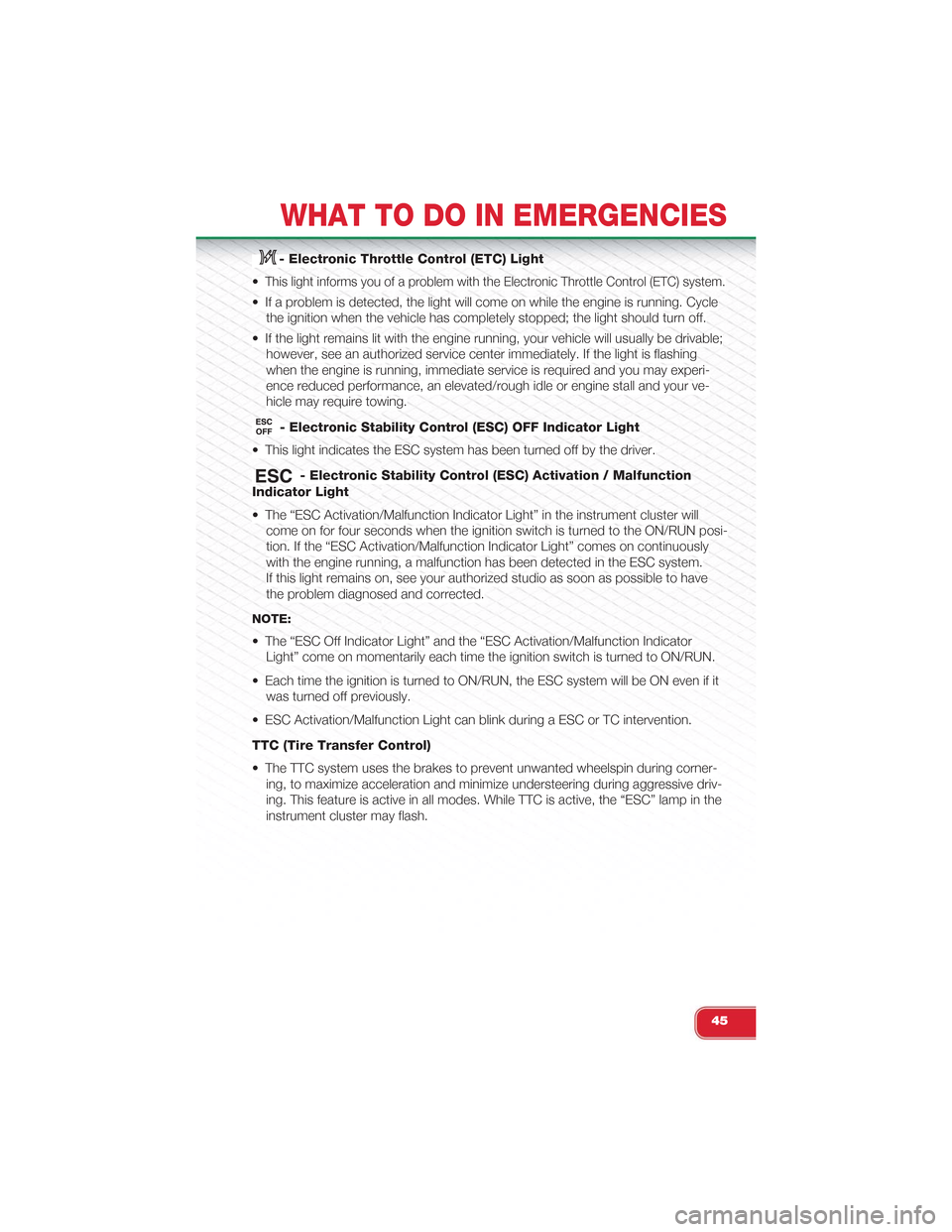
- Electronic Throttle Control (ETC) Light
•This light informs you of a problem with the Electronic Throttle Control (ETC) system.
• If a problem is detected, the light will come on while the engine is running. Cycle
the ignition when the vehicle has completely stopped; the light should turn off.
• If the light remains lit with the engine running, your vehicle will usually be drivable;
however, see an authorized service center immediately. If the light is flashing
when the engine is running, immediate service is required and you may experi-
ence reduced performance, an elevated/rough idle or engine stall and your ve-
hicle may require towing.
- Electronic Stability Control (ESC) OFF Indicator Light
• This light indicates the ESC system has been turned off by the driver.
- Electronic Stability Control (ESC) Activation / Malfunction
Indicator Light
• The “ESC Activation/Malfunction Indicator Light” in the instrument cluster will
come on for four seconds when the ignition switch is turned to the ON/RUN posi-
tion. If the “ESC Activation/Malfunction Indicator Light” comes on continuously
with the engine running, a malfunction has been detected in the ESC system.
If this light remains on, see your authorized studio as soon as possible to have
the problem diagnosed and corrected.
NOTE:
• The “ESC Off Indicator Light” and the “ESC Activation/Malfunction Indicator
Light” come on momentarily each time the ignition switch is turned to ON/RUN.
• Each time the ignition is turned to ON/RUN, the ESC system will be ON even if it
was turned off previously.
• ESC Activation/Malfunction Light can blink during a ESC or TC intervention.
TTC (Tire Transfer Control)
• The TTC system uses the brakes to prevent unwanted wheelspin during corner-
ing, to maximize acceleration and minimize understeering during aggressive driv-
ing. This feature is active in all modes. While TTC is active, the “ESC” lamp in the
instrument cluster may flash.
WHAT TO DO IN EMERGENCIES
45
Page 59 of 84
TOWING A DISABLED VEHICLE
With Ignition Key
Manual Transmission
• Vehicle can be flat towed (all four wheels on the ground) with the transmission in
NEUTRAL.
• Vehicle can be towed with the front wheels elevated.
• Vehicle can be towed on a flatbed truck (all wheels off the ground).
NOTE:If it is necessary to use the accessories while being towed (wipers, defrosters, etc.), the keymust be in the ON/RUN position. Make certain the transmission remains in NEUTRAL.
Without The Ignition Key
• Special care must be taken when the vehicle is towed with the ignition in the
OFF/LOCK position. A dolly should be used under the front wheels if the rear
wheels are raised. Proper towing equipment is necessary to prevent damage to
the vehicle.
CAUTION!
• Failure to follow these towing methods can cause severe transmission dam-
age. Such damage is not covered by the New Vehicle Limited Warranty.
• If the vehicle being towed requires steering, the ignition switch must be in the
ON/RUN position.
• Do not attempt to use sling-type equipment when towing. When securing
the vehicle to a flatbed truck, do not attach to front or rear suspension com-
ponents. Damage to your vehicle may result from improper towing.
ENHANCED ACCIDENT RESPONSE SYSTEM
• In the event of an impact causing air bag deployment, if the communication net-
work remains intact, and the power remains intact, depending on the nature of
the event the Occupant Restraint Controller (ORC) will determine whether to have
the Enhanced Accident Response System perform the following functions:
• Cut off fuel to the engine.
• Flash hazard lights as long as the battery has power or until the ignition key is
turned off.
• Turn on the interior lights, which remain on as long as the battery has power or
until the ignition key is removed.
• Unlock the doors automatically.
WHAT TO DO IN EMERGENCIES
57
Page 61 of 84
FREEING A STUCK VEHICLE
• If your vehicle becomes stuck in mud, sand or snow, it can often be moved by a
rocking motion. Turn your steering wheel right and left to clear the area around
the front wheels. Then shift back and forth between 1st gear and REVERSE. Us-
ing minimal accelerator pedal pressure to maintain the rocking motion, without
spinning the wheels, is most effective.
NOTE:If your vehicle is equipped with Traction Control or Electronic Stability Control (ESC), turnthe system OFF before attempting to “rock” the vehicle.
CAUTION!
• Racing the engine or spinning the wheels may lead to transmission overheat-
ing and failure. Allow the engine to idle with the shift lever in NEUTRAL for at
least one minute after every five rocking-motion cycles. This will minimize
overheating and reduce the risk of transmission failure during prolonged ef-
forts to free a stuck vehicle.
• When “rocking” a stuck vehicle by moving between 1st and REVERSE, do
not spin the wheels faster than 15 mph (24 km/h), or drivetrain damage may
result.
• Revving the engine or spinning the wheels too fast may lead to transmission
overheating and failure. It can also damage the tires. Do not spin the wheels
above 30 mph (48 km/h) while in gear (no transmission shifting occurring).
WARNING!
Fast spinning tires can be dangerous. Forces generated by excessive wheel
speeds may cause tire damage or failure. A tire could explode and injure some-
one. Do not spin your vehicle's wheels faster than 30 mph (48 km/h) when you
are stuck. Do not let anyone near a spinning wheel, no matter what the speed.
WHAT TO DO IN EMERGENCIES
59
Page 80 of 84
Rear Seat, Folding. . . . . . . . . . . . .15Reclining Front Seats. . . . . . . . . . .14Recreational Towing. . . . . . . . . . . .43Remote Keyless Entry (RKE)Power Convertible Top Function . . .8Replacement Bulbs. . . . . . . . . . . .72Reporting Safety Defects. . . . . . . . .74Restraints, Child. . . . . . . . . . . . . .12
Schedule, Maintenance. . . . . . . . . .64Seat Belts. . . . . . . . . . . . . . . . .10SeatsAdjustment. . . . . . . . . . . . . .14Rear Folding. . . . . . . . . . . . . .15Security Against Theft. . . . . . . . . . .9Setting the Clock. . . . . . . . . . . . .33Signals, Turn. . . . . . . . . . . . . . . .18Spark Plugs. . . . . . . . . . . . . . . .63Speed ControlAccel/Decel. . . . . . . . . . . . . .21Cancel. . . . . . . . . . . . . . . . .21Distance Setting (ACC Only) .. . . .21Speed Control (Cruise Control). . . . . .21StartingCold Weather. . . . . . . . . . . . .29SteeringTilt Column. . . . . . . . . . . . . .16
Steering Wheel Audio Controls. . . . . .34Store Radio Presets. . . . . . . . . . . .33Stuck, Freeing. . . . . . . . . . . . . . .59
Theft System Arming. . . . . . . . . . . .9Theft System Disarming . .. . . . . . . .9Tilt Steering Column . .. . . . . . . . . .16TIREFIT. . . . . . . . . . . . . . . . . . .49TiresAir Pressure. . . . . . . . . . . . . .70Pressure Warning Light. . . . . . .46Towing24-Hour Towing Assistance. . . . .44Disabled Vehicle. . . . . . . . . . .57Recreational. . . . . . . . . . . . . .43Towing Vehicle Behind a Motorhome . .43TransmissionFluid. . . . . . . . . . . . . . . . . .63Turn Signals. . . . . . . . . . . . . . . .18
USB Port . . . . .. . . . . . . . . . . . .39
WasherRear. . . . . . . . . . . . . . . . . .20Wheel and Wheel Trim Care. . . . . . .71Wind Buffeting. . . . . . . . . . . . . . .29Wiper, Rear .. . . . . . . . . . . . . . .20
INDEX
78